Edinburgh in two or three days: inside both royal ends, up the volcano, and a day north of the valley
Last updated 15 August 2026
Overview
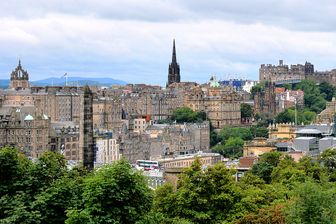
Edinburgh is two towns with a railway line in the ditch between them, and a short visit is really a question about how much of it you go inside rather than how much you see. A single day here walks the medieval ridge and enters one building on it, because the ridge has a ticketed royal residence at each end and each one is most of a morning. Two days is the length at which that stops being the choice. Day one goes into both ends and into the ground between them, and then climbs the volcano behind the palace, which is the thing a shorter visit always trades away. Day two crosses the valley and spends the whole day north of it, on flat ground, in buildings that cost nothing.
Neither day needs a bus, a tram or a train between its stops. Day one is about four kilometres of walking on the flat and then two hundred metres of climb on top of that; day two is just under five, and the steepest thing on it is a spiral staircase you can decline. The one leg that is not obvious is the first, and it is covered below.
Day one is also where the money is. Three tickets — the castle, the underground close and the palace — came to somewhere between sixty and seventy pounds a head in 2026 if all three were bought online, and two of them have to be booked before you travel. Day two’s two big rooms, the national museum and the national gallery, are free, and the only tickets on it are small ones you can take or leave. So the shape of the spend follows the shape of the trip: one expensive day, one that costs a sandwich.
The light decides the direction both days run in, and here it swings further than almost anywhere people fly to. The sun goes down over the city at twenty to four on the shortest December evenings and not until a few minutes past ten in the last week of June — six and a half hours between the two ends of the year, which is longer than either of these days spends indoors. Both days below are written forwards, ending outdoors: day one on the summit, day two on the river. From roughly late March to the end of September that works. In the dark half of the year it cannot, and the fix is the same for both and is not a different itinerary — you run the day backwards, which puts the outdoor half at the front where the daylight is and finishes you indoors. Each day says below exactly what that costs it.
Counting for day one: from the castle gate to the summit, the recommendations below plus the walking between them come to about eight and a half hours. That is the time you spend in the places and on the pavement and nothing else — not the wait at the esplanade gate, which is the only queue on either day long enough to eat a later stop, and not the ten minutes the underground close asks you to arrive before your slot. Take your own month’s sunset and count eight and a half hours back from it, and one of three answers falls out. From about April to August it lands hours after the castle opens, so the count does not bite at all: go up when you get there rather than kill two hours waiting for a sunset that is not coming until ten. In March and again in late September it lands almost exactly, and that is when the order below is doing real work. From October to February it lands before the castle has opened, which is the signal to turn the day round.
If you are arriving rather than already here: the tram from Edinburgh Airport is one line and runs to Princes Street and St Andrew Square in about half an hour, and trains arrive at Edinburgh Waverley in the valley or at Haymarket a mile west. The airport tram is its own fare and a dear one, and it is the one journey the daily cap does not touch: Lothian carves it out of the scheme on its own ticket pages, in the words “except Airport”, so pay for that ride as a ride and expect it to count towards nothing. Nothing on days one and two needs a fare at all after that, so buy nothing in advance and simply hold a contactless card at the validator — the capping scheme is called TapTapCap and, from the first city stop onwards, it works out the cheapest daily rate on its own across both the buses and the tram. The rechargeable card you will see advertised, the Ridacard, is a season ticket for people who live here and is the wrong purchase for a visitor.
Day one
- Morning
- 1Edinburgh Waverley
- 2Scotsman Steps
- 3Edinburgh Castle
- Afternoon
- 4St Giles' Cathedral
- 5The Real Mary King's Close
- 6The Canongate
- 7Scottish Parliament Building
- 8Palace of Holyroodhouse
- Evening
- 9Holyrood Park
- 10Arthur's Seat
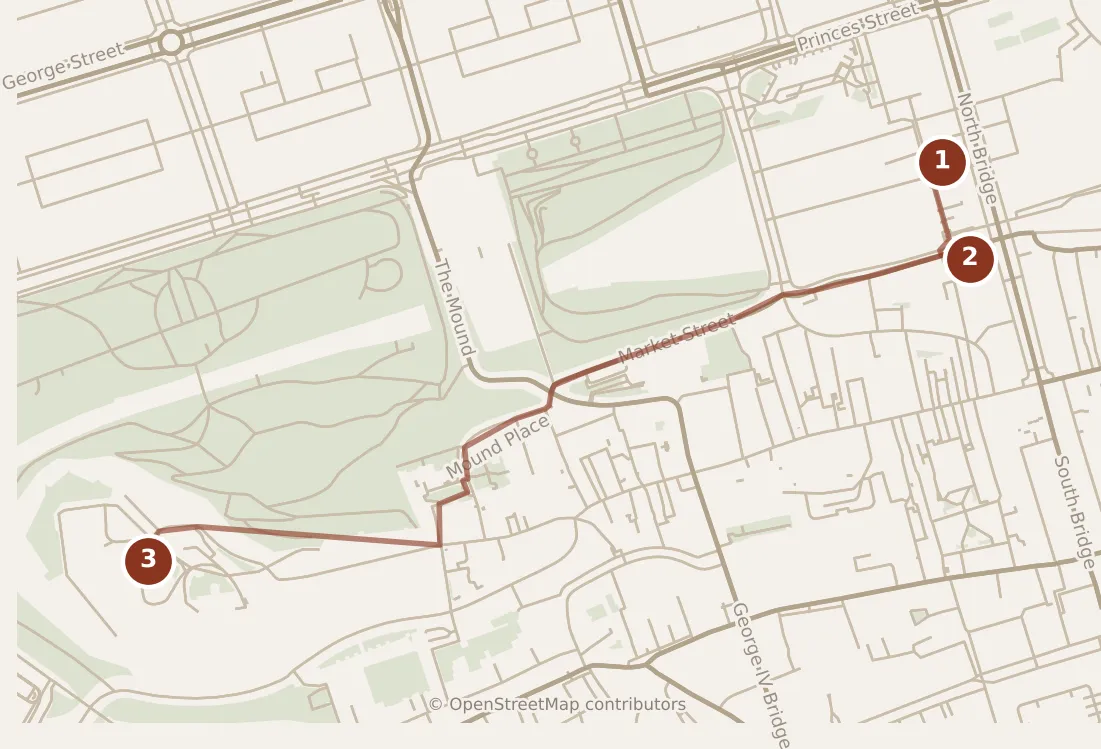
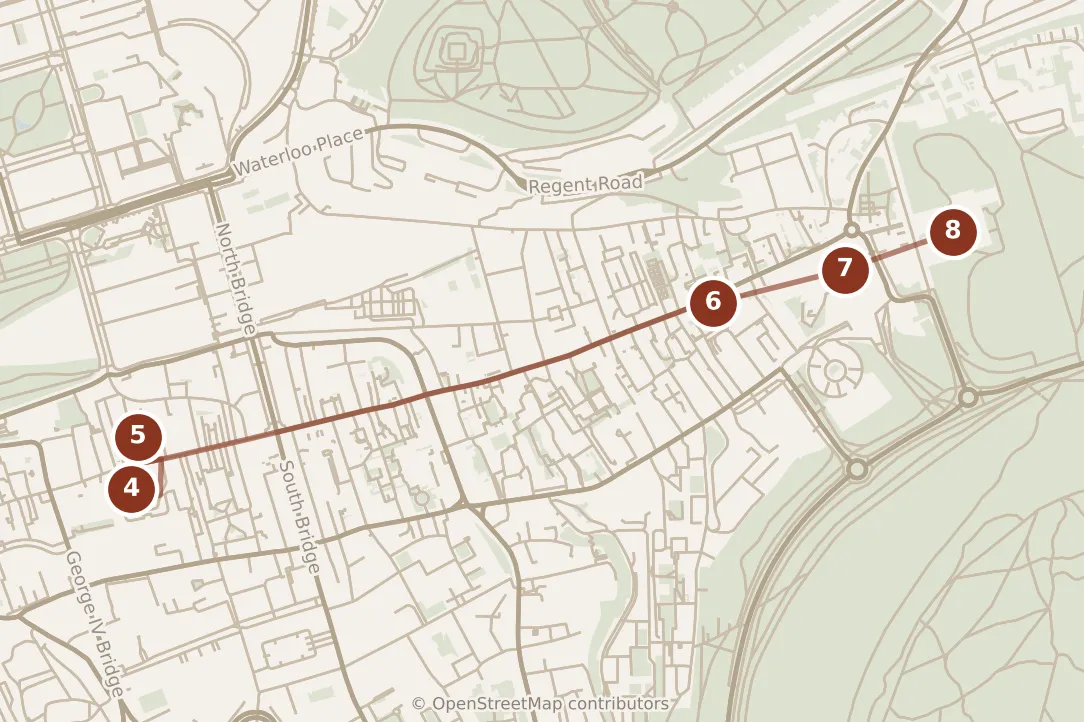
One street, top to bottom, and the three interiors that make it worth two days instead of one. Everything below is on foot and nothing doubles back: you start at the high end, you finish in the park at the low end, and you never walk the same hundred metres twice.
Morning
Leave Edinburgh Waverley by the Market Street exit and take the Scotsman Steps, which are the covered stair immediately outside it, climbing to North Bridge. There are a hundred and four of them and every one is clad in a different marble, quarried from all over the world — an artwork by Martin Creed installed in 2011 in a stairwell that had been a notorious dead space for a century. It takes two minutes and it is the best two minutes of arrival in the city. The steps come out on North Bridge, not on the Royal Mile: turn south along the bridge, walk the two hundred metres to the High Street crossroads, and only there turn west and climb the Royal Mile through the High Street, the Lawnmarket and Castlehill to the esplanade. About sixteen minutes from the top of the steps, rising the whole way, and by far the steepest stretch of the day that is not the volcano.
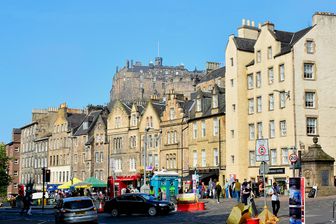
Edinburgh Castle is a walled town on a volcanic plug rather than a building, and with two days you can afford it properly instead of sprinting the highlights. Give it two hours. The Crown Room and the Honours of Scotland — crown, sceptre and sword — are what the queue inside is for, and they are worth the queue. But the part most visitors miss is underneath: the vaults below the Great Hall, fitted out as the Prisons of War they were, held men taken in the American war of independence and the long wars against France, and what survives is what they cut into the timber — ships, names, dates, and a version of the Stars and Stripes carved by a prisoner into a cell door. It is the only place in the castle where the building is not the point. Upstairs, the Great Hall carries an early sixteenth-century hammerbeam roof on carved stone corbels, the timbers open to view above you. What to leave: the regimental museums, three of them, excellent and entirely for people who already care about regiments.
One thing here is fixed to the clock. A gun is fired from Mills Mount at one o’clock every day except Sunday, Good Friday and Christmas Day, and you will hear it from anywhere in the centre. Seeing it fired means holding the castle until one, which is an hour and a half you have not got in this day as written.
Local tip. Take the castle at opening and let the gun go. The cost of staying for it is not the ninety minutes, it is the palace: add them to the count below and you reach its door after the last admission, in every month of the year. The only arrangement that survives is to drop the parliament as well, and even then you arrive with minutes rather than an hour in hand, and only in summer. That is a poor trade for something you can hear perfectly well from the pavement.
Afternoon
Come back out and go down Castlehill and the Lawnmarket, twelve minutes of easy descent, to St Giles’ Cathedral standing in the middle of the street. The name is a courtesy: the Church of Scotland has no bishops, this has been a cathedral only for two short seventeenth-century spells, and it is and always was the parish kirk of the burgh. The room to find inside is the Thistle Chapel, a tiny vaulted space added early in the twentieth century with a carved stall for each knight of the order, and it has more worked stone and wood per square metre than the whole church around it. Half an hour. It is a working church before it is a sight — services take the building whenever they happen, entry runs on a suggested donation at the door rather than a ticket, and on a Sunday it belongs to worship in the morning and opens to visitors only afterwards.
Two minutes away, through the arch at 2 Warriston’s Close beside the City Chambers, is The Real Mary King’s Close, and it is the reason this day has an underground hour in it. When the Royal Exchange went up here in the 1750s the builders took the tops off the closes running down the hill and left the bottom storeys standing, then roofed them with the new building — so you walk down a seventeenth-century street with houses either side and a ceiling where the sky should be. It is guided, timed and an hour long, it must be booked, and they ask you to arrive ten minutes before your slot. It is steep, uneven and narrow underfoot, no place for a case or a pushchair, and not open to children under five.
Lunch after it, an hour, sitting down, in the closes and the lanes dropping south towards the Cowgate rather than on the Mile itself, where the price follows the footfall.
Then walk the rest of the street. Sixteen minutes gets you from the cathedral into The Canongate without stopping, so give it half an hour, because the interest is in the change: the shopfronts thin, the crowd thins with them, and by the lower half you are on a quiet row of seventeenth- and eighteenth-century fronts on what was a separate burgh with its own council until the middle of the nineteenth century.
At the bottom, the Scottish Parliament Building. The free guided tour runs three quarters of an hour and is worth booking; walking yourself round takes half that. In 2026 it opened to visitors Monday to Saturday with a last entry at half past four and did not open on a Sunday at all — one of the two weekly closures on this day, and the parliament publishes its own dated calendar. Enric Miralles designed it to look as though it had grown out of the ground at the foot of the crags, and died in 2000, four years before it opened; from the public gallery over the Debating Chamber the roof is a forest of laminated timber, and the Garden Lobby beneath its leaf-shaped rooflights is where the building stops arguing with you. There is a security check at the visitor entrance, of the airport kind, and it takes a few minutes rather than the queue people brace for.
Three minutes on is the Palace of Holyroodhouse, and today you go in. Give it an hour and a half, the abbey included. The Great Gallery is the room nobody expects: a hundred and eleven portraits of Scottish kings, painted by Jacob de Wet in the 1680s under a contract that gave him about two years for the lot, most of them from no likeness whatever — a wall of invented ancestors, all with the same nose, hung to prove a line. Beyond it, in the older tower at the end that visibly does not match the rest of the front, are Mary, Queen of Scots’ own rooms, including the small supper chamber her secretary was dragged out of and murdered in front of her in 1566. Behind the palace, roofless and open to the sky, is Holyrood Abbey, and it is inside the same ticket. The hour that decides this whole day is the palace’s last admission: in 2026 it stopped admitting at half past four from April to October and at a quarter past three from November to March. Everything above it, counted from a half past nine start, puts you at its door a little after half past three: an hour clear of the first figure, and twenty minutes the wrong side of the second. So from November to March even this forward version has to give up the parliament to get through the door, and that is the smaller of the two reasons the day turns round in winter. The larger one is at the end of this section. If you find a different hour when you check, rebuild the day from it — what matters is that the palace comes before the light, not the number itself.
Evening
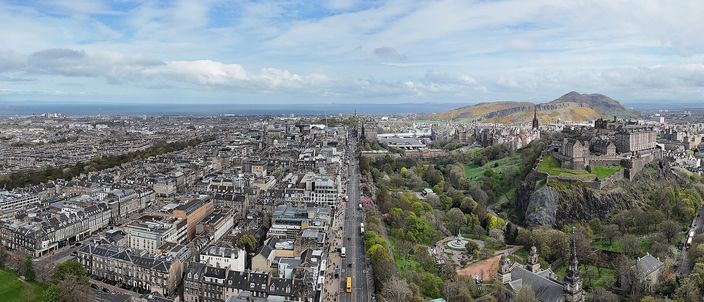
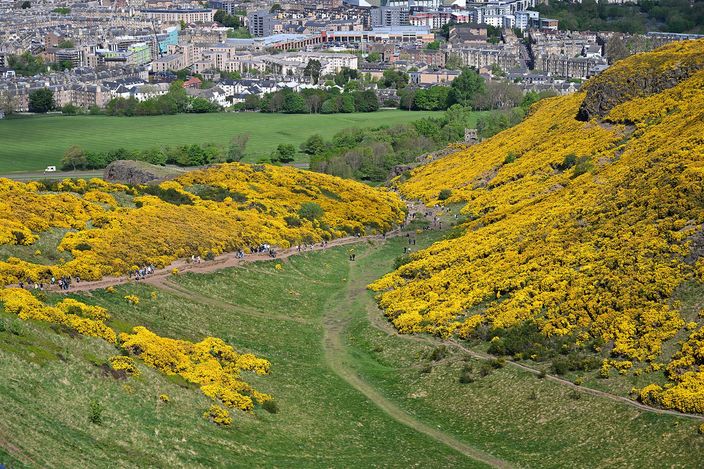
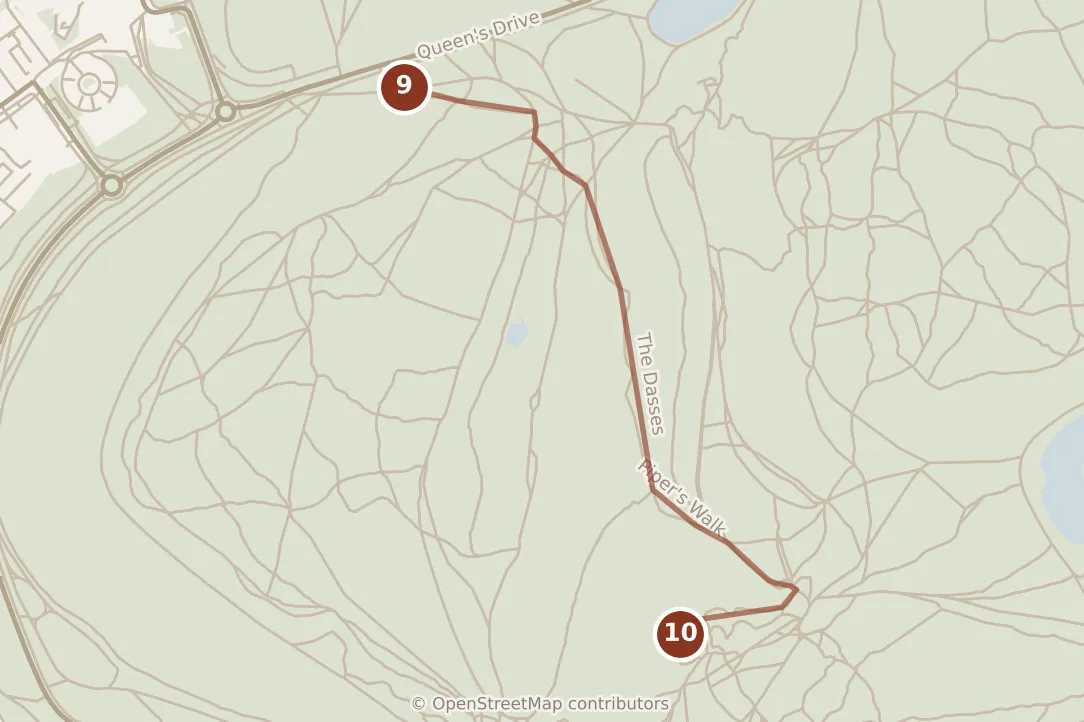
Out of the forecourt and straight into Holyrood Park, which starts at the palace gates and has no gate, no ticket and no closing time. Seven minutes across the grass brings you to the foot of the paths. Arthur’s Seat is an extinct volcano of about three hundred and forty million years, and from here it is two hundred metres of climb over roughly a kilometre and a half of path. Reckon on three quarters of an hour up if you are not racing it, half an hour down, and half an hour at the top; the paths from this side all converge, so the choice is only how much of the climb you take in one go, and the last few metres are bare basalt where most people use their hands. What you get is the whole city on its ridge with the castle at the far end, the Firth of Forth and Fife to the north, and the Pentland Hills to the south-west — the view that makes sense of everything the two days walk through.
Two things a visitor cannot guess. This is a bald hill in a maritime climate: the wind at the top is a different weather from the wind at the bottom, the grass is slippery for days after rain, and there is no lighting anywhere in the park, so coming down in the dark means coming down with a torch. And the path along the foot of Salisbury Crags — the Radical Road, which looks on a map like the obvious way — has been shut since fifty tonnes of rock came off the cliff in 2018, with Historic Environment Scotland saying in 2025 that a stretch of it would reopen. Whether it has by the time you are standing there changes nothing about the route above, which never uses it; if you meet a barrier, it is the closure and not a diversion. Salisbury Crags is worth knowing about anyway from below: the sheet of rock exposed in its face, still called Hutton’s Section, is where James Hutton argued in the 1780s that the earth was unimaginably older than anyone then said, and won.
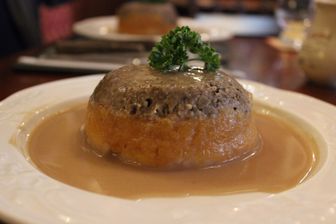
This is the stop the day is built around and the only one on it that cannot be moved, so work backwards: it wants the hour before the light goes, everything above it comes to about eight and a half hours, and that is when to start. And this is the larger reason the winter version runs the other way. From a half past nine start you are on the summit around six in the evening, which in June is four hours before the sun goes and in December is more than two hours after it — no rearrangement of the stops above closes a gap that size, which is why the answer is to turn the whole day round rather than to shuffle it. Dinner afterwards is either the twenty minutes back up the Canongate or the streets just outside the park’s western edge, ten minutes away, and haggis with neeps and tatties is the honest order at the end of a day that has been about crowns and kings since half past nine.
Day two
- Morning and afternoon
- 11National Museum of Scotland
- 12Scottish National Gallery
- 13Scott Monument
- 14Charlotte Square
- 15Dean Village
- Evening
- 16Stockbridge
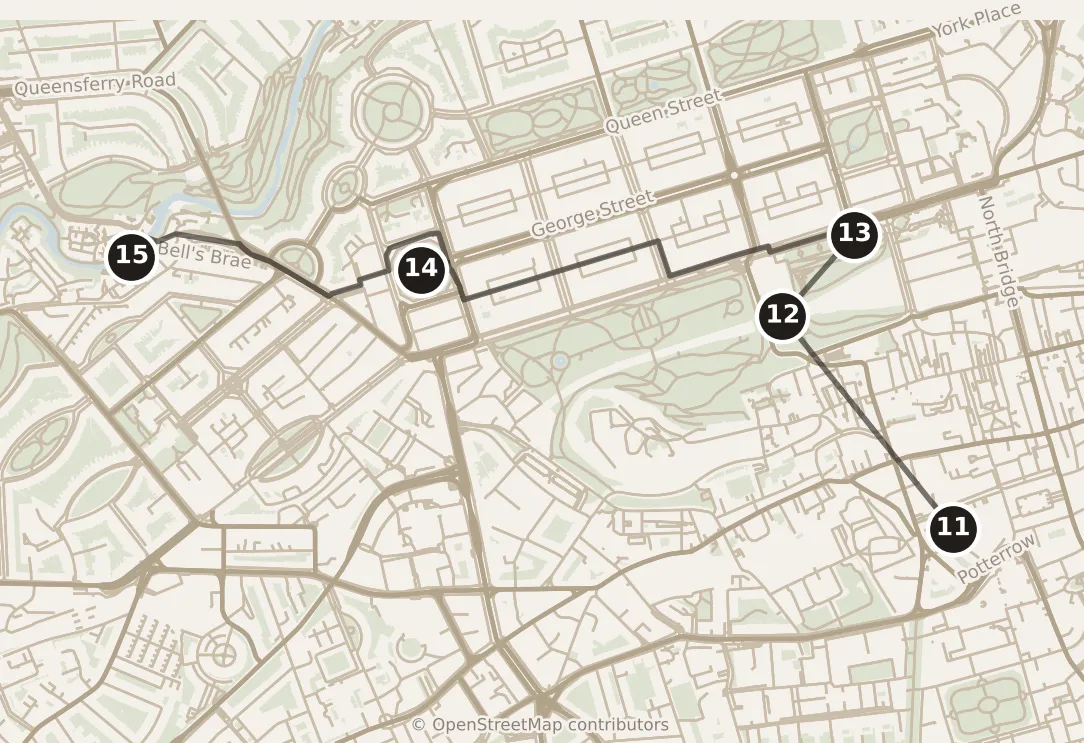
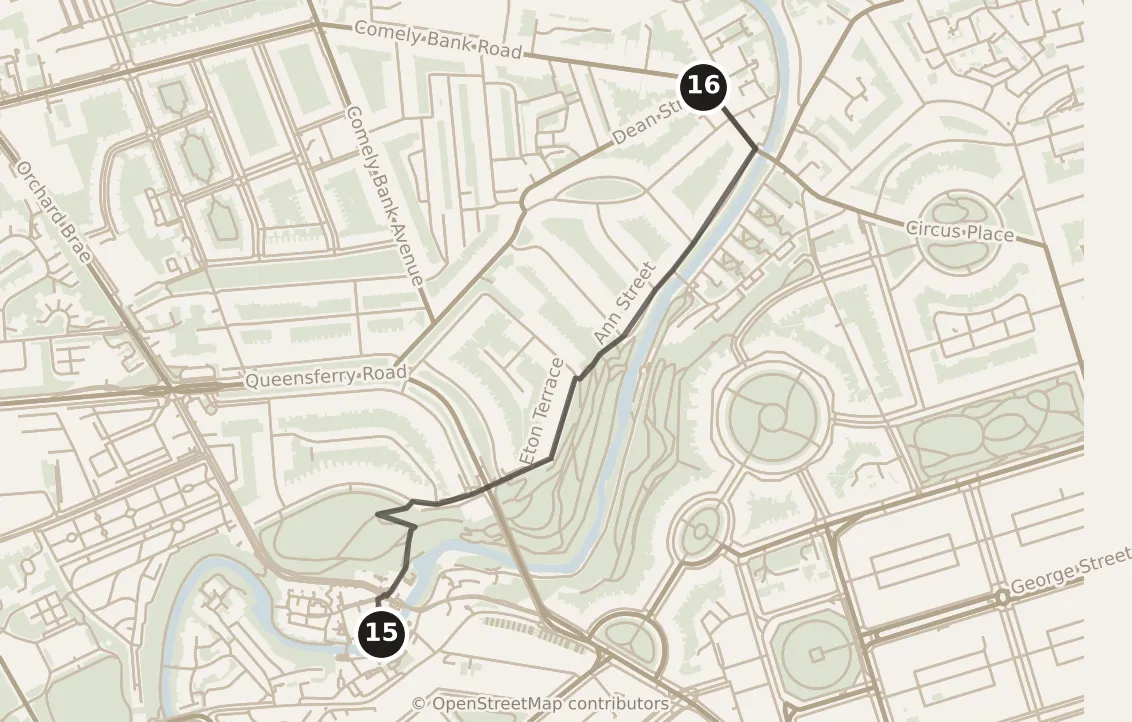
Everything north of the valley, plus the one great collection on the Old Town’s southern edge that day one deliberately walks past. It is flat, it is nearly free, and it ends beside a river in a village the city grew around rather than over.
Morning
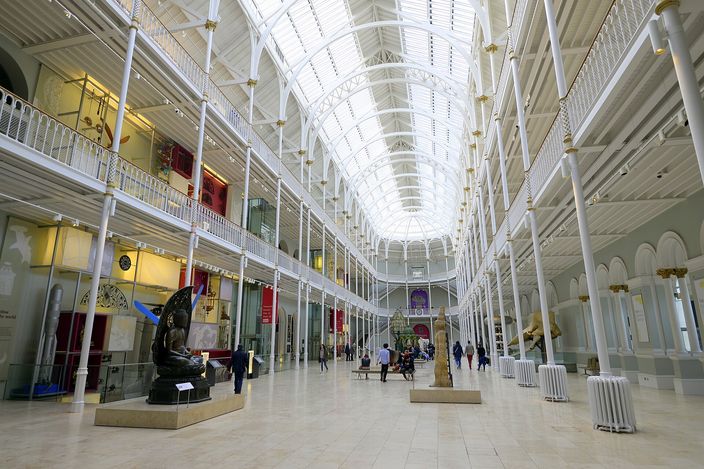
Start on Chambers Street, eleven minutes from Edinburgh Waverley up the far side of the valley, when the National Museum of Scotland opens. It is free and needs no ticket, which means no slot to hold and nothing to book. It is two buildings sewn together: a hall of cast iron and glass begun in 1861, the Grand Gallery, which is a Victorian exhibition palace that happens to be indoors, and a 1998 wing in golden Moray sandstone built for Scotland’s own story. Take those two and let the rest go. The Scotland galleries run upwards from the geology of the country through the Lewis chessmen — eleven of the walrus-ivory pieces are here — into the industrial and the modern, and they are the argument for the whole museum. Dolly, the first mammal cloned from an adult cell, is upstairs and takes four minutes. Then go to the roof terrace at the top of the newer building, which is free, which almost nobody finds, and which gives you the entire Old Town ridge and the castle from behind. Two and a half hours.
Local tip. The natural world and science floors of this museum are genuinely first rate and they are a separate visit, not a section of this one. If you are travelling with children the honest move is to swap: give them those floors instead of the Scotland galleries, keep the two and a half hours the same, and take the roof terrace either way. What breaks the day is trying to have both, because that is four hours and it is the gallery and the Georgian House that pay for them.
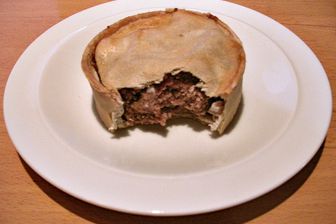
Lunch is the hour after, in the streets between Chambers Street and George IV Bridge, which feed the university and are priced accordingly. If you would rather keep the hour, a scotch pie eaten standing up is the local version of exactly that decision.
Eleven minutes north-west, down onto the Mound, is the Scottish National Gallery — free as well, and part of National Galleries Scotland. An hour and a half, and take two things. The Scottish rooms, rehung and reopened in 2023, are the best short account of the country’s own painting anywhere: Raeburn’s Skating Minister, a black figure on ice that has become the national image without ever meaning to, and Landseer’s Monarch of the Glen, which did mean to. And, if they are here, Titian’s two Dianas, painted for a Spanish king in the 1550s, in which Actaeon blunders in on the goddess bathing and Callisto is stripped in front of her. They are two of the greatest paintings in Britain and they are owned jointly with London, bought one at a time — the first in 2009, the second three years later under an option the first purchase held open — on terms that move them between the two cities in five-year spells, so they hang here for some visits and not for others, and one of them was in London as recently as 2024. Check the gallery’s own site for them before you count on them; the Scottish rooms are the reason to go in either way.
Afternoon
Five minutes east along Princes Street is the Scott Monument, sixty-one metres of blackened Gothic spire put up over Walter Scott between 1840 and 1844. The ticket is small and the climb is two hundred and eighty-seven steps up a stair that narrows at every stage — the last flight is a genuine squeeze and there is no shame in stopping at a lower platform. Half an hour, and what it buys is the New Town grid seen as a grid, which is not obvious from inside it.
Then west along George Street, eighteen minutes of the best-preserved street of the Georgian plan, to Charlotte Square, which closes it. Robert Adam drew it in 1791 and died the following year; it was finished in 1820 and is the piece of the New Town that shows what the whole thing was meant to be — a single palace front with houses hidden behind it. Number six is Bute House, the official residence of the First Minister, and next door at number seven the Georgian House is open as a restored interior by the National Trust for Scotland. Three quarters of an hour if it is open, and this is the one stop today with a real chance of being shut when you arrive. Two things can shut it. It keeps trust hours, which are seasonal and shorter than a museum’s, and the Trust publishes them on the property’s own page. And the day as written reaches its door a little after four, which on trust hours is at or past the last admission — a house like this stops letting people in a good while before it stops being open. So read the hours and the last entry together, and if the interior is what you want rather than the square, give the Scott Monument a miss and be at this door by half past three. If it is closed you lose forty-five minutes and nothing else, because the square itself is free and is most of the point.
Twelve minutes down Queensferry Street and off it, the ground drops away and you are in Dean Village, which is not a suburb but a milling settlement that ground the city’s grain for eight hundred years — eleven mills at its height, all driven by the same small river. It is now a pocket of restored millworkers’ housing in a gorge with the traffic passing a hundred feet overhead on Thomas Telford’s Dean Bridge, built in the early 1830s. Half an hour is enough, and the millworkers’ cottages are lived in rather than exhibited, so it is a place to walk through quietly rather than to stand about in a narrow lane photographing somebody’s front door.
From there the Water of Leith Walkway runs downstream to Stockbridge in about seventeen minutes, and it is the one stretch of these two days that genuinely needs daylight: it is a riverside path in a wooded cut, and it is not lit. On the way, standing over a mineral spring on the bank, St Bernard’s Well is a circular Greek temple of 1788 on ten Doric columns, built because the water was briefly believed to cure things.
Evening
Stockbridge is a village high street that the New Town caught up with and never digested, and it is where day two eats. It is half an hour’s walk from where the morning started and feels a great deal further out than that. On a Sunday there is a farmers’ market at Jubilee Gardens by the water, and it is the one day of the week this district is unambiguously better than any other — but it is a daytime market and the day as written reaches Stockbridge at about six in the evening, by which time it has packed up. If you want it, take day two on a Sunday and run the day backwards: Stockbridge first thing, then the walkway upstream to Dean Village, Charlotte Square, the monument, and the gallery and the museum through the afternoon. Nothing on this day has to be booked, and the one clock on it — the Georgian House’s last admission — is easier backwards than forwards, because the reversal reaches Charlotte Square in the middle of the morning. So it costs nothing to turn it round. Check the market’s own hours before you build a Sunday on it. Getting back is half an hour uphill on foot to Princes Street, or a bus from the high street, and it is one of the few moments in Edinburgh where the bus is the sensible answer rather than the lazy one.
Added up, day two comes to about seven and a half hours from the museum door to the top of the walkway, and just under eight to the table in Stockbridge. Unlike day one it has no queue in it anywhere and nothing that has to be booked, so the count has almost nothing hidden inside it — the one clock on it is the Georgian House’s last admission at the far end, and that is a stop you can lose. This is still the day to put a slow start, a late flight or a hangover on.
With a third day
- With a third day
- 17Royal Yacht Britannia
- 18Leith
- 19Calton Hill
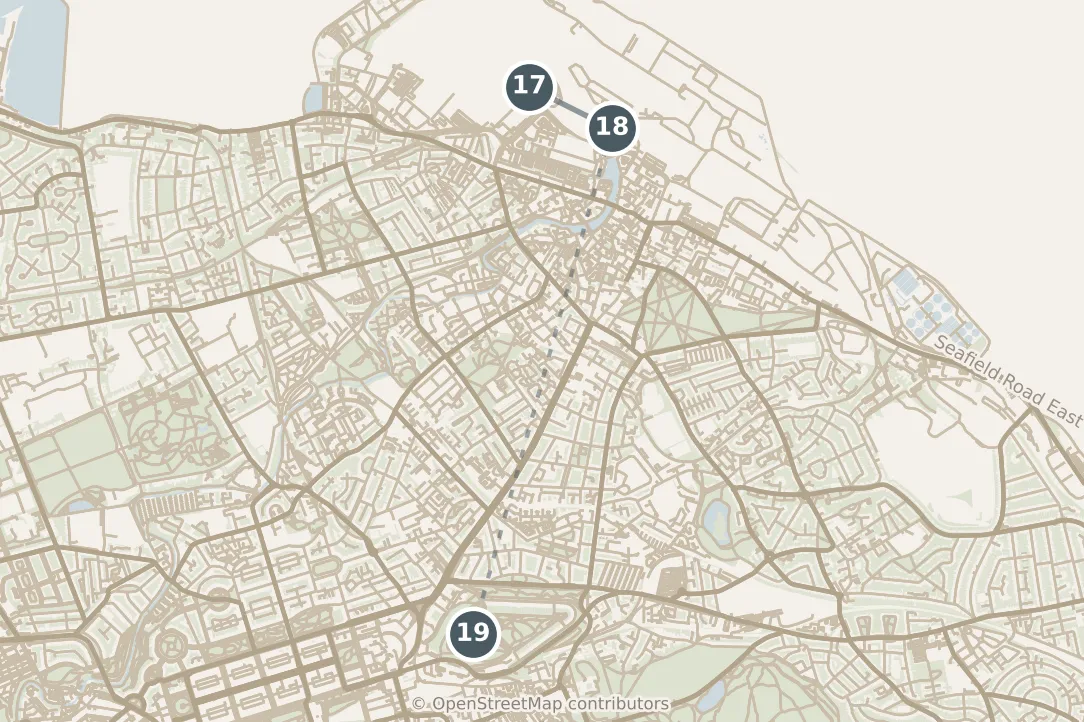
A third day is Leith, a port that was a separate burgh with its own council until 1920, was amalgamated into Edinburgh against its own recorded vote, and has never entirely accepted that it stopped being a town of its own. It goes on the end rather than between. Days one and two are a pair — the ridge teaches you the shape and the New Town is the answer to it — and Leith is neither. It is also the only one of the three that needs transport, the only flat one, and the only one you can cut in half without breaking it, which is what you want on a day with a plane at the end of it. The one thing that moves it off the end is the palace’s closed days: where your dates force day one to a Thursday, Leith is what you do on the Tuesday instead, and the pair behind it runs in reverse — day two on the Wednesday, day one on the Thursday. Pushing the pair back a day rather than reversing it would put day one on the Wednesday, which is the closed day this whole arrangement exists to route around. What the reversal costs is the order the two days are written in: the New Town answers the ridge better than it introduces it, and that is the price of putting the third day first.
Adding it moves exactly one thing, and it is worth stating because on two days that thing is simply lost: Calton Hill. Day one ends on the volcano and day two ends beside a river, so there is no slot for the small hill in the middle, and a two-day trip does not get it. On three days it is the last half hour.
The tram is one line, running from Edinburgh Airport to Newhaven, and this is the only day of the three that uses it — twice, out and back. Board at St Andrew Square or Princes Street and get off at Ocean Terminal, about twenty minutes. Hold the same contactless card you have not been using for two days; the daily cap does the arithmetic and two rides will not reach it.
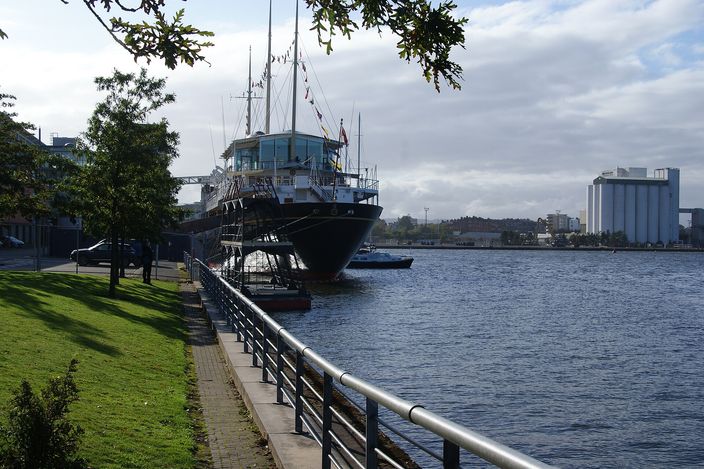
The Royal Yacht Britannia is berthed there and is the reason to come. It was in service from 1954 until 1997 and is preserved as it was left: five decks, the state dining and drawing rooms, the bridge, the engine room, a Land Rover in the garage, and the clocks throughout stopped at one minute past three, the moment the Queen last walked off. The visit is self-guided with a commentary and the operator’s own average is two hours, which is about right. The adult ticket was in the low twenties of pounds booked online in 2026, a couple of pounds more at the door, and it does not need booking far ahead.
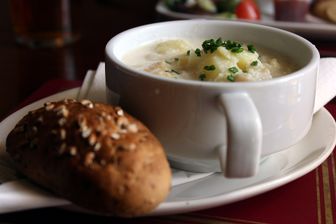
Ten minutes’ walk south is the Shore, the old quayside on the Water of Leith where the port actually was, and this is where the meal goes — an hour and a half, unhurried, because the whole point of this day is that it is not a schedule. Cullen skink belongs here more than anywhere else on the trip: it is a northeast-coast fish soup rather than a city dish, and this is the water it came down. Give the quays and the streets behind them another three quarters of an hour on foot afterwards.
Then take the tram back from The Shore or Port of Leith to Picardy Place, about twelve minutes, and walk the seven minutes up onto Calton Hill for whatever light is left. It is open ground with no gate and no charge on every evening of the year but one — the exception is 30 April, when the hill is given over to the ticketed Beltane Fire Festival and you need a place bought in advance to be on it — and it carries an unfinished stone colonnade begun in 1826 as a full-size copy of a Greek temple and abandoned three years later with twelve columns standing. West along Princes Street the whole Old Town ridge lies side-on with the castle at the end of it, which is the picture of this city, and to the south-east is the hill you climbed on day one. Half an hour, and Edinburgh Waverley is eleven minutes downhill if you are going straight to a train.
That is about five and a half hours in total, deliberately shorter than the other two.
If you have already done enough ships and interiors, the honest alternative is to leave the city altogether, and it replaces the whole third day rather than being added to it: a train from Edinburgh Waverley to Dalmeny takes about twenty minutes, and the station sits directly under the Forth Bridge, the red cantilever railway bridge of 1890, which is the one thing near this city that is genuinely worth leaving it for. It is also the only journey in these three days that a contactless tap at a tram or bus reader will not pay for, so buy the return at Waverley before you go. South Queensferry is a short walk down the hill from it, a single old street on the water between three bridges of three different centuries. What that costs you is the Britannia and the Leith meal, and — because it does not come back through Picardy Place — Calton Hill as well, which then goes back to being the thing you do not get.
Practicalities
Two tickets have to be held before you travel, one should be, and the fourth booking is free. The two are Edinburgh Castle, which sells timed slots through Historic Environment Scotland and whose early ones go first, and The Real Mary King’s Close, which is guided and timed, takes its bookings on its own page and nowhere else, and sells out days ahead in summer across the middle of the day. Book the close for the slot immediately after the cathedral — roughly a quarter past twelve if the castle opened at half past nine — and the whole afternoon falls into place behind it. The one that should be booked rather than must is the Palace of Holyroodhouse: it sells at the door as well, several pounds dearer, but the Royal Collection Trust is also where its dated calendar lives and you have to read that anyway. The free booking is the Scottish Parliament’s guided tour, and it is the one you can afford to lose. Together the three tickets came to between sixty and seventy pounds a head in 2026, all of it on day one.
Ask four questions about your dates, in this order, and only the last two are about the day of the week. The first is whether your dates cross a fixed closure. Christmas Day, the day after it, and the first two days of January are all public holidays here — the second of January is the one a visitor from outside Scotland will not expect — and across those dates the castle, the close, the palace and the parliament are variously shut or on cut hours, so day one does not exist in any order and no rearrangement builds it. They do not all close on the same days, so check the four of them separately rather than assuming one calendar covers them. The second is whether it is August. For that month the Fringe, the International Festival and the Royal Edinburgh Military Tattoo run together, the stretch of the Mile around the cathedral becomes a performance venue rather than a street, and the castle esplanade is occupied by the Tattoo’s grandstand — a structure that takes about a month to put up and take down, so the approach to the castle is a works site either side of the shows. None of that ruins the trip, but day one’s timings stop applying and accommodation is booked out months ahead. The other date that governs rather than inconveniences is Hogmanay, when the centre is closed to traffic and given over to the street party.
The third question is the palace, because it is the only stop on either day with a weekly closure that a visitor would never guess. Through 2026 it opened Thursday to Monday and shut on Tuesdays and Wednesdays, except from 21 May to 7 September when it opened daily; it also closes for about a week at the turn of June and July while the King is in residence, and for shorter spells announced at short notice. So day one wants a Thursday, Friday, Saturday or Monday outside that summer window. The fourth question is Sunday, and it cuts both ways: the parliament does not open to visitors then and the cathedral gives its Sunday morning to worship, so day one avoids it — while day two is better on a Sunday if you run it backwards, because that is market day in Stockbridge and the market is finished long before the forward day arrives. Day two will take any date the first question has not already taken out, and so will a third day in Leith — the national museum, the national gallery and the Britannia keep the same public holidays as day one’s venues, and over Christmas and New Year they are variously shut or on cut hours too. Past those dates the only thing on either with a calendar of its own is the Georgian House, and that costs three quarters of an hour rather than a day.
That leaves one arrival that quietly breaks a two-day trip, and it is the reason to write the rules out rather than just name a start day: landing on a Monday evening. Outside 21 May to 7 September your two days are then Tuesday and Wednesday, and both are palace days that are not. The fix is not to shuffle: take day two on the Tuesday, and on the Wednesday run day one without the palace — castle, cathedral, close, the Mile, the parliament, and then a long unhurried afternoon on the hill instead of ninety minutes indoors. You lose the state rooms and the abbey and you keep everything else. A Friday-evening arrival is the best of them, giving day one the Saturday and day two the Sunday — and the market with it, if you run that day backwards, since the forward day reaches Stockbridge long after it has packed up. On three days the Monday landing is not a problem at all — Leith on the Tuesday, day two on the Wednesday, day one clean on the Thursday — which is a reason of its own to take the third day if you are hovering.
In the dark half of the year both days run backwards, and each pays a different price. Day one reversed goes into the park as it gets light, takes the palace at its opening, then lunch, then walks up the Mile to the cathedral and the close, and finishes inside the castle as the city lights come on below the esplanade — which is a genuinely good ending rather than a consolation. Two things it asks of you that the forward day does not. It sends you up the hill before full light rather than down it after dark, on the same unlit paths and the same grass that stays slippery for days after rain, so in December the torch is not optional and neither is the footing. And it does not all fit. The castle opened at half past nine and stopped admitting at four in the winter of 2026 — that last figure is the number the whole reversal turns on, so check it and rebuild from it the way you check the palace’s. The parliament comes out, and that is the same three quarters of an hour the forward day gives up when it is running late: in the summer arrangement it buys the light on the summit, in the winter one it buys the castle’s gate. One cut, one day, two different purchases in two different seasons — not two spends. Even so the castle gets an hour and a half rather than two before it shuts, which is enough for the Crown Room and the vaults and not for both of those and a wander. Day two reversed does the river and Stockbridge first thing, walks back up, and puts the gallery and then the museum in the afternoon; nothing at all is cut, and the day’s one clock — the Georgian House’s last admission — is met in the middle of the morning rather than at four, which makes this the one reversal that buys a stop back instead of spending one.
In the deepest weeks there is a trade the reversal cannot solve, and something standing in the way of day two besides. From late November to early January the gardens below Princes Street hold the city’s Christmas market and a funfair, and that is ground day two walks: the Scott Monument stands inside them and the leg along Princes Street runs the length of the installation, fenced and crowded rather than open. Budget the extra minutes, or take the monument as a thing to look at from outside and give the time back to the gallery. The trade proper is the light: two days in December cannot hold both the volcano and the river walk in daylight, and no ordering fixes that; there are about seven hours of it and these are the two things that need it. Take the hill if the sky is clear, because the view is the entire reason it is on the list and a shorter visit never gets it. Take the river if it is not, because a wooded gorge is good in flat grey light and Arthur’s Seat in low cloud is a wet field with nothing to see from it.
What goes first when a day is short. On day one it is the parliament, as above: free, the one booking on the day that costs nothing to give up, and nothing later in the day refers back to it. On day two it is the Scott Monument and the Georgian House, half an hour and three quarters of an hour, which between them hand back an hour and a quarter and a few minutes of walking besides. That is enough to save the riverside stretch in October or February, when the light goes at about five; it is not enough in December, when it goes before four and the answer is the reversal above rather than a cut.
Rain takes out one stop on each day, and the summit is the one that matters. Decide it in the morning rather than at four in the afternoon, because the alternative you want is at the front of the day and the castle will be shut by the time the weather has finished making up its mind. If the cloud is down on the hill, drop the summit and give the day an extra hour and a quarter at the front: take the castle’s regimental museums and vaults at leisure instead of skipping them as written, and finish the day with a level twenty-five-minute walk along the floor of Holyrood Park under the crags and out the far side, which is the part of the park worth having when there is nothing to see from the top. On day two nothing needs replacing: the walkway is a wooded path and it is one of the few places in this city that is better wet, so take it as written with a waterproof.
The bag, if you are arriving or leaving on one of these days. Waverley has a staffed left-luggage counter and it keeps its own hours rather than the station’s, so read them before you leave anything in it. What matters more is which stops refuse a case outright rather than where to put it: the underground close is narrow, steep and stepped, the parliament and the castle both put you through a bag check, and Arthur’s Seat with a suitcase is not a decision anybody makes twice. If you land in the morning and cannot check in yet, take day two — it is flat, it is free, and the museum and the gallery are the two buildings on this trip where an extra hour costs nothing — and start day one clean the next morning.
Between the stops, none of this needs a fare. Days one and two are walked end to end; only the third day uses the tram, and the buses matter only for the climb back out of Stockbridge. Pay for both by holding a contactless card at the reader, which TapTapCap caps at the day rate on its own, or through the Lothian Bus and Tram app if you would rather see the ticket. How the fares work in general, and how to get in from the airport, belong to the city guide rather than to this page.