Haggis in Edinburgh: what it is, how to order it, what to avoid
Last updated 20 July 2026
Overview
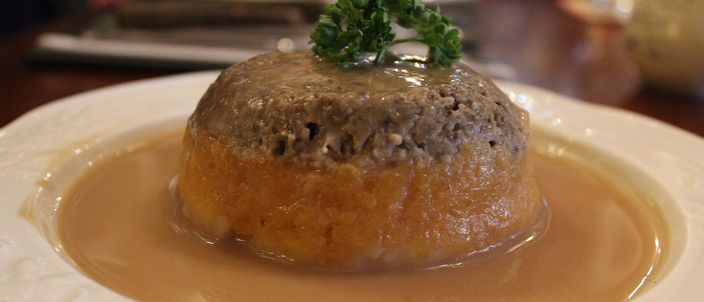
Haggis is a savoury pudding, not a mystery. It is sheep’s pluck — heart, liver and lungs — minced with onion, oatmeal, suet and a hard hit of black pepper and other spices, bound with stock and traditionally packed into a sheep’s stomach to cook. The result is crumbly rather than sliceable, warm brown, peppery and faintly livery, and it is meant to be spooned rather than carved. Cooked well it is one of the best arguments there is for offal; the pepper and the oats are doing as much work as the meat.
It is worth being honest about the geography. Haggis is Scotland’s national dish, not Edinburgh’s local one — it is eaten the length of the country and versions of the same idea, offal stretched with grain, are ancient and turn up far beyond here. What ties it to the capital is simpler and more useful to a visitor: Edinburgh is where most people from elsewhere first sit down to it, it is the home of one of the country’s best-known commercial producers, and it is the stage for the one ceremony that made the dish famous.
That ceremony is real history, not folklore. In 1786 the poet Robert Burns wrote a poem addressed directly to a haggis, hailing it — in Scots — as the great chieftain o’ the puddin-race and mocking the thin French cooking that fashionable people preferred. On Burns Night, the 25th of January, the dish is still piped to the table on a platter, the poem is recited, and the haggis is slit open with a knife at the line that calls for it. If you are in the city in late January, this is not a tourist re-enactment; it is a live tradition that happens in ordinary halls and front rooms.
One modern fact matters for planning. A vegetarian haggis — pulses, oats, mushrooms, seeds and the same spicing — has existed since 1984 and is now genuinely common, not a grudging afterthought; a good kitchen will have one and it is frequently very good. If you do not eat offal, you have not been shut out of the dish.
What to order
The default, and the one to have first, is haggis, neeps and tatties: the pudding with two mashes beside it. A warning on the vocabulary, because it trips people up. Tatties is potato, straightforwardly. Neeps is not the small white turnip an English speaker pictures — in Scotland it means swede, the big orange-fleshed root, mashed with butter and plenty of pepper. Asking for it by the Scots words is normal and unremarkable; nobody will blink.
Beyond the plate, the words worth knowing:
- a dram — the measure of whisky poured alongside. Pouring a little over the haggis, or simply drinking it with, is traditional and not a gimmick. A good bar will steer you by region of whisky rather than by brand.
- haggis supper — the chip-shop version: a scoop of haggis deep-fried in batter, served with chips. This is proper everyday food, not a debasement, and it is the cheapest honest way to try the dish.
- haggis pakora — battered, spiced, deep-fried haggis served with a dipping sauce, a fixture of Scottish-Indian kitchens and one of the genuinely good hybrids the city produces.
- haggis at breakfast — a slice or round is a standard component of a full cooked breakfast here, alongside the egg and bacon. Ordering it that way is entirely local.
If you want it as a starter rather than a main, many places serve a small haggis with a whisky-cream sauce, sometimes stacked in a tower with the two mashes. That presentation is fine in itself — the caution about the tower version is below.
What to avoid
The thing most likely to mislead a visitor is not a bad kitchen but a souvenir. Tinned haggis and the postcard “wild haggis” — the invented shaggy hill animal with legs shorter on one side for running round mountains — are a running joke sold on the Royal Mile. The joke is harmless; just know that a tin is a keepsake, not a meal, and that the fresh dish from a butcher or a kitchen bears little relation to it.
On a menu, the tells are specific. A haggis reduced to a single dainty quenelle balanced on a tower of mash under a moat of whisky sauce, on an otherwise unremarkable tourist-strip menu, is usually the dish dressed up for people who are nervous of it — small, expensive and apologetic. That is different from a serious restaurant’s plated version; the difference is whether the rest of the room is cooking or performing. On the same strip, a place leaning on tartan, bagpipe soundtracks and a photograph of the haggis on a board outside is selling the idea of Scotland rather than the plate.
Be a little wary of haggis that has plainly been sitting on a hot line, dried out and crusted at the edges — this is the failure mode of a busy pub kitchen at an odd hour, not of the dish. Freshly cooked, it should be moist and loose, almost spreadable.
And do not let anyone tell you the vegetarian version is a lesser substitute or a trap; it is a real, long-established Scottish product in its own right, and treating it as suspect is a mistake, not caution.
Practicalities
The dish sorts cleanly into three price bands, and knowing which you are in prevents disappointment. A haggis supper from a chip shop runs roughly £5 to £8 and is the low-effort, high-reward end. A plate of haggis, neeps and tatties in a pub sits at around £10 to £15. A starter portion in a proper restaurant, with the whisky sauce and the table service, is usually £8 to £12 — and if a bare starter of it is being priced like a main on a Royal Mile menu, that number is telling you about the address, not the food.
It is available all year and at every meal — breakfast fry-up, pub lunch, chip-shop dinner — so timing is easy, with one exception that is worth planning around. In the run-up to Burns Night on the 25th of January the dish is everywhere and many places run a set Burns supper; book if you want the full piped-in ceremony, because those seats go. The rest of the year needs no strategy.
Cards and contactless work essentially everywhere in the city, chip shops included, so you do not need to carry cash for this the way you might elsewhere. If you eat no offal, ask for the vegetarian haggis by name rather than assuming — it is common, but not universal, and asking saves the awkward menu hunt.
One last practical point: haggis is filling out of proportion to its size. The oats and suet make even a modest plate a heavy meal, so a starter portion is often the honest amount for a first try, with the appetite left for the whisky.