Cullen skink in Edinburgh: what it is, how to order it, what to avoid
Last updated 20 July 2026
Overview
Cullen skink is a thick soup of smoked haddock, potatoes, onions and milk — three or four honest ingredients cooked until the potato half-collapses and thickens the pot on its own. It is pale, not yellow; it should smell of smoke before you taste it, and taste of smoke and fish rather than of cream. Done properly it sits between a soup and a light stew: too substantial to be a starter for a big eater, too loose to be a chowder. A good bowl is one of the most quietly satisfying things you can eat in cold weather, which in this country is most of the year.
The honest geography first. This is not Edinburgh’s dish — it belongs to the northeast coast. It is named for the fishing town of Cullen, on the Moray coast well to the north, and it is a creature of that cold, herring-and-haddock shoreline rather than of the capital. What brings it to an Edinburgh table is that it long ago escaped its home town: it is now a fixture on menus the length of Scotland, and the capital, being where most visitors eat, is where most visitors meet it. Treat it as a regional soup the city serves well, not as a local invention.
The name repays a moment. Skink is an old Scots word for a soup or broth, from a Germanic root meaning the shin or knuckle of an animal — the part you boil long and slow. Historically a skink was a beef-shin broth; the word was carried over to this fish version at some point that the records do not pin down precisely. So “Cullen skink” is, plainly, “Cullen’s broth”. That much is well attested; anyone who tells you a tidier origin story is likely tidying.
What to order
You mostly order it by name — it is a fixed dish, not a family of variants — but two words are worth knowing, because they are the difference between the real thing and a shortcut.
The fish should be smoked haddock, not fresh, and ideally undyed smoked haddock. This is the single most useful phrase in the whole subject. Undyed smoked fish is a soft straw colour, because the colour comes only from the smoke. The alternative is dyed a bright, uniform yellow-orange to look more smoked than it is, and it usually signals a cheaper, faster-cured product. A kitchen that says “undyed” on the board is telling you it cares; a bowl the colour of a highlighter pen is telling you the opposite.
You may also see the fish called Finnan haddie — a cold-smoked haddock named for the village of Findon near Aberdeen, the traditional cure for exactly this kind of dish. If a menu uses that term it is a good sign: it means someone knows the pedigree.
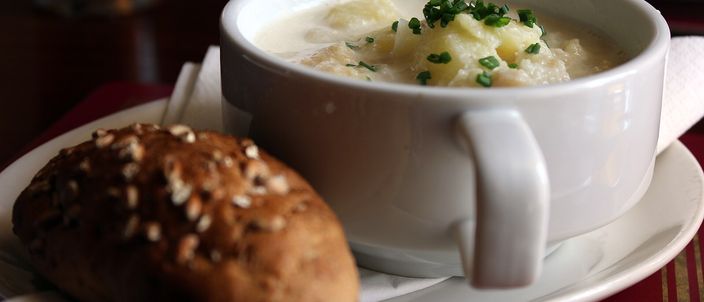
What arrives should be pale and flecked, with visible pieces of flaked fish and soft potato, not a smooth blended purée. Some cooks poach a whole extra piece of haddock to lay on top, and a poached egg is a traditional and very good addition where it appears. It is almost always served with bread for dipping, and that is the correct way to eat it.
What to avoid
The failures here are specific and easy to spot once you know them.
The dye is the first tell. A luridly yellow bowl has almost certainly been made with dyed haddock, and while that is not dangerous, it is the mark of a kitchen buying the cheap cure and hoping the colour reads as flavour. The real thing is muted.
The second is cream doing the work the smoke should do. A version that is thick, bland and heavy, tasting mainly of dairy, has usually been floured to a paste and cushioned with cream to hide thin, under-smoked fish. Cullen skink is traditionally thickened by its own potato, not by a roux; when cream appears it should be a finishing touch, not the main event. If you cannot taste smoke, something has been covered up.
The third is the mislabelled bowl. A “seafood chowder” heavy with mussels, prawns and salmon is a different dish wearing a similar coat — pleasant enough, but not this. Cullen skink is smoked haddock and little else, and a version crowded with mixed shellfish has drifted away from what the name promises. Likewise, a soup that is perfectly smooth has been blended into submission; the flakes and the lumps of potato are the point.
None of this is about spotting a tourist trap in the usual sense — it is a home-cooking dish, not a monument, so the risk is a lazy kitchen rather than a predatory one. The signs are on the plate, not on the door.
Practicalities
Expect to pay roughly £6 to £9 for a starter-sized bowl and closer to £9 to £13 for a large bowl served as a light meal with bread. A number well below that range, especially on a soup that arrives suspiciously smooth and bright, is a fair warning that the fish was cheap; a number well above it is usually buying the room rather than a better bowl of soup.
It is genuinely a soup for weather, and this is a place with a great deal of weather, so it is on menus all year and is at its best on the cold, wet, windy days the city specialises in — which is to say most of them. It reads most naturally as a lunch or a first course rather than a headline dinner, and a bowl with good bread is a complete and cheap midday meal on a grey afternoon.
You will find it more reliably in a proper kitchen — a pub doing real food, a seafood place, a café that cooks — than in a fast, tourist-facing spot, and it is worth seeking out near the water down in Leith, where the seafood tradition is strongest. The dish is taken seriously enough on its home coast that the town of Cullen holds an annual championship to crown the best version, which tells you it is a matter of real local pride rather than a menu afterthought.
Cards and contactless are fine everywhere for this, as across the city, so no special cash habit applies. One last thing worth knowing: smoked haddock is salty by nature, so a well-made bowl is seasoned lightly and may not need the salt cellar — taste before you reach for it.