Scotch pie: the mutton pie with a rim, and how to eat one properly
Last updated 22 July 2026
Overview
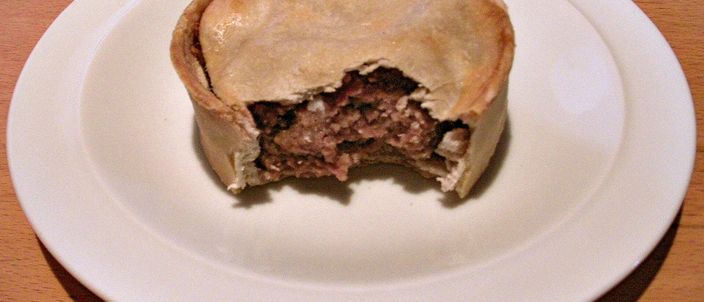
A Scotch pie is small, round, straight-sided and about as tall as it is wide — the shape is the first thing to understand, because everything else follows from it. The pastry is hot-water crust: flour worked with boiling water and fat, which sets into a rigid wall that stands up on its own without a tin. That wall is structural. The pie is designed to be held in one hand, outdoors, in bad weather, and eaten without a plate.
Inside is minced mutton — not beef, and that distinction is the dish’s identity — seasoned heavily with black or white pepper and very little else. Mutton is strong, slightly gamey and fatty in a way that lamb is not, and the pepper is there to meet it. The result is savoury, coarse and quite salty, and it is not subtle. A version made with beef is a different pie, and honest bakers say so on the label.
The lid is the detail people miss. It sits below the rim, leaving a shallow well perhaps a centimetre deep at the top. That is not a mistake or a decoration: it is a container, meant to be filled — with gravy, with baked beans, with mashed potato, with brown sauce — so that the pie carries its own accompaniment. A pie whose lid is flush with the top of the wall has lost the point.
It is a national thing rather than an Edinburgh invention, and the city eats it the way every other town here does: from bakers, from butchers, and above all at football grounds, where it has been the standard half-time food for well over a century. The association is so fixed that the trade’s own competition, the World Championship Scotch Pie Awards, run since 1999 by Scottish Bakers, has a separate category for football pies alongside the Scotch pie proper.
That competition is the strongest checkable fact available about a food with no protected designation and no documented invention. There is no legal definition of a Scotch pie; there is an annual judged standard, entered by hundreds of bakers, and the winners put the plaque in the window. When you see one of those in an Edinburgh shop front, it means something specific.
What to order
Ask for a Scotch pie or simply a pie in a baker’s, and you will get this one — the word is the default across the country. What is worth knowing is the family it belongs to, since the same counter sells four or five things that look adjacent:
- Scotch pie — mutton, hot-water crust, recessed lid. The subject here.
- Bridie — a folded pastry turnover with steak and onion. No lid, no wall, different animal entirely.
- Macaroni pie — the same crust filled with macaroni cheese. Sounds absurd, works, and has its own award category.
- Steak pie — larger, softer pastry, gravy inside. A sit-down thing.
Hot or cold: a Scotch pie is meant to be hot, and a baker will usually have both a warm cabinet and a cold shelf. The cold one is for taking home and reheating; eating it cold is possible and is what the mutton fat is least forgiving about.
The additions, in rough order of orthodoxy: beans in the well, gravy poured in, mashed potato on top, brown sauce. All are traditional and none is compulsory. If you are eating it standing up, the sauce version is the manageable one; anything liquid will find your sleeve.
If you want to eat one where the dish makes most sense rather than where it is most convenient, that is a football ground on a Saturday afternoon in winter, hot pie in one hand, in the rain. The whole design of the object is an argument for that setting.
What to avoid
The commonest failure is a pie that has stood too long in a warming cabinet. Look at the wall: hot-water crust should be pale, matt and firm enough that the pie holds a perfect cylinder. When it has been warm for hours, the base darkens with absorbed fat and the sides bow outwards slightly. A pie that is no longer round has been sitting.
Second: the beef substitution. Mutton is dearer and less popular than it was, and plenty of places quietly use beef mince while keeping the name. It is greyer, milder and blander, and if the filling tastes like a burger it is not a Scotch pie. Butchers who use mutton say so, because it is a selling point.
Third, and specific to this city: the pie sold reheated from a chiller in a late-night shop on the main tourist axis of the old town, at two or three times a baker’s price. This is a sub-two-pound object made by bakeries at scale, and any version priced like a restaurant starter is charging for the hour and the address, not for the pie.
Fourth, an outright substitution to watch for: the small round “Scottish pie” on a hotel buffet or a pub’s tourist menu, with a soft, glossy, egg-washed shortcrust lid domed over the top. Wrong pastry, wrong shape, no well. It may be perfectly nice; it is not this.
Practicalities
Cheap, and worth knowing the band because it is diagnostic: roughly £1.50 to £3 from a baker’s or butcher’s counter, a little more at a football ground or a café where it comes with beans and a mug of tea. Well above £5 for a pie on its own means a kitchen has made it a plated item.
It is an all-day food but a morning-baked one. Bakers put trays out early, and the good ones are gone by early afternoon in a busy shop — the practical rule in Edinburgh is that a butcher’s or baker’s with an empty tray at three o’clock is a recommendation, and one with a full warm cabinet at five is not.
There is no season, and the useful thing to do with that is match it to weather rather than to the calendar: this is food built for cold hands, and the city gives you plenty of days for it between October and April, including in what the calendar insists is summer.
Cards work everywhere, but many small bakers still have a card minimum that a single pie will not meet, so a couple of coins saves an awkward moment. Eat it within a few minutes of buying — the crust holds heat well and the filling holds it far too well, so the first bite is genuinely hot enough to hurt. Bite the well end first and let it cool while you work down.