Salzburger Nockerl: what it is, how to order it, what to avoid
Last updated 20 July 2026
Overview
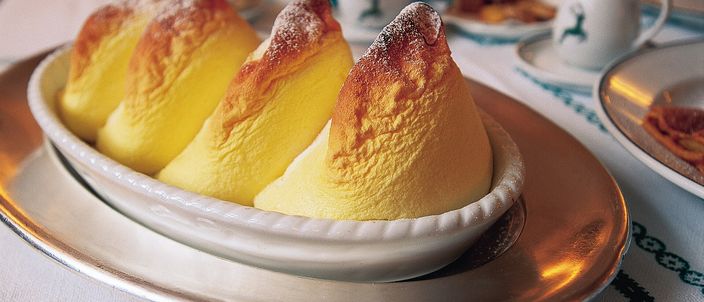
A Salzburger Nockerl is a hot sweet soufflé, and almost all of it is air. Egg whites are whipped stiff with sugar, loosened with a little yolk and a spoon of flour, piled into a buttered dish and baked just long enough to set the outside while the middle stays warm and barely-there. It comes out tall, pale-gold at the tips, and buried under a thick fall of icing sugar. Then it starts to sink, which is the whole drama of the thing and the reason you eat it the moment it lands.
It is built as three big peaks, and the shape is the point: they stand for the hills that ring the old town — Mönchsberg, Kapuzinerberg and Gaisberg — with the icing sugar as their snow. That reading is repeated on every menu, and unlike most such stories it is at least consistent with a dessert that is genuinely three mounds under white.
The origin tale is softer ground. It is usually credited to Salome Alt, the companion of the Prince-Archbishop Wolf Dietrich von Raitenau, in the early 1600s — a lovely story that puts the dish four centuries deep in the city’s own history, and one for which the documentary evidence is thin to non-existent. Treat it as folklore worth knowing, not as a dated fact. What is solid is that the Nockerl has been Salzburg’s signature sweet for generations, enough to earn its own song: the 1938 operetta Saison in Salzburg by Fred Raymond praises it as sweet as love and tender as a kiss, which is roughly the register the city still sells it in.
The word itself is worth untangling. A Nockerl is a small dumpling — the Austrian cousin of gnocchi, and normally a savoury thing swimming in soup or butter. The Salzburger Nockerl is the odd one out: same name, but a sweet, vast, oven-baked cloud that shares nothing with its namesake except the rounded shape.
What to order
There is, honestly, one dish here, and the skill is in reading how it is served rather than choosing between versions. Menus list it as Salzburger Nockerl or the plural Nockerln, and the single most useful line on that menu is the portion note: it almost always says for two or three people. Take that seriously. It is not modesty — a Nockerl is a sharing dessert by design, and one person facing a whole one is facing a lot of sweet foam.
The other line to look for is the timing note — “please allow twenty minutes”, or words to that effect. A kitchen that tells you this is telling you the truth about the dish: it is whipped and baked to order, and it cannot be hurried. Order it at the start of your meal, not after the mains arrive, so it reaches the table hot rather than keeping you waiting at the end.
What arrives is the plain thing dusted with sugar, sometimes with a thin seam of fruit hidden at the base of the dish — raspberry, or the tart lingonberry the German menu calls Preiselbeeren — and occasionally a little warm vanilla sauce or milk pooled underneath to cut the sweetness. None of these is a fancier “version” to hunt down; they are house habits, and the fruit at the bottom is the common and welcome one. If you are given a choice, the fruit earns its place: it is the only sharp note against an otherwise sweet, eggy whole.
What to avoid
The failure mode is not a bad recipe; it is a stale one. A Nockerl that reaches you in five minutes, already sunk flat and dense, was baked earlier and reheated, and it is a different, sadder food than the one made to order. The genuine article involves a wait and arrives standing up, wobbling, still steaming where you break into it. The interior should be soft and creamy, almost underdone; if it is dry and cakey all the way through it was overbaked, and no amount of icing sugar on top rescues that.
Be wary, then, of any place that offers it as a single instant portion from a warmer, especially where the menu drops the “for two” note and the twenty-minute warning — those two lines are the honest kitchen’s fingerprints, and dropping them usually means the dish has been pre-made to move fast. A café packed with day-trippers and a Nockerl that appears before your coffee has cooled is telling you plainly what happened in the kitchen.
And resist the impulse to order one each. It is not meanness on the menu’s part; it is that the dish is engineered to be shared, and a solo portion is either enormous or has been shrunk into something that has lost the drama of the peaks entirely.
Practicalities
This is a restaurant and café dessert, and only that — you cannot buy a Nockerl at a counter or carry one away, because it does not survive the walk. It collapses within minutes, so it exists only where it can go straight from oven to table. That single fact governs everything else about eating one.
Expect to pay roughly €12 to €20 for the whole sharing dish, not per head — which makes it, split two or three ways, a modest price for what is really a small piece of theatre. A number far below that range usually signals the reheated single portion rather than a bargain; a number far above it is the view or the address talking, not the eggs.
It is eaten as a dessert, after a meal, though it is filling enough that a shared one with coffee in the afternoon is a legitimate way to have it and skip a course. There is no season to wait for and it is on menus all year, so the only timing that matters is within the meal itself: put the order in early, because the twenty minutes it takes are the twenty minutes it is worth. Cards are fine everywhere it is served, as they are across the city.