Kaiserschmarrn: the torn pancake that counts as a main course
Last updated 22 July 2026
Overview
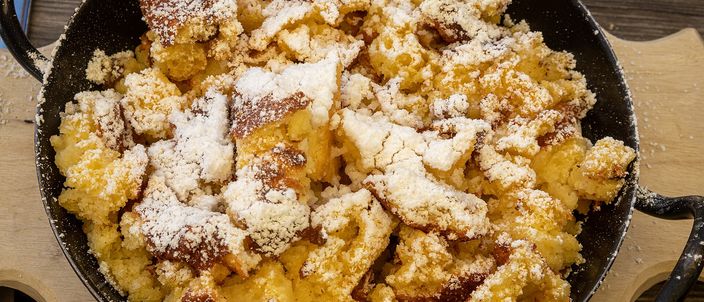
Kaiserschmarrn is a thick pancake that is deliberately destroyed. The batter — eggs, flour, milk, sugar, often with the whites beaten separately to make it rise — goes into a hot buttered pan, sets on one side, and is then torn apart with two forks or the edge of a spatula while it finishes cooking. The pieces are tossed in butter and sugar until the edges caramelise, dusted heavily with icing sugar, and brought to the table in a heap, usually in the pan itself.
Schmarrn means a mess, or nonsense — the word is used in ordinary speech for rubbish talk — and that is exactly the register. Half the pleasure of the dish is textural: the outside pieces are crisp and sticky with caramelised sugar, the inside ones are soft, eggy and still slightly wet. A version where every piece is the same is a version that was cooked flat and cut up afterwards.
Raisins are standard, usually soaked in rum first, and they are also the single most contested ingredient in the dish — plenty of people order it ohne Rosinen, without them, and nobody minds.
It arrives with something sharp on the side, and the classic pairing is Zwetschkenröster, plums stewed with cinnamon and cloves until they collapse into a dark, tart compote. Apfelmus — apple sauce — is the other standard. Neither is optional in practice: the pancake is sweet, and the compote is what stops it being monotonous.
It is a regional dish, Austrian rather than Salzburg’s own, and its real home is not a city café at all but the mountains. This is the standard midday plate at an Alpine hut, eaten by people who have walked or skied to get there — a large, hot, sweet, egg-and-butter dish that is a main course rather than a pudding. Salzburg sits at the mouth of those valleys, which is why the dish is on every menu here and why the city’s version is a half-domesticated one.
The name means “the emperor’s mess”, and the story attached to it — a court kitchen, a dessert that went wrong, Franz Joseph eating it anyway — exists in several incompatible versions, all of them nineteenth-century and none of them documented. Enjoy the story, and note that the imperial attribution was almost certainly attached to the dish later, as it was to a good many others in this part of the world.
What to order
Say einen Kaiserschmarrn and expect a plate that is larger than you think. The decisions:
- Mit or ohne Rosinen — with or without raisins. Ask; many kitchens make both.
- The compote. Zwetschkenröster is the traditional one, Apfelmus the milder alternative, and some places offer a cranberry-type Preiselbeeren. If it does not come with any, ask.
- Sharing. In a mountain hut a portion is genuinely for one hungry walker. In a city restaurant it is often plated for two, and menus frequently say so.
Where it is on the menu tells you what the kitchen thinks it is. Under Mehlspeisen — the category of sweet flour dishes that in this country are proper main courses, not desserts — you are getting a full portion made to order. Under Nachspeisen, desserts, you may be getting a smaller, sweeter one, and sometimes one that was made earlier.
It takes fifteen to twenty minutes when it is cooked properly, and a good restaurant will tell you so. That wait is the most reliable signal available: a Kaiserschmarrn that arrives in five minutes was not torn in a pan for you.
Drink: coffee, or in the mountains a small beer or a Sturm in autumn. It is sweet enough that wine is a struggle.
What to avoid
The reheated version is the one to know. Batch-cooked Kaiserschmarrn is held in a warming cupboard and finished under a salamander, and it comes out uniformly golden, uniformly dry, with no soft interior at all — the pieces rattle slightly when the plate is set down. Real ones are irregular: dark caramelised edges, pale steaming middles, some pieces the size of a thumb and some the size of a coin.
Second, the pre-portioned bag. Frozen Kaiserschmarrn is a genuine industrial product sold to catering kitchens, and it is identical in every piece, sweet all through, and served with a compote from a tin that is smooth rather than lumpy. If the plums in the pot have no skins and no shape, they came in a tub.
Third, the sugar. Icing sugar is dusted over the top as a finish; some tourist-facing kitchens use it to conceal a batch that has dried out. A drift deep enough to hide the pancake entirely is not generosity.
And a point specific to this city: the streets between the river and the fortress carry an enormous day-visitor flow, and the cafés on that route serve this dish to people who will eat one Kaiserschmarrn in their lives. Ten minutes’ walk in any direction — across the river, out along the residential streets, or genuinely up into the hills — the same dish is made to order and costs less. The best versions in this region are eaten at a wooden table at altitude, and that is a bus ride, not a fantasy.
Practicalities
Reckon on roughly €10 to €16 in a city restaurant, a little less at a mountain hut, and up to €20 where it is served in a copper pan in a smart dining room. There is nothing expensive in it, so the price is about the room and the labour, and a very cheap one is almost always the reheated one.
It is lunch, or an early-afternoon meal, and treating it as a pudding after a full dinner is the commonest visitor mistake — this is several eggs, a great deal of butter and a plate of sugar. Hut kitchens serve it from late morning until mid-afternoon and then stop.
The season worth planning around is winter and the shoulder months, when the dish makes obvious sense: cold air, a long walk, a hot pan of it at midday. In August a full portion at two in the afternoon in the city is heavy going. Mountain huts run to their own calendars — many close between seasons, roughly in November and again after the ski season — so the plate at altitude is a summer or winter proposition, not a spring one.
Cards are normal in the city and increasingly accepted at huts, but many mountain kitchens are still cash only and the cable car back down does not care about your predicament. Carry notes if you are eating it where it belongs.