Mozartkugel: what it is, how to spot the original, what to avoid
Last updated 20 July 2026
Overview
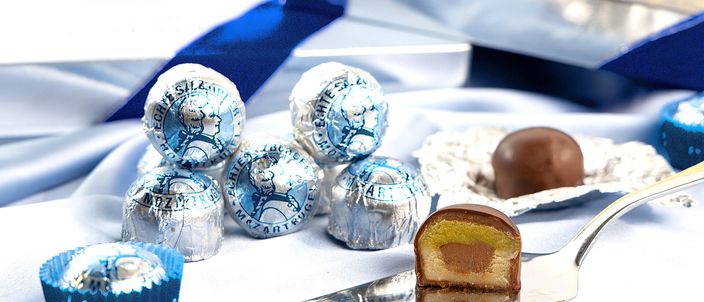
A Mozartkugel is a small chocolate ball built in layers from the centre out: a core of green pistachio marzipan, wrapped in a shell of nougat — the hazelnut-and-sugar kind, not the chewy white sweet the word means in English — and the whole thing coated in dark chocolate and wrapped in foil. It is round, it is about the size of a large cherry, and it is named after the composer Wolfgang Amadeus Mozart, who was born in this city in 1756. The name is the entire marketing, and it works: the ball is sold on nearly every shopping street here.
Unusually for a famous sweet, its origin is documented rather than legendary. A Salzburg confectioner, Paul Fürst, made the first one in 1890 and called it a Mozart-Bonbon. That is a checkable date and a named person, not a folk tale, and it matters because it is the whole basis of the distinction a visitor actually needs to make — between the thing he invented and the thing the name has since been stretched to cover.
The method he used is the reason the original still looks the way it does. The marzipan core is set on a small wooden stick, dipped by hand in chocolate, and the stick then pulled out; the little hole it leaves is closed over, so a genuine hand-made ball carries a faint flat spot and is never a flawless sphere. That imperfection is not a flaw to avoid — it is the signature of the hand-dipped article, and the perfectly round, machine-smooth version is the one that isn’t it.
What to order
There are, in practice, two products wearing one name, and telling them apart is the whole skill.
The one worth seeking is the hand-made original. Look for the words Original Salzburger Mozartkugel and for silver-and-blue foil — that wording is legally reserved to the inventor’s line and cannot be used by the industrial makers, so it is a reliable label rather than a boast. These are sold loose from a confectioner’s counter, or boxed in small numbers, and they are coated entirely in dark chocolate. Buy one or two singly before committing to a box: the marzipan-forward, distinctly bitter-chocolate profile is not to everyone’s taste, and it is a different sweet from the milder mass version.
The mass-produced balls are not a trap so much as a different, lesser thing sold beside the real one. They come in gold-and-red foil, in sealed boxes and tins, are usually milkier and sweeter, and are made by machine — some of them not in the city at all. They are perfectly fine as an inexpensive gift and they travel well. Just know which one is in your hand: the wrapper colour and the wording Original versus the industry’s own Echte (“the real one”) are the tell, decided in actual trademark courts rather than invented here.
What to avoid
The thing to be wary of is not a bad sweet but a premium price on the ordinary one. The gold-foil balls in the airport tins and the souvenir-shop pyramids are the mass version, and paying a hand-made price for them is the only real mistake available. If they are stacked by the hundred in a sealed display near a tourist queue, they are the industrial ball whatever the shop’s frontage suggests.
Two concrete signs cut through it. A flawless, seamless sphere is machine-made by definition — the hand-dipped original carries the small flat mark from its stick. And any foil that is not silver-and-blue, or any packaging that avoids the word Original, is telling you, quite legally, that it is not the inventor’s article. Neither is a scandal; both are just information the wrapper is obliged to give you.
Finally, resist the assumption that a box bought here is somehow the Salzburg sweet coming home. Some of the best-known mass brands are produced across the border in German factories, and a ball made in another country is exactly as un-local as that sounds — a decent chocolate, but not the thing this city can claim to have invented.
Practicalities
The original is bought where it is made: from a confectioner’s counter, loose or in small boxes, at a handful of outlets in the old town, and essentially nowhere else — not the supermarket, not the airport. That single fact is the most useful one for finding the real thing, because the search narrows itself to a counter with a queue of people buying two or three at a time rather than a shelf of sealed tins.
Expect roughly €1.50 to €2.50 for a single hand-made ball, which makes a small boxed handful a modest and genuinely local gift; the mass tins run far cheaper per piece, which is part of how you tell them apart on a shelf. A price near the low end for something sold loose and dark-coated is normal, not suspicious; a “hand-made” claim at supermarket prices is the combination that doesn’t add up.
This is a sweet for coffee or for taking home, not part of a meal, and it keeps for a few weeks, so it survives a suitcase better than most edible souvenirs. Cards are taken at the counters as they are across the city, and nothing here needs cash — but the smallest confectioners are the likeliest to prefer it for a single-ball purchase, so a coin or two saves a fuss.