Pavlova in Melbourne: what it is, what to order, what to avoid
Last updated 20 July 2026
Overview
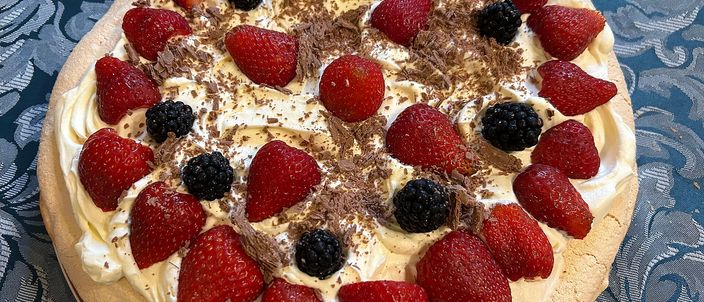
A pavlova is a large disc of meringue with a crisp, dry outer shell and a soft, marshmallow- like centre, crowned with softly whipped cream and fruit. That contrast of textures is the whole thing: a meringue that shatters at the edge and gives way to something almost molten in the middle, cut through by cold cream and sharp fruit. Get the middle wrong — bake it until it is meringue all the way through — and you have made a large biscuit, not a pavlova.
It belongs to Australia and New Zealand together rather than to this city in particular, and it is worth saying so plainly: this is a national and trans-Tasman dessert, made and argued over on both sides of the water, not a Melbourne speciality the way some dishes are tied to one town. Melbourne’s claim on it is simply that it is a fixture of the summer table here, at its most inevitable around Christmas, which in this hemisphere falls in the heat of December.
The name is the good part of the story and, unusually, it is documented rather than folklore. The dessert was named after Anna Pavlova, the Russian ballerina, who toured both countries in the 1920s and was a genuine celebrity at the time — the airy, white, weightless pudding was a tribute to her. Where documentation runs out is the question of which country invented it, and that is a real and unresolved fight. Culinary historians who have chased the earliest printed recipes have generally traced them to New Zealand in the late 1920s, which irritates a great many Australians; the honest position is that the naming is certain and the birthplace is contested. Take anyone’s flat assertion of ownership as patriotism rather than history.
What to order
The first thing to know is that a pavlova is more often met at a table than ordered from a counter. It is a celebration dessert and a home-kitchen showpiece, so the most likely places to encounter one are a Christmas lunch, a shared meal, a bakery cabinet in December, or a café that does a proper dessert list — not a thing you grab walking down the street. That shapes how you order it: usually by the slice from a bakery or café, or whole from a bakery to take to a gathering.
The vocabulary and the variations worth knowing:
- the topping — the classic Australian finish is whipped cream and passionfruit, the pulp spooned over so the seeds and tartness cut the sweetness. Cream with berries — strawberry, raspberry, blueberry — is the other common dressing, and kiwifruit is the finish more associated with the other side of the Tasman. Any of these is legitimate; a good one uses fruit that is actually in season in the southern summer.
- individual pavlovas — small single-serve versions, sometimes called pavlova nests: a hollowed meringue shell filled with cream and fruit. Easier to serve, and a fair way to try one without committing to a slice of a metre-wide disc.
- the cream — it should be softly whipped, barely holding shape, not the stiff piped kind. Sweetened lightly or not at all, because the meringue is already sweet; the cream is there to be the cool, plain counterweight.
There is no secret local order that marks you out here — a pavlova is a pavlova. The one thing worth doing is asking, if it is not obvious, whether the middle is soft, because that is the single detail that separates the real thing from an imitation.
What to avoid
Almost everything that goes wrong with a pavlova is the same failure: it has been made or held in a way that kills the soft centre. The tells are learnable.
The supermarket shell is the main one. A pre-made, cellophane-wrapped meringue base sold to be filled at home is crisp the whole way through — no marshmallow middle, just sweet crunch and air. It is fine for what it is, but it is not a pavlova and it should not cost like one.
Weeping and collapse come from time and refrigeration. A pavlova sitting cut in a cold cabinet for a day goes sad: the shell softens and turns chewy, beads of syrup form on the surface, and the crisp edge is gone. A meringue that has been assembled with its cream and fruit hours ahead has softened right through. The real thing is topped close to serving and does not survive long once it is, which is exactly why it is a fresh-made, occasion dessert rather than a grab-and-go one.
Be a little wary, too, of a pavlova piped with stiff, sculptural cream and glazed, out-of- season fruit arranged for the photograph. That is a decorated object built to look good in a cabinet; the plainer one, with loose cream and ripe seasonal fruit spooned on without ceremony, is almost always the better dessert. And a slice that is meringue-hard right to the middle has either been overbaked or was never a pavlova to begin with — send your attention elsewhere.
Practicalities
By the slice from a café or bakery a pavlova runs to roughly $6 to $12; a whole one to feed a table is more like $25 to $50 depending on size and where it comes from. A single-serve nest sits at the lower end. A slice priced well below that range is usually the supermarket-shell version rather than a find.
Its calendar is the honest headline: this is a summer dessert, and its true season is the run of Christmas and Boxing Day and the January weeks after, when the passionfruit and berries are at their best and half the households in the country are making one. You will find it year-round on café dessert lists, but a December pavlova is a pavlova with the fruit on its side. Bakeries take orders for whole ones in the weeks before Christmas, and leaving it late is how you end up with the supermarket shell by default.
Buying it is ordinary café and bakery business — Melbourne runs cashless and a card covers it — and if you are carrying a whole one to a lunch, know that it does not travel or wait well: topped, it wants to be eaten within a couple of hours, so the cream and fruit are best added at the table rather than at the shop. Eaten fresh, edge crisp and centre still soft, it is one of the genuinely good things about a hot southern summer.