Choclo con queso in Cusco: what it is and how to order it
Last updated 20 July 2026
Overview
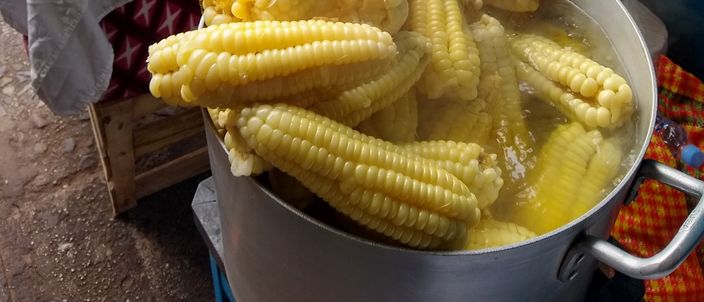
Choclo con queso is the plainest good thing you can eat in Cusco: a boiled cob of large white Andean corn, handed over hot with a thick slab of fresh cheese to eat alongside it. It is a snack and a cheap lunch rather than a restaurant dish, and it is one of the honest staples of the whole southern Andean highland — not this city’s invention so much as the everyday food of the wider Cusco region and the valleys around it. What makes it worth a paragraph to a visitor is the corn itself.
The kernels are enormous — pale, matte-white, each one the size of a fingernail — and they are nothing like the small, sweet, yellow corn most visitors know. This is choclo: starchy rather than sugary, chewy, faintly milky, closer to a fresh bean than to a dessert. It grows best in the high valleys northwest of the city, and the finest of it carries a genuine legal pedigree. Peru granted the giant white corn of the Sacred Valley a Denominación de Origen — a protected origin designation, of the same family as a wine appellation — tying the name to corn grown in the Urubamba and Calca valleys. That is the strongest possible answer to “why here”: the specific corn on the cob has a documented home a short drive from the plaza, and it is not the same product grown anywhere else.
The cheese is the counterweight — a firm, mild, slightly salty fresh white cheese, often the Andean queso paria, cut in a generous wedge. Corn and cheese are meant to be eaten in alternate bites: a mouthful of the bland, chewy starch, then the salt and fat of the cheese. There is no sauce, no cooking beyond boiling, and no cleverness. That is the point of it.
What to order
You ask for choclo con queso and that is essentially the whole transaction — one cob, one slab of cheese. But a few distinctions are worth knowing:
- choclo con queso — the standard: boiled cob, fresh cheese on the side. What you will be handed at a market stall or a roadside pull-in.
- choclo sancochado — simply “boiled corn”, the cob on its own without the cheese, often sold by the same vendors for a little less. If you only want the corn, this is the phrase.
- the cheese, fried — some stalls will griddle the cheese slab until it is golden and soft rather than serving it cold. It is worth asking whether the cheese is a la plancha (grilled) if you prefer it warm; both are normal.
It usually comes with a small pot of ají or a spoon of green huacatay sauce to dip into — take it, it is what lifts a plain cob. The correct way to eat it is with your hands, corn in one, cheese in the other, and there is no tidy method; that is expected.
The one thing that marks a visitor is treating it like sweetcorn — reaching for butter or salt, or expecting it to be sweet. It is neither buttered nor sweet, and the vendor has nothing to add to it, because nothing is missing.
What to avoid
There is not much to be swindled on with a boiled cob, but two things separate the good from the tired.
The first is the cob sitting in cold water. Choclo con queso is only as good as its temperature: fresh from the pot the corn is hot, soft and milky; left standing, it goes tough, cool and starchy, and a cob fished from a lukewarm tub has been there a while. The tell is steam and turnover — a stall with a queue and a visibly boiling pot is serving corn that has not been sitting.
The second is the cheese. In a market or a highland stall the cheese is local fresh cheese, cut to order. Where a place is set up for tour groups, that same slab can quietly become an industrial processed slice — flatter, shinier, rubbery and uniform — which is a different and worse thing. Fresh cheese crumbles slightly at the edge and has an uneven, hand-cut face; a perfectly rectangular, plastic-bright slab is the giveaway.
Beyond that, the corn is a peasant food and its price reflects that. A cob and cheese offered at a tourist-restaurant premium is not better corn — the same cob costs a fraction of that two streets away or at any market counter.
Practicalities
Bought from a market stall, a roadside vendor in the valley, or a street cart, choclo con queso costs only a few soles — call it roughly 3 to 8 soles, firmly in pocket-change territory and one of the cheapest filling things you can buy in the region. Inside a sit-down restaurant it appears as a starter at several times that, which buys you a table and a plate rather than better corn.
It is genuinely all-day food and needs no occasion, but it is at its best where you can see the pot: the covered central market, the corn vendors along the roads through the high valleys, and the little stalls at the ruins and viewpoints that ring the city. The valley stalls, sitting in the middle of the fields that grow the corn, are as close to the source as it comes.
This is a cash purchase, always — the vendors selling it are exactly the small, informal sellers the city guide means when it says to carry soles, and none of them take a card. Small notes and coins are what you want; nobody at a corn cart will thank you for a large note. No tipping is expected on a street snack, and there is no bargaining on a fixed few-soles cob — the price is the price.