Sarmale in Bucharest: what they are, how to order, what to avoid
Last updated 20 July 2026
Overview
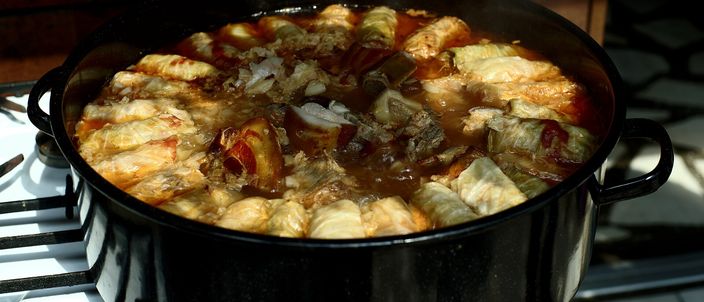
Sarmale are cabbage rolls: minced pork, or pork and beef, mixed with rice, onion and herbs, wrapped in a leaf of soured cabbage and stewed slowly for hours until the parcel is soft and the filling has taken on the sourness of the leaf around it. They are not Bucharest’s own invention, and it would be dishonest to say otherwise — sarmale belong to the whole country and to a wide arc beyond it. The name gives the game away: it comes from the Turkish sarma, “to wrap”, and the dish travelled with the Ottoman kitchen across the Balkans, where every country has a version. What Romania did was make it national. It is eaten from one end of the country to the other, and Bucharest is simply where you will most easily find it done well.
That national ownership is real even if the origin is borrowed. Sarmale are the anchor of the Romanian feast — the dish that must be on the table at Christmas and Easter, at weddings, at a funeral wake, at any gathering that matters. A Romanian will tell you their grandmother’s sarmale are the correct ones and everyone else’s are merely food, and they will half mean it. There is no single recipe, and the regional lines are genuine: in Transylvania the filling leans on paprika and the influence is Hungarian; toward Moldavia the rolls are made small and neat and the count on the plate goes up; some cooks build the pot with a tomato sauce and others regard tomato as heresy. All of these are correct at once.
The classic accompaniment fixes the dish in place. Sarmale arrive with mămăligă — a firm maize polenta — and a spoon of smântână, the thick sour cream that cuts the richness. Often a wedge of the sour cabbage and a fresh chilli sit alongside. That trio, not the roll alone, is the plate people mean.
What to order
You order sarmale by the portion, and a portion is a number of rolls — usually three or four, served in their sauce with the polenta and cream on the side or under them. If you are unsure how hungry you are, this is a filling dish and three is plenty.
The distinction worth knowing is the wrapper. The standard, year-round version uses soured cabbage leaves (varză murată), which give the tang that defines the dish. In late spring and summer you will also see sarmale în foi de viță — rolls wrapped in vine leaves instead, smaller, greener and a little sharper, and worth ordering when they appear because they are seasonal rather than default. A menu that offers both is a menu paying attention.
Ask what the filling is if it matters to you: most sarmale are pork or pork-and-beef, but meat-free versions exist, wrapped around rice, mushrooms and vegetables, and they are a genuine tradition tied to the Orthodox fasting calendar rather than a modern concession. During the fasts before Christmas and Easter these sarmale de post are everywhere and are the real thing, not a substitute.
The words that get you the local plate: sarmale cu mămăligă și smântână — cabbage rolls with polenta and sour cream. That is the whole order, and it marks you as someone who knows the dish has a correct set of companions.
What to avoid
The enemy of sarmale is speed, and speed is easy to hide. These are a slow dish — the leaves have to soften and the filling has to cook down over hours, ideally made the day before and reheated, which genuinely improves them. What you are avoiding is the opposite failure: rolls that were assembled fast and simmered briefly, so the cabbage is still firm and the filling tastes like plain mince in a wet leaf. If the roll holds its shape too crisply and the leaf has bite, it has not been cooked long enough.
Be cautious of sarmale that arrive swimming in bright, sweet tomato sauce in a place otherwise aimed at tourists. Tomato is legitimate in parts of the country, but a thick sugary red gravy smothering the roll is often covering for a filling that has no depth of its own — the sourness should come from the cabbage, not from a jar. The honest versions taste of fermented cabbage and slow pork, not of sweet sauce.
The other thing to watch is the freezer. Sarmale reheat beautifully but freeze poorly: a thawed roll turns watery and the cabbage goes flabby. Out of the festive season, a place that clearly sells few of them may be defrosting a batch, and the tell is a puddle of thin liquid on the plate and a filling that has gone loose and grainy rather than holding together.
Practicalities
A portion of three or four rolls with polenta and cream runs roughly 25 to 45 lei — a hearty, inexpensive main, a handful of euros — and priced much above that you are usually paying for a tablecloth rather than better rolls. It is a main course, not a starter, and ordering it alongside a soup and a grill is a mistake of appetite you will regret.
Sarmale are cold-weather food and feast food. You can get them any day of the year in Bucharest, but they belong to autumn and winter and to the holiday table, and they are at their most abundant and best-made in the run-up to Christmas, when every kitchen in the country is turning them out by the pot. If you are in the city in December, this is the dish the season is built around, and it is the moment to eat it rather than in July.
They are almost always eaten sitting down, as a proper plated meal in a restaurant or a home rather than on the move — this is not street food, and a roll sold from a hot counter to eat standing is missing its polenta and its point. Cards are standard in the sit-down places that serve them, so cash is less of a concern here than at a grill stall; the more useful habit is to come hungry and not over-order around them.