Mici in Bucharest: what they are, how to order, what to avoid
Last updated 20 July 2026
Overview
Mici are skinless sausages: minced meat, heavily seasoned, squeezed into short fat cylinders and grilled hard over charcoal until the outside is dark and blistered and the inside stays loose and juicy. There is no casing, which is the whole point of them, and the name says so — mici means “little ones”, and the fuller form mititei means the same. Everyone uses both; they are the same thing, and no one will correct you for either.
The meat is the argument. A proper mix is mostly beef, usually with some pork and often a little lamb or mutton, and it is worked with garlic, black pepper, thyme, coriander, savory and sometimes a breath of allspice or paprika until it turns sticky and dense. Two things make the texture that people cross the city for: a little stock or water beaten into the paste, and a pinch of sodium bicarbonate, the additive that gives mici their springy, snapping bite. That bicarbonate is not a folk detail — it became a documented fact of the dish in 2013, when a change to the European additive rules briefly threatened to ban it, and after a year of lobbying the Commission signed off on its use in mici specifically. The dish that a rule had to be rewritten for is a dish worth taking seriously.
The origin story is charming and should be treated as a story. The most repeated version has a cook in a 19th-century Bucharest tavern, in the old Lipscani trading quarter, running out of sausage casings on a busy night and grilling the filling bare — and finding it better that way. It is folklore. What is documented is more modest and more useful: mici appear by name in Bucharest beer-hall records around the turn of the twentieth century, and a written recipe survives from 1920. However they began, this is a Bucharest thing that the rest of the country adopted, not the other way round.
What to order
The unit of mici is the piece, and you order by number, not by portion. Five or six is a normal plateful for one hungry person; order fewer and pair them with something else if you are grazing. On a printed list they may be sold each, so a plate is simply a count you name.
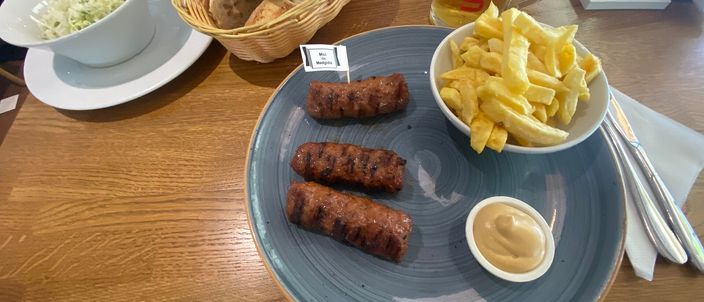
What comes with them is nearly fixed. Mustard is not optional — a dab of sharp yellow muștar on the side, which you smear on each mic as you go, is how they are eaten, and asking for ketchup instead is the clearest possible sign you are a visitor. Bread, usually a plain white slice or two, and a pile of murături — mixed pickles — round out the plate. A cold lager is the standard partner and the reason mici and beer terraces are the same institution in summer.
Watch how they are cooked rather than what garnish arrives. Good mici are grilled to order over charcoal, pressed and turned so they colour evenly, and they should reach you hot, glistening and slightly charred, not grey. The grătar — the grill itself — is the thing to look for: an open charcoal grill worked by someone who is clearly busy is a better signal than any sign in the window.
If you want to sound like you know the drill, you name a number and add cu muștar și pâine — with mustard and bread. That is the entire transaction.
What to avoid
The failure here is rarely a bad recipe; it is a lazy grill. Mici that arrive pale, uniform and suspiciously fast have been steamed, microwaved or boiled and only kissed by heat at the end — the giveaway is a soft, even surface with no char and no charcoal smell. The whole pleasure is the contrast between a crusted outside and a loose inside, and you cannot fake that at speed.
Be wary of mici sold from a heated tray or a bain-marie rather than grilled in front of you, especially at stalls near heavily-touristed sights. Held warm for an hour, they go dense and greasy and lose the bounce that bicarbonate gave them. The same applies to any place where the grill is cold and the mici are plated the instant you order: that speed is not service, it is reheating.
One honest warning on content: the cheapest mici, at fairground stalls and some bargain terraces, lean hard on pork and filler and go slack. This is not a tourist trap so much as the bottom of the market, and the tell is price sitting well below everywhere else nearby for a plate that looks identical. Mici are cheap, but there is a floor, and a plate priced under it has cut the beef.
Finally, the word mici on a menu beside a photograph of a mixed grill platter, in a room with laminated menus in several languages, usually means the grill is an afterthought. The dish is too simple to garnish your way out of doing it properly.
Practicalities
Reckon on roughly 4 to 7 lei a piece, so a plate of five or six with bread and mustard lands around 25 to 45 lei — a genuinely cheap meal, a few euros, and one of the best-value hot things in the city. A plate priced far above that is charging for the terrace view; far below, and the meat has been cut with filler.
Mici belong to warm weather and open air. They are a year-round staple, but the season they are made for is late spring to early autumn, when the beer terraces put their charcoal grills out on the pavement and the smell does the advertising. They are eaten at any hour those terraces are open — a mid-afternoon plate with a beer is as normal as an evening one — and the busiest, smokiest, best moment is a warm weekend evening. Public holidays and the long May weekend are peak mici, when whole parks fill with grill smoke.
They are bought two ways: sat down at a terrace with waiter service, or handed over at a grill counter or park stall to eat standing with a paper napkin. The stall version is the older, more democratic one and often the better mici, because the grill never stops. Cards are normal in sit-down places, but park stalls and festival grills are frequently cash only, and the queue moves faster if you have small notes ready. Carry a little cash for exactly this.