Papanași in Bucharest: what they are, how to order, what to avoid
Last updated 20 July 2026
Overview
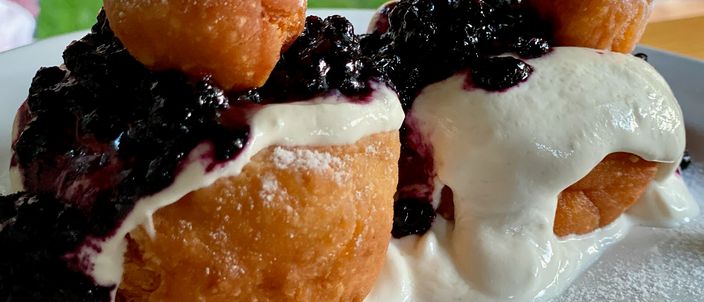
Papanași are fried cheese doughnuts: a soft dough built around fresh curd cheese, shaped into a fat ring with a little ball perched in the hole, deep-fried until golden, and served warm under a thick layer of smântână — sour cream — and a spoonful of tart, runny jam. The classic jam is sour cherry, though blueberry is common and equally correct. They are a dessert, and a large one: a single order is genuinely enough for two, which is worth knowing before you add one each to the end of a meal.
They are not Bucharest’s own. Papanași belong to Romania as a whole, and the dish is usually traced to the Moldavia region in the country’s northeast rather than to the capital — this is a national dessert that Bucharest serves, not a Bucharest speciality. The name is old: it is generally derived from the Latin papa, meaning food or mush, which points to a dish that has been around in some form for a very long time. That etymology is the honest limit of what is known; there is no reliable founding date and no invention story worth repeating as fact, and any menu that gives you one is decorating.
The cheese is the thing that makes them papanași rather than ordinary doughnuts. It is brânză de vaci, a fresh cow’s-milk curd cheese, or sometimes urdă, a softer whey cheese — both mild and faintly sour. That tang in the dough is what the sweet cream and sharp jam are built to play against, and it is why a good papanaș tastes balanced rather than simply sweet. Get a version made with real fresh cheese and the whole thing makes sense; get one made without it and you have a plain fried doughnut wearing a costume.
What to order
There is one fork in the road, and it is worth understanding before you order. The version nearly everyone means, and the one you will see almost everywhere, is papanași prăjiți — fried. That is the golden ring-and-ball with cream and jam. The older, quieter version is papanași fierți — boiled — which are more like large dumplings or gnocchi, rolled in toasted breadcrumbs rather than fried, with no ball on top, and served the same way with cream and jam. If a menu lists both, that is a good sign; the boiled kind is homely and rarely done for tourists, and ordering it marks you as someone who knows the dish has two forms.
When they arrive, the test of a good one is in the assembly, and you eat it accordingly. The ball sits on top, the cream is generous and cool against the warm dough, and the jam is loose enough to run. Eat it warm and eat it soon — the pleasure is the contrast of hot dough, cold cream and sharp fruit, and it collapses as it sits. Break the ring, load each piece with cream and jam, and do not be precious about it.
The words that get you the standard plate: papanași cu smântână și dulceață — with sour cream and jam. If you have a preference between sour cherry and blueberry, name the fruit; both are usual and either is right.
What to avoid
The commonest disappointment is the industrial papanaș: made from a plain sweet dough with little or no cheese, fried in advance and reheated, or worse, thawed from frozen. The tells are visible. A real one is fried to order and reaches you hot, the surface crisp and freshly golden; a reheated one is pale, greasy and evenly soft, sometimes faintly stale, and the inside is uniform bread rather than the slightly dense, tangy crumb the cheese gives. If it comes out suspiciously fast in a busy room, it was cooked hours ago.
Be wary, too, of the plate that hides behind its toppings. A modest papanaș drowned under a mountain of whipped cream from a can, glossy commercial fruit syrup and a fan of tinned fruit is usually covering for a poor doughnut — the toppings should be smântână and real jam, not aerosol cream and syrup. Whipped cream in place of sour cream is the clearest signal that the kitchen is aiming at appearance rather than the actual dish.
The last thing to avoid is your own over-ordering. Because one portion feeds two comfortably, a table that orders one each ends up defeated and wasteful. Order one to share and a second only if you truly want it; this is a dessert that punishes ambition.
Practicalities
A portion runs roughly 20 to 35 lei — a few euros — in an ordinary sit-down restaurant, and since it easily serves two, it is one of the better-value desserts in the city. Priced well above that, you are paying for the room rather than the doughnut, and priced far below it, the cheese has probably been left out.
Papanași have no fixed season and are eaten year-round, but they are firmly an after-a-meal dessert rather than a snack you grab in passing: this is not street food, and it belongs to the end of a sit-down lunch or dinner. That is also when they are made best, because a kitchen serving mains will fry them to order while the industrial ones turn up where dessert is an afterthought. The single most reliable move is to order them where you have just eaten a proper meal, not from a dessert-only counter aimed at foot traffic.
They are eaten warm, so there is no sense in taking them away — a boxed papanaș an hour later is a soggy shadow of the plate. Cards are standard in the restaurants that serve them, so cash is not a concern here as it is at a grill stall; the only real discipline is to arrive with room for a dessert built for two.