Tokyo in two or three days: one day west, one day east, one down the middle

Last updated 8 August 2026
Overview
One day in Tokyo makes you choose. There is no center, so there is no arrangement of a single day that holds both the old low city in the north-east and the young, expensive west: half an hour by subway separates them, and a day that crosses the map twice is a day spent on platforms. Two days is the number at which the choice stops being necessary. That is the entire argument for the second day, and it is why the two below are not one long day cut in half. Each is complete on its own side of the loop, neither borrows from the other, and they can be taken in either order.
Day one is the west: a manufactured forest with a shrine in the middle of it, the avenue built to reach that shrine, a buried river you walk along without knowing it, and then a roof and a road crossing at Shibuya after dark. Day two is the east: the great museum at Ueno in the morning, and the oldest temple in the city taken in the afternoon and the evening instead of the morning. That last inversion is what the second day actually buys. Everyone who comes to Tokyo on a day trip does Sensō-ji before lunch; almost nobody is there when the shutters come down on the approach and the courtyard is left to the people who live around it.
The west day ends after dark and needs the hour of it. The east day ends after dark too from October to March, but in high summer it finishes in daylight, because it is built backwards from a five o’clock closing rather than from the light. The sun sets here between about half past four at the end of November and just after seven at the end of June. That band is only two and a half hours wide, which is narrower than a European or North American reader expects: Japan keeps no summer time, so the evening never gets its artificial hour, and the winter afternoon is genuinely short. Take your month’s hour out of that range — the west day below says how far to count back from it.
Exactly one thing on these days is bought before you arrive, and a third day adds nothing to that count: the timed slot for the roof at Shibuya. Everything else is free, or is a ticket sold at the door.
One closing day shapes the two days below, and a third day adds a second. The museum on the east day shuts one day a week and it is the Monday; the west day has no weekly closure among its sights, which is why the Monday goes to the west day, wherever in your run the Monday falls. A third day is inserted between them rather than added at the end, so the numbering shifts and the rules at the end of this article are written for the days by name. The full method, including the one arrival that quietly breaks the arrangement, is there.
You need one thing in your hand that you do not already have: the rechargeable travel card the city guide names. These two days tap through a gate four or five times each, on the loop line and on the metro, and the guide says which card and where to get it. Carry cash as well. The counters and stalls at the end of both evenings are the kind of place that has never wanted a card.
Day one

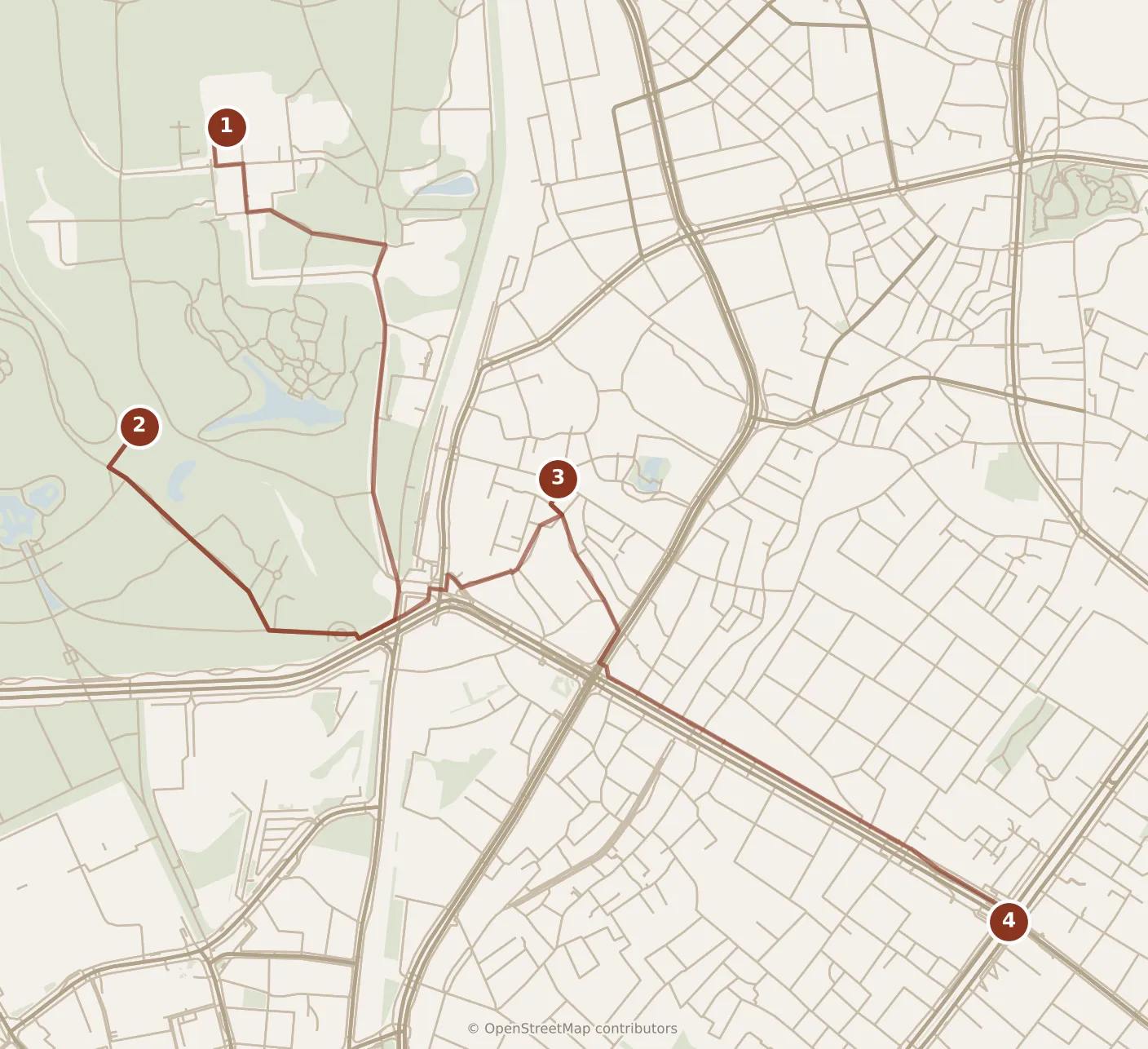
- Morning and afternoon
- 1Meiji Jingū
- 2Yoyogi Park
- 3Takeshita Street
- 4Omotesandō
- Cat Street — in the prose, not on the map
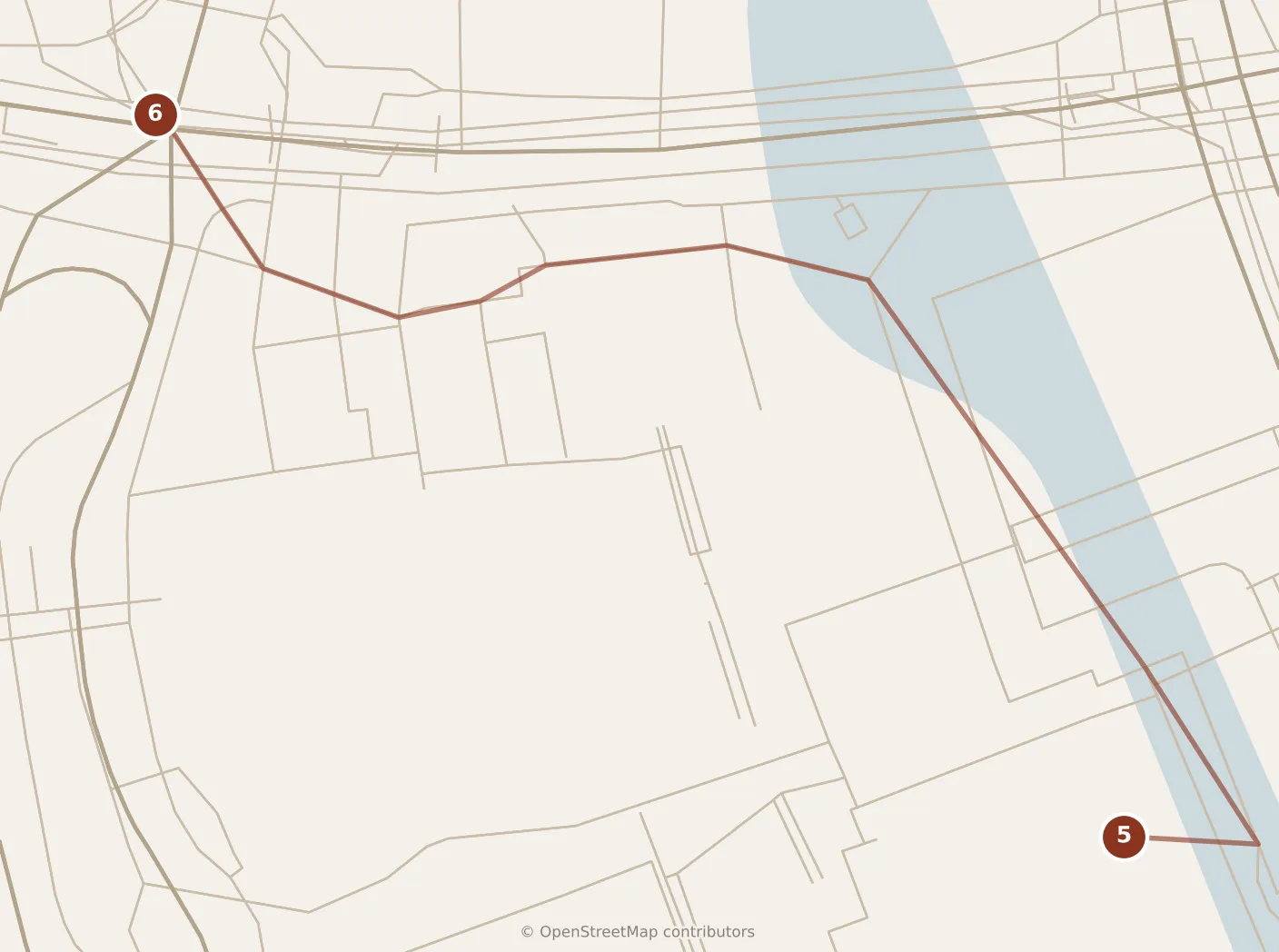
- Evening
- 5Shibuya Sky
- 6Shibuya scramble crossing
- Nonbei Yokochō — in the prose, not on the map
The whole day runs downhill and eastward, from the forest at the top of Harajuku to the crossing at the bottom of Shibuya, and it does not double back except once, deliberately, on one avenue. It is a little over six and a half kilometers on foot, about an hour and forty minutes of actual walking, with no train in the middle of it at all.
The one thing here that will not wait is the roof, and it wants the hour before the sun goes. Everything above it — the shrine, the park, the two streets, the avenue, lunch and the lane — comes to about four and three-quarter hours at an unhurried pace, and you want to be through the gate up there an hour before sunset, so start close to six hours before it. At the end of November that means being at the shrine gate soon after half past ten. At midsummer the same arithmetic says start just after one, which is not a morning anybody wants, so in the long half of the year begin when you like — but count the gap rather than assume it. From a nine o’clock start in late June there are three or four hours to lose before the roof; the forest and the lane will take an hour each without complaint, and the rest goes into a long lunch or into starting later than felt necessary.
That figure counts the time you spend inside the places and the time you spend walking between them, and it counts nothing else. It does not count the line for the elevator at the roof, which on a clear evening is not a formality, and it does not count the half-hour you will lose in the shops on the lane when you meant to lose ten minutes.
Morning
The day begins at Harajuku Station, on the JR Yamanote loop, or at the metro station under the name Meiji-jingūmae ‘Harajuku’ a hundred meters away. Getting there is the leg nobody describes. From Tokyo Haneda International Airport, take the Keikyu line to Shinagawa and change to the Yamanote: Harajuku is six stops round the western side of the loop, and the whole run is a little under three quarters of an hour. From Narita International Airport it is the Narita Express to Shibuya and one stop back up the Yamanote, or the Keisei Skyliner to Nippori and a longer ride round the loop; the Skyliner is the faster train and it lands you on the wrong side of the city for this day, which is a reason to take the east day first if you arrive that way — whenever the closure rules at the end of this article leave you the choice. On two days they usually do; on three the east day is usually the ending, and unless a closure moves it you swallow the wrong-side arrival.
Straight across the road from the JR exit is the great wooden torii of Meiji Jingū, and behind it a gravel path that takes a quarter of an hour to walk. The length is the point. The shrine was dedicated in 1920 to the emperor Meiji, and every tree around you was put there on purpose: a hundred and twenty thousand of them, donated from every part of the country and planted to grow into something that would look like wild woodland in a hundred years. It has, and it is one of the few places in central Tokyo where you stop hearing the city. Two things worth knowing as you walk in. People bow once at the torii on the way in and again on the way out, and they walk to one side of the gravel rather than straight down the middle of it; copying both badly is entirely normal and not copying them at all is the thing that reads as rude. And the shrine keeps the sun’s hours — it opens at sunrise and shuts at sunset, month by month, which in December means it is closed in the late afternoon, well before dinner. That is the rule that stops you running this day backwards. Give it an hour and a half including the walk in and out.
Yoyogi Park shares the same approach, so it costs you a gate and ten minutes. Through it and you are out of forest and into open lawn, which is where Tokyo does things in public that it does nowhere else — drum circles, dog people, bands rehearsing at volume, and almost all of it at a weekend. On the Monday the closure rules send here it is a large quiet lawn. Half an hour, and it is the first thing to go if the day is short.
A quarter of an hour east, past the station, is Takeshita Street: four hundred meters of teenage retail, crêpe stands, photo booths, and a crowd density that has to be walked rather than read about. Fifteen minutes is a complete visit and there is no shame in leaving at that.
Afternoon
Come out of the far end, cross to Meiji-dōri and turn south for six minutes, and you are standing on Omotesandō. This is the correction to Takeshita Street and also its parent: the avenue was cut in the Taishō era as the formal approach to the shrine you have just left, which is what the name means, and the zelkova trees down both sides were planted for that purpose. It has since become the street where architects are given a shop to design and told not to be boring. Walk up it east to Aoyama-dōri, about ten minutes, and read it above the first floor, where the buildings are doing the work; then walk the ten minutes back down. Forty minutes there and back with the looking. It is the one deliberate doubling-back of this day and it is worth it, because the good half is the upper half and the lane you want next starts at the bottom.
Lunch happens somewhere in that stretch, and here it means going one street back from the avenue into the lanes, where a bowl of ramen or a stand-up soba costs a fraction of what the frontage suggests. Three quarters of an hour if you sit down to it, ten minutes if you take it standing.
Then drop off Omotesandō at the Meiji-dōri junction into Cat Street, and walk it all the way to Shibuya — twenty minutes if you do not stop, which you will not manage, so give the lane half an hour. It is a narrow lane that bends and pinches for no reason you can see from street level, and the reason is that it is following a river: the Onden, culverted and running under your feet, which meets another buried stream in the middle of Shibuya and becomes the Shibuya River. Above the culvert is the best browsing on this day — small independent shops, few chains at the northern end — and the walk delivers you into Shibuya from the back rather than through the station, which is the civilized way to arrive.
Evening
The tower stands directly over Shibuya Station and the way up to Shibuya Sky is signed from inside it. The deck is on the roof at about two hundred and thirty meters and the top of it is open air, with no glass between you and the drop except a low barrier at the edge — which is the difference between this and every enclosed observation floor in the city, and the reason it is worth the money and the booking. The ticket is a timed slot sold on the operator’s own site, and at a higher price at the counter on the day if any are left; it sat in the two-and-a-half to three-thousand-yen range in 2026. Book it before you travel, and book the slot that puts you up there for the hour before sunset: you want the city gray and enormous in daylight, then the same city turning into the thing it is famous for while you stand still. An hour is right.
Local tip. Do the roof first and the crossing afterwards, never the other way round. The crossing only improves once it is dark and the screens are lit, while the roof loses everything the moment the light has gone. And if the day has run short and you can only have one of them, keep the crossing: it is free, it takes five minutes, and it is the thing you came for whether you admit it or not.
Down at street level, three minutes away, is the Shibuya scramble crossing. Having just looked down on it from a roof, the thing to do is not to look at it again from a walkway but to walk across it, twice, on two different greens. Five crossings meet here and the scramble phase stops every road at once, so for about half a minute the junction belongs entirely to people; then it goes back to being a road. The way to be disliked here is to stop in the middle of it with a camera while three thousand people go round you.
Finish a couple of hundred meters north-east, along the embankment that carries the Yamanote, at Nonbei Yokochō: two rows of very small two-story bars, put up in the years after the war and never rebuilt, with the trains going over the top. Rooms hold six or eight people. Walk the whole lane before you choose a door, because from outside they look identical and from inside they are not, and go in with as little as you can carry — there is nowhere to put a bag in a room this size, and everybody in it will have to move if you try.
Day two

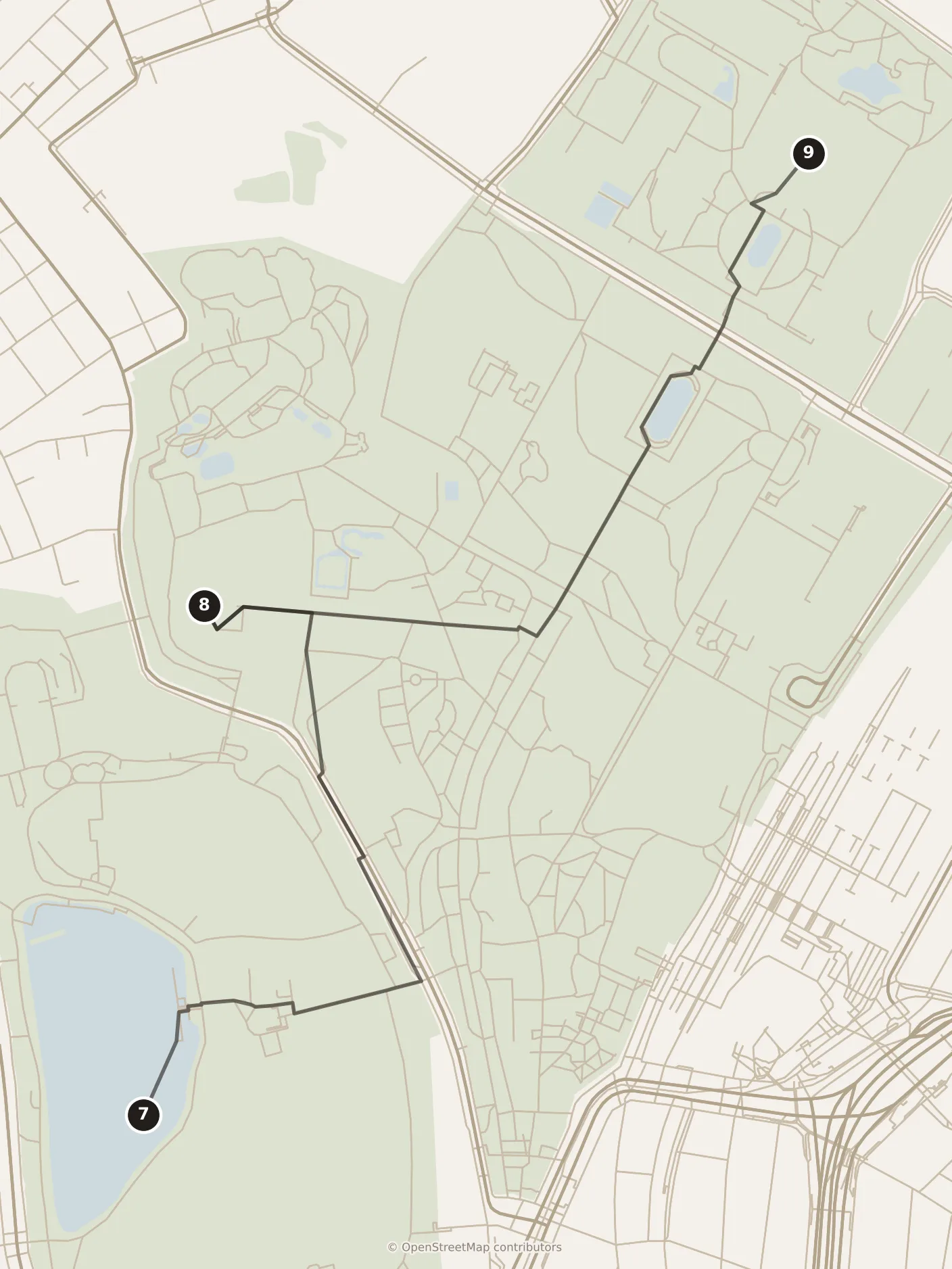
- Morning
- 7Shinobazu Pond
- 8Ueno Tōshō-gū
- 9Tokyo National Museum
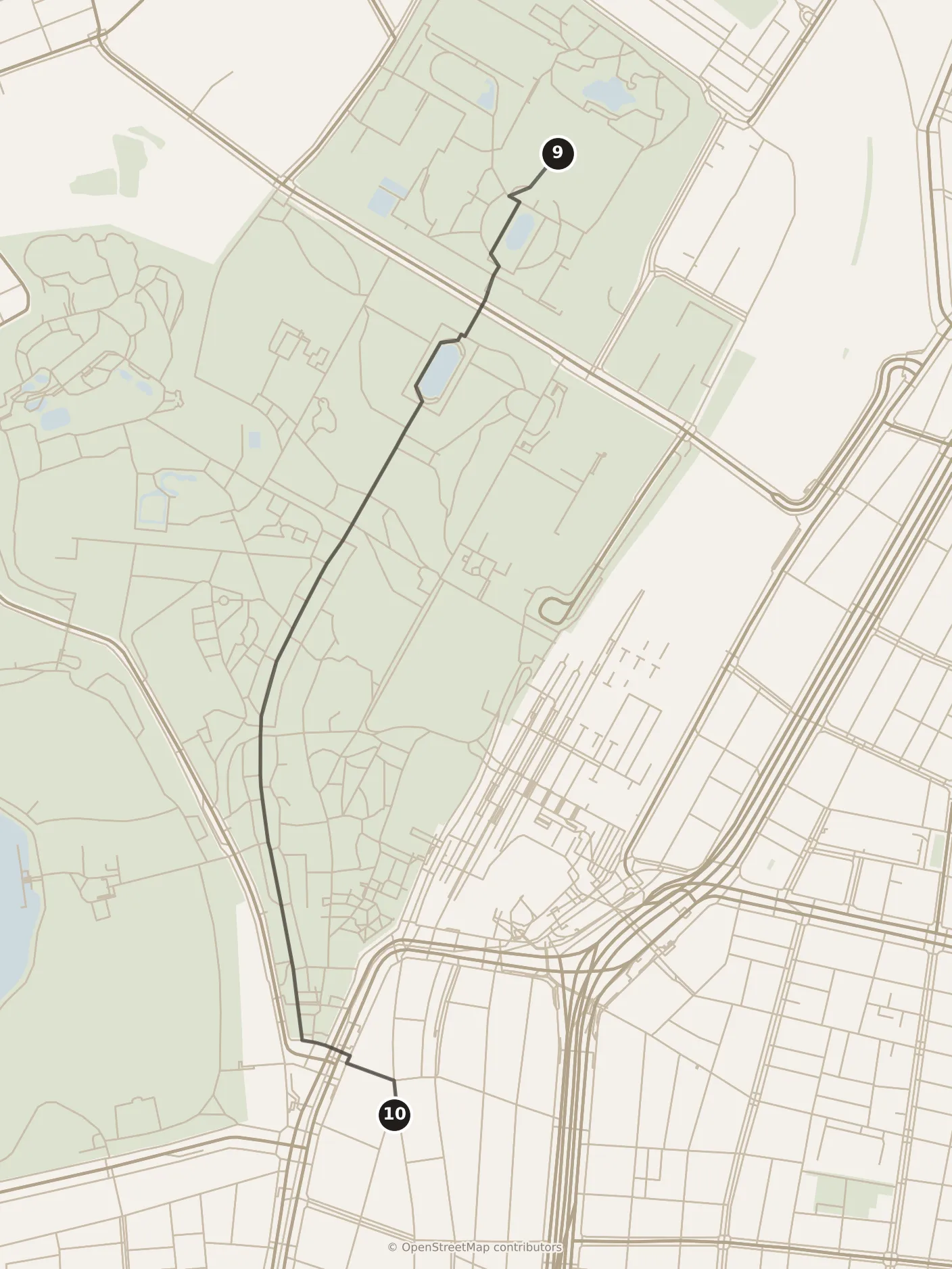
- Afternoon
- 10Ameya-Yokochō
- Afternoon
- 11Kaminarimon
- 12Nakamise Street
- 13Sensō-ji
- 14Asakusa Shrine
- Evening
- 15Azumabashi
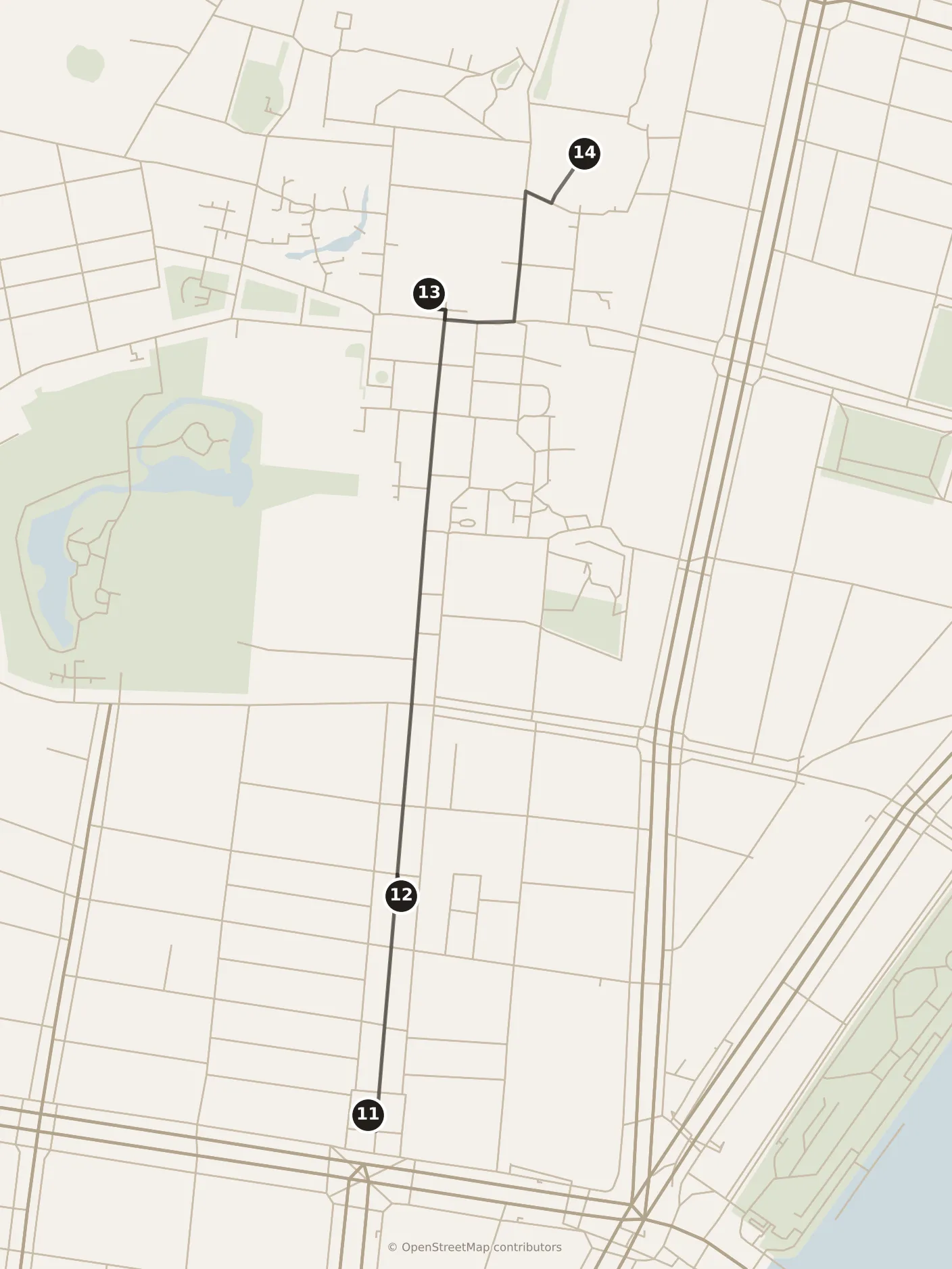
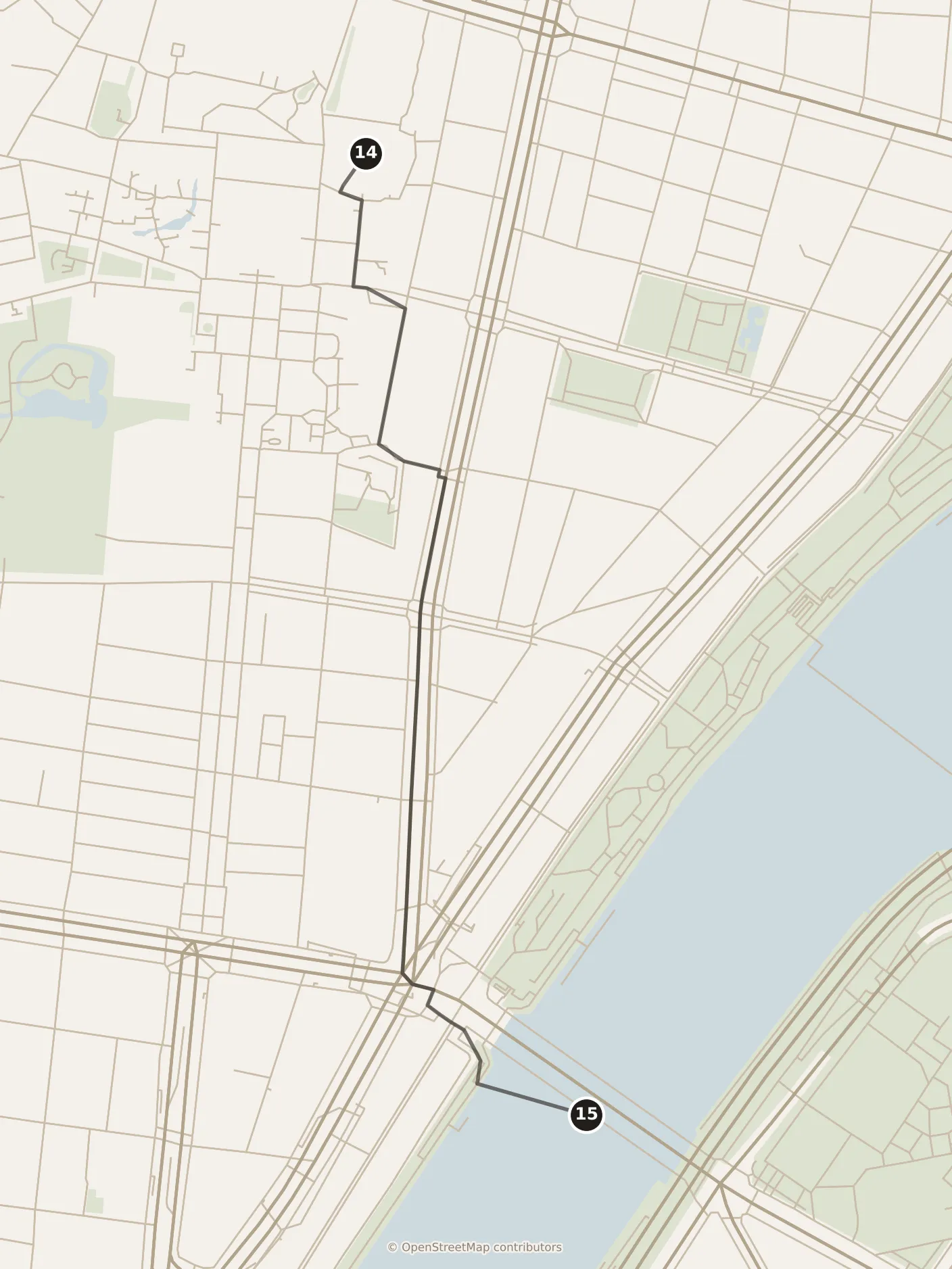
Today runs west to east and gets slower as it goes: a museum in the morning, a market lunch, a short ride, and then a temple district taken at the hour the day-trippers leave it. Around five kilometers on foot, an hour and twenty minutes of walking, plus one ride of five minutes.
Nothing here has to be seen in a particular light, but there is one hour that decides the order. Sensō-ji’s main hall admitted visitors until five in the afternoon in 2026 — from six in the morning, and from half past six between October and March — while the grounds around it have no gate at all and are open at every hour. So the hall has to happen before five and the evening happens after it, and if you find a different closing hour when you check — the temple publishes its own — build the same shape back from the new one. From the ticket gate at Ueno to the gate at Asakusa is about five and a quarter hours with the museum, the lunch, the walking and the ride inside it. The gate, the street and the hall then take another hour and a quarter, and the hall shuts at five, which puts the latest sensible start at twenty past eleven and makes a mid-morning one far more comfortable. That total does not include the ticket desk at the museum, and it does not include the fact that the museum is a compound rather than a building, so the two-minute walk between its halls happens more often than you expect.
Morning
Come up at Ueno Station — the JR loop, the Ginza line and the Hibiya line all serve it, and if you have arrived from Narita International Airport on the Keisei Skyliner you came in at Keisei-Ueno, which is the same place with a different name over the door. Leave by the park exit and walk a quarter of an hour down to Shinobazu Pond.
The pond is the oldest thing on this day and it does not look it: it is what is left of an inlet of the bay that the land silted round and closed off, so a lake in the middle of a city is here an accident of geology rather than a piece of landscaping. It is divided in three by causeways — lotus so thick in high summer that no water shows, pedal boats, and a third part behind a fence left to the birds — with a small octagonal hall on an island in the middle. Half an hour, walked slowly, and it is the correct start because it is the only quiet thing before the museum.
Under ten minutes north, up through the park, is Ueno Tōshō-gū. It was put up in 1651 by Tokugawa Iemitsu and it has stood through the fighting of 1868, the earthquake of 1923 and the firebombing, which in this city is close to unique. It is small and covered in gold leaf, and the approach to it — a long avenue lined with a couple of hundred stone lanterns — is free to walk; going inside the fence to stand in front of the building has a modest ticket of its own. Twenty minutes. If the day is tight, the avenue alone tells you most of it.
A quarter of an hour further north is the Tokyo National Museum, founded in 1872 and far too large to see in one visit. It is five buildings around a courtyard, not one, and the mistake is to start at the nearest and grind on until you stop enjoying yourself. Take two. The Honkan is not optional: Japanese art from prehistory to the nineteenth century, swords and screens and lacquer and ceramics, laid out so that one circuit at your own pace is a complete visit. For the second, take the Heiseikan and its archaeology rooms on the first floor, which are the thing this museum has that no other collection in the city does — grave figures and clay vessels from a Japan that had no writing yet, including the dogū figurines of the Jōmon, and the hollow haniwa people and horses that were stood in rows around burial mounds. Two and a half hours for the pair, and let the other three buildings go without regret; a third costs you the whole shape of the afternoon.
Afternoon
Walk twenty minutes back down through the length of the park and out at its southern end into Ameya-Yokochō, the market packed along and beneath the railway viaduct, and eat here rather than sitting down anywhere grander. What you want is Edomae sushi, and this is the right place for it in the literal sense: Edomae means “in front of Edo”, which is to say the bay a few kilometers south of where you are standing, and the style exists because there was no ice — the fish was cured, vinegared, simmered or salted before it reached the rice, and the whole thing was sold from stalls to people standing up. The counters wedged under the girders here are the descendants of a post-war market, not of the Edo stalls — but eating standing up under a railway is nearer the original than a dining room is. Three quarters of an hour.
The Ginza line entrance is at the top of the market. Three stops to Asakusa — the last stop on the line — and it takes five minutes, which is the only ride of the day. Come up at Asakusa Station and Kaminarimon is two minutes away.
Under the gate hangs a paper lantern getting on for four meters tall, and the thing almost nobody looks at is directly overhead: a carved wooden dragon on the underside of it. Behind the gate, Nakamise Street runs two hundred and fifty meters of small shops to the inner gate, Hōzōmon, and it is seven minutes if the street is empty and twenty if it is not. One local convention that catches visitors: several of these stalls sell food, and the street asks you to eat it standing where you bought it rather than walking along with it in your hand. There are usually people doing both and only one of them is being watched.
Then Sensō-ji, the oldest temple in Tokyo, founded by its own account in 628 around a statue of Kannon that two fishermen brought up in a net. What you are looking at is a rebuilding — this whole quarter burned on 10 March 1945 — but the interesting part is how it was rebuilt: the roof you see is titanium, tiled to imitate the ceramic it replaced, because titanium weighs a fraction of the same area in clay and this is a building designed above everything else not to come down again. Give the gate, the street and the hall an hour and a quarter together, and be inside the hall before five.
A hundred meters north-east, and missed by most of the crowd who have just walked past it, is Asakusa Shrine. It is not part of the temple: it is a Shinto shrine built two years before the one at Ueno, for the two fishermen and the man who understood what they had found, and it came through both the earthquake and the war without being rebuilt at all. Small, dark-timbered, ten minutes, and with Ueno Tōshō-gū from this morning it is one of the two things on these days that the seventeenth century would recognize on sight.
Evening
Now the reason for doing all this in the afternoon. Go west out of the temple grounds into Denbōin-dōri and the low streets behind it, which are where Asakusa eats, and take an hour and a half over dinner. Then walk back through the temple grounds on your way out. The hall’s doors have shut, the shutters are down the length of Nakamise, the coach parties left three hours ago, and the courtyard belongs to the neighborhood — people cutting through it on bicycles, somebody at the offering box, the pagoda standing over an empty forecourt. Nobody on a one-day visit ever sees this, and it costs nothing and needs no booking.
Local tip. If the day has run late and you have to choose, give up the inside of the main hall and keep the evening. The hall is a post-war interior and it will still be there at six in the morning; the empty courtyard happens once, at the end of the only day you have shaped to reach it.
Three minutes east of Kaminarimon the street runs into the river at Azumabashi, and this is where the day ends: the bridge, the water, and Tokyo Skytree standing on the far bank with the whole of the east behind it — lit, if the month has put you here after dark rather than before it. It is a view you get for nothing, which is worth saying after an evening that involved a ticket. Asakusa Station is at the foot of the bridge. The Ginza line goes back to Ueno and on under the center; the Toei line from the same station runs east and south, and some of its trains continue onto the Keikyu tracks and reach Tokyo Haneda International Airport without a change, which is useful to know if your flight is the following morning.
With a third day

- With a third day
- 16Imperial Palace East Gardens
- 17Nihonbashi
- 18Tokyo Station
- 19Tokyo International Forum
- 20Ginza
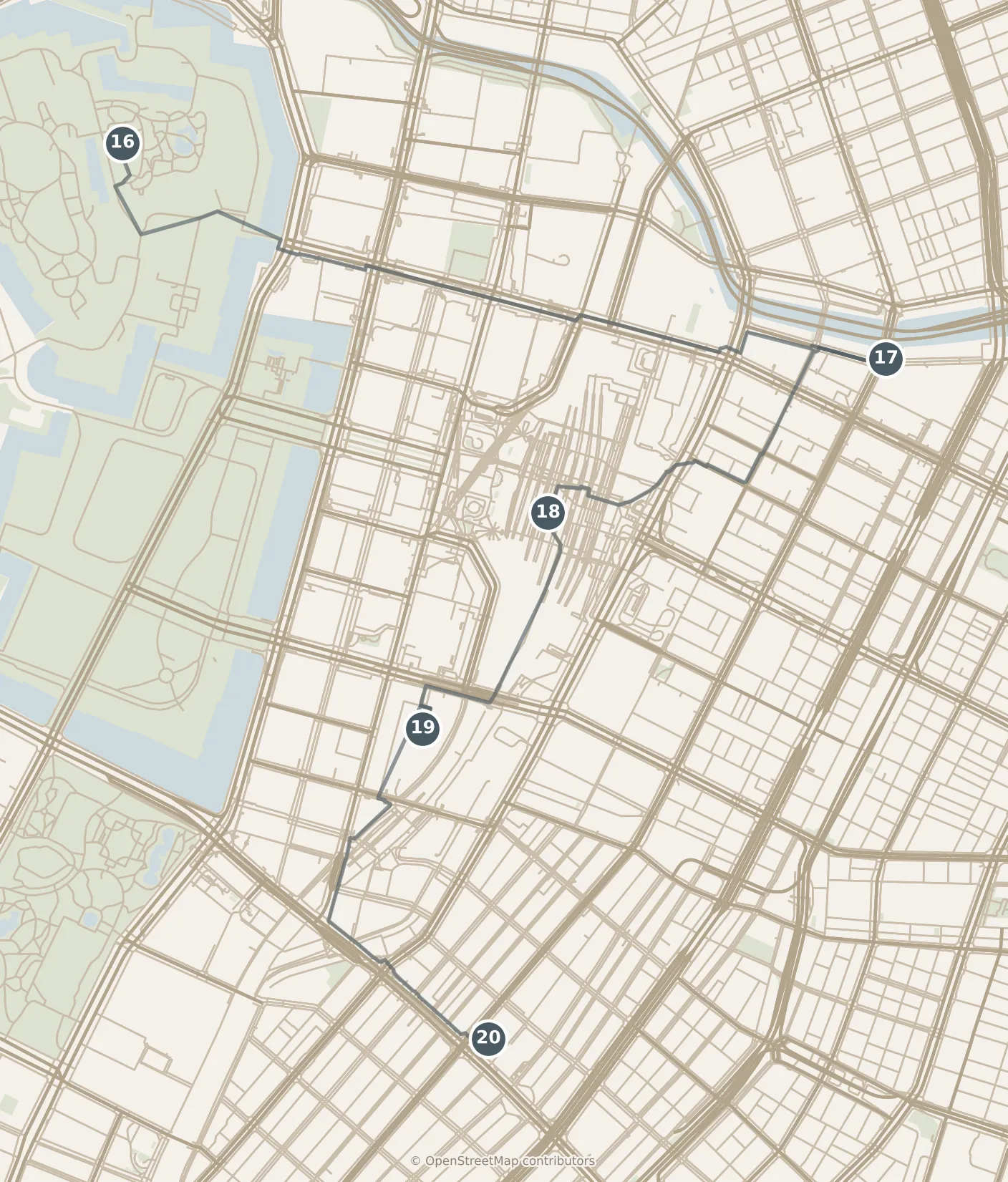
A third day goes in the middle, not on the end, and it is the formal center — the ground between the two days you have already done, geographically and in every other sense. Inserting it costs nothing inside either written day: neither depends on the other, so day two simply becomes day three. What you gain by inserting rather than appending is the shape of the trip. The center is the one day here that is finished by dusk, since it is an office district and it empties; put it last and you end three days in Tokyo with a flat evening, when the empty temple courtyard is available instead. There is a hole in that argument and it is worth naming: the monjayaki street at the end of this section is a real evening, and a reader who takes it turns the center day into a perfectly good last one. It is also the shortest of the three — about four and a half hours with lunch — which happens in the office blocks between the gardens and the bridge, and is the one meal on these three days with no quarter of its own: counters built for the working week around Ōtemachi, thinner on a weekend. That is against more than six hours on either side of it, which is the reason it belongs in the middle, where a spare afternoon is a rest rather than a waste.
Start at Ōtemachi and walk in through the Ōtemon gate to the Imperial Palace East Gardens, which are free and need nothing booked. This is the inner keep of the castle the city grew around, and the thing to climb is the base of the great tower: an enormous plinth of fitted granite with steps up it and absolutely nothing on top, because the tower burned in 1657 and was never rebuilt. Standing on a foundation looking at office blocks is a better lesson in what happened to Edo than any caption. Ninety minutes with the stroll garden below it.
Leave by the east side and it is twenty-five minutes to Nihonbashi. The present bridge is stone on a steel frame and dates from 1911, and set into it is the marker from which every road distance in the country is measured — a sign anywhere in Japan giving the kilometers to Tokyo means the kilometers to this parapet. Two things about it are worth the four minutes. It used to have a view of Mount Fuji straight down the river, and it has not had one since an elevated expressway was thrown over it just before the 1964 games; that expressway is now being buried, with completion targeted at the early 2040s, so this is the before picture. And the fish market that fed the city stood at the foot of this bridge from the beginning of Edo until the 1923 earthquake destroyed it, which is when it moved to Tsukiji, and from there to Toyosu. The market under the viaduct at Ueno, on the east day, is not its descendant: that one grew up after 1945.
A quarter of an hour south-west is Tokyo Station, and it is the red brick you have come for rather than the platforms. It opened in 1914, lost its domes and its top story to bombing in 1945, stood as a flat two-story building for sixty years, and was put back to its original height in 2012. Go into either dome and look straight up: relief eagles, and the animals of the zodiac set round the rim. Ten minutes, free. Ten minutes further south, the Tokyo International Forum is a glass hall built like the hull of an upturned ship, ribbed in steel, with walkways strung along the inside at height — walk in, go up a level, look down its length. A quarter of an hour, free, usually empty in the afternoon, and it is the first thing to cut if the day runs short.
End in Ginza, a little over ten minutes south, and give it three quarters of an hour. Be honest about what it is: there is nothing to see there. It is a grid, laid out after a fire in the 1870s and the only part of central Tokyo that reads as planned, and the pleasure is walking wide straight blocks in a city that has almost none. If you are not shopping, there is no reason to stay past dusk — with one exception. Two stops east on the Yūrakuchō line from Ginza-itchōme is Tsukishima, a reclaimed island with a single long street of hot plates set into the tables, and what is cooked on them is monjayaki, which is Tokyo’s own dish and belongs to nowhere else. It is loose, untidy, scraped off the iron in small crisp pieces with a spatula the size of a teaspoon, and it is a much better last evening than Ginza will give you.
Local tip. If what you actually have is two and a half days — a late arrival, or an early flight home — give the half day to this one and not to a third of a day elsewhere. It is the only day of the three that works in pieces: the gardens are a self-contained morning, and the bridge, the station and Ginza are a self-contained afternoon. The other two days both collapse if you take a piece out of the middle.
Practicalities
The one booking. The timed slot for the roof at Shibuya, on the west day. It is sold on the operator’s own site; book it before you travel and pick the slot that lands you up there an hour before sunset. Nothing else on any of these three days needs buying in advance. The museum and the inner precinct of the shrine at Ueno both sell at the door, and the palace gardens on the center day are free.
Which day is which. Because a third day is inserted rather than appended, the numbering moves — so the rules below are written for the days by name, not by number. The west day is the one with no weekly closure among its sights, which is why it takes the Monday in your run, and on a three-day trip the Friday as well, wherever in the run that falls — day one on most runs, but not on all of them. The east day is day two on a two-day trip and normally day three on a three-day one; the center day is the one you add, and it is taken second of the three wherever the closures allow it. Where a placement and a closure collide the closure wins: a shut door cannot be argued with, and a Sunday–Monday–Tuesday or a Thursday–Friday–Saturday run is where it happens.
- The east day must miss Monday. The Tokyo National Museum closes on Mondays, and when a Monday is a public holiday it opens on that Monday and closes the following day instead — so the Tuesday after a holiday Monday is the closed day, and it is the one nobody expects. The museum publishes its own calendar; read it the week before you fix the order.
- The center day must miss Monday and Friday. The palace gardens close on both, and they carry the same holiday displacement onto the Tuesday.
- The west day has no weekly closure among its sights: the shrine, the park, both streets, the lane, the roof and the crossing are open every day. The bar lane at the end of it is the one thing that is not a single business, so some doors will be shut whichever day you come. So the Monday, or on a three-day trip the Friday, goes to the west day. That is the whole method, and beyond those two placements the days may be taken in any order at all.
Two or three consecutive days can never contain both a Monday and a Friday — check it on a calendar and you will find no run of three that does — so you are only ever dodging one of them, and the west day absorbs it.
The trap is a holiday Monday, because it turns both rules inside out: the museum is open on it and shut on the Tuesday instead. So on a Sunday–Monday–Tuesday run over a holiday, do not put the west day on the Monday as usual. The gardens carry the same displacement, so they are open on that Monday too and the center day can still be in the middle. Put the east day on the Sunday, the center day on the holiday Monday when both the museum and the gardens are open, and the west day on the Tuesday when both are shut. On a two-day trip the same displacement is simply a gift: over a holiday Monday and Tuesday, take the east day on the Monday and the west day on the Tuesday.
If the roof is sold out, or you did not book, the replacement is the free deck at the Tokyo Metropolitan Government Building, and it is a real plan rather than a gesture. From Shibuya Station it is three stops north on the Yamanote to Shinjuku Station and about ten minutes on foot west from there. The decks are on the forty-fifth floor of the two towers, around two hundred meters up, with no ticket and no booking; the towers do not both open on the same days, so ask on the first floor which one you are going up. Arrive an hour before sunset as above, then ride the three stops back for the crossing after dark. The cost is two rides and about forty minutes, and the way to pay for them is to cut Yoyogi Park from the morning.
If the museum is shut on your day — a Monday you could not move, or the displaced Tuesday — the east day loses two and a half hours and not its shape. The park keeps two buildings that survived the destruction of Kan’ei-ji in 1868, a five-story pagoda of 1639 and the Kiyomizu Kannon-dō of 1631 on its terrace above the water. Only the second is free and only the second is a stop: the pagoda stands inside Ueno Zoo, behind a paid gate, and the zoo closes on Mondays and on the Tuesday after a holiday Monday — the same two days this paragraph is written for. You see it over the fence from the Ueno Tōshō-gū approach. Then go to Asakusa early and put the extra time on the river: the pier is at the foot of Azumabashi beside the station, and the boats run downstream from it to Hamarikyū Gardens, a shogun’s duck-hunting park kept walled inside the office towers. That costs you the empty courtyard, because you will have done the temple in the middle of the day — which is the trade, and it is worth making rather than standing in front of a locked museum.
What to cut if you are short. On the west day, in this order: Yoyogi Park first, which saves forty minutes, because Meiji Jingū’s forest is the same trees with a shrine in it; then the upper half of Omotesandō — drop into the lane at the Meiji-dōri junction instead of walking up to Aoyama-dōri and back, which saves forty minutes and costs you the architecture, and that is the honest trade; then Takeshita Street, worth fifteen. On the east day: the Heiseikan first, which brings the museum down to an hour and a half; then the inner precinct of Ueno Tōshō-gū, standing at the gate and looking down the lantern avenue instead, which is the free half and saves ten of the twenty. Do not cut Shinobazu Pond — it sits on a walk you are making anyway, and cutting it saves half an hour and costs the only quiet on the day.
The bag. Every station on these routes has coin lockers, and in Japan they sit behind the ticket gates rather than out on the street, which is what to know if you land in the morning and cannot check in yet. Both days run as a straight line and neither comes back to where it began, so a bag left at one end has to be collected from that end — but the geometry is kind. The west day starts at Harajuku Station and ends at Shibuya Station, and those two are a kilometer and a half apart and one stop apart on the Yamanote, so a locker at either end is three minutes’ detour. The east day starts at Ueno Station and ends at Asakusa Station, under two kilometers apart and three stops back on the Ginza line, which is the same arrangement. Where a case genuinely spoils a stop it is the gravel approach at Meiji Jingū and the length of Nakamise: both are long, crowded, and have nowhere to stand aside.
Which produces the one place where two of the rules above collide. If you land on a Sunday morning with a bag and your two days are that Sunday and the Monday, the closure rule sends the west day to the Monday and puts you on Nakamise on your arrival day. The closure wins, because a shut museum cannot be argued with and a bag can be put in a locker. The move that costs least: leave it at Ueno Station in the morning, collect it at lunchtime — the Ginza line entrance is at the top of the market where you are already eating — carry it three stops, and put it in a locker at Asakusa Station, which is two minutes from the temple gate. About fifteen minutes in all, and nothing else in the day changes.
Getting between the stops. The west day is walked end to end, a little over six and a half kilometers, and the longest single stretch is the twenty minutes down Cat Street from Omotesandō to Shibuya. The east day is around five kilometers on foot with one five-minute ride, and the longest stretch is the twenty minutes back down through the park to the market. The center day is about four and a half kilometers including the walking inside the gardens, and its longest leg is the twenty-five minutes from the gardens to Nihonbashi. Nothing on any of the three days is uphill in a way you will notice, with one exception: the east day climbs off Shinobazu Pond onto the plateau the rest of the park sits on, twenty meters or so, and does it by steps.


.jpg)

.jpg)