Tokyo in one day: one line walked, from Sensō-ji to the market at Ueno

Last updated 3 August 2026
Overview
Tokyo has no center, and on a single day that is luck rather than a warning. A city with no center has nothing you can fail to see, because there is no one place where everything is. So a day here is not a compressed tour of the whole city; it is a choice of which Tokyo you spend it in. The way to waste it is to take three of them and spend the day on the trains between. Half an hour underground is an ordinary hop between neighborhoods here, and three of those is a morning gone.
This is one line, walked. You go under once to reach it and once to leave, and between those two stations you board nothing: the whole day is a little over five kilometers on foot, about an hour and a quarter of actual walking, running steadily westward across the old low city. Nothing below is more than twenty-odd minutes from the thing before it, and the day never doubles back.
What it costs you is the other Tokyo, and the cost is total: no crossing, no observation deck, no neon. If that is the picture you came for, the honest move is to take the other line instead — the planted forest at Meiji Jingū, then downhill along Omotesandō to the crossing at Shibuya is the same shape of day on the far side of the loop, and it is a good day. Do not attempt both. A day split across the map is a day of platforms, and the platforms are what you will remember.
The case for this line, if you have not already decided, is that it is where the age is — or rather where the argument about age is. Tokyo has been flattened twice in living memory, by the earthquake of 1923 and by the firebombing of March 1945, so almost nothing you see standing is old, and it is possible to spend a week here without touching anything built before the war. Two of the exceptions are on this walk, and each of them stands a few steps from something famous that was rebuilt around it. Knowing which is which is most of what makes the day interesting rather than merely pretty.
The day

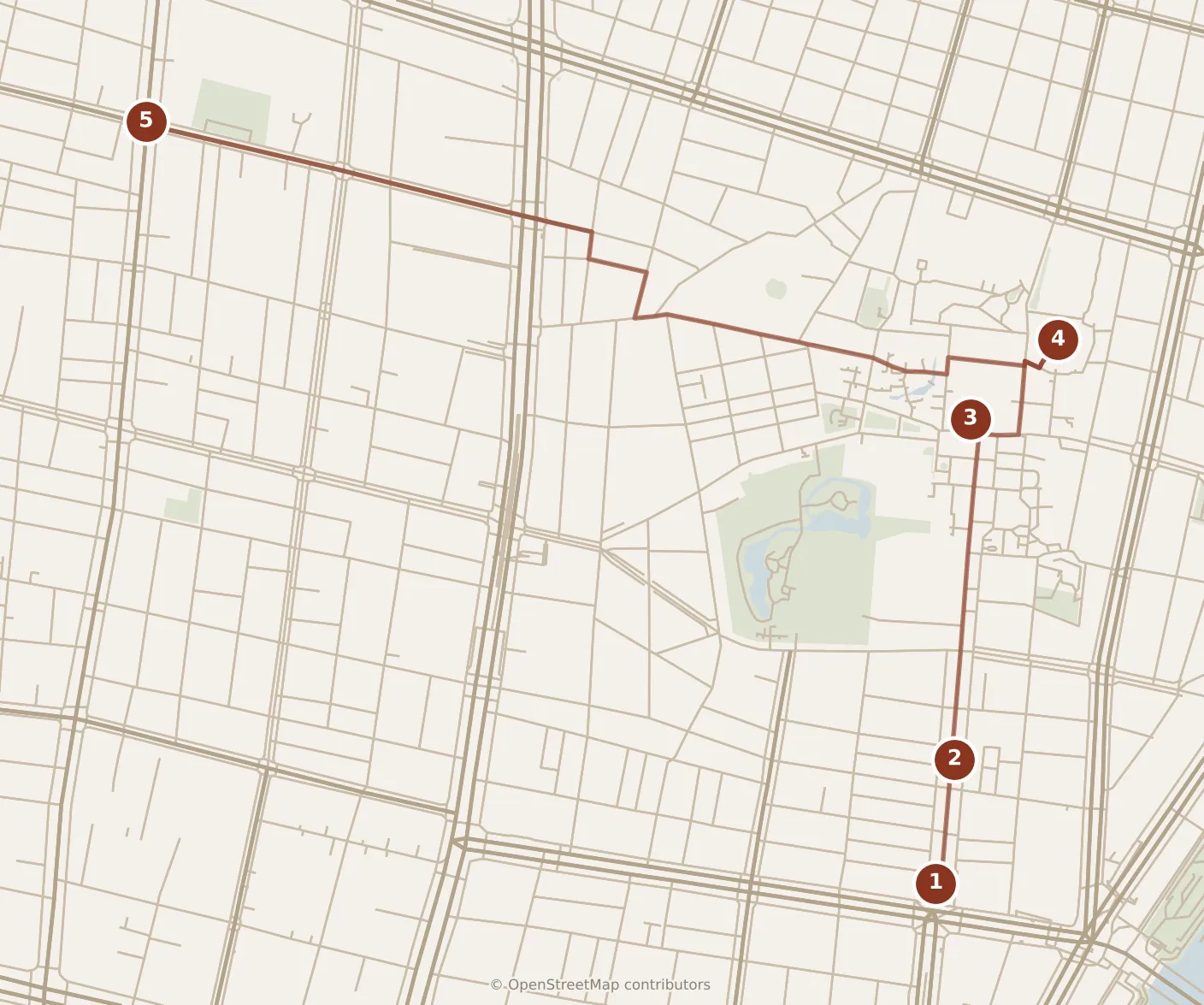
- Morning
- 1Kaminarimon
- 2Nakamise Street
- 3Sensō-ji
- 4Asakusa Shrine
- 5Kappabashi-dōri
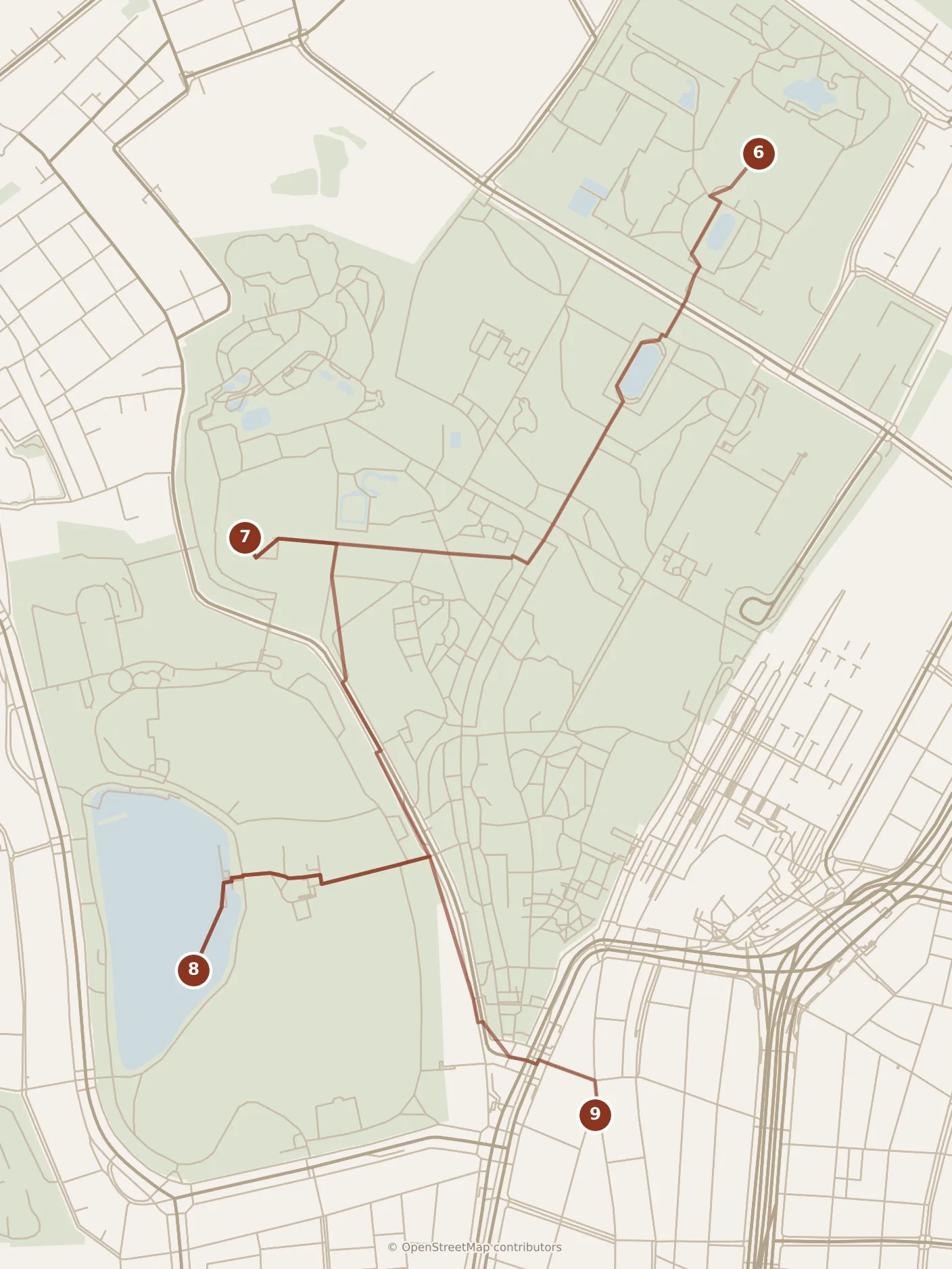
- Afternoon and evening
- 6Tokyo National Museum
- 7Ueno Tōshō-gū
- 8Shinobazu Pond
- 9Ameya-Yokochō
Morning
This day has no moment that must be caught in a particular light. There is no dusk view in it, no tide, no market that turns into something else after dark — so the counting runs forwards from the gate rather than backwards from anything. From the gate to the pond, everything below comes to about six and a half hours with the walking and the meal included, and the evening sits on top of that. That figure counts the time you spend inside places and the time you spend between them, and it counts nothing else: not the ticket desk and the bag check at the museum, and not the forty minutes it is very easy to lose in one shop on the kitchen street when you meant to lose ten. Six and a half hours can only come out of the front of a day. That is the whole argument for starting early, and it is a better one than beating the crowds.
Start at Kaminarimon, the outer gate, under a paper lantern getting on for four meters tall and weighing something like seven hundred kilograms, with a carved wooden dragon on its underside that almost nobody looks up at. Behind it Nakamise Street runs about two hundred and fifty meters to the inner gate, small shops packed down both sides selling rice crackers, fans, folded paper and wooden combs. It is unashamedly a souvenir arcade, and it has been the commercial approach to the temple for centuries, so the commerce is not a modern intrusion on the sacred — it is the older half of the arrangement. Gate to hall is under half a kilometer and takes seven minutes when nobody is in front of you, which they will be.
Through Hōzōmon, the second gate, and you are at Sensō-ji, the oldest temple in Tokyo: founded, by its own account, in 628, around a statue of Kannon that two fishermen brought up in their net. Here is the thing to know before you look at it. The main hall burned in the raid of 10 March 1945 and was rebuilt between 1951 and 1958; the pagoda went up again in 1973; the outer gate you came in by dates from 1960. What survived is not the timber but the practice — the smoke you pull over your head at the bronze burner, the paper fortunes and the racks of bad ones tied off to be left behind, the line at the offering box — and once you stop hunting for age, the crowd is plainly the monument. It costs nothing, and the courtyard has no gate to shut: the halls keep hours, the grounds do not. Give the gate, the street and the temple an hour and a half together.
Then the exception, a hundred meters north-east of the main hall and missed by most of the people who have just walked past it. Asakusa Shrine is not part of the temple: it is a Shinto shrine built in 1649 for the two fishermen and the man who recognized what they had found, and it is one of the few buildings in central Tokyo that came through both the earthquake and the war without being rebuilt. It is small, dark-timbered, and it is genuinely the thing on this route that the seventeenth century would recognize. Ten minutes, and they are the ten minutes the day is for. One warning that is worth the words: this shrine’s festival, the Sanja Matsuri, takes over these streets on the third weekend of May, and it draws something like a million and a half people over three days. If your one day lands inside it, the temple is not a visit but a crush — which is either the best thing that could happen to you or the end of the plan, and you should decide which before you set out rather than at the barrier.
A quarter of an hour west, out of the temple’s gravity and into an ordinary working district, is Kappabashi-dōri: something like eight hundred meters of shops that supply restaurant kitchens. Knives forged for one job each, moulds, lacquer, ceramics by the crate, the split cloth curtains that hang in shop doorways, and the plastic food that fills Japanese restaurant windows, sold by the piece and startlingly expensive. It is not a sight and it does not pretend to be; it is a trade street that visitors have been let into, which is why it is the most ordinary and most memorable forty minutes of the morning. Buy the knife if you are going to. It will be the only thing you take home that you use.
Afternoon
Lunch happens somewhere in the twenty-odd minutes of walking west from the kitchen street, and in this district it should be tonkatsu. That is not an arbitrary pick: the thick-cut version of the dish, deep-fried whole and sliced before it reaches you, is credited to a shop in Ueno around 1930 — the bed of shredded cabbage it arrives on is older than that and came from elsewhere in the city — and the neighborhood is still full of places that fry that one thing and nothing else. Sit down for it, and give it three quarters of an hour: the walk west is twenty-odd minutes and the meal is on top of them. The single-day temptation is to eat something out of a paper bag and keep moving, and here that is a false economy.
Then into Ueno Park and north to the Tokyo National Museum, founded in 1872 and far too large to see. It is five buildings, not one, and the mistake everyone makes is to start at the first and grind on until they stop enjoying themselves. On one day you take the Honkan and let the other four go: Japanese art from prehistory to the nineteenth century, swords, screens, lacquer and ceramics, arranged so that you can walk it once at your own pace. An hour and a half. A second building would cost you the rest of the park, and the park is the reason you are here rather than in a gallery district.
Local tip. If you arrive at the gate later than you meant to, take the hour out of the temple and not out of the museum. The temple grounds have no ticket and nothing to close, so they are still there at the end of the evening when everything else has stopped; the museum is the one thing on this line that can only happen in the middle of the day.
A little over ten minutes back down through the park is Ueno Tōshō-gū, and it is the second exception. The building you are looking at was put up in 1651 by Tokugawa Iemitsu — the same shogun who paid for the shrine you saw in Asakusa two years earlier — and it has stood through the fighting of 1868, the earthquake and the war. It is covered in gold leaf, which sounds vulgar and is not: it is a small building, and the effect at the end of an avenue of some two hundred stone lanterns is closer to a lit window than to a palace. The avenue and the front of the gate are free to walk; going inside the fence to stand close has a modest ticket of its own. Twenty minutes either way.
Under ten minutes downhill is Shinobazu Pond, which is what remains of an inlet of the bay that the land grew round and cut off. It is divided in three — one part under lotus so dense in high summer that the water disappears, one part with pedal boats on it, one part left to the birds behind the zoo’s fence — with an octagonal hall on an island in the middle and paths round the edge. Half an hour, walked slowly, and it is the correct last daylight of this route because it is the only quiet thing on it.
Evening
Under ten minutes east and you are at Ameya-Yokochō, a market packed along and underneath the viaduct that carries the Yamanote loop, and by evening it has stopped being a market and become somewhere to drink. Dried fish, fresh fish, spices, cheap sneakers and fruit sold by the piece give way to counters wedged in under the girders, six stools to a counter, trains going over the top of you every couple of minutes. Walk it south to north, which is the direction that ends at the station: let the market deliver you to your train rather than strand you at the far end of itself. It is loud, it is cheap, and it is a truer last hour of Tokyo than any view would have been. If you wanted the view, the tower standing over the whole first half of the day was Tokyo Skytree, across the Sumida from the temple, and going up it is a different day.
Practicalities
The one thing to sort before you start is cash. An offering box takes nothing else; plenty of the small shops on the kitchen street and of the stalls and counters at the end of the day are cash businesses, and this is a route made almost entirely of small shops and stalls. The parent guide says where to draw it. You will also want the rechargeable travel card that guide names, though this day uses it exactly twice: once to come up at Asakusa and once to go down at Ueno.
Two stops here can be shut when you arrive. The kitchen street is a trade street on trade hours: nearly all of it opens on a Saturday, well under half of it on a Sunday or a public holiday, and the shutters come down about five. The museum is the other, and it is the one with a rule worth learning: Japanese museums close one day a week and it is usually the Monday, but when that Monday is a public holiday they open on it and shut the following day instead. Check both before you fix your date — and if the museum falls badly, the day loses an hour rather than its shape: the shrine, the lantern avenue and the pond are open, free, and will absorb the afternoon between them. Everything else on this line is a street, a temple or a market, which is why a single day in Tokyo is better spent here than on a route built round galleries.
Between the two stations, all of it is on foot: a little over five kilometers, about an hour and a quarter of walking, no train, tram or bus in the middle. The longest single stretch is the twenty-odd minutes from the kitchen street to the park, and it is flat. Both ends are major stations with coin lockers, which matters if you are doing this between hotels or on a long layover — but a bag left at one end has to be fetched from that end, and this route does not go back. So put it in a locker at Ueno, ride the few minutes up the line to Asakusa, and walk home to it.
Two notes on weather, because this day is almost entirely outdoors. In rain, the museum is the thing to lengthen rather than the thing to cut, and the covered length of Nakamise and the market arcades at the end will take an hour off you between them. In the humidity of July and August, cut the kitchen street rather than the park: shade and water are easier to find in Ueno Park than anywhere else on the route.


