Rome in a week: seven days, one quarter at a time, ending on the Appian Way

Last updated 3 August 2026
Overview
Most cities are planned by distance. Rome is planned by the calendar, and that is the thing nobody tells you. Each of its great institutions takes a different day off — the Vatican Museums are shut on Sundays, the Galleria Borghese and the Etruscan museum on Mondays, the catacombs on the Appian Way on Wednesdays, the food market in Testaccio on Sundays — and the Appian Way itself is only closed to cars on weekends. Two weekly fixtures belong on the same calendar: the pope’s general audience fills St Peter’s Square on Wednesday mornings, and the one Sunday the Vatican Museums do open — the last of the month — they open free, which makes it the most crowded morning of their year. Seven days is exactly long enough for those closures to collide, and a week that ignores them loses two afternoons to locked gates. The last section of this article resolves the whole thing into one instruction, and it is the most useful sentence here.
Geography is the second constraint and the parent guide states it plainly: the Vatican, the Colosseum and the Spanish Steps sit at three corners of a large triangle, and you will not stroll between them. So the week takes one quarter a day and walks it properly, and the between-quarters travel happens once, in the morning, before anything begins. Five of the seven days below are a single continuous walk from the first stop to the last.
The order is deliberate in one respect only. It begins in the Colosseum valley, where the city’s oldest surviving crowd-scale architecture is, and finishes on a road opened in 312 BC, which is older than everything in between. In between it climbs: the papal city on day two, the Baroque city on day three, then the river and the hills. The last two days are the quiet ones, and by then you will want them.
Two appointments cannot be moved and both must be booked before you leave home: the Vatican Museums on day two and the Galleria Borghese on day five, the second of which admits you for a fixed two hours and does not extend them. The Colosseum on day one also needs a timed slot, and so do the excavations under San Clemente the same morning, which are sold online only, in half-hour slots, and cannot be bought at the door. Beyond those four, almost nothing on this route requires a reservation and a good deal of it is free.
One more structural habit to plan around: Roman churches shut for a few hours in the middle of the day and reopen in the later afternoon. This breaks more itineraries than crowds do, because a church you walked twenty minutes to reach is simply closed, and the fix is to put churches at the start and end of a day rather than at lunchtime.
What this week leaves out, and it is a real omission rather than an oversight: the Esquiline and its basilicas — Santa Maria Maggiore, San Pietro in Vincoli and the museums around Termini. They are the first thing to add if you have eight days rather than seven. Where to sleep is the city guide’s decision and this article does not repeat it.
Day one

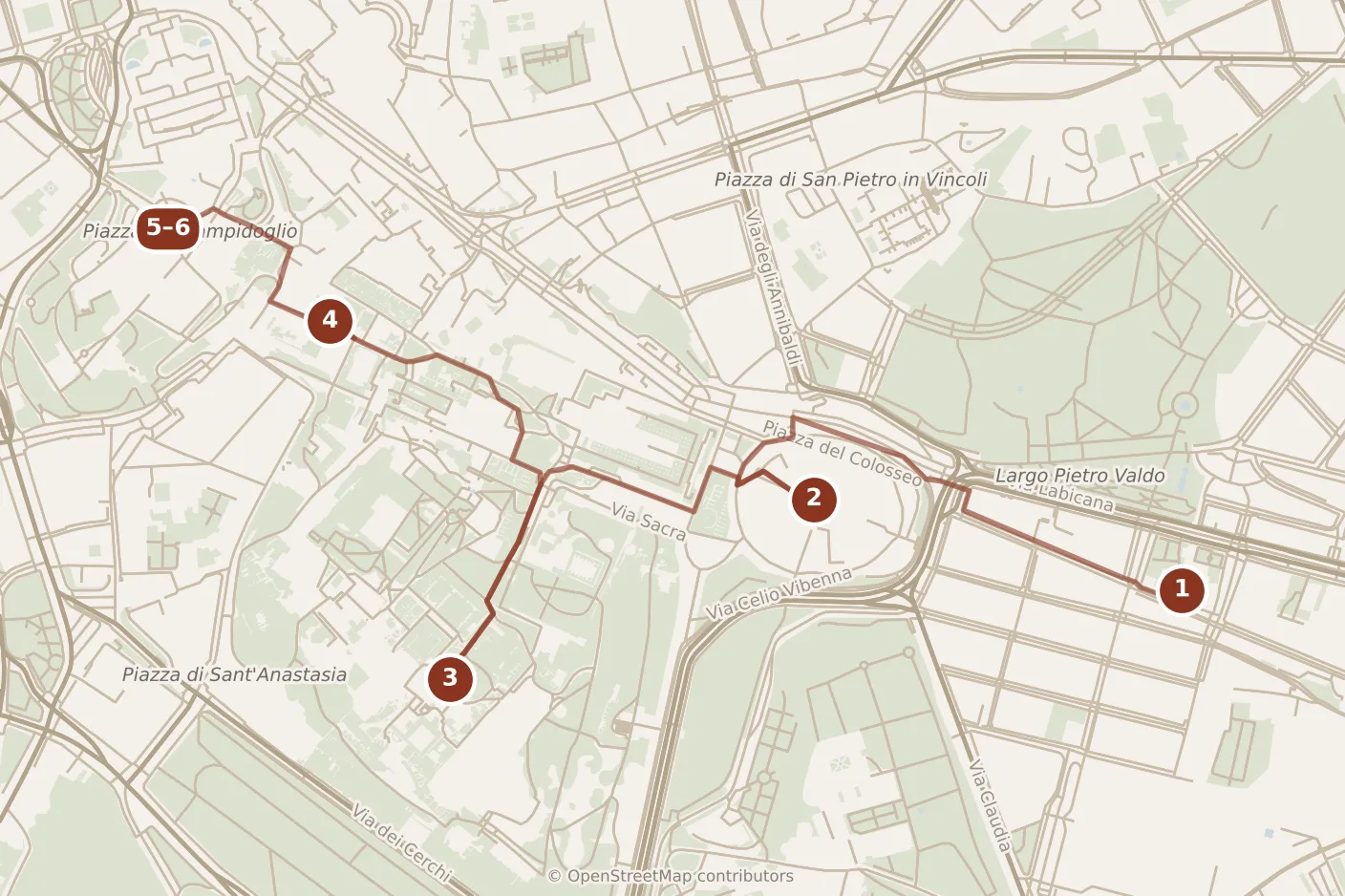
- Day one
- 1Basilica of San Clemente
- 2Colosseum
- 3Palatine Hill
- 4Roman Forum
- 5Piazza del Campidoglio
- 6Capitoline Museums
The Colosseum valley and the hill above it, where the city began.
Start early at the Basilica of San Clemente, five minutes from the Colosseum. It is three buildings in a stack. At street level a twelfth-century church with a gold mosaic filling the apse. Down one flight, the fourth-century basilica it replaced, with wall paintings still on the plaster. Down another, a first-century Roman house and beside it a temple of Mithras, with its stone benches and an altar showing the god killing a bull. Water runs somewhere below that, audibly. The church is free and the levels below it are a separate ticket, booked online for a half-hour slot — there is no counter selling them on the day, and the whole building shuts between half past twelve and two, so take the nine o’clock opening and the day works. Forty-five minutes, and it teaches you how to read every other site in this article: in Rome the ground is not the bottom.
Then the Colosseum, on the timed slot you booked. The standard ticket puts you on the first two tiers, which is where you want to be: you look down into the hypogeum, the brick warren beneath the vanished arena floor, and the building stops being a ruin and becomes a machine, with elevator shafts, animal pens and trapdoors laid open. The arena floor and the underground itself are a separate, fuller ticket that sells out furthest ahead. Ninety minutes on the ordinary one.
The same ticket admits you to the Palatine Hill and the Roman Forum, and the order matters: do the Palatine first. It is the hill above the Forum, so you spend an hour among the imperial palaces looking down on the ground you are about to walk through, and the Forum then makes sense in a way it never does from inside. The Forum is a field of fragments and it defeats people who try to see all of it. Take three things: the Arch of Titus, whose inner relief shows the menorah being carried out of Jerusalem; the house of the Vestals, still recognisable as a courtyard with a garden; and the Curia, the senate house, which survives as an intact brick box because it spent a thousand years as a church. Ninety minutes.
Leave by the western end and climb the Cordonata, the shallow ramped stair Michelangelo designed to be ridden up, to Piazza del Campidoglio. The bronze horseman in the center is a copy; the original Marcus Aurelius is indoors, in the Capitoline Museums, which close the day. Two hours if you have them: the bronze she-wolf, the Dying Gaul, the real Marcus Aurelius under glass, and a courtyard holding the wreckage of a colossal Constantine — a head, a hand and a kneecap, each the size of a small car. If your legs are finished, the courtyard and the two bronzes are twenty minutes and the rest can go.
Local tip. The combined ticket runs for twenty-four hours from your first entry anywhere in the archaeological park, and only the Colosseum has a fixed slot. So if the day overruns, the Forum and the Palatine will keep until tomorrow morning and cost you nothing extra. The Colosseum slot is the one thing that does not keep.
Day two

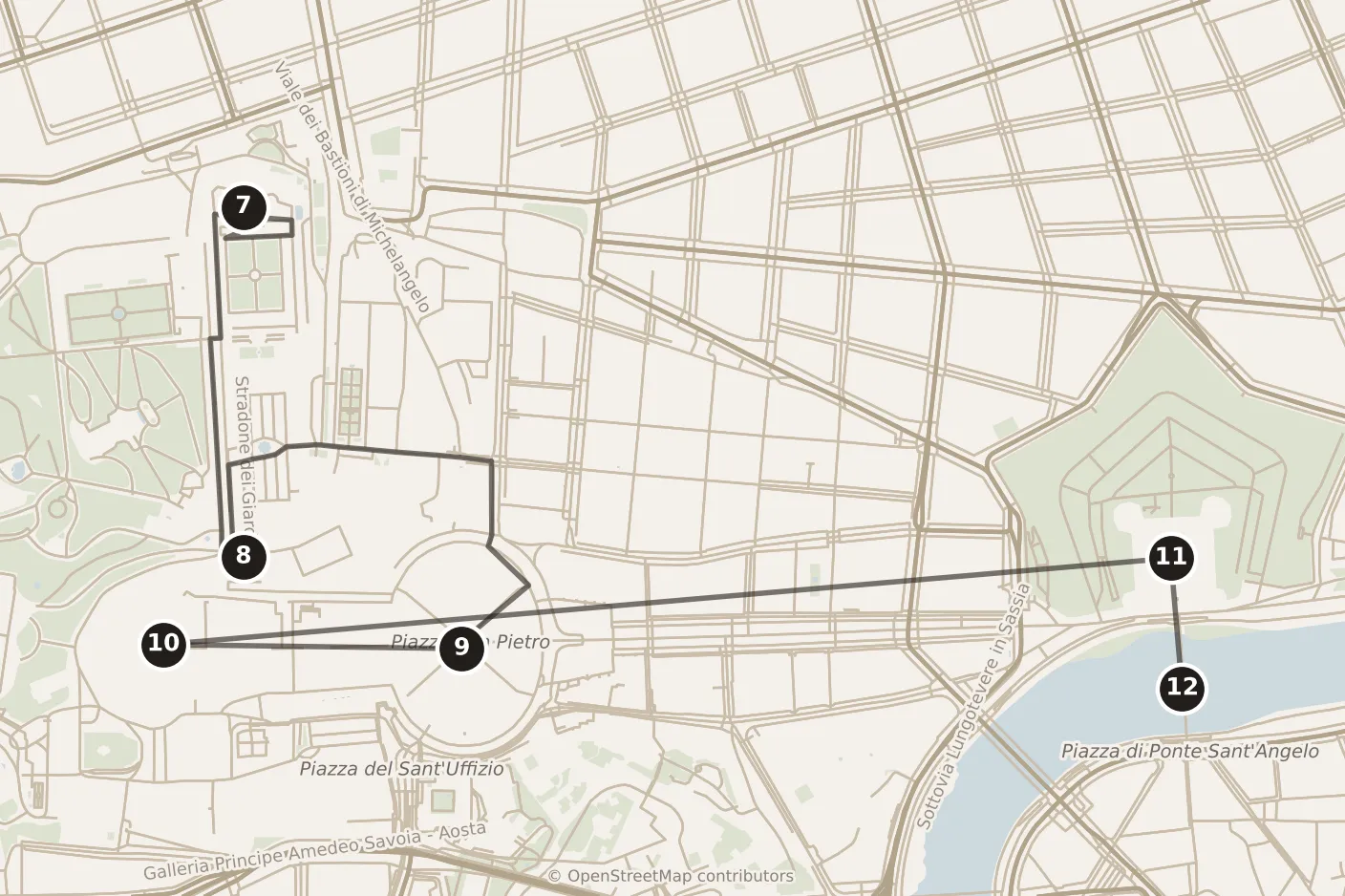
- Day two
- 7Vatican Museums
- 8Sistine Chapel
- 9St Peter's Square
- 10St Peter's Basilica
- 11Castel Sant'Angelo
- 12Ponte Sant'Angelo
The Vatican: a single sustained morning, then an easy afternoon along the river.
Be at the Vatican Museums for your booked entry, ideally the first of the day. This is a one-way system several kilometers long that funnels everyone toward the same room, and the mistake almost everyone makes is to walk all of it, arriving at the Sistine Chapel too tired to look up. Do the opposite: follow the shorter signed route toward the chapel and spend what you save on two things on the way — the gallery of painted maps, a corridor of sixteenth-century wall maps under a gilded vault, and the rooms Raphael frescoed for the pope, which are the equal of anything ahead and are walked past by people saving themselves. Two and a half hours to the chapel door.
The Sistine Chapel enforces silence and bans photography, and guards say so out loud every few minutes. There are benches around the edge of the room; using one is the difference between seeing the ceiling and craning at it for eight minutes. The ceiling is the famous half. The wall behind the altar is the Last Judgment, painted twenty-five years later by the same man in a considerably darker frame of mind, and the contrast between the two is the actual subject of the room.
Out into St Peter’s Square, which is Bernini’s, its colonnade shaped as two arms closing around a crowd. St Peter’s Basilica is free to enter and there is a security line across the square for it. Inside, three things repay the walk: the Pietà, behind glass near the entrance; Bernini’s twisted bronze canopy over the high altar, four stories of it; and a trick of scale you can test yourself — the lettering running round the base of the vault is taller than a person and does not look it, because nothing in the building is at human size to measure it against. The dome climb is 551 steps, or an elevator to the roof terrace and 320 steps after that, and the final spiral leans as the dome curves, which is unsettling and entirely normal.
Then fifteen minutes down to Castel Sant’Angelo: built as Hadrian’s mausoleum, converted into the fortress the popes ran to when the city was sacked, and still joined to the Vatican by a walled passage. The spiral ramp inside is the original Roman one. An hour. Cross Ponte Sant’Angelo on the way out, lined with Bernini’s angels, and the day finishes in the streets on the far bank.
Local tip. The dress code — shoulders and knees covered, for everyone — is enforced at the security screening rather than at the church door, which means it governs your whole morning and not just the ten minutes you are inside. Dress for it at breakfast. Being sent back across the square to change is how people lose an hour here.
Day three

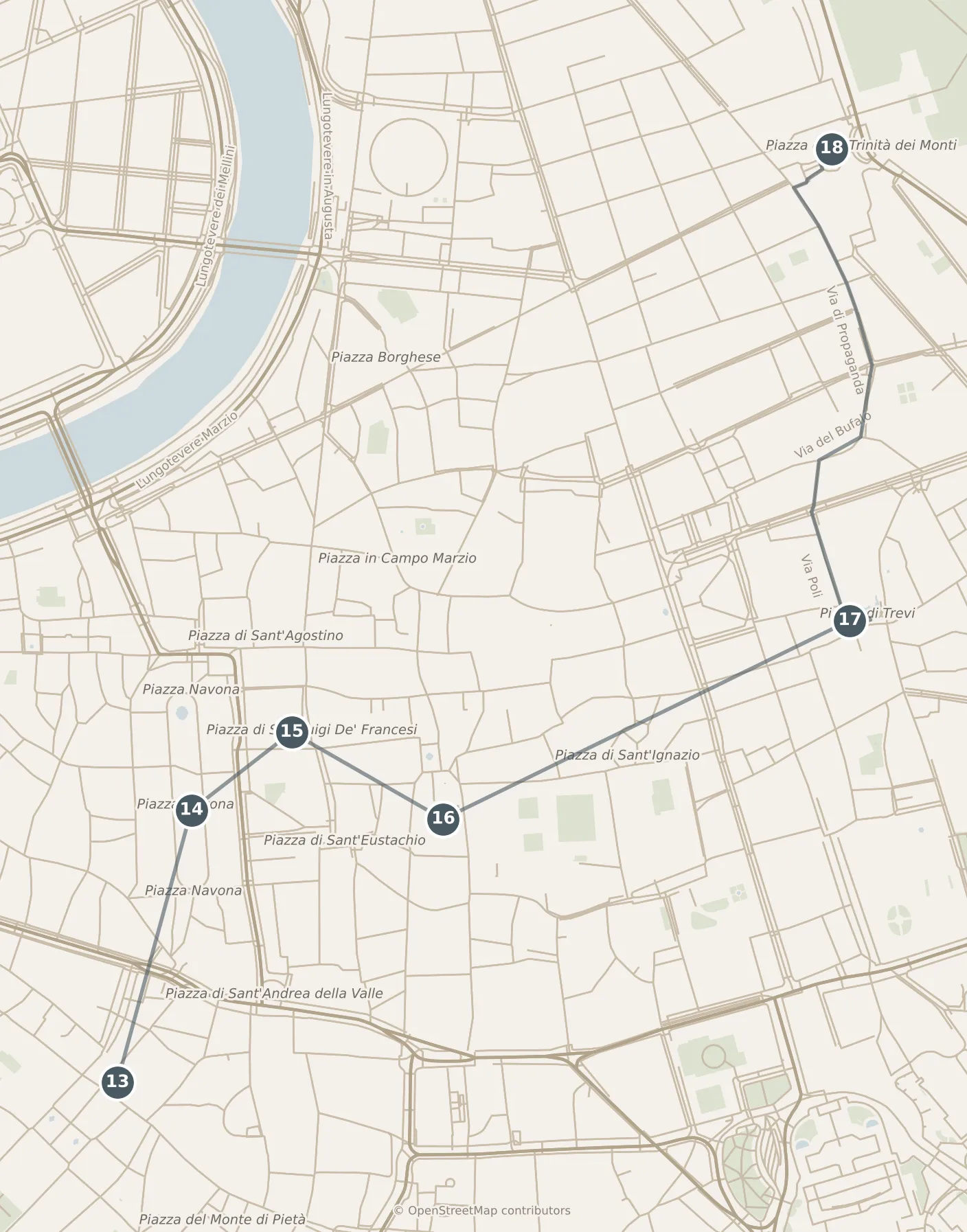
- Day three
- 13Campo de' Fiori
- 14Piazza Navona
- 15San Luigi dei Francesi
- 16Pantheon
- 17Trevi Fountain
- 18Spanish Steps
The Baroque center on foot, all of it free except one ticket, and the shortest walking day of the week.
Begin at Campo de’ Fiori while the market is still on, mid-morning at the latest. Come for the square rather than the market: a handful of fruit and vegetable stalls still trade, but most of the stands now sell souvenirs, spice jars and colored pasta by the bagful, and it turns into a drinking square by night. The hooded bronze standing in the middle of it is Giordano Bruno, burned on that spot in 1600 and put back there in effigy by the anticlerical city of 1889. Twenty minutes.
Piazza Navona is four minutes north. Its shape is the whole story: it is not a square but the floor of a Roman stadium built by Domitian, and the buildings around it stand on the line of the seating, which is why it is a long oval with rounded ends. Bernini’s fountain of the four rivers is in the middle, Borromini’s church front faces it, and the two men loathed each other, which every guide in the square will tell you at length. Give it half an hour and do not eat here.
Two minutes away, San Luigi dei Francesi is free and holds three Caravaggios in one side chapel — the calling, the inspiration and the death of Matthew — lit by a coin meter that somebody in the crowd always feeds. Fifteen minutes, and they are the best fifteen minutes of the morning.
The Pantheon is five minutes further. It has required a ticket since 2023, worth booking to skip the line, and it is free on the first Sunday of the month, when there is no booking and a long line instead. The dome is still the largest unreinforced concrete dome ever built, nineteen centuries on. The oculus is genuinely open — rain comes in, and the marble floor slopes to drains that have been doing that job since it was laid. The inscription across the front names Agrippa, who put up the first building on the site; what you are standing in is Hadrian’s replacement, which kept the older man’s name on the front.
Ten minutes east, the Trevi Fountain. Since its cleaning in 2024 the space at the basin has been managed with a line and a cap on numbers, so the fountain now has an inside and an outside. The view from a few steps back is free, needs no line, and is better, because the whole facade is a piece of theater that wants distance.
Finish at the Spanish Steps, ten minutes on. Sitting on them has been banned since 2019 and the ban is enforced with real fines, so treat this as a five-minute stop and not a rest: the boat-shaped fountain at the foot is by the elder Bernini, the church at the top is Trinità, and the streets running off the square are the expensive shopping ones. Walk back down into the centro storico to eat.
Day four

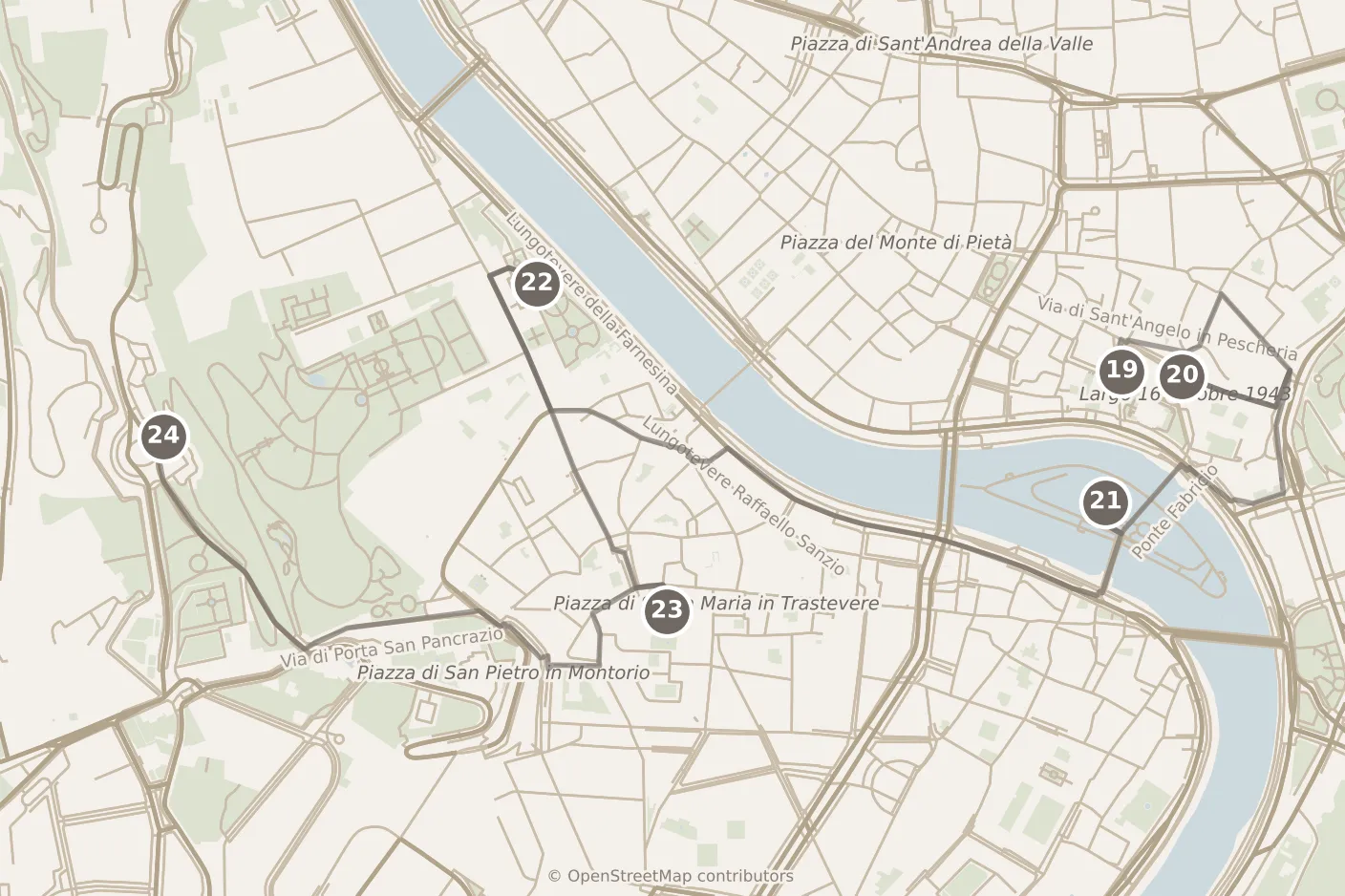
- Day four
- 19Roman Ghetto
- 20Portico d'Ottavia
- 21Tiber Island
- 22Villa Farnesina
- 23Santa Maria in Trastevere
- 24Janiculum
The Ghetto, the island, Trastevere and the hill above it. This is the day the river organizes, and it has one hard time limit in the middle of it.
Start in the Roman Ghetto, early and quiet. Jews were confined to these few blocks by papal decree from 1555 and not released from them until 1870, in a quarter deliberately sited on the floodplain; the streets are still the center of Jewish Rome, and small brass plaques set into the paving outside the doors mark the people taken from them in 1943. Read the ground here. Half an hour.
The Portico d’Ottavia is in the middle of it: a ruined colonnade with a medieval church wedged bodily into the gap, and the fish market that operated under the arch for centuries left its name on the church. Ten minutes and one photograph. Then cross to Tiber Island by Ponte Fabricio, which was built in 62 BC and has carried traffic ever since — the oldest Roman bridge in the city still doing its job. The island has been in the healing business without a break since a temple of Asclepius was founded on it in 291 BC, and there is a working hospital on it now, which is a continuity nothing else in Rome quite matches.
Now the time limit. Villa Farnesina, ten minutes upriver, opens in the morning only and closes at lunchtime, and it is shut on Sundays. It is worth arranging the day around: a Renaissance banker’s suburban villa, small, uncrowded, with Raphael’s Galatea on one wall, a loggia painted with Cupid and Psyche, and upstairs a room whose painted columns open onto a painted view of sixteenth-century Rome, so convincingly that the corner of the room disappears. An hour, and you will be almost alone in it.
Then down into Trastevere proper for lunch, and to Santa Maria in Trastevere, one of the oldest churches in the city. The mosaics filling the apse and the strip below it are twelfth and thirteenth century, gold-ground and enormous, and the facade carries more of them, lit after dark. The square in front is the neighborhood’s living room; the parent guide is right that the quarter has tipped a long way toward visitors, but at two in the afternoon it is still a place where people live.
Finish by climbing the Janiculum, twenty to thirty minutes uphill from the square, for the whole city laid out at once — the one view in Rome that shows you the shape of everything you have walked. A cannon has been fired from the hill at noon every day since 1904, continuing a signal begun in 1847 to give the church bells one time to agree on; if you would rather take the hill first and the villa another day, that is when to be up there.
Day five

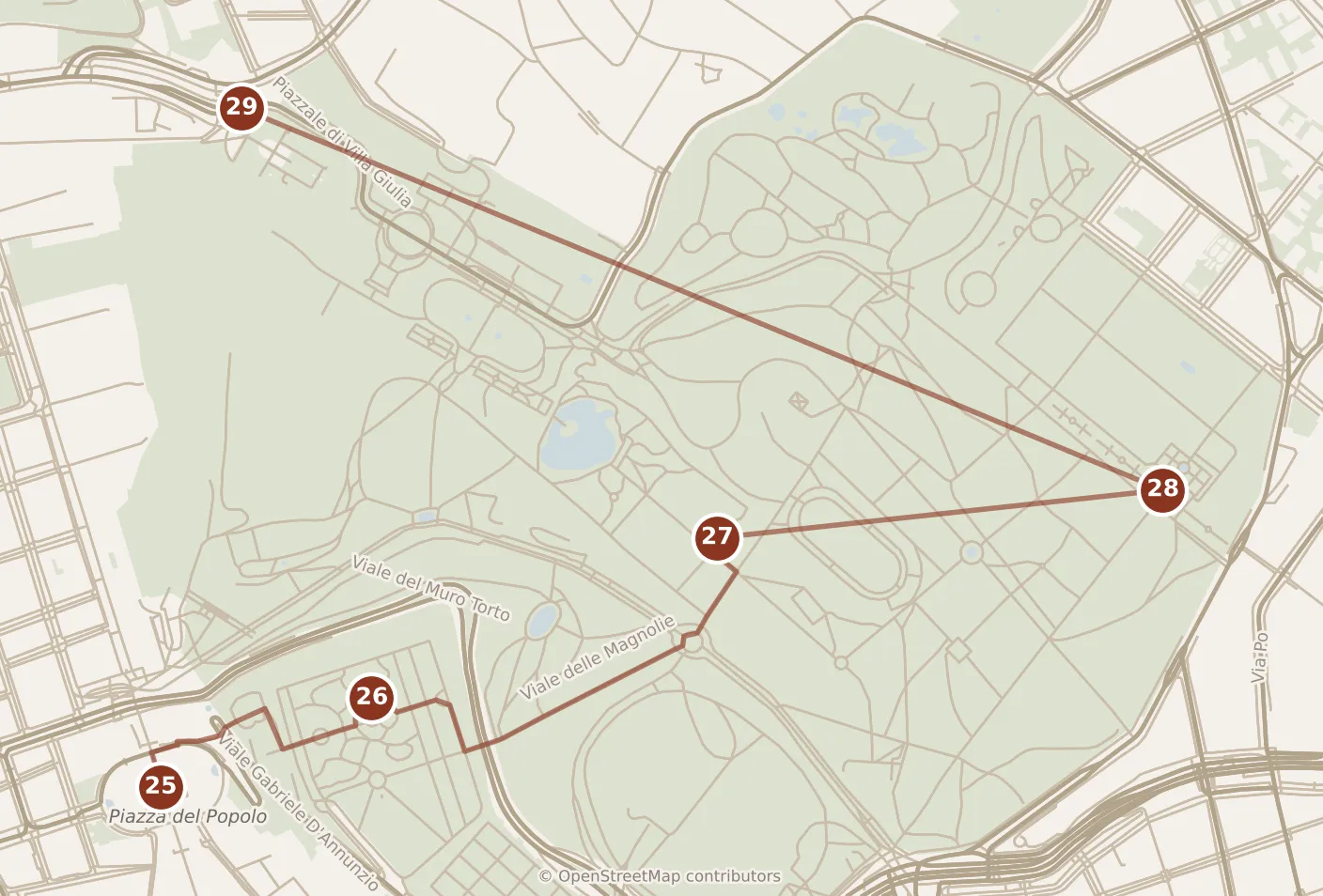
- Day five
- 25Piazza del Popolo
- 26Pincian Hill
- 27Villa Borghese gardens
- 28Galleria Borghese
- 29Villa Giulia
The northern gate, the park and the one museum in Rome you can see whole. The Galleria Borghese admits you for a fixed two-hour slot, and everything below arranges itself around whichever slot you were given.
Piazza del Popolo was the door to Rome for anyone arriving by road from the north, and it still reads as an arrival: a huge oval with an Egyptian obelisk in the middle and three streets fanning south out of it. The two churches flanking the central street look like a matched pair and are not — the sites are different widths, so one dome is oval and the other round, and the illusion only holds from the middle of the square. Santa Maria del Popolo, on the square, is free and holds two late Caravaggios in one chapel, a conversion and a crucifixion, both staged in near-total darkness. It keeps church hours and shuts from about half past one until half past four, and on Sundays it does not reopen at all. Forty minutes for both.
Climb the ramps to the Pincian Hill, five minutes, for the postcard of the square from above with the dome of St Peter’s beyond it. Then into the Villa Borghese gardens: not a wilderness but a formal private park the city bought, with a boating lake and a small temple on an island in it. Twenty minutes across, longer if you sit.
The Galleria Borghese is the point of the day. Two hours is genuinely enough because the collection is small and the building is a villa rather than a palace, which makes it the opposite of the week’s other museums: you can see all of it and should. Downstairs is Bernini carving marble into things marble should not do — Apollo and Daphne, with her fingers already turning into leaves; the abduction of Proserpina, where the hand presses into the thigh and the stone gives; a David caught mid-throw with his face screwed up. Canova’s reclining Pauline is in the same run of rooms. Upstairs is the painting: Caravaggio, Raphael, Titian. Two hours is enough only if you accept that you will not read the labels.
End at Villa Giulia on the far edge of the park, fifteen minutes’ walk, closed on Mondays. It is the Etruscan museum, and it exists to answer a question the rest of the week raises without addressing: who was here before Rome. The Sarcophagus of the Spouses is the reason to come — a terracotta couple from the sixth century BC reclining together on a couch, both smiling, the wife’s hand raised in a gesture nobody has satisfactorily explained. An hour and a half.
Local tip. The Borghese slot is the only appointment this week that cannot be shifted, so book it before you book anything else and read this day outward from it. An early slot puts the square, the park and the Etruscan museum after it; a late one puts them before. The order changes one thing only, and it is the church: Santa Maria del Popolo is locked from about half past one to half past four, so an early slot means seeing it before you go in, or coming back to the square at the end of the day. Missing the slot ends it.
Day six

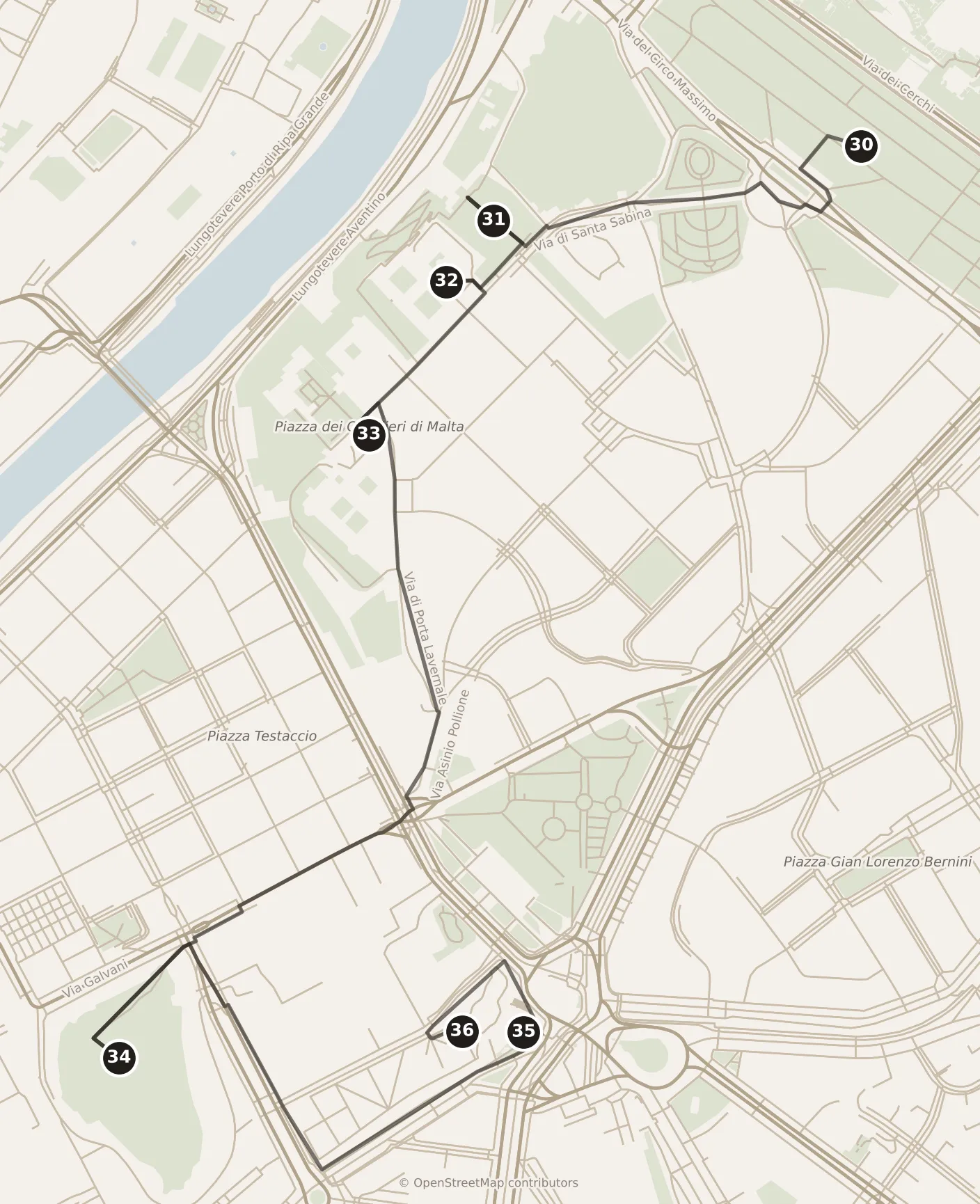
- Day six · stops 30–36
- 30Circus Maximus
- 31Orange Garden
- 32Basilica of Santa Sabina
- 33Piazza dei Cavalieri di Malta
- 34Testaccio
- 35Pyramid of Cestius
- 36Non-Catholic Cemetery
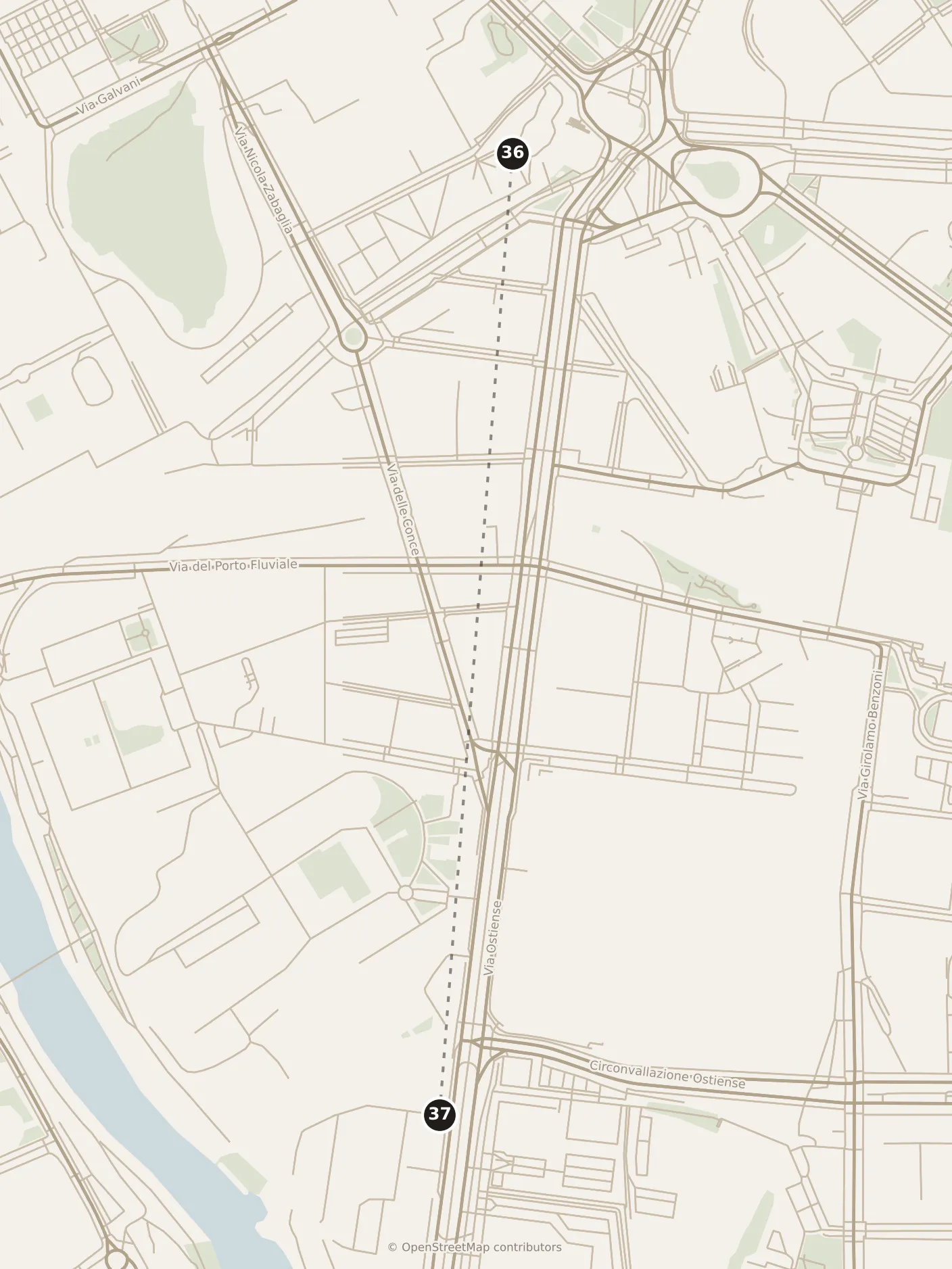
The leg out of the center: from stop 36 by metro, not on foot.
- Day six · stop 37
- 37Centrale Montemartini
The Aventine, Testaccio and Ostiense: a hill, a lunch and two of the strangest places in the city. This is the day Rome stops performing.
Start at Circus Maximus, now an enormous grassed hollow with almost nothing built on it. That is what makes it worth ten minutes: nothing survives but the shape, and the shape is the better part of half a mile long, so you take the scale of Roman mass entertainment by walking a fraction of it and giving up.
Climb the Aventine, fifteen minutes, and everything changes — a residential hill of walled gardens and convents, silent, with almost no shops. The Orange Garden is a public terrace planted with orange trees, the city dropping away below it. Next to it, the Basilica of Santa Sabina is the best ten minutes of the day: a fifth-century church nobody ever gilded over, so it shows what an early Christian basilica actually looked like — a plain hall, columns, clear windows, no gold, which is a shock after four days of Baroque. Its cypress doors date from around 422, and one carved panel is the earliest surviving public image of the crucifixion anywhere.
Two minutes on is Piazza dei Cavalieri di Malta, where there is always a small patient line at a green door. Piranesi laid out the square and the garden behind it in 1765 so that an avenue of clipped hedge lines up exactly with the dome of St Peter’s, framed by the keyhole. It is free, everyone gets about ten seconds, and it is worth the wait.
Down into Testaccio for lunch — twenty minutes, downhill. The covered market opens mornings and early afternoon and is shut on Sundays, and it is a real neighborhood market with a row of good food counters rather than a food hall pretending to be one. This is the district that built Roman offal cooking, and a reasonable place to eat carbonara made by people who are not performing it.
Then the Pyramid of Cestius, ten minutes east: a genuine pyramid, sharper-sided than the Egyptian ones, put up around 12 BC as the tomb of a magistrate with a taste for the exotic and later swallowed whole by the Aurelian walls, which is why it is now half city gate. Beside it, the Non-Catholic Cemetery is free and one of the quietest places in Rome: Keats under a stone that refuses to name him, Shelley’s ashes higher up the slope, the Angel of Grief weeping over a tomb, umbrella pines, and a resident colony of cats. Forty-five minutes, and not a morbid place at all.
Finish at Centrale Montemartini: the metro station beside the cemetery is Piramide, and it is one stop south to Garbatella and about seven minutes on foot from there. When the Capitoline collections overflowed, the city put the surplus into a decommissioned power station and never took it out, so Roman gods and emperors in white marble stand in front of black diesel engines and turbines the size of houses. Closed on Mondays. An hour.
Day seven

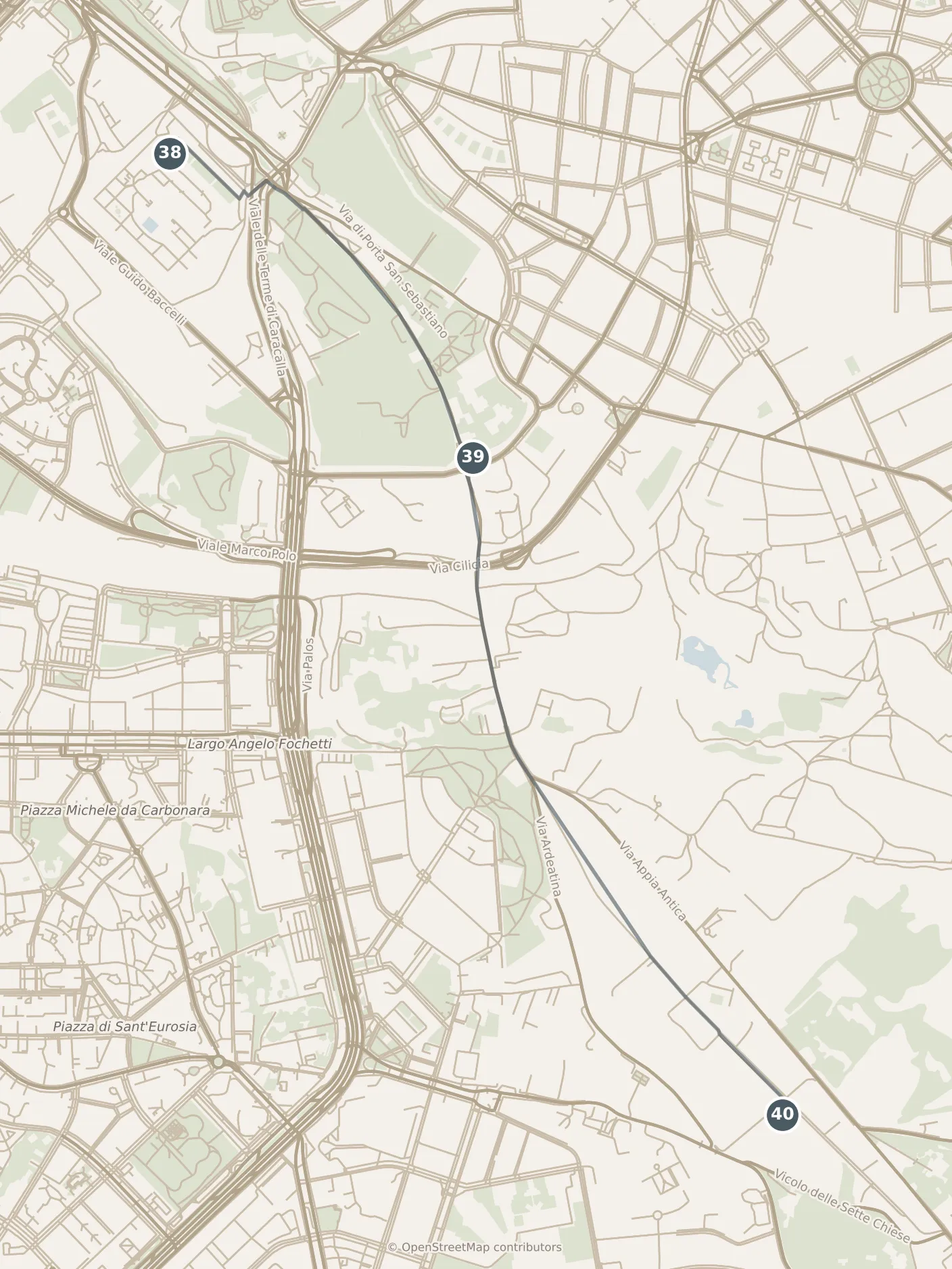
- Day seven
- 38Baths of Caracalla
- 39Porta San Sebastiano
- 40Catacomb of Callixtus
The last day leaves the crowds behind and walks out of the city along the road the Romans built first. It is the longest walk of the week, it is flat, and turning back early is a perfectly good way to do it.
Begin at the Baths of Caracalla, twenty minutes from Circus Maximus. What survives is the brick core of a bathing complex the size of a small town, walls still standing thirty meters, mosaic floors under your feet in places. There is no roof and almost nothing explaining itself, so the work is yours: the vast rectangular halls were hot, warm and cold rooms in sequence, the open ground beyond them was for exercise, and the whole thing ran on furnaces and aqueducts in tunnels below. An hour.
Walk twenty minutes down to Porta San Sebastiano, the largest and best-preserved gate in the Aurelian walls, with two round towers you can climb into for a small ticket and a walk along the top of the wall itself. Then through it, and you are on the Via Appia Antica.
The road was opened in 312 BC, the first of the great Roman highways, and it is closed to private traffic on Sundays and public holidays — which is the single reason to put this day on a Sunday, because with cars it is a narrow lane with no sidewalk and with none it is one of the best walks in Europe. Basalt paving surfaces in long stretches, worn into ruts by cartwheels. Tombs line both sides, some of them brick cylinders the size of houses, because Roman law forbade burial inside the city and the rich competed along the approach roads. Umbrella pines the whole way.
Two and a half kilometers out is the Catacomb of Callixtus, which can only be seen on a guided visit; tours leave every half hour and run about forty minutes, and it is closed on Wednesdays. It also shuts for lunch, from noon until two, which is exactly when an unhurried morning delivers you to the door — so either be there before twelve, or walk on up the road first and come back for the two o’clock reopening. Underground you walk galleries cut on several levels into soft rock, past shelf graves stacked from floor to ceiling, into the chamber where nine popes of the third century were buried. It is cool, damp and narrow, and anyone unhappy in confined spaces should say so before the group goes down rather than after.
Beyond the catacombs the road empties out and gets better, and you can walk as far as your legs allow before turning round — it is identical in both directions, so there is nothing to miss by stopping. You do not have to walk back: bus 118 runs along the road itself, stops outside the catacombs, and returns to Circus Maximus every twenty minutes or so, every day of the week. If you would rather leave Rome altogether, the alternative is Ostia Antica: the port town that served the ancient city, half an hour by suburban train from Piramide — the same station as yesterday’s metro stop — on an ordinary city ticket. It gives you streets, shops, baths and a theater instead of a road, and it is the better choice for anyone who wanted a ruined city and found the Forum too fragmentary.
Practicalities
Start the week on a Monday. Every closure in Rome then falls where it does no damage, and this is the whole planning problem solved in one line. Day two lands on Tuesday, so the Vatican Museums are open — they are shut every Sunday but the last of the month, when they are free and the line is the year’s worst — and Tuesday also keeps the Vatican day clear of the Wednesday general audience, which takes over St Peter’s Square all morning and holds visitors out of the basilica until around midday. Day five lands on Friday, so the Galleria Borghese and Villa Giulia are open — both shut on Mondays. Day six lands on Saturday, when the Testaccio market is trading and Centrale Montemartini is open — that market is shut on Sundays and the museum on Mondays. Day seven lands on Sunday, when the Appian Way is closed to cars and the Catacomb of Callixtus is open — it is shut on Wednesdays, which a Monday start also misses. And day one survives a Monday because the Capitoline Museums, unusually, open every day of the week.
If a Monday start is not on offer, the page of closures above comes down to three lines: Sunday must miss days two, four and six — it shuts the Vatican Museums, the Farnesina and the Testaccio market — Monday must miss days five and six, for the Borghese and Centrale Montemartini, and Wednesday must miss day seven, for the catacombs, and is the one morning to keep the Vatican day away from too. Days one and three will take any date the week gives them, and the days may otherwise trade places freely — you simply book the timed slots above to whichever dates the days land on, and the quiet trap is a Saturday arrival, which puts the Vatican day straight onto a Sunday.
Book four things before you arrive. The Colosseum timed slot on day one, which sets the shape of that morning; the excavations under San Clemente the same morning, which are sold online only and in half-hour slots; the Vatican Museums entry on day two; and the Galleria Borghese two-hour slot on day five, which is the strictest of them and the one to book first. The Pantheon on day three is worth booking simply to skip the line. Nothing else on this route needs a reservation.
Three openings are narrow enough to break a day if you ignore them. Villa Farnesina on day four opens mornings only and is closed on Sundays, so it belongs at the front of that day or not in it at all. The Testaccio market on day six closes in the early afternoon, which is why lunch is placed where it is rather than later. And the Catacomb of Callixtus on day seven closes from noon until two, which is the hour a leisurely walk out of the city delivers you there.
Getting between the stops is mostly walking. Days one to five are each a single continuous route on foot, and only two legs are not: the end of day six is one metro stop, Piramide to Garbatella, plus a short walk; and day seven ends several kilometers out along a road with no station on it, where the way home is bus 118 from the stop outside the catacombs back to Circus Maximus.
Local tip. If the week cannot start on a Monday, move day seven to whichever day is the Sunday and let the rest rotate around it. Sunday is the only day the Appian Way belongs to pedestrians, and it is the one arrangement in this article that a different starting day cannot reproduce.


,_Kolosseum_--_2024_--_0610.jpg)
.jpg)


