Rome in two days: the ancient city and its interiors, then the Vatican and the walk back across the river

Last updated 4 August 2026
Overview
Two days is the commonest trip to Rome and the hardest to shape, because it is the exact length at which the choosing starts. One day makes the choice for you, and the one-day itinerary on this site makes it honestly: it hands back the Vatican, and it hands back every collection in the city too, because a day that crosses the Tiber and comes back has spent itself on the crossing.
Two days buys back precisely those two things and nothing else. It buys the far bank. And it buys interiors — the rooms a compressed day has to walk past, which in Rome is most of what sits behind the walls you photograph. It does not buy Testaccio, the Appian Way, the Borghese or the catacombs, and a two-day article that promised them would be describing a week.
So the days below take one bank each and neither doubles back. Day one stays east of the river and goes indoors twice: a church standing on two older churches and a Roman street, then the archaeological park from its opening hour, then the two hours of bronze and marble on the Capitoline that a single day cannot afford. Day two crosses to the Vatican for the morning and walks back east through the Baroque center, ending at the one fountain in Rome worth arriving at late.
Three tickets are bought before you leave home and only two of them fix a day: a timed Colosseum entry on day one, wanting a slot at or just after ten, and a timed Vatican Museums entry on day two, wanting the earliest on offer, plus the excavations under San Clemente, which are sold online and nowhere else. Everything else on these two days is free or bought at the door.
Now the arithmetic, because a day is only plannable if you can add it up. Day one comes to about six and a quarter hours inside its stops plus fifty minutes of walking between them; day two to about six hours inside and just over an hour of walking between. Both counts model the time you spend in the places and nothing else. They do not include lunch, and they do not include the three security screenings that are the largest omissions on the route — the one at the Colosseum, the one at the Vatican Museums, and the one for St Peter’s, which forms out in the open across the square and is the single thing on these two days that can swallow an hour without warning.
Day one has no deadline at its far end, so it is anchored at the front instead, and the front is nine o’clock: the reason is a door, and it is a few paragraphs below. Day two is the day anchored to light, because it finishes at the Trevi Fountain. The sun sets in Rome from about twenty to five in the first week of December to about ten to nine at midsummer, so take your own month’s hour and hold it against the nine hours day two runs from the museum door once lunch and that basilica line are added to the count above. In December you will reach the fountain after dark without trying. In June you will reach it three hours early — which is not a problem to fix by hurrying, but by eating dinner between the last church and the water and coming back at nine.
Where to sleep, how you pay for a bus or a metro ride, and what each season here does to you are all the city guide’s, and worth reading before you come. The only thing this route needs beyond those three bookings is an ordinary city transport ticket for each metro ride you take — they are timed rather than dated, so one will not carry you across two days.
Day one

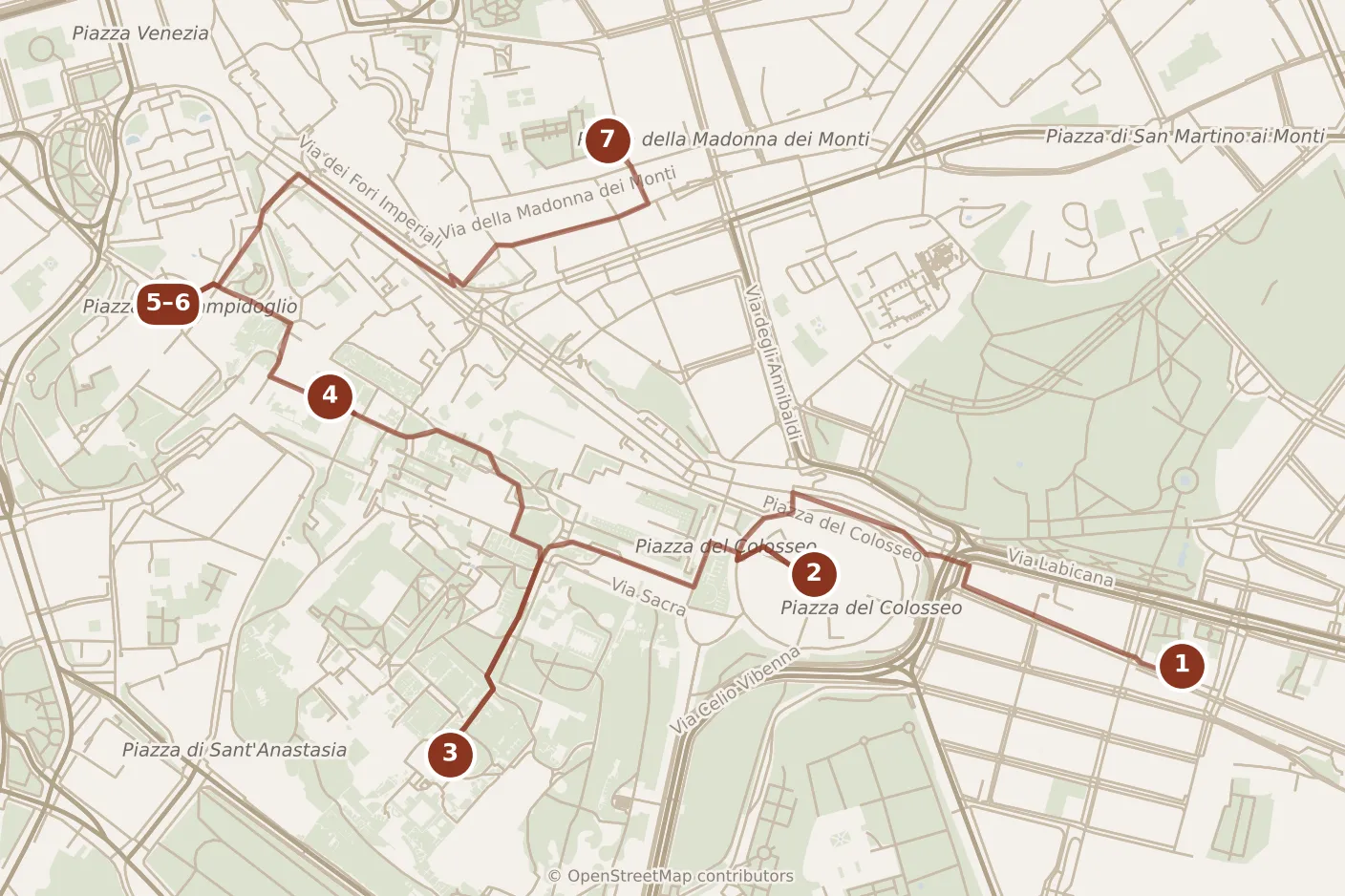
- Day one
- 1Basilica of San Clemente
- 2Colosseum
- 3Palatine Hill
- 4Roman Forum
- 5Piazza del Campidoglio
- 6Capitoline Museums
- 7Monti
East of the river, and the day the extra time is spent going inside things.
It assumes a whole day counted from a church door at nine, which makes it your arrival day only if you are in the city early. If your train gets in at eleven, run it in the order the callout below gives for a late Colosseum slot — it is the same problem, arriving from the schedule instead of the ticket.
Morning
Almost everyone arrives at Termini: the fast trains from the rest of Italy, the Leonardo Express in from the larger airport in about half an hour, and the shuttle coaches from the smaller one. From the concourse, take metro line B towards Laurentina, two stops to Colosseo, about four minutes; the exit puts you at the foot of the amphitheatre. On foot it is close to half an hour downhill instead, which is a decent walk and a poor use of the first hour of a short trip.
But do not go into the Colosseum yet. Walk nine minutes east along Via di San Giovanni in Laterano, away from it, to the Basilica of San Clemente, and give it forty-five minutes. It is three buildings stacked on each other. The church you walk into is twelfth-century, and the half-dome over its altar is one sheet of gold mosaic with a vine coming out of the foot of the cross and running over the whole of it. A staircase drops to the fourth-century basilica underneath, whose plaster still holds painted scenes, one of them captioned in what is among the earliest written Italian anywhere. A second staircase drops again, to a first-century lane with a Roman house down one side and facing it a shrine to Mithras: stone benches to eat from, and an altar showing the god putting a knife into a bull. Under all of it there is running water, loud enough to hear the whole time you are down there. It is the right stop to open with because it is a cross-section: a thousand years of city in fifteen meters of staircase, and every ruin you look at over the next two days is one slice out of something built the same way.
This is the door day one is counted from. In 2026 the basilica opened at nine, closed from half past twelve until two, and on Sundays and public holidays did not open until noon at all; the two lower levels take a ticket of their own, in half-hour slots, sold on the basilica’s own site and nowhere else — ten euros or so in 2026, with nothing available at the door. If you find a different hour, build the morning back from the new one — what matters is not the number but that this is the only stop today whose door decides the order, and that it has to come before the Colosseum rather than after.
Then back west, nine minutes, to the Colosseum on your slot. Take the ordinary ticket, not the one that puts you on the arena floor; ninety minutes on the first two tiers is the right amount and the fuller ticket sells out furthest ahead anyway. Look at the ground-floor arches on the way in and round: several still carry Roman numerals cut into the stone above the opening. The arcade was numbered, and the crowd was sorted through it by those numbers into its stairs — which is the detail that turns the building from a monument into a stadium with a crowd-control problem, and it is the thing most people walk under without seeing.
Six minutes south, past the Arch of Constantine, the gate to the Palatine Hill is on Via di San Gregorio, and your Colosseum ticket covers it. Give it forty-five minutes and do it before the Forum, because it stands directly above it. What you walk through is not really one thing: brick vaults and corridors of the imperial palaces, a sunken garden shaped like a small racecourse, and on top of all of it the terraced gardens the Farnese laid out over the emperors in the sixteenth century, which are where the view down into the Forum is. The Forum reads as a plan from up here and as rubble from inside it, which is the whole reason for the order.
Local tip. If the only Colosseum slot left is a late-morning one, do not force San Clemente in ahead of it. The church shuts its doors at half past twelve and you would be hurrying a stack of three buildings to make a line. Take the slot you have, do the Palatine and the Forum after it, and put San Clemente at the end of the afternoon instead, when it reopens — it is nine minutes east of the amphitheatre and the day loses nothing but its shape.
Afternoon
Come down off the hill into the Roman Forum. An hour, spent walking its length rather than trying to put a name to what is in it: the labelling is thin and the reward here is four things rather than forty. Take the temple of Antoninus and Faustina, where a church front has been grafted into the ancient portico and its Baroque door hangs several meters above the excavated floor — that gap is how deep the Forum was buried before anyone dug it out, and it is the most useful single sight in the field. Take the three colossal coffered vaults of the basilica of Maxentius standing alone above the path, which are one side aisle of a hall whose middle span was half as high again. And take the column of Phocas near the western end: put up in 608, it is the last monument anyone ever added here, and it marks the moment the Forum stopped being a place where things happened.
There is little to eat inside the park, and the ring of places around it is poor value, so take day one’s lunch standing up — pizza al taglio, sold by weight and eaten walking — and let dinner be the meal. For the counter, cross north of Via dei Fori Imperiali and go a few minutes up towards Monti rather than eating on the Forum’s own edge. Sitting down anywhere between the Colosseum and Piazza Venezia costs you an hour and buys you a photograph of a menu.
Leave by the western end and go up the Cordonata — the wide, shallow-stepped ramp Michelangelo laid out so that a man on a horse could ride it — to Piazza del Campidoglio. Fifteen minutes. The oval paving with its star pattern looks as old as the palaces around it and is not: Michelangelo drew it, it was never executed, and the city finally laid it in 1940. The bronze horseman at the center is a copy.
The original is fifty steps away, and it is what day one is really for. Two hours in the Capitoline Museums, which fill the two palaces flanking the square and are the collection a single day in Rome cannot afford. In the courtyard, an emperor in pieces: Constantine’s head propped against a wall and taller than the people photographing it, a forearm, a pointing finger, one kneecap. Indoors, the bronze she-wolf; the Dying Gaul, a beaten man holding himself up on one arm, carved by the side that beat him and granted more dignity in stone than he was granted alive; and Marcus Aurelius himself, down off his plinth and under a roof, the gilding still on him in patches. Best of the lot, the underground passage joining the two palaces runs through the Tabularium, the republic’s record office, and its row of arches looks straight down the length of the Forum you have just spent the afternoon in. If two hours turns out to be one, take the courtyard, the she-wolf, the Gaul and the Tabularium, and let the picture gallery upstairs go without regret.
Evening
Thirteen minutes north-east, up past Piazza Venezia and along Via dei Fori Imperiali, is Monti, the oldest inhabited quarter in the city and one that is still doing something in the evening. The lanes to look for are Via del Boschetto and Via dei Serpenti, and the place everybody ends up is the sloping Piazza della Madonna dei Monti, where the fountain has a set of steps around it that function as the local sofa. This is where day one’s real meal is, and cacio e pepe is the plate to order: three ingredients, a technique that goes wrong easily, and the reason it is worth eating somewhere that is not serving it to a coach party.
Day two

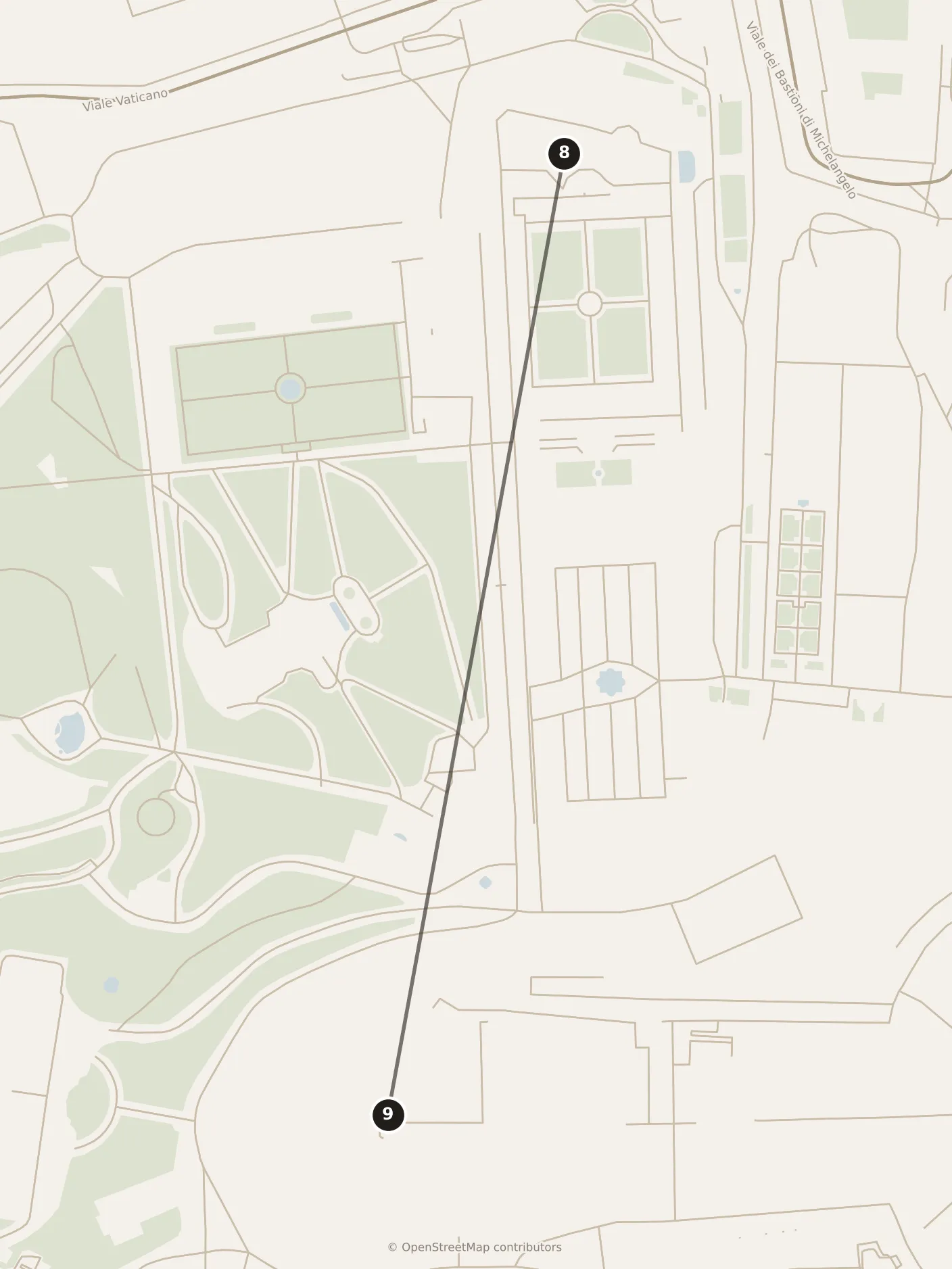
- Morning
- 8Vatican Museums
- 9St Peter's Basilica
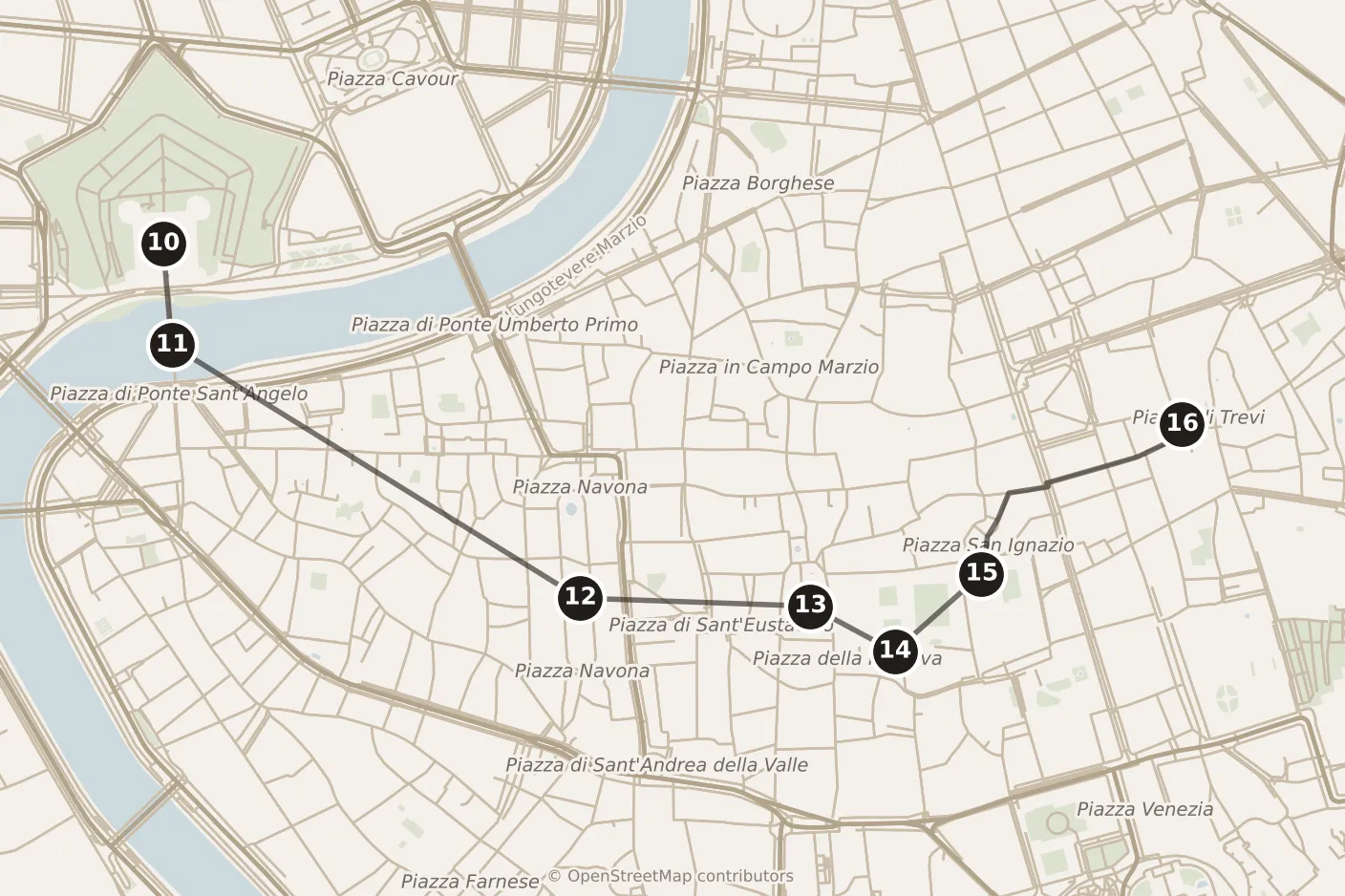
- Afternoon and evening
- 10Castel Sant'Angelo
- 11Ponte Sant'Angelo
- 12Piazza Navona
- 13Pantheon
- 14Santa Maria sopra Minerva
- 15Sant'Ignazio
- 16Trevi Fountain
The far bank in the morning, then the whole walk back east, finishing after dark.
Morning
From Termini it is metro line A towards Battistini, six stops to Ottaviano, about twelve minutes, then ten minutes or so on foot round the outside of the Vatican wall to the entrance on Viale Vaticano. Be there for the first entry you could book.
Settle one thing at breakfast, because being turned away costs an hour: shoulders and knees must be covered, by everyone, and the check happens at the security screening on the way in rather than at a church door. So it governs the whole morning — museums, square, basilica — and not the ten minutes you spend actually standing in front of an altar. In July that is an unwelcome sentence and it is still the sentence.
Give the Vatican Museums two and a half hours, and know what you have walked into: several kilometers of corridor with one destination, which everybody in the building is moving towards at the same speed. The trap is completeness. Try to see it in order and you will reach the Sistine Chapel with nothing left to look with. Take the shorter signed route and spend the difference on two things. The first is the octagonal courtyard of ancient sculpture, for the Laocoön — a father and two sons in the coils of sea serpents, dug out of a vineyard in 1506 with Michelangelo among the people who came to watch it surface, and visibly the object that changed European sculpture’s mind about what it was for. The second is the suite of rooms Raphael painted for the pope’s own apartments, which most visitors hurry because the chapel is ahead of them and which in any other city would be the reason to come. The Egyptian and Etruscan wings and the modern religious art are the honest cuts.
In the chapel itself talking is stopped by the guards at intervals and cameras are not allowed. Sit down — there is seating along the walls — because standing with your head back lasts about eight minutes before your neck decides for you, and the ceiling wants longer than that. Everyone comes for the ceiling; what surprises people is the end wall over the altar, a Last Judgment the same man put there a quarter of a century afterwards, and the difference in temperature between the two is what the room is really about. Then the exit: the door in the corner that opens straight onto the basilica is signed for guided groups, so plan on the long way — back through the museum, out of the main entrance, about twelve minutes round the outside of the wall to St Peter’s Square. If a guard waves you through it, take the twelve minutes as a gift.
St Peter’s Basilica costs nothing to go into, and its line is the security screening, which forms out in the open across the square with very little shade along it. Give the building an hour once you are through, and do not count the line inside that hour: how long it runs is not predictable from anything you can see before you join it. What is predictable is where the cost comes out of. The nine hours at the top of this article already carries the standing lunch and about an hour of this line; a line that runs longer than that comes out of the choice in the callout below instead, and you reach the fountain on time with one fewer view over the rooftops. Three things repay it. The Pietà, glazed and set back near the door, carved before Michelangelo was twenty-five and the only object he ever signed. Bernini’s bronze canopy over the high altar, twisted columns four stories tall, cast in part from metal stripped off a building you will be standing inside later this afternoon. And a scale trick you can run yourself: the gold lettering circling the base of the dome is taller than you are and does not read as it, because the building contains no object at human size to check it against. The climb to the top of the dome is 551 steps from the floor, or an elevator to the roof and 320 after that; the staircase tilts sideways near the top because it is running up between the dome’s two shells and following the curve, which is the building working rather than a fault.
Local tip. The dome climb and Castel Sant’Angelo are each about an hour and each ends in a view over the same rooftops, and day two has comfortable room for one of them, not both. Decide before you go into the basilica, because coming back for the climb afterwards means recrossing the square and waiting in line through security a second time. Take the dome if you want the city arranged below you; take the castle if you would rather be inside something.
Afternoon
Fifteen minutes from the far end of the square to Castel Sant’Angelo, and take Borgo Sant’Angelo rather than the wide avenue running beside it: the same fifteen minutes, and the better street. An hour at the castle. Hadrian put it up as his own tomb, a marble-faced drum on a square base; the popes took it over as the building to run to when Rome was being sacked, and kept a covered walkway along the top of a wall so they could get there without going out into the street — that wall is what is over your head the whole length of Borgo Sant’Angelo, which is the reason to walk it. Inside, the ramp spiralling up through the core is Hadrian’s own, cut to carry an emperor’s ashes to the center of his tomb, and it is the most intact piece of the mausoleum left.
Leave over Ponte Sant’Angelo, the footbridge in front of it, lined with ten angels carrying the instruments of the crucifixion. They are workshop copies, and worth knowing as such: the two Bernini carved himself were thought too good to leave outdoors and are in the church of Sant’Andrea delle Fratte, on the other side of the center.
Thirteen minutes south-east brings you into Piazza Navona, whose oval is not a design decision: the houses are built on the footprint of a Roman stadium’s seating banks, so the open ground is the track. Twenty-five minutes. The detail worth carrying away is that the paving dishes very slightly towards the middle, and that from the seventeenth century until 1866 the fountain outlets were plugged on August weekends and the whole square flooded ankle-deep on purpose, so that carriages could be driven round in the water while everybody else stood in it. Do not eat here — and day two’s lunch is day one’s, taken standing and on the move, in the gap between the basilica and the castle, and bought a few streets back from whichever square you are crossing rather than on it. The meal on this day is dinner, and it belongs between the last church and the fountain in any month, not only in June.
Six minutes on, the Pantheon, half an hour. Nineteen centuries later nobody has poured a larger unreinforced concrete dome, and the hole at the top of it is a hole: rain falls through, and the marble floor is cambered to a ring of drains that have never once been out of service. The building survived because it was made a church in 609 and never stopped being one — which did not save it from the papacy, since the bronze sheathing the portico ceiling was stripped out in 1625 by a Barberini pope and went, among other things, into the canopy you stood under this morning. Raphael is in the wall as you go round, in a niche with two lines of Latin above him. A ticket has been needed since 2023; book it a day or two ahead if you mind waiting in line, and not otherwise.
Three minutes behind it, on Piazza della Minerva, an elephant carved by Bernini’s workshop carries a small Egyptian obelisk on its back, and behind the elephant is Santa Maria sopra Minerva — the one major Gothic church in Rome, named for a temple of Minerva it was long thought to stand on and which was probably a temple of Isis instead. Twenty minutes. The vault inside was painted deep blue and gilded with stars in the nineteenth century and looks like nothing else in the city. Michelangelo’s Risen Christ stands by the high altar, a naked man carrying his own cross like a piece of furniture, with a bronze drapery added later by people who could not leave it alone. Catherine of Siena is buried under the altar, without her head, which is in Siena. If twenty minutes turns out to be ten, take the vault and the Risen Christ. And before you go in, look at the church’s outside wall on the square: a stack of marble plaques, each with a carved hand at the level the water stood in a particular flood, the highest of them from the sixteenth century. They explain a piece of the city’s geography that nothing else does, and the third day below walks into it.
Three minutes further, the church of Sant’Ignazio is free and worth fifteen minutes for one reason. The money for a dome ran out, so in 1685 Andrea Pozzo painted one on a flat canvas some seventeen meters across and hoisted it into the crossing, and it works completely from the right spot and collapses into a smear from anywhere else. Marble discs are set into the floor to tell you where to stand — one under the nave for the vault fresco of Ignatius being taken up into a painted sky, one further along for the dome — and there is usually a tilted mirror on a stand so you can look at the ceiling without breaking your neck.
Both are working churches, and only one of them keeps the Roman habit of locking up for a couple of hours after midday: Santa Maria sopra Minerva, which is why it sits at the back of this afternoon rather than after lunch. Sant’Ignazio stays open straight through into the evening, and is the one stop of the day you cannot arrive at too late. Read the Minerva’s own hours the week before, and if they have moved, move that stop and the rest of the afternoon holds. The covering rule from this morning is not only the Vatican’s, either — these churches post it at the door as well, so if you dressed for the basilica, stay dressed.
Evening
Seven minutes north-east, and day two ends at the Trevi Fountain, which is the one stop on these two days that wants the dark. The whole front of it is a piece of theater built across the end of a small square; it is floodlit, and late enough in the evening the water drowns out everything else there. The 2024 cleaning was followed by crowd control: a fixed limit on how many people may stand at the water at once, a line to join for it, and from early 2026 a two-euro charge for non-residents to go down to the basin at all, lifted only after ten at night. So there are now two ways to see it and the free one is better — free by where you stand at any hour, and after ten the basin costs nothing either, which changes its price and not its view. Stay up in the square, where the facade is in view all at once and reads as the stage set it was designed to be; from down at the basin you are standing inside the set, seeing about a third of it.
To leave: Barberini, on metro line A, is a ten-minute walk from the fountain and two stops from Termini. On foot back to the station it is about half an hour, through streets that are lit and busy and worth walking if you are not carrying anything.
With a third day

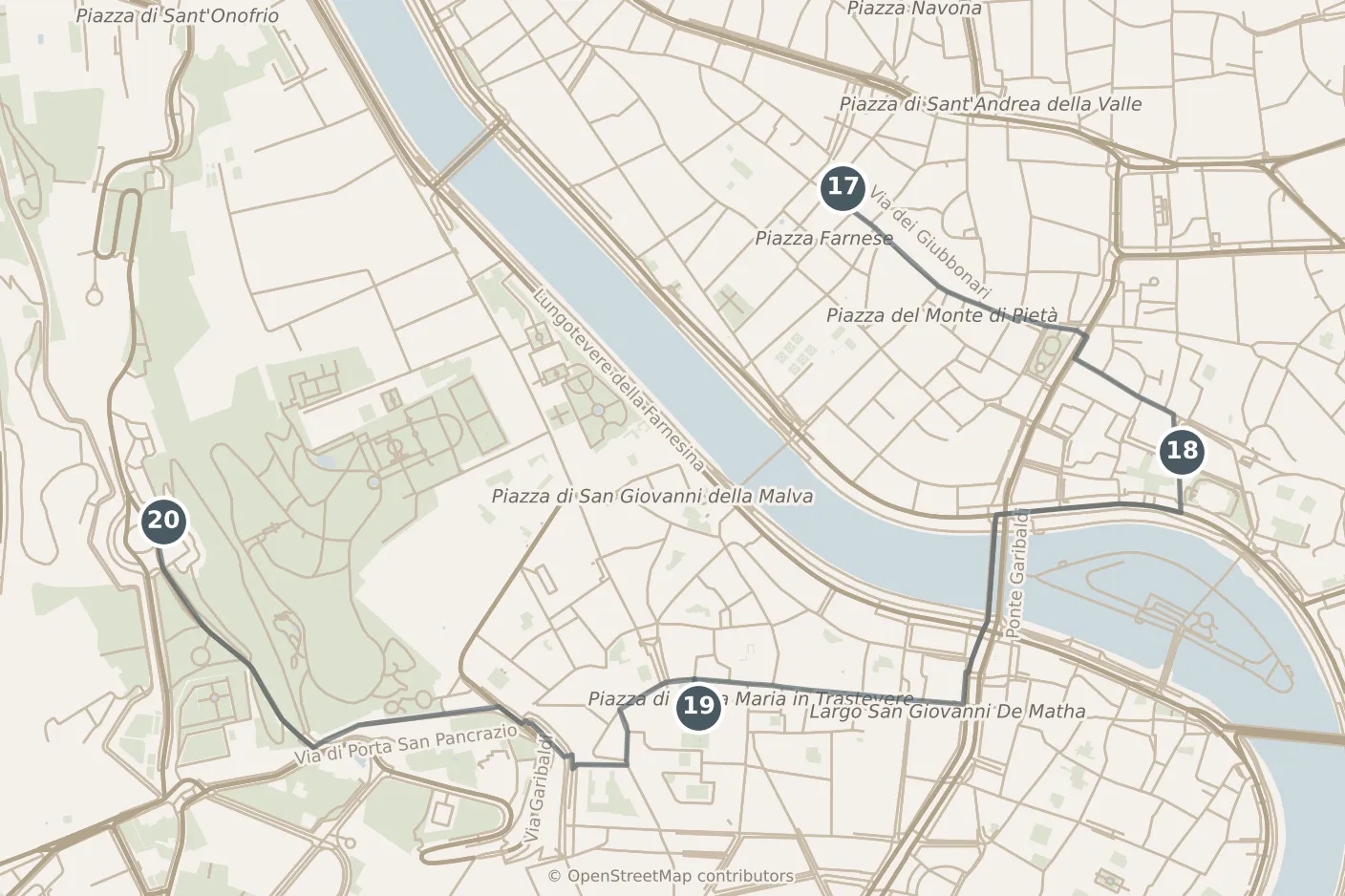
- With a third day
- 17Campo de' Fiori
- 18Roman Ghetto
- 19Santa Maria in Trastevere
- 20Janiculum
The third day goes in the middle, not on the end, and it takes the east end of day two’s afternoon with it, and day two’s evening as well. That is the point of it: two days ask you to do the Vatican in the morning and then six more stops after crossing the river, which is the one genuinely hard thing in this article. A third day dissolves that rather than adding to it.
So the order becomes ancient city, center and river, Vatican. Day one is untouched. The new middle day inherits Piazza Navona, the Pantheon, Santa Maria sopra Minerva, Sant’Ignazio and the Trevi Fountain as written above, and puts a morning in front of them that two days cannot fit. Two instructions do not survive the move. The first is the fountain’s hour: picked up after the Ghetto lunch, that afternoon reaches the fountain by about two, in daylight. So see it then for the sculpture and come back another night for the dark, or eat early on the middle day and walk back after. The second is the Minerva’s place in the afternoon: on two days it sits at the back of it to clear the midday lock-up, and on three the same four stops start after an early lunch and can reach the church inside that window instead — which is the one thing eating early makes worse rather than better. Read its hours before you come, and if they bar you, give the Ghetto and its table the extra time this section already says the stop repays, and pick the afternoon up after two; the fountain moves back with it. On a three-day trip the sunset hour belongs to the Janiculum at the end of the Vatican day, which is where this section spends it.
One warning about the route map on this page: it is drawn against the written order, not this one, so it gathers all four of this section’s stops into a single cluster. Campo de’ Fiori and the Roman Ghetto belong to the new middle day and hand you to Piazza Navona; Santa Maria in Trastevere and the Janiculum belong to the far end of the Vatican day. Do not walk that cluster as one line.
Begin at Campo de’ Fiori, early enough for the market: it trades in the mornings from Monday to Saturday and is packed away by the early afternoon. Come for the square rather than the shopping, since a good deal of what is on the stalls now is spice jars and colored pasta sold for suitcases. What to look at is the cowled bronze in the center, hood up and head down: Giordano Bruno, who was burned here in 1600 and put back on the same paving in 1889 by a city that had just taken itself out of the popes’ hands. Twenty minutes.
Eleven minutes south-east is the Roman Ghetto, and it is what the flood plaques on the Minerva wall — which you will be standing in front of later this afternoon — are actually about. A papal bull of 1555 shut the city’s Jews into these few blocks behind gates that were locked at night, and the gates did not come down until 1870; the ground chosen for it was the strip of bank that went under whenever the river rose. The confinement and the water were one decision. The quarter is still the center of Jewish Rome: the synagogue of 1904 carries a squared dome unlike anything else on the skyline, and set into the paving at the thresholds are small brass squares, one for each person taken from that address in 1943, a name and a date stamped on the top of each. Read the ground first, and give it the time it asks for rather than the time the plan has left over. Then eat, if the quarter is open to eat in on the day you come — the reading is the fixed part of this stop and the table is not. Carciofi alla giudia is the reason to eat here rather than anywhere else: the artichoke opened out flat and put into oil twice, so the outer leaves come out brittle and the heart stays soft. It belongs to the spring and does not pretend otherwise; the rest of the year the quarter’s own cooking carries the meal. Take an hour over it, then walk fifteen minutes north-west and pick the afternoon up at Piazza Navona.
What the Vatican day gains, now that it is last and has no center to cross back into, is an evening. Take the dome climb and Castel Sant’Angelo — the choice in the callout above stops being a choice — and then instead of crossing east, walk south along the west bank, half an hour, into Trastevere. Santa Maria in Trastevere is among the oldest churches in Rome, and what to look at is the mosaic: twelfth- and thirteenth-century work filling the apse and running in a band beneath it, with more of it across the front of the building, floodlit once it is dark. The square outside is where the quarter sits in the evening. Then go up the Janiculum behind it, twenty minutes uphill and more if you stop, past the enormous fountain of the Acqua Paola, and from the top you can see at once the shape of every day you have walked. Time that climb against the sunset band at the top of this article: it is the one hour of the three days worth reaching by counting backwards.
Dinner takes its place from the same band, and the hill decides it: in winter the light goes first, so climb and come back down to the square to eat; in summer eat first and go up after. The way down is the twenty minutes you came up by, and it is the last of them.
The arithmetic, since the third day changes both of the days it touches. The new middle day is the short one — twenty minutes at Campo de’ Fiori, an hour at the table, an hour and a half inside the four inherited stops that carry a stated time, the fountain taking whatever you give it, and three-quarters of an hour on foot, about three kilometers — which leaves the Ghetto itself as much of the morning as you care to give it, and it is the stop on these three days that most repays being unhurried. The Vatican day goes the other way: about five and a half hours inside its stops before you reach Trastevere, now that it keeps the dome climb as well as the castle, and an hour and a half on foot, close to six kilometers, including the half-hour down the west bank and the climb at the end. It is the longest of the three days rather than the lightest, which is worth knowing before you plan a late start into it.
Practicalities
Three bookings, all made before you leave home. The timed Colosseum entry on day one is one ticket good for twenty-four hours and it covers the Palatine Hill and the Roman Forum as well; the archaeological park sells it on its own site, releases slots about a month ahead, and it sat in the eighteen-to-twenty-euro range in 2026. The Vatican Museums entry — day two on a two-day trip, the last day on a three-day one — comes from the museums’ own site: twenty euros at the door and twenty-five booked ahead in 2026, and that five euros is what buys you a place in the first hour of the day, which is the best money spent anywhere on this route. Third, the excavations under San Clemente — half-hour slots, online only, about ten euros in 2026, nothing sold at the door. The Pantheon’s own small ticket dates from 2023 and is a booking only if waiting in line bothers you.
The weekday rules, rather than a start day. Set your dates against the Vatican day, which is day two on a two-day trip and the last day on a three-day one. That day must miss Sunday, because the Vatican Museums shut on Sundays — every Sunday but the last one of the month, which they open free of charge and which is therefore the most crowded morning in their year; and it is better kept off Wednesday too, because the pope’s general audience takes over St Peter’s Square on Wednesday mornings and everything else lines up behind it. Whichever day carries the Pantheon minds a Saturday, though only if it runs late: from five o’clock on Saturdays and the eves of public holidays, and from half past ten on Sundays and holidays, only the congregation is admitted while the service is on. On two days that is day two’s late afternoon, which lands close enough to five to matter; on three it is the middle day, which reaches the Pantheon in the early afternoon and is clear of it. Day one takes any day of the week — the Capitoline Museums, unusually for Rome, open every day — with the single exception that on a Sunday or a public holiday San Clemente does not open until noon. And on a three-day trip the new middle day must miss Sunday as well, since it opens on the Campo de’ Fiori market, which trades Monday to Saturday and not that morning.
So on two days the trap is a Saturday arrival, which puts day two on a Sunday, and a Tuesday arrival, which puts it on a Wednesday. In both cases the fix is the same and it is free: swap them and run day two first. That drops day one onto the Sunday or the Wednesday instead, and day one does not care about Wednesday at all. If it lands on the Sunday, run day one backwards — the Capitoline Museums opened at half past nine every day of the week in 2026, so start there, walk down into the Forum, and finish at the Colosseum, taking San Clemente in the late afternoon once it has finally opened. That reversal has to be booked as well as planned: the Colosseum slot wants the afternoon rather than ten o’clock and the San Clemente excavation slot wants the hour after it, both fixed before you leave home like the others. What you lose is the Palatine before the Forum, which is the better order. What you gain is a day that happens. The one thing the swap adds is that it puts day two on the Saturday, so keep that afternoon moving and reach the Pantheon before five.
On three days the numbering shifts and so do the traps. The reordering above puts the Vatican at the end, so it is a Friday arrival that lands it on a Sunday and a Monday arrival that lands it on a Wednesday; and a Saturday arrival, harmless on two days once you swap, now drops the new middle day onto the Sunday and takes its market with it. All three are easier to fix than the two-day version, because day one is the day that minds least: give it the barred Sunday or the barred Wednesday, run it backwards if it is the Sunday, and let the Vatican day and the middle day take the days either side, in whichever order leaves the Vatican later. On the Friday and the Monday arrivals that puts day one last, so the Vatican day is the later of the first two rather than the last of the three: the Janiculum evening moves with it, and the rain fallback below loses the next morning it relies on.
If it rains on day one, the Forum and the Palatine are the problem: open ground, gravel and marble underfoot, no shelter for half a kilometer. The swap is inside the day rather than out of it. From the Colosseum, walk fifteen minutes west along Via dei Fori Imperiali to the Capitoline Museums and take your two hours there at midday instead of at three; then go into the park in the afternoon when it has passed. The park ticket runs twenty-four hours from your first entry, so if it has not passed, the Forum and the Palatine keep until the next morning at no extra cost — but only if there is a next morning that is not the Vatican, which is to say only on a three-day trip.
What to cut when the trip is short. On day two, the first thing to go is Castel Sant’Angelo: it is an hour plus the fifteen minutes that lead to it, it is the afternoon’s one substantial admission, and everything after it lies on the same line east, so cutting it costs the day nothing structural. Walk from the far end of St Peter’s Square straight to Ponte Sant’Angelo instead and pick up at the bridge. On day one, the cut is the second hour of the Capitoline Museums, not the museums themselves. And if the trip collapses to a day and a half, drop San Clemente rather than anything in the park — it is the one stop whose door dictates the morning, and losing it makes the rest of the day easier.
The bag. Left luggage at Termini is on the Via Giolitti side of the station, at the far end of platform 24. That is the one to aim for on both days, because this route touches no other railway station — there is nowhere to leave a case at the Vatican, in the centro storico or anywhere near the fountain. Which day it matters on is the whole point. If you are leaving on day two, the bag goes in before you get on the metro, not after: the museums and the basilica both screen every visitor, and a wheeled case in either of those lines is a real problem rather than a nuisance. Day two then ends at the Trevi Fountain, two stops on line A from Barberini back to Termini, so you come back for it easily. Leaving on day one is the kinder case: it ends in Monti, which is a few minutes from Cavour and one stop on line B from the station.
Between stops you are on foot the whole time, on both days: about three and a half kilometers on day one and four and a half on day two, with no single stretch running over fifteen minutes. The rides the route itself asks for are the two at the head of each morning — line B to Colosseo, line A to Ottaviano — and then whatever gets you back to your bed at the end of each evening; if you are sleeping in the center rather than by the station you may not need any of them.


.jpg)