Rome in one day: the ancient city at opening, the Baroque center on foot, and no museums at all

Last updated 3 August 2026
Overview
One day in Rome is an exercise in subtraction, and the two things you give up are large enough to be worth naming at the start: the Vatican, and every museum in the city.
The Vatican goes because of where it stands. The city guide is blunt about the geography — the Vatican, the Colosseum and the Spanish Steps sit at three corners of a large triangle, and you will not stroll between them. The museums there are a sustained morning on the far bank of the Tiber, and by the time you have crossed back you have spent the light and the legs of the day on one quarter of the city. If the Vatican is the reason you are coming to Rome at all, invert the day below: give the morning to it, and accept that the ancient city becomes something you walk past rather than something you go into. That is a coherent day too. It is simply not this one.
The museums go for a smaller reason that adds up to the same thing. Rome’s ruins, churches and squares are open air and mostly free, and they are what the city is actually made of; an hour indoors is the hour that would have bought you the walk between them. Naming a fourth collection is easy and useless.
What is left is one continuous walk of four or five kilometers, running west across the middle of the city and never doubling back. It starts inside the archaeological park at opening, comes up onto the Capitoline for the view back over the ground you have just crossed, drops into the Ghetto for lunch, spends the afternoon working through the Baroque center on foot, and finishes at a fountain that is better after dark.
One appointment fixes the whole shape. The Colosseum sells timed entry and the same ticket admits you to the Roman Forum and the Palatine Hill, so that slot is the only thing in the day that cannot be decided on the morning. Book it for the opening hour, and the rest falls out of it as arithmetic: the morning below comes to about four hours including the walking, lunch is an hour, and the six stops of the afternoon come to roughly two and a half more. So it is an eight-hour day from the slot to the fountain, which is why the fountain lands last, where it belongs, and why the early slot is not a preference. Start at nine and the day finishes in daylight with the evening still ahead of it. Start at noon and you are hurrying the Forum against a closing time that in winter falls in the middle of the afternoon.
The day

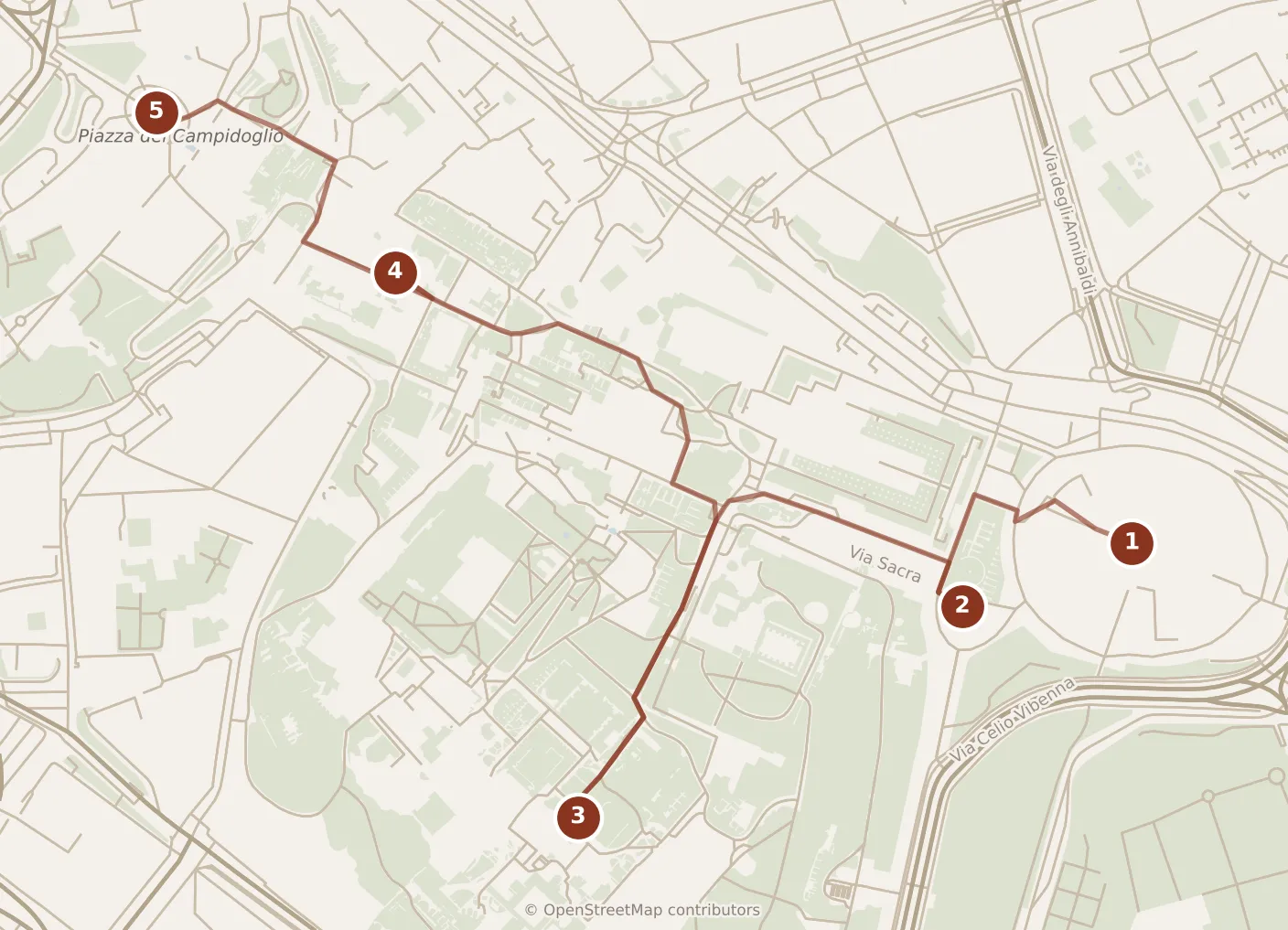
- Morning
- 1Colosseum
- 2Arch of Constantine
- 3Palatine Hill
- 4Roman Forum
- 5Piazza del Campidoglio
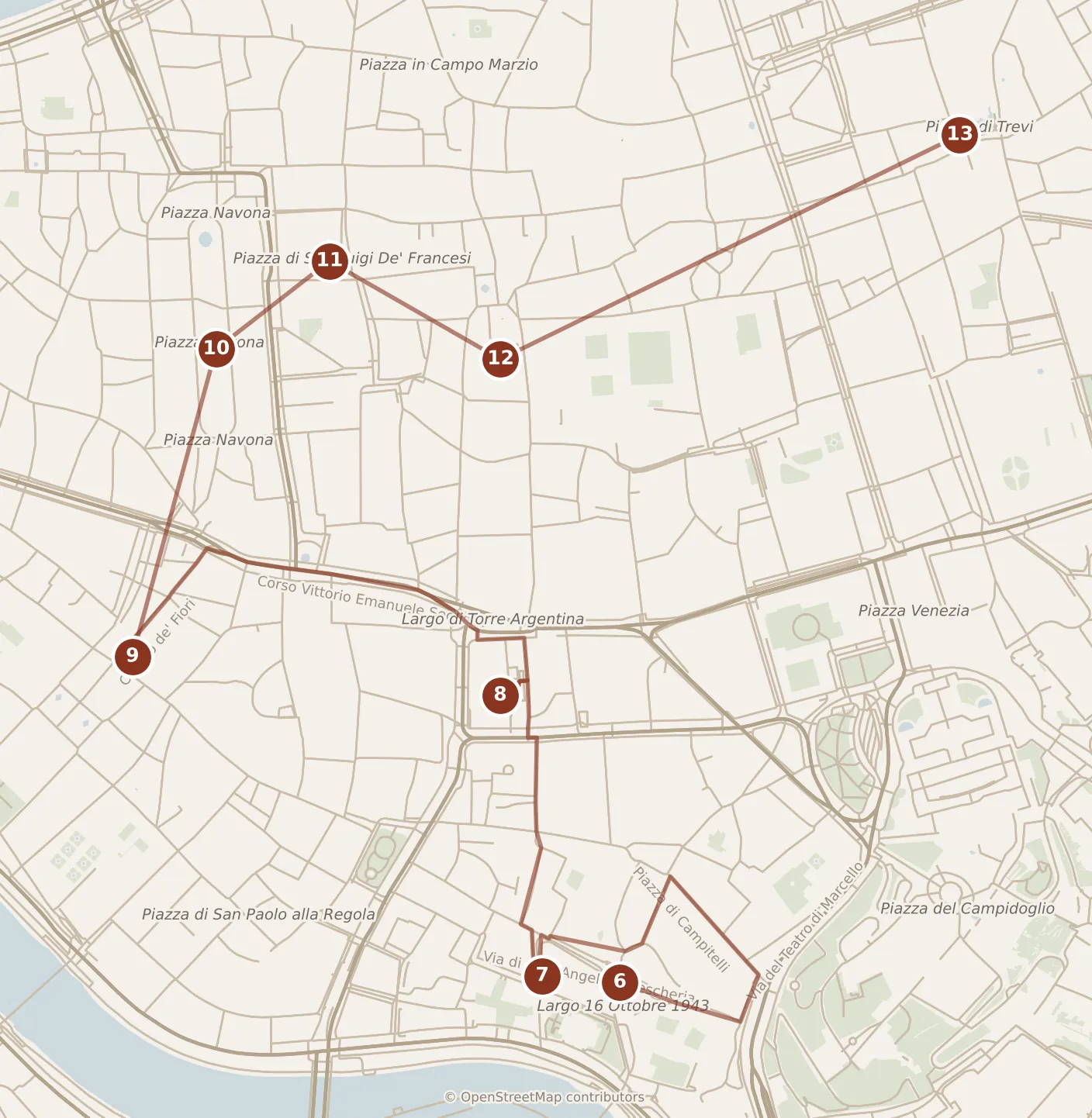
- Afternoon and evening
- 6Portico d'Ottavia
- 7Roman Ghetto
- 8Largo di Torre Argentina
- 9Campo de' Fiori
- 10Piazza Navona
- 11San Luigi dei Francesi
- 12Pantheon
- 13Trevi Fountain
Morning
Be at the Colosseum for your slot, and take the ordinary ticket rather than the one that puts you down on the arena floor. From the first two tiers you look into the hypogeum — the brick warren beneath the vanished floor, with its elevator shafts, animal pens and trapdoors laid open — and that is the view that turns the building from a ruin into a machine. The fuller ticket sells out furthest ahead and shows you the same warren from inside it. Give the ordinary one ninety minutes and leave while you still want more.
Outside, five minutes and no ticket: the Arch of Constantine, standing on its own between the amphitheatre and the hill. Read it as a collage rather than as a monument. Much of the sculpture on it was carved up to two centuries earlier for other emperors’ buildings and reused here with the heads recut, so the reliefs sit in three or four different styles at once and the joins are visible from the ground once you know to look.
Then onto the Palatine Hill, on the same ticket, and do the hill before the Forum. This is the ground the emperors built their palaces on and it stands directly above the Forum, so you spend forty-five minutes among brick vaults and a sunken garden shaped like a racecourse, looking down on the field you are about to walk through. The Forum makes sense from up here in a way it never does from inside it.
Come down into the Roman Forum and give it an hour, walking the Via Sacra from one end to the other. The mistake is to try to identify everything: it is a field of fragments, thinly labeled, and the reward is in three or four things rather than forty. The arch at the top of the slope is the one Titus’s brother put up for him, and the relief inside the archway shows the menorah being carried out of Jerusalem after the sack of the city. Halfway down, the house of the Vestals still reads as a courtyard with a garden and a row of statues. At the far end the Curia, the senate house, survives as an intact brick box, because it spent a thousand years as a church.
Leave by the western end, which puts you at the foot of the Capitoline. Climb the Cordonata, the shallow ramped stair Michelangelo designed to be ridden up, to Piazza del Campidoglio — his square, with its oval paving and a bronze horseman in the middle. The horseman is a copy; the original Marcus Aurelius is indoors in the Capitoline Museums on the square, along with the bronze she-wolf and a courtyard holding the wreckage of a colossal emperor, a head and a hand and a kneecap each the size of a small car. Twenty minutes, and instead of going in, walk round the side of the palace at the top of the square: a lane runs behind it to a railing above the Forum, free and unticketed, and it is where the whole valley finally resolves into a plan.
Local tip. The museums on this square are the one thing the day cannot have, and the choice is better made standing here than at four o’clock with tired feet. Two hours indoors costs you the Ghetto, the market square and the entire walk through the centro storico below. If you would rather have the bronzes, take them and let the afternoon stop at the Pantheon instead — the trade is real in both directions, and only one of the two halves can be unhurried.
Afternoon
Walk down off the hill and west, ten minutes, past the enormous white monument at Piazza Venezia and into the low streets beyond it. The Portico d’Ottavia is the way in: a ruined colonnade with a medieval church wedged bodily into the gap, and a fish market traded under the arch for so many centuries that it left its name on the church. Five minutes and one photograph.
Behind it lies the Roman Ghetto. Jews were confined to these few blocks by papal decree from 1555 and not released from them until 1870, in a quarter deliberately sited on the stretch of bank that flooded; small brass plaques set into the paving outside the doors name the people taken from those houses in 1943. Read the ground before you eat. Then eat, because this is the one lunch on the route the city gives you a reason to take in a particular place: carciofi alla giudia, a whole artichoke flattened and fried until the outer leaves go to glass, which is a spring dish and honest about being one — out of season the same kitchens carry the rest of the quarter’s own repertoire, and the reason to eat here stands. Give lunch an hour and sit down for it.
Four minutes north-west is Largo di Torre Argentina, which most visitors know only as something a bus goes round. It is a sunken square holding four temples of the republic, several centuries older than anything you saw this morning, and the meeting hall in which Caesar was killed stood at one end of it. Since 2023 a walkway takes you down into the excavation on a small ticket instead of leaving you to look over the railing, and that is worth twenty minutes. The colony of cats living in it is not a rumor.
Five minutes west, Campo de’ Fiori. By mid-afternoon the market has packed up and the square is bare, which is what one day can afford — you are here for the shape of the place and for the hooded bronze standing in the middle of it, Giordano Bruno, burned on that spot in 1600 and put back there in effigy by the anticlerical city of 1889. Ten minutes.
Piazza Navona is four minutes north, and its shape is the whole story: it is not a square but the floor of a Roman stadium built by Domitian, and the buildings around it stand on the line of the seating, which is why it is a long oval with rounded ends. Bernini’s fountain of the four rivers is in the middle and Borromini’s church front faces it. Half an hour, and do not eat here.
Two minutes on, San Luigi dei Francesi is free and holds three Caravaggios in a single side chapel — the calling, the inspiration and the death of Matthew — lit by a coin meter that somebody in the crowd always feeds. Fifteen minutes, and they are the best fifteen minutes of the afternoon. The two churches sit at this end of the day deliberately: Roman churches shut for a few hours in the middle of it and reopen in the later afternoon, and a church you walked twenty minutes to reach and found locked is what breaks a single day here.
Then the Pantheon, five minutes east. It has required a ticket since 2023, worth booking only to skip the line. The dome is still the largest unreinforced concrete dome ever built, nineteen centuries on, and the oculus is genuinely open — rain comes in, and the marble floor slopes to drains that have been doing that job since it was laid. The inscription across the front names Agrippa, who put up the first building on the site; what you are standing in is Hadrian’s replacement, which kept the older man’s name on the front. Half an hour.
Evening
Ten minutes north-east and the day ends at the Trevi Fountain, the one stop on this route that is better in the dark. The whole facade is a piece of theater, it is floodlit, and once the traffic thins the water is the only thing you can hear in the square. Since the fountain was cleaned in 2024 the space down at the basin has been managed with a line and a cap on numbers — and since early 2026 a small entry charge as well — so there is now an inside and an outside to it. The outside — the view from a few steps back — is free, needs no line and is the better one anyway, because a facade built as theater wants the distance.
Then walk back down into the lanes between the fountain and the Pantheon to eat, and let that part of the evening go unplanned. The lanes between the fountain and the Pantheon are largely free of traffic after dark, the streets are lit, and every square you crossed in daylight is a different place with the day crowds gone out of it. Carbonara and cacio e pepe are the two plates to look for; where to eat them is the city guide’s business rather than this article’s.
Practicalities
One thing wants buying before you leave home and it is the only one: the timed Colosseum entry, which also admits you to the Roman Forum and the Palatine Hill on the same visit. Slots are released about a month ahead and the earliest go first, so buy it the day they open and take an opening one, because it is the pivot the day turns on. The slot skips the ticket office, not the security check — that wants fifteen to thirty minutes of the morning, which is one more reason the opening slot is the good one. The Pantheon has needed its own small ticket since 2023, worth booking a day or two ahead purely to skip the line; it is free on the first Sunday of the month, when there is no booking and a much longer line instead. Largo di Torre Argentina takes a small ticket at the door. Everything else here — the arch, the Capitoline square and its terrace, the Ghetto, the two piazzas, the church of the Caravaggios and the fountain — is free. How the metro and the buses are paid for, and everything else about arriving, belongs to the city guide and is worth reading before you come.
Closing times matter more on one day than on any other. The archaeological park follows the sun: it shuts near sunset and stops admitting an hour or so before that, so the usable afternoon is much shorter in winter than in summer, and the early slot is worth most in the months when it looks least urgent. Roman churches close for a couple of hours in the middle of the day and reopen later on, which is why the two on this route sit at the end of the afternoon rather than after lunch. On a Sunday morning they belong to their congregations.
Local tip. If your one day falls on a Monday, take this route as written rather than rearranging it. Everything on it is a ruin, a square, a church or a fountain, and Monday is the day most of Rome’s museums are shut — so the closure that wrecks more short trips here than any other cannot touch this one. That is not luck. It is only true because the day gives the museums up in the first place.
Getting between the stops is walking, all of it: four or five kilometers across the day, with no single stretch much longer than ten minutes, and no point on the route where a bus would save you anything.
If Rome is a day between trains rather than a stay, the shape helps you at both ends. The Colosseum is two stops on the metro from the main station, and the Trevi Fountain, where the day finishes, is a twenty-minute walk back to it. Leave the bag at the station’s left-luggage office before you start: everything above assumes your hands are empty.


