Paris in a week: one quarter a day, the big museums in full, and a day at Versailles

Last updated 27 July 2026
Overview
A week is the length at which Paris stops being a checklist of things you have already seen photographs of, and the trap is to treat the extra days as room for more of them. It is not. The city is dense but it is genuinely big, and the two things that ruin a long visit here are crossing it twice a day and giving ninety minutes to places that need four hours.
So this is one quarter a day, walked. Each day below is a place rather than a theme: you come up from the métro once in the morning and the rest of it is on foot, with the single exception of the day that leaves the city altogether. That also means the week barely depends on where you sleep — every day begins at a station, so any base the city guide recommends will serve it, and choosing between them is that article’s job rather than this one’s. The one day the base shows is day five: the train to Versailles is RER line C, which runs along the Left Bank and the river, so a base on that side saves a change on the morning that hangs on a timed ticket.
The shape of the week is set by four things a short trip in Paris has to give up. The Louvre, which cannot be done in the ninety minutes a day trip can spare and is better not started than started badly. The Marais, which is streets rather than monuments and only works slowly. Montmartre, which is half a day before you have climbed anything. And Versailles, which is a day, not an excursion, and ruins the day it is squeezed into. Each of those gets a whole day here — days two to five — and that is what the extra time is actually for. Around them, day one takes the island the city started on and the old university hill behind it, day six takes the grand Left Bank quarter and ends at the top of the tower rather than underneath it, and day seven goes east into the part of the city nobody photographs and everybody lives in.
Two appointments fix the week and both are timed tickets bought before you leave home: the Louvre on day two and the palace on day five. Between them they also carry the week’s only real planning problem, because the Louvre and almost everything else here take different days off, and seven days is exactly long enough for those closures to collide. The last section resolves the whole thing into one instruction, and it is the most useful sentence on this page.
One omission worth stating rather than leaving a reader to discover. The city’s great modern-art collection, on the western edge of the Marais, closed in September 2025 for a rebuild announced to run until 2030; the Centre Pompidou is showing work in other venues meanwhile. If you are working from an older list of Paris museums, that is the entry that has gone, and day three passes within a few streets of the building rather than going into it.
Day one

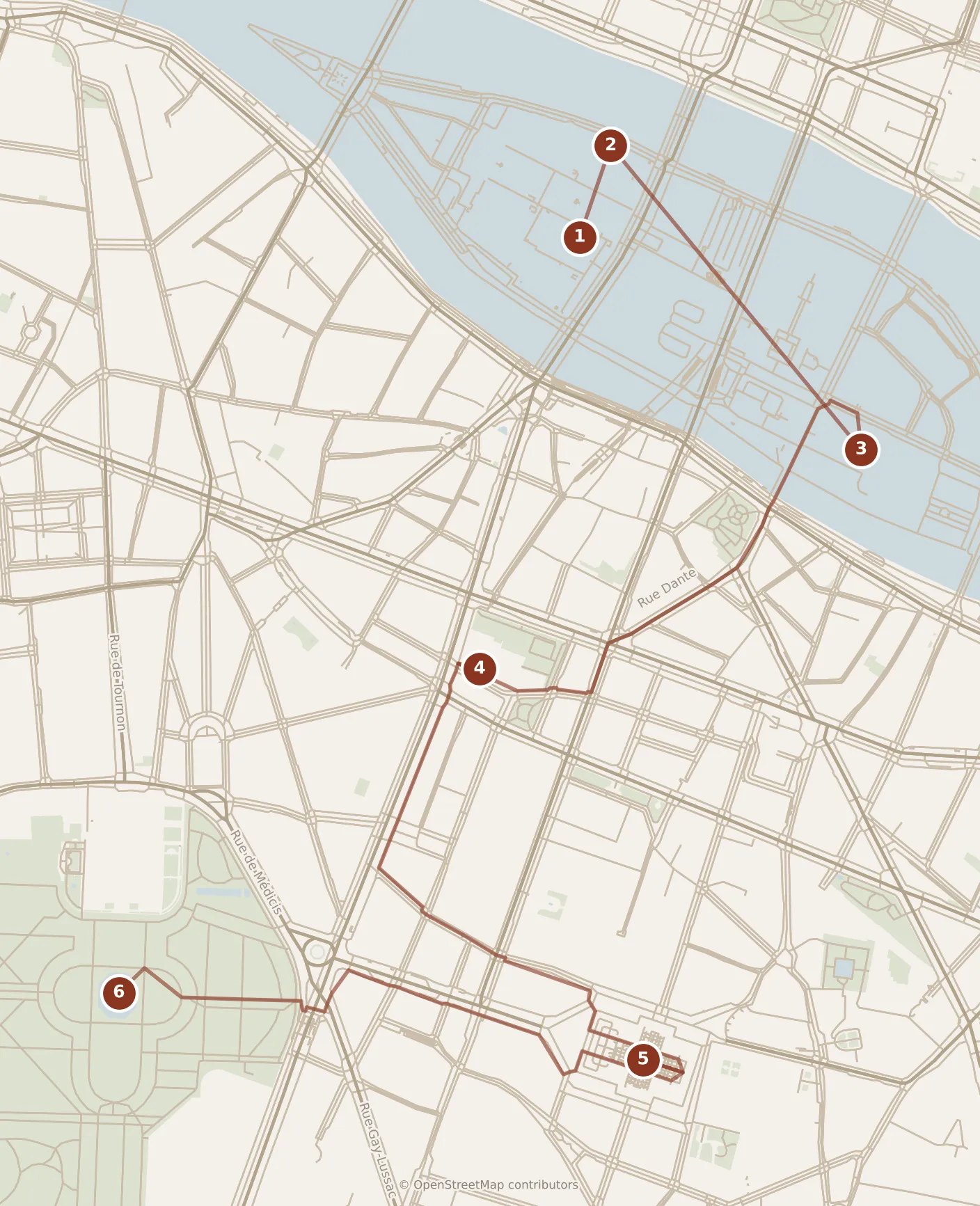
- Day one
- 1Sainte-Chapelle
- 2Conciergerie
- 3Notre-Dame
- 4Musée de Cluny
- 5Panthéon
- 6Jardin du Luxembourg
The island the city was founded on, and the hill behind it. This is the only day that touches the postcard core, and it is deliberately first: get it behind you and the rest of the week stops feeling like an obligation.
Start at Sainte-Chapelle, at opening. It stands inside the old palace enclosure among working law courts, so there is a security check at the gate, and that rather than the building is what makes the line slow later. You come in at the bottom, into a low painted chapel built for the palace servants, and a corner staircase takes you up into what the whole structure exists for: a room with almost no wall left in it, fifteen windows of thirteenth-century glass running from waist height to the vault. Sit down for a few minutes instead of circling — eyes take time to adjust, and on a bright morning the room does something it cannot do under cloud. Forty minutes.
Two minutes away, in the same enclosure, the Conciergerie is what remains of the royal palace that stood here before the kings moved across the river, and buying the two together on one ticket is the sensible move. The ground floor is the Salle des Gens d’Armes, a vaulted hall of about 1300 built to feed two thousand palace staff and one of the largest surviving secular Gothic rooms in Europe; the point of seeing it directly after the chapel is that they are the same building, read twice — one wing for the king’s soul and one for his household. Upstairs the building’s second life takes over: it became the revolutionary prison, and Marie-Antoinette was held here for two and a half months before her execution in 1793, her cell reconstructed on the spot as a chapel. Forty-five minutes.
Five minutes east along the island is Notre-Dame, which reopened in December 2024, five years after the fire. What startles anyone who knew it before is not the rebuilt spire but the color: the stone was cleaned during the works, so the interior is pale and bright where it used to be brown. Entry is free and the free timed slot is worth having, since without one you join a line that is long in season. Forty-five minutes inside. The towers reopened separately in September 2025 as a ticketed climb of several hundred steps, sold online only, and a week has room for it — this is the morning to take it, because you will not come back to this island. Allow an hour with the line, and know that it makes day one the fullest of the seven: with the towers this is a day that runs from opening until the light goes, with one hour in the middle of it for lunch and no slack anywhere else. The free slot for the cathedral itself is released only a couple of days ahead, so it is the one booking on this route to set a reminder for.
Cross to the Left Bank and walk ten minutes into the Latin Quarter to the Musée de Cluny, which is two buildings in one: a Gallo-Roman bath house of around the year 200, whose cold room survives whole and is used as a gallery, with a late-medieval abbot’s mansion built into it. The reason to come is The Lady and the Unicorn, six tapestries of about 1500 hung in a room of their own, five of them illustrating the senses and the sixth arguing about what the other five are for. The other thing to find is a row of twenty-one battered stone heads: the Kings of Judah from the front of Notre-Dame, hacked off in 1793 and buried, and dug up by accident under a bank courtyard in 1977. Ninety minutes.
Eight minutes uphill past the Sorbonne is the Panthéon, begun as a church and finished as the revolution’s mausoleum, which is why a building shaped like a temple has almost nothing in it. A pendulum hangs from the dome, repeating the demonstration Foucault gave here in 1851 that the earth turns underneath it. The crypt is the visit: Voltaire and Rousseau facing each other across a passage, having disliked each other in life, then Victor Hugo, Zola, Marie Curie and Josephine Baker. From April to October the outdoor colonnade around the dome is open, 206 steps up a spiral with no elevator, and it is the best view of this half of the city. An hour and a half with the climb, an hour without.
Finish eight minutes west in the Jardin du Luxembourg, laid out from 1612 for Marie de’ Medici around the palace that is now the Senate. It is a formal garden used as a public one: free green chairs that move, an octagonal basin where children push rented model sailboats with sticks, an orchard of trained fruit trees, and a long dripping fountain at the end of a narrow basin under deep trees that most people walk past without seeing. Take a chair, face the water and do nothing for half an hour. The day has been churches and museums and it should end sitting down.
Local tip. Buy the chapel and the Conciergerie on the single joint ticket and do the chapel first, in that order and no other. The chapel is the one whose value depends on the light and on the room being empty, and both are gone by mid-morning; the Conciergerie is a stone hall that looks the same all day.
Day two

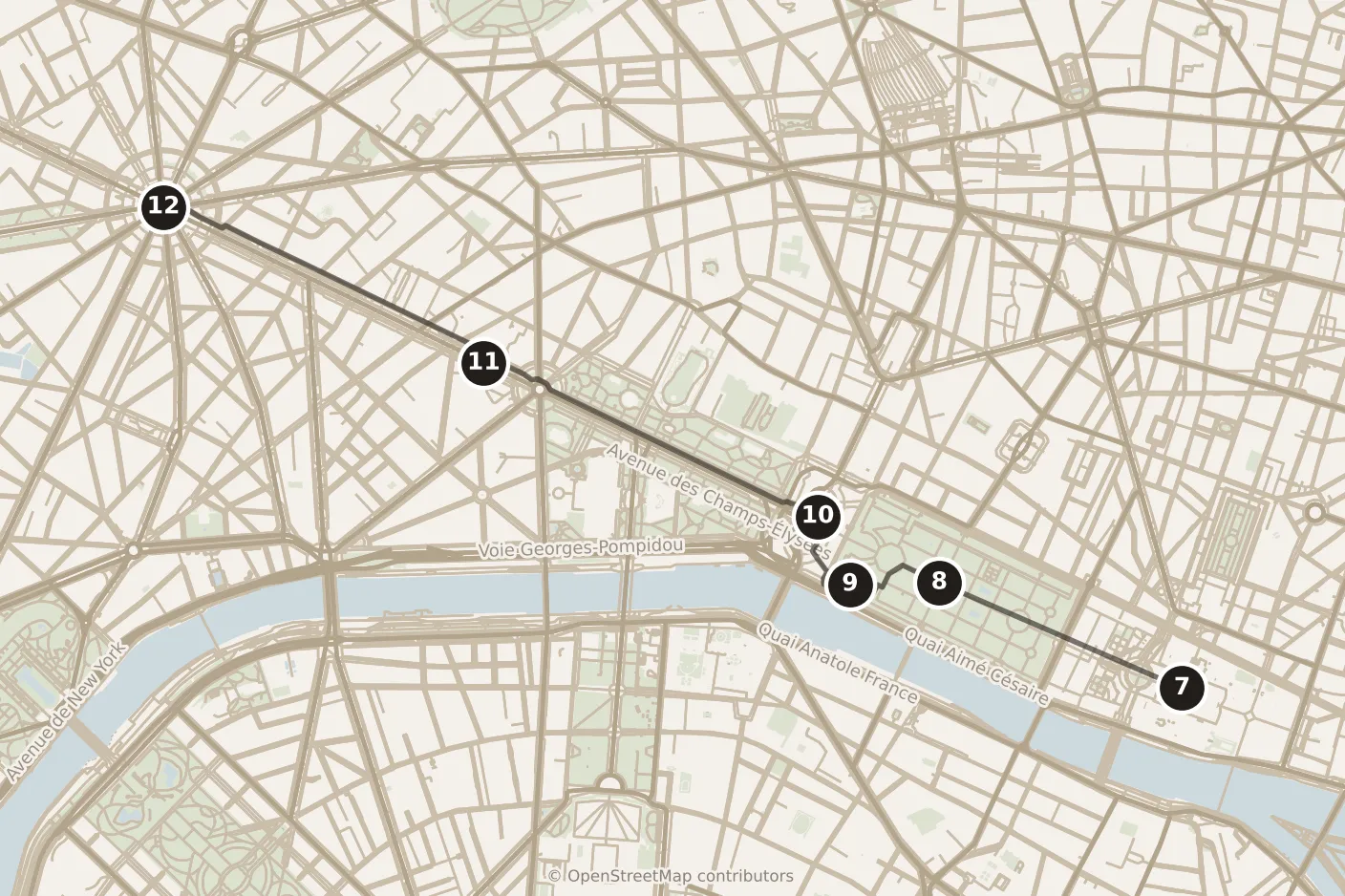
- Day two
- 7Louvre
- 8Jardin des Tuileries
- 9Musée de l'Orangerie
- 10Place de la Concorde
- 11Champs-Élysées
- 12Arc de Triomphe
The Louvre, and then the straight line west that the city was rebuilt around. It is the biggest museum day of the week and the second half of it is all open air, which is the right order.
The Louvre is not a museum you finish, and everything about a good visit follows from admitting that. It has three wings — Denon, Sully and Richelieu — and the discipline is to take one properly and half of another. Choose before you go in, at breakfast, not in the entrance hall under the glass pyramid. Denon is the famous one: Italian painting, the Winged Victory of Samothrace at the head of a staircase where it stops everybody dead, and the Mona Lisa. Sully holds the Venus de Milo and the Egyptian rooms, and in its basement the moat and the base of the keep of the fortress Philippe Auguste built here around 1190 — the reason there is a palace on this spot at all, and the emptiest rooms in the building. Richelieu is the one nobody chooses: French sculpture standing in two glass-roofed courtyards, the Cour Marly among them, northern European painting, and the Napoleon III apartments, kept as they were furnished, which are the most surprising rooms here.
About the Mona Lisa, plainly, so it does not eat your morning: she hangs in the Salle des États behind glass at the end of a managed line, and what you get is a short look from a barrier several meters back, over other people’s phones. It is worth doing once and it is worth doing early. It is not worth an hour, and the room is the only part of the Louvre that feels like a station concourse. Three hours in the building is a proper visit; five is an endurance test that people mistake for thoroughness.
Come out into the Jardin des Tuileries, which begins at the palace door. Le Nôtre laid it out in the 1660s for a palace at its far end that burned in 1871 and was cleared away, which is why the garden now runs out into open air and why you can stand in it and see the entire axis in one line, from the Louvre behind you to the arch on the skyline ahead.
At the western end of the garden the Musée de l’Orangerie is an hour and the best hour of the afternoon. Two oval rooms were built to Monet’s own instructions to hold eight water-lily panels, curved to the walls and lit from above by daylight, so the paintings wrap round you rather than hang in front of you; a compact collection sits underneath. If the Louvre has finished you, skip it without guilt — but it is the only room in the city designed around the pictures in it rather than the other way round.
A few minutes further west the garden ends at the Place de la Concorde, which is an enormous traffic circle and loud with it, so cross it rather than linger. The obelisk in the middle is three and a half thousand years old, came from Luxor and was raised here in 1836; the guillotine stood on this square, and the square advertises that fact hardly at all.
Then the Champs-Élysées, and an honest word about it: it is a wide shopping avenue with several lanes of traffic down the middle, and it is not the best walk in Paris. Walk it anyway, once, uphill, twenty-five minutes, because it is the only way to feel the ground rise towards the Étoile and understand why the arch was put where it was. At the top, do not try to cross the roundabout on the surface — twelve avenues meet there, the traffic runs without lanes, and the underground passage from the avenue is the only sane way in. The Arc de Triomphe is 284 steps up a spiral stair, with an elevator reserved for visitors who cannot manage them and more steps waiting at the top of it even then. Go up at the end of the afternoon: from the roof the twelve avenues run out like spokes, the tower stands clear across the rooftops, and the whole axis you have spent the day walking is laid out behind you in one line. An hour with the climb.
Day three

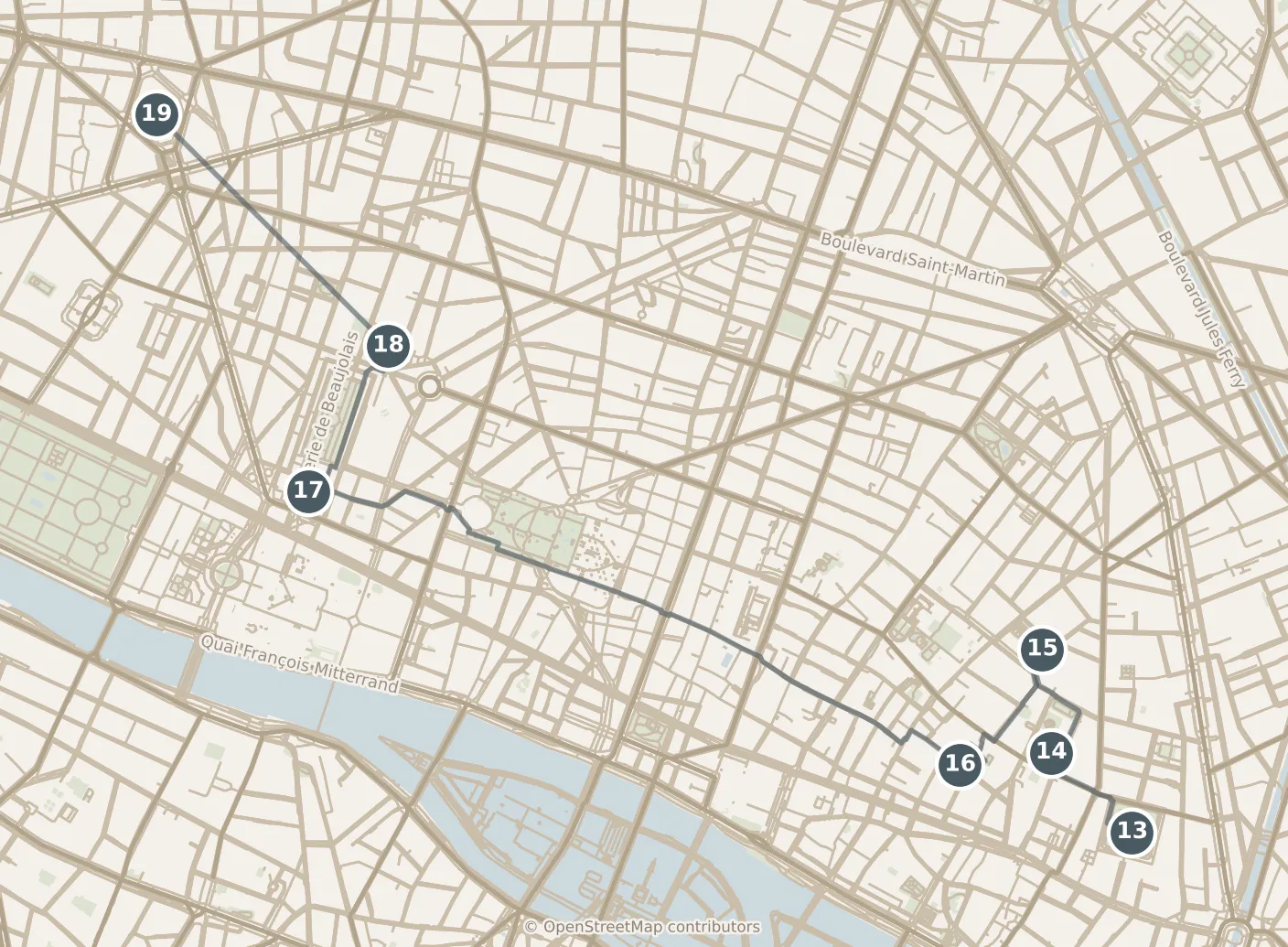
- Day three
- 13Place des Vosges
- 14Musée Carnavalet
- 15Musée Picasso
- 16rue des Rosiers
- 17Palais-Royal
- 18Galerie Vivienne
- 19Palais Garnier
The Marais, and then a straight walk west into the covered arcades. This is the longest day on its feet and the least demanding otherwise: two museums, and after that streets.
Start early at the Place des Vosges, built between 1605 and 1612 as the Place Royale and the oldest planned square in the city. Thirty-six pavilions of red brick and pale stone stand to one design on all four sides, with an arcade running unbroken round the ground floor and a square of gravel and limes in the middle. It set the pattern for the residential squares built across Europe after it. The house Victor Hugo lived in occupies one corner and is a free museum; twenty minutes in the square and twenty more if you go in.
Local tip. On a Thursday or a Sunday, start five minutes further east than the square. The food market that runs up the boulevard from the Bastille end of the quarter takes those two mornings and is one of the largest in the city — a hundred-odd traders down several hundred meters of sidewalk — and it packs up in the early afternoon. It is the one thing on day three that exists on no other day of the week. A Tuesday start lands this day on the Thursday and a Friday start on the Sunday, so on either of those you would have to work at missing it; a Sunday start puts day three on a Tuesday, and then it is simply not there.
Five minutes north-west, the Musée Carnavalet is the history of Paris told in two connected mansions, and its permanent collection is free. It runs chronologically and the pleasure of it is that it collects objects rather than art: painted shop signs taken down from streets that no longer exist, a whole art-nouveau jewelry shop interior by Mucha reassembled indoors, keys and models from the revolution, and the cork-lined bedroom Proust wrote in, moved here entire. Do not sweep it. Pick the century you care about and give it ninety minutes.
Five minutes on, the Musée Picasso occupies the Hôtel Salé, a salt-tax farmer’s mansion of the 1650s with a staircase worth the ticket by itself. What makes the collection unusual is where it came from: it is what was in the artist’s own studios and houses when he died, taken by the state in place of inheritance tax, so it is not a curated selection of his best work but the work he chose to keep, including his own collection of other painters. Ninety minutes.
Ten minutes back down towards the river is the rue des Rosiers, the spine of the old Jewish quarter and where lunch goes: falafel counters with lines on the sidewalk, bakeries, and a handful of shops that have been there for generations. Two practical things. The kosher places close for the sabbath, from Friday evening to Saturday evening, which is the one day this stop does not work. And this street is the busiest few hundred meters in the quarter at lunchtime, so eat standing up like everyone else rather than looking for a table.
Then walk twenty-five minutes west along one street, past the Hôtel de Ville, to the Palais-Royal. The modern-art museum’s building site is not on that street — it stands a few minutes north of it, behind its own hoardings — so if you want to see the scaffolding you turn off for it deliberately, and otherwise you keep going. Its garden is enclosed on all four sides by arcades, and that enclosure is the whole effect: you go through an archway off a loud street and the traffic simply stops. It fills with office workers in the middle of the day and empties again, and at either end of the day it is one of the calmest places in the middle of the city. In the front courtyard stand Buren’s black-and-white striped columns, installed in 1986 and loathed at the time, cut to every height from ankle to shoulder so that the courtyard is permanently full of people walking along the tops of them. Free, and half an hour.
Five minutes north, the Galerie Vivienne of 1823 is a glass-roofed shopping arcade with a mosaic floor and a half-turn in the middle, one of a couple of dozen survivors from the hundreds built before department stores made them pointless. It takes ten minutes and the ones around it are the real reason to be here — the Passage des Panoramas, across the boulevard, is older, scruffier and full of stamp and postcard dealers.
Finish ten minutes north at the Palais Garnier, finished in 1875. The staircase inside is the building’s actual subject: it is a theater designed so that arriving was the performance, with a double flight of marble under a painted vault built to be looked at from every balcony by people watching each other. The auditorium ceiling was repainted by Chagall in 1964 over the original, which was controversial and is now simply what is there. It is a working opera house, so the auditorium is not always open to visitors — rehearsals close it at short notice — while the staircase and the foyers are open regardless, and they are the part you came for. An hour.
Day four

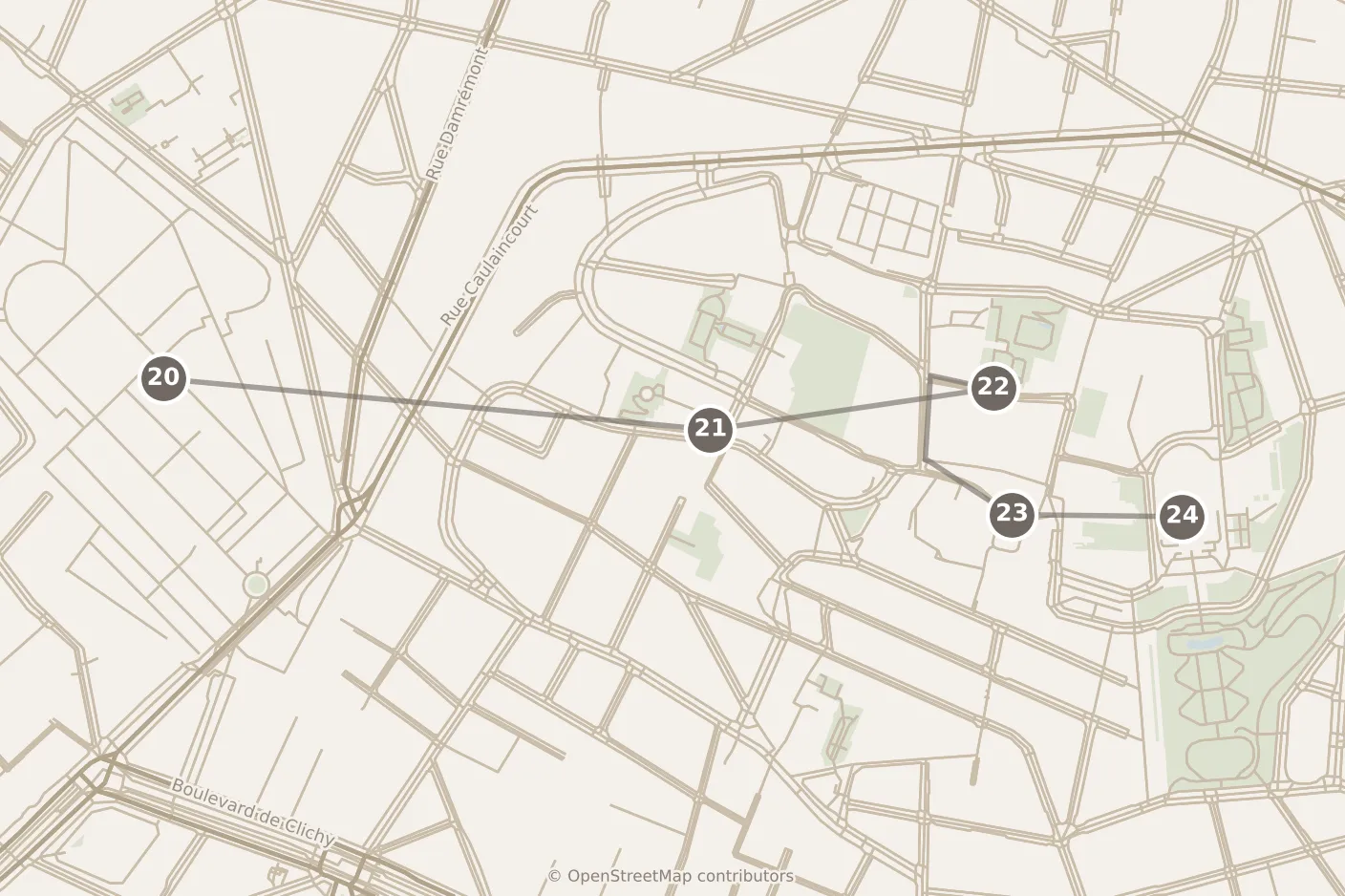
- Day four
- 20Montmartre Cemetery
- 21Moulin de la Galette
- 22Musée de Montmartre
- 23Place du Tertre
- 24Sacré-Cœur
Montmartre, climbed from the bottom, which is the whole trick of the day. The hill is a village that Paris grew around rather than a district it built, and arriving at the summit by métro skips everything that makes that legible.
Start at the Montmartre Cemetery, at the foot of the western slope. It was dug into an abandoned gypsum quarry, so it lies below the level of the streets and a road bridge crosses straight over it on iron pillars, which means you look down into it before you go in. It is quieter and more overgrown than the great cemetery in the east and takes three quarters of an hour: Degas, Berlioz and Nijinsky are here, and so is Zola’s tomb, although Zola himself was moved to the Panthéon in 1908 and the grave was left standing.
Climb the rue Lepic, which winds because the hill is steep, to the Moulin de la Galette. Dozens of windmills once ground grain and pressed grapes up here when this was open country outside the city; two survive, both part of what was the Moulin de la Galette, the open-air dance garden Renoir painted in 1876. One stands on a street corner and the other on the higher ground behind it. Neither can be visited — they are things you look at from the sidewalk, and knowing that in advance saves you hunting for a door.
The Musée de Montmartre, five minutes on, is the oldest house on the hill and was studios for a long list of painters, Renoir among them; its gardens have been replanted the way he painted them and are the reason to come, since they look out over the north slope with almost nobody in them. Below them lies the Clos Montmartre, a working vineyard of about fifteen hundred square meters planted in 1933 on ground the city had refused to build on, harvested every October with a procession. An hour for the house and the gardens together.
Two minutes away is the Place du Tertre, and this is the part of the hill that has to be taken on its own terms. It is a small square packed edge to edge with painters at easels selling portraits, and it has worked that way for a century, which makes it either a survival or a tourist trap depending on your mood. You will be approached repeatedly. Ten minutes, walking through, is the right amount.
Sacré-Cœur is two minutes further and closes the day. It was begun in 1875, finished in 1914 and consecrated after the war, and it is built of a stone that bleaches itself in rain, which is why a church in a coal-burning city has never looked dirty. The inside is free and worth twenty minutes for the mosaic filling the apse. The dome is a separate ticket and 300 steps with no elevator, and it is one of the highest places you can stand in the city. Then take the steps down onto the terrace and stay for the light going: the whole city lies below in one piece, flat and low, with the hill you are on the only thing above it. This is the single most worked crowd in Paris, so keep your bag in front of you and expect to be sold things.
Then walk down into Abbesses to eat, rather than eating on the summit. It is five minutes downhill, it is where the hill is residential rather than performed, and the difference between the two is roughly the difference between the two halves of the day. This is the wrong end of the day for the funicular, which runs up and down the other face of the hill; Abbesses is downhill and west of the summit and it is fifteen minutes on your feet.
Day five

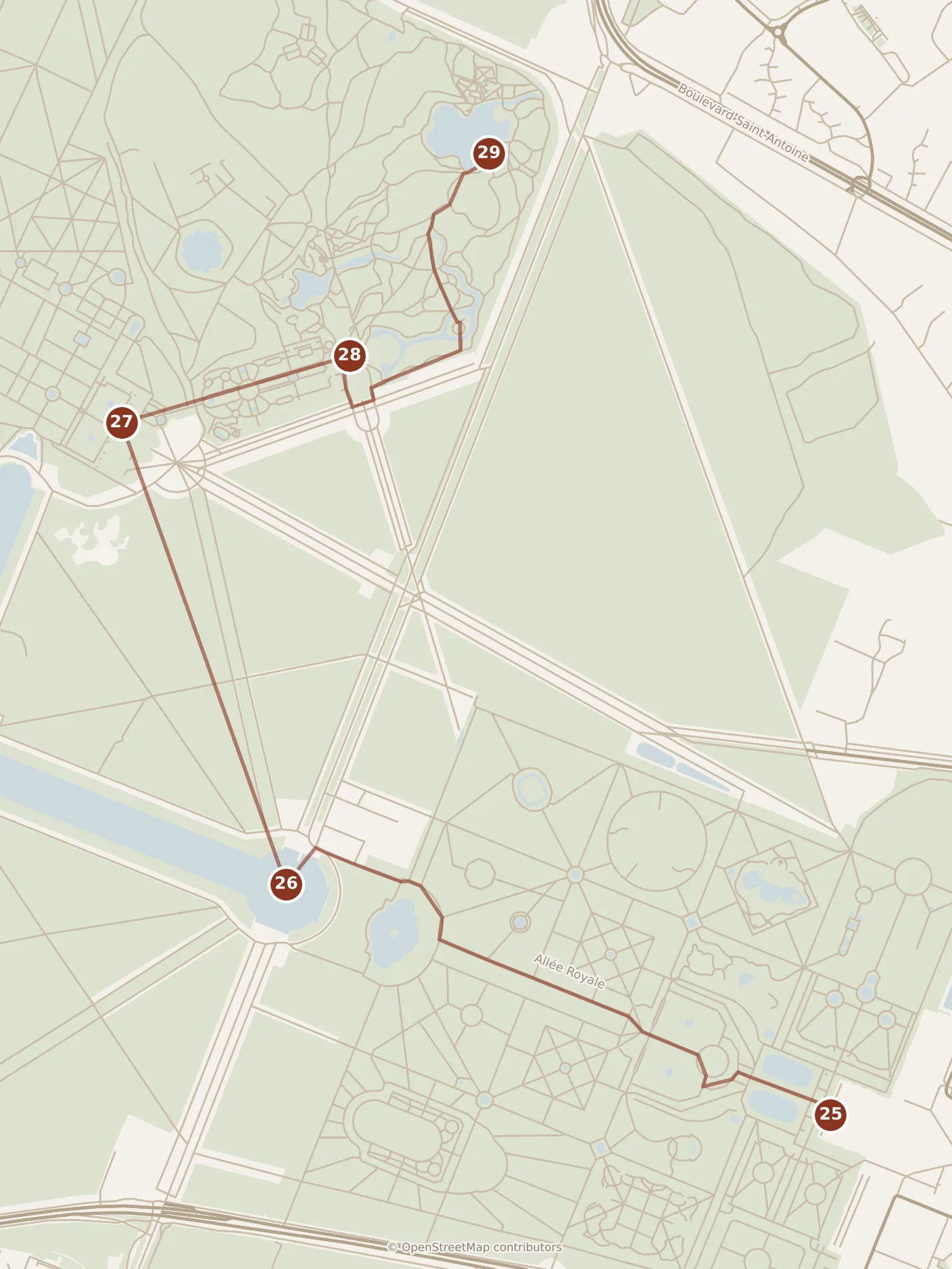
- Day five
- 25Palace of Versailles
- 26Gardens of Versailles
- 27Grand Trianon
- 28Petit Trianon
- 29Queen's Hamlet
The one day that leaves the city, and it takes the whole of it. Versailles is about forty minutes out on the suburban express line that runs along the Left Bank, to the nearer of the town’s three stations, and about ten minutes on foot from there. Every station it calls at in the center is on the Left Bank, which is worth knowing when you choose where to sleep: from the Right Bank this day starts with a crossing. Know the fallback before you go, because this is the day that hangs on a timed ticket and that line is the one most often cut for weekend engineering work — two mainline stations also run ordinary trains out to the town, landing at the other two stations, both a longer walk to the gates. It is closed on Mondays, the palace needs a timed ticket booked before you travel, and there is no version of this that is also a Paris afternoon.
Be at the Palace of Versailles for your slot and early rather than late. The state apartments are a one-way route through a fixed sequence of rooms and by the middle of the morning it is a slow-moving crowd rather than a visit. The room everything builds to is the Hall of Mirrors: seventeen mirrored arcades facing seventeen windows down the length of the garden front, built when mirror glass was among the most expensive substances money could buy and hung to double the daylight coming off the park. What is worth understanding before you walk it is that none of this was private. The king’s bedroom was a public room with a rail across it, courtiers watched him get up and go to bed as a matter of ceremony, and the building is best read as a machine for keeping several thousand nobles where Louis XIV could see them. Two hours.
Then the Gardens of Versailles. They are free only outside the fountain season: from the beginning of April to the end of October the fountains are run to music on most of the days the estate is open — as the full show on weekends, as a quieter musical-garden version on weekdays — and the gardens are ticketed on every one of them. Unless you are traveling in winter, assume you are paying to walk into them, and put that on the same booking as the palace rather than settling it at the gate. Le Nôtre did not design a garden here so much as a landscape: one axis running west for as far as the eye goes, with hedged outdoor rooms opening off it, each holding a basin or a piece of sculpture, and at the end of it the Grand Canal, a kilometer and a half of water dug in the shape of a cross. Walk the axis at least as far as the head of the canal. The fountains do not run continuously and never have — there was never enough water — so seeing them play means being there in the season from April to October and walking round after them as they are switched on in turn.
The Trianon estate is at the far end of the park, it is shut on Mondays like the palace, and it does not open until the middle of the day, which decides the order of the day for you. It is a two-kilometer walk from the palace across open ground; there is a road train, and bicycles and small electric cars can be rented near the canal if the walking is too much. Eat before you cross it. The head of the Grand Canal is where this day naturally breaks and where its food is — a sit-down brasserie on the water and a couple of kiosks out in the gardens, with a tea room inside the palace and another beside the Petit Trianon if you would rather wait. It is the last of it before the Trianons, and on a six-to-eight-kilometer day that matters more than it sounds. The Grand Trianon is a single-story building faced in pink marble where the king went to not be at court, and the scale of it after the palace is the point. The Petit Trianon, a few minutes on, is a small neoclassical house that Marie-Antoinette was given outright and ran on her own rules, admitting people by invitation rather than by rank, which scandalised a court whose entire logic was rank.
Behind it is the Queen’s Hamlet, and it is stranger than its reputation. A dozen cottages with thatched and deliberately cracked walls stand round a lake with a mill and a dairy, built in the 1780s as a place to walk to and be rustic in — and also a functioning farm that supplied the household with milk and eggs, which the story of playing at peasants usually leaves out. Give it an hour and walk back slowly; the estate is six to eight kilometers of walking on the day if you do all of it on foot, and it is the longest day of the seven.
Local tip. If your palace slot is late in the morning, invert the day rather than waiting about: take the gardens first, go into the palace when your slot comes, and keep the Trianons for the afternoon, which is the only part of the estate whose hours are fixed against you. The gardens are the one component here that is never shut and never timed, which makes them the right thing to move — buy the garden ticket with the rest and you can walk in whenever the day leaves a gap.
Day six

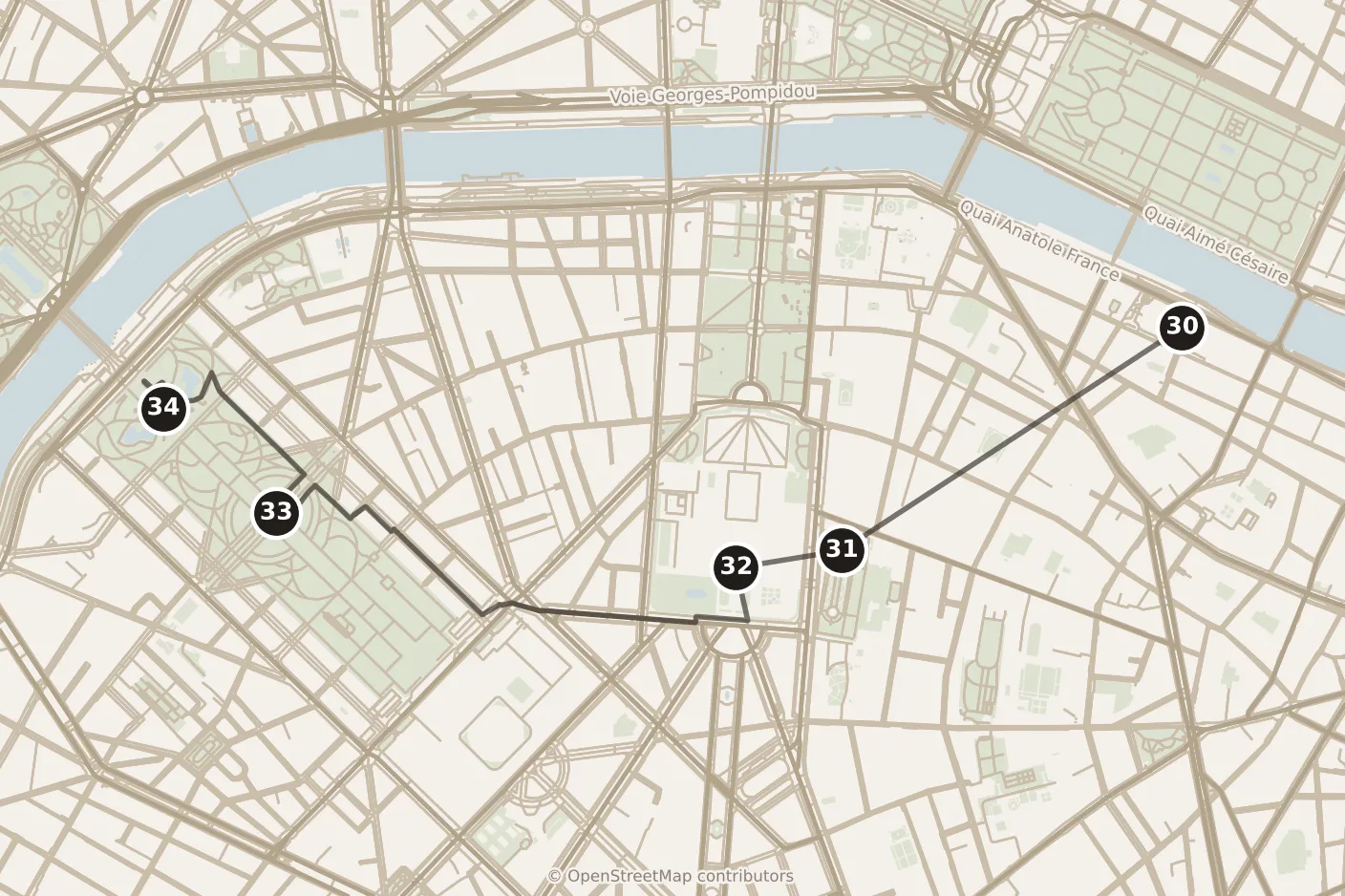
- Day six
- 30Musée d'Orsay
- 31Musée Rodin
- 32Les Invalides
- 33Champ de Mars
- 34Eiffel Tower
The grand Left Bank quarter, and the day the week has been saving the tower for. Everything below is one walk of about three kilometers, and it ends at the top of the tower.
Be at the Musée d’Orsay when it opens. It was built as a railway terminus for the world’s fair of 1900 and killed by its own success — the platforms were too short for longer trains within forty years — and the main hall still reads as a station, which is half the pleasure of standing in it. Go straight to the top floor for the Impressionists before you look at anything on the way up: they are what most people come for and the rooms are unbearable by mid-afternoon. Then, and this is what a week buys you here, come back down and take the rest, which a shorter trip never has time for — the sculpture down the middle of the nave, the Post-Impressionist rooms with the Van Gogh self-portraits, and a floor of art-nouveau furniture that explains half of what you saw in the Marais. Two and a half hours. One of the station’s great clock faces has been left as a window, and you can stand behind it and look north across the river.
Twenty minutes’ walk west is the Musée Rodin, in the Hôtel Biron, the eighteenth-century house the sculptor rented rooms in and eventually gave the state along with everything in it. The garden is the reason to come rather than the interior: The Thinker and The Gates of Hell stand outdoors in a formal walled garden with chairs and gravel walks, which is the way the work was meant to be seen and is not how sculpture is usually shown. Indoors there is a room of Camille Claudel, whose work is the thing most people leave talking about. Ninety minutes, and it carries a crowd better than anything else on this route, because most of the visit is outdoors and a garden absorbs people in a way a gallery cannot.
Five minutes on, Les Invalides was built in the 1670s as a hospital for wounded soldiers, is still partly military, and holds two separate things. Under the gold dome is Napoleon’s tomb: a sarcophagus of red stone on a green granite base, set in a circular well sunk into the floor so that you look down onto it from a gallery, which was designed to make you bow your head. Around the courtyard is the army museum, which is enormous; the medieval and renaissance armor is the part worth the time and the rest can go. It is open every day of the week except the first Monday of the month, which matters when you are arranging the others. Ninety minutes for the tomb and one gallery.
Then walk fifteen minutes to the far end of the Champ de Mars, the old parade ground with the École Militaire closing it, and take the tower down the length of the lawn on foot. Arriving at it from a distance is a different experience from surfacing underneath it, and it costs you nothing but the walk.
This is the day you go up the Eiffel Tower, and it is the clearest thing a week gives you that a short trip cannot. Elevator tickets are released up to sixty days ahead on the tower’s own site and the summit goes first — so this is booked when the trip is booked, months before the rest of the week is planned. Go up in the last hour of daylight and you get the city lit by the sun and lit by itself in one visit. The second level is the better place to look from: you are close enough to read streets and pick out the day’s walking, where from the summit the city flattens into a map. Come down and eat east of here, because this quarter is handsome and almost entirely closed in the evening.
Local tip. If the elevator tickets have gone, the stairs to the second level are a separate, cheaper ticket sold at the pillar on the day, and the climb up through the ironwork is the more interesting way up in any case. That is the whole reason to mention them: they are the option still open to somebody who booked nothing, and the second level is where you wanted to be anyway.
Day seven

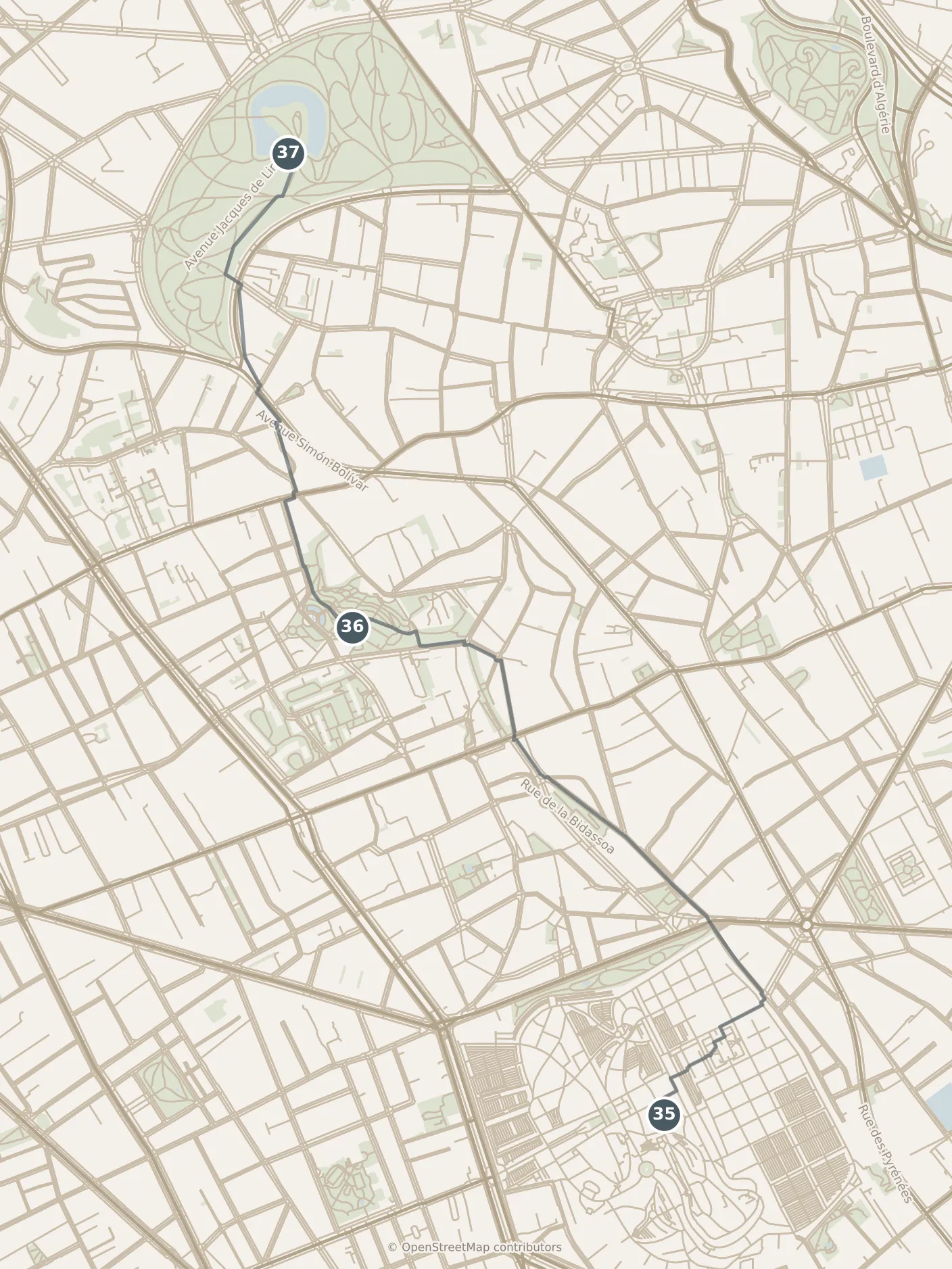
- Day seven
- 35Père Lachaise Cemetery
- 36Parc de Belleville
- 37Parc des Buttes-Chaumont
- Canal Saint-Martin — in the prose, not on the map
East, out of the monumental city and into the one a great many Parisians actually live in. Nothing on this day is indoors, nothing has an opening hour that can wreck it, and that is not an accident — it is why this day is here and not somewhere else in the week.
Père Lachaise Cemetery opened in 1804 on a hill that was then outside the city, and nobody wanted to be buried so far out of town. So the administration ran what was, plainly, a marketing campaign: it moved the remains of Molière and La Fontaine here in 1817, along with a medieval pair of famous lovers, and within a generation it was the address everybody wanted. It is now laid out like a small city, with cobbled avenues, numbered divisions and steep lanes of tombs built as chapels, and it is genuinely easy to get lost in — come in by the main gate at the foot of the hill, on the boulevard, and take one of the free maps there — wandering is pleasant, hunting without a map is not, and that is also the side you come back out of for the walk on to Belleville. Chopin is here, though his heart was taken to Warsaw; Oscar Wilde’s tomb has stood behind a glass screen since 2011, put up to stop the lipstick kisses that were eating the stone; Jim Morrison’s grave has a small permanent crowd and a guard; Édith Piaf is in a family plot with no fuss about it. In one corner of the cemetery is the Mur des Fédérés, the wall against which the last defenders of the 1871 commune were shot and buried where they fell, which is the most visited grave here that is not a grave. Two hours.
Walk twenty-five minutes uphill through Ménilmontant to the Parc de Belleville. This was a village annexed by the city in 1860, and it has been a working-class and immigrant quarter for as long as it has been part of Paris — less polished than the center and a good deal more mixed, and both of those are why it looks the way it does rather than a verdict on it. The park climbs the side of the hill in terraces and the terrace at the top is one of the highest points in the city, looking straight back across the whole of it with the tower on the far side — and it is rarely the crowd the rest of the week has been, which is the point — though it does fill for the sunset on a fine summer evening, so if you want it to yourself, get up there well before the light goes rather than with it. Half an hour.
Twenty minutes north is the Parc des Buttes-Chaumont, and it is the strangest park in Paris because every bit of it is fake. It was made in 1867 out of an exhausted gypsum quarry and a trash dump, in a poor district, on the instruction to give it a park as good as the rich ones: the cliffs are constructions, the lake is dug, the grotto’s stalactites are cast concrete, a suspension bridge crosses a gorge that was quarried rather than cut by water, and the Temple de la Sibylle on the pinnacle in the middle is a copy of a Roman one. The result is the least formal and most used park in the city — steep lawns full of people lying on them, where the formal gardens earlier in this week let you onto the grass only where a sign says so. An hour, or two if you sit.
Finish at the Canal Saint-Martin, a couple of métro stops west and then a short walk, or twenty-five minutes downhill on foot if the legs are still good. It is four and a half kilometers of water with nine locks and two swing bridges, cut in the 1820s to bring drinking water and freight into the city, and the stretch worth walking is the open one: plane trees leaning over the water, high iron footbridges you cross for no reason, and the locks still working boats through in stages while people sit on the edge and watch. Further south it disappears under a boulevard altogether, which is why the canal appears to stop. In the evening the quays fill with people sitting on the stone with something to drink, and that is the correct last night of this week — not another neighborhood at the end of another line, but the one thing you have not done yet, which is spend an evening the way the people who live here spend theirs.
Practicalities
Start the week on a Tuesday, and the whole planning problem solves itself in one line. The Louvre closes on Tuesdays, so day two cannot fall on one. Everything else that closes here closes on a Monday: the palace on day five, the Musée d’Orsay and the Musée Rodin on day six, the Musée de Cluny on day one, the Musée Carnavalet and the Musée Picasso on day three. That leaves three days of the seven that survive a Monday. Day two survives it, because the Louvre and the Orangerie are the two things on this route that take Tuesday off instead. Day four survives it — a hill, a house and a church, all open daily. And day seven survives it, being a cemetery, two parks and a canal. Begin on a Tuesday and Monday lands on day seven, where it costs nothing at all.
One consequence is worth naming: a Tuesday start puts Versailles on a Saturday, which is its busiest day of the week. There are two ways round that and only one of them is an improvement. Starting on a Friday moves Monday onto the Montmartre day, which survives it, and puts the palace on a Tuesday — but Tuesday is the day the Louvre is shut, and a good share of that day’s traffic goes out to Versailles instead, so it trades one of the estate’s two busiest days for the other and pays the Louvre on a Saturday as well. Starting on a Sunday is the swap that works: Versailles lands on a Thursday, which with Wednesday is the quietest day of the week out there, the Louvre stays midweek, Monday falls on day two where nothing closes, and the week ends on the canal on a Saturday evening, which is when that quay is at its best. Its one cost is day one on a Sunday, when Notre-Dame gives its mornings to a run of services and visitors come second — so on that start, take the towers first and the interior later in the day.
If none of those three is your arrival day, the whole grid comes down to two lines. Day two must not fall on a Tuesday. Your Monday must fall on day two, day four or day seven. Day one is first and day seven is last by design, but days two to six can otherwise be taken in any order — you simply book the two timed tickets to whichever dates they land on.
Three things must be booked before you leave home and one of them long before. The Louvre sells timed entry only and it is not optional. The palace at Versailles is the same. The Eiffel Tower on day six is the one with a real deadline: elevator tickets are released up to sixty days ahead and stair tickets up to thirty, the summit goes first, and if you are reading this inside sixty days of traveling, book that before you finish the rest of the plan. Sainte-Chapelle and the Conciergerie sell a joint ticket in advance and it is worth having so that day one starts on time. Notre-Dame is free, with a free timed slot that saves you the line, and the towers are a separate ticket sold online only. Nothing else on this route needs reserving.
Three seasonal things and one weekly one. The first is the light, because two of these days are built to end on it — the terrace at Sacré-Cœur on day four and the tower on day six. This far north the sunset moves by about five hours between midsummer and midwinter, which is a bigger variable than anything else in the week. Near the solstice the last hour of daylight comes after the kitchens have opened, so eat before you go up rather than after, and expect to come down at the end of the evening. In the short months it arrives in the middle of the afternoon, and both of those days finish with a whole evening still to spend — which is an argument for the cold half of the year rather than against it. The Panthéon’s outdoor colonnade on day one is open from April to October only, so in winter that day is an hour shorter. The fountains in the gardens at Versailles run on most days from April to the end of October, and the gardens are ticketed rather than free on every one of those days; in winter they are free and silent. And the kosher food on the rue des Rosiers is shut from Friday evening to Saturday evening, which is the one day day three’s lunch has to be planned around rather than walked into.
Days one, three, four and six are single continuous walks and the only ride in any of them is optional. Day two is a walk of about four kilometers, half of it uphill along one avenue, and it is longer than it looks on a map. Day five is a train out and back and six to eight kilometers on the estate. Day seven has one uphill stretch at the start and a short métro ride at the end that you can walk instead. Two days climb properly — the hill on day four and the terraces on day seven — and both are worse in the wet than the distance suggests, because the steps are stone and there are a lot of them.
Local tip. Six of these seven days have no meal written into them, and that is not because they do not need one. Lunch here is a service rather than something available all afternoon: kitchens open around the middle of the day and shut again well before the evening, and dinner does not begin until late. So each day above has an hour in it that is not optional, and the only real decision is which shape to give it. A café table is an hour and it is not cheap; the weekday set lunch chalked on the board outside is the same kitchen for less; a filled baguette from a bakery, eaten on a bench, is fifteen minutes. Take the short version on the full days — one, two and five — and the long one on three, four and seven, which have the room for it.


.jpg)


.jpg)
_%C3%A0_Paris,_13_juin_2021_01.jpg)
