Paris in two or three days: one bank a day, and a third for the museum and the hill

Last updated 4 August 2026
Overview
Paris is not a two-day city, and the useful thing to say about that is what specifically goes wrong. With one day you walk past doors. The subject of this city is its interiors — a chapel that is more glass than wall, a hall built to feed a royal household, a museum the size of a village — and a single day can do little except stand outside most of them and photograph the front. Two days is the length at which the doors start opening: one great museum taken at the pace it needs, one quarter walked rather than crossed, and four or five interiors instead of one.
The shape follows from the map. This is one bank of the Seine a day, and the river is crossed once. Day one is the Right Bank: the Louvre from opening, then a straight walk east into the Marais, which is a quarter rather than a monument and only gives anything up to somebody moving slowly. Day two is the island the city started on, the old university hill behind it on the Left Bank, and one métro ride west to the tower at the end. Neither day goes back into a district it has finished with. That sounds obvious and it is the thing two-day plans here get wrong most often: Paris is dense but it is genuinely large, and forty minutes lost underground is forty minutes that came out of a building.
What two days costs you, plainly. Versailles, which is a day rather than an excursion and turns a two-day trip into one day of Paris seen from a train window. The second great museum: the Louvre and the Musée d’Orsay each reward four hours, and taking one of them at that pace is worth more than taking both at half. And the north — Montmartre is a hill, a climb and a whole afternoon, and it lies in the wrong direction from everything above. The third day below buys back exactly two of those three, and not the first one.
Two moments in these days turn on the light, and this far north the light is the largest variable in the plan. The sun sets here anywhere from just before five in early December to a few minutes short of ten at midsummer — a five-hour swing, wider than anything else on this page. Each day below is counted forward from the hour it opens on, and the light is left to you: where an hour turns on it, the count is written so that you do it with your own month’s sunset rather than with mine.
You have arrived holding nothing, so: this route needs two timed tickets bought before you travel, a third if you take the third day, and a fourth if you want to go up the tower. The cathedral on day two takes a free timed slot as well, but that one is released only days ahead and is dealt with in Practicalities. The two-day route contains one métro ride; the third day adds the second. What the fares are and how they are paid for belongs to the city guide rather than to this page. The one thing worth adding here is that you want a Navigo card or a phone loaded with fares settled the night before, not at a machine at nine on the first morning.
One current state, so that you meet it knowing rather than reading about it afterwards. The Napoleonic crown jewels were stolen from the Louvre’s Galerie d’Apollon in October 2025. The gallery reopened in July 2026, restored as a ceremonial state room, with the cases empty and the pieces still missing. It is a magnificent barrel-vaulted room and it is no longer the room the older guidebooks describe.
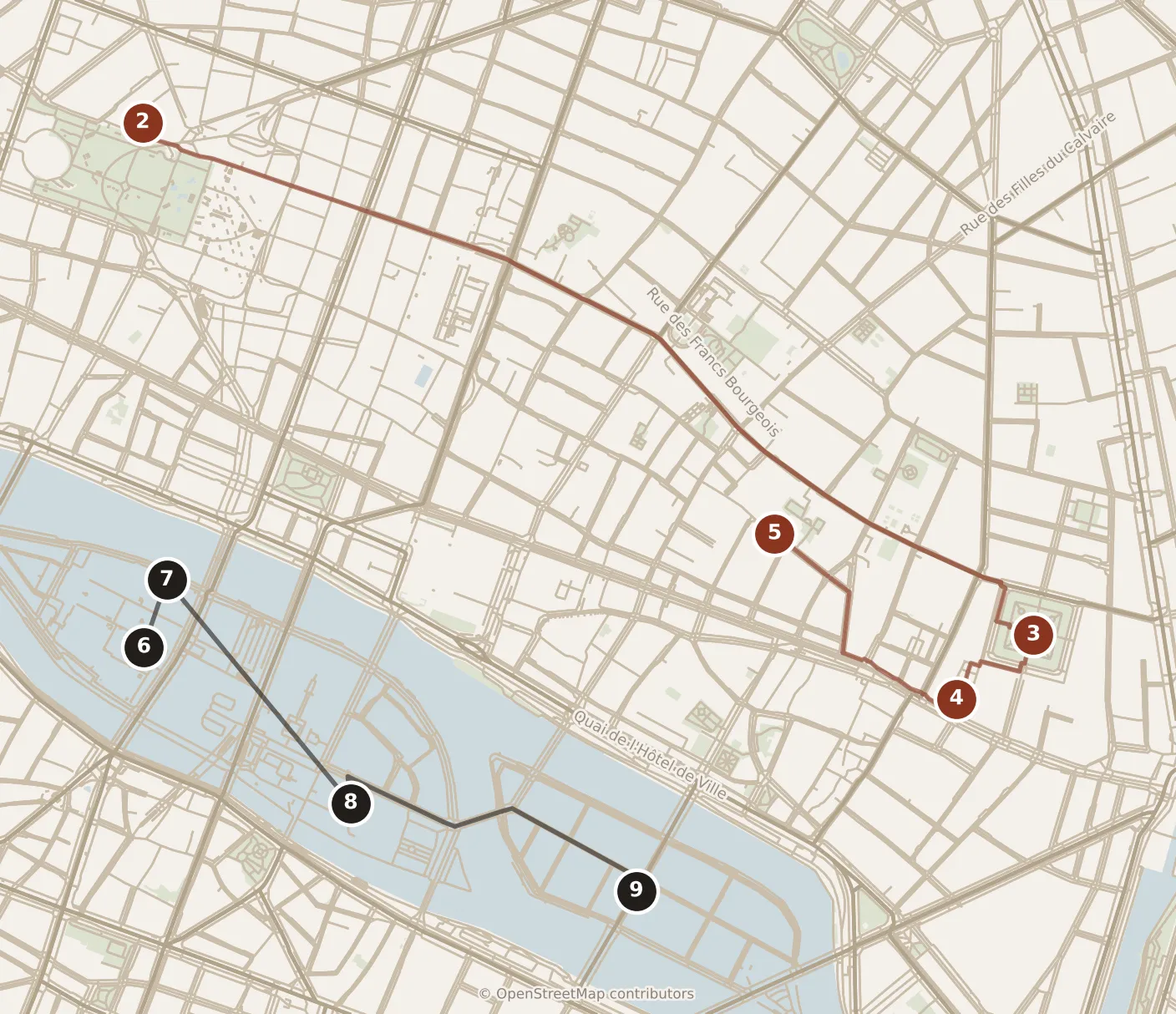
- Day one
- 2Saint-Eustache
- 3Place des Vosges
- 4Hôtel de Sully
- 5rue des Rosiers
- Day two
- 6Sainte-Chapelle
- 7Conciergerie
- 8Notre-Dame
- 9Île Saint-Louis
Day one

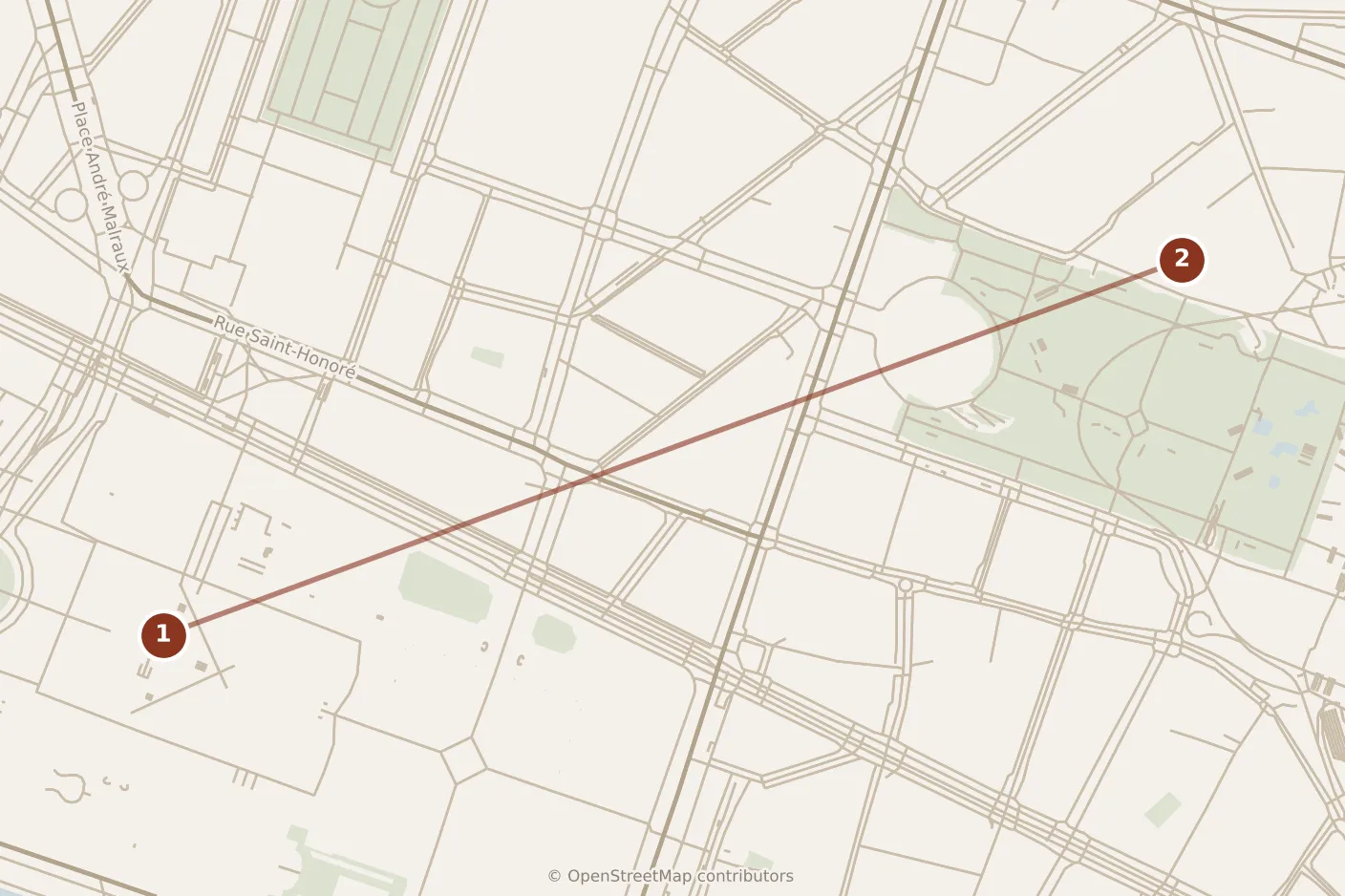
- Morning
- 1Louvre
The Right Bank, west to east, in one line: three hours in the most visited museum in the world, and then a long afternoon walk into the oldest streets left in the middle of the city.
Morning
However you come into Paris, the leg that matters here is the one that puts you at the museum door for opening, and nearly every route funnels through one interchange. From Charles de Gaulle the airport train runs to Châtelet–Les Halles; the mainline stations all connect to it. From that concourse it is about fifteen minutes on foot west along rue de Rivoli, or two stops on line 1 to Palais Royal–Musée du Louvre, which is the entrance under the Carrousel. Walk it if you have the quarter of an hour — it goes past Saint-Eustache, which is where you come back to after lunch, so the walk quietly explains the shape of the day.
If you are arriving on the morning of day one rather than the night before, do not bring the case with you. Neither the museum’s security nor the chapel’s tomorrow will take a suitcase, and there is nowhere at either to leave one. There is a staffed left-luggage office at the Gare du Nord and there are lockers at the Gare de Lyon; both are downstairs and both are signed from the concourse. Budget the better part of an hour for the detour, line included, and take it off the front of the morning rather than out of the museum. If the bag is already in a room somewhere, none of this applies and the day starts clean.
The Louvre is not a building you finish, and every decision about it follows from admitting that. In 2026 it opened at nine and it took Tuesdays off, and it is worth building the morning back from whatever the opening hour is when you go — if it has moved, move the morning with it, because everything after it today is elastic and this is not. The reason to be there at the door is not virtue: the room holding the Mona Lisa is a shuffling line of raised phones by the middle of the morning and a crush by noon, and it is the single stop in the building where an hour’s delay costs you an hour.
With two days you take one wing, plus the basement under another. There are three of them, meeting at one point under the glass. Denon is the famous one and the right choice on a first visit — Italian painting, the Winged Victory of Samothrace standing at the head of a staircase where it stops people mid-sentence, and the small dark portrait behind glass at the end of a controlled line. Richelieu is the one nobody picks: French sculpture standing in two glass-roofed courtyards, northern painting, and a suite of nineteenth-century state apartments kept furnished, which are the most surprising rooms in the museum. The third is Sully, which holds the Egyptian collection and, one level down at its eastern end, the castle the palace grew out of.
Before you leave, go down to the lower level of Sully, at the east end. Under the square court is the excavated ditch and tower base of the fortress the palace was built on top of: a circuit of bare stone you walk right around, underground, with almost nobody in it. From Sully it costs twenty minutes; from the far end of Denon or Richelieu add about fifteen each way, which is the one crossing in this museum worth making. It is the part of the visit that explains why there is a palace on this spot at all — and in August it is the only cool room you will stand in all day.
Local tip. Two and a half hours in one wing plus twenty minutes in the basement is a better morning than three hours spread across all three. The reason is not stamina, it is walking: the wings are long, they meet at a single point, and crossing between them twice spends most of an hour inside the museum’s own corridors rather than in front of anything.
Day one turns on no hour and does not need one — nothing in it changes character after dark, and the Marais at ten at night is the same streets with more people in them. So the count runs forward from the door rather than backwards from anything. Three hours inside, an hour for lunch, twenty-five minutes in the church, an hour and a quarter of walking, and an hour between the square and the courtyards comes to about seven hours, which from a nine o’clock opening puts you on rue des Rosiers in the late afternoon with a whole evening still in hand. What the count does not carry is the entry line at the pyramid, which in season is its own half hour even with a timed ticket, and which is the only real wait of the day.
Afternoon
Eat before the church rather than after it: the old market district begins just north of the church, fifteen minutes north-east of the pyramid, and the kitchens start at noon. Walk past the shopping center and the food court underneath it; the eating is in the streets on the far side.
Saint-Eustache is the second-largest church in Paris after the cathedral and a distinctly odd one — a Gothic skeleton finished in the sixteenth century and then dressed in Renaissance detail, so the bones are medieval and none of the ornament is. Three things to find. The organ over the west door has nearly eight thousand pipes and is among the largest instruments in France; the parish has kept up free Sunday-afternoon recitals for decades and publishes its music program itself, so if day one lands on a Sunday it is worth a look before you set out. Colbert, who ran the finances of Louis XIV, lies under a monument with allegorical figures either side of him. And in a side chapel there is a small bronze triptych by Keith Haring, his last work, finished in 1990, which has no business being in a sixteenth-century church and is the best thing in it. Twenty-five minutes. On the paving outside lies a giant stone head and hand, L’Écoute, put there by Henri de Miller in 1986, and the round domed building beyond it is the Bourse de Commerce, now a contemporary art museum — which closes on Tuesdays, like the Louvre, so it is not the substitute a Tuesday needs.
Now the long leg of the trip, and the best walking in it: a little over two kilometers east to the Place des Vosges, about thirty-five minutes on foot. Go by rue Rambuteau and then rue des Francs-Bourgeois rather than by the boulevard. The streets narrow, the buildings lose a story, the stone changes color, and you are inside the part of central Paris the nineteenth century cut roads through but never rebuilt — which is what the Marais actually is, and why it cannot be done from a métro station.
The Place des Vosges was laid out between 1605 and 1612 on the site of a demolished royal palace where a king had been killed in a tournament, and the king who ordered it was assassinated before it was finished. It is a square of identical brick-and-stone pavilions over a continuous arcade, and what makes it worth forty minutes rather than a photograph is that the middle of it is grass you are allowed to sit on, which is rarer here than it ought to be. Do that; and if the lawns are shut when you get there, the benches under the arcade do the same job out of the weather. Then leave by the arcade at the south-west corner, where a doorway leads through into a formal garden and then into the two courtyards of the Hôtel de Sully, a mansion of the 1620s carved with allegories of the seasons and the elements, and out again onto rue Saint-Antoine. It is a shortcut and a piece of theater at once, and from either end it reads as somebody’s private door. Twenty minutes. The way through is open during the day and shut at night, so it belongs to this hour and not to after dinner.
If it is raining hard, this is the half of day one that suffers, because most of it is a walk. The substitution is five minutes north-west of the square, on rue de Sévigné: the Musée Carnavalet, the history of the city told through objects rather than art, in two connected mansions, with a permanent collection that is free to walk into. Ninety minutes there displaces the courtyards and the wandering, you come out onto the same streets, and the evening below is unchanged. The one thing to know is that it closes on Mondays. The Monday answer in this quarter is the Shoah memorial, a few minutes south-west of the square towards the river: free, indoors, no booking, and open every day but Saturday. It is not a substitute for the courtyards and nobody should pretend it is a wet-weather diversion, but it is open when nothing else here is.
Evening
Eight minutes north-west of the courtyards is rue des Rosiers, the spine of the old Jewish quarter of the Marais: falafel counters with lines on the sidewalk, bakeries selling poppy-seed and cheese pastries, and a handful of shops that have been in the same families for generations. It is better late in the afternoon than at the lunchtime crush. One thing a visitor cannot guess and will otherwise discover by standing in front of a shutter: the kosher businesses on this street close from Friday afternoon until Saturday nightfall, and earlier on a winter Friday, when the sabbath begins before five. So neither a Friday afternoon nor a Saturday daytime is when this street works.
Where it goes instead is two minutes north, around rue Vieille-du-Temple and rue des Archives, which have been the center of gay Paris since the 1980s and are where the quarter drinks and eats after dark, all week and every week. This is a good evening for the plainest thing on a Paris menu, steak-frites, sitting down, in a quarter that stays awake — the deliberate opposite of tomorrow, which ends in a district that shuts. And if your day one falls on a Sunday, you have picked the right quarter by accident: the Marais is one of the few parts of central Paris where the shops are open on one.
Day two

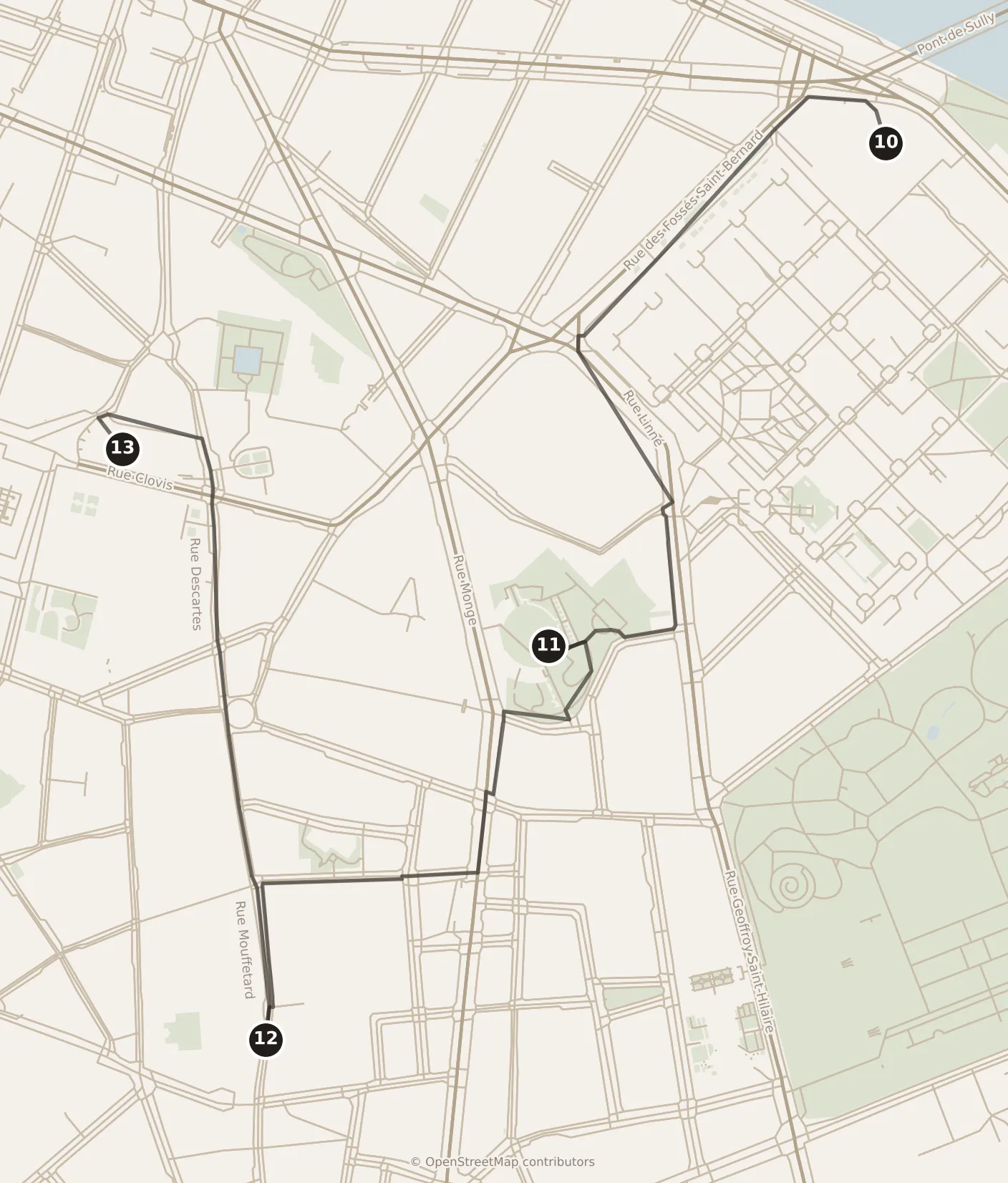
- Afternoon
- 10Institut du Monde Arabe
- 11Arènes de Lutèce
- 12rue Mouffetard
- 13Saint-Étienne-du-Mont
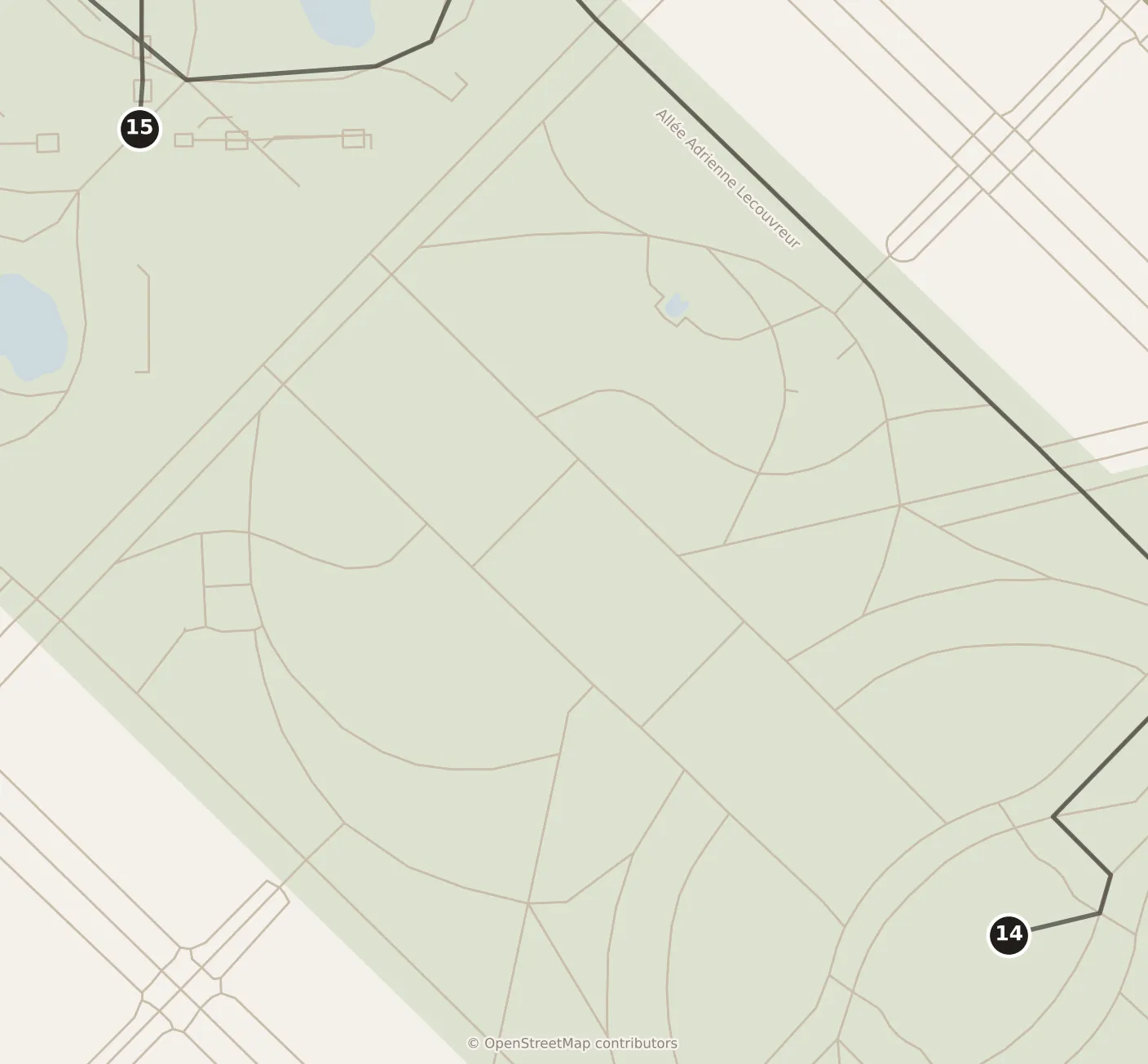
- Evening
- 14Champ de Mars
- 15Eiffel Tower
The Île de la Cité, the hill behind it, and then one ride west. Everything up to the métro is on foot and none of it doubles back.
Morning
The order of the first two stops is settled by their doors rather than by preference. In 2026 the chapel admitted its first visitors at nine and the old palace beside it at half past, so taking the chapel first makes the half hour free rather than spent waiting in line; if either hour has moved by the time you go, the rule survives it — take whichever opens first. The island has its own métro station, Cité on line 4, three minutes from the gate.
Sainte-Chapelle stands inside the enclosure of a working courthouse, which is why there is an airport-style check at the entrance, and why the line later in the day is a line about security rather than about the size of the building. You come in at ground level, into a low painted chapel built for the palace servants; the stair in the corner is the whole point of the place. What is worth knowing before you climb it is that the glass upstairs is a text and not a decoration. The windows run in sequence, bottom to top and left to right, through the books of the Bible, and the last of them tells the story of how the relics the chapel was built to house arrived in the city — a building narrating the reason for its own existence, in the material it is mostly made of. About two-thirds of it is the original thirteenth-century work. Sit on the benches instead of circling the walls: the room is small, the crowd rotates, and your eyes need several minutes before the color does anything. Forty-five minutes, and all of it depends on the sky. On a bright morning this is why people come to Paris; under flat cloud it is a good Gothic interior and no more.
Next door and on the same ticket, the Conciergerie is what is left of the royal palace that stood here before the kings crossed the river, and the first room gives the game away: a vaulted hall of about 1300, the size of a small church, built to feed a household of two thousand, with the kitchens still attached at one end. Upstairs the building’s second career takes over. It became the prison of the revolutionary tribunal, and Marie-Antoinette was held here before her execution in 1793, her cell rebuilt on the spot. Forty-five minutes, and the reason to take it directly after the chapel is that they are one building read twice — one wing for the king’s soul and one for his kitchen staff.
Local tip. Buy the chapel and the old palace on the joint ticket and do them in that order, which is not a preference. The chapel is the one whose value depends on the light and on the room not yet being full, and both of those are gone by the middle of the morning. The vaulted hall next door looks exactly the same at four o’clock as it does at ten.
Ten minutes east along the island is Notre-Dame, reopened in December 2024 after the fire of 2019. It is a working cathedral before it is anything else and that is not a formality here: services run through the day, visitors are moved into the side aisles while one is on, there is a stewarded one-way route you follow rather than choose, and photography stops during a service. Hats off, phones silent. Entry is free, and so is the timed slot that skips the line: book it for about eleven, which is when this morning arrives. The thing to look at, if you knew the building before, is what the cleaning did to the light — the stone came out of the works pale, so the nave is now roughly the color it was built, and the whole interior reads as bigger. Whether that is an improvement is the argument the city has been having ever since. Forty-five minutes, and give it more only if you have booked the towers, which reopened as a separate ticketed climb in September 2025 and are sold online.
Ten minutes further east, across the short footbridge from the end of the island, is the Île Saint-Louis, and this is the part of the morning that nobody plans and everybody remembers. It is one island and essentially one street, built out in a single speculation in the 1620s to a single pattern, and it has almost nothing to see: no monument, one church, a run of seventeenth-century fronts and a stone quay you can sit on with your feet over the water. Twenty-five minutes, walked end to end. Its value is that it is domestic rather than monumental — one commercial street between two extraordinary things — and a two-day trip is the shortest one that can afford it.
Afternoon
Cross to the Left Bank from the eastern tip of the island — you are now in the Latin Quarter for the rest of the afternoon — and six minutes brings you to the Institut du Monde Arabe, a building of 1987 by Jean Nouvel whose river-facing wall is a grid of motorised metal irises meant to open and close with the daylight — a traditional carved screen rebuilt as a machine. Go straight up to the ninth floor. The roof terrace is free, open to anyone who walks in, and it hands you the one view this trip would otherwise miss: the cathedral seen end-on from behind, its flying buttresses and rebuilt spire against the sky, with both islands laid out in the river below. Twenty-five minutes. It is shut on Mondays, which is dealt with in Practicalities and matters more than it sounds.
Ten minutes south-west, you go in through what looks like a gap between two apartment buildings and come out inside a Roman amphitheatre. The Arènes de Lutèce held something like fifteen thousand people in the first or second century, lay buried for more than a thousand years, and was found in the 1860s when the ground was opened for a tramway depot; Victor Hugo was among those who campaigned to stop it being built over. What makes it worth ten minutes rather than a photograph is what it is now: the arena floor is a public pitch, so on most afternoons there is a game of boules at one end and a football match at the other, inside a Roman ruin, with nobody charging for anything.
Eight minutes downhill is rue Mouffetard, one of the oldest streets in the city, running down the spine of the hill on the line of the Roman road south. Be clear about what you are getting at this hour: the street market here is a morning market and it is packed up by the middle of the day, so what is left in the afternoon is the permanent half — the cheese shops, the bakers, the fishmonger, and a long run of small restaurants with the day’s menu chalked outside. That is where lunch goes, and there are two versions of it. A jambon-beurre from a bakery, eaten on the steps at the foot of the street, is fifteen minutes and a fraction of the price. A table is an hour and is the better idea if the morning has been spent standing up. Either way, eat here: this is the last easy food before the evening.
Ten minutes back up the hill, Saint-Étienne-du-Mont holds the one thing of its kind left in Paris. A rood screen is a carved gallery thrown across the nave like a bridge, built to separate the congregation from the choir; almost every one in France was torn out in the seventeenth and eighteenth centuries, and this one, of about 1545, survived. Stand underneath it and look up at the underside of the arch, then climb your eye up the spiral stair that curls round each end of it. The church also holds the shrine of Sainte-Geneviève, the city’s patron, and the graves of Pascal and Racine. It is free and takes twenty-five minutes, and it closes on Mondays. The domed building filling the square outside is the Panthéon, and this route deliberately does not go in: it is an hour and a ticket, and two days have neither to spare. If you have a third day and the museum has run short, this is the door to use.
The métro is five minutes east of the church door, at Cardinal Lemoine, and line 10 from there runs the whole length of the Left Bank without a change: nine stops to La Motte-Picquet–Grenelle, about a quarter of an hour. You come up on the corner of the Champ de Mars.
Evening
From that corner it is about a kilometer up the length of the Champ de Mars to the foot of the tower — fifteen minutes at an unhurried pace, and worth every one of them. The lawn is not a park; it is a drill field, kept clear so that officers from the academy closing the far end could be marched about on it, and it has since been a racecourse, a site of revolutionary festivals and a fairground twice over. It is the only place in Paris where you can watch the tower get larger for a quarter of an hour, which is the entire argument for arriving from this end instead of surfacing underneath it. The fenced ground beneath the tower has a bag check at the entrance whether or not you are going up, and it is free.
Everything above comes to roughly six and a half hours with lunch inside it, so a nine o’clock chapel slot puts you at the foot of the tower in the middle of the afternoon. What that count leaves out is the line at the pillars, which is the longest wait on this route and which a booked elevator shortens rather than removes, because the security check into the ground below is the same for everybody.
That arithmetic decides the last question of the day. With two days you can book an elevator, which is precisely the thing a shorter trip cannot do, and the honest advice is to do it and to take the second level rather than the summit: the second level is high enough to read the streets and low enough to still see them, where from the top the city flattens into a map. Elevator tickets are released about two months ahead on the tower’s own site and the summit goes first. In 2026 the second-level elevator was in the low twenties of euro and the summit in the mid-thirties, with the stairs to the second level well under either. The stairs are the answer for somebody who has booked nothing: sold at a pillar on the day, cheaper than either elevator, and the one way up this tower that needs no reservation at all.
Then the light, and this is where your own month’s hour does the work. Arriving mid-afternoon, the hour you spend up the tower is the hour the light goes in the short half of the year, and you come down to a city that has switched itself on. In the long half the sun is still hours away and waiting for it is a poor use of an evening: take the view in daylight, come down, and walk east to eat: the streets immediately under the tower are handsome and residential, and the eating is a few minutes further in that direction rather than at its foot. The lit tower is not something that needs planning for. It is visible from half of Paris, and you will get it from a bridge on the way to dinner. The one thing worth knowing is that it sparkles for five minutes on the hour, every hour after dark — so if you are on a bridge at four minutes past, wait fifty-six.
If the elevators have gone and the stairs with them, the replacement is not a line, it is a crossing. Walk under the tower, over the Pont d’Iéna in front of it, and up the hill to the terrace between the two curved wings of the Palais de Chaillot: about a quarter of an hour on foot and uphill at the end, free, no ticket and no check, and what you get is the view of the tower rather than the view from it — full-face, entire, and the one people actually picture when they picture this city. It displaces the ascent and nothing else, and the evening after it is unchanged.
With a third day

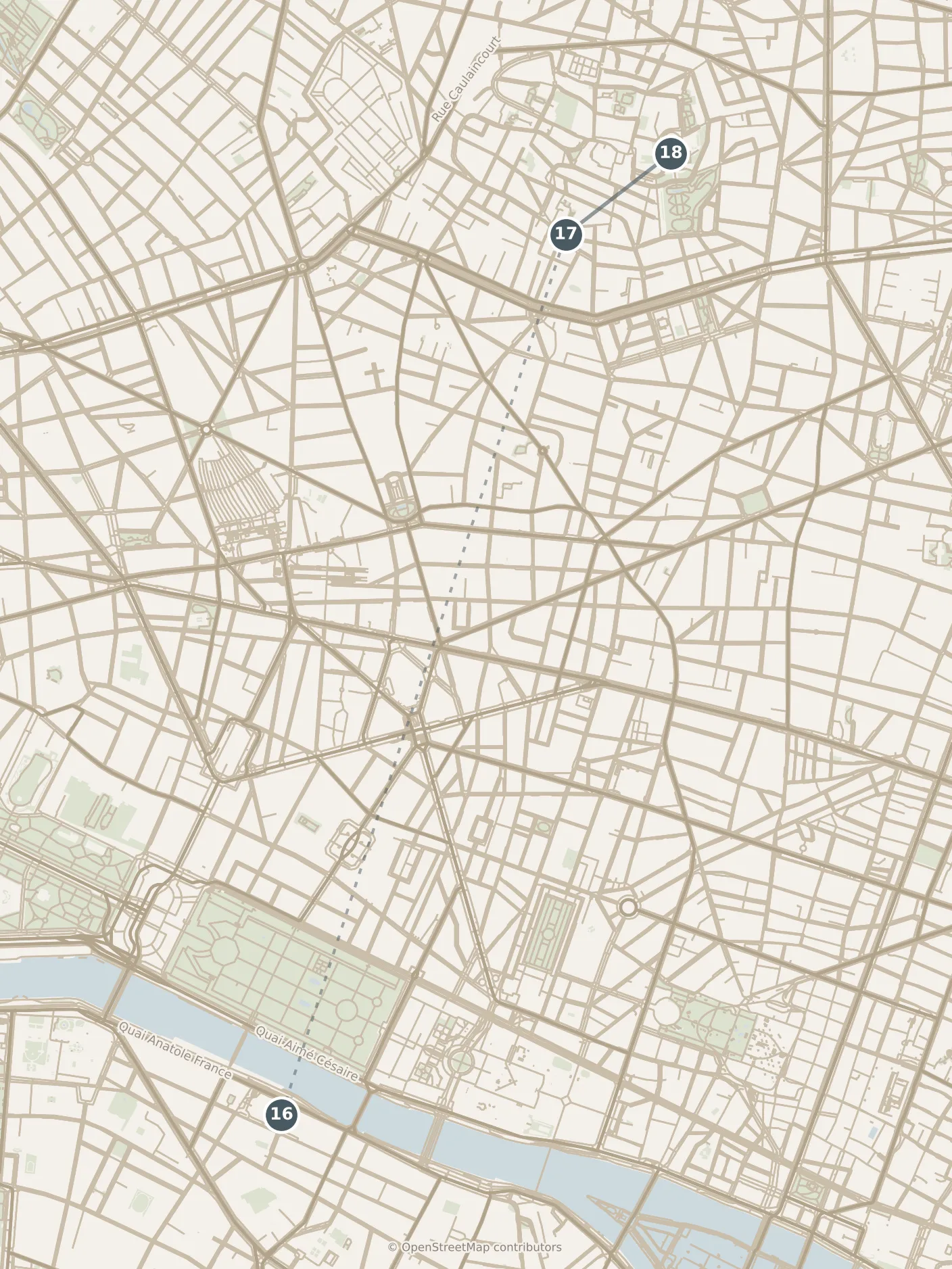
- With a third day
- 16Musée d'Orsay
- 17Place des Abbesses
- 18Sacré-Cœur
The third day is appended rather than inserted, and the reason is what you can afford to lose rather than geography. All three days hang on a timed ticket at a fixed hour, so none of them is the loose one: the third has its own booked museum slot, it is shut on a Monday exactly as day two is, and its hill is the worst ground of the three in the wet. What it has instead is that it is the only one that can be halved, or dropped altogether, without spoiling what is under it — a short third day is the hill and no museum. Put it last and that stays true. What it buys back is two of the three things the two-day plan gave up: the second great museum, and the hill. It does not buy back Versailles, and three days is not enough to make that trade worth it.
Give the morning to the Musée d’Orsay. It was built as a railway terminus for the world’s fair of 1900 and had stopped working as one inside forty years, because its platforms were too short for the trains that came after it. Since March 2026 its entrance halls have been under a rebuild running to 2028, and while that lasts every visitor needs a booked time slot, including anyone who would otherwise walk in free — there is no turning up. The galleries themselves are untouched.
Two hours, which is the museum at half pace and part of why this is a third day rather than a second one. Go straight to the top floor before you look at a single thing on the way, because that is where the Impressionist rooms are, they are what most people have come for, and they are unpleasant from the middle of the morning onwards. Then come back down through everything else, which is the part a two-day trip never reaches: the sculpture standing down the middle of the old train hall, the Post-Impressionist rooms above it, and a floor of art nouveau furniture and panelling that explains a good deal of what you walked past in the Marais. One of the station’s great clock faces has been left glazed as a window; stand behind it and look north over the river, and the hill on the skyline is where you are going next.
Solférino is five minutes from the museum door, and line 12 runs from there to Abbesses without a change — about a quarter of an hour, straight up under the Right Bank. Abbesses is among the deepest stations on the network, thirty-six meters down, with an elevator and a spiral staircase painted the whole way up. Take the elevator; take the stairs another time. What you come out into is one of only two surviving glass-roofed cast-iron Guimard entrances left anywhere on the métro, and it is not even originally from here — it stood at Hôtel de Ville until 1974.
You are now halfway up the hill, and that is a compromise made on purpose. Montmartre climbed properly starts at the bottom of the western slope and takes a whole day; an afternoon does not have that, and coming up at Place des Abbesses is the version that still gives you the part of the climb that matters — the last of it, on steps, through streets, rather than riding to the summit from the tourist end. Give an hour and a half to the streets between the square and the top and do not follow the signs straight up: the hill was a village the city grew around rather than a district it built, and the evidence for that is in the lanes rather than at the summit, where a working vineyard, two surviving windmills and a great many staircases are wedged between buildings on ground too steep to develop.
Sacré-Cœur closes the day. It was begun in 1875 as a national act of penance after the defeat of 1870 and the Commune that followed it, finished in 1914 and consecrated after the next war. Inside it is free, and two things are enforced at the door that a visitor cannot guess: silence, because continuous prayer has been kept up here without a break since 1885, and no photography at all. The mosaic filling the apse above the altar is the reason to go in — something close to five hundred square meters of it, among the largest anywhere — and it takes twenty minutes to look at properly. The dome is a separate ticket and three hundred steps.
Then go out and sit on the steps below the terrace. This is the third day’s one hour with nothing behind it, and it is why the hill comes last: the whole city lies flat below you, the sun goes down over your right shoulder, and what there is to watch is the city changing color rather than the sun itself. Everything above it comes to about four hours and no meal in it, so a half past nine museum slot puts you up here in the early afternoon — which is hours short of sunset in any month on this page. What day two says about the light holds here as well: sitting those hours out is a poor use of an afternoon, so take the view in the light you have and go down to eat. If you want the sun on this terrace instead, book the museum for late morning and let the whole day slide back behind it. What the count leaves out is the transfer: two flights of métro stairs and a ride between two halves of the city, which is the second of the route’s two métro rides and the only part of this day that is not a walk or a room.
Do not eat at the top. The square you came up in is eight minutes back down, and the difference between the two is the difference between a place selling to people who will never return and a place selling to people who live upstairs. A croque-monsieur at a counter down there is the correct end to three days in Paris exactly because it is unremarkable.
Local tip. If the third day is only half a day — an afternoon flight, a train at four — take the hill and drop the museum, not the other way round. The museum wants two hours and a booked slot at a fixed time, so it cannot be shortened without being wasted; the hill wants a couple of hours and no ticket at all, and line 12 from the station at the bottom of it reaches Saint-Lazare in about ten minutes.
Practicalities
Four things are booked rather than bought at a door, and three of them are compulsory: two on any trip, and the third if you take the third day. A fifth thing is not sold at a door either — the cathedral’s towers — and is dealt with in the paragraph below. The Louvre sells timed entry only: its own ticket was in the low twenties of euro in 2026 for residents of the European Economic Area and in the low thirties for everyone else, a two-tier price introduced that January, and a few days ahead is normally enough outside high summer. The chapel and the old palace beside it sell a joint ticket in advance, which is what makes day two start on time. On a third day, the Musée d’Orsay’s time slot is compulsory for the duration of the entrance works and cannot be got round. The tower’s elevator is the one with a real deadline — released about two months ahead, summit first — and if you are reading this inside two months of traveling, settle it before you plan anything else. All four are sold by the institutions themselves; most of what a search returns is a reseller.
Notre-Dame is free and has a free timed slot that saves you a line that runs to hours in season, but its slots are released only two or three days ahead, so it is the one booking to set a reminder for rather than to do now. When it opens, take a slot from about eleven: the chapel opens at nine, it and the old palace beside it are forty-five minutes each, and the walk east along the island is ten. That hour is the one fixed point in day two you do not choose, so build the rest of the morning around it. Its towers are a separate ticket, sold online only.
Two rules about the day of the week, and one trap. Day one must not fall on a Tuesday: the Louvre is shut, and so is the round museum beside Saint-Eustache, so that quarter offers no equivalent substitute. Days two and three must not fall on a Monday: the Monday closures cluster exactly where day two spends its afternoon: the roof terrace and the church with the rood screen are both shut, and the market street is at its deadest, since the food shops on it take the same day. The Musée d’Orsay is closed on a Monday as well. Day one is the only one of the three that survives a Monday, because the Louvre is among the few large museums here that opens on one. So: put your Monday on day one, keep Tuesday off day one, and on a Friday afternoon or a Saturday expect day one’s evening to be the streets north of rue des Rosiers rather than the street itself. What is left of the week will take any of the three in any order, with the Sunday qualification below.
The trap is a Monday that is not your first day, and it is silent, because nothing about the plan announces it. A Sunday start puts the Monday on day two and a Saturday start puts it on day three, and in both cases that day is not diminished, it is gone. The fix is to reorder rather than to reschedule: take day one’s content on the Monday and the other two around it. What that costs is the rule above about appending the third day rather than inserting it, and there is no order that keeps both — a Monday in the middle of a trip forces the choice, and a day lost outright is the larger loss. Take day two on whichever of the two remaining days is not a Sunday. A Sunday is a milder problem and it lands on the morning rather than the afternoon — the cathedral gives Sunday mornings to services and visitors come second — so if one of your days is a Sunday it is the better day for day one or the third day.
If you are short — three hours where a day expects six — the order in which things go is fixed, and it is worth having decided in advance rather than on a sidewalk. On day one the church goes first, then the courtyards behind the square; the museum’s opening hour is the last thing to touch, because everything else in that day can move and it cannot. On day two the amphitheatre goes first, being ten minutes and a curiosity, and then lunch becomes a bakery eaten walking rather than a table; the chapel’s slot is untouchable for the same reason. On the third day there is nothing useful to cut, since it is one museum and one hill, so a short third day means taking the hill and leaving the museum for another trip.
Day one is about four kilometers on foot, almost all of it in one eastward line, and its longest single leg is the thirty-five minutes from the church to the square. Day two is about five and a half kilometers on foot plus one métro ride of a quarter of an hour, and it has no climb in it worth the name. The third day is a museum, a ride and a hill, and the hill is the only real climb in this article — much worse in the wet than the distance suggests, because the steps are stone and there are a great many of them.
The last morning has the first morning’s problem again. If you are traveling out in the afternoon of your final day, the left-luggage offices named on day one are the answer, and the third day is the shape that suits it: the museum is five minutes from a station on a line that reaches the northern part of the city directly, and the hill is not somewhere to go carrying a case.


