Paris in one day: the island, the river west, and the tower after dark

Last updated 3 August 2026
Overview
Paris is too large for one day, and the mistake is to treat that as a problem with a solution. There isn’t one. The city holds three or four separate days’ worth of things several kilometers apart, and a day spent traveling between them is a day spent underground. The way out is to pick one line through the city and stay on it.
That line is the river. Everything below sits within a few hundred meters of the Seine and moves west along it, from the island the city was founded on to the tower at the far end. It is about six kilometers of walking spread across a whole day, with a single métro ride at the end, and after the first hour it never turns back east.
What it costs you is the Louvre, and this is the sentence most one-day plans will not write, so here it is plainly: with one day, do not go in. It is not a museum you see in ninety minutes, it is one you see badly in ninety minutes, and those are the ninety minutes that would otherwise have bought you the Left Bank, a lunch sitting down, and the light coming off the water in the late afternoon. The Musée d’Orsay below is the museum this day does take — one building, one collection, and finishable — and taking exactly one is the whole discipline of the thing.
It costs you the hills and the east as well. Montmartre is half a day on its own and it is in the wrong direction; the Marais is a morning of streets rather than monuments and deserves to be walked slowly; Versailles is a day, not an excursion, and people who try to fit it into this one arrive back at dusk having seen Paris from a train window. Give all of it up cleanly rather than nibbling at it.
Two things fix the shape of the day before you plan anything. The first is that the two things worth waiting in line for are at the start, in the cool and the quiet, which is why the day begins on the island and not with the tower everybody pictures. The second is that the tower is the end, because it is the only stop on this route whose value depends on the hour: it does at nightfall what it cannot do at two in the afternoon. Run the day the other way round and you have kept all the stops and lost the point of one of them.
The day

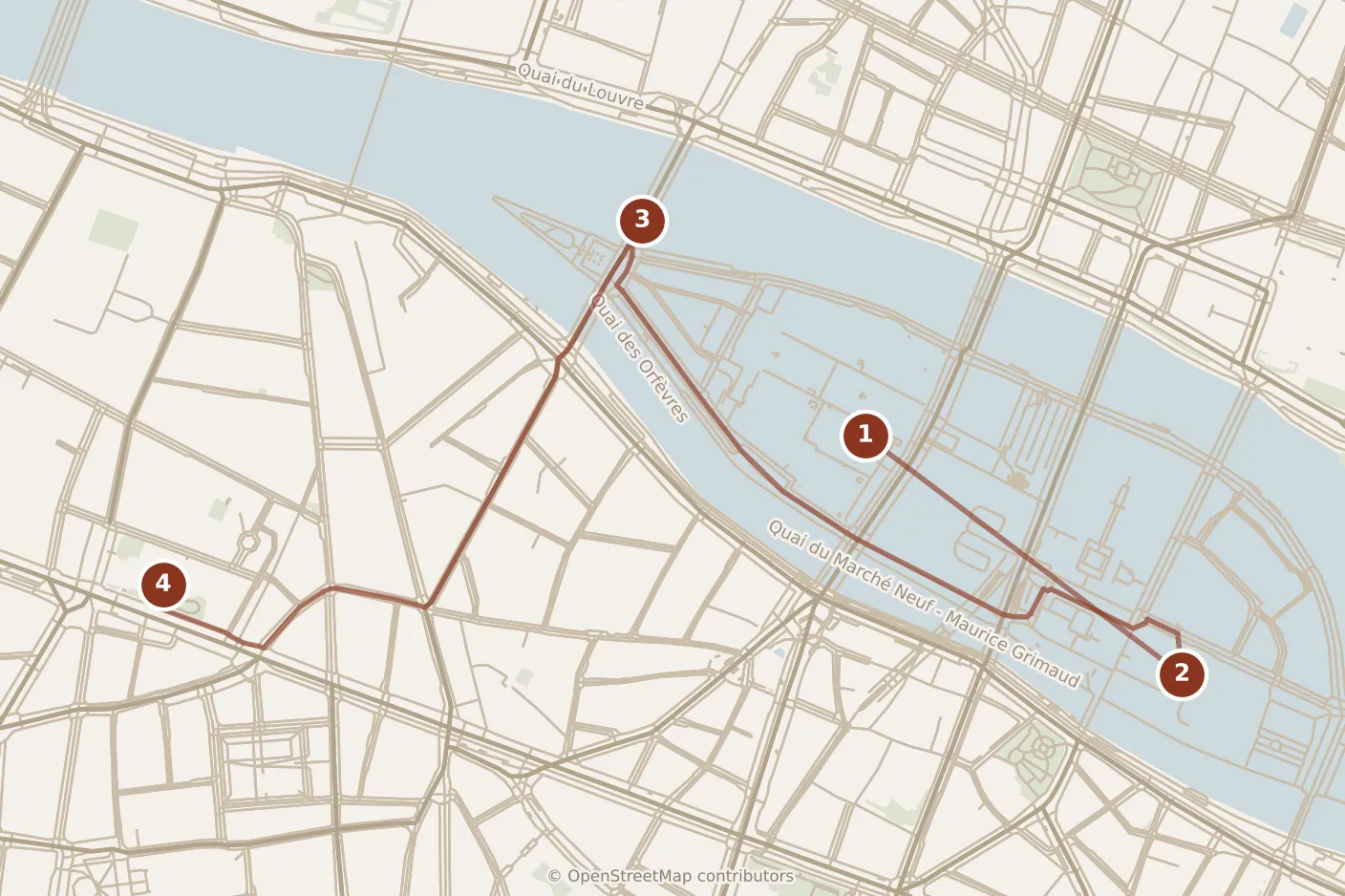
- Morning
- 1Sainte-Chapelle
- 2Notre-Dame
- 3Pont Neuf
- 4Saint-Germain-des-Prés
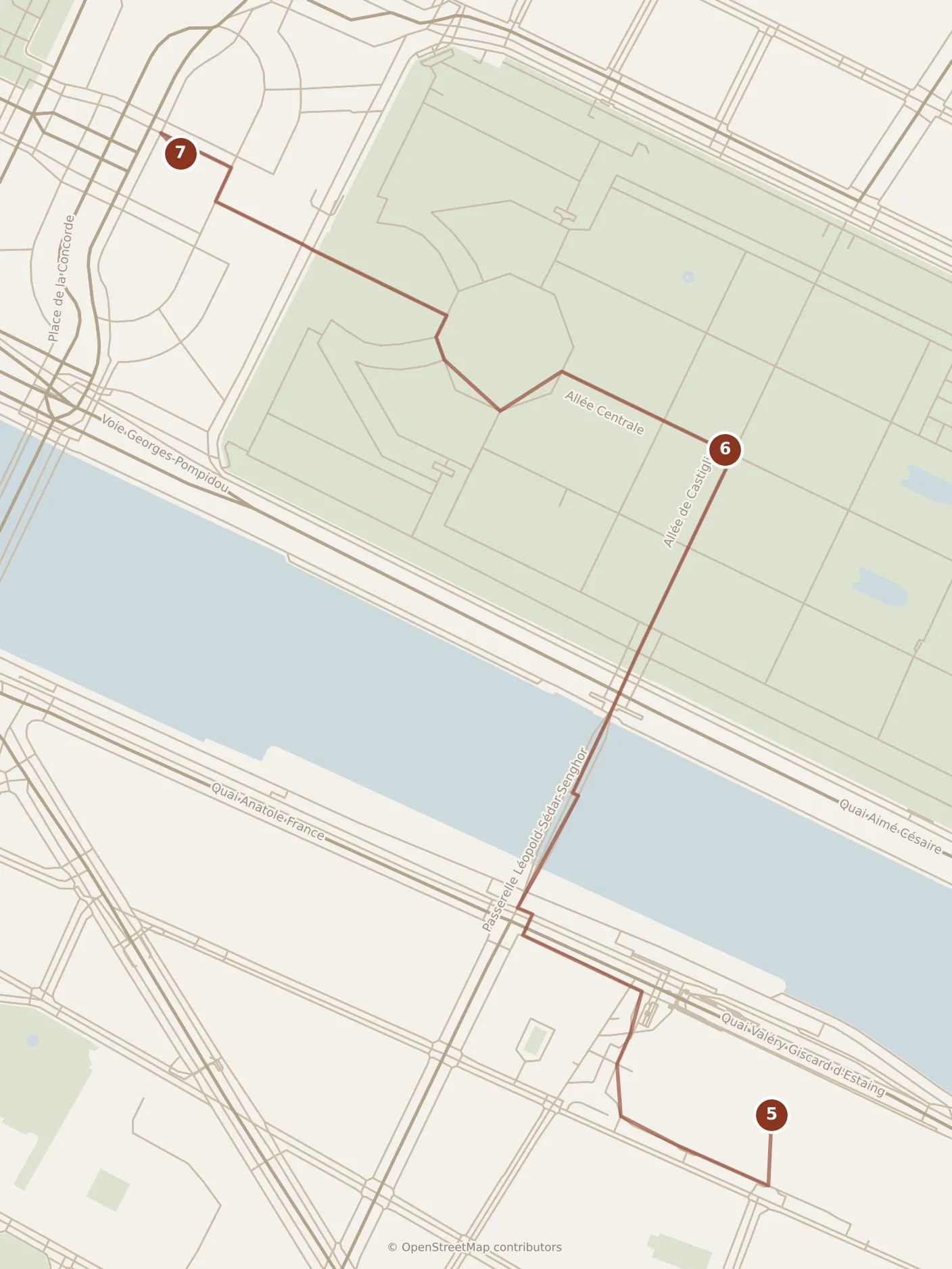
- Afternoon
- 5Musée d'Orsay
- 6Jardin des Tuileries
- 7Place de la Concorde
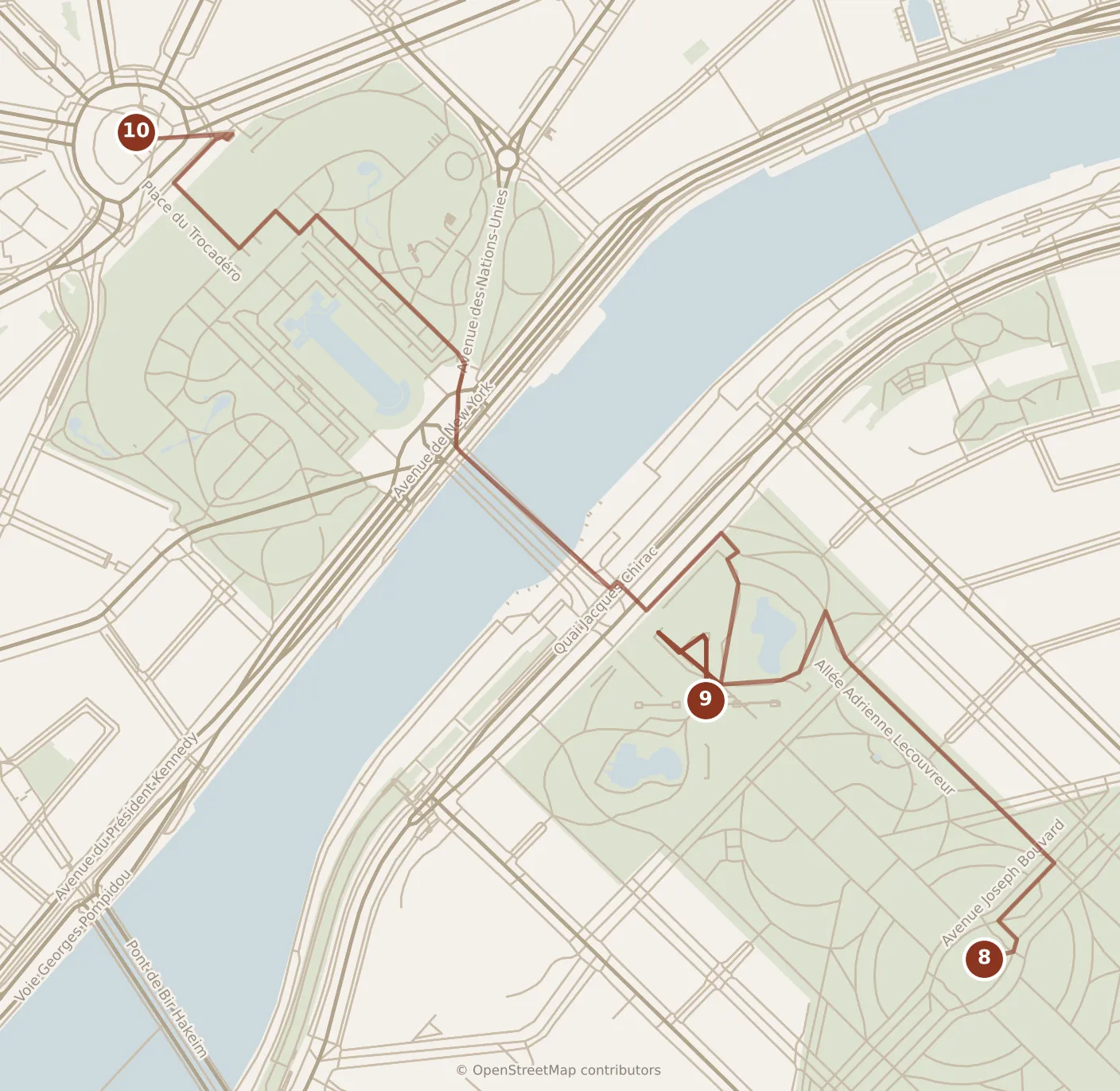
- Evening
- 8Champ de Mars
- 9Eiffel Tower
- 10Place du Trocadéro
Morning
Start at Sainte-Chapelle, at opening, on the Île de la Cité. There is a security check at the gate — it stands inside the old palace enclosure, among working law courts — and that, rather than the size of the building, is what makes the line slow later on.
You come in at the bottom, into a low, dark, heavily painted chapel built for the palace staff, and the first reaction is usually mild disappointment. That is the design working. A staircase in the corner takes you up into what the whole structure exists for: a room with almost no wall left in it, fifteen windows running from waist height to the vault, more than a thousand scenes of scripture in glass, about two-thirds of it original thirteenth-century work. Louis IX had it built in the 1240s as a reliquary for the Crown of Thorns, and the number that explains the building better than any adjective is that the chapel cost roughly a third of what he had paid for the relic to go in it.
Sit down for a few minutes rather than circling. Eyes take time to adjust and the room needs light: on a bright morning the glass does the thing the building was made to do, and on a flat gray one it is a good Gothic interior and no more. Forty minutes.
Five minutes east along the island is Notre-Dame, which reopened in December 2024, five years after the fire of April 2019. What is startling to anyone who knew it before is not the new spire but the color: the stone was cleaned during the works and the inside is now pale and bright where it used to be brown. The three rose windows came through the fire intact, the vaults that fell have been rebuilt, and the organ was taken apart and cleaned of lead dust piece by piece. Entry is free. Give the interior forty-five minutes and leave anything that needs a second ticket and a second line to a longer trip.
From the cathedral cross to the Left Bank and walk west along the quays, past the green lock-up boxes of the second-hand booksellers — most of them still padlocked at this hour — about a kilometer, to the Pont Neuf. It is the oldest bridge still standing across the Seine here, finished in 1607 despite the name, and the thing to know about it is why it feels different from a medieval bridge: it was the first in the city built with no houses along it, which is the reason it has sidewalks, and viewing bays, and a view. Walk out to the middle by the equestrian statue of Henri IV, look back at the prow of the island, then come off it again. Several hundred carved stone faces run along the outside of the parapet, below the deck — which means the bridge is the one place you cannot see them from. The stairs beside the statue go down to the garden at the prow of the island, and from there you look back up at them.
Then south-west into Saint-Germain-des-Prés, ten minutes, where lunch goes. Look into the abbey church on the way: its bell tower has been standing since about the year 1000, which makes it the oldest in the city, and a long restoration has put the nineteenth-century painting back on the walls inside, so it is far more colored than the photographs of it. Fifteen minutes.
Local tip. Lunch here is a choice, not a search. Kitchens start at noon and this route arrives a little before, so you have a moment to decide. A café table in this quarter is an hour and it is not cheap; the weekday set lunch chalked on the board outside is the same kitchen for less; a jambon-beurre from a bakery, eaten on a bench, is fifteen minutes. All three are correct — but the hour comes out of the museum, so decide which you want before you sit down rather than after.
Afternoon
Twenty minutes west along the Left Bank brings you to the Musée d’Orsay. It was built as a railway terminus for the world’s fair of 1900 and killed by its own success: by 1939 the platforms were too short for the longer trains coming into service, and it spent decades looking for a use before opening as a museum in 1986. The main hall still reads as a station, which is half the pleasure of being in it.
Do one thing on arrival and the afternoon works: go straight up to the Impressionist galleries at the top before you look at anything on the way. They are what most people came for, they are the busiest rooms in the building by mid-afternoon, and the first floor is still there afterwards. Monet, Manet, Degas and two rooms of Van Gogh are the core of it. Two hours is the right amount to give this museum with one day; three turns it into the afternoon rather than a part of it. On the same level, one of the station’s great clock faces has been left as a window you can look out of, north across the river to the hill with Sacré-Cœur on it.
Cross the footbridge in front of the museum to the Right Bank and you come out in the western half of the Jardin des Tuileries, the Louvre away behind you at the far end. Le Nôtre laid it out in the 1660s for the palace that stood at the far end of it, and the palace burned in 1871 and had its ruins cleared twelve years later, which is why the garden now runs out into open air — and why you can stand in it and see the whole axis, from the Louvre behind you to the Arc de Triomphe on the skyline ahead, in one unobstructed line. The green metal chairs around the big octagonal basin ahead of you are free and they move; take one, face the water, and give yourself twenty minutes of not walking. It is the one point on this route designed to be sat in.
A few minutes further west the garden ends at the Place de la Concorde, which is a very large traffic circle and loud with it, so treat it as a place to cross rather than to linger. What is worth the crossing is the obelisk in the middle: three and a half thousand years old, brought from Luxor, given away in 1830 and raised here in 1836. It stands where the guillotine stood, and where the king was executed in January 1793 — a fact the square does almost nothing to advertise. From the base of it, the Louvre is behind you at the end of the gardens and the Champs-Élysées runs uphill ahead to the arch. Fifteen minutes and a photograph, and then take the métro.
Evening
Line 8 runs from Concorde south-west without a change and puts you out at École Militaire, at the far end of the Champ de Mars, which is the right way to arrive. This was the parade ground of the military academy that closes the end of it, then the fairground of 1889, and walking the length of the lawn towards the tower is a better approach than surfacing underneath it. Fifteen minutes on foot, slowly.
The ground directly under the tower is fenced, and going in means a bag check at the south or east entrance even if you are not going up. It is free, but leave time for it, or keep to the outside of the perimeter and walk round to the bridge.
The Eiffel Tower was three hundred meters when it was finished, built for the world’s fair of 1889 a century after the revolution, and the permit it went up under was for twenty years — what saved it from being dismantled was the antenna on top and the fact that the army found a use for it. Whether you go up is the last real decision of the day, and the honest answer for one day is no, unless you booked an elevator weeks ago. The lines at the pillars are where an unbooked day disappears, and the view from the top is a view of Paris with the tower missing from it. If you want the height anyway, the stairs to the second level are ticketed separately, can be bought at the pillar on the day, and the climb up through the ironwork is more interesting than the ride. That is the whole reason to offer them: they are the option still open to someone who booked nothing.
Then cross the bridge and go up to the Place du Trocadéro, ten minutes, for the last thing. The terrace between the two curved wings of the Palais de Chaillot, above the gardens, looks straight back down the axis at the tower full-face, and this is where the day was always going. The tower lights come on at dusk, and for the first five minutes of each hour after dark the whole structure sparkles. It is worked hard at those hours — the terrace fills and so do the sellers — so keep your bag in front of you. Wait for one sparkle, then go back east to eat: this quarter is handsome and almost entirely shut in the evening.
Two warnings about the hour, because they change the plan rather than decorate it. Walked at the pace above, this day reaches the terrace in the late afternoon. In high summer that is five or six hours before the sky is dark, so the tower is not something to wait for: eat east of here and come back at the end of the evening if you want it, or take it lit against a blue sky and let that be enough. In winter the opposite is true and it is dark before six, so the sparkle comes first and dinner is still two hours off; this is the wrong quarter to spend them in, and the métro back east is ten minutes. Either way you have an evening left over — which is the argument for taking the single day in the cold months rather than the crowded ones.
Practicalities
One thing to settle before the day starts: this route does not work with luggage. Sainte-Chapelle and Notre-Dame both turn away large bags and neither has anywhere to leave one, the museum will not take a suitcase at all, and storage is banned inside the tower’s perimeter. Put it in a station locker first. The day itself begins at Cité, the island’s own métro station, two minutes from the gate.
Three things on this route need booking, and one of them is not optional. The Musée d’Orsay is rebuilding its entrance halls, and for as long as those works last a timed slot is what gets you in: the door for people arriving without one is reserved for priority visitors, and even a museum pass has to be booked onto a slot of its own. An early-afternoon ticket is the one purchase this day cannot be run without. Sainte-Chapelle sells timed tickets in advance and a few days ahead is normally enough; the point of one is that the day starts on time, which everything after it depends on. Notre-Dame is free and books the same way, except that its slots open only on the day itself, a few hours ahead — the cathedral does not allow booking days in advance, and trying too early from too far away can get you temporarily blocked — so take one that morning, from Paris, for about an hour after the Sainte-Chapelle slot. All three are sold by the monuments themselves; most of what a search returns is resellers. If you do want to go up the Eiffel Tower, that booking has to happen weeks ahead in summer and it is worth doing properly or not at all; this day is written to work without it.
The day of the week matters more here than the season. The Musée d’Orsay closes on Mondays, and with one day that removes the afternoon’s center. The substitution is easy because it is already on the route: the Musée de l’Orangerie sits at the Concorde end of the Tuileries, closes on Tuesdays instead, and holds two oval rooms of Monet’s water lilies plus a compact collection under them — an hour, not three. So on a Monday, walk the Left Bank quays straight to the footbridge, cross into the garden and take the Orangerie there. On a Sunday the pressure moves to the morning instead: both Notre-Dame and the church at Saint-Germain-des-Prés are working churches before they are anything else, and services take precedence over visitors for a good part of the morning. Of the seven days, a Monday costs this route the least and a Sunday morning the most.
Everything from Sainte-Chapelle to the Place de la Concorde is on foot and none of the legs is longer than about twenty minutes; the only ride is the one at the end, and it is direct. The kilometer along the Left Bank quays from Notre-Dame to the Pont Neuf is the most pleasant part of the walking, so do not shorten it by going underground.
Only one stop on this day is indoors for any length of time. That is fine in June and a real consideration in a wet February, when the museum is the hour to hold back rather than the hour to cut — the gardens, the bridges and the terrace at the end are all weather, and the tower in rain is a line with nothing at the top of it.


.jpg)
.jpg)