New York in a week: seven days that never cross the city twice

Last updated 3 August 2026
Overview
A week is the length at which New York stops being a list of things to photograph and starts being a place you are living in for a while, and the whole difficulty of planning one is that the city rewards depth and punishes zig-zagging. Manhattan is thirteen miles long. Two sights that look adjacent on a map can be forty minutes and two trains apart, and a week spent criss-crossing it is a week spent underground.
So this is one neighborhood a day, in an order that walks. Each day below is a place, not a theme: you come up from the subway once in the morning, and everything after that is on foot until you choose otherwise. Which also means the week does not depend on where you sleep: every day starts at a station, so anywhere in Manhattan or brownstone Brooklyn within a few minutes of a line will serve it equally. Where to stay is a decision the city guide makes properly, and this article deliberately does not repeat it. The days are also arranged so the city opens outward — the postcard first, because it is what you came for and getting it out of the way frees the rest of the week, then downtown and the bridge, then Brooklyn, then the park, and only later the quarters where nothing in particular is scheduled.
Two museums anchor the week, on days four and six, and only one of them fixes a date: the Metropolitan closes on Wednesdays, so day four cannot fall on one, while the natural history museum on day six opens every day. Both are enormous, and a closing day is the sort of thing that wrecks a fixed itinerary rather than bending it — so put day four on the calendar first and let everything else move around it.
Two more things are worth knowing before the first morning. Paying for the subway needs no preparation at all: you tap the same contactless card or phone you already carry against the reader at the turnstile — nothing to buy, register or download — and once you have made a dozen paid journeys inside seven days, the rest of that week travels free. On a week like this one you pass that mark around day five, which is worth knowing before you go looking for a visitor pass that would cost you more than doing nothing.
The other is that the subway runs all night, which is unusual and changes how a day can end: nothing here obliges you to be back before dark. And almost every stop below is free. The ones that are not — the two big museums, the observation deck, the museum beneath the memorial, the art museum on day seven — are named as such where they appear, and none of them is compulsory.
Day one

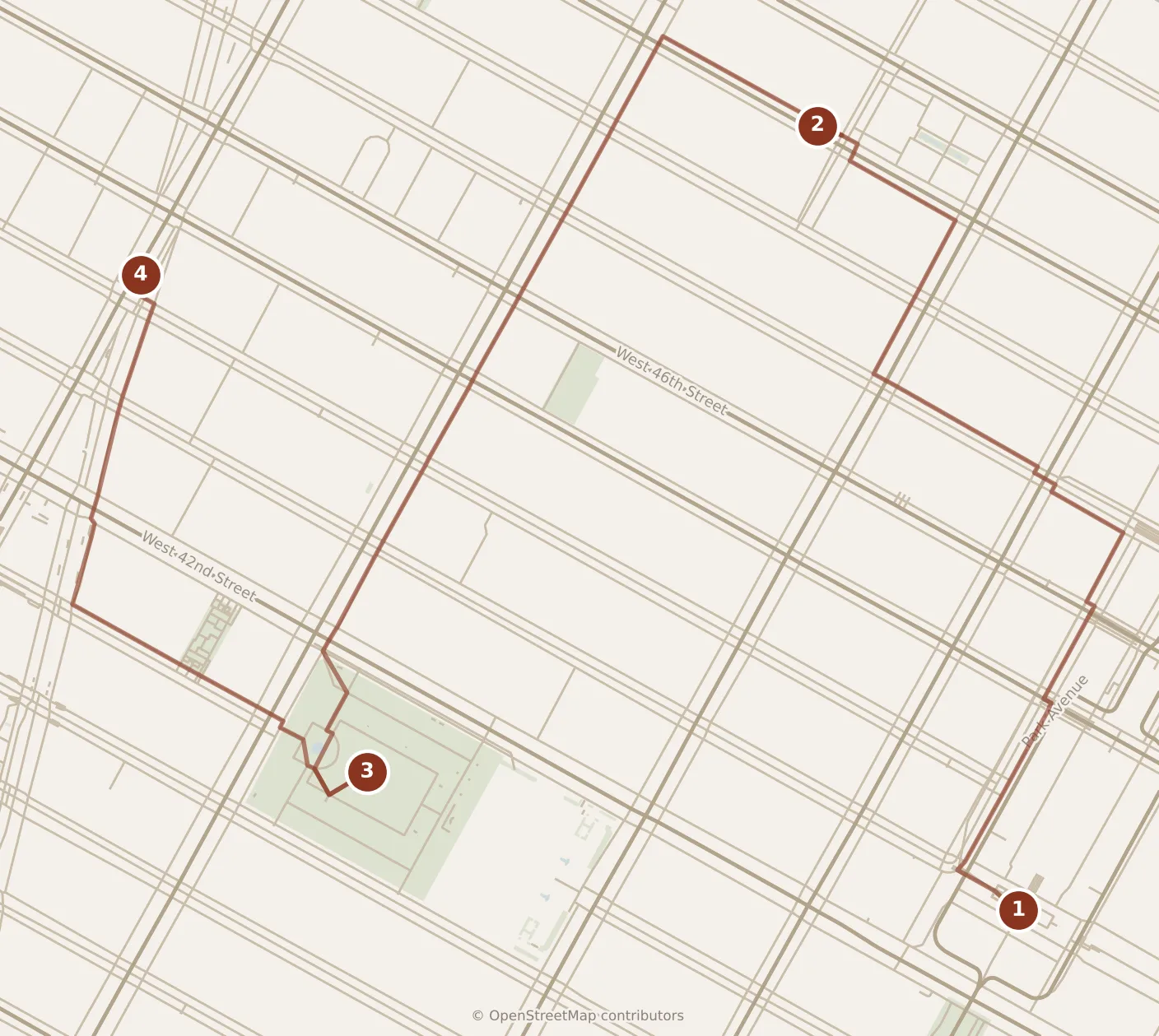
- Day one
- 1Grand Central Terminal
- 2Rockefeller Center
- 3Bryant Park
- 4Times Square
Midtown, and deliberately first. It is the New York a first-time visitor has already seen a thousand times, and getting it out of the way on day one turns it from an obligation into a backdrop for the rest of the week.
Start inside Grand Central Terminal, mid-morning rather than at rush hour, when the room is full of people with somewhere to be. It is a Beaux-Arts hall the size of a cathedral, and the thing to do is stand still in the middle of it and look up: the ceiling is a painted night sky with the constellations laid out in gold, and they are reversed — the sky as it would look from outside the heavens rather than from underneath, which was either a mistake or a conceit depending on who is telling you. Give it twenty minutes. It is a working station, so the crowd crossing under the zodiac is the exhibit as much as the ceiling is.
Walk two blocks west to the New York Public Library, guarded by its two stone lions, and go upstairs to the main reading room: a hall the length of a city block with painted clouds on the ceiling and long oak tables where people are actually working. It is free, it takes fifteen minutes, and it is the quietest room you will stand in all week. Bryant Park is directly behind it — lawn, movable green chairs, and the place the surrounding offices eat lunch, which is what to do here rather than seek out anywhere grander.
Rockefeller Center is ten minutes north, and the observation deck at the top is the afternoon’s one fixed thing. Book the timed slot when you book the trip rather than the night before, since the late-afternoon ones go first, and take one late in the afternoon: this deck faces south, so the view is the Empire State Building with the whole of downtown behind it — the skyline everyone pictures, which you cannot see from the Empire State itself because you are standing on it. An hour, deck and the line included. The morning’s stops will not fill the time until that slot, and the hours in between are the only unscheduled ones in the day: Midtown is what to spend them on. St Patrick’s Cathedral is across the street on Fifth Avenue and free to walk into on the way past.
Finish at Times Square after dark, which is fifteen minutes’ walk west and needs about fifteen minutes of your time. The lights are the entire point, the crowd is the price, and nobody has ever wished the visit longer.
Day two

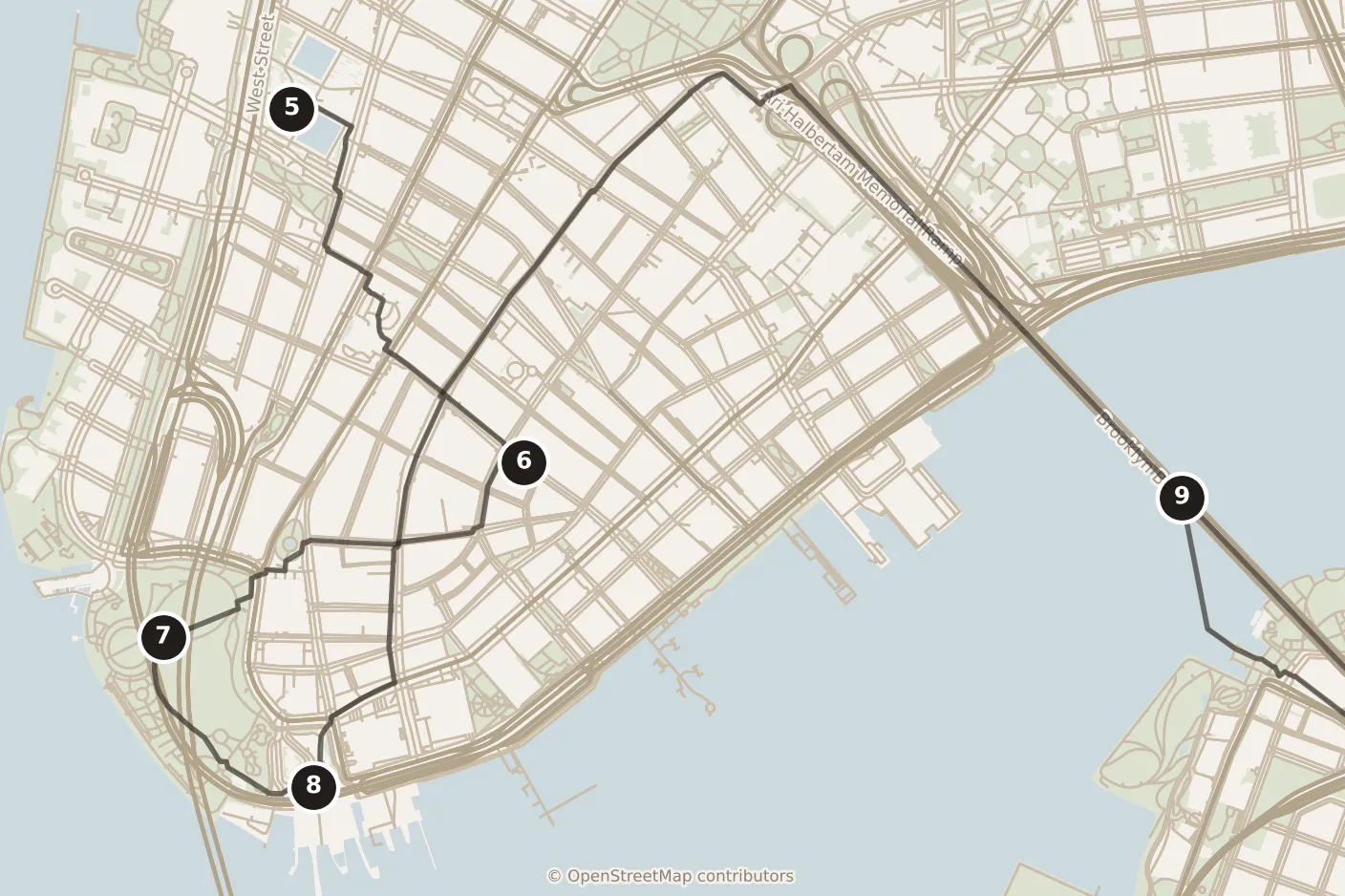
- Day two
- 5National September 11 Memorial
- 6Wall Street
- 7Battery Park
- 8Staten Island Ferry
- 9Brooklyn Bridge
Downtown, and it ends on the bridge, so keep the evening free and do not book anything for it.
Begin at the National September 11 Memorial: two square voids sunk into the footprints of the towers, water falling down the black granite and disappearing into a second void at the center, with the names of the dead cut through the bronze parapet around each. It is free, open air, and takes as long as you want it to. The museum beneath is a separate ticket and at least two hours, much of it harrowing; decide before you arrive rather than in line, because it changes the shape of the day. Beside it, the transit hall known as the Oculus is worth the four minutes it takes to walk through: a vast white ribbed vault that from outside looks like the skeleton of a bird.
Then walk south into the old financial city, which is the only part of Manhattan that ignores the grid — narrow lanes on the original seventeenth-century street plan, canyons of stone that go dark by mid-afternoon. Wall Street itself is short, and the pleasure of it is the scale rather than any one building. Keep going to the island’s tip and Battery Park, where the harbor opens up.
From there take the Staten Island Ferry, which is free, runs constantly, and takes twenty-five minutes each way across the harbor, passing close enough to the Statue of Liberty that the crossing is the view. You must get off at the far end and walk round to board again — allow an hour and a quarter for the round trip. Going ashore on Liberty Island or Ellis Island is a different proposition: a ticketed boat, security, and half a day gone. This week does not spend one on it, and the ferry is the reason it does not have to.
Finish by walking the Brooklyn Bridge, and walk it toward Brooklyn, starting in the late afternoon. This is counter to the instinct and it is the single most useful thing in this article. The famous view is of Manhattan, which means that walking away from the city it is behind you the whole way; you reach the far end, turn around, and get it whole — and then walk back into it with the towers lit. The crossing is about thirty minutes each way on the raised wooden promenade above the traffic. Doing it the other way puts the crowd in front of you and the view at your back.
Day three

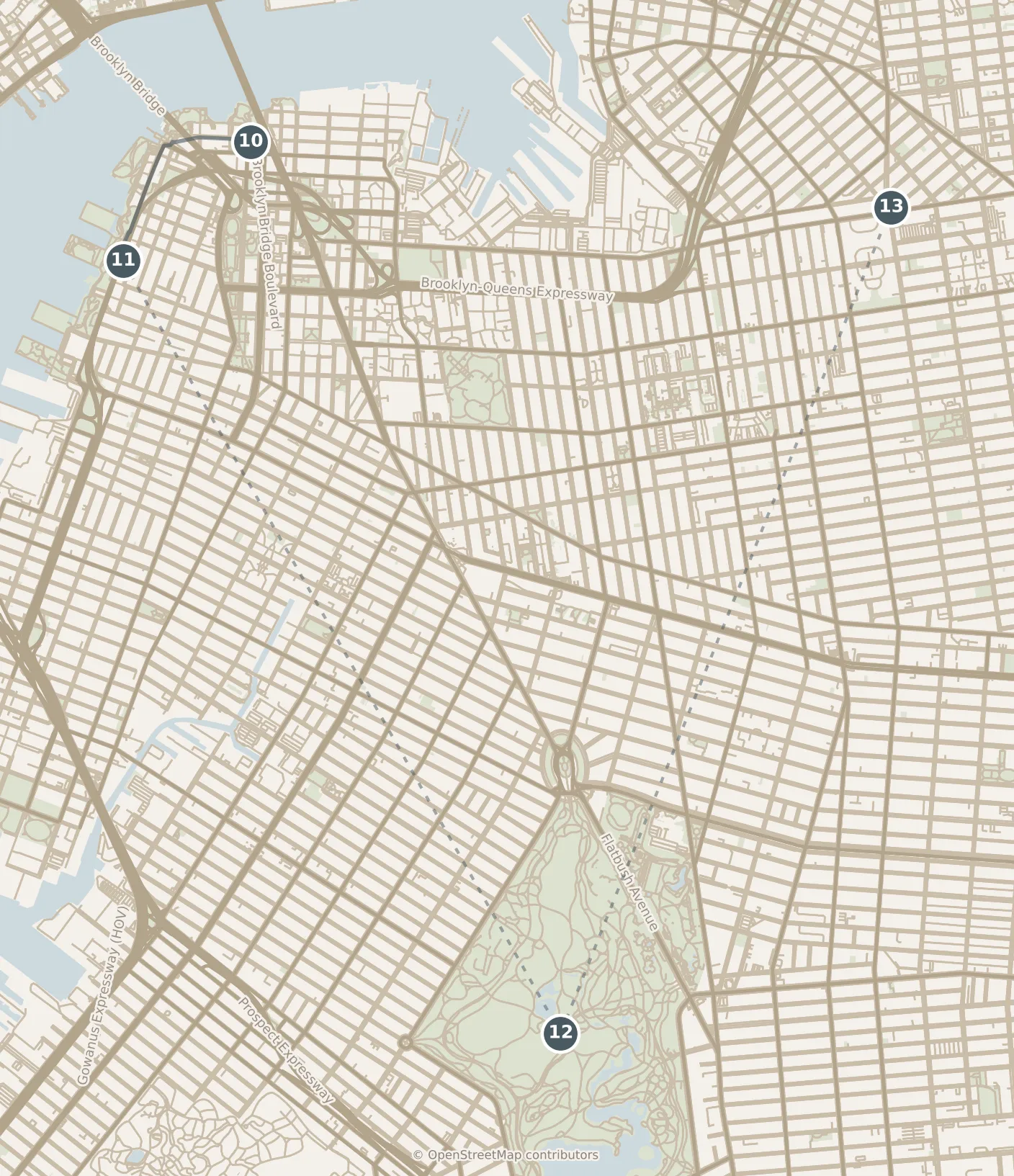
- Day three
- 10Dumbo
- 11Brooklyn Heights Promenade
- 12Prospect Park
- 13Williamsburg
Brooklyn, all day, because it is a place rather than an excursion — and because after two days in Manhattan you want to see the city from outside itself.
Start in Dumbo, under the bridge you crossed yesterday. The photograph everybody takes is from the cobbles of Washington Street, where the bridge’s stone tower frames the Empire State Building between the warehouses; go early, because by mid-morning there is a line to stand in the middle of the road. Then down to the waterfront park beneath the bridge, where a restored carousel sits in a glass pavilion and the view back at Manhattan is the one on the postcards.
Walk up into Brooklyn Heights and along the Promenade, a raised walkway built over the expressway with the whole of Lower Manhattan laid out across the East River. Behind it are the streets that give brownstone Brooklyn its name: nineteenth-century houses on straight leafy blocks, stoops and iron railings, with the shops gathered onto a few commercial streets you will cross rather than spread through the whole neighborhood. This is the city most people here actually live in, and none of the postcards show it. Walk as much of it as the morning wants; there is nothing to see in the sense of a sight, which is the point.
Then take the subway to Prospect Park rather than walking it: the two are four miles apart, which is an hour and a half on foot between two parks, and the hour is better spent in the second one. Prospect Park is by the same designers as Central Park and, they said, the better of the two — they had learned from the first, and this one is smaller, less crossed by roads and much less visited. Enter from the north, where the Long Meadow opens out, and give it an hour of aimless walking rather than a route.
In the evening the subway again, north to Williamsburg. The change of register is the reason to go: warehouses turned into bars and record shops, the waterfront looking back at Midtown rather than downtown, and a crowd that lives here rather than visits. It is the day’s second ride and its last, and it is twenty minutes.
Day four

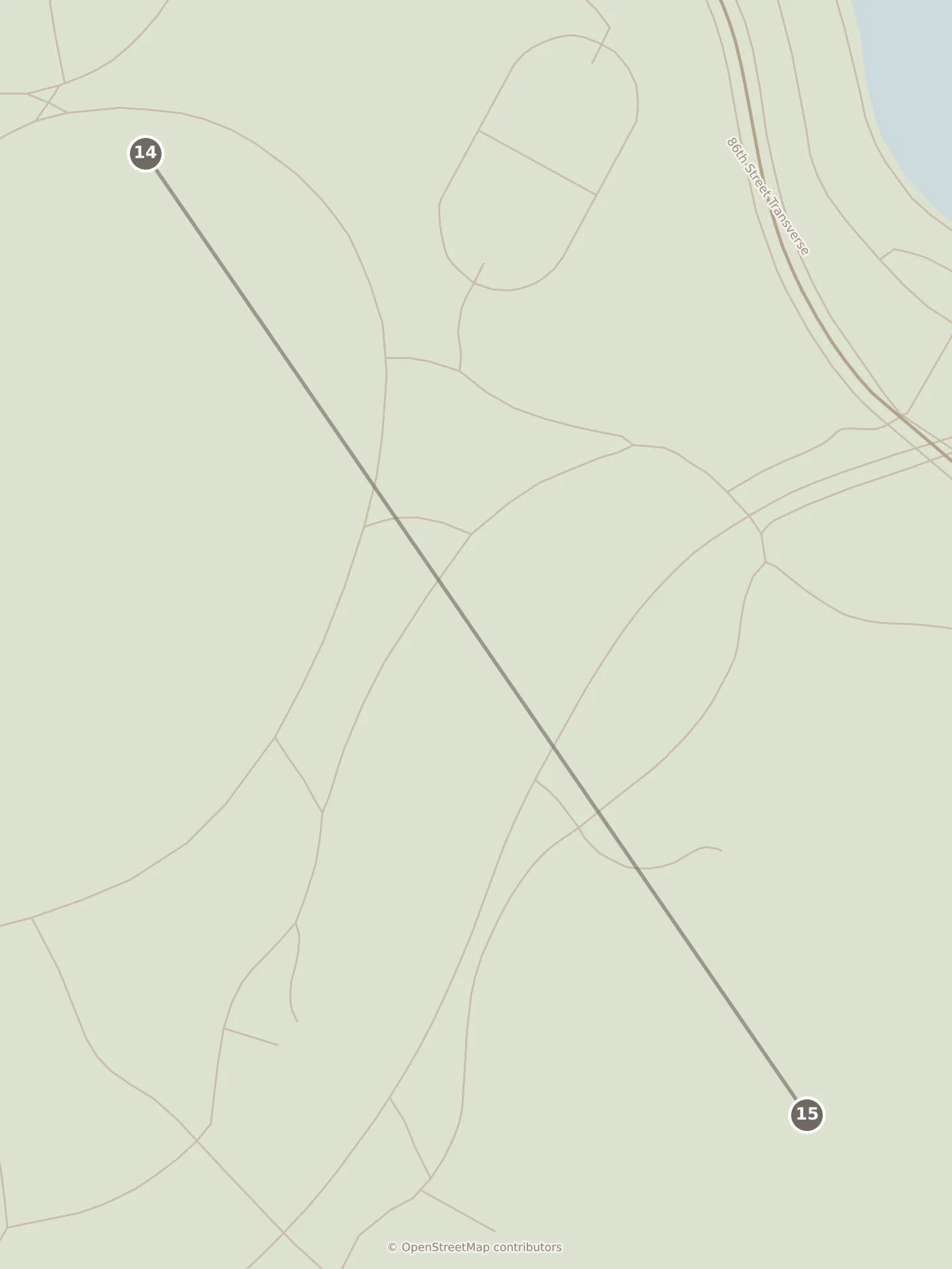
- Day four
- 14Central Park
- 15Metropolitan Museum of Art
Central Park and the Metropolitan Museum of Art, and this is the day the week is built around. It is also the longest day on your feet, so it is placed in the middle, when you are fit but not yet tired of the city.
The park is two and a half miles long and you do not finish it; you cross it. Enter at the south-east corner and walk north for a couple of hours. The formal beginning is the Mall, an avenue of elms that is the only straight line in the whole park, which delivers you to Bethesda Terrace and its fountain above the lake — the park’s front room, and usually a busker under the arcade. From there the Ramble is thirty-six acres of deliberately confusing woodland paths designed to feel like wilderness, and past it Belvedere Castle sits on an outcrop of bare rock with the Great Lawn beyond. The change from formal to wild and back is the design, and walking it in that order is the point.
Come out on the east side at the Metropolitan Museum of Art, which is too big to see. Two million objects, two miles of galleries: pretending otherwise is how people end a day exhausted having enjoyed nothing. Pick two departments before you go in and let the rest go. The Egyptian wing ends in a whole temple, moved stone by stone from the Nile and rebuilt inside a glass hall facing the park. The European paintings are on the second floor. The American Wing has a courtyard you can sit down in. Two or three hours is a full visit, and if it is warm the roof garden is open and looks back over the park you have just walked — which is the right last thing to do, because it closes the day where it began.
Day five

- Day five
- 16Washington Square Park
- 17Chinatown
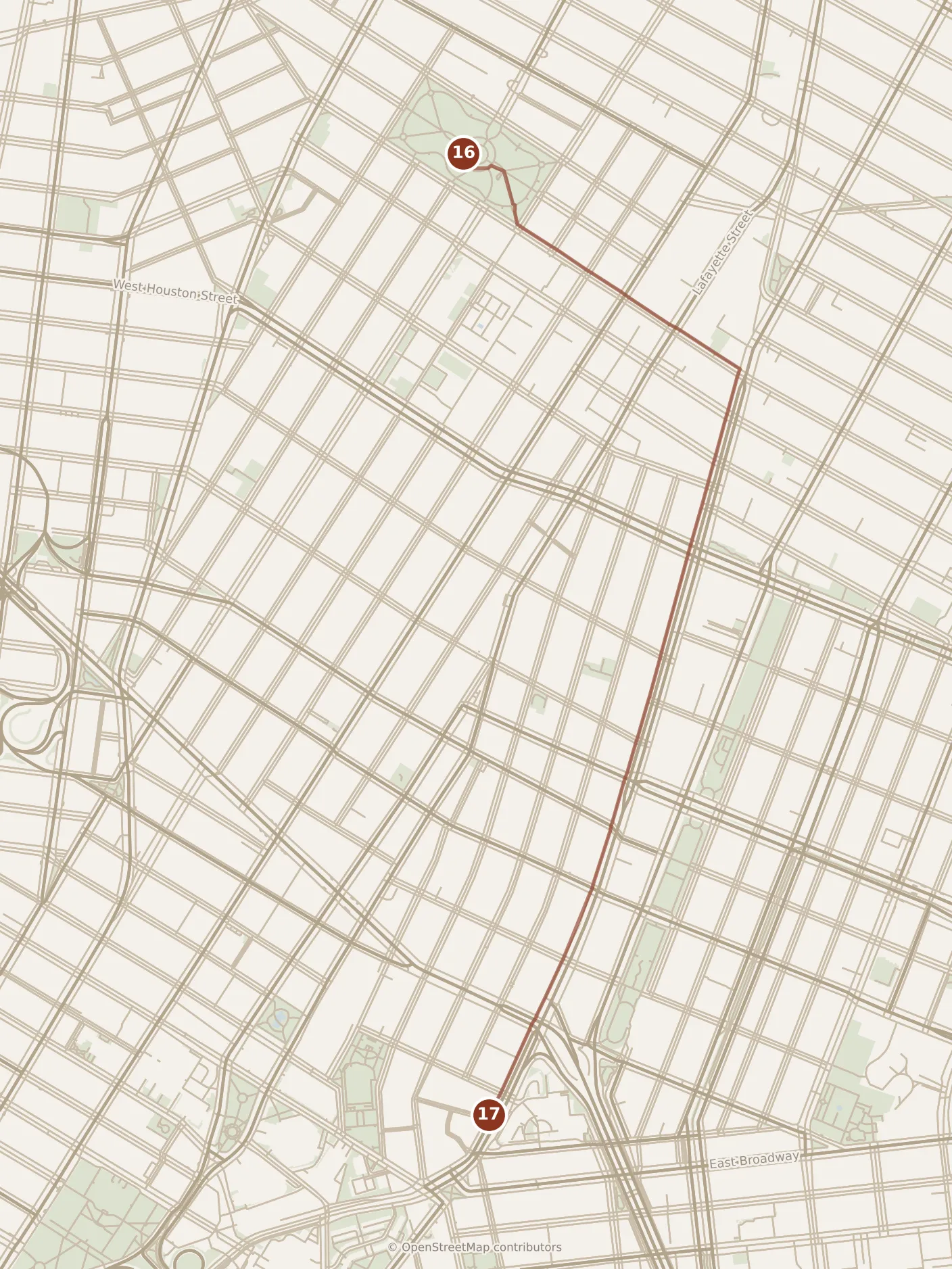
Greenwich Village, SoHo and Chinatown. No museums, no lines, no view, no ticket: after two heavy days this is deliberately the loose one, and the first where the schedule is genuinely yours.
Washington Square Park is the hinge — a marble arch, a fountain that people sit on the rim of, a chess corner, and a permanent audience for whoever is performing. It is the front garden of the university that surrounds it, so the crowd is mostly students, and half an hour there is not wasted time.
West of the square the grid breaks, which is why the Village feels different underfoot before you can say why: these streets were laid out before the city imposed its numbered plan on everything above Houston, so they wander, cross at angles and occasionally meet themselves. There is no route here and there does not need to be, but walking west from the square for half an hour takes you across four things worth recognizing when you reach them: Bleecker Street, where the neighborhood does its shopping and its eating; Christopher Street, where the modern gay rights movement began, marked now by a small triangular park that is a national monument; the low nineteenth-century houses of the far west Village, which is what the whole island looked like before it grew; and the river at the end of it, its piers turned into parkland. Stop when one of them holds you.
South of the square, SoHo is the largest concentration of cast-iron architecture anywhere: warehouses built in the 1870s with fronts poured in a foundry and bolted on, now holding expensive shops, which means the thing to look at is above the ground floor. Greene Street has the best of it. Keep going south and the language on the signs changes twice in ten minutes — first to Italian, in the few blocks that survive of Little Italy, then to Chinese, in a Chinatown that is one of the largest in the western hemisphere and, more usefully, cheap and very good to eat in. The evening belongs back in the Village.
Day six

- Day six
- 18American Museum of Natural History
- 19Apollo Theater
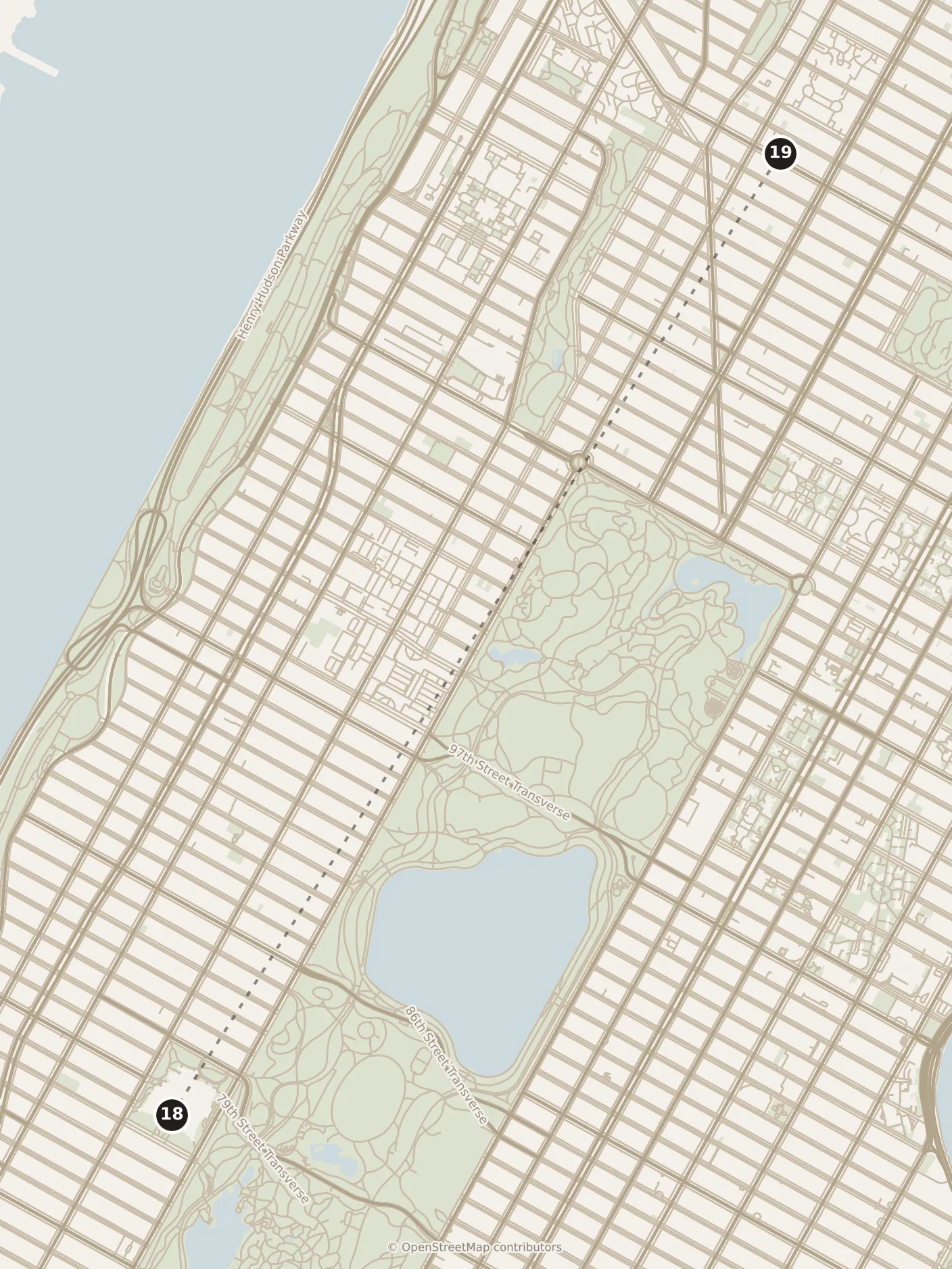
Uptown and Harlem, on the west side of the park, and the second of the two museum days.
The American Museum of Natural History takes a morning. Unlike the Met it is a place children forgive you for: a ninety-four-foot blue whale hanging over a darkened hall of ocean life, two floors of dinosaur skeletons arranged as a walk through evolutionary time, and the habitat dioramas — glass cases painted and modeled a century ago, which are now as much a museum of how museums used to look as of the animals in them. The planetarium sits in a glass cube on the north side. Two to three hours, and the same rule as the Met applies: choose, do not sweep.
Then go north, and take the subway rather than walking it, because Harlem is a genuine neighborhood at the top of the island and not an annexe of the last one. Come up at 125th Street, which is the main artery: shops, churches, the Apollo Theater with its marquee, and a street life that is nothing like the one you left twenty minutes earlier. The Apollo is the landmark, but the reason to be up here is the residential blocks either side — long rows of brownstones and, on a couple of streets, some of the handsomest domestic architecture in the city, built speculatively in the 1890s for a middle class that arrived a generation late.
If day six falls on a Sunday there is a choice to make rather than a bonus to collect: a service is a morning event at the Harlem end of a day that opens with the museum, so it is one or the other — go north first and give the museum the afternoon. Some churches welcome visitors to their services and some have stopped, having been treated as an attraction — so the first thing to establish is whether the one you have in mind has invited anyone at all. Where it has, the etiquette matters: you are attending a service, not a performance. Arrive early, dress as you would for church, stay for the whole thing, and do not photograph. The evening is a subway ride back down, and this is the night to eat where you are staying rather than plan anything.
Day seven

- Day seven
- 20High Line
- 21Chelsea Market
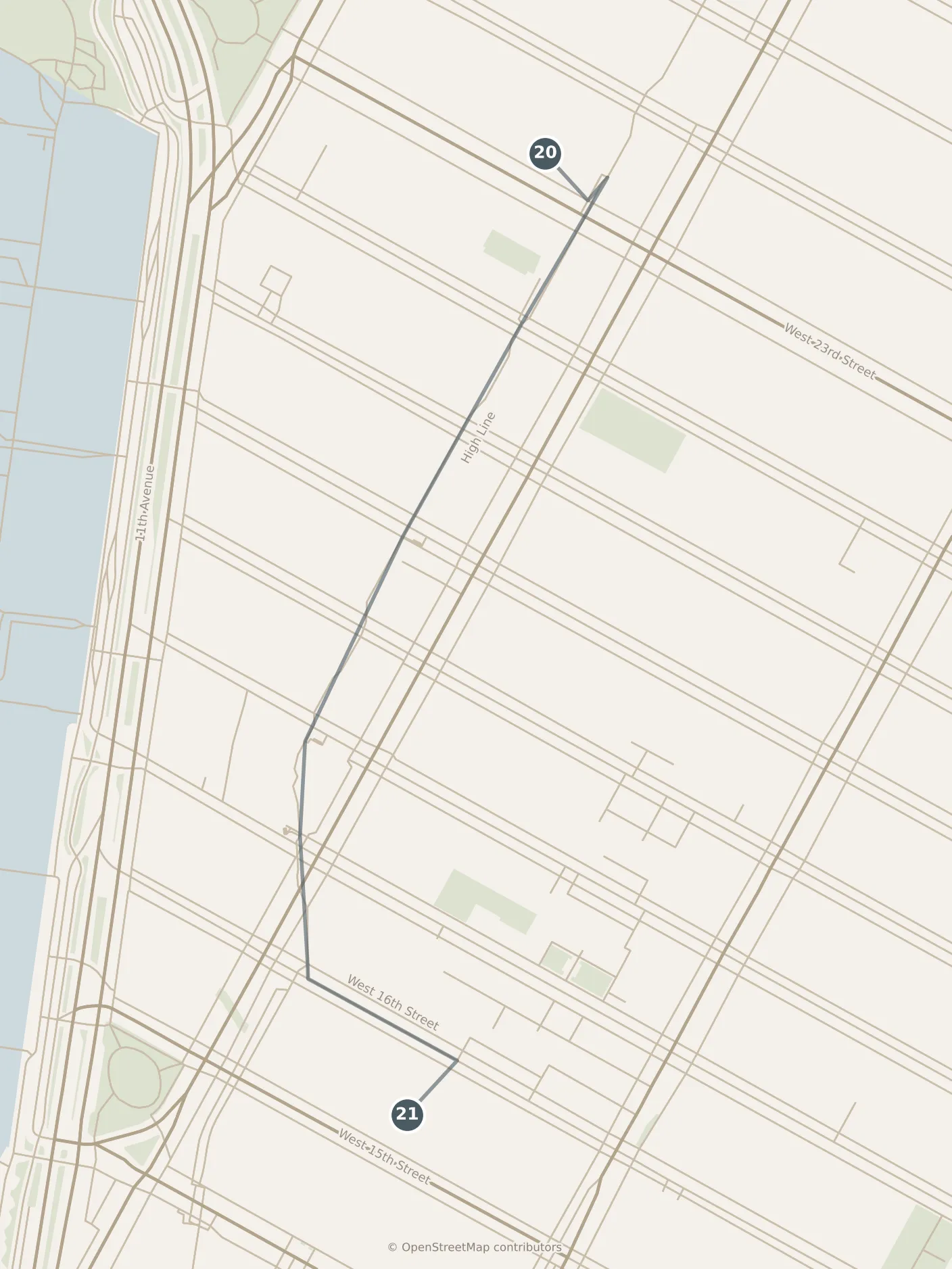
The High Line and Chelsea, and this is deliberately the lightest day of the seven.
The High Line is a mile and a half of disused elevated railway turned into a narrow park, thirty feet above the street, running north from the Meatpacking District through and sometimes between buildings. Walk it from the southern end and allow an hour without hurrying. The planting is the point — it was designed to echo the self-seeded weeds that colonized the tracks in the twenty-five years the line stood abandoned — and so is the height, which puts you at the level of second-floor windows and fire escapes for a mile. It gets busy from late morning; early is better.
Two things sit at the ends of it. At the southern end the Whitney Museum of American Art is ticketed and one of the few large museums in the city you can see properly in two hours, and its outdoor terraces look back over the neighborhood; beside it Little Island is a small public park built on concrete tulips out in the river, free, though afternoon entry often needs a timed pass. At the northern end the line delivers you to Chelsea Market, a former cookie factory whose ground floor is now a hall of food stalls. It is worth walking through and it is packed at lunchtime; the blocks around it are where you would actually sit down.
Walk back down through Chelsea itself on the way out. The blocks between the High Line and Tenth Avenue are dense with commercial art galleries, most of them free and empty on a weekday afternoon, and you can walk into any of them. Nobody will ask you anything.
Then leave the evening empty on purpose. A week is long enough to have found something you want to do twice, and the last night is better spent on that than on a new neighborhood at the far end of a train line.
Practicalities
One date decides this week, and two others only color a day. The Metropolitan Museum closes on Wednesdays, all year, so day four cannot fall on one — place it first and let the rest of the week follow. First onto the calendar, that is: pin day four to any day that is not a Wednesday — a Sunday arrival lands it exactly on one — and the other six days follow in the order they are written, on whatever dates that leaves. The American Museum of Natural History on day six opens every day and constrains nothing. Two days are colored by where they land without being decided by it: day six only has its church services if it falls on a Sunday, and day seven’s galleries are as empty as described here on a weekday afternoon, which is not a promise about a Saturday.
Three things are worth reserving. The observation deck on day one is a timed ticket and the late-afternoon slots go first. The museum beneath the September 11 memorial is timed entry and sells out on wet days. The park in the river on day seven often needs a free timed pass for afternoon entry, and never for the morning. The two big museums do not need booking, though buying online saves waiting in line.
Days three and six end away from where they started, and both are simple returns because the subway runs through the night. That is what makes the ending of day three possible at all — you cross into Williamsburg in the evening and come back whenever you like — and it is worth remembering on day one, when the instinct is still to head back before dark.
Two stretches catch people out. Central Park on day four is a couple of hours of walking before you have even entered the museum, which is more than most legs want; if the weather is against you, the Ramble and Belvedere Castle are the parts to drop, and the Mall and Bethesda Terrace still deliver you to the Met. And the Brooklyn Bridge is longer than it looks from either end — a mile, exposed, with no shade and nowhere to sit down. Take water for both.


.jpg)


