New York in one day: the free ferry, then the bottom of the island on foot to the bridge

Last updated 3 August 2026
Overview
The mistake with one day in New York is reading the map as a list. The famous things are strung along thirteen miles of island and joined to each other by train, so a day that takes Midtown, then downtown, then the park is a day that spends two hours underground and never sees a street properly. This one refuses to do it. Everything below sits at the bottom of the island, which is the one part of the city where the things worth seeing are within a walk of each other, and where the walking is not the cost of the day but most of the point of it.
What that buys is paid for in postcard. No Times Square, no Empire State Building, no Central Park, no Metropolitan Museum of Art: they are six kilometers north of here at the nearest, and going up for them means a train each way, twice. The museums are the easiest loss to accept and the hardest to admit. Any one of the great ones is a morning, and a morning spent inside is this entire walk given up — so if a museum is the reason you came, take the museum and abandon this route rather than trying to hold both. What you get instead is the oldest part of the city, laid out on lanes that predate the grid, with the harbor at one end and a bridge at the other.
It is also, unusually for New York, free from end to end. The boat, the fort, the church, the street, the memorial plaza and the bridge cost nothing at all, and the only ticketed things anywhere near this route are the ones it deliberately declines. That is worth knowing in a city where the default plan runs to a hundred dollars a head before lunch.
The day is built around its last hour, and the hinge is light rather than opening times. You cross the Brooklyn Bridge on foot as the light goes, so that you reach the far side while the towers behind you come on. Everything before the bridge — the stops, and the walking between them — comes to about four hours, so count back four hours from the hour the light goes where you are standing. In December, when the sun is down by about half past four, that is a start around midday, and this day fills the short afternoon almost exactly. In June the light lasts until about half past eight, which would put the start in the middle of the afternoon — and that is the one place the count-back breaks, because the fort in the Battery closes at five and the church not long after. Begin by two whatever the season. A summer version of this route then has hours of slack in it, and the honest thing to do with them is to lengthen the stops rather than bolt another neighborhood on the end.
That four hours measures the time you spend in places and walking between them, and it measures two things not at all. The first is the wait for the ferry. The crossing itself is twenty-five minutes each way and that is fixed; the boats leave each terminal every half hour outside the weekday peaks and every fifteen or twenty minutes inside them, so the wait is bounded but it is the one part of this route nobody can time to the minute. The second is the museum beneath the memorial, which is a separate ticket and a long, harrowing visit — take it and the bridge does not happen, so decide before you arrive rather than in line. Four hours is the floor of this day, not the estimate, and the ferry terminal is where the difference will come from.
Nothing here has to be booked and nothing has to be bought. The one thing you need in your hand is a contactless card or phone to tap at a turnstile, for the single subway ride at the start and the single one at the end; how that works, and everything else about paying your way around this city, belongs to the city guide rather than to this page.
The day

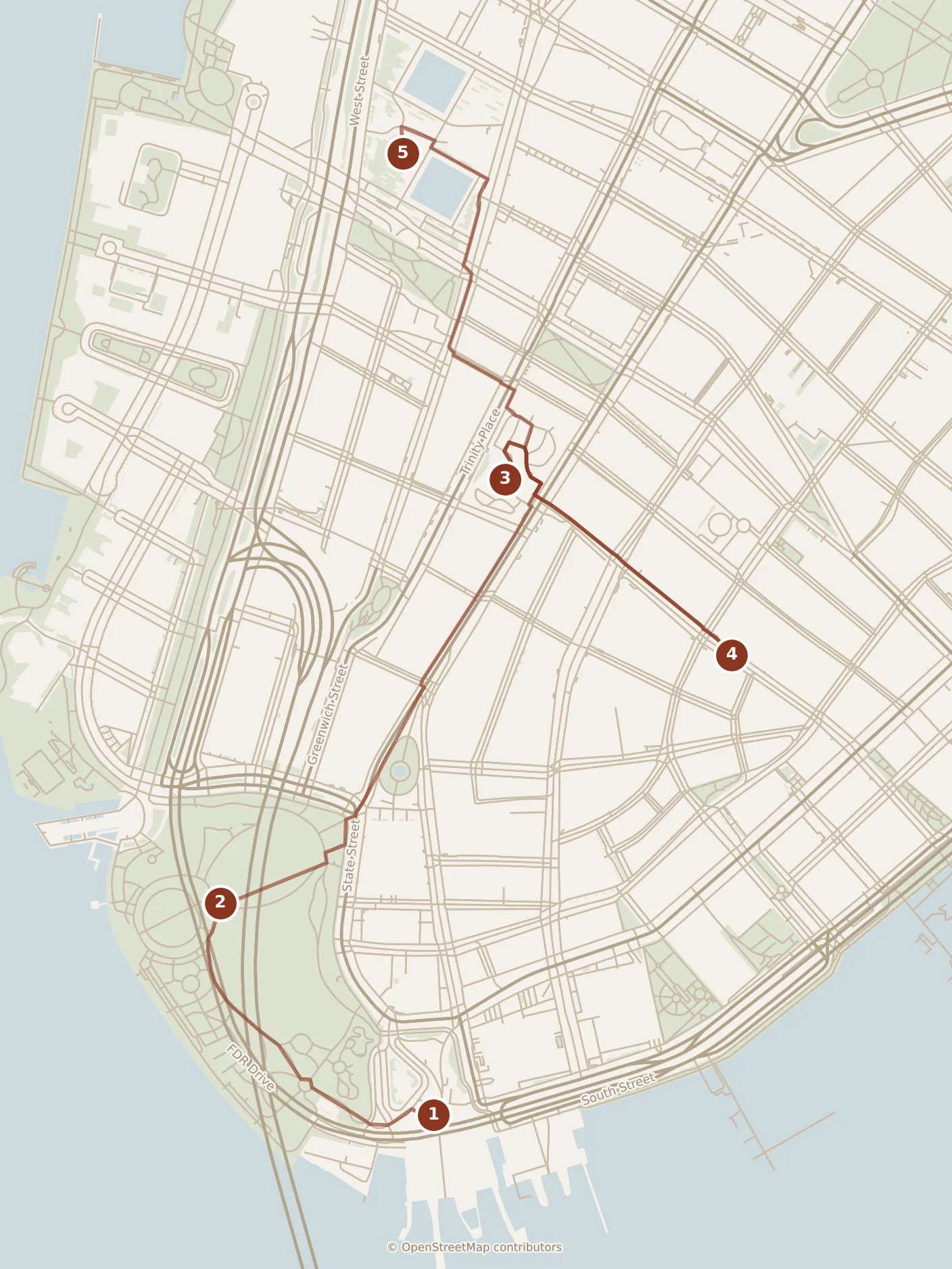
- Morning and afternoon
- 1Staten Island Ferry
- 2The Battery
- 3Trinity Church
- 4Wall Street
- 5National September 11 Memorial
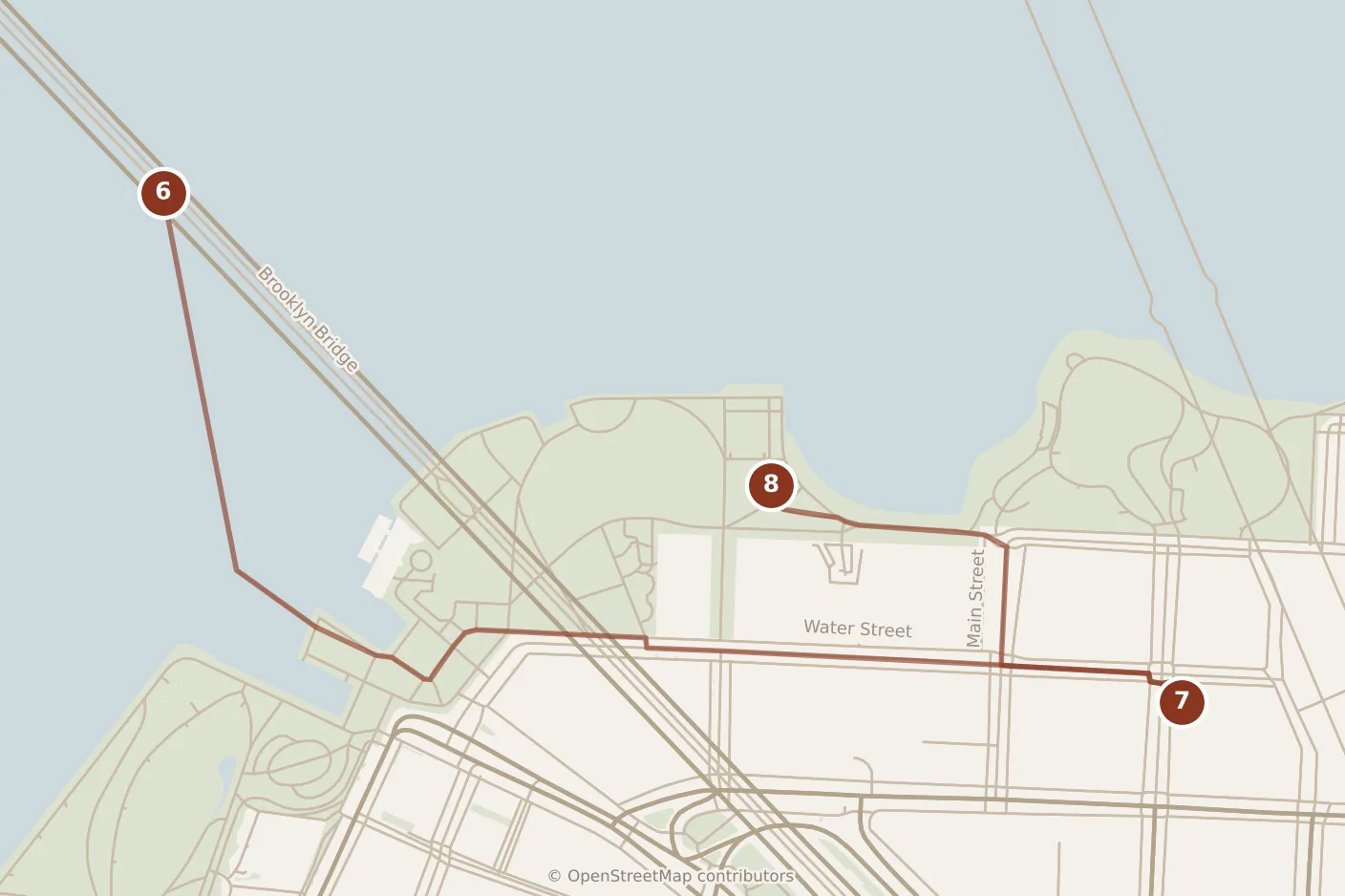
- Evening
- 6Brooklyn Bridge
- 7Dumbo
- 8Empire Fulton Ferry
Morning
Begin at the ferry terminal at Whitehall, on the eastern edge of the Battery, and take the Staten Island Ferry out and straight back before you do anything else. It goes first for a mechanical reason: it is the only leg of this day with a schedule in it, and putting it at the front means nothing later is waiting on a boat. It is free, and it is a commuter service rather than an excursion. The crossing is twenty-five minutes each way and passes close enough to the Statue of Liberty that the crossing is the view; you are turned off the boat at the far end and walk round to board again, and outside the weekday peaks the boats go every half hour, so you either make the immediate turnaround or wait for the next one. Give the round trip an hour and a quarter, spend it standing outside rather than sitting in, and stand on the right going out and the left coming back: that is the side the statue passes on.
You come back into the Battery, which is a park on the harbor and the reason this is a good place to start rather than to finish: the whole of the water is in front of you before the city has closed over your head. In the middle of it stands Castle Clinton, a squat circular sandstone fort of 1811 that has been almost everything since — as Castle Garden it was the immigration station before Ellis Island, and more than eight million people first stepped ashore in America through that doorway between 1855 and 1890; later it was the city aquarium for forty-five years. It is free, it takes ten minutes, and inside it now are the ticket windows for the boats to Liberty Island.
Local tip. The whole shape of this day rests on taking the free ferry rather than the ticketed boat to Liberty Island, and both of them leave from this same corner of the island, so it is a choice worth making deliberately rather than by accident. They show you the same statue. One is free, needs nothing booked and costs you an hour and a quarter; the other is a ticket, a security screening and the better part of the day. With one day the free one is not the compromise — it is what pays for everything below.
From the Battery walk north up Broadway, a little over ten minutes, and you will pass the Charging Bull on the way at Bowling Green. It was set down outside the Stock Exchange illegally overnight in December 1989 as an unsolicited gift to the city, moved here shortly afterwards, and has been ringed by people photographing it ever since; look at it as you go past and keep walking, because there is nothing to do there that takes longer than that.
Broadway delivers you to Trinity Church, which is the third church on the site and dates from 1846 — Gothic Revival, by Richard Upjohn, in brownstone. Two facts make it worth twenty minutes, or half an hour if it is busy. The first is that its spire, at eighty-five meters, was the tallest thing in New York until 1890, which is impossible to believe standing at its foot among towers several times its height, and is the single clearest measure of how recently this skyline happened. The second is the churchyard around it, which is older than the church, full of leaning slate headstones and holds Alexander Hamilton — a graveyard in the middle of the financial district, which is exactly as odd as it sounds.
Wall Street starts at Trinity’s door and runs east to the river. It is six hundred meters long, nine minutes end to end if you never stop, and being shorter and narrower than it sounds is the whole experience of it: a stone trench that loses the sun long before the day is over, with the New York Stock Exchange on the corner behind its columns. Two blocks along is Federal Hall, with a bronze George Washington on the steps marking the spot where he was sworn in as president in 1789. The building behind him is not that building — that one was pulled down in 1812 — but a customs house of 1842, in marble, which then held the federal treasury. It was the demolished one that had been raised partly from the stones of the Dutch wall the street is named after. Peter Stuyvesant had it thrown up across the island in 1653, in earth and planks near enough three meters high, to keep the English out of New Amsterdam. It failed.
Afternoon
Eat here, in the lanes just south and east of Wall Street, before going on. This is a district that eats at a counter rather than a table, which is the honest way to have lunch on a day with this much walking in it: ten minutes standing up and back on the street. A New York slice is genuinely one of the things this city does better than anywhere, though whether the good one is on the block you happen to be standing on is a different question. Allow three quarters of an hour if you want to sit.
Then a quarter of an hour north-west, up Nassau Street and across, to the National September 11 Memorial. Each of the two towers left a square footprint and each footprint is now a sunken pool, an acre of water going down black granite walls into a smaller central void you cannot see the bottom of, with the names of everyone killed cut through the bronze parapet at the rim. Entry to the plaza costs nothing and it is open to the sky, and there is no honest way to say how long it takes — give it three quarters of an hour and stay longer if it holds you. The one thing it asks is that you walk right round both pools instead of stopping at the first. They are twins, and seeing only one of them misses the point that there were two.
One World Trade Center stands at the north-west corner of the site, and beside it is the transit hall everyone calls the Oculus: a white ribbed vault, ribs meeting overhead like the inside of a hull, which from the street looks like the skeleton of a bird. Under the vault it is a shopping center — a hundred-odd shops and counters, with the station beneath them — which is a jolt worth being ready for on the way out of the plaza. It is free to walk into and through, it takes four minutes, and it is worth them as a change of temperature.
What this afternoon does not do is go into the museum below the memorial. It is a separate ticket, it is a serious two hours or more, and it is the one thing on this route that would end the day where it stands. If it is what you came downtown for, do it and let the bridge go — that is a defensible way to spend a single day, and it is not this one.
Evening
From the memorial it is a quarter of an hour east to the top of City Hall Park, where the Brooklyn Bridge walkway begins on Centre Street; it is signposted from the street and there is a steady file of people going the same way. Walk it toward Brooklyn. This is the opposite of the instinct and it is the most useful sentence on this page: the view everyone crosses this bridge for is of the city you are leaving, so walking away from it puts that view behind you the whole way, and you get it whole in one piece when you turn round at the far end.
The bridge opened in 1883 and the walk is about two kilometers, half an hour at a steady pace, longer with stops and longer again on a summer evening, when everyone else is also up there for the light — which makes it comfortably the longest single stretch of this day. The promenade is a raised timber deck running down the middle, five and a half meters above the traffic and straight through the two great stone towers, and since September 2021 the cyclists have had a lane of their own on the roadway below, so the boards are pedestrians only — which is new enough that a good deal of advice about elbowing past bikes on this bridge is out of date. There is no shade on it, and once you are on the span there is no way off until the far end.
The walkway comes down by a staircase into Dumbo, which is not a joke but an acronym — Down Under the Manhattan Bridge Overpass — coined by residents in the 1970s in the hope that a name that ugly would keep developers away. It did not. Go straight down to the water, ten minutes, to the stretch of waterfront park called Empire Fulton Ferry: a lawn, a restored carousel in a glass pavilion, the Manhattan Bridge directly overhead, and the whole of Lower Manhattan lit across the East River with the bridge you just walked lying off to the west. Give it three quarters of an hour, and give it in that order — the skyline first, while it is still turning on.
What not to do here is wait in line on the cobbles of Washington Street for the photograph of the bridge tower with the Empire State Building framed under it. It is a good photograph, and you have just spent half an hour on the bridge itself; that was the version worth having. The subway back is a few minutes’ walk — York Street, or High Street a little further along — and it runs all night, though at that hour the trains are about twenty minutes apart, so nothing obliges you to leave when the light goes, but do not read the schedule as a license to lose track of it. If you have the legs, walking back over the bridge is three quarters of an hour once you have climbed up to it again, with the lit city head-on the entire way, which is the reverse of the crossing you have just made and, unusually, just as good.
Practicalities
This route survives any day of the week, and that is the strongest single argument for giving your one day to it. Nothing on it is a museum, nothing on it has a weekly closing day that would break the shape, and the ferry, the parks, the street and the bridge are indifferent to the calendar. The two things that do have doors — Trinity Church and the fort in the Battery — are between them half an hour of the day, so if either is shut when you arrive you have lost half an hour and nothing else. Trinity is a working parish church rather than a monument, so a service takes precedence over visitors; if that is the morning you get, the churchyard is the half you came for.
The weekend is worth a thought, though not the one most advice gives. This was an offices-only district and it has not been one for years: something over seventy thousand people now live at this end of the island, roughly three times the number at the turn of the century, and the conversions that put them into the old towers brought the shops and the kitchens with them. So a Saturday down here is not the deserted, echoing version of these streets — it is the busier one, and what the weekend actually costs you is the crowd on the memorial plaza and on the bridge rather than somewhere to eat. If it is the empty version you want, that is a weekday morning, early, before the offices break. Either way, walking the length of Wall Street to the water and turning north for five minutes brings you to South Street Seaport, which lives on visitors rather than on desks.
Nothing here needs booking. The three ticketed things this route turns down — the boat to Liberty Island, the museum under the memorial, and the observation decks up in Midtown — are deliberate omissions rather than oversights, and each of them would cost you the rest of the route. If you want one of them instead, take it knowingly and expect to lose the bridge.
Two warnings that are earned rather than decorative. The first is the bridge: two kilometers, exposed, no shade and no way off it, at the end of a day that comes to about six kilometers of walking in all, of which the bridge is the last two. Carry water, and if the weather is genuinely against you, cross it anyway — the crossing is the day — but do it earlier and shorten the memorial rather than the bridge. The second is that this route is almost entirely outdoors, which is its character and also its one real fragility: in sustained rain there is very little here to shelter in. The honest answer to a wet day is to shorten the route rather than to put something else in its place: start later, cut the memorial to the two pools, and keep the bridge, which is the day.


