New York in two or three days: the park and the great museum, then the island running out into water

Last updated 8 August 2026
Overview
One day in New York is a subtraction problem. You give the whole of it to the bottom of the island, because that is the one part of the city you can cross on foot in an afternoon, and you accept losing the park and the great museums, which sit far enough north that reaching them costs a train each way, twice. Two days is the length at which you stop having to give them up. It is not one day with more crammed into it. It is the island’s two ends, one each, and they are two different cities that happen to share a subway map.
Day one is the north: one enormous museum, the park it stands in, and a walk down out of the trees into the skyscrapers. Day two is the south, where the grid breaks up and the island runs out into water — the memorial, the seventeenth-century lanes, the harbor, and the bridge across it in the last of the light. Both days have the same shape: one subway ride in the morning, then on foot until you choose otherwise. Neither depends on where you sleep, which is a question the city guide answers properly and this page will not answer badly.
The sun goes down here anywhere from about half past four in the first week of December to just after half past eight in the last week of June, and each of the two days has a stop that wants the dark. Day two is the one that really turns on it: everything before the bridge comes to about four and a half hours, so from roughly October to March you take your month’s sunset hour, count back four and a half, and start there — that puts you on the span as the light goes and on the far bank while the towers behind you are coming on. From about the start of April to about the tenth of September the same count delivers you to a fort that has already shut, and the section below says what to do about that instead of pretending the arithmetic still holds. Every total in this article measures the time you spend inside places and walking between them, and it measures nothing else — not the security line at a museum door, not the wait in a ferry terminal for a boat that goes every fifteen to thirty minutes. They are the floor of a day rather than a forecast of one.
One thing decides which day is which before you read either. Day one is built around a museum, and that museum closes one day of the week. Establish which day before you fix your order: the museum publishes its own hours and its own closed day, and nothing else on the route across these two days has a weekly closure at all, so if it lands on your first day you simply run them the other way round, at the one cost the section below sets out: the bridge then falls on the day you arrived.
Nothing on the route has to be booked in advance, which is unusual for this city and worth saying plainly. The museum on day one is ticketed, but you walk up and pay at the door, and buying online only saves you the line. The single thing in this article that must be reserved is the museum underneath the memorial, and that is offered on day two as a swap rather than as a stop: general admission was in the thirty-to-forty-dollar range in 2026, it is timed entry bought online rather than at a window, and it does not open on a Tuesday. A third day adds nothing to book. What this route does require, from the first morning, is something to tap against a turnstile reader — an ordinary contactless bank card or a phone will do it, and there is no separate pass to buy. The mechanics of that, and the rest of what a stranger needs to know about fares here, are the city guide’s.
Day one

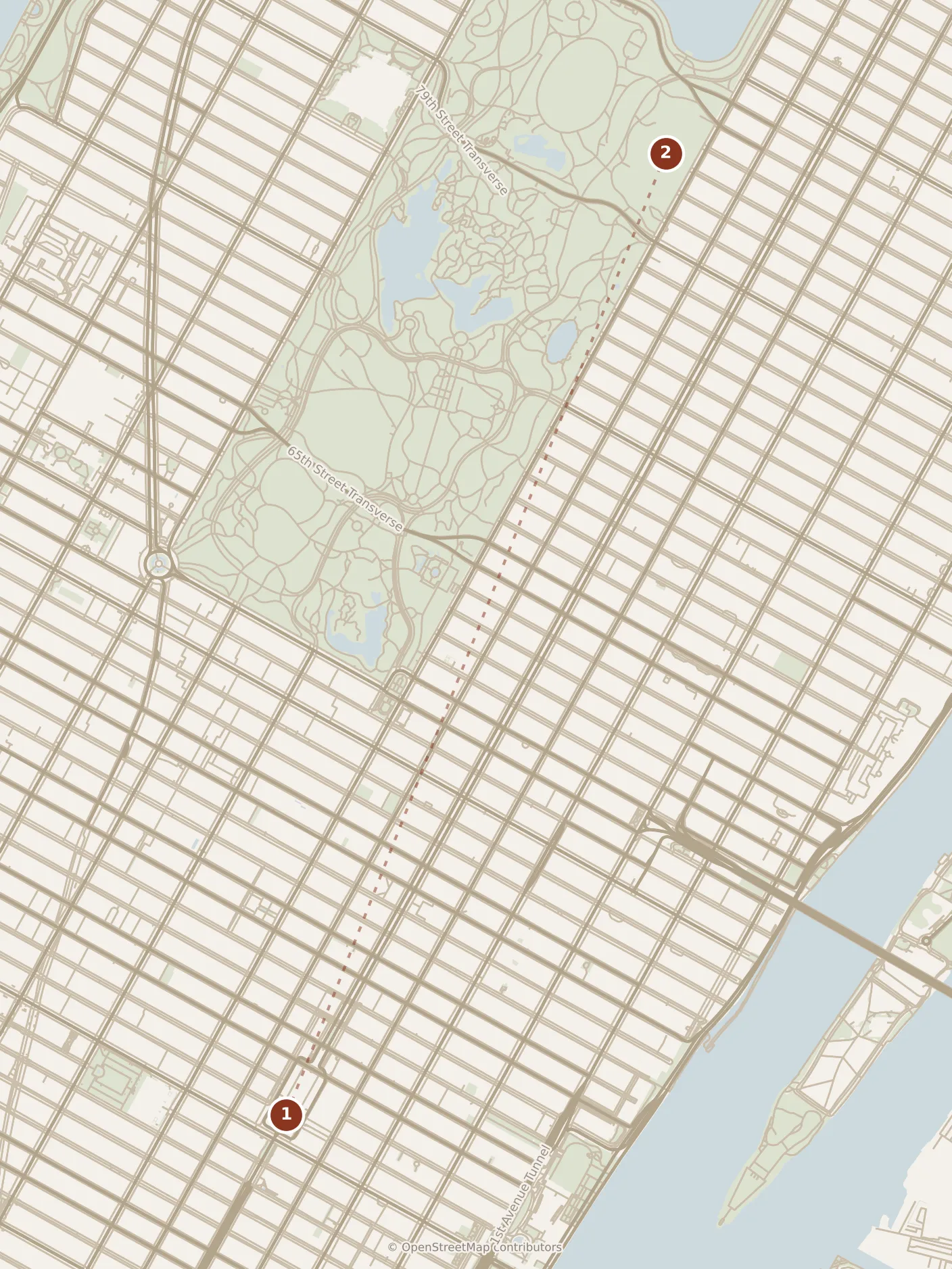
- Morning
- 1Grand Central Terminal
- 2Metropolitan Museum of Art
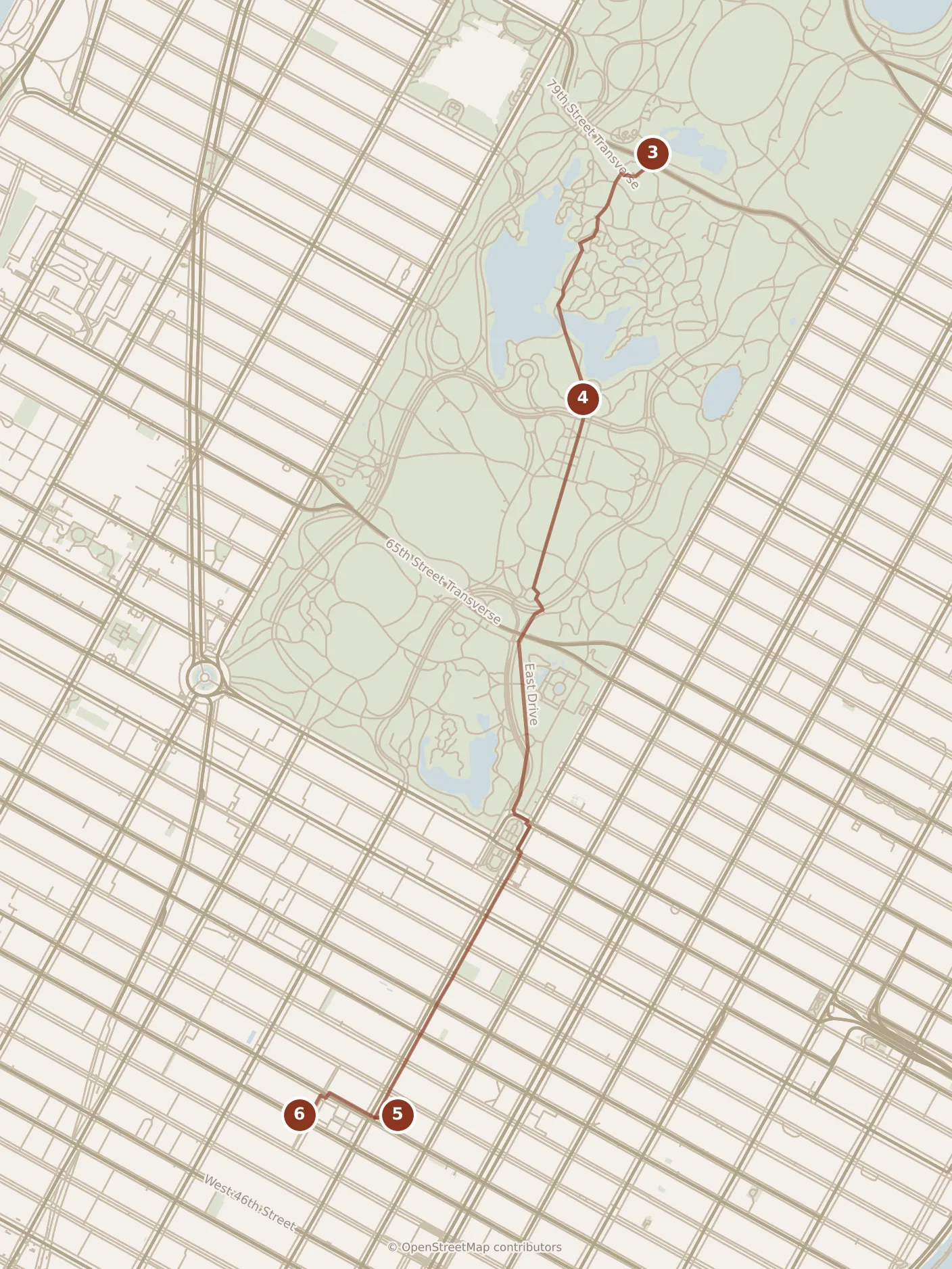
- Afternoon
- 3Belvedere Castle
- 4Bethesda Terrace and Fountain
- 5St Patrick's Cathedral
- 6Rockefeller Center
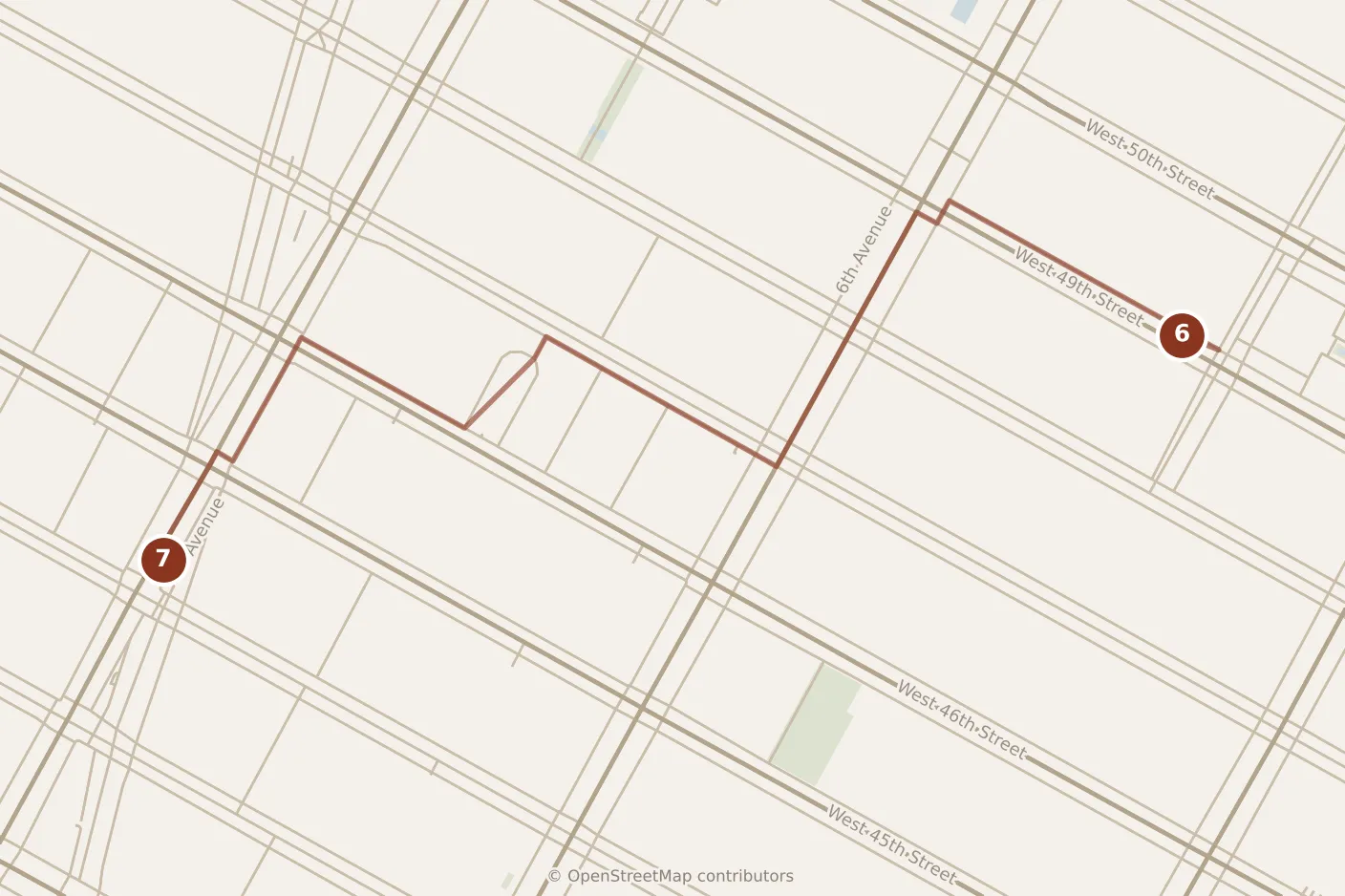
- Evening
- 7Times Square
The north end of the island, walked from the top downwards. This is the day with the ticket, the line and the crowd on it, and it goes first for a plain reason: it is the only one of the two that a closed door can wreck, so putting it first leaves you a whole second day to move it into.
Morning
Begin inside Grand Central Terminal, because the day’s train leaves from the room you are standing in. Coming from Penn Station, that is the 1, 2 or 3 up to Times Square–42nd Street and the S shuttle across — four minutes of riding, and a good deal more door to door once you have walked the transfer at Times Square and waited for two trains; from the east side the 4, 5, 6 and 7 all put you underneath it.
Give the main concourse twenty minutes. It is a Beaux-Arts room built on the scale of a nave, with a painted sky overhead that was scrubbed back to its colors during the restoration of the 1990s, and the whole of the instruction is to plant yourself in the middle of the marble and look up, at an hour when everyone around you is going somewhere. Then go down the ramps towards the dining level and stop at the low tiled arches at the foot of them. The vault there is Guastavino tile, and its curve carries sound along the arch: a person murmuring into the corner on one side is heard perfectly by someone facing the diagonally opposite corner, and not at all by anybody standing between the two. It costs nothing, it takes four minutes and it needs two of you. Eat a bagel on the way through — it is the correct breakfast in this city and nobody makes a ceremony of it.
Then take the 4 or 5 north from Grand Central–42nd Street to 86th Street, the 6 being the local and slower, and walk about twelve minutes west along 86th Street and down Fifth Avenue to the Metropolitan Museum of Art. The museum’s door is the true start of this day. Count forward from whatever hour it publishes — twenty minutes in the station, half an hour to get up here — and if that hour has moved since you last looked, the count works just as well from the new one.
Give the Met two and a half hours and give them to two departments only. A million and a half objects are spread over something like two miles of gallery, so the honest instruction is not what to see but what to refuse. Four candidates, and any two make a good morning. The Egyptian rooms finish with a temple that was dismantled in its own country, given away, shipped across an ocean and reassembled indoors, and now stands in a glass hall with the park on the other side of the wall. The arms and armor hall has a column of mounted, armoured riders down the center of it and converts people who thought they disliked museums. The American Wing has an entire marble frontage standing inside a roofed courtyard, with benches, which after ninety minutes on a stone floor counts for more than it sounds. And the European paintings are the conventional pleasure and the right answer if you only want one.
Local tip. Choose your two departments at the information desk in the Great Hall before you go in, not once you are inside. The building is laid out so that every direction looks equally promising, which is exactly why people give the first hour to whatever happened to be nearest the door and then reach the thing they came for with twenty minutes left. Two departments picked in advance is a visit. Six taken as they arrive is a corridor.
Afternoon
Come out and go straight into the park behind the museum. Ten minutes west stands Belvedere Castle, a folly of 1867 to 1869 by Calvert Vaux and Jacob Wrey Mould, put up to be looked at from across the water rather than lived in; there is nothing inside it but a small visitor room. It is free, worth twenty minutes, and shuts at five — the only door on this day besides the museum’s that can be closed when you reach it. The reason to climb it is not the architecture. It stands on the second-highest rock in the park, and since 1919 it has carried the park’s official weather station — when a forecast quotes a temperature for Central Park, this is the roof that number comes off.
Twelve minutes south through the Ramble — thirty-six acres of paths tangled on purpose, and the one stretch where the city genuinely goes quiet — brings you out above Bethesda Terrace and Fountain, the formal room of a park that spends the rest of its length pretending to be countryside. A double staircase drops to the water; the Angel of the Waters, by Emma Stebbins, has stood on the fountain since 1873. Under the terrace runs an arcade whose ceiling holds some sixteen thousand patterned tiles, made by Mintons to Mould’s design, taken down in the 1980s and not put back until 2007 — so older writing about this place describes a bare ceiling and is not wrong, only out of date. Someone is nearly always singing under it, for reasons the first note makes obvious. Twenty minutes.
From the terrace to the cathedral is a little over half an hour on foot: south down the Mall, which is the single straight line Vaux and Frederick Law Olmsted allowed themselves and an avenue of elms for its whole length, out of the park at Grand Army Plaza, then eight blocks down Fifth Avenue. St Patrick’s Cathedral is free, takes fifteen minutes, and is the largest Gothic Revival Catholic cathedral in North America, faced in white Tuckahoe marble. What makes it legible is the date: the cornerstone went down in 1858 on rocky ground among unopened streets, well north of where the built city then stopped. It was a bet on where New York would go, and the wall of glass now standing at its back is the settlement of that bet. It is a working cathedral with Mass said through the day, so if you walk into one, stay at the back or come round again in twenty minutes — you are in a service, not a monument.
Rockefeller Center is four minutes further. This route keeps it at street level. The bronze Atlas with an armillary sphere on his shoulders stands on Fifth Avenue looking directly across at the cathedral, which is a nineteen-thirties argument with a nineteenth-century one and reads as exactly that. Round the corner the plaza drops below the sidewalk to the gilded Prometheus, with the rink in winter and tables in summer and the Art Deco slab of the main tower standing over the whole thing. Twenty-five minutes. The observation deck at the top is the day’s second ticket and this route leaves it out deliberately: it is an hour and a timed ticket for the skyline seen from above, and tomorrow gives you that same skyline twice from outside it — from the middle of the harbor, and from the middle of the bridge — for nothing. With two days, that hour would have to be taken out of the museum. With money to spare and legs that have finished, it is a good hour.
Evening
Eleven minutes west is Times Square, which wants fifteen minutes and not one more. The screens are the whole of it, the crowd is what they cost, and the only mistake available here is staying.
From the moment you walk into the station, the day above comes to about six hours. Between October and March, counting those six hours back from your month’s sunset hour lands you in the square after dark with no effort at all. From about April to September it cannot, and the thing that binds is not the museum but the castle: it shuts at five, so once your month’s sunset is later than about half past seven the count puts you at its door after it has closed — the park cut below removes that door, at the price of the park. In those months, start in the morning as written, take the square by daylight for the intersection it is, and if the lit version matters to you, come back after dinner — it is ten minutes on a train from anywhere in Midtown. Times Square–42nd Street below you is the busiest station in the system and will send you home on the 1, 2, 3, 7, N, Q, R, W or S.
If the day is short, cut the park rather than the museum. Leave the Met by the Fifth Avenue door, take the 6 from 77th Street to 51st Street and walk about eight minutes west along 50th Street, and you arrive at the cathedral having given up the castle, the Ramble and the terrace and saved a little over an hour — the ninety-odd minutes they take, less the twenty-odd the walk and the ride cost you back. Cutting the museum would save more than twice that, and costs the day its reason for existing.
Day two

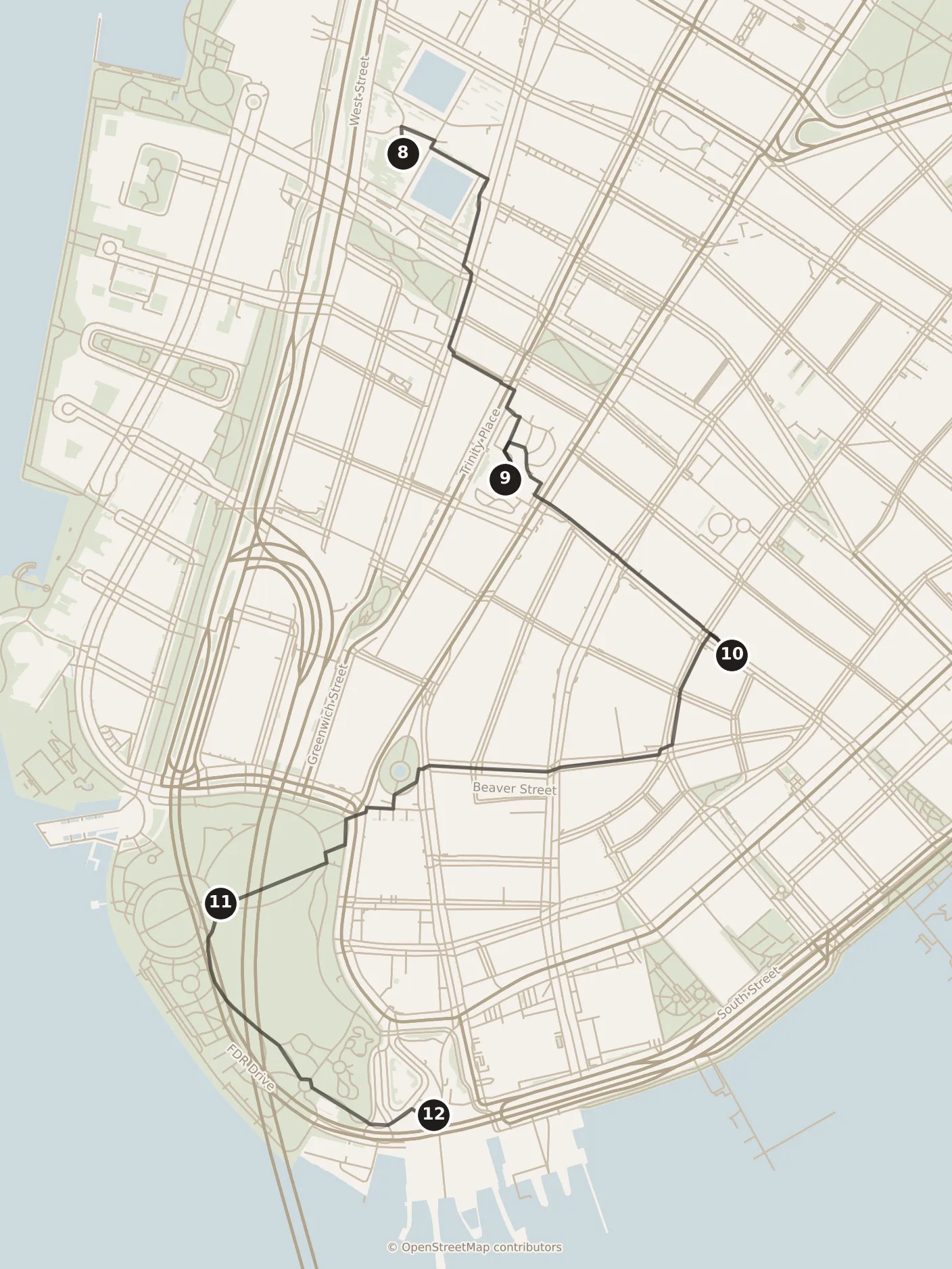
- Morning and afternoon
- 8National September 11 Memorial
- 9Trinity Church
- 10Wall Street
- 11The Battery
- 12Staten Island Ferry
- Evening
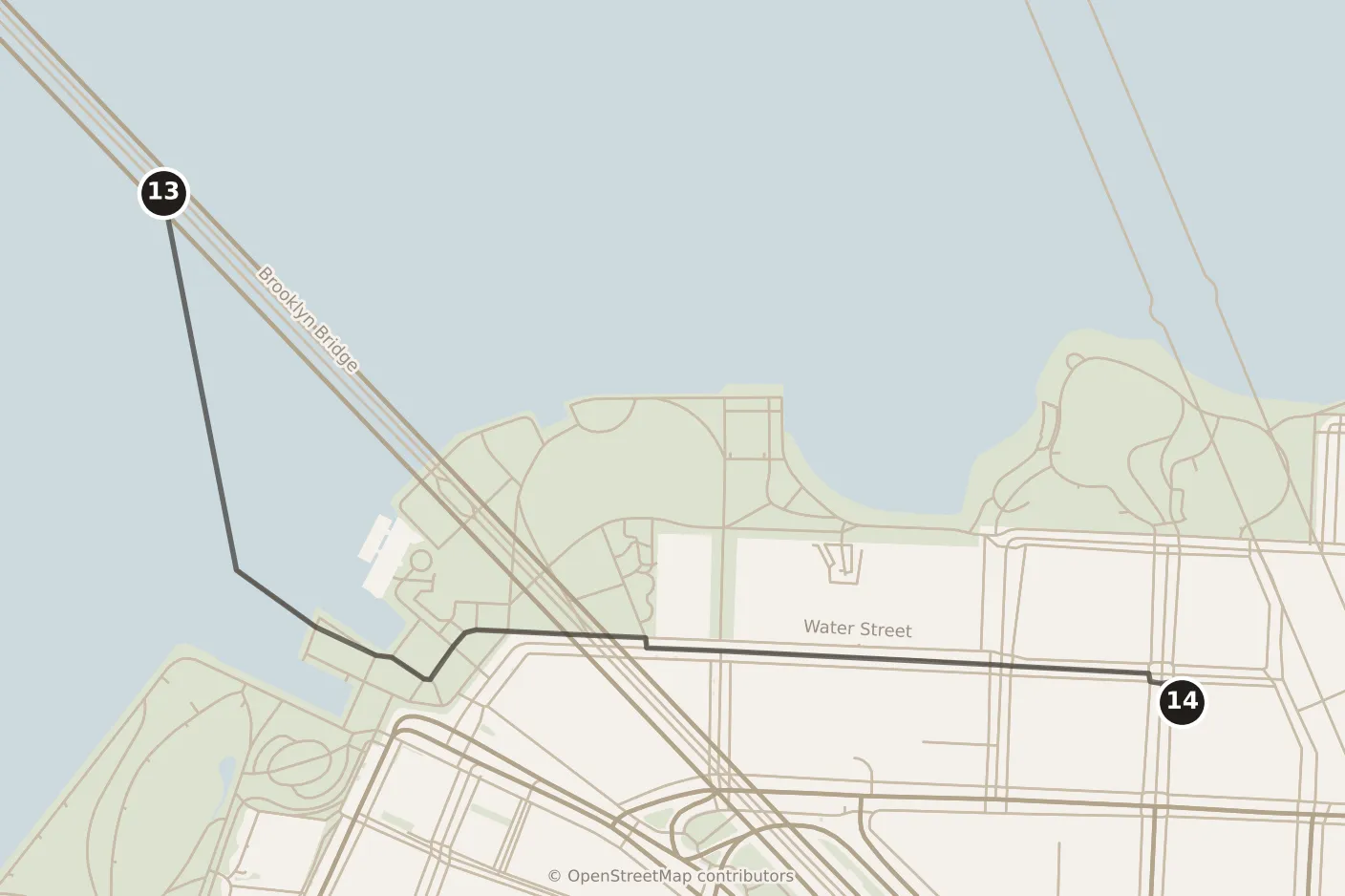
- 13Brooklyn Bridge
- 14Dumbo
The bottom of the island, which is a different city: no grid, no numbers, lanes laid out for shipping, and water at the end of most of them. Today is free from beginning to end unless you take the swap below, and it finishes on the far side of the river.
Morning
Arrive at the National September 11 Memorial. The E terminates at World Trade Center directly underneath it, the 1 stops at WTC Cortlandt, and the 2, 3, 4, 5, A, C, J and Z all reach Fulton Street, five minutes east on foot. The plaza is open air, free, and open from eight in the morning, and the earlier you get here the quieter it is — though be clear that in the short half of the year the count below will not let you be very early, and ending on the bridge in the light is worth more than an empty plaza.
Each tower left a square footprint an acre across, and each footprint is now a pool: sheets of water dropping down black granite and vanishing into a second opening at the center. They are the largest artificial waterfalls in the country and were built to hold the traffic noise down rather than to impress. 2,983 names are cut through 152 bronze parapets around the two rims, and the thing to know before you look is that the order is not alphabetical. Names were set by what the designers called meaningful adjacencies — who was standing near whom, who worked for the same firm, and some 1,200 specific requests from families — so the bronze is a map of who was together at the end. Eleven of the women were pregnant, and the parapet says so after their names. Three quarters of an hour, and go round the second pool as well as the first: the whole design turns on there having been two of them, and a visitor who sees one has been given half a sentence.
Understand where you are standing while you do it. The long-unidentified remains of some eleven hundred people are held in a repository cut into the bedrock seventy feet below the plaza, which makes this a grave in practice as well as a memorial, and some of the people at the parapet beside you are family.
Beside the pools, the vaulted transit hall everybody calls the Oculus is worth ten minutes of walking through — a white ribbed vault with a shopping center underneath it, which is a change of temperature worth expecting rather than meeting.
Then eight minutes south to Trinity Church, where today the churchyard rather than the church is the point: leaning slate headstones in a walled square with towers on all four sides, the earliest of them older than the country by the better part of a century. Twenty minutes. It is a working parish, so a service takes precedence over sightseers and the yard is open either way.
Wall Street begins at the church door and runs east to the river, and it is over sooner than anyone expects — the pleasure is that it is a stone trench rather than an avenue, dark by mid-afternoon, with Federal Hall two blocks along and a bronze president on its steps. Then turn south into the lanes below it and give them half an hour, because they explain the shape of everything around them. Stone Street is a paved lane of restored warehouses with tables down the middle from late spring to early autumn. Pearl Street, a block on, is where the water used to be: it follows the island’s original eastern shoreline, and everything seaward of it — Water Street first, Front Street later — is made ground, tipped into the East River across the eighteenth and nineteenth centuries to build wharves. That is why these lanes bend while the avenues above them do not. Lunch happens here and it happens standing at a counter: a slice, which is what this district does and the right way to eat with this much walking still to come. Allow three quarters of an hour if you would rather sit.
The swap. If the museum beneath the memorial is what brought you downtown, take it, and take it first thing while you are standing on the plaza. It is a serious two hours and a good deal of it is harrowing. The cost is a simple subtraction and worth doing before you decide: two hours against the ferry’s hour and a quarter, so you surrender the crossing of the harbor and you step onto the bridge three quarters of an hour later than the count below. What does move is the fort, which arrives two full hours later — so if you are counting back from a sunset later than about a quarter past five, start that much earlier or you will find Castle Clinton shut. Nothing else on the day moves. In winter that later start is the difference between crossing in the last light and crossing in the dark, which is a lesser thing but not a ruined one; from May to August it costs you nothing whatever, because the light lasts anyway. Settle it before you leave for the day rather than at the ticket desk, and note that it is the only thing anywhere on day two with a weekly closing day, and that day is a Tuesday.
Afternoon
Thirteen minutes south-west and the island stops. The Battery is a park along the harbor, and the water opens all at once — the bay, the container ships riding out to sea, the statue small and green in the middle distance. Standing in the middle of the grass is Castle Clinton, a low circular sandstone fort of 1811 that spent the century after its retirement as, in turn, a concert hall, the landing station where millions of immigrants first set foot in the country, and the city aquarium. It is free and takes ten minutes. Forty minutes for the fort and the waterfront together.
The fort is the one hour this day rests on. It kept national-park hours in 2026 and shut at five, which is why it belongs to the afternoon rather than the end of the day, and why the count runs forward from the morning in summer instead of backwards from the light. If the hour has moved, the rule has not: this closes while there is still daylight, and the bridge never closes at all. It also shuts on Thanksgiving and on Christmas Day, and on nothing else.
The ticket windows inside the fort are for the boats to Liberty Island and Ellis Island, which is where most people make this decision by accident rather than on purpose. Going ashore means a ticketed boat, an airport-style screening and the better part of a day. This itinerary does not spend one on it; if you want it, understand that it takes this whole afternoon and the bridge with it, and that day two then ends at the Battery in the middle of the afternoon.
What the afternoon does instead is seven minutes further round to Whitehall Terminal for the Staten Island Ferry, out to St George Terminal and straight back on the next boat. It costs nothing, it is a commuter service and not an excursion, and it runs within a few hundred meters of the Statue of Liberty, which is why the crossing is the reason for taking it and the far shore is not. Twenty-five minutes each way; everybody is put ashore at the far end and walks round the building to the gate for the next departure. Departures are every fifteen to twenty minutes at the peaks and every half hour between them. The hour and a quarter is the two crossings and the turnaround at the far end; the wait for the first boat at this end sits on top of it and is the part nobody can time in advance, so leave room for as much as another half hour. Stand out on the deck rather than sitting in the cabin — on the right going out and the left coming back, which is the side the statue passes on — and dress for a harbor rather than for a street.
Local tip. The ferry and the bridge hand you the same harbor twice, once from the water and once from above it, and if the day is running late you can only have one of them properly. Cut the ferry. Not a minute of its hour and a quarter is negotiable — the crossing is fixed, the turnaround is fixed, and a boat cannot be hurried — whereas the bridge simply shortens if you walk it faster. Nothing else today is long enough that dropping it buys you anything.
Evening
Do not walk back up Broadway; you came down it this morning. Take the 4 or 5 uptown from Bowling Green and get out at Brooklyn Bridge–City Hall, which leaves you five minutes from the ramp onto the walkway at the top of City Hall Park, where Centre Street begins. A quarter of an hour door to door.
Everything above comes to roughly four and a half hours from the memorial, and the crossing itself is about half an hour at a steady pace, three quarters if it is crowded and you stop. Cross towards Brooklyn rather than out and back from this side. Almost nobody does and almost everybody should. The skyline is at your back for the whole span, which means you get it in one piece at the moment you turn round, instead of watching it approach for half an hour and arriving with nothing left to look at.
The walkway is a raised timber deck running above the traffic and through two masonry towers, on cables that were the first anywhere to be spun from steel wire. It is nearly two kilometers, there is no shelter of any kind on it, and from the moment you are out over the water there is no exit until the far end — which is worth knowing in weather and worth knowing with luggage.
A staircase brings you down into Dumbo. Go to the water: ten minutes downhill from the foot of the stair, and they belong in the count above. The lawn under the bridges faces the whole of Lower Manhattan across the East River, with the span you have just walked running off to one side, and three quarters of an hour there is not too much. Take the skyline in the first ten minutes, while the windows are still coming on one floor at a time, rather than after. The fort forces a start no later than about three in the afternoon on the day as written, and about one o’clock if you have taken the swap, which puts two more hours in front of it. Three puts you on this lawn by about eight — so through high summer you will arrive here in full daylight, and it is only in April and in the first half of September that starting as late as the fort allows still brings you here near sunset. That is the trade and it is not a bad one: the lit version is either the walk back, half an hour with the towers head-on, or this same stretch of grass after dinner. York Street on the F, and High Street on the A and C, are both a few minutes away, and trains run all night, so the light going is not a summons.
With a third day

- With a third day
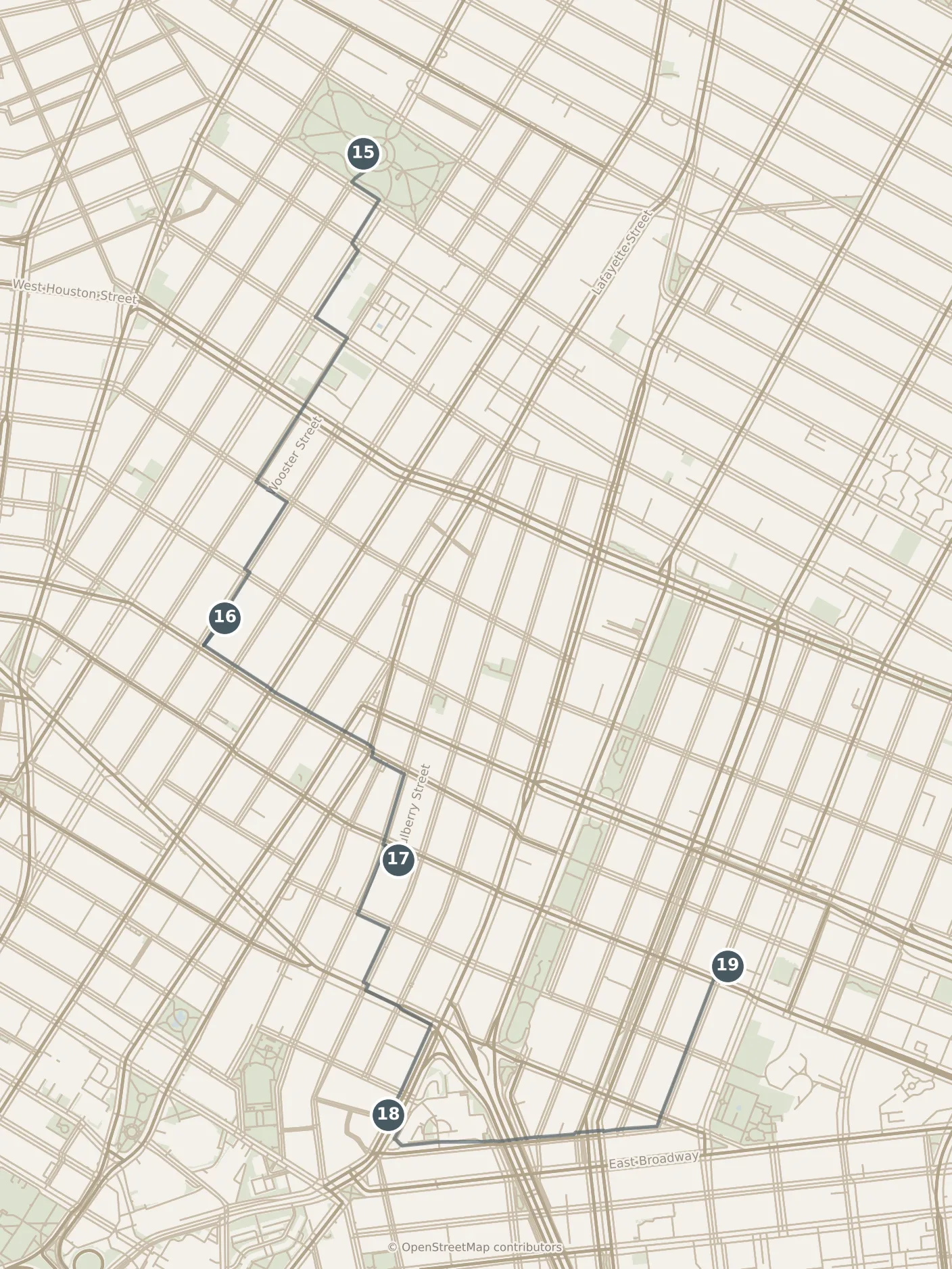
- 15Washington Square Park
- 16SoHo
- 17Little Italy
- 18Chinatown
- 19Lower East Side
A third day goes best in the middle, though nothing forces it there, and it is the middle of the island: the low-rise blocks between the two ends that days one and two have taken. It is the day with no ticket, no line, no view and nothing that closes, and after two days of monuments it is the one people describe afterwards.
Put it second and let the harbor day slide to third. That ordering is better for one reason and worse for one. Better, because day two ends across the river after dark with nothing you have to come back for, and that is the right way for a trip to end. Worse, if you fly out on your last day — a suitcase and a two-kilometer bridge do not belong together, and neither do a suitcase and a ferry that makes you change boats. If your last day has a plane in it, append the middle day instead and keep the harbor day second. With a case at both ends of the trip the middle day is wanted in two places at once and cannot be in both — that is a real collision and not an oversight, and the way out is to give up the default: run the middle day first, the harbor day second and the museum day last, which at least keeps the bridge and the ferry on the day you are carrying nothing. Moving it about costs nothing, which is what softens the one scheduling problem in this article: the middle day contains nothing that shuts, so it will take any of the three slots, and the museum’s closed day binds only in the arrangement just given, where the museum day is pinned last and that final date had better not be the closed one.
Start at Washington Square Park — the A, C, E, B, D, F and M all reach West Fourth Street–Washington Square. Half an hour is plenty. There is an arch, a fountain with people sitting round the rim, a corner given over to chess, and whoever has decided to perform today; the university owns most of the buildings on the square, so the crowd is undergraduates rather than visitors, and that sets the register for the whole day.
Eighteen minutes south is SoHo. The streets feel wrong underfoot before you can say why, and the reason is that they were surveyed before the numbered plan was imposed on the island above Houston, so they run at their own angles. No district on earth has more cast iron standing in it: warehouses of the 1860s and 1870s whose facades — columns, cornices, window surrounds and all — were cast in a foundry and bolted on, because iron came out of a catalog and carved stone did not. Expensive shops occupy the ground floors, which is precisely the argument for looking at everything above them. Greene Street and Prince Street hold the best of it. Three quarters of an hour, walking slowly with your head tipped back.
Eleven minutes on, Little Italy has contracted to a few blocks of Mulberry Street and is honest about being a memory of itself. Twenty minutes is a fair reckoning, and they are worth it for the compression: Chinatown has grown into the streets on every side, and the seam between the two is visible from the sidewalk rather than needing to be pointed out. Nine minutes further and you are inside Chinatown proper, which holds the highest concentration of Chinese people in the western hemisphere, and this is lunch and the early afternoon — an hour and a half for the food and the streets together. Canal Street is the loud edge; a couple of blocks south of it the noise drops and the prices with it, and the fish and vegetable stalls out on the sidewalk are a working market rather than a display laid on for anyone.
Fourteen minutes north-east lies the Lower East Side, and it takes what is left of the day, an hour and a quarter and more if the evening goes well. At the turn of the twentieth century this was about the most densely inhabited ground on the planet, and the tenement rows still standing on and around Orchard Street are the evidence: five and six stories, fire escapes zigzagging down the fronts, and narrow airshafts driven between buildings that had been put up without them and were made to comply afterwards. Walk it for the buildings and stay for the eating — a pastrami sandwich on rye belongs to these blocks more than to anywhere else in the city, and the delicatessen trade that started here is the reason. Delancey Street–Essex Street on the F, J, M and Z takes you out.
The day comes to about five hours, which makes it the shortest of the three and the only one meant to overrun. If you are short, cut the Lower East Side. It is the one stretch where the walking is itself the content, so losing it costs a mood rather than a sight, and Chinatown already sits on Canal Street, which several lines run through.
Practicalities
One thing to book, and it is optional. Nothing on the two core days needs a reservation. The only reserved ticket anywhere in this article is the museum beneath the memorial, offered as the day two swap: timed entry, bought online, in the thirty-to-forty-dollar range in 2026, and shut on a Tuesday. The museum on day one is ticketed but walk-up. A third day adds nothing.
Which day must miss which, and which may move. Only one day here is load-bearing, and it is day one, which has to miss the museum’s weekly closed day and carries a second door — the castle in the park — that shuts at five. The museum publishes that day and its hours itself, and it is the one thing worth reading the week before you travel. Day two as written must miss nothing at all: the plaza, the lanes, the fort, the ferry and the bridge run seven days a week, and the fort’s only closures in the year are Thanksgiving and Christmas Day. A third day must miss nothing either. So the two core days will take any pair of dates in either order, and one rule settles which order: if your first date is the museum’s closed day, run them the other way round. Two smaller things are true on particular days rather than closed on them, and neither breaks anything. Trinity Church is a working parish and the cathedral on day one says Mass through the day, so on a Sunday morning you will meet a service in both — the churchyard is open regardless, and the cathedral simply asks you to stand at the back. And the day two swap is off on a Tuesday; if that is your downtown day, the ferry stands, which is what the route does by default anyway.
The one arrangement that quietly goes wrong is the two-day trip whose first date is the closed one. The fix above is right, but it moves the bridge onto the day you arrived, which is the day you are least likely to want two kilometers of exposed walkway at the end of. If that is you, sleep on it and cross in the morning: the walk is good in either direction and in either light, and what you lose is the skyline switching on, not the bridge.
Moving between the stops this article names. Each day is one ride and then feet. Day one: the 4 or 5 from Grand Central–42nd Street to 86th Street, and everything after that on foot down to Times Square–42nd Street. Day two: the E to World Trade Center or the 1 to WTC Cortlandt at the start, the 4 or 5 from Bowling Green to Brooklyn Bridge–City Hall in the evening, and York Street on the F or High Street on the A and C to get home. A third day: West Fourth Street–Washington Square at one end and Delancey Street–Essex Street at the other. Beyond reaching the first stop and getting home from the last, day one contains one paid ride, day two contains one, and a third day contains none at all — which is the whole transport cost of this itinerary. What a journey costs and how you pay for it is the city guide’s business rather than this page’s.
The bag, which is only a question on two half-days. In the middle of a trip this length it lives where you sleep, and that is the real advantage two days has over one. It is the morning you arrive and the afternoon you leave that need thought, and the answer is not a locker at a terminus: Grand Central’s lockers went decades ago and the room that held them is now the escalator hall down to the Long Island platforms. Solve it with the running order instead. Two stops on these days are genuinely bad with a case and both are on day two — the bridge, which is nearly two kilometers with a staircase at the far end and nowhere to put anything down, and the ferry, which turns you out at St George Terminal and walks you round the building to board again. So if you are carrying a bag on a half-day, make it the middle day: Washington Square down to the Lower East Side is flat, short, full of places to sit and never far from a station on several lines. If you have only two days and the bag is with you on the first morning, start day one late and take the park cut given at the end of that section — the station and the museum are both indoors and neither minds luggage.
Two things worth being warned about, both on day two. One is the span itself: no cover, nowhere to stop, and no exit between the two banks, arriving at the end of a day already several kilometers long. Take water with you in any weather warmer than cold. The other is that the whole day happens out of doors, which is what gives it its character and is also the one thing that can spoil it, because there is very little down there to stand under in prolonged rain. A wet day is not a reason to substitute a different route; it is a reason to compress this one. Take the swap, spend the two hours below ground at the memorial, drop the ferry, and cross anyway — the crossing is the point of the day and it is no worse wet than dry. On a wet Tuesday the swap is shut and that fallback is gone, so compress by cutting the ferry instead and keep the bridge.


.jpg)


