London in a week: one quarter a day on foot, the free museums in full, and a river day to Greenwich

Last updated 28 July 2026
Overview
A week is the length at which London stops being a list of things you already have photographs of and starts being a place you are living in, and the thing that ruins a long visit here is not choosing badly — it is traveling. The city guide states the constraint plainly and it is the one that shapes everything below: London has no single center. It is a collection of villages that grew together, and two things that look adjacent on a map can be forty minutes and two lines apart. A week spent criss-crossing it is a week spent underground.
So this is one quarter a day, walked. Each day below is a place rather than a theme: you come up from the Tube once in the morning, and after that everything is on foot until you choose otherwise, with one day that goes down the river instead. That also means the week barely depends on where you sleep — every day starts at a station, so any of the bases the city guide recommends will serve it, and choosing between them is that article’s job.
Two things make a London week unlike a week in most European capitals, and both are worth knowing before you plan it. The first is that the great museums are free — the British Museum, the National Gallery, the three in South Kensington, the two at Greenwich, Tate Modern — so the week below has very few tickets in it, and none of the free ones can be sold out from under you. The second follows from it: those museums do not take a day off. There is no closing day to plan around, which dissolves the problem that dominates a week in Rome or Paris. London’s calendar problem is a different one and it is a single one, and the last section resolves it into two lines.
The order is deliberate in one respect. It begins with the London on the stamps, because getting that behind you turns the rest of the week from an obligation into a city, and it ends in the East End, which is where London is most itself and least like its own postcards. In between it works outward: the old financial quarter and the Tower on day two, the river on day three, then the two great collections that each need a morning of their own, then a day on the water, and then east.
Almost everything below is free or costs the price of a coffee. The exceptions are named where they appear — the abbey, the cathedral’s floor and dome, the Monument, the Tower, the war rooms, the palaces, the painted hall and the clipper at Greenwich, the observatory courtyard, the wheel — and of everything in this week only two things need booking in earnest, one of which is not on that list.
What this week leaves out, and it is a real omission rather than an oversight: everything north and west. Camden and its markets, the crescent-and-terrace grandeur around the great northern park, the heath above the city, the antiques street in the west. Those are the eighth day, and the ninth is out of town — a Tudor palace up the river, a royal castle an hour west, the botanic gardens. One more absence is temporary rather than editorial: the city’s own museum has been shut since December 2022 while it moves into the old market halls at Smithfield, and is announced to reopen as the London Museum in 2026. If you are working from an older list, that is the entry that has gone.
Day one

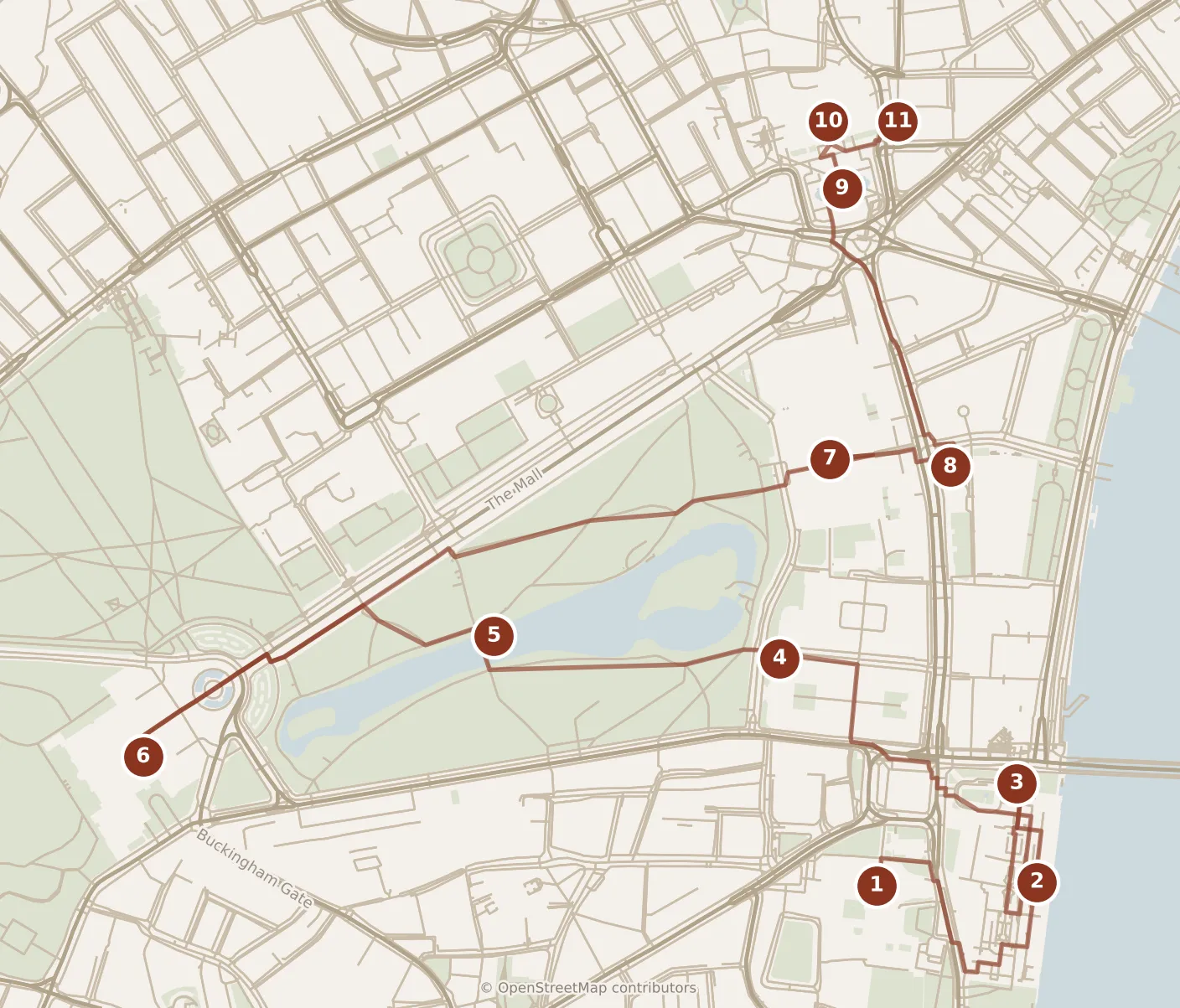
- Day one
- 1Westminster Abbey
- 2Palace of Westminster
- 3Big Ben
- 4Churchill War Rooms
- 5St James's Park
- 6Buckingham Palace
- 7Horse Guards Parade
- 8Banqueting House
- 9Trafalgar Square
- 10National Gallery
- 11St Martin-in-the-Fields
Westminster and Whitehall: a compact quarter — four and a half kilometers end to end, with no single leg over a mile — almost all of it out of doors, and deliberately first. It is compact in walking and long in standing: read the durations below before you decide it is an easy first day. This is the London that everyone arrives already knowing, and putting it on the first morning turns it from a duty into a backdrop.
Start at Westminster Abbey, at opening, and know that it is a church rather than a museum: it is shut to sightseeing on Sundays. Every English monarch since 1066 has been crowned in it and a great many are buried in it, which makes the floor the exhibit — you are walking on tombs almost everywhere. Three things repay knowing what you are looking at. The Cosmati pavement in front of the high altar is a thirteenth-century geometric floor of porphyry and glass, laid by craftsmen brought from Rome and uncovered again after centuries under carpet. Poets’ Corner is a wall and floor of writers, some buried and most only commemorated, and reading it is an argument about literary reputation conducted in stone over six hundred years. And in the nave, just inside the west door, is the grave of the Unknown Warrior, the one stone in the building nobody is allowed to walk on. A separate ticket takes you high into the roof space, where the church is seen from above and the crowd is thin. Ninety minutes, two hours with the galleries.
Five minutes on is the Palace of Westminster, which you will mostly look at rather than enter. The riverfront is the picture: a quarter of a mile of Gothic detail put up after fire destroyed the old palace in 1834, with Big Ben at the near end. The name belongs to the bell, not the tower, which is the Elizabeth Tower; the climb up it is reserved for residents of this country through their own member of Parliament, so it is not something a visitor can book. The building itself can be toured, on Saturdays and on weekdays when the two houses are not sitting, which is the one item on this day worth checking against your own dates rather than assuming.
Six minutes west, under a government building on the edge of the park, the Churchill War Rooms are the best hour of the day and the only timed ticket in it. This is the basement from which the Second World War was run, and the Map Room was locked in August 1945 and left: the pins are still in the wall charts, the colored telephones still on the desks, the sugar in a tin. What makes it land is not the grandeur but the meanness of it — low ceilings, bad air, a converted broom cupboard for the transatlantic telephone, a Cabinet room with a chair that has the arms scored by fingernails. Ninety minutes with the audio guide.
Cross St James’s Park, which is the prettiest of the royal parks and the most royal of them, and stop in the middle of the bridge over the lake: it gives you the whole quarter in two views, government domes and turrets one way and the palace the other. Pelicans have been kept here since the 1660s and are fed in the afternoon. Twenty minutes to cross, longer if you sit. Buckingham Palace is at the far end and is, honestly, a plain gray front onto a roundabout; the State Rooms inside open only for a summer season of about eleven weeks from early July, so for most of the year the building is something you look at for ten minutes and leave. Changing the Guard happens here but not every day, and the schedule is published in advance. Check the date — and know that it is a late-morning fixture, which is the part that decides your day: taken in the order written above you reach this end of the park hours after it. If you want the ceremony, the palace has to be the first thing of the morning and the abbey has to follow it, not precede it. If you do go, stand along the Mall rather than at the railings, where you will see the backs of several hundred heads.
Walk back east down the Mall, which is the processional road and reads like one, to Horse Guards Parade: a gravel parade ground the size of a small field with two mounted troopers of the Household Cavalry sitting motionless in an archway, and a dismounted sentry you may photograph. Through the arch into Whitehall itself, past the Cenotaph in the middle of the road and the black gates of Downing Street, to the Banqueting House — the one surviving fragment of the vast Tudor palace that burned in 1698, with a ceiling by Rubens that is the only one of his still in the room it was painted for. Charles I was executed on a scaffold outside it in 1649, having walked out through a first-floor opening under his own ceiling. It closed in May 2024 for a long restoration and has been opening in seasons since rather than daily, so check whether it is open on your dates and plan the day so that the answer does not matter.
Lunch belongs somewhere in this stretch, in one of the pubs in the lanes off Whitehall, which feed the civil service. They fill hard in the middle of the day and empty again quickly — and note where the order above puts you: if you have taken the abbey, the war rooms and the park as written you arrive well after that hour, which is the easy version. If you are running earlier than the page, eat first and see the Banqueting House after.
Finish at Trafalgar Square, five minutes north, with Nelson’s Column in the middle and one corner plinth left permanently empty for a rotating commission of new sculpture, which is the most interesting thing in the square. The National Gallery fills the north side, is free, and runs in one chronological line from the thirteenth century to the twentieth. Do not sweep it: take the newer wing at the west end, which holds the earliest paintings, and then two rooms of whatever you care about. The things people cross London for are here — a Van Eyck of a couple in a mirrored room, Turner’s Fighting Temeraire being towed to the breaker’s yard, a Velázquez, a Seurat — and two hours is a proper visit. St Martin-in-the-Fields is on the corner of the square, free to walk into, and puts on concerts including free ones at midday; there is a café in its crypt, among the gravestones, which is where the day can end sitting down.
Local tip. The war rooms are the only timed slot of this day, so read the day outward from it rather than starting at the top of this page. An early slot puts the abbey first and the park and the palace after; a late one puts the park and the palace first and the abbey second, which works just as well because the abbey holds its light all day and the basement has none at all. Everything else here is either free, out of doors, or both.
Day two

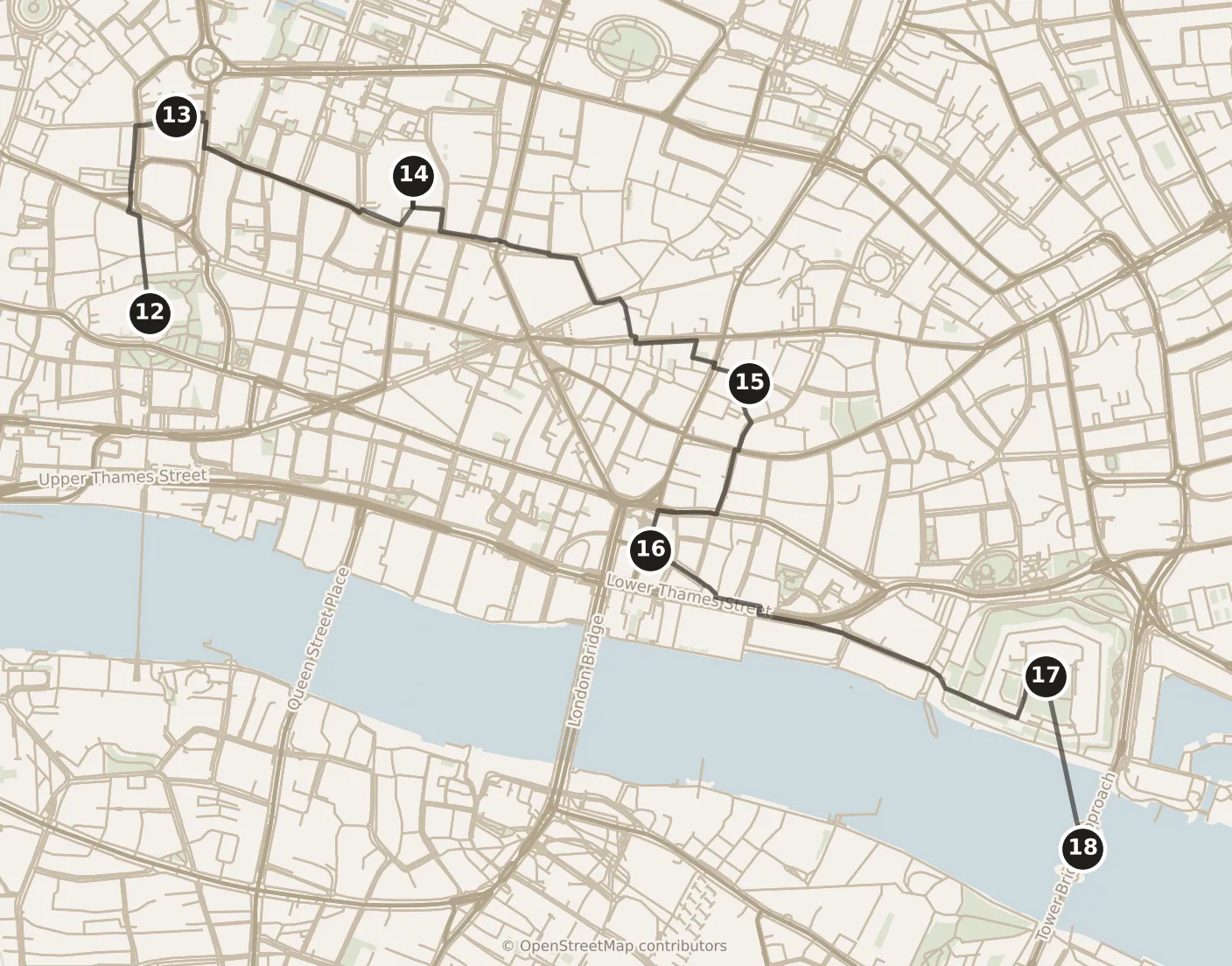
- Day two
- 12St Paul's Cathedral
- 13Postman's Park
- 14Guildhall
- 15Leadenhall Market
- 16Monument to the Great Fire of London
- 17Tower of London
- 18Tower Bridge
The City — the square mile that was the whole of London until the seventeenth century — and the Tower at the end of it. This is one continuous walk west to east of about three and a half kilometers, and it belongs midweek: the quarter is an office district, so on the weekend the streets are handsome and completely dead and the places to eat are shut, and the two ends of the working week are thinner than the middle of it.
Begin at St Paul’s Cathedral, which is closed to sightseeing on Sundays. It is Wren’s, built between 1675 and 1710 to replace the cathedral the Great Fire destroyed, and the interior is cool, pale and enormous in a way photographs flatten. Two things to do inside. The crypt holds Nelson in a black sarcophagus, Wellington in a granite one the size of a car, and Wren himself under a plain slab with an inscription telling the reader that if they are looking for his monument they should look around them. And then the climb, which is one staircase with three landings: 257 steps to the Whispering Gallery, running round the inside of the dome at the springing of the paintings; 376 to the Stone Gallery, outdoors on the drum; 528 to the Golden Gallery at the top, where the last stretch is a narrow iron spiral inside the structure and the view is the whole city. There is no elevator. Two hours for the church and the climb together.
Five minutes north is Postman’s Park, which takes ten minutes and is the thing people remember. Under a wooden canopy along one wall is a run of glazed tiles, each one recording an ordinary person who died saving somebody else — a boy drowned pulling his brother out, a woman who went back into a burning house — set up in 1900 and still occasionally added to. It is small, free, unsignposted from the street, and completely quiet.
Ten minutes east, Guildhall has been the seat of the city’s own government since the fifteenth century, and its great hall survived both the Great Fire and the Blitz, which almost nothing around it did. Underneath the art gallery beside it, found by accident in 1988, is the Roman amphitheatre: you go down into a dark room and see the surviving stone of the entrance passage and the drain, with the missing walls drawn in light. The full outline is marked in dark stone in the paving of the yard above, so you can walk the ellipse at ground level for nothing. Forty-five minutes for both.
Ten minutes on, past the Bank of England and the columns of the Royal Exchange, Leadenhall Market is a cross of glazed arcades in cream and maroon ironwork, built in 1881 by Horace Jones on a site that has been a market since the Middle Ages. The arcade is a public street and never closes, but its shops and pubs trade for the office week, so this is where lunch goes and it is another reason today is not a Saturday. Look up at what surrounds it while you are here: the Lloyd’s building opposite wears its pipes, ducts and elevators on the outside so the interior could be rebuilt without touching the shell, and the Gherkin is one street further. The contrast between the ironwork and the machinery above it is the whole point of this quarter.
Down to the Monument, ten minutes south-east: a fluted column of 1677 by Wren and Robert Hooke, 202 feet high, standing exactly 202 feet from the baker’s shop on Pudding Lane where the fire started. Hooke also meant it as a scientific instrument — a hollow shaft with a hinged lid at the top and a laboratory in the basement, for observations straight up — which is why the stair is a cylinder around nothing. It is 311 steps and a small ticket, and the platform is caged, which matters to the photographs. Half an hour.
Then the Tower of London, ten minutes further east, and give it three hours — which is the reason to read this day backwards from it. On the durations above, the cathedral and its climb, the park, the guildhall, lunch and the Monument between them take most of the day, and the Tower is the one stop here with a last admission and a last warders’ tour that goes before it. On a short winter day, drop the Monument rather than arrive with an hour. It is nine hundred years of building in one enclosure: the White Tower at the center is the Norman keep begun around 1078 and it still reads as a threat, which is what it was for. The Crown Jewels are in a vault you cross on a moving walkway, twice if you go round again, and the walkway is the reason the line moves. But the thing to plan for is the Yeoman Warders’ tour, which is free, included, sets off every half hour from inside the gate, and is the best hour on the site — they live here, they are all long-serving soldiers, and they are very funny about the executions. Take the tour first and wander afterwards. Finish by walking out onto Tower Bridge, which is by the same architect as the market you ate in and is a steel bascule bridge dressed in stone to keep the neighbors happy. It still opens for shipping and the times it will do so are published ahead; the high-level walkways with the glass floor are a separate ticket.
Local tip. The three dome galleries at the cathedral are one climb and one ticket, not three, and you pass the lower ones on the way to the top. So the only decision is where you stop, and you can make it on the stairs rather than at the door — which is the useful thing, because 528 steps is a great many more than it sounds at the bottom and there is no shame at all in the second landing.
Day three

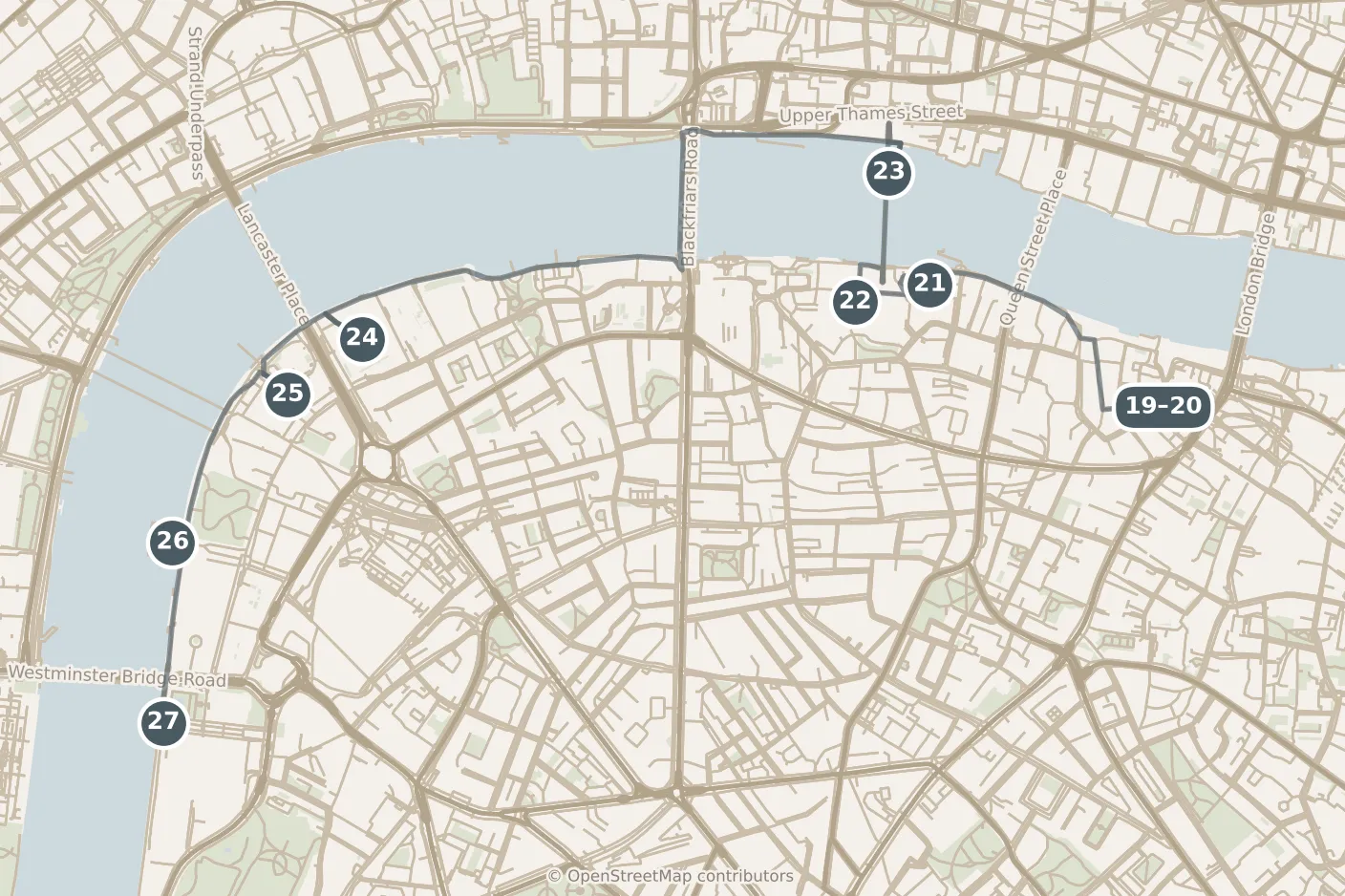
- Day three
- 19Southwark Cathedral
- 20Borough Market
- 21Shakespeare's Globe
- 22Tate Modern
- 23Millennium Bridge
- 24Royal National Theatre
- 25Southbank Centre
- 26London Eye
- 27National Covid Memorial Wall
The south bank of the river, walked from London Bridge to Westminster: about four kilometers downstream to upstream, with the whole of the north bank on your right the entire way. This is the loosest day of the week, and the one to move if the weather is against you.
Start at Southwark Cathedral, tucked under the railway viaduct beside the market. Parts of it are thirteenth-century, which makes it one of the oldest church buildings in London, and it is small enough to see properly in twenty minutes. It is free, it is usually almost empty, and it has the particular quality of a building that has been repeatedly nearly demolished and is still doing its job.
Borough Market is two minutes away and is where the morning goes. There has been a market around this junction for something like a thousand years and on this site since 1756, and what it is now is a covered food market that trades every day but Monday: cheese, fish, game, bread, and two or three dozen stalls cooking things to eat standing up. Go through it once looking and once buying. It is at its best before the lunch crowd arrives and is genuinely unpleasant in the middle of a Saturday, so this is an early stop rather than a midday one, and eating here at half past eleven is not a defeat.
Ten minutes west along the river, Shakespeare’s Globe is a reconstruction of 1997, built a couple of hundred meters from where the original stood and thatched — the only thatched roof permitted in London since the fire, and a condition of building it was a modern sprinkler in the reeds. Plays run outdoors from late April to early October, and the standing tickets in the yard in front of the stage are the cheapest and the best, because that is the audience the plays were written for and you are three meters from the actors. Outside the season the company moves into a small candlelit indoor playhouse next door. If nothing is on, the tour of the empty theater is forty minutes and worth it.
Tate Modern is three minutes on, and it is free. The building is a power station of 1947 by Giles Gilbert Scott — the man who also designed the red telephone box — converted in 2000 with the boiler house gutted into galleries and the Turbine Hall left as a single space the size of a cathedral nave, which is used for one huge commissioned work at a time and is free to walk into even if you go no further. Above it the collection is arranged by theme rather than date, which divides people; the way to enjoy it is to pick one floor and abandon the rest. Two hours. Go up to the top levels before you leave: they are free, and the view is straight back across the river at the dome you climbed yesterday.
The Millennium Bridge is directly outside, and it was built on that alignment on purpose — stand in the middle and the cathedral is framed at the end of it. It opened in June 2000, swayed alarmingly under the crowd, and was shut two days later; it did not reopen until February 2002, after nearly forty dampers were fitted, which is why Londoners of a certain age still call it the wobbly bridge. Walk half of it for the view and come back.
Then it is a straight walk west along the water: past a 1920s tower whose windows were cut in the shape of letters spelling a meat-stock brand, because advertising signs on the river were forbidden and the owner wanted his name on the skyline anyway; under Blackfriars and Waterloo Bridges; past the Royal National Theatre, three interlocking terraces of board-marked concrete by Denys Lasdun that people either love or want demolished, with free music in its foyers most evenings; and into the Southbank Centre, built around the Royal Festival Hall, the one thing left standing from the Festival of Britain in 1951. The undercroft beneath it has been skated continuously since the early 1970s and is the reason the whole terrace sounds the way it does. Everything on this stretch is free to walk into, and the second-hand book stalls under the bridge are open in most weather.
The London Eye is the end of the walk: 135 meters, thirty-two capsules, and one turn takes half an hour, which it does without ever stopping — you step on and off while it moves. It is expensive for what it is, and the honest view is that the free upper floors of Tate Modern earlier today did much of the same job. What it does uniquely is put you level with the roof of Parliament directly across the water.
Cross under Westminster Bridge and finish at the National Covid Memorial Wall on the embankment opposite the palace: about half a kilometer of hand-painted hearts, one for every person in this country who died, begun by bereaved families in March 2021 and repainted since by volunteers. It is free, it is out of doors, nobody manages it, and it is the quietest ten minutes on the river.
Day four

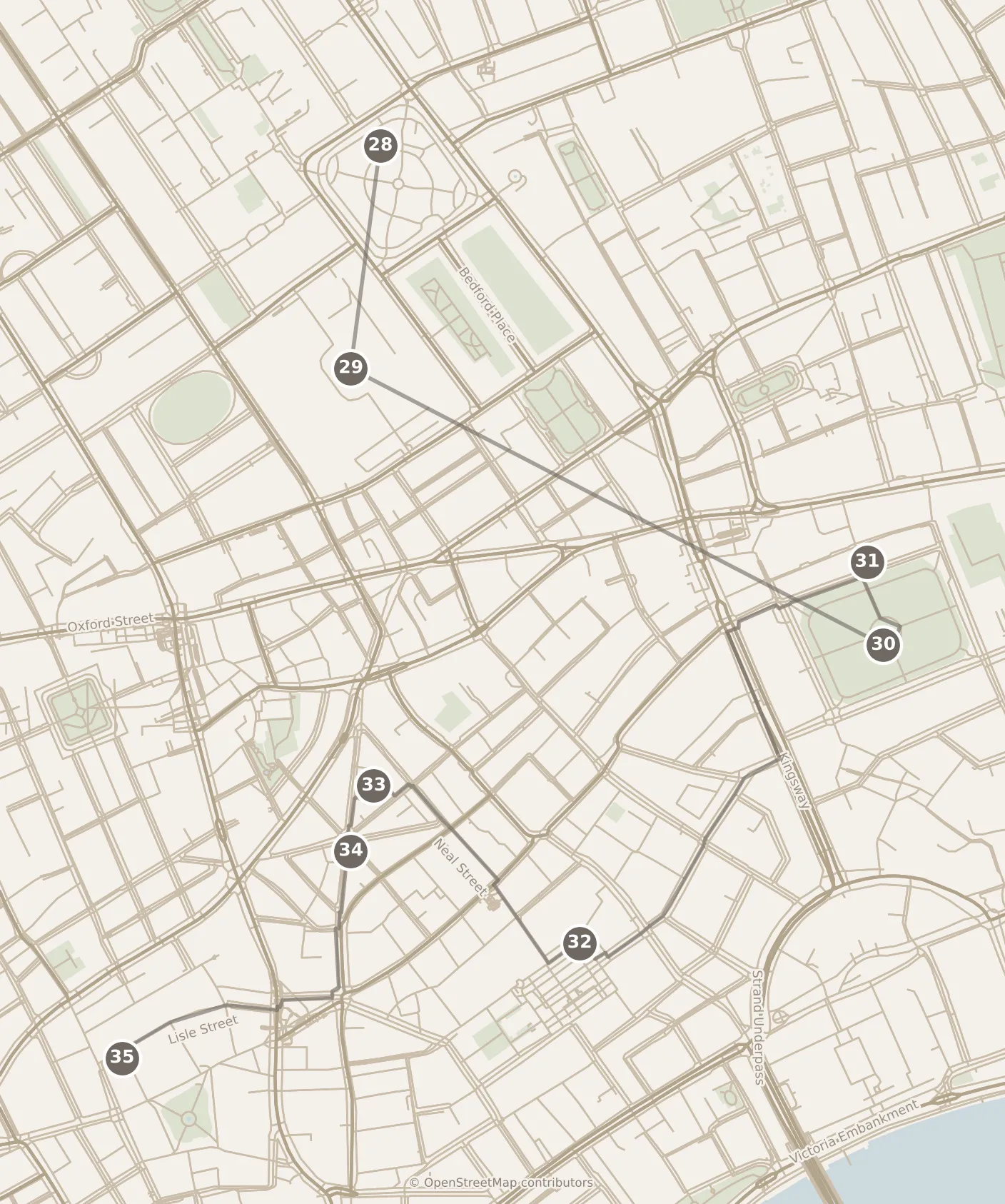
- Day four
- 28Russell Square
- 29British Museum
- 30Lincoln's Inn Fields
- 31Sir John Soane's Museum
- 32Covent Garden
- 33Neal's Yard
- 34Seven Dials
- 35Chinatown
The British Museum in the morning, and then a straight walk south-west through Holborn into the West End, ending with dinner and a play. Three and a half kilometers in total and the least strenuous day of the week.
Begin in Russell Square, five minutes north of the museum, because it takes five minutes and it explains Bloomsbury: a big Georgian garden square of plane trees and gravel with a café in the middle, one of a dozen laid out here by a single landowning family, all open to the public and all still doing what they were built for. It also brings you to the museum’s north entrance on Montague Place rather than the main forecourt on the far side, which is the shorter of the two lines when it is open — it can close at short notice, and the front door is two minutes round if it has.
The British Museum is free and it is not a museum you finish. Eight million objects; you take two departments and let the rest go, and choosing before you walk in is the difference between a good morning and a forced march. Whatever you choose, the Great Court is on the way — a courtyard that was open sky until 2000 and now carries a curved glass roof of more than three thousand panes, no two of them the same shape, with the old circular Reading Room standing in the middle of it like a drum. The obvious choices: the Egyptian sculpture gallery on the first floor, where the Rosetta Stone sits behind glass in a permanent scrum; the Assyrian reliefs from Nineveh alongside it, carved lion hunts running for twenty meters, which almost nobody stops at and which are the best thing on that floor; the Parthenon sculptures in their own long room, whose presence in London is an argument this article will not settle for you but which you should know is live; and upstairs, the Anglo-Saxon helmet and gold from the Sutton Hoo ship burial, and the Lewis chessmen, carved from walrus ivory, with the most anxious expressions in the building. Three hours.
Lunch goes on the walk south-east, in the streets of Holborn between the museum and the legal quarter, which feed a working population of solicitors and students and are the plainest eating on this route. Fifteen minutes from the museum is Lincoln’s Inn Fields, the largest of London’s garden squares, with the barristers’ chambers of the legal quarter around it. On its north side, Sir John Soane’s Museum is free, small, and the strangest interior in the city. Soane was the architect of the Bank of England, and he left his own house to the nation on the condition that nothing in it be moved — a condition he had put into an act of Parliament in 1833 — so what you walk through is one man’s collection exactly as he arranged it: a picture room whose walls open outwards on hinges to reveal more walls of paintings behind them, including Hogarth’s A Rake’s Progress hung in a cupboard; a basement crypt lit from above; and in the middle of it the alabaster sarcophagus of Seti I, which Soane bought when the British Museum declined it and celebrated with a three-day party. It is closed on Mondays and Tuesdays, numbers inside are limited, and an hour is plenty. It is also the single most concentrated thing on this route.
Ten minutes south-west and you are in Covent Garden. The square is the oldest of its kind in the country, laid out by Inigo Jones in the 1630s as an Italian-style piazza with a church closing one end; the covered market building in the middle is of 1830, the fruit and vegetable trade left in 1974, and what fills it now is shops and cafés with buskers underneath. The performers are licensed and audition for their pitches, which is why the standard is high and why they hold a crowd. Half an hour, and do not eat in the square.
Five minutes north, Neal’s Yard is a courtyard the size of a large room, reached through an alley, with every building painted a different color — it takes four minutes and it is worth them. Seven Dials is a minute on: seven streets converging on a pillar carrying six sundials, the seventh being the column itself. The original was pulled down in 1773 by a mob who believed money was buried under it; this one went up in 1989.
Then Chinatown, ten minutes south-west, which moved here from the docks at Limehouse in the 1950s and 60s and is centered on Gerrard Street under two ceremonial gates. It is largely Cantonese, and the West End’s playhouses are two minutes away in every direction, which is why this is the block a theater evening eats in. Pick one meal rather than two: eat here before the curtain, in which case go early and order less than you want, or eat here after it, in which case this is the part of central London most likely to still be serving when you come out.
Day five

- Day five
- 36Natural History Museum
- 37Science Museum
- 38Victoria and Albert Museum
- 39Exhibition Road
- 40Royal Albert Hall
- 41Albert Memorial
- 42Kensington Gardens
- 43Kensington Palace
- 44Serpentine
- 45Speakers' Corner
- 46Marble Arch
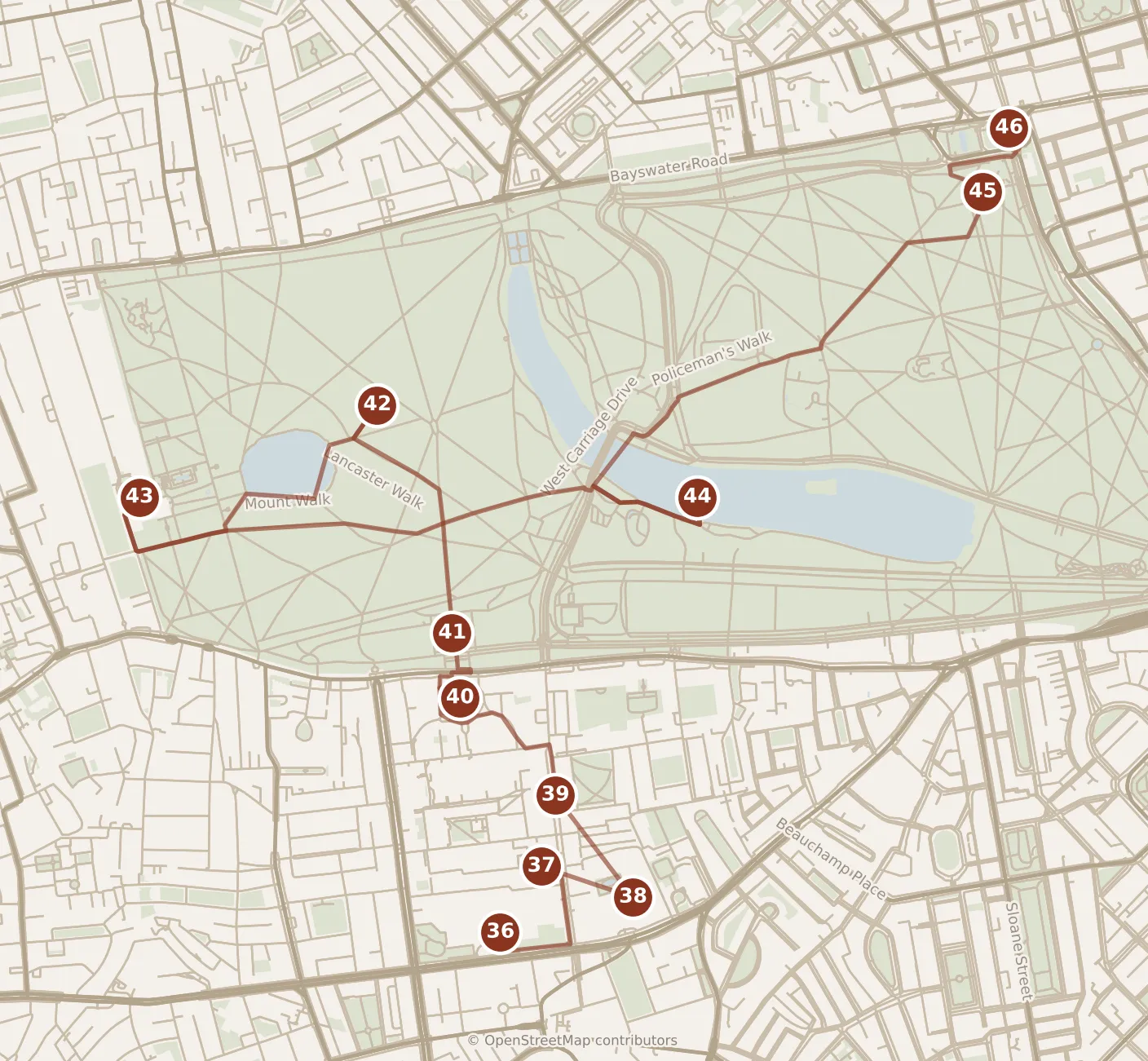
South Kensington and the two parks, walked broadly west to east with one spur back on itself. This is the longest day on your feet — six kilometers or so, and nearer seven if you take the spur — but it is flat, half of it is grass, and there is a bench whenever you want one.
Three enormous free museums stand in a row here, all of them built with the profits of the Great Exhibition of 1851 on land bought for the purpose, which is why the quarter was nicknamed Albertopolis and why the memorial and the concert hall are at the top of the same street. Take two of the three. Three is a forced march, and the third is always the one you walk through at speed resenting it.
The Natural History Museum is the one to start with, at opening, because its line is the worst of the three. The building is the exhibit as much as the collection: 1881, and the terracotta that covers it inside and out is carved with animals throughout, living species in one wing and extinct ones in the other. The main hall is a Romanesque nave with the skeleton of a blue whale hung the length of it, diving. Behind that, two floors of dinosaurs, a hall of minerals that most visitors walk straight past, and an earthquake room children wait in line for. Two hours.
The Science Museum is next door and is the one most adults end up dropping — though that is a preference and not a rule, and its engineering and space galleries are aimed squarely at grown-ups. With children it is the one to keep and the other two to drop. The Victoria and Albert Museum is across the road and is the world’s largest museum of art and design, which means it contains everything and has no natural route through it. Take the cast courts, which are two double-height halls of full-size plaster casts made in the 1860s so that art students who could not travel could still study — Trajan’s Column stands in two pieces because it does not fit, and Michelangelo’s David is here with a detachable fig leaf that was kept ready for royal visits. Then take the fashion rooms, or the jewelry, or the ironwork gallery, and stop. Lunch is in the museum’s own refreshment rooms, three decorated rooms of the 1860s which were the first restaurant in any museum anywhere and are still the café. Two hours.
Walk north up Exhibition Road, which was rebuilt in 2011 with no kerbs and no separation between cars and people, so it reads as a single stone surface and traffic behaves accordingly. At the top of it stands the Royal Albert Hall, an oval of red brick and terracotta of 1871 whose acoustic was so bad for a century that the echo was a standing joke; the fibreglass discs hung under the roof in 1969 to break it up look like mushrooms and are the reason it works now. Cross the road to the Albert Memorial, which is the high-water mark of Victorian Gothic and entirely unembarrassed about it: a gilded prince sitting under a 55-meter canopy holding the catalog of the exhibition that paid for everything behind you.
You are now in Kensington Gardens, and the rest of the day is park. One decision first, and it is the only one on this day that costs distance. Kensington Palace sits on the western edge, which is the opposite end of the park from everything that follows: walking down to the Round Pond in front of it and back out again adds the better part of a kilometer and a half to a day that is already the longest on your feet. It is a working royal residence with a public half, closed on Mondays and Tuesdays for much of the year and with parts of it under a long conservation project, so check what is open before you spend the legs on it — and if it is shut, or if the museums have already taken more out of you than you planned, skip it and start the park where you entered it. Nothing later in the day refers back to it.
Whether you take that western spur or not, the rest goes in one line east: across to the Italian Gardens at the northern corner, a formal water garden of 1860 with four basins and a pump house disguised as a lodge, and then south-east down the west bank of the Long Water, past the statue of Peter Pan, put up secretly overnight in 1912 so that children would think it had appeared by itself.
Then east along the water. The Serpentine was made in the 1730s by damming the Westbourne, a river that now runs in a pipe, and it is swum in all year round from the lido on the south side — there are people in it on Christmas morning. Where the boundary crosses the lake you pass out of Kensington Gardens and into Hyde Park without anything marking it except that the planting gets less formal. Finish at Speakers’ Corner, in the north-east corner, where the right to stand on something and address strangers has been exercised since 1872. It is a Sunday morning thing above all, and on the week this article recommends you will reach it on a Friday afternoon and find a stretch of grass beside a large road — worth knowing before you walk two parks to get there. If your week does put a Sunday morning here, take it: it is not a performance for visitors and it can be extremely bad-tempered. Marble Arch is on the traffic island just beyond it: it was built as the gateway to Buckingham Palace and moved here in 1851, and it stands a short distance from where the Tyburn gallows stood for six hundred years, which nothing much marks. Behind it is the top of Oxford Street, and the evening belongs somewhere else entirely: you have walked out of a museum quarter that shuts early into a shopping one that is no better after dark.
Local tip. Two museums, not three, and decide which two at breakfast rather than at the door. Everything else on this day is a park and costs nothing, so the museums are the only part that can overrun — and the way this day fails is not by running out of time at the end but by arriving at the gardens with no legs left. If you are traveling with children the choice makes itself and the natural history and science museums are next door to each other; if you are not, the art and design museum is the one that rewards a second visit.
Day six

- Day six
- 47Cutty Sark
- 48Greenwich Market
- 49Old Royal Naval College
- 50Queen's House
- 51National Maritime Museum
- 52Greenwich Park
- 53Royal Observatory
- 54Greenwich foot tunnel
- 55Island Gardens
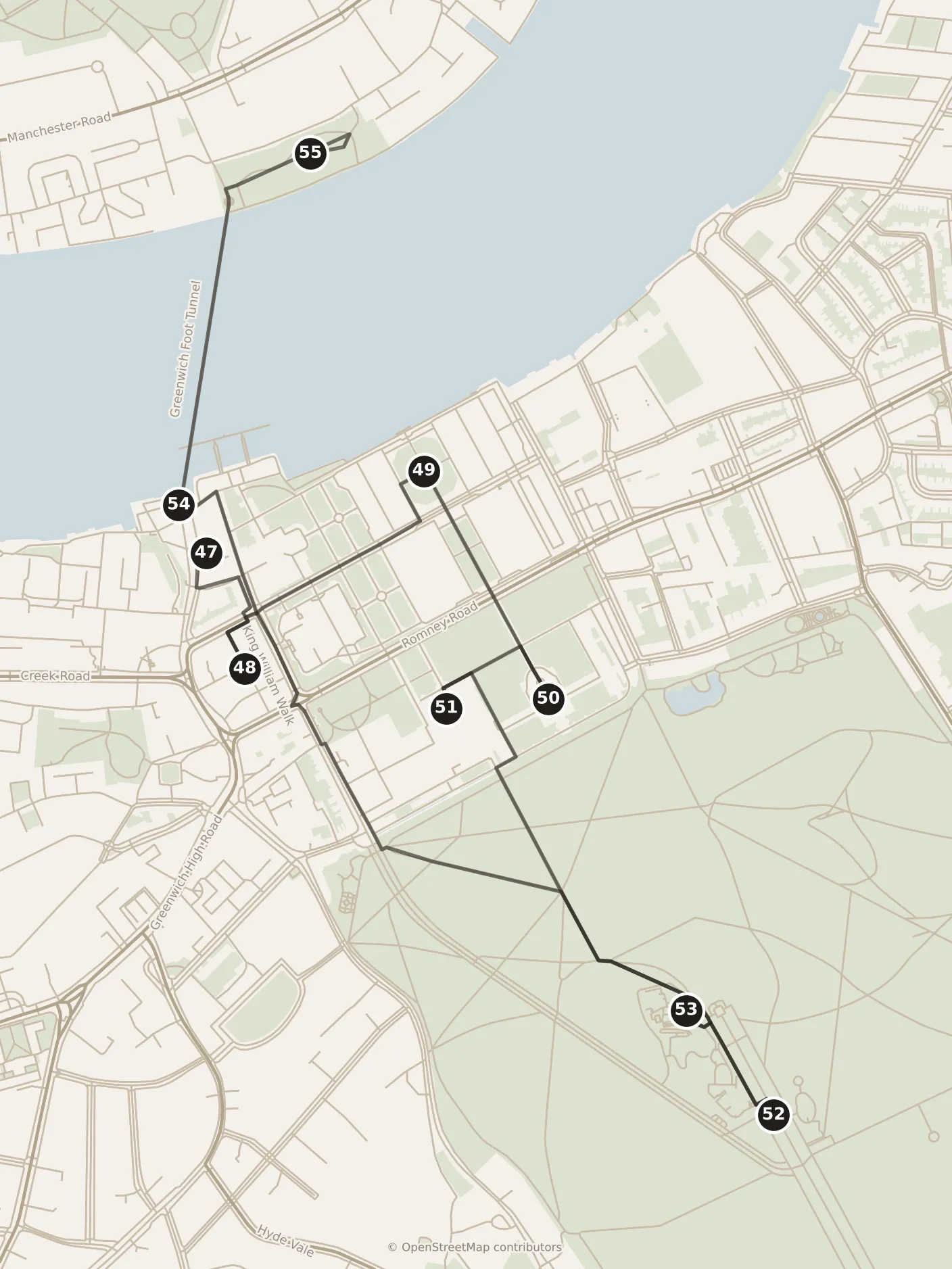
Greenwich, and go by river. The commuter catamarans run down to Greenwich pier from Westminster, Embankment and Tower piers, every ten to twenty minutes through the day — about an hour from the first two and roughly half that from the last. It is the only form of transport in London where the journey is the sightseeing, and it puts the whole day’s geography into your head before you land: you pass under Tower Bridge, along the wharves, round the loop of the peninsula with the towers of Canary Wharf on both sides, and the pier is a hundred meters from the first stop. Note one thing the city guide’s advice does not cover, because it is the exception to it: the river boats take the same contactless card as everything else and give you a fare discount for it, but they sit outside the daily cap, so this journey is charged on its own.
The Cutty Sark is on the quay: a tea clipper of 1869, one of the last built and the fastest of them, which raced cargoes home from China until steam and the Suez canal ended the trade. It caught fire in 2007 halfway through restoration, and the rebuilt ship now sits raised three meters above its dry dock on a glass collar, so you walk underneath the hull and see the shape that made it fast — a hull like a knife, sheathed in a copper alloy that gave the ship its color and its speed. An hour, and it is ticketed — though the space under the hull, which is where the shape is best seen, is free to walk into without one.
Greenwich Market is two minutes inland, under a roof, and this is where lunch is: a covered square of stalls with a row of people cooking, plus the antique and craft trade around them. Busiest on the weekend and thinner midweek.
Then the Old Royal Naval College, which is the reason Greenwich is a world heritage site. Wren laid it out from 1696 as a hospital for injured seamen, and he split it into four blocks with a gap straight up the middle because the queen would not have her view of the river blocked — so the grandest baroque composition in the country has a hole in the center of it, on purpose. Two of the four are open. The Painted Hall was built as the pensioners’ dining room and painted by James Thornhill between 1707 and 1726: nineteen years, paid by the square yard, and so overwhelming when it was finished that the pensioners were fed somewhere plainer and the room became a paying attraction instead. There are mirrored trolleys and reclining seats so that you can look up without wrecking your neck, which is the sort of thing more places should do. Nelson lay in state here in 1806. An hour, it is ticketed, and it is the single best interior in this article — the grounds it stands in are free to walk through, so this is a decision rather than an ambush.
The Queen’s House is five minutes uphill and is free. Inigo Jones began it in 1616 and it is the first properly classical building in the country — plain white, flat-fronted, and a shock beside everything Tudor. The main hall is an exact cube 12 meters each way with a gallery running round it, and the Tulip Stairs beside it are the first self-supporting spiral staircase in Britain, a helix with nothing under it. Forty minutes. The National Maritime Museum is attached and also free: it is uneven, and the thing to find in it is the coat Nelson was wearing when he was shot, with the hole in the shoulder.
Then up through Greenwich Park, enclosed in 1433 and the first of the royal parks to be enclosed, on a steep path to the Royal Observatory on the crest. This is the one deadline in the day: the observatory stops admitting a good while before it closes, and it closes long before the park does. If the morning has run over, climb the hill before the maritime museum rather than after it. Wren built it in 1675 for the specific purpose of solving longitude at sea, and the answer is in the room: John Harrison’s four sea clocks, the first the size of a wardrobe and the last a watch, which finally kept time on a rolling ship after forty years of work and against the opposition of most of the astronomical establishment. Outside in the courtyard is the brass line of the Prime Meridian, defined here in 1851 and adopted as the world’s zero of longitude in 1884, along with Greenwich Mean Time. Stand on it with a phone and it will tell you that you are about a hundred meters west of zero: satellite longitude is measured from a slightly different zero, 102 meters to the east, and the discrepancy is real rather than a fault in the phone. The courtyard and the line are ticketed; the terrace outside is free, and the view from it — the two domes, the white house between them, the river, and the towers behind — is the one on all the postcards.
Come down the hill and, instead of taking the boat back, walk through the Greenwich foot tunnel: opened in 1902, 370 meters of white tiled tube under the river, free and open at all hours. There are elevators at both ends with a long record of being out of service and stairs when they are. You come up on the Isle of Dogs in Island Gardens, a small park on the north bank, and turn round: what you are looking at is the view Canaletto painted, the whole hospital laid out symmetrically with the house in the gap and the observatory on the hill behind. It is the best five minutes of the day and it costs nothing. The Docklands Light Railway station is beside it and takes you back into the city; it is driverless, so sit at the very front.
Local tip. Everything at Greenwich except the observatory is at the bottom of the hill and the observatory is at the top of it, so climb once, at the end, and do not go up and down. Come by water and leave under it. You come down the hill either way — the tunnel mouth is at river level, a hundred meters from the pier — but leaving under the water puts the Canaletto view at the bottom of the descent instead of a pier you have already used.
Day seven

- Day seven
- 56Columbia Road
- 57Arnold Circus
- 58Shoreditch
- 59Brick Lane
- 60Old Spitalfields Market
- 61Christ Church Spitalfields
- 62Whitechapel Gallery
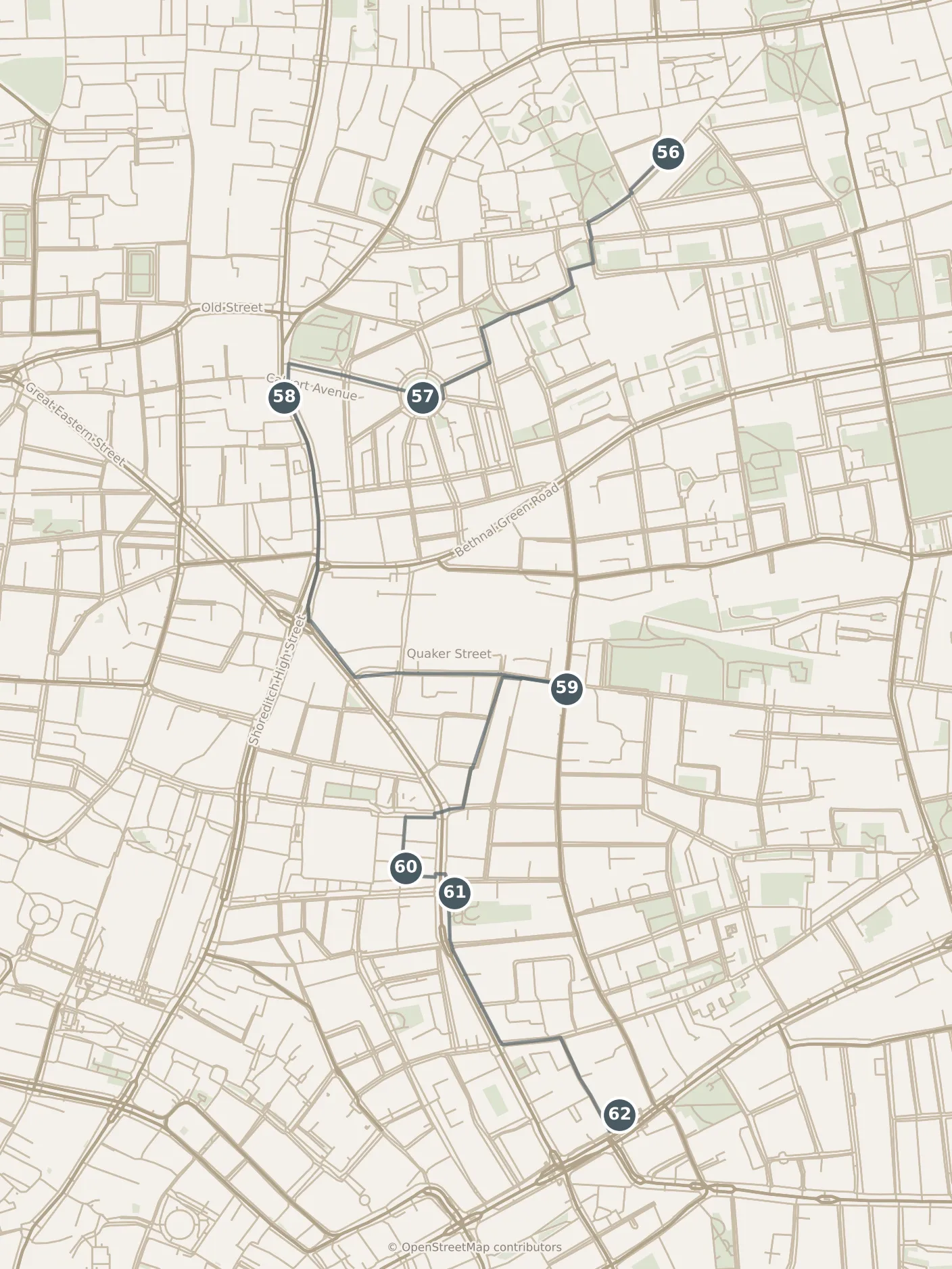
The East End: three kilometers of walking, no ticket, nothing indoors that matters, and the day that most repays being a Sunday. This is where London’s successive waves of arrivals landed, and it is the only day of the week where you can read that in one street.
If it is a Sunday, start at the Columbia Road flower market, which happens on that day and no other, from early morning until about the middle of the afternoon. It is one narrow street of Victorian shopfronts filled end to end with cut flowers, plants and trees, and it is sold at volume by people shouting; by late morning you are moving at the pace of the person in front and you cannot turn round. Go at the beginning for the room to look or at the end for the prices, because both ends of the day are better than the middle, and it packs up early. If it is not a Sunday, this stop simply is not there — the street is still worth five minutes for the shops behind the stalls, and the day starts at the next one.
Ten minutes south, Arnold Circus is a circular garden on a raised mound with a bandstand on top, with seven streets radiating off it and tall brick blocks along each one. This is the Boundary Estate, opened in 1900, generally reckoned the first council housing in the country: the city authority cleared a notorious slum called the Old Nichol and built this in its place, and the mound in the middle is made from the rubble of the houses that were pulled down. It takes fifteen minutes and it explains more about London than most of what has a ticket.
Walk south into Shoreditch proper, and specifically Redchurch Street and the lanes off it. This is where the painted walls are: some of it is commissioned, most of it is not, all of it changes, and the point is that it is not a trail with a map — you look up and along the side walls of buildings as you go. It has become expensive and knows it, which is worth saying plainly rather than pretending otherwise.
Then Brick Lane, and walk the whole of it from north to south, because the street is a lesson in order. At the northern end are two bagel bakeries, open round the clock, selling salt beef and smoked salmon in boiled bread, which is what is left of the Jewish East End at street level, and eaten standing up they are the quick version of lunch. If the day has fallen on a Sunday there is a slower version, and it has to be decided now rather than later: a roast in one of the old pubs off the main street, booked ahead, eaten in the early afternoon. A pub roasts a finite number of joints for that one service and stops when they are gone, so it is a booking and a sitting rather than something you walk into — and it eats the rest of the afternoon, which is the point of it. Take the bagels and the day below runs as written. Further down the street becomes Bangladeshi — the restaurants, the sweet shops, the street signs in two alphabets — and this stretch is sometimes called Banglatown. And on the corner of Fournier Street stands the building that carries the whole street’s history at once: a plain brick hall put up in 1743 as a chapel for Huguenot silk weavers fleeing France, which became a Methodist chapel, then a synagogue in 1898, and has been a working mosque since 1976. One building, four congregations, three religions, in the order the street received them — and the fourth is in use rather than on show, so the sidewalk is the place to look at it from. On its wall is the original sundial of 1743, with two words cut under it, Umbra Sumus — we are shadows.
Five minutes on, Old Spitalfields Market is a covered hall of 1887 that was the vegetable market for the whole east of London until it moved out in 1991; it now sells clothes, records and food, it trades every day, and it is at its fullest on a Sunday. Beside it, Christ Church Spitalfields is Nicholas Hawksmoor’s, finished in 1729, and it is deliberately overbearing: an enormous portico and a spire put up by the state in a quarter full of dissenters and immigrants, to make a point about whose church this was. It is free and usually open, and the interior is white, high and severe.
Finish ten minutes south at the Whitechapel Gallery, which is free, closed on Mondays, and has been showing contemporary art to a neighborhood that was not expected to want it since 1901. Guernica hung here in 1939, on tour to raise money, and forty thousand people came to see it in three weeks. Then walk back up for the evening: this quarter is where London goes out, and after six days of monuments the correct last night is a bar in a converted warehouse rather than anything with an opening time. The roast, if you took one, was lunch — it is a midday meal that runs into the afternoon and then stops, and a pub still carving beef at this hour is a pub that was not roasting to order.
Practicalities
Only one day of this week is fixed, and it is day seven. The flower market on Columbia Road exists on Sundays and on no other day, and the two Sunday markets around Brick Lane and Spitalfields are the fullest of their week, so putting day seven on a Sunday is the single arrangement here that a different start cannot reproduce. That means a Monday start, and it resolves everything else at the same time: the abbey and the cathedral are open, the old financial quarter is alive for day two, and no market on the route is shut.
If your arrival day makes that impossible, the whole grid comes down to two lines. Sunday must not fall on days one, two or three — the abbey is closed to sightseeing, the cathedral is closed to sightseeing, the City is deserted and its lunch trade is shut. Monday must not fall on days three, four or seven — the market is closed on Mondays, the house museum on day four is closed on Mondays and Tuesdays, and the gallery on day seven is closed on Mondays. And Tuesday must not fall on day four either, for that same house museum, which is the single most concentrated hour on this route and the one thing a reshuffle quietly costs you. Everything else is free: days two to six can be taken in any order you like, and so can day one — it is first for the feel of the week, not because anything on it shuts. If Sunday cannot land on day seven, put it on day five, which is the one day that actively gains from it: its last stop is the only place in this article at its best on a Sunday morning. Day six survives a Sunday equally well if you would rather. Either way day seven loses its flower market. So a Saturday evening arrival, which cannot end on a Sunday however you shuffle, has a week already: open on the Sunday with day five, take day one on the Monday, and let the rest fall in order. One caution if you do reorder — day four ends with a play, and Sunday is the thinnest evening in the West End, so it is the one day not to move there. Two smaller notes: the palace on day five is shut on Mondays and Tuesdays for much of the year, which costs that day one optional hour rather than its shape; and the summer opening of the state rooms on day one runs only for about eleven weeks from early July, so outside that window the palace is a facade.
What London does not do is take a weekly day off. Every free museum in this article — the British Museum, the National Gallery, the three in South Kensington, the two at Greenwich, Tate Modern — opens every day of the year bar a handful around Christmas, and so do the Tower, the war rooms and the observatory. That is why the grid above is two lines rather than a page.
Two bookings matter and the rest do not. The war rooms on day one are timed entry and the slots do go, so book that when you book the trip rather than the night before. A play in the West End on day four is the other: book before you travel for anything specific, and if you did not, the official half-price booth on Leicester Square sells same-day seats to whatever has not gone. Beyond those, the abbey, the cathedral and the Tower all sell timed tickets online that save you a line and a little money but rarely sell out, and everything free needs nothing at all. One extra worth knowing: the City has three free high viewpoints and day two walks past all of them. The Sky Garden, on the top floors of an office tower a few streets from the Monument, is the famous one, and its free slots open about three weeks ahead. Horizon 22, two streets away, is higher again and also free, with slots released weekly and taken quickly. And the Garden at 120, a roof garden on the same street as the Sky Garden, takes no booking at all — you wait in line a few minutes, go through a security check and go up. Book one of the first two if you like the idea of them; the third is why none of this needs planning.
Getting between the stops is walking, with two exceptions. Days two, four, six and seven are each a single continuous route on foot of about three to four kilometers; days one and three are nearer four and a half. Day five is the outlier at six or more, and half of it is grass, which is more than it sounds; if the weather is against you, take the museums and the memorial and pick up the parks on another afternoon. The two exceptions are the boat out to Greenwich on day six and the driverless railway back from it, and the boat is the one fare in this week that is charged on its own rather than counting toward the daily cap.
Three things are worth knowing in advance because they are not on the route. Changing the Guard on day one does not happen every day, the schedule is published a few weeks ahead, and it is canceled in bad weather — check the date rather than building a morning around it. The Banqueting House on day one closed in May 2024 for restoration and has been opening in seasons rather than daily since, so treat it as a bonus. And the open-air season at the theater on day three runs from late April to early October; outside it the company plays indoors next door, and the tour of the empty playhouse runs all year.
Local tip. If you can only fix one thing about this week, fix Sunday, and fix it on the last day. Every other collision here costs you a single building that is open again tomorrow; Sunday on day seven is the only arrangement that buys something which is not available on any other morning of the trip. Book the flights around that and let the six days in front of it fall wherever they fall.


.jpg)

.jpg)


