London in one day: the Tower at opening, then the river walked west to Westminster

Last updated 3 August 2026
Overview
London has no center, and that single fact decides everything about a day here. There is no old town to walk out into and no square that everything else hangs off; two sights that look adjacent on a map are routinely forty minutes and two lines apart, and a day spent joining the famous things by Underground is a day spent underground. So this one refuses to do it. After the journey in, every step below is on foot, and it is on foot because it follows the one thing in this city that is continuous: the river.
What a single day costs you is the collections, and it is worth being blunt about the size of that. The British Museum, the National Gallery, the three great free museums of South Kensington — any one of them is a morning, and a morning spent in one is the whole of this walk given up. The day also costs you Greenwich, which needs a boat and half a day to be worth doing at all, and the East End, which is where London is least like its own postcards. Those are what a second day buys, and they are not extensions of this route: they are somewhere else.
The order runs east to west, which is the reverse of the way London days are usually written, and the reason is arithmetic rather than taste. Exactly one stop on this route has a gate, a ticket and a closing time, and it is the first one. Put the Tower anywhere but at the start and the rest of the day becomes a countdown; take it at opening and everything after it is a street, a bridge, a market or a free gallery — things that cannot be sold out and do not shut in the middle of the afternoon. The day also gets steadily easier as it goes, which matters more than it sounds three hours into standing on stone.
This day has no natural hinge, and rather than invent one it is worth saying so. There is no tide to catch, no view it is built around and no market here that is only a market at dawn. The one fixed thing is the Tower’s own closing time, which is a number that changes and which this page will not print. So the count runs forwards from the start instead of backwards from an end. The Tower wants three hours. The thirteen stops west of it, of which only two are longer than twenty minutes, come to about five more. Call it eight hours end to end, and understand that what decides whether the day fits is what time you are at the Tower gate — not how fast you walk afterwards.
That total measures the time you spend inside and beside things, and it measures nothing else. It does not include the ticket line and the bag check at the Tower’s entrance. Far more importantly, it does not include the Tower as a piece of ground: it is a walled enclosure with a moat and two rings of wall around a keep, and simply crossing it between one building and the next takes real minutes that have nothing to do with looking at anything. The vault holding the Crown Jewels has a line of its own inside those three hours. Eight is the floor, not the estimate, and the Tower is where the difference will come from.
One thing has to be in your hand before you set out and only one: a Tower ticket for the earliest entry of the day. Everything else here is free, walk-up or a market stall. How you pay for the two Underground journeys at either end — in at the start, out at the finish, and nothing in between — is the city guide’s business rather than this page’s.
The day

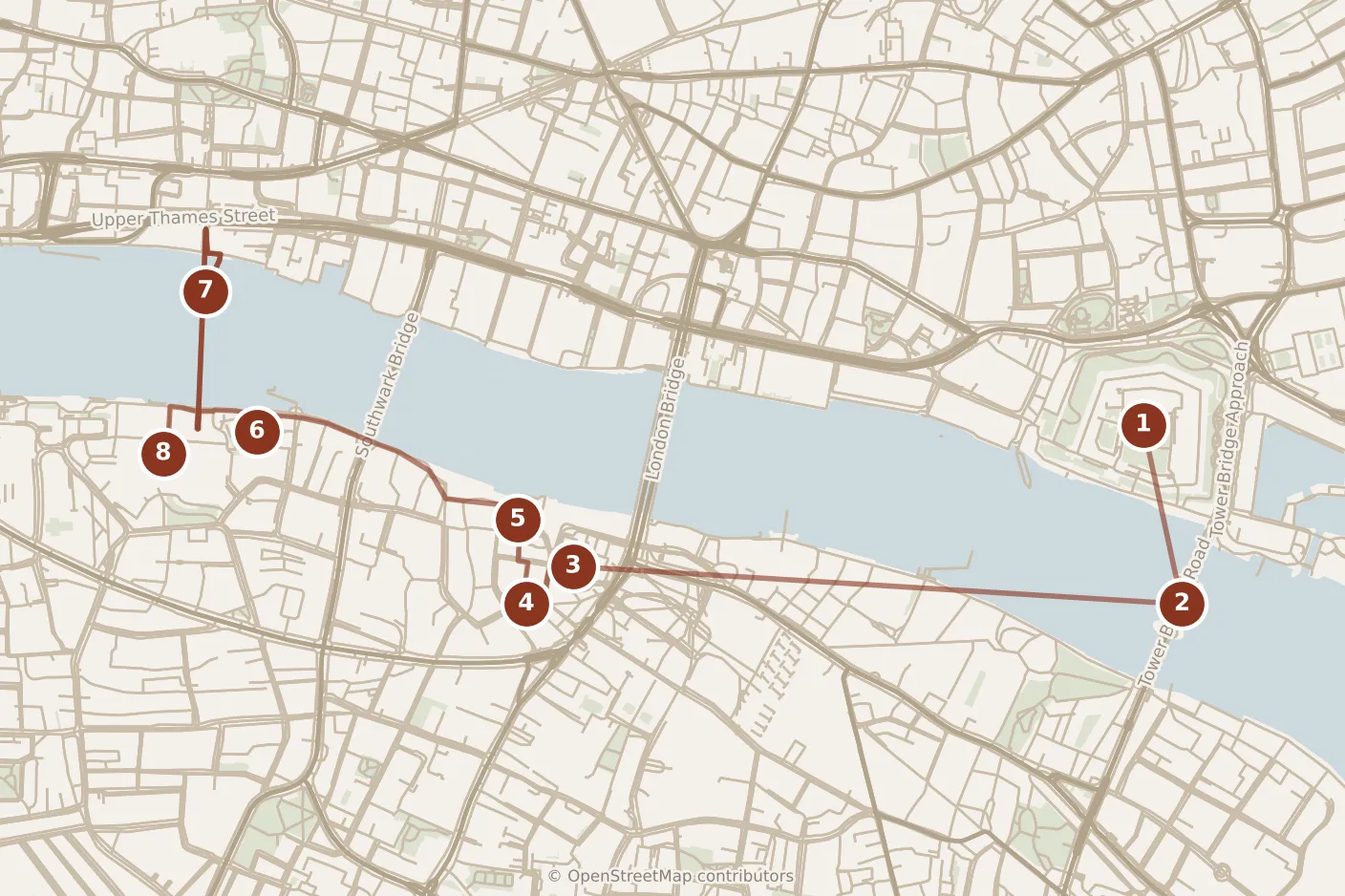
- Morning and afternoon
- 1Tower of London
- 2Tower Bridge
- 3Southwark Cathedral
- 4Borough Market
- 5Winchester Palace
- 6Shakespeare's Globe
- 7Millennium Bridge
- 8Tate Modern
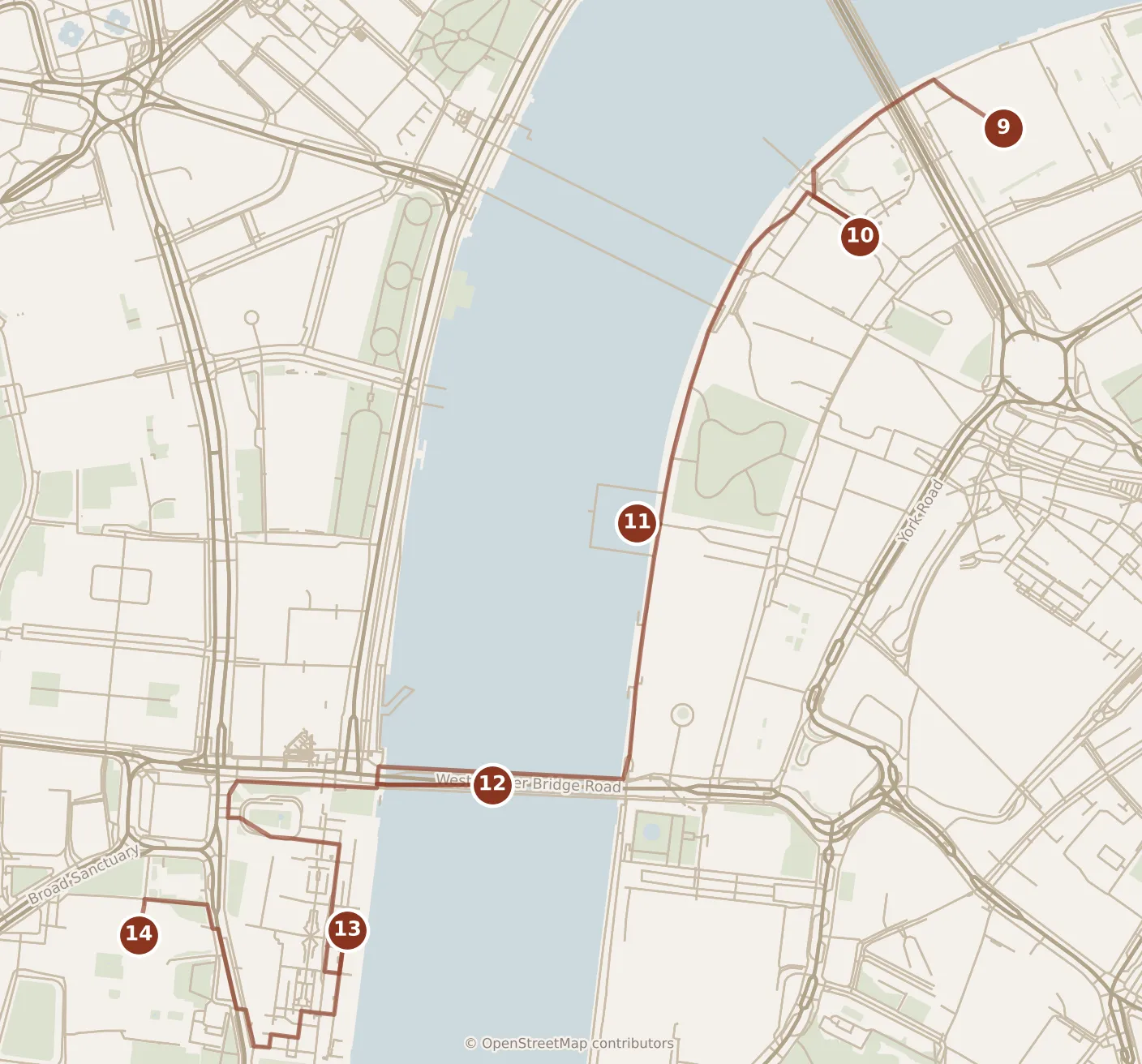
- Evening
- 9Royal National Theatre
- 10Southbank Centre
- 11London Eye
- 12Westminster Bridge
- 13Palace of Westminster
- 14Westminster Abbey
Morning
Start at the Tower of London, at opening, and give it three hours. It is not a building but nine centuries of them inside one wall. The White Tower in the middle is the Norman keep begun around 1078, put up by a conqueror in a city he had just taken, and it still reads as a threat because that is precisely what it was built to be; around it are two later rings of wall, a drained moat and a score of smaller towers, most of which you can walk into.
Three hours is plenty if you spend them in the right order. Go straight to the Crown Jewels, which sit in a vault you cross on a moving walkway; the walkway is the only reason the queue moves, the line is never shorter than in the first minutes, and nothing stops you going round a second time later. Then the Yeoman Warders’ tour: the tours set off from just inside the gate through the day, but the first leaves a while after the gate opens, which is exactly the gap the jewels have just filled. It is free, it is included in the ticket, and it is the best hour on the site — the warders are long-serving soldiers who live inside the walls, they are very funny about the executions, and an hour with one gives you the shape of the place so that everything you look at afterwards means something. Then the White Tower for the armor, and the wall walk for the view down over the river. What to skip: the smaller display towers strung along the inner wall, which are dark, cramped and much of a muchness once you have been in two of them.
Local tip. If the morning runs short, cut the wall walk and never the tour. The view from the walls is one you are about to get again, higher and for nothing, from the middle of the bridge twenty minutes from now — while the tour is the only part of this morning that no other part of the day can replace.
Leave by the river and walk up onto Tower Bridge, which is not, and has never been, the bridge people mean when they say London Bridge. It is a bascule bridge of 1894: the roadway splits and lifts in two halves, and the stone towers and the clad Gothic detail were put on it so that it would not embarrass the castle standing beside it. It still lifts for shipping and the times it will do so are published in advance. Crossing it is free and takes ten minutes with stops. The high walkways between the towers, which have a glass floor, and the Victorian engine rooms under the southern approach are a separate ticket, and they are the first thing this day gives up. Halfway over, turn round: the whole enclosure you have just spent the morning in is laid out below you with the City behind it.
Afternoon
You come off the bridge on the south bank, and from here to the last crossing the route is one continuous riverside path with the north bank across the water the entire way. There is no navigation to do: keep the water on your right. Twenty-five minutes west along Queen’s Walk, past a run of glass offices and past HMS Belfast, a Second World War cruiser moored to the bank as a museum — ticketed, two hours, and one of the things a single day has no room for — the path reaches London Bridge, and tucked in beside it under the railway viaduct is Southwark Cathedral.
It is small, free, usually almost empty and far older than the outside suggests: parts of it are thirteenth-century, which puts it among the oldest church buildings in London. Twenty minutes. What earns it those twenty minutes on this particular day is what it was — the parish church of the theater district that used to stand here. Shakespeare’s youngest brother Edmund, an actor, was buried in it in 1607, and there is a reclining alabaster figure of the playwright himself with a carved panel of the seventeenth-century skyline behind it. You are about to walk to the theater; this is where the people who worked in it were christened and buried.
Two minutes inland is Borough Market, and lunch goes here. There has been a market at this junction for something like a thousand years and on this site since 1756, and what it is now is a covered food market under a railway: cheese, fish, game, bread, and three dozen stalls cooking things to be eaten standing up. Walk it once looking and once buying, which sounds like advice about pleasure and is really advice about waiting in line. Give it an hour, eating included.
The market is also the one stop on this route whose week is not flat. It shuts outright one day a week — Monday — and the days it does trade are not all equal, so this is the single thing worth checking before you set out. If your day lands on the shut one the loss is small: the lanes immediately around the market and the arches under the viaduct feed a working population all week and will do the job.
Leave by the northern lanes into Clink Street, a short dark cobbled street under the railway, and about a hundred meters along it, standing in a wall left between the modern buildings, is a fourteenth-century rose window with nothing behind it. That is the surviving gable end of the great hall of Winchester Palace, the London residence of the bishops of Winchester. It is free, unstaffed and takes five minutes, and it explains the entire afternoon. This bank of the river lay outside the City’s jurisdiction and inside the bishop’s, which is why everything London would not license stood here — the playhouses, the bear pits, and the brothels whose workers were known as Winchester geese, on land owned by the bishop who taxed them. What you are about to walk past was built in a gap in the law.
Five minutes further west the lane opens onto the water again at Shakespeare’s Globe: a timber-framed drum with a thatched roof, built in 1997 a couple of hundred meters from where the original stood. The thatch is the only one permitted in London since the fire of 1666, and the price of getting permission was a modern sprinkler buried in the reeds. Plays run in the open-air yard from late spring to early autumn, and the standing tickets in front of the stage are both the cheapest and the best, because standing is the audience the plays were written for. On a single day you are almost certainly not seeing one, and the honest thing is to say so rather than pretend the option is live: look at the outside, which takes ten minutes, and let the guided tour of the empty theater go. It is good. It is also the better part of an hour you need later.
Three minutes on, the Millennium Bridge crosses to the north bank, and it is worth stepping onto whether or not you intend to cross. It was aligned deliberately: walk a third of the way out and St Paul’s Cathedral stands framed at the far end of it, dome, portico and steps, which is the best free view in this article. The bridge opened in June 2000, swayed alarmingly under the weight of the crowd on it and shut two days later; it did not reopen until February 2002, after some ninety dampers were fitted underneath, which is why Londoners of a certain age still call it the wobbly bridge. Walk half of it and come back. Crossing it properly is how you would add the cathedral to this day, and adding the cathedral is how you lose the rest of it.
Tate Modern is directly behind you, and it is free. The building is a power station of 1947 by Giles Gilbert Scott, the man who also drew the red telephone box, converted in 2000 by gutting the boiler house into galleries and leaving the Turbine Hall as one room the length of a cathedral nave, used for a single enormous commissioned work at a time. You can walk into the Turbine Hall without going upstairs at all, and on a day this tight that is a legitimate visit rather than a half-measure. If you do go up, take one floor and abandon the rest: the collection is hung by theme rather than by date, so there is no route through it and no reward for thoroughness. An hour, not more. One thing not to build the visit around — the public viewing level at the top of the newer block was the subject of a court case decided in 2023, brought by residents of the apartments it overlooks, and parts of it have been shut since. Check what is open when you are there, and plan the hour so that the answer does not matter.
Evening
From here the last stretch is two kilometers of riverside path and it costs nothing and asks for no decisions, which after the Tower is exactly what you want. You pass under Blackfriars Bridge and past a 1920s warehouse tower whose windows were cut in the shape of letters spelling a meat-extract brand, because advertising signs on the river were forbidden and the owner wanted his name on the skyline anyway. Then the Royal National Theatre: three interlocking terraces of board-marked concrete by Denys Lasdun, a building people either love or want demolished. Its foyers are open to anyone, free, warm and full of chairs, and there is often live music in them in the early evening, unbookable and included in nothing. This is the best place on the route to sit down for twenty minutes, and by now you will want to.
Two minutes on is the Southbank Centre, built around the Royal Festival Hall — the one thing left standing from the Festival of Britain of 1951, and the reason this whole bank became what it is. The undercroft beneath the terrace has been skated continuously since the early 1970s and is where the noise comes from. The second-hand book stalls under Waterloo Bridge trade in most weather, and the hall’s own foyer is another free room with chairs and a view of the water. Ten minutes, or half an hour if you let it be.
Then the London Eye, which the path takes you directly under: 135 meters, thirty-two capsules, and one rotation of exactly half an hour, which it completes without ever stopping — you step on and off while it is moving. The honest advice for a single day is not to ride it. It is expensive, and half an hour is precisely the thing you have least of at this point. What it gives you that nothing else does is being level with the roof of the Palace of Westminster directly across the water, and you are three minutes from standing on a bridge that gives you the same building from the ground for nothing.
Cross Westminster Bridge, and cross it slowly, because this is the end of the walk and the reason the day runs in this direction. The whole river front of the Palace of Westminster is on your left as you go: a quarter of a mile of Gothic detail put up after fire destroyed the old palace in 1834, with the clock tower at the near end. The tower is the Elizabeth Tower and Big Ben is the bell inside it rather than the building — a distinction Londoners enjoy making and nobody else has ever cared about. If your day has been a short winter one the building is floodlit and this crossing is the best five minutes of the itinerary; in June you get a long gold evening instead, which is not a worse deal.
At the north end of the bridge you are at the foot of the palace, and you will look at it rather than go in. It can be toured, on Saturdays and on weekdays when the two houses are not sitting, but a tour is the better part of two hours and this day has already spent them at the Tower. Walk along the front instead, past the statues, to the square in front of Parliament — ten minutes, and the last of the day’s free views.
Five minutes across that square is Westminster Abbey, and the last thing this itinerary does is decline to go into it. It is shut to sightseeing on Sundays, being a working church and not a museum, and on the other six days it is ninety minutes and a ticket that this day has already spent — which is the trade the whole page rests on: one great interior done properly rather than two done at a trot. So stand in front of the two towers over the main door, where English monarchs have been crowned since 1066 and a great many are buried, and put it at the top of the list for the day you come back. Then the evening, which belongs somewhere else entirely: the West End is fifteen minutes north up Whitehall, and it is where dinner and a play are.
Practicalities
One booking, and it is the first stop. The Tower sells timed entry online, it costs a little less than at the gate, and the earliest entry of the day is the slot this whole itinerary is built on — so book it when you book the trip, not the night before. Nothing else on this route needs anything at all: the bridges, the riverside path, the cathedral, the market, the theater’s outside and the whole of Tate Modern are free or walk-up. The two things that would need booking — a play in the evening, and the tour inside the theater at Bankside — are both things this day has deliberately given away.
This route survives every day of the week, which is unusual and is most of the reason it is written this way. London’s great collections do not take a weekly day off, so nothing here but the market has the closing day that dominates a short trip to most European capitals. The one building on the route that could interrupt you is the cathedral by the market, which is a working church where services take precedence — and this day reaches it in the early afternoon rather than on a Sunday morning, so in practice they do not. The abbey at the end is the classic Sunday problem in London and this itinerary sidesteps it by never going inside. That leaves exactly one thing to check before you set out, and it is the market, shut one day a week and thinner on some others; if your day is the wrong one, lunch moves to the streets immediately around it and nothing else changes.
Getting between the stops is walking, and there is about six kilometers of it. Two Underground journeys and no more — in to Tower Hill at the start, out from Westminster at the end. Everything between is one riverside path, flat the whole way, with a bench or a free foyer with chairs every few hundred meters, which is worth knowing at the point where the Tower has already taken three hours out of your legs. The longest single stretch without a stop is the twenty-five minutes from the south end of Tower Bridge to the cathedral. How the fares work, and which card to tap, is the city guide’s subject rather than this one’s.
Rain does not break this day, but it changes where the slack is. Roughly three-quarters of the route is out of doors and there is no indoor version of it. What there is instead are two large warm buildings holding an hour each, one at the beginning and one near the end, plus the theater foyers between them — so on a wet day the thing to do is lengthen the Tower and lengthen Tate Modern and shorten the walking, rather than try to reorder anything.
Local tip. The whole plan hangs on one decision, and it is not which sights to take. It is whether you are at the Tower gate when it opens. With that slot, the day below runs itself and leaves an hour spare. Two hours later and there is no version of this route that does not end with you walking past Tate Modern in the dark without going in — so if the earliest entry has gone on your date, move the day rather than the order.


![[Duncan] from Nottingham, UK](https://commons.wikimedia.org/wiki/File:Tower_of_London_from_the_Shard_(8515883950).jpg)