London in two or three days: Westminster inside, the City on foot, and a third day for the British Museum

Last updated 4 August 2026
Overview
London has no center and no old town, and that decides more about a short visit than any list of sights does. Two things that look adjacent on a map are routinely forty minutes and two changes apart, so the way to lose a trip here is to spend it traveling between the famous things rather than looking at them. Each of the two days below is therefore one quarter of the city, walked: you come up from the Underground once in the morning and stay on your feet until the evening. Day one is Westminster and Whitehall, five kilometers end to end. Day two is the City, the square mile inside the Roman and medieval walls that was the original London, and it is four.
What the second day buys is not more sights. It is the insides. A single day here can walk the whole postcard front — the abbey, the palace, the cathedral, the castle — and go into exactly one of them, because each of the others is between one and three hours with a ticket and a door that shuts in the middle of the afternoon. Two days is the length at which that stops being true. These two go in: into the church where the coronations happen, into the basement the war was run from, into the dome of the cathedral, into the castle, and into the one great free collection you can reach on foot from all of them.
Neither day is anchored to the light, and it is worth saying so rather than inventing a hinge: there is no view either day is built around and no market here that is only a market at dawn. What the light does decide is the shape of the evening, and in London that swings further than visitors expect. The sun goes down over the city at just before four in the middle of December and not until nearly half past nine at midsummer — five and a half hours between the two ends of the year. In the winter half you come out of the Tower into the dark and day two ends under floodlights; in the summer half you come out with hours of daylight still to run. Neither is worse, but they are not the same evening, and the paragraphs below say which is which.
Two things have to be arranged before you travel, and only two: a timed slot for the Churchill War Rooms on day one, because they sell out, and a timed slot for the Tower on day two, because the hour printed on it decides the order of that whole day. Four tickets carry these two days — the abbey, the war rooms, the cathedral and the castle — and in 2026 each sat between roughly twenty-five and forty pounds for one adult, so the four together came to between a hundred and a hundred and sixty pounds a head before you had eaten. The Monument on day two takes a fifth ticket, much the smallest of them, on top of that figure rather than inside it. That total is what decides whether this is your shape of trip, and it is better had now than at the third ticket desk. The only other thing this route needs is a way of paying for four short Underground journeys, one at each end of each day; how that works in London is the city guide’s subject rather than this page’s.
Day one

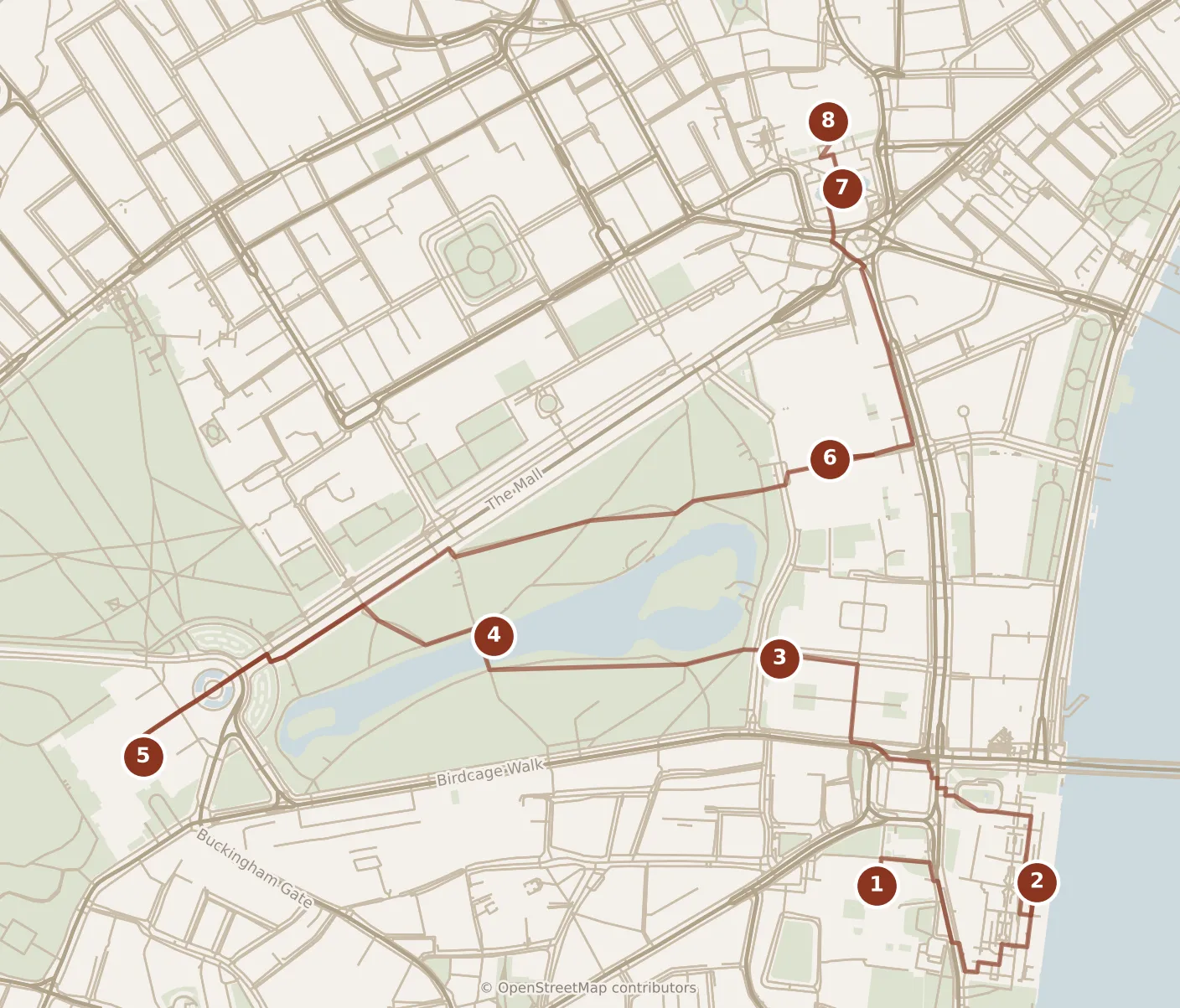
- Morning and afternoon
- 1Westminster Abbey
- 2Palace of Westminster
- 3Churchill War Rooms
- 4St James's Park
- 5Buckingham Palace
- 6Horse Guards Parade
- 7Trafalgar Square
- 8National Gallery
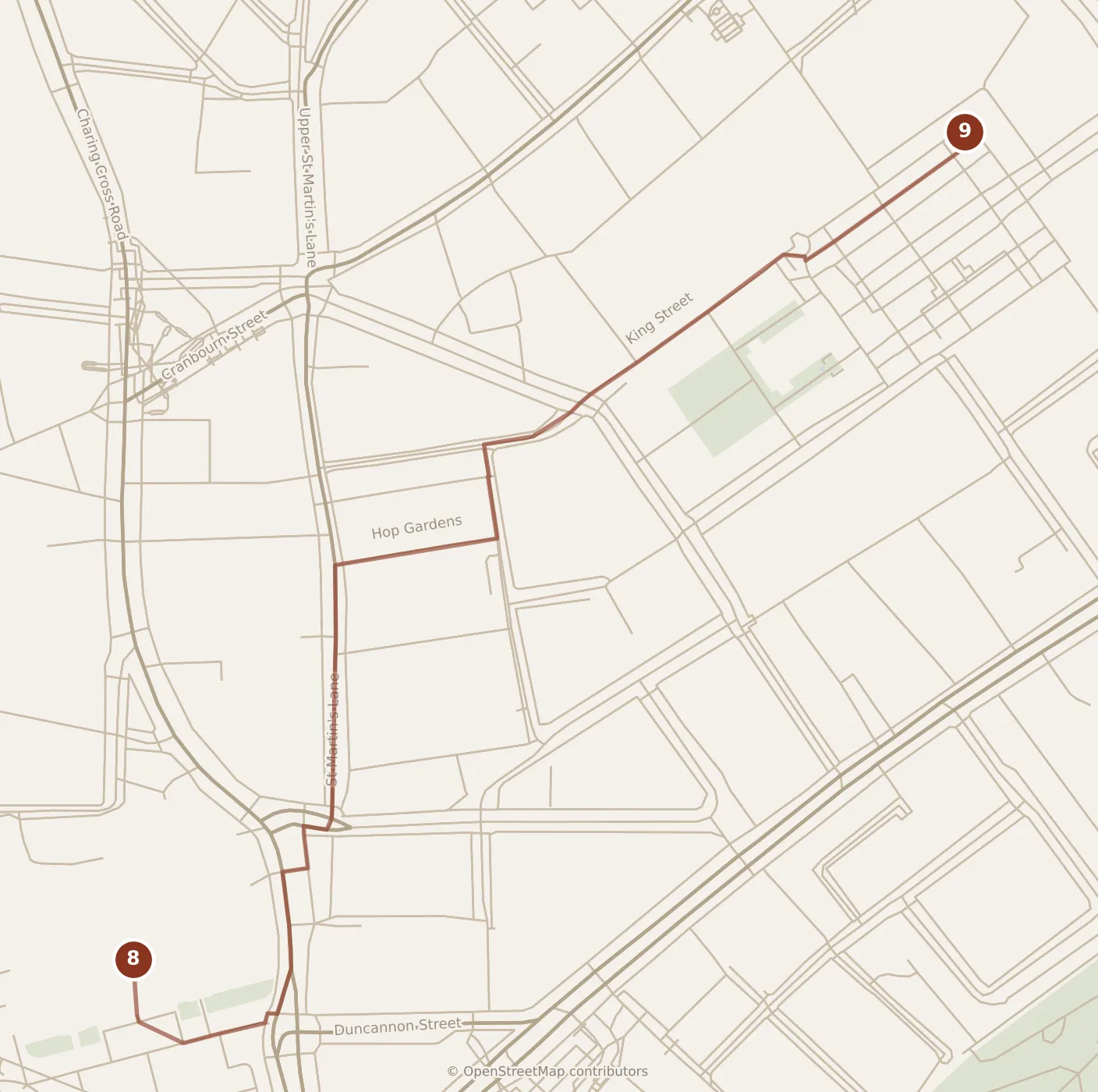
- Evening
- 9Covent Garden
Westminster and Whitehall: the government quarter, laid out along one straight mile with a park in the middle of it. Nothing below needs transport, and it goes first because getting the London of the stamps behind you turns the rest of the trip from a duty into a city.
Morning
The day starts at Westminster station, which is on the Jubilee, District and Circle lines. It has several exits and only one of them is the arrival worth having: follow the signs for Westminster Bridge and you come up on the sidewalk with the clock tower directly overhead. From Heathrow the quickest way in is the Elizabeth line to Bond Street and the Jubilee from there to Westminster, a single change and a little over forty minutes; the Piccadilly line the whole way to Green Park and one stop on the Jubilee is the same single change for about ten minutes more, and it is the cheaper of the two. From Gatwick, the train to Victoria and two stops on the District or the Circle. From St Pancras, King’s Cross or the Eurostar platforms, the Victoria line to Green Park and the same one stop, about fifteen minutes. Westminster Abbey is five minutes from the station across Parliament Square.
Start there, at opening, and give it two hours. In 2026 it admitted no sightseeing visitor before half past nine on any day and none at all on a Sunday; it is a working church first, so it publishes a dated calendar rather than one schedule, and if the opening has moved, this day still counts forward from wherever it has moved to. Inside, the floor is the exhibit. Every English and British coronation since 1066 has taken place here, and a great many monarchs are buried under the floor, so you walk on tombs almost everywhere — with one exception, and it is the thing a visitor cannot guess. The black slab at the west end of the nave, ringed with poppies, is the grave of an unidentified soldier brought back from the front in 1920, and it is the one stone in the building nobody steps on. It is impossible to miss — black marble, a brass inscription, a ring of poppies, a few feet inside the west door. Walk round it. Then find Poets’ Corner, which is six hundred years of argument about literary reputation conducted in stone, and the Coronation Chair, a battered oak seat made about 1300 and used at every coronation since, which looks like something recovered from a barn. A separate ticket takes you up into the roof space above the church, where the crowd is not; it is time on top of the two hours above rather than inside them.
Four minutes east you are in front of the Palace of Westminster: a quarter of a mile of Gothic detail put up after fire destroyed the old palace in 1834, with the Elizabeth Tower at the near end. You can go inside — the public galleries when Parliament is sitting, guided and audio tours when it is not — and this route looks at it from the sidewalk instead, because the interior is another one to two hours and this day has not got them. Big Ben is the bell inside that tower and not the tower itself, a distinction Londoners enjoy making and nobody else has ever needed. Twenty minutes along the river front.
Ten minutes north-west, in a basement under a government building on the edge of the park, the Churchill War Rooms are the best ninety minutes of the day and the only timed ticket in it. This is where the Second World War was run from. The Map Room was locked in August 1945 and left, so the pins are still in the wall charts and the colored telephones still on the desks, and what lands is not the grandeur but the meanness of it: low ceilings, bad air, a converted broom cupboard housing the transatlantic telephone, a Cabinet room with chair arms scored by fingernails.
Afternoon
Lunch first, about five minutes east in the lanes off Whitehall that feed the civil service and empty as fast as they fill; going there and coming back adds roughly ten minutes before the park. Then cross St James’s Park and stop halfway over the bridge across the lake, which gives you the whole quarter in two views — domes and turrets one way, the palace the other. There have been pelicans on this water since the 1660s. Twenty minutes to cross, longer if you sit, and it is the only grass of the day.
Buckingham Palace is at the far end, and the honest description is a plain gray front onto a roundabout. The state rooms open only for a summer season of about eleven weeks from early July, so for most of the year this is fifteen minutes of facade behind railings — which makes it the first thing to cut when the day is late. Dropping it and cutting straight across to the parade ground instead saves a kilometer and a third of walking and about half an hour, and costs you nothing the rest of the day refers back to. Changing the Guard happens here, not every day, on a schedule published in advance and canceled in bad weather. It is a late-morning fixture, so the order above reaches this end of the park hours after it; if you want the ceremony, the palace goes first and the abbey second, and the whole day runs backwards from this paragraph.
Walk back east down the Mall, twenty minutes of processional road that reads like one, to Horse Guards Parade — a gravel ground the size of a small field, with the sentries not on this side of it but on the far side of the building, on the Whitehall front. The mounted troopers of the Household Cavalry stand there from ten until four and are changed every hour; after four two dismounted sentries hold the post until eight, so a late-afternoon arrival finds the dismounted pair. Through the arch you come out on Whitehall with the Banqueting House opposite, the one surviving fragment of the Tudor palace that burned in 1698; it closed in May 2024 for a long restoration and has opened in seasons rather than daily since, so check your dates and plan the afternoon so that the answer does not matter. The Cenotaph standing in the middle of the carriageway and the black gates of Downing Street are two hundred meters south of that arch, towards Parliament — five minutes there and back, and the thing to know is that they are not on the way to Trafalgar Square but in the opposite direction. Then seven minutes north to the square.
Trafalgar Square has Nelson’s Column in it and the National Gallery filling the north side, which is free and takes the rest of the afternoon. Give it two hours and do not sweep it. It runs in one chronological line from the thirteenth century to the twentieth, so start in the newer wing at the west end, which is now the gallery’s main entrance and holds the earliest paintings, then take two rooms of whatever you actually care about. The things people cross London for are here: a Van Eyck of a couple standing in a mirrored room, Turner’s Fighting Temeraire under tow to the breaker’s yard, a Velázquez. Two hours is a proper visit and four is a forced march.
Evening
Ten minutes north-east is Covent Garden, the oldest square of its kind in the country, laid out in the 1630s with a church closing one end; the covered market building in the middle is of 1830, the fruit and vegetable trade left in 1974, and buskers hold the crowd underneath it because the pitches are licensed and auditioned for. Do not eat in the square. Eat in the streets north and west of it, with the theaters five minutes away in every direction.
Add the durations above and day one comes to about eight hours from the abbey’s door to the gallery’s last room, of which a little over an hour is walking — so a half past nine start puts you at dinner. What those eight hours do not measure is the ticket desk and bag check at the abbey, which is the one line on this day worth allowing for, and the abbey’s own audio guide, which comes with the ticket and adds half an hour if you use it rather than carry it.
Local tip. The war rooms are the only timed slot today, so book them for around midday — half past twelve if you are going to use the abbey’s audio guide — and let everything else fall around that. The exception is the ceremony: if you want Changing the Guard, that day runs backwards from the palace and the war rooms want a mid-afternoon slot instead. An early slot forces the abbey after them, and the abbey is the one building here whose door shuts in the middle of the afternoon while the gallery and the park do not. The choice costs nothing to get right and a whole interior to get wrong.
Day two

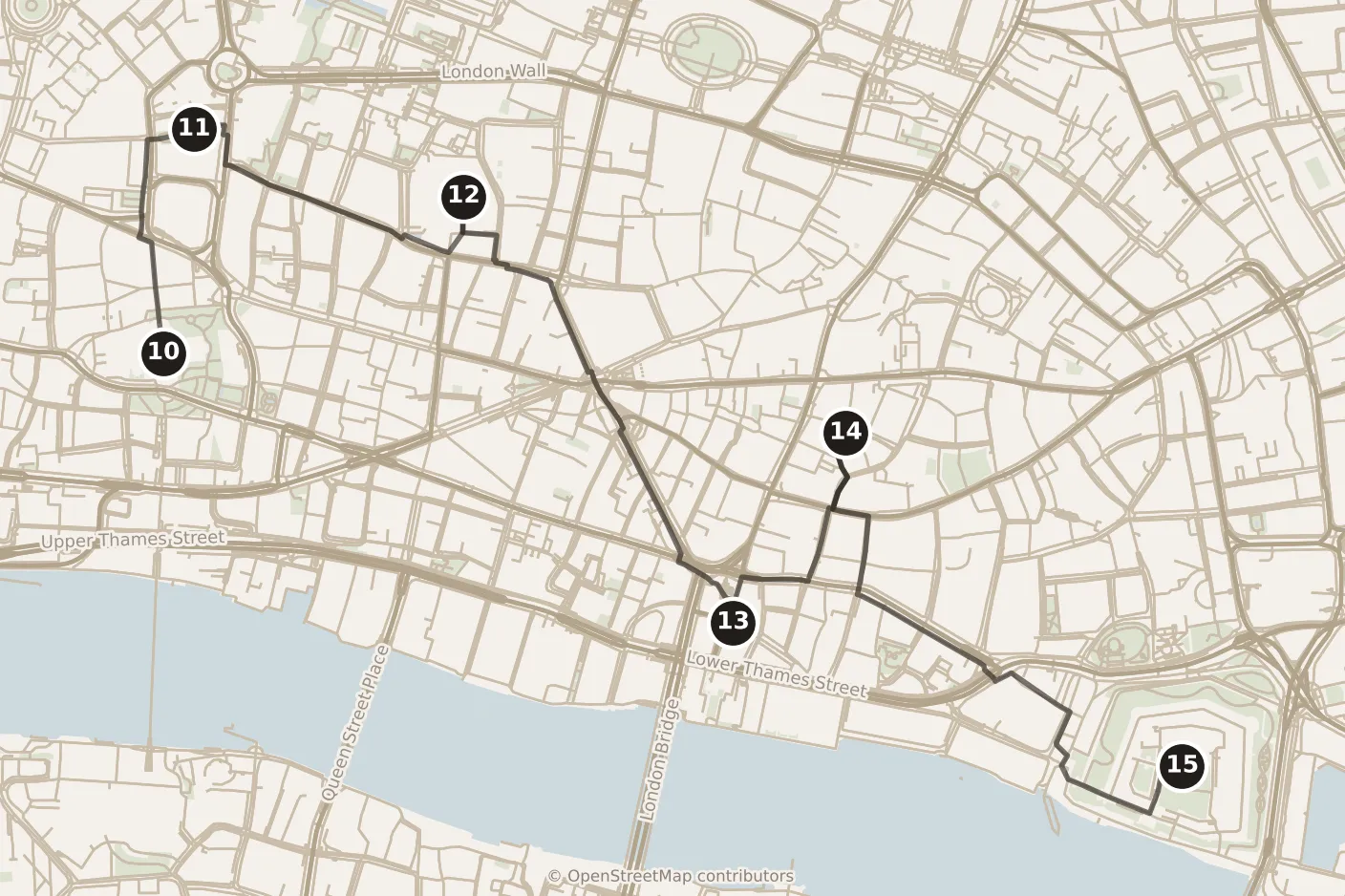
- Morning and afternoon
- 10St Paul's Cathedral
- 11Postman's Park
- 12Guildhall
- 13Monument to the Great Fire of London
- 14Leadenhall Market
- 15Tower of London
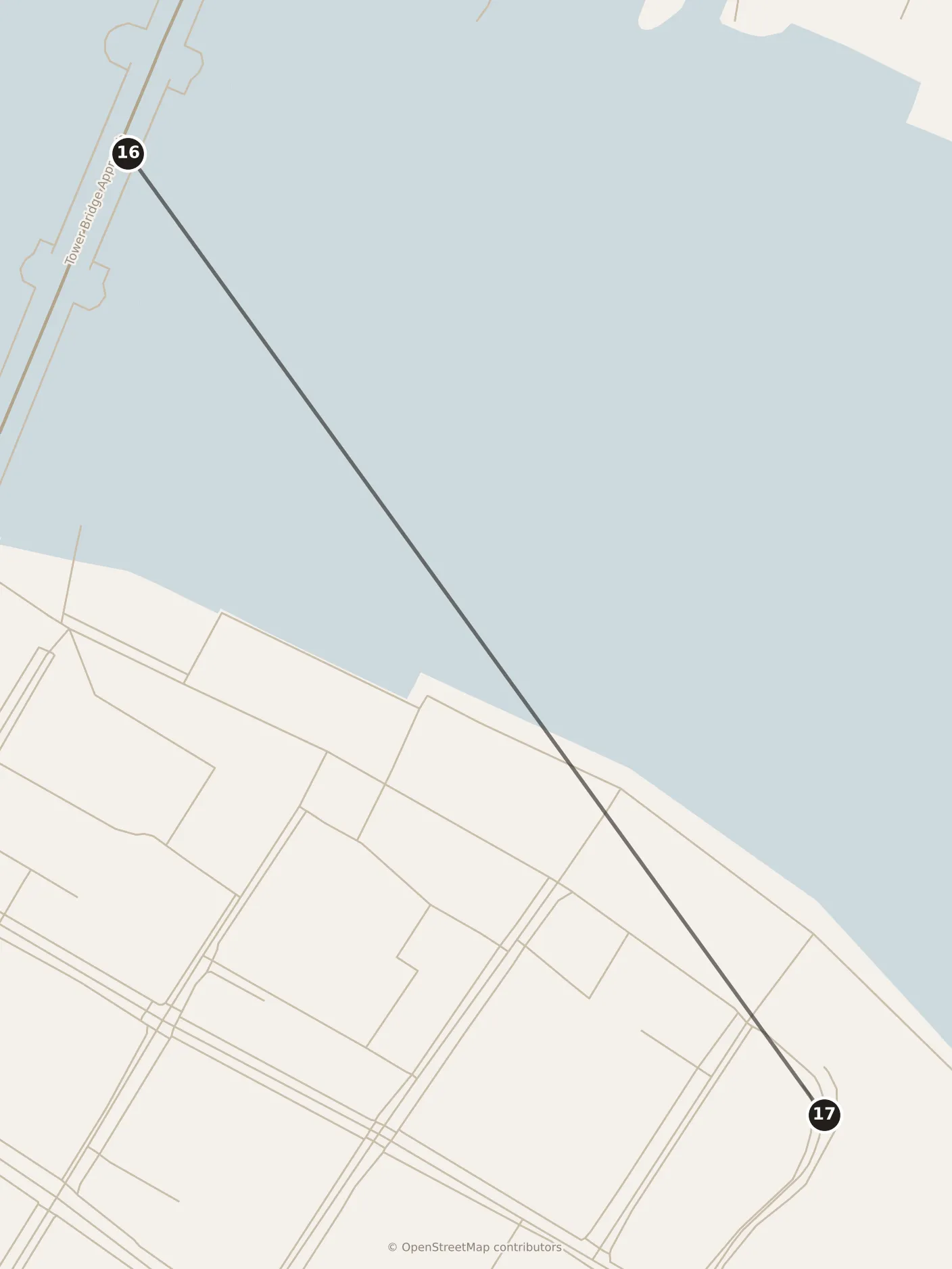
- Evening
- 16Tower Bridge
- 17Shad Thames
The City: a square mile of banks standing on a Roman town, walked west to east from the cathedral to the castle. It belongs on a weekday. This is an office district, so on the weekend the streets are handsome and most of the places to eat in them are shut.
The order is not a preference, it is arithmetic, and it is better had before the day than during it. The castle at the end stops admitting far earlier than it closes: in 2026 the Tower’s last timed entry was half past three from March to October and half past two from November to February, with the last Yeoman Warders’ tour a quarter of an hour before that, and Historic Royal Palaces publishes both. The cathedral at the start has the opposite shape — it opens earlier than anything else on either day. Everything above the Tower here comes to about five and a quarter hours including the walking, so a half past eight start at the cathedral door puts you at the castle gate a little before two, which is inside the winter last entry as well as the summer one, with the better part of an hour in hand either way. If you find different hours, that sum is what you rebuild the day from, not a reason to abandon the order.
Morning
St Paul’s Cathedral is where the day counts forward from, and the useful thing about its hours is that there are two of them. In 2026 the doors opened for sightseeing at half past eight and the dome stair about an hour after that, and on one weekday of the week both started an hour and a half later again; the cathedral publishes its own dated calendar, so read it and take the same shape from whatever it says. Give the building two and a quarter hours in total. It is Wren’s, built between 1675 and 1710 to replace the cathedral the Great Fire destroyed, and the interior is cool, pale and far larger than photographs manage.
Use the gap between those two hours for the ground floor and the crypt, which holds Nelson in a black sarcophagus, Wellington in a granite one the size of a car, and Wren himself under a plain slab whose inscription tells the reader that if they want his monument they should look around them. Then be at the foot of the stair when it opens, because that is the whole reason this stop is at the start of the day and not the end of it. It is one staircase with three landings: 257 steps to the Whispering Gallery running round the inside of the dome, 376 to the Stone Gallery outdoors on the drum, 528 to the Golden Gallery at the top, where the last stretch is a narrow iron spiral inside the structure itself. There is no elevator and no shame at all in stopping at the second landing. The stair is single file, which is what makes the hour matter — empty for the first of them, a shuffling line by the middle of the morning. One rule most visitors guess the wrong way round: photography is allowed here rather than banned. Non-flash stills for your own use are welcome on the cathedral floor, in the crypt and on both the Stone Gallery and the Golden Gallery. The two places they are not are the Whispering Gallery, on health-and-safety grounds, and St Dunstan’s Chapel, which is kept for private prayer — and nowhere at all during a service. Flash, tripods and selfie sticks are out throughout.
Seven minutes north is Postman’s Park, ten minutes long and the thing people remember afterwards. Along one wall, under a wooden canopy, runs a line of glazed tiles each recording an ordinary person who died saving somebody else — a boy drowned pulling his brother out, a woman who went back into a burning house. Set up in 1900, still occasionally added to, free, and not signposted from the street.
Eight minutes east, Guildhall has been the seat of the City’s own government since the fifteenth century, and its great hall came through both the Great Fire and the Blitz, which almost nothing around it did — though the hall is a working civic building, closed to visitors whenever it is in use, so it is not a stop to build an hour on. The reason to come is underneath the art gallery beside it: London’s Roman amphitheatre, found by accident in 1988, where you go down into a dark room and see the surviving stone of the entrance passage and the drain, with the missing walls drawn in light. The full ellipse is marked in dark paving in the yard above, so you can walk its outline at ground level for nothing. Both are free. Forty-five minutes for the pair.
Afternoon
Fifteen minutes south-east is the Monument, a fluted column of 1677 by Wren and Robert Hooke, 202 feet high and standing exactly 202 feet from the baker’s shop on Pudding Lane where the fire started. Hooke also meant it as a scientific instrument — a hollow shaft with a hinged lid at the top and a laboratory in the basement, for observations straight up — which is why the stair winds round nothing at all. It is 311 steps, the platform is caged, which matters to the photographs, and the ticket is much the smallest on either day. Half an hour. It comes before lunch rather than after because the Monument shuts for an hour over the middle of the day; if that hour has moved, keep the order and move the meal.
Six minutes north-east, Leadenhall Market is lunch: a cross of glazed arcades in cream and maroon ironwork of 1881, on Gracechurch Street, on a site that has held a market since the Middle Ages. The arcade is a public street and never closes, but the shops and pubs under it trade for the office week, which is the second reason today is not a Saturday. Look up while you eat. The Lloyd’s building opposite wears its pipes, ducts and elevators on the outside so the interior could be rebuilt without touching the shell, and the Gherkin is one street further; the contrast between the ironwork and the machinery standing over it is the whole argument of this quarter.
Fifteen minutes south-east, the Tower of London, and give it three hours. It is not a building but nine centuries of them inside one wall, and the sequence inside matters as much as the sequence outside. Take the Yeoman Warders’ tour first: it is free, included in the ticket, led by long-serving soldiers who live inside the walls, and an hour with one gives the site a shape so that everything you look at afterwards means something — and it is the part that stops earliest, which is what the arithmetic above is protecting. Then the Crown Jewels, in a vault crossed on a moving walkway, and nothing stops you going round twice. Then the White Tower, the Norman keep begun around 1078, for the armor. What to skip: the small display towers along the inner wall, which are dark, cramped and much of a muchness after two.
One thing catches people out at the gate. The Tower has no cloakroom and no left luggage of any kind, bags much larger than a daypack are refused entry outright, and there is nowhere on the site to put one down — so this is a stop you cannot combine with an arrival or a departure.
Evening
Five minutes on, walk out onto Tower Bridge, which is not and never has been the bridge people mean when they say London Bridge. It is a bascule bridge of 1894: the roadway splits and lifts in two halves, and the stone towers and Gothic cladding were hung on a steel frame so the thing would not embarrass the castle beside it. It still lifts for shipping and the times are published in advance. Crossing is free and takes ten minutes with stops. The high walkways with the glass floor and the Victorian engine rooms under the southern approach are a separate ticket with a last entry of their own in the early evening, and they are what this day gives up: the Tower keeps you inside its wall until it closes and you cannot have both. Halfway over, turn round and look back at the enclosure you have just spent the afternoon in.
Off the south end, five minutes east, is Shad Thames: a canyon of Victorian warehouses with iron footbridges still strung between them three and four stories up, built so that sacks could cross the street without ever touching the ground. The warehouses are apartments now and the ground floors are where the evening is, at Butler’s Wharf and up into Bermondsey behind it. Which version of this you get is the one thing on these two days the calendar decides rather than you: in December the Tower turns you out into the dark and you arrive with the bridge floodlit behind you, which is the better picture; in June you arrive with hours of daylight left, which is the better evening. Either way, London Bridge station is twenty minutes west along the water, and Bermondsey, on the Jubilee, is fifteen minutes south.
Local tip. If you can face only one climb today, take the cathedral’s and not the Monument’s. Both are stairs and a view, and the difference is that half of the cathedral’s happens inside the dome itself, which is the thing you have paid to see, while all of the Monument’s happens inside a chimney. Dropping the Monument also widens the winter version of this day’s margin, because it takes better than half an hour off the way to the castle gate.
With a third day

- With a third day
- 18British Museum
- 19Lincoln's Inn Fields
- 20Sir John Soane's Museum
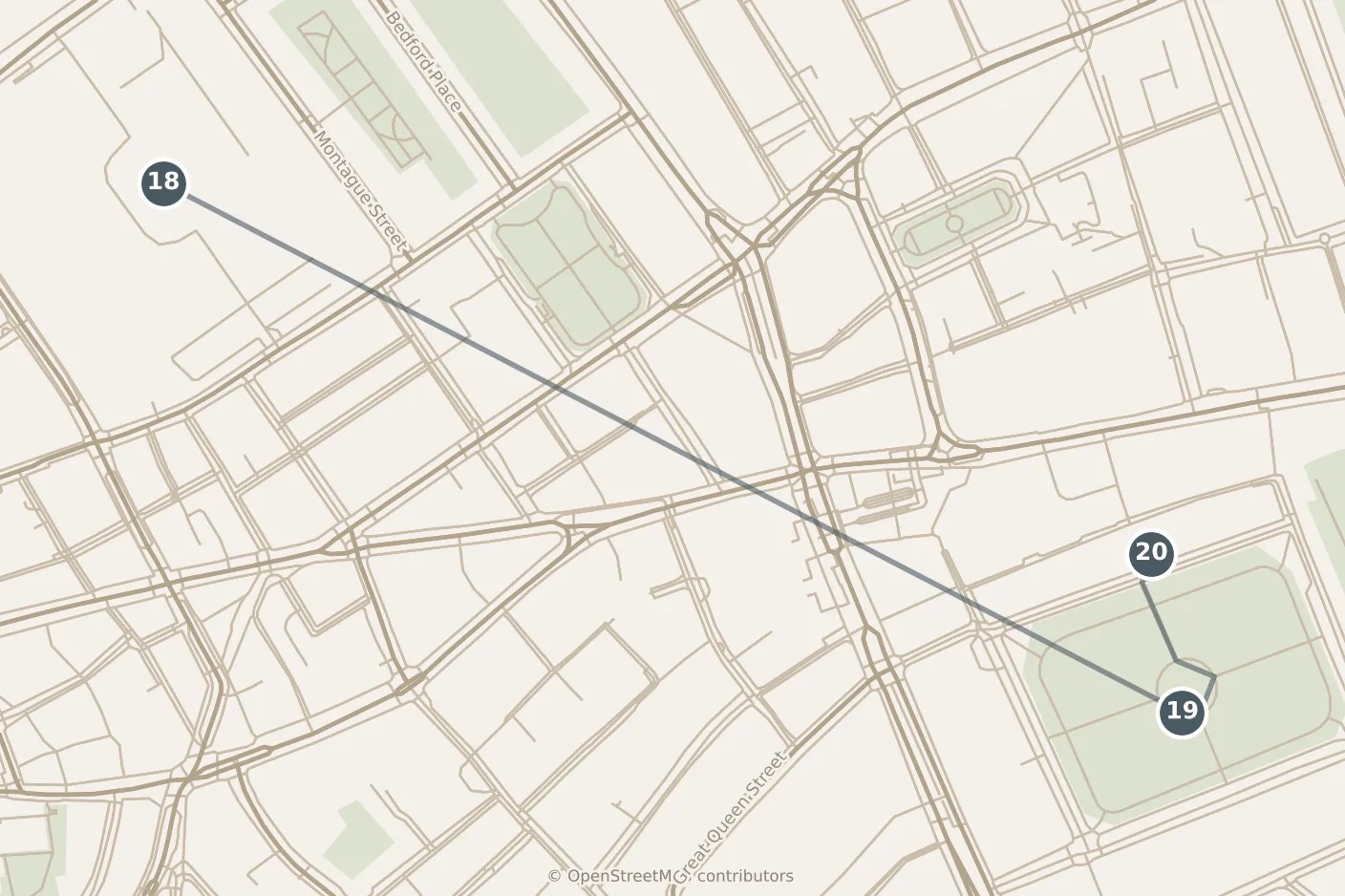
A third day in London is the British Museum, the legal quarter east of it and the West End below it — and it goes between the two days above rather than after them.
Three reasons, and the last is the one that decides it. It runs west to east across the middle of the city, so Westminster, then Bloomsbury and Holborn, then the City is one continuous line with nothing doubling back. It is flat and almost entirely indoors, which is what you want between a day spent standing on stone and a day that opens with 528 steps and ends in a castle. And of the three it is the one a Sunday costs least: the museum, the square and Covent Garden are all open, and only the legal quarter’s own grounds are a weekday pleasure. So if any of your days is a Sunday, this is the one to put there.
Inserting it moves exactly one thing: day one’s evening. Day one as written ends in Covent Garden, and so does this day, and two theater evenings in the same six streets is one too many. So on a three-day trip day one stops at the National Gallery and eats near the square, and the Covent Garden evening moves here — where it belonged anyway, because you arrive on foot at the end of the afternoon instead of walking back for it.
Start at the British Museum when it opens, and understand that it is not a museum you finish. Eight million objects; you take two departments and let the rest go, and choosing before you walk in is the difference between a good morning and a route march. Whatever you choose, the Great Court is on the way — a courtyard that was open sky until 2000 and now carries a curved glass roof of more than three thousand panes, no two the same shape, with the old circular Reading Room standing in the middle of it like a drum. For a reader who has just walked this trip, two departments follow from the two days rather than from a list. Upstairs, the room of Roman Britain holds what came out of the town whose amphitheatre you stood in, and beside it the gold and the iron helmet from the Sutton Hoo ship burial sit squarely in the six centuries between the Romans leaving and the men who built the White Tower arriving — precisely the gap the days on either side of this one leave open. On the first floor, the carved lion hunts from Nineveh run for twenty meters and are widely held to be the supreme masterpieces of Assyrian art; the Rosetta Stone sits behind glass in a permanent scrum you may walk past without guilt. The Parthenon sculptures are in their own long room, and whether they should be in London is an argument this page will not settle for you, only tell you is live. Three hours.
Lunch is on the walk east, in the plain streets of Holborn that feed solicitors and students. Fifteen minutes brings you to Lincoln’s Inn Fields, the largest of London’s garden squares, and on its north side Sir John Soane’s Museum, which is free, small and the strangest interior in the city. Soane was the architect of the Bank of England and left his house to the nation on condition that nothing in it be moved, a condition he wrote into an act of Parliament in 1833 — so you walk through one man’s collection exactly as he arranged it: a picture room whose walls swing outwards on hinges to reveal further walls of paintings behind them, Hogarth hung inside a cupboard, and the alabaster sarcophagus of Seti I in the basement, which Soane bought when the British Museum declined it and celebrated with a three-day party. An hour, and the most concentrated hour of the three days. It is closed on Mondays and Tuesdays and limits numbers inside, so check that before you build the afternoon on it; if it falls on your day, the square and the legal quarter behind it still repay the fifteen-minute walk and the morning in the museum simply runs an hour longer.
Then Covent Garden, twelve minutes south-west, and the evening as described at the end of day one. Three hours in the museum, an hour in the house, lunch and about forty minutes of walking make this much the shortest of the three days, which is the point of it sitting in the middle.
If you have seen the great collections before, the honest alternative is Greenwich, and it changes the shape: that is a day out rather than a day between, so it goes on the end and nothing is inserted. The commuter catamarans run from Tower Pier, two minutes from where day two spends its afternoon, and from Westminster Pier at the foot of day one’s first stop; from the former it is about half an hour on the water and the journey is itself the sightseeing. What it costs you is the British Museum, which is the largest single hole a two-day trip leaves, and one fare — the river boats take the same card as everything else but sit outside the daily cap, so that crossing is charged on its own.
Practicalities
Two bookings, and they are the ones that decide the days. The war rooms on day one are timed entry and the slots genuinely go, so book when you book the trip rather than the night before. The Tower on day two is timed too, and the slot you want is the first one after lunch, because the day above is built to arrive there then. If the only slot left is a morning one, do not fight it: run day two backwards. Tower at opening, then the Monument, Leadenhall for lunch, Guildhall and Postman’s Park, and the cathedral at the end. That costs you the empty stair — you climb the dome in the afternoon with everybody else — and, in the winter half of the year, a real risk that the cathedral’s last entry beats you there, in which case you get the floor and the crypt and the climb is gone. Reversed, the day also ends somewhere else: ten minutes north-west of the cathedral are the streets round the old meat market at Smithfield, which is where the City eats after dark, with Farringdon station at the end of them. The abbey and the cathedral both sell timed tickets online that save waiting in line and a little money and rarely sell out; everything free here needs nothing.
Sunday is the day of the week this trip pays for, and day one is where it pays most. The abbey admits no sightseeing visitor at all on a Sunday — it is a working church and Sunday is what it is for — and it is the interior day one is built around. The cathedral is only half shut: in 2026 it closed the floor and the crypt to sightseeing on Sundays but kept its three dome galleries open on Sundays between 15 March and 25 October, so through the main season a Sunday still buys you the climb this day is really built on, and costs you the crypt and Wren’s slab. Everything else on both days is open: the war rooms, the gallery, the Guildhall and its amphitheatre, the Tower, the parks, every street. So the rule is short. Day one must miss Sunday; day two on a summer Sunday keeps the climb and loses the floor, the crypt and the City’s lunch trade; and day two is thin on a Saturday as well, because that lunch trade shuts with the offices and Leadenhall’s arcade becomes a handsome empty crossroads; if you must take day two on a weekend, move lunch to the streets by the castle, which feed weekend visitors all year. The third day’s museums are open on the weekend and it loses only an hour early in the week. Any two consecutive weekdays work, and Wednesday to Friday works for all three — with one check on the calendar first: keep day two off the weekday the cathedral opens an hour and a half late, because the half past eight start is what the whole day counts forward from. A Friday night arrival is the awkward one on a two-day trip, because Saturday and Sunday between them cannot hold day one: take day two on the Saturday and the third day’s shape on the Sunday, and accept that Westminster’s interiors are what that weekend has cost you. On three days it is not awkward at all — day two on the Saturday, the third day on the Sunday, day one clean on the Monday, and the only cost is day two’s Saturday lunch, which moves to the streets by the castle as above.
If a Sunday is what you have, go to a service instead of buying a ticket. Both the abbey and the cathedral sing evensong on most days and hold several sung services on a Sunday; they are free and need no ticket. Both publish their own service times, which is where to read them. It is not a cheaper ticket and should not be treated as one: you go in when the stewards let you in, you sit where you are put, you stay to the end, and you do not wander or photograph. What you give up is the rest of the building — the abbey’s royal tombs, the cathedral’s crypt.
Getting between the stops is walking, about nine kilometers over the two days — five on day one, four on day two, both flat, neither with a single leg over about twenty minutes. Four Underground journeys in total: in to Westminster and out from Covent Garden or Leicester Square on day one, in to St Paul’s on the Central line and out from London Bridge or Bermondsey on day two. Nothing in between needs transport of any kind.
The bag is the one thing this trip cannot absorb, and the reason is the Tower. No cloakroom, no left luggage, a size limit at the gate — so day two cannot be your arrival or departure day with a case in hand, and neither can day one, since the abbey and the war rooms both put you through a bag check. There is no left luggage anywhere on the Underground at all; the staffed offices are inside the mainline termini — St Pancras, King’s Cross, Euston, Paddington, Victoria, Waterloo, Charing Cross, Liverpool Street — and they are counters rather than lockers, so you wait in line at both ends of the day. In practice: if you land in the morning and cannot check in, leave the bag at the terminus you arrived at, spend that afternoon on the third day’s shape rather than on either of the two days above, and start day one clean the next morning.
Rain changes one stop on each day and nothing else. On day one it is the park: from the war rooms turn north-east up Whitehall instead of west into the grass, which is fifteen minutes of sidewalk to Trafalgar Square and puts you inside the gallery an hour and a half early — which is what buys you the rooms you would otherwise have skipped. What you give up is the park and Buckingham Palace, and Buckingham Palace is a facade; Horse Guards Parade keeps its sentries on the Whitehall front, so you pass them either way. On day two it is the Monument, an open platform at the top of a wet spiral: drop it, spend the half hour under Leadenhall’s glass roof instead, and take an earlier slot at the Tower, where the crossings between one building and the next are the only part of the afternoon that gets wet.
Local tip. Of everything on this page, one decision costs nothing to get right and half an afternoon to get wrong, and it is the hour printed on the Tower ticket. Take the first slot after lunch and day two arranges itself: the cathedral gets its empty stair, the City gets its lunch while the offices are still open, and the castle gets three hours before the gate stops admitting. Take a morning one and you have chosen the reversed day whether you meant to or not.


