Cologne in two to three days: the cathedral, the Rhine and a baroque palace at Brühl

Last updated 18 October 2026
Overview
Cologne is a two-day city with one building in the middle of it. The cathedral stands at the top of the steps outside the main station, so the first thing you see on arrival is the thing most people came for, and the temptation is to treat the rest as an afterthought. It is not. The old town runs down from the cathedral to the Rhine, the river runs south past a rebuilt harbor to a neighborhood where the city goes out in the evening, and all of it is flat and walkable. Two days covers the center properly on foot. A third day takes a short train out to Brühl, where an elector-archbishop of Cologne built himself a palace with one of the great staircases of the eighteenth century, and comes back for an afternoon in the city’s western quarters.
Most of what you see is not as old as it looks. The center was very heavily bombed in the Second World War, and the old town, the churches and the bridge were rebuilt afterwards; the cathedral came through damaged but standing. That is worth knowing before you start, because it explains why a medieval street plan is lined with postwar buildings, and why the churches carry their repairs openly.
Day one is built around one view: the cathedral from the far bank of the Rhine, at the end of the day, as the light goes and the floodlights come on. That is the moment that does not wait, and day one counts back from it. The sun sets here from just before half past four in early December to nearly ten at the end of June, so take your month’s hour and count back the roughly seven hours day one works out to below.
One thing decides which day is which: the weekly closing days. Day one’s Museum Ludwig and Groß St. Martin close on Mondays; day two’s two museums, the Roman-Germanic Museum and Kolumba, both close on Tuesdays, and Kolumba also closes over the carnival days and from mid-August to mid-September while its exhibition changes. The city’s old-master gallery, the Wallraf-Richartz Museum, is closed for renovation until about 2028, which is why it is not on these pages. If a day would land on a closing day, read the Practicalities before you set out.
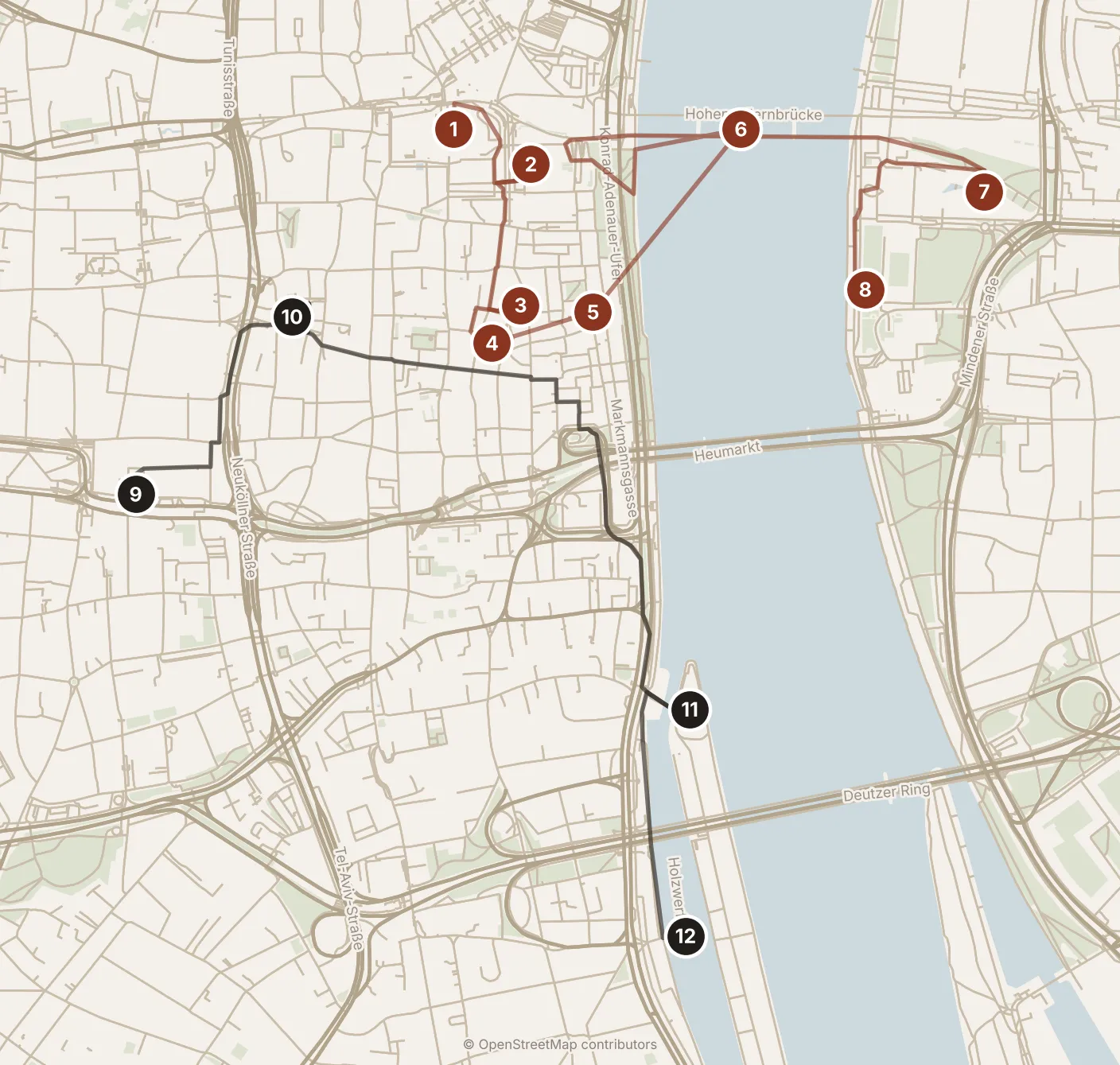
- Day one
- 1Cologne Cathedral
- 2Museum Ludwig
- 3Alter Markt
- 4Historic City Hall
- 5Groß St. Martin
- 6Hohenzollern Bridge
- 7KölnTriangle
- 8Rheinboulevard
- Day two
- 9Belgisches Haus
- 10Kolumba
- 11Chocolate Museum
- 12Rheinauhafen
Köln Hauptbahnhof — not on the walking map.
- With a third day · stop 16
- 16Köln Hauptbahnhof
Day one

Everything today is within a kilometer of the cathedral, and it ends on the other side of the river looking back at it. You arrive with the cathedral and you leave with it.
Morning
If you come in by rail you arrive at Köln Hauptbahnhof; from Cologne Bonn Airport the S19 runs straight into it. Leave by the main exit and climb the steps: the plaza in front of the cathedral, the Domplatte, is two minutes from the platforms. Left luggage is at the station, and today’s route never strays more than twenty minutes on foot from it, so a bag left there in the morning can be collected on the way to an evening train.
Cologne Cathedral is the reason the day starts here. Since July 2026 sightseeing inside costs €12 (children up to 13 free; services and prayer stay free), bought online or at the ticket office in the Kurienhaus on Roncalliplatz, on the cathedral’s south side, which opens at nine. Visiting hours are 10:00 to 17:45, and on Sundays and church holidays only 13:30 to 16:30. Construction began in 1248 and stopped for about three centuries with the building half done; it was finished in 1880 to the medieval plans, which is why a Gothic cathedral has two towers that look newer than its choir. Inside, go first to the gilded Shrine of the Three Kings behind the high altar, made around 1200 to hold the relics that made the city a pilgrimage center and paid, in the end, for the building around them. Then find the Gero Cross, a carved crucifix from the late tenth century, generally held to be the oldest surviving large crucifix north of the Alps; Stefan Lochner’s Altar of the City Patrons, the city’s great fifteenth-century painting, is also in the cathedral. Last, look for the one window that looks like a screen of pixels: Gerhard Richter’s, installed in 2007, thousands of squares of colored glass. Give the interior an hour. It closes to sightseeing during services, and on a Sunday the nave opens to visitors only at 13:30 and the tower’s bell chamber stays closed until 14:00, so on a Sunday swap the order: Museum Ludwig first, then lunch at Alter Markt and Groß St. Martin, which opens at 13:00 on Sundays, and the cathedral and the tower after (last admission 16:15).
The tower is a separate ticket (€8), sold online and at the same ticket office on Roncalliplatz; the climb starts from its own entrance outside the building at the base of the south tower. It is 533 steps up a narrow stone spiral to a platform about a hundred meters above the plaza, with no lift and no way to stop halfway that does not hold up the people behind you. Give it forty-five minutes, up and down. Skip it if you dislike tight stairs; the view from the far bank tonight is the better picture of the cathedral, and this is a view from it rather than of it.
Museum Ludwig is two minutes away, on the river side of the cathedral. It is the modern art museum, and it is worth the two hours it asks: one of the largest Picasso collections in Europe, a Pop Art collection with Warhol at its center, and German Expressionists. Do not try to see it whole. Take the Picassos and the Pop Art, look at the Expressionists if there is energy left, and leave the temporary exhibitions for another trip. If the day is running short, this is the stop that goes first: everything after it is outdoors and walkable, and the cathedral and the view are what the day is for.
Afternoon
Walk south into the old town, about eight minutes from the museum, to Alter Markt, the old market square. Lunch can be here, in one of the brewery taverns of the old town. This is where to eat Himmel un Ääd, black pudding with mashed potato and apple, or a Halve Hahn, which despite its name is a rye roll with a thick slice of cheese and no chicken at all.
Local tip. Kölsch arrives in small straight glasses and keeps arriving: the waiter, the Köbes, replaces an empty glass without being asked and marks your coaster each time. When you have had enough, put the coaster on top of the glass. That is the custom a visitor is least likely to guess; at the end you settle the tally on the coaster with the Köbes.
The Historic City Hall is on the west side of the square, and its tower is worth standing back to look at: rebuilt after the war, it carries more than a hundred stone figures of people who mattered to the city, and its Renaissance loggia from the sixteenth century faces the next square over. You do not need to go in; ten minutes outside is the visit.
Groß St. Martin is four minutes east, its square crossing tower the shape that sits under the cathedral in every photograph from the river. It is one of the city’s twelve great Romanesque churches, built on the remains of Roman warehouses on what was once an island in the Rhine, and like the others it was gutted in the war and rebuilt; inside it is plain and quiet, and twenty minutes is enough; below it, the excavated Roman remains in the lower church can be seen outside prayer times. It is closed on Mondays, opens only at 13:00 from Tuesday to Thursday, and shuts to visitors during its services and prayers. Then walk down to the river promenade and turn north, along the water, with the cathedral ahead of you.
Evening
This is the stop the day is built around, so work backwards. The view wants the last half hour of light, when the sky is still blue and the cathedral is lit. Everything above it comes to the better part of seven hours with the walks between, so start about seven hours before your sunset. That does not include the line at the tower, which on summer weekends can be the longest wait of the day, or the time the nave is closed for a service. In midsummer, start at ten anyway, because the cathedral’s last admission is 17:30, Museum Ludwig closes at 18:00 and Groß St. Martin at 17:25; spend the hours left before the light on the promenade or in a tavern; in December the cathedral opens at ten and the sun is down before half past four, so there is not room for everything, and Museum Ludwig is what goes.
From Groß St. Martin, follow the promenade north to the Hohenzollern Bridge, the railway bridge just behind the cathedral, about seven minutes. Walk across it on the footway beside the tracks: it is about four hundred meters, with trains passing at your elbow and the railings hung with tens of thousands of padlocks left by couples. On the far side you are in Deutz.
KölnTriangle is the glass tower at the end of the bridge. It has a viewing platform at the top with a separate small ticket; go up if you want the cathedral and the river from above, and give it half an hour. Otherwise skip it and walk on.
Rheinboulevard is the long flight of wide concrete steps along the Deutz bank, a few minutes south of the bridge. From Groß St. Martin to here is about twenty minutes on foot in all. Sit down. This is the picture: the bridge, the cathedral, Groß St. Martin and the old town in one line across the water, and the floodlights coming on as the color goes out of the sky. On a warm evening the steps fill with people doing exactly this. To get back, cross the bridge again: Köln Hauptbahnhof is ten minutes from the steps on foot, which is the leg to time if you have a train to catch.
Day two

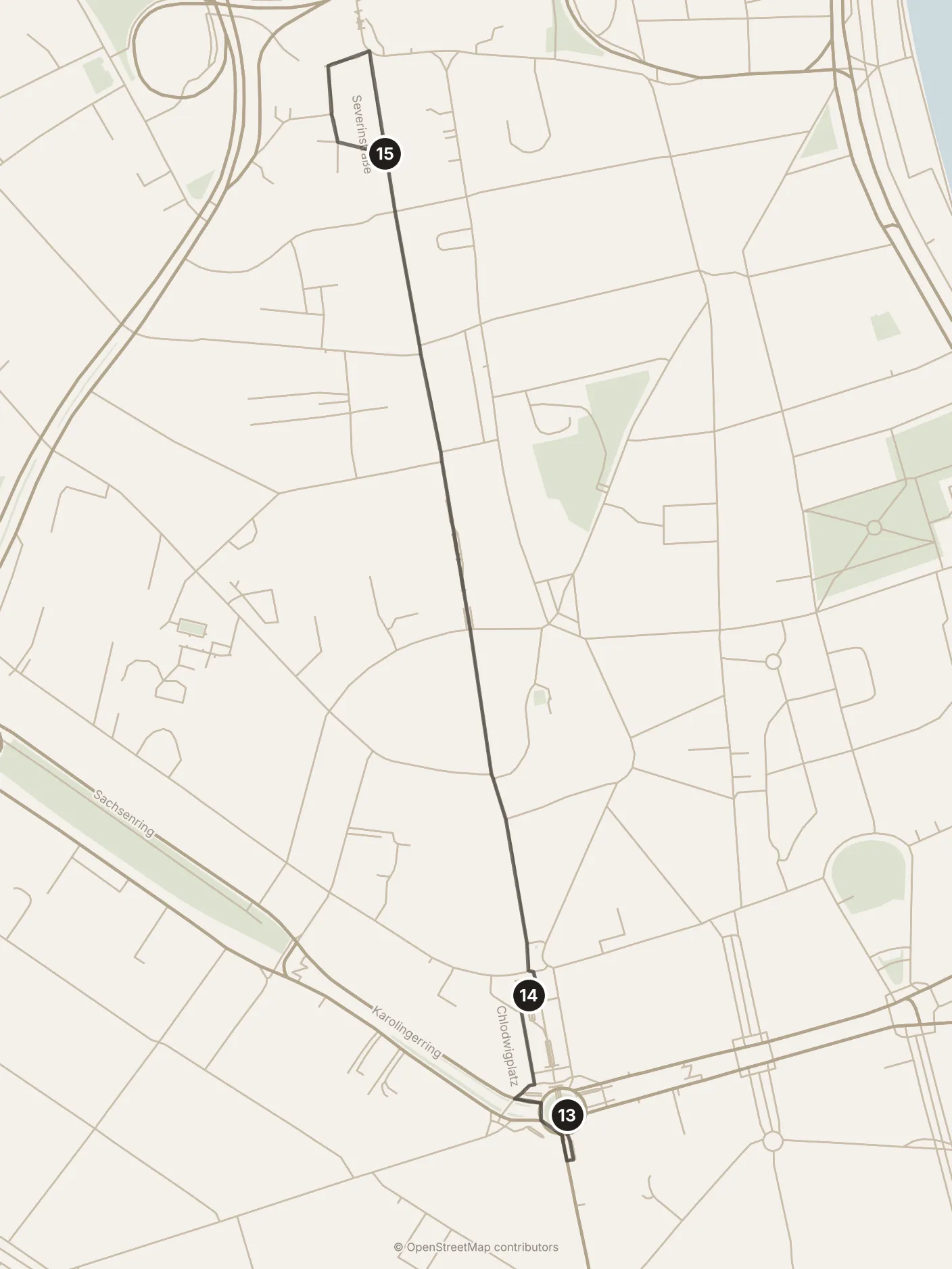
- Evening
- 13Chlodwigplatz
- 14Severinstorburg
- 15Severinstraße
Today starts on the west side of the old town, turns east to the river and then runs south down it, and ends in the Südstadt — the neighborhood south of the old walls. It has no moment that does not wait. What sets its start is the Roman-Germanic Museum’s opening at ten; Kolumba, the next stop, does not open until noon.
Morning
The Römisch-Germanisches Museum, the Roman-Germanic Museum, is the city’s museum of its Roman past — Cologne began as a Roman town, and this is where that history is shown. Its own building beside the cathedral is closed for renovation, so for now its major finds on the city’s history are shown in the Belgisches Haus on Cäcilienstraße, by Neumarkt, about a quarter of an hour on foot southwest of the cathedral. The large mosaic and the Roman tomb that made the old building famous stay behind in it and cannot be seen. It is open from 10:00 to 18:00 every day except Tuesday, and admission is €6. Give it an hour and a quarter. If a museum morning is one more than you want, this is the stop to drop: sleep in, have a long lunch, and start the day at Kolumba at noon.
Lunch is in the streets around Neumarkt, on the way to Kolumba. Keep it light, since the evening is the big meal: a Halve Hahn, the rye roll with a thick slice of cheese, if you did not have one yesterday. You will pass the ends of Hohe Straße and Schildergasse, the two big shopping streets; they are busy and entirely ordinary, and there is no reason to spend time in them.
Afternoon
Kolumba is about ten minutes northeast of the Belgisches Haus, and it comes after lunch for a reason: it opens at noon, and closes at five. It is the art museum of the archdiocese, built by Peter Zumthor in 2007 on top of the ruins of a Gothic church destroyed in the war, and the building is the main exhibit. You walk on a raised path through a tall hall whose walls are pierced brick, over the excavated foundations of the churches that stood here back to Roman times, with air and street sound coming through. The collection is shown with very few labels and changes yearly, mixing medieval objects with contemporary work. The small postwar chapel of the Madonna in the Ruins by Gottfried Böhm is built into the same site. Give it an hour, and be prepared for a museum that asks you to slow down rather than read.
From Kolumba walk east to the river and south along it to the Chocolate Museum, about twenty minutes. It sits on the tip of the old harbor peninsula in a glass building shaped like a ship’s bow, and it is a working display: a small production line, the history of cocoa, and a fountain of chocolate at which a staff member dips a wafer for you. It is pleasant and busy and takes an hour. Skip it without regret if it is not your kind of museum; the walk on to the harbor is the better part of this stretch, and this is the stop to cut first if the day is short.
South of it, the Rheinauhafen is the old Rhine harbor turned into a long promenade of restored warehouses and new buildings. The three Kranhäuser — tall office and apartment blocks shaped like inverted L’s, deliberately recalling the cranes that used to stand here — are the landmark. Walk the length of the quay, half an hour at an easy pace, with the river on your left.
Evening
At the south end of the harbor, cut inland about ten minutes to Chlodwigplatz. On the square, the Severinstorburg is one of the surviving gates of the medieval city wall, a squat stone gatehouse that marked where the road south left the city. Look at it from outside; that is the visit.
Then walk north up Severinstraße, the long street of the Südstadt, a residential neighborhood street with places to eat and drink and none of the old town’s sense of being looked at. Brewery taverns, small bars and neighborhood restaurants line it and the streets off it. This is the evening for the big meal: in a brewery tavern, order Rheinischer Sauerbraten, beef marinated for days in vinegar and served in a sweet-sour sauce with raisins, the dish yesterday’s lunch did not cover. Then stay put and order more Kölsch.
To get back, keep walking north: Severinstraße leads towards the center, and from Chlodwigplatz the cathedral and the main station are about half an hour on foot. Chlodwigplatz also has a Stadtbahn station underground; the KVB app and journey planner give the line and the next departure for wherever you are staying.
With a third day

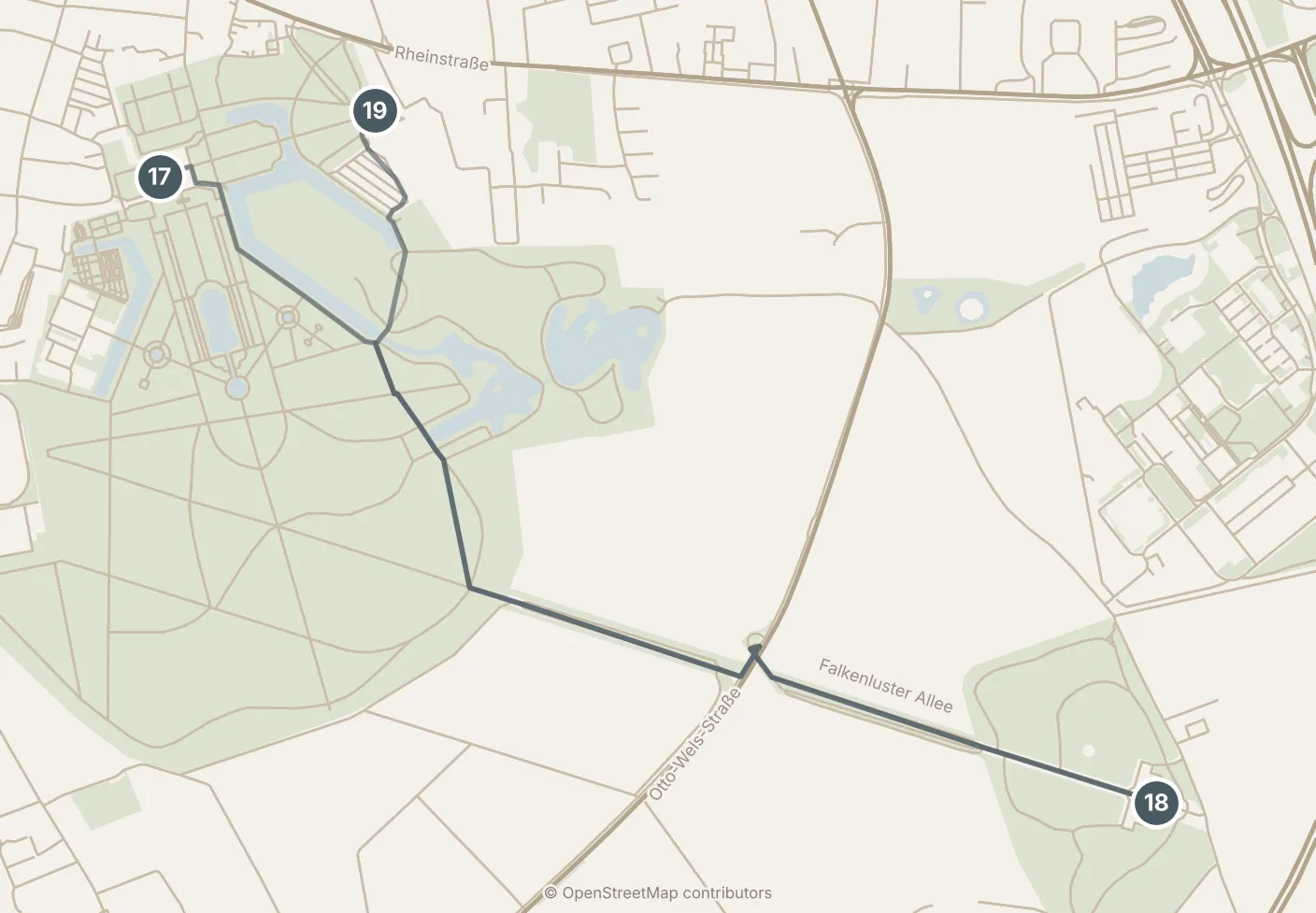
- With a third day · stops 17–19
- 17Augustusburg Palace
- 18Falkenlust
- 19Brühl station
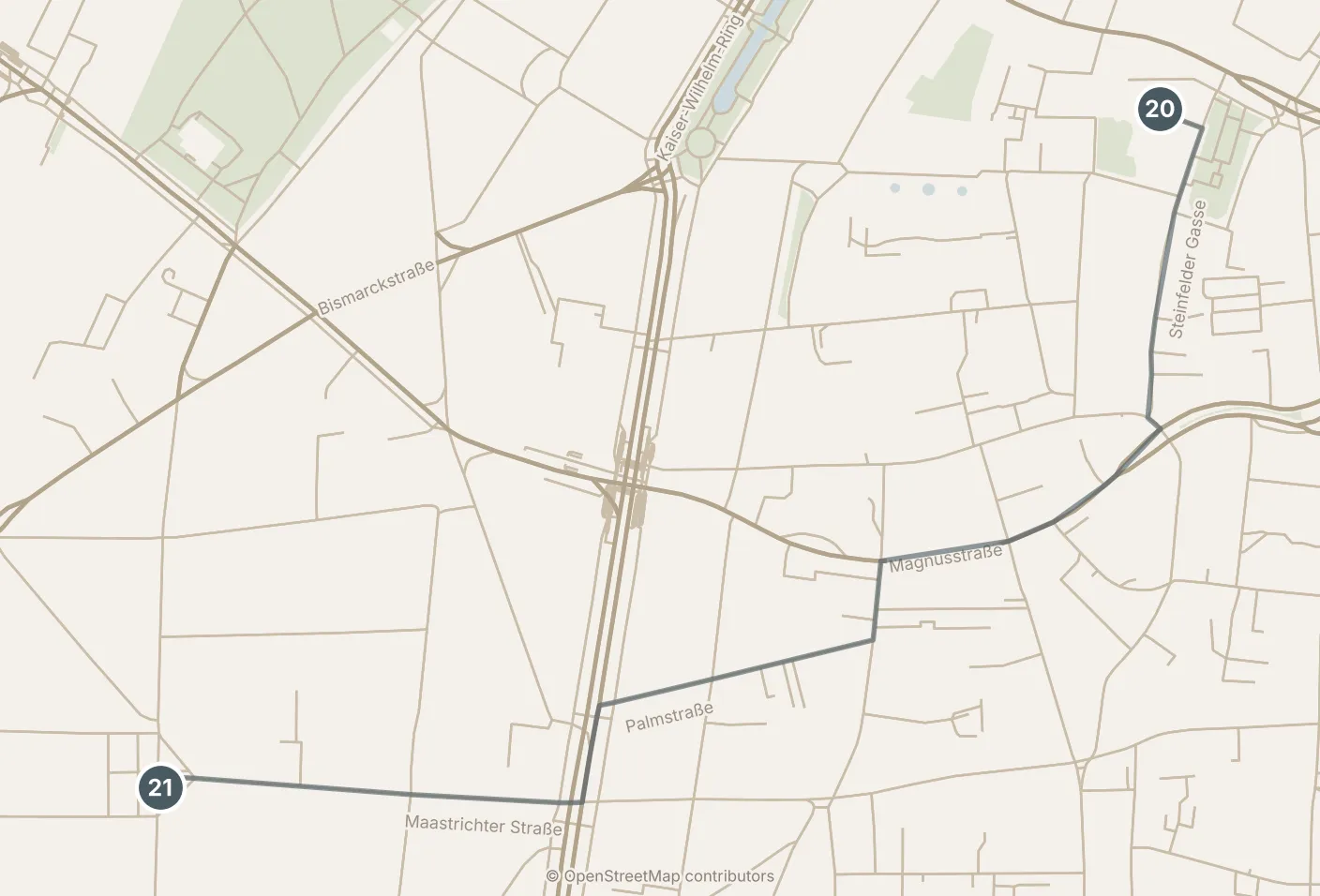
- With a third day · stops 20–21
- 20St. Gereon
- 21Belgian Quarter
Give the third day to Brühl, and give it the morning. It is a short train out, and it is the one day in this article that leaves the city.
From Köln Hauptbahnhof, regional trains towards Bonn stop at Brühl station in about a quarter of an hour; not every train on that line stops there, so read the departure board for Brühl rather than taking the first train south. You need an ordinary regional ticket from the machines or the DB Navigator app; a Deutschlandticket covers it. Brühl station stands directly across the road from the palace gardens, so the leg on the far end is two minutes on foot.
Augustusburg Palace was built in the eighteenth century for Clemens August, elector and archbishop of Cologne, as his favorite residence, and with its hunting lodge it has been a UNESCO World Heritage site since 1984. The reason to come is the staircase by Balthasar Neumann: a ceremonial stair of marble, stucco and painted ceiling designed to stage an arrival, and as theatrical as anything the period built. The interior is seen only on the palace’s guided tour, included in the ticket sold at the palace; give it an hour and a half with the rooms around the staircase. Then give half an hour to the formal baroque garden behind it, which is free.
Falkenlust is the lodge Clemens August built for falconry, at the far end of the park — about half an hour on foot along the long straight avenue through the woods. It is small and intimate after Augustusburg, a few richly decorated rooms seen at your own pace rather than a state apartment, and three quarters of an hour is enough. Walk back the same way to Brühl station, another half hour, and take a train back to the city. The whole outing, trains included, comes to about four and a half hours. Falkenlust is the hour of walking in this day, there and back; if your legs are tired from two days on foot, skip it and take the train back from Augustusburg.
Eat when you are back in Cologne rather than squeezing a meal around the palace tour: a late lunch near the station, or hold out for an early dinner in the Belgian Quarter at the end of the day.
The palaces are closed on Mondays and through December, January and February. If they are shut on your day, stay in the city and give the morning instead to the Romanesque churches west of the station, starting at St. Gereon, which is the stop below and works just as well first.
Back at the station, St. Gereon is about fifteen minutes west on foot. It is the most unusual of the city’s Romanesque churches: its core is a late Roman oval building, enlarged in the thirteenth century into a ten-sided domed hall that is unlike any other church in the country. Give it half an hour; it is a building to stand in the middle of and look up.
From there, walk about a quarter of an hour southwest into the Belgian Quarter, a grid of nineteenth-century streets named after Belgian towns, with independent shops, cafés and bars rather than sights. Nothing here needs a ticket or a plan. It is where the city’s younger residents go out, and after a palace, a park walk and a ten-sided church it is the right flat, slow end to the trip: a last dinner in one of its cafés or restaurants, and a last Kölsch.
Practicalities
Nothing on these days has to be booked weeks ahead. The cathedral (€12), its tower (€8) and the treasury are ticketed online or at the ticket office in the Kurienhaus on Roncalliplatz (daily 9:00 to 17:30); the museums and the Brühl palace sell their tickets at the door.
The days work as written in any order except for the closing days. On Mondays, Museum Ludwig and Groß St. Martin on day one are closed, and so are the Brühl palaces; on Tuesdays, both museums of day two, the Roman-Germanic Museum and Kolumba, are closed. Kolumba also closes from Weiberfastnacht to Ash Wednesday and from 15 August to 18 September. So if day one lands on a Monday, swap it with day two; if day two lands on a Tuesday, swap it with day one, or with the third day if you have one. The third day must also miss the palaces’ winter closure, December to February; if it falls there, take the St. Gereon alternative above. The Chocolate Museum also closes on some Mondays in winter; check its hours.
On the street-carnival days, from Weiberfastnacht, the Thursday before Lent, to Shrove Tuesday, Kolumba is closed and the old town is given over to the carnival; plan around those days, or for them. The season opens on 11 November at 11:11, which also packs the old town.
The first two days are entirely on foot, and the distances above are real: the longest single walk is the half hour back from Chlodwigplatz at the end of day two, which you can replace with the Stadtbahn. The third day needs the train to Brühl and back; everything else in it is walking. For tickets, transport passes and how the city’s buses and trams are paid for, see the city guide.


