Cologne in one day: the cathedral, the old town and the Rhine on foot

Last updated 18 October 2026
Overview
Cologne is an easy city to do in a day for one structural reason: its main station sits at the foot of the cathedral. You step out of the station and the building you came to see is the first thing in front of you, the old town runs south from it down to the river, and the best view of the whole thing is from the opposite bank, a ten-minute walk across a railway bridge. Everything on this route is walked, and the day ends a quarter of an hour from where it started.
What a single day costs you is the museums and most of the city’s twelve great Romanesque churches. Cologne has more good museums than a day can hold, and the temptation is to add one more; the route below takes one, and tells you which one to swap in if it rains. It also gives up the bigger, newer city west of the old walls, which a single day has no room for.
The day is built around its last hour, which is the light on the cathedral from the Deutz bank. The sun sets here from just before half past four in early December to just before ten at the end of June, and the sun goes down behind the old town as you look at it from the far side of the Rhine. Everything before that comes to about six hours, and the cathedral opens to visitors at ten, so from November to January the day does not fit as written: be at the station by ten, walk straight in, and drop the Chocolate Museum and the walk south along the river and back, which gives the afternoon nearly two hours. In summer you have hours of slack, which the evening below says what to do with.
That six hours counts the time inside the places and the walks between them, and nothing else. It does not count the line for the cathedral tower on a busy weekend, which can be the longest wait of the day, and it does not count the nave being closed to sightseeing during a service. If either eats an hour, the afternoon museum is the thing that gives way. On a Sunday the cathedral opens to visitors only in the afternoon, and the practicalities below turn the day around for it.
The day

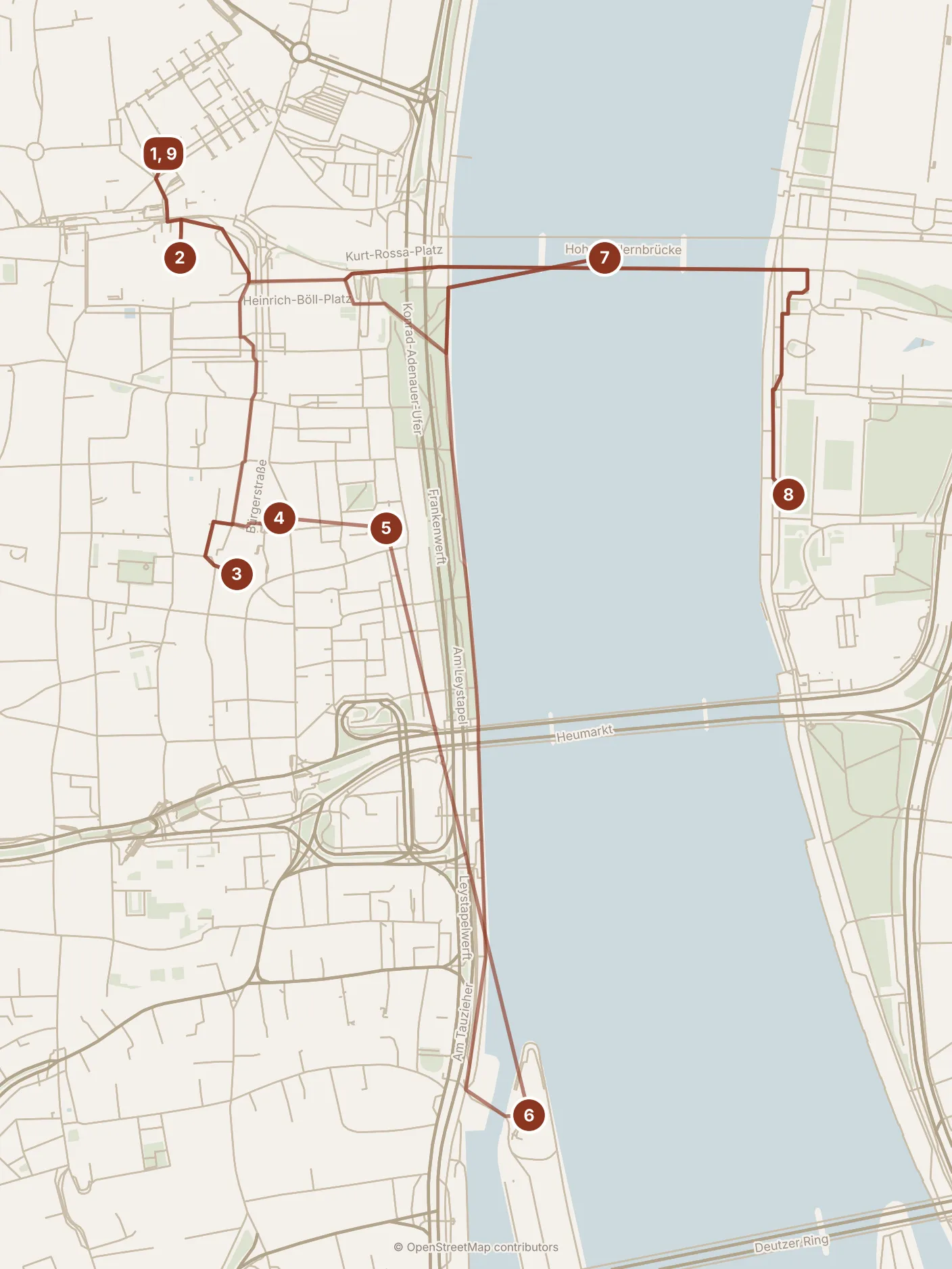
- The day
- 1Köln Hauptbahnhof
- 2Cologne Cathedral
- 3Historic Town Hall
- 4Alter Markt
- 5Great St. Martin
- 6Chocolate Museum
- 7Hohenzollern Bridge
- 8Rheinboulevard
- 9Köln Hauptbahnhof
Morning
You arrive at Köln Hauptbahnhof, and if you are carrying a bag this is where to leave it: the station has left luggage, signposted with the luggage pictogram from the main hall, and the whole of this day comes back within a quarter of an hour of it. Walk out onto the forecourt and the cathedral is the dark wall rising directly ahead, three minutes away up the steps.
Since July 2026 sightseeing in the cathedral needs a ticket: €12 for the interior (children up to 13 free), €8 for the tower, or €12 for the tower and the treasury together. Buy them online in advance or at the ticket office in the Kurienhaus on Roncalliplatz, on the cathedral’s south side (daily 9:00 to 17:30), not at the tower; praying and services stay free. The interior is open to visitors from 10:00 to 17:45, and you go in by the main west portal.
Cologne Cathedral was begun in 1248 and finished in 1880, and the gap between those dates is most of the story: work stopped in the sixteenth century and a medieval wooden crane stood on the unfinished tower for some three hundred years before anyone resumed. Give the interior an hour. Walk the nave to the choir and the gold Shrine of the Three Kings behind the high altar, the reliquary the whole building was raised to house, begun in the workshop of Nicholas of Verdun at the end of the twelfth century. Look for the Gero Cross, a carved crucifix from around 970 and the oldest large one north of the Alps, and for the one window that looks like nothing else in the building: a field of thousands of small colored squares, made by Gerhard Richter and installed in 2007, in a church otherwise lit by medieval and nineteenth-century glass.
Then the tower, which has its own entrance from outside the cathedral and needs the tower ticket you bought with the other: 533 steps up a narrow stone spiral, past the bell chamber, to a platform just under a hundred meters above the square. There is no lift, and this is the stop that would have been impossible with a bag. Give it forty-five minutes up and down, and skip it if stairs are a problem, because the view from Deutz this evening is the better picture of the cathedral, and the tower is the picture of the city.
Local tip. If the line for the tower is long when you come out of the nave, take it anyway and drop the afternoon museum instead. The museum can be replaced by another on a different day; the climb is the one thing on this route you can only do here.
From the cathedral it is six or seven minutes south through the old town to the Historic Town Hall. Its tower is covered in some 130 stone statues of figures from the city’s history, and below the clock there is a carved head that sticks its tongue out on the hour; in front, the Renaissance loggia is the part that survived the war most intact. A few steps on is Alter Markt, the old market square, and from it you can already see the square tower with four corner turrets of Great St. Martin, three minutes toward the river: that church comes after lunch, because on most mornings it is not open.
Afternoon
Lunch goes in the old town, and the right place for it is a Brauhaus, one of the big brewery taverns around Alter Markt and the streets running down to the river. Kölsch is served in a small straight glass called a Stange, and the waiter, the Köbes, keeps replacing an empty one with a full one until you put your beer mat on top of the glass: that is how you say stop, and not saying it is how you end up with a fourth. Order a Halve Hahn, which despite the name is a rye roll with a thick slice of medium-aged Gouda and mustard, not chicken, or Himmel un Ääd, black pudding with mashed potato and apple. Give it an hour and a half and sit down for it.
Then walk the three minutes to Great St. Martin, the Romanesque church whose tower is the other shape on the city’s skyline. It was largely destroyed in the war and rebuilt; give it twenty minutes, mostly for the plain, tall interior. It is closed on Mondays, opens only from 13:00 Tuesday to Thursday and on Sundays, and from 10:00 to 12:30 and again from 13:00 on Fridays and Saturdays, and it shuts to visitors during its prayer times; when it is shut, see it from outside and look up at the tower from the riverbank. Then walk down to the Fischmarkt below it, where the narrow colored houses face the Rhine.
Then south along the riverfront promenade, fourteen minutes with the Rhine on your left, to the Chocolate Museum, which sits at the tip of the Rheinauhafen, the old harbor turned into offices and flats; the three Kranhäuser, towers shaped like upturned harbor cranes, stand just beyond it. The museum is the most popular in the city and it earns that more than it sounds: a glasshouse of cocoa trees, a small working production line, and a fountain of chocolate at the end. Give it an hour and a quarter. If the rooms on the history of the trade are crowded, walk through them; the greenhouse and the production line are the part you will not see anywhere else.
From the museum walk back north along the river, twenty minutes on the same promenade you came down, past the old town and on to the Hohenzollern Bridge, the railway bridge carrying the trains you arrived on. Its walkway is lined with thousands of padlocks left by couples on the fence.
Evening
Cross the bridge to Deutz, and on the far side go down to the Rheinboulevard, the long flight of wide concrete steps descending to the water. The crossing and the steps take under ten minutes, and this is the stop the day was built around: the cathedral, the old town and Great St. Martin in one line across the river, with the sun going down behind them. Be here for the last hour of light, which is what the count in the overview is for, and stay until the lights come on.
In winter that is the end of the day. In summer, when the light outlasts the afternoon by hours, spend the slack before you cross: Museum Ludwig, the modern art museum between the cathedral and the river, stands at the start of the Hohenzollern Bridge and is open until 18:00 every day but Monday. And move the Brauhaus meal here: have something lighter at lunch, and after the light goes, walk back over the bridge into the old town, five minutes from its far end, and eat there instead.
Either way, the walk back to Köln Hauptbahnhof is about a quarter of an hour from the steps, back over the bridge, which lands you beside the cathedral and at the station’s door. If your bag is in the left luggage there, that is where you are going. If you have no bag, check which station your train names: some long-distance trains stop at Köln Messe/Deutz on this bank instead, five minutes on foot from the bridge, and you would not need to cross back at all.
Practicalities
Nothing on this day has to be booked in advance, but the cathedral now charges sightseers: €12 for the interior (children up to 13 free), €8 for the tower, or €12 for the tower and the treasury together, sold online and at the ticket office in the Kurienhaus on Roncalliplatz, beside the cathedral (daily 9:00 to 17:30), not at the tower door. Praying and services stay free. The tower line, not the ticket, is the thing to plan for; the Chocolate Museum is walk-up.
The cathedral is a working church, and while a service is on the nave is closed to sightseeing; dress and behave as you would in any church in use, and keep your voice down inside. On Sundays and church holidays the nave is open to sightseers only from 13:30 to 16:30, and the tower’s bell chamber stays closed until 14:00. So on a Sunday walk the old town and the river in the morning, and do the cathedral and the tower in the afternoon.
Apart from Great St. Martin, closed on Mondays, the Chocolate Museum is the stop that may keep a closing day: it shuts on some Mondays in winter, so check its own published hours before you set out. If it is shut, or if it is raining, walk five minutes north from Great St. Martin to Museum Ludwig instead, the modern art museum between the cathedral and the river, for its Pop Art and its Picasso holdings (it is closed on Mondays). It replaces the museum and the walk south and back, leaves you right at the start of the Hohenzollern Bridge, and gives the afternoon back nearly an hour. If you are simply short of time, the Chocolate Museum is the first thing to cut, and the tower is the second.
The street-carnival days before Lent, from the Thursday to the Tuesday before Ash Wednesday, turn this route into a different day: the old town is packed, the Brauhaus tables are taken, and the walking times above stop being true. Plan around it or plan for it. On 11 November, when the carnival season opens at 11:11, and on Advent weekends, when a Christmas market fills the square beside the cathedral, expect the old town and the Brauhaus tables to be much busier than usual.
The route needs no transport ticket; it is walked from end to end. If you do use the S-Bahn between Köln Messe/Deutz and the main station, it is one stop, and it needs a VRS ticket from the machine (a Deutschlandticket covers it); the parent guide has the rest of the city’s transport.


