Istanbul in a week: seven days across two continents, without crossing twice

Last updated 28 July 2026
Overview
Istanbul is three cities sharing a name, and the water between them is what planning a week here is actually about. The Bosphorus separates the European side from the Asian one; the Golden Horn then cuts the European side again, leaving the old imperial capital alone on its peninsula and the newer, steeper city across the inlet. Nothing is walkable end to end, and the mistake here is not missing something — it is crossing water twice in a day for two things that were never near each other.
So this week is one quarter a day, working outward from the tip of the peninsula. Three days in the old city, where the density is so absurd that the headline monuments are ten minutes apart on foot. Then across the Golden Horn into Galata and the modern city. Then west, into the Byzantine quarters almost nobody gives a day to. Then the water itself: the strait on one day and the Asian shore on the next, because in this city a ferry is not a transfer between sights, it is one of the reasons you came, and the last two days are built to treat it that way rather than to apologize for it.
Three dates fix everything else. Topkapı Palace closes on Tuesdays, which sets day two. The Grand Bazaar closes on Sundays and public holidays, which sets day three. Dolmabahçe Palace closes one day a week, which sets day six — find out which day before you settle anything else. Place those three and the remaining four days can fall in any order you like.
One structural thing will shape more hours than you expect. The mosques in this article are working mosques, not monuments with a mosque past, and they close to visitors around each of the five daily prayers — longest around the main midday prayer on Friday. The times move through the year with the sun, so there is nothing to memorize and no schedule worth writing down; the only rule that helps is never to build an hour around a mosque door. Every day below has something beside the mosque it names, so a closed door costs you the order of an afternoon and nothing else — with one exception, Chora on day five, which is the only stop in the week that is the whole reason for its day, and the only one worth timing between prayers.
Hagia Sophia deserves its own paragraph, because its arrangement confuses people at the door and it is easily understood in advance. It has been a working mosque again since 2020. The ground floor is for worshippers; everyone else goes up to the gallery, which reopened as a ticketed visit in 2024 and which foreign nationals have paid to enter since January of that year. Separately, the main dome has been under restoration since 2024, with scaffolding standing inside and out. Find out what has come down before you go, and read day one as a day that works either way: the gallery is where the surviving Byzantine mosaics are, which is a piece of luck, since it is the part you are admitted to.
What this week leaves out is the Princes’ Islands, and it is worth saying why rather than letting you discover the omission. They are a long ferry each way into the Sea of Marmara, and motor traffic is banned on them, which is exactly their charm and exactly the problem: a day there is a day away from everything the other six are about. If you want them, they replace day seven. They do not fit beside it.
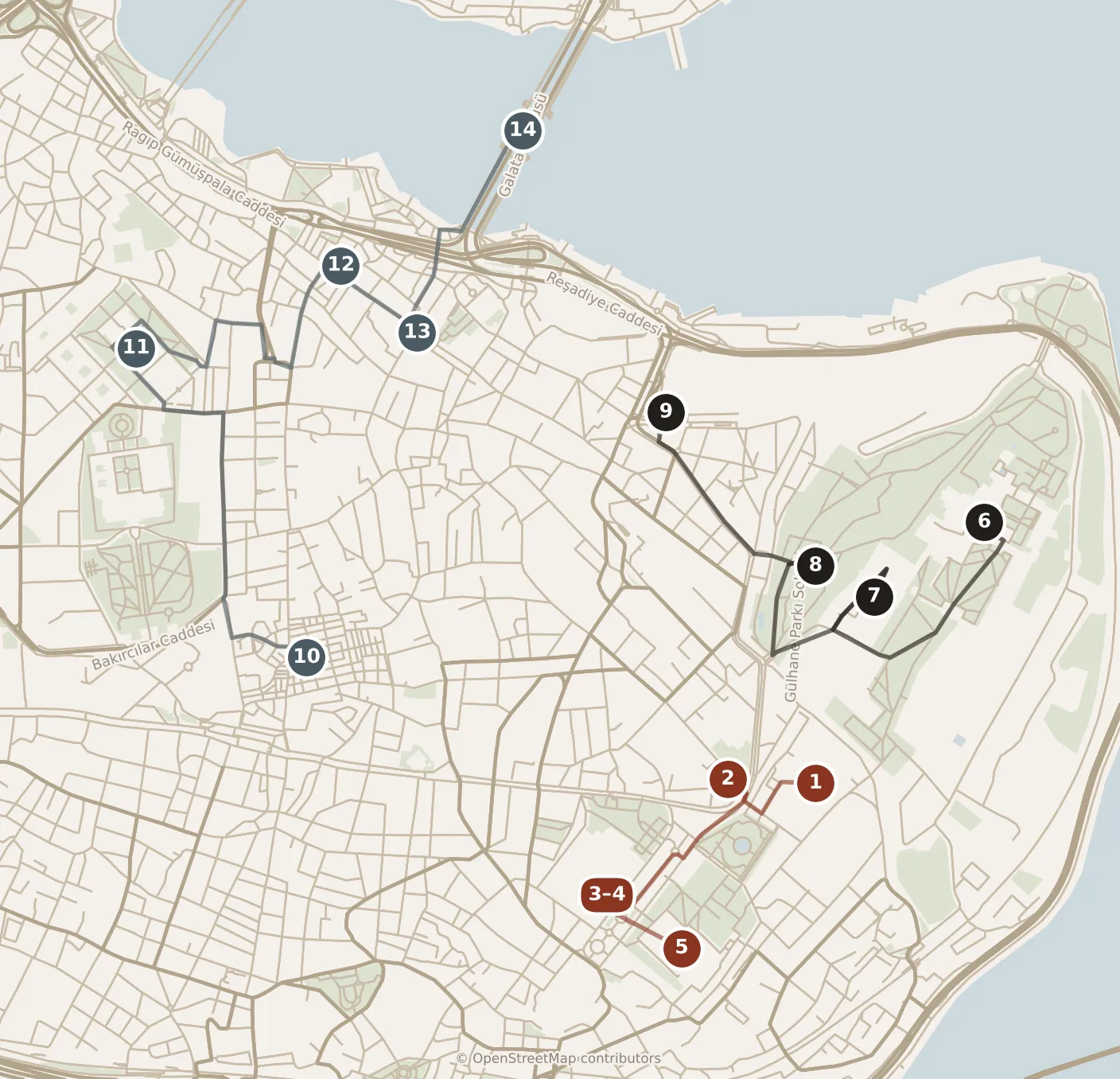
- Day one
- 1Hagia Sophia
- 2Basilica Cistern
- 3Hippodrome
- 4Turkish and Islamic Arts Museum
- 5Blue Mosque
- Day two
- 6Topkapı Palace
- 7Istanbul Archaeology Museums
- 8Gülhane Park
- 9Sirkeci station
- Day three
- 10Grand Bazaar
- 11Süleymaniye Mosque
- 12Rüstem Pasha Mosque
- 13Spice Bazaar
- 14Galata Bridge
Day one

Sultanahmet, and deliberately first. Everything today sits inside a rectangle you could walk across in fifteen minutes, which makes it the one day that forgives a late start, a long lunch and a change of mind.
Begin at Hagia Sophia when it opens. It was built for Justinian in the 530s in under six years, and for a thousand years afterwards there was no interior in the world of its size; what survives of that is the span, which the gallery is the right place from which to feel. Up there are the mosaics — most famously the Deesis, three enormous figures whose lower half has been lost, and whose faces are the finest surviving Byzantine work of their century. Give the gallery an hour, and give it that hour first, before the coaches. Expect the dome to be partly hidden and do not let it spoil the visit; the building is not principally a ceiling.
The Basilica Cistern is a few minutes away and is the correct thing to do second, because it is cold, dark and quiet after a room full of people. It is a sixth-century underground reservoir: 336 columns in twelve rows, most of them robbed from older buildings, standing in shallow water under a brick vault. Two of them rest on carved Medusa heads, one upside down and one on its side, and nobody knows why. It was closed for restoration from 2020 and reopened in 2022 with steel walkways and a lighting scheme that some people find theatrical and some find the making of the place. Give it forty-five minutes.
Come up into the Hippodrome, which is now a long public garden and was a Roman chariot track; the garden keeps the track’s shape, which is the whole pleasure of standing in it. Three things survive on the central line: an Egyptian obelisk cut for Thutmose and re-erected here by Theodosius, still crisp, on a carved base showing the emperor watching the races; the Serpent Column, a bronze trophy brought from Delphi and now sunk below ground level, headless; and the Walled Obelisk, stripped of its bronze plates by crusaders. Fifteen minutes, and it is free.
The Turkish and Islamic Arts Museum stands on the edge of the same square in a sixteenth-century vizier’s palace, and it is the day’s quiet surprise: the carpets are one of the great collections of Ottoman and Seljuk weaving, hung in rooms with the proportions of a house rather than a gallery. An hour.
Finish at the Blue Mosque in the late afternoon. It reopened in 2023 after a restoration that had run for five years, so what you see is newly cleaned: six minarets outside, and inside a cascade of domes over some twenty thousand tiles whose blue gives the building its English name. Visitors have their own entrance, separate from the worshippers’. Twenty minutes inside is enough, and the courtyard is worth as long again.
Local tip. Do the two ticketed stops — the gallery and the cistern — first thing, and leave the Blue Mosque for the afternoon. A mosque you find shut for prayer costs you twenty minutes and a walk round the block; a ticket line at eleven in the morning costs you an hour, and it is the only hour today you cannot get back.
Day two

Topkapı Palace, and this is the day that cannot fall on a Tuesday.
It is not a palace in the sense of a building. It is four walled courtyards of low pavilions, kitchens, barracks and gardens on the headland above the water — an administrative city that ran an empire for four hundred years, and the reason it is confusing is that there is no grand facade to orient you and no single route through. So decide before the gate. The Imperial Treasury is objects behind glass, spectacular and exhausting in that order. The kitchens hold thousands of pieces of Chinese porcelain under ten domes, which is more interesting than it sounds because the porcelain was bought as tableware and not as art. The fourth courtyard is terraces and pavilions looking down the Bosphorus, and it is where to sit. The chamber of the sacred relics is a place of devotion with a reciter working continuously; go in quietly or not at all.
The Harem is a separate ticket, and if you take only one thing beyond the courtyards, take it over the Treasury: a warren of tiled rooms around small courtyards, and the only part of the complex that still reads as somewhere people lived rather than somewhere things are kept. Give the palace three hours in total and accept that you have not seen it.
The Istanbul Archaeology Museums are inside the palace’s own first courtyard, so you are already through the gate. Two things justify the hour. The Alexander Sarcophagus, carved for a king of Sidon and named for the figure on its side rather than its occupant, still carries traces of its original paint, which is what makes it startling rather than merely fine. And the Tiled Kiosk across the garden is a 1470s pavilion, one of the oldest Ottoman buildings in the city and a completely different architecture from everything above it on the hill.
Walk down through Gülhane Park, which was the palace’s outer garden and is now the shaded public one, and out of its lower gate to Sirkeci station. It was built in 1890 as the eastern terminus of the line from Europe, and it is a small, strange, orientalist building put up by a German architect to look like what Europe thought this city looked like. Five minutes and a glance at the platforms. From here the tram runs back along the shore, and the walk on to the water at Eminönü is short if the evening is fine.
Local tip. Buy the Harem ticket at the same moment as the palace ticket, whether or not you have decided to use it. Deciding later means a second line in the middle of the visit, which is the one way to turn three good hours at Topkapı into four tired ones.
Day three

The bazaar quarter, on any day but Sunday.
The day ends on the Galata Bridge at dusk, but what sets the start is the bazaars rather than the light: they, the mosque and the walk between them come to a little over three hours if you do not linger, and this is a day to linger, which puts the start in the middle of the morning. The bazaars close in the early evening, well before the light does, so a late start loses the beginning of the day rather than the end of it.
Start inside the Grand Bazaar in the morning, and start with the right expectation: it is a fifteenth-century covered town of some sixty streets, and it is a building to be walked through rather than a shop to be visited. The streets are still named for the trades that held them, the two oldest halls at the center are stone and domed and were built as strong rooms, and the light comes down from windows under the vaults in a way that no photograph manages. Give it an hour of getting lost on purpose. Buying is optional and being approached is not.
Leave by any gate on the downhill side and walk to the Süleymaniye Mosque, ten minutes away on the crown of the hill. This is the one to see if you see one: Mimar Sinan built it in the 1550s for Suleiman, and its greatness is spatial rather than decorative — a single vast room under a dome carried on four piers, with almost no tilework and an extraordinary evenness of light. The garden behind holds the tombs of Suleiman and of Hurrem, and the architect’s own small tomb sits just outside the complex wall, which is the sort of thing you walk past twice before noticing. The terrace at the edge of the precinct looks straight down over the Golden Horn, and the city you have spent two days inside is suddenly a shape rather than a set of streets. Give the whole complex an hour, and sit down for part of it: this is the one interior in the old city that rewards staying still, and the reason is acoustic as much as visual — it was built to carry a single voice to the back wall, and it still does.
Walk down the hill through the hardware and lighting streets — an ordinary working quarter, and one of the few places where you see the old city at work — to the Rüstem Pasha Mosque. It is small, it is hidden above a row of shops, and you reach it by a staircase that is easy to miss twice. Inside is the best İznik tilework in the city, floor to gallery, at a scale you can stand close to. Twenty minutes, and it is free.
Two hundred meters on is the Spice Bazaar, which bends at a right angle, is seventeenth-century and much shorter than the Grand Bazaar, and where you should take your time is the streets outside it rather than the aisles within: this is where the city buys its cheese, its coffee and its pickles. Come out at Eminönü, where the boats sell balık ekmek at the quay, and finish on the Galata Bridge at dusk, with fishermen’s lines along the whole upper deck and the domes of the day behind you.
Local tip. The two bazaars are not the same errand and doing both properly is a mistake. If you want only one, take the Spice Bazaar: it is twenty minutes rather than an hour, it is on the way to the water, and the streets around it are better than either building.
Day four

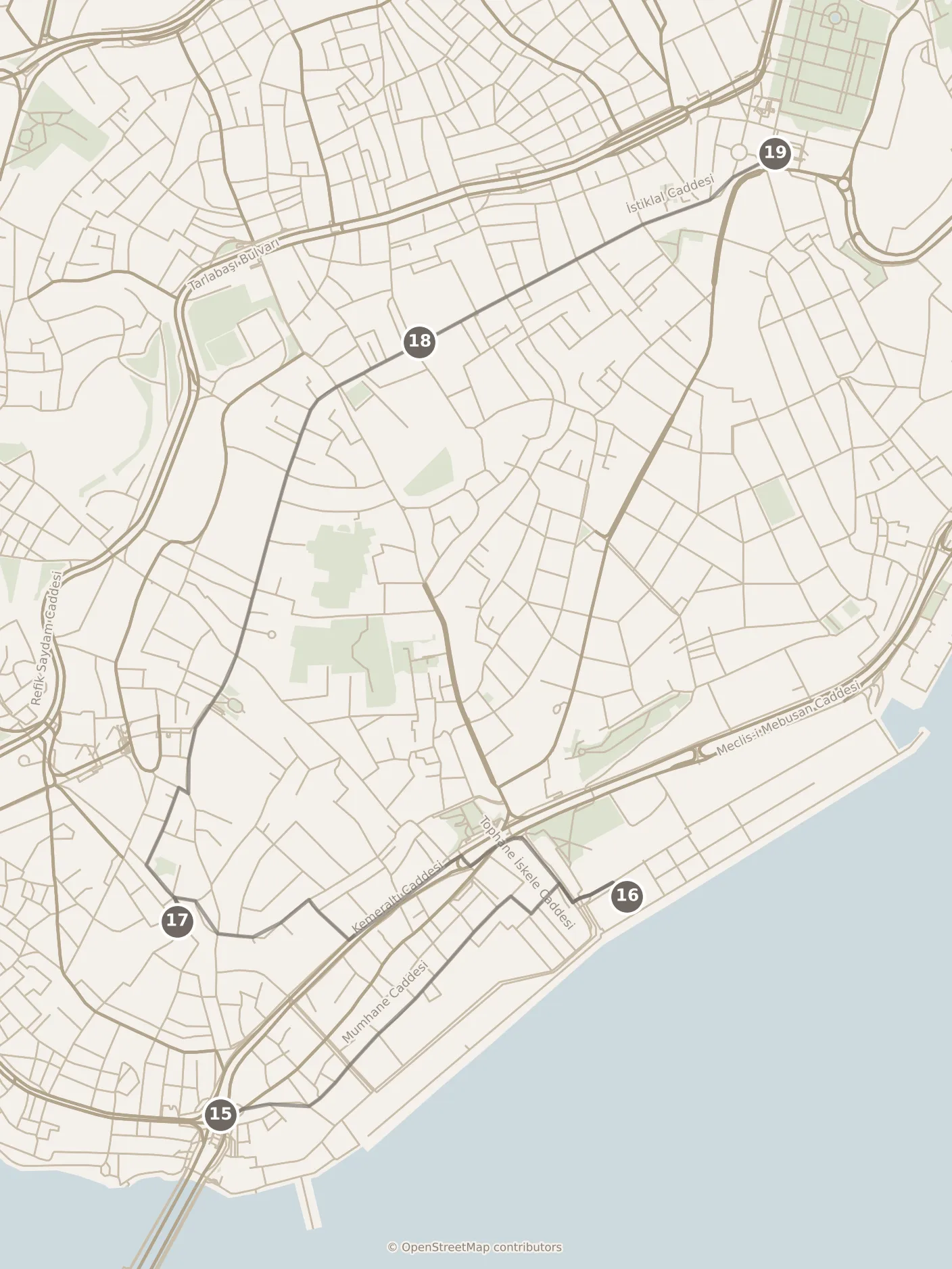
- Day four
- 15Karaköy
- 16İstanbul Modern
- 17Galata Tower
- 18İstiklal Avenue
- 19Taksim Square
Galata and Beyoğlu — the other city, the one that is not Ottoman and imperial but nineteenth-century and European, and the day is uphill from beginning to end.
Cross the Galata Bridge on foot from Eminönü. It takes ten minutes, the old city recedes behind you the whole way, and the lower deck under your feet is a row of restaurants with the worst value and the best position in the city. On the far side is Karaköy: a warehouse quarter that turned into coffee, design and small galleries about fifteen years ago and has kept enough of its hardware shops and ships’ chandlers to still feel like a port.
İstanbul Modern is on the water a few minutes along, in a building by Renzo Piano opened in 2023 — five floors of glass and metal sitting out over the quay, with a roof terrace that gives you the peninsula you spent three days inside, seen whole for the first time. The collection is modern and contemporary Turkish art, which is exactly the thing this week has otherwise no room for. Two hours, terrace included.
Then climb to the Galata Tower, which is the steep part of the day and takes about fifteen minutes on foot. The tower is a Genoese watchtower of 1348 from the days when this side of the water was a separate colonial town, and the view from the balcony is the best single view of the old city there is — the peninsula laid out in profile with the Golden Horn in front of it. It has been run as a museum since 2020 and reopened in 2024 after work on the roof, with entry capped by the hour, so it is a stop to take early rather than at sunset.
From the tower, İstiklal Avenue runs the best part of a mile to Taksim Square: a pedestrian street with an old red tram rattling down the middle of it, arcades and covered passages off both sides, and the nineteenth-century embassies of a city that expected to matter. Walk it slowly and look above the shopfronts, where the buildings are: the street level has been rebuilt into chain frontages, and the architecture is all on the two floors above it. The passages are the other half of it, and more of a reason to be here than the avenue itself — glass-roofed arcades of the 1870s, some restored into food halls, some left as staircases to dentists and tailors, and you can only tell which by going in. Give the walk an hour with the detours. The side streets below the avenue are where the meze-and-rakı taverns are, which is where this evening should end. Taksim Square at the top is a transport interchange with a monument in it, and five minutes there is generous.
Local tip. The Tünel funicular runs from beside the bridge up to the top of the hill and has done since 1875. Save it for the way down rather than the way up: you will want the climb behind you at six in the evening less than you want it at eleven in the morning, and the walk down at the end of a long night is the easy direction.
Day five

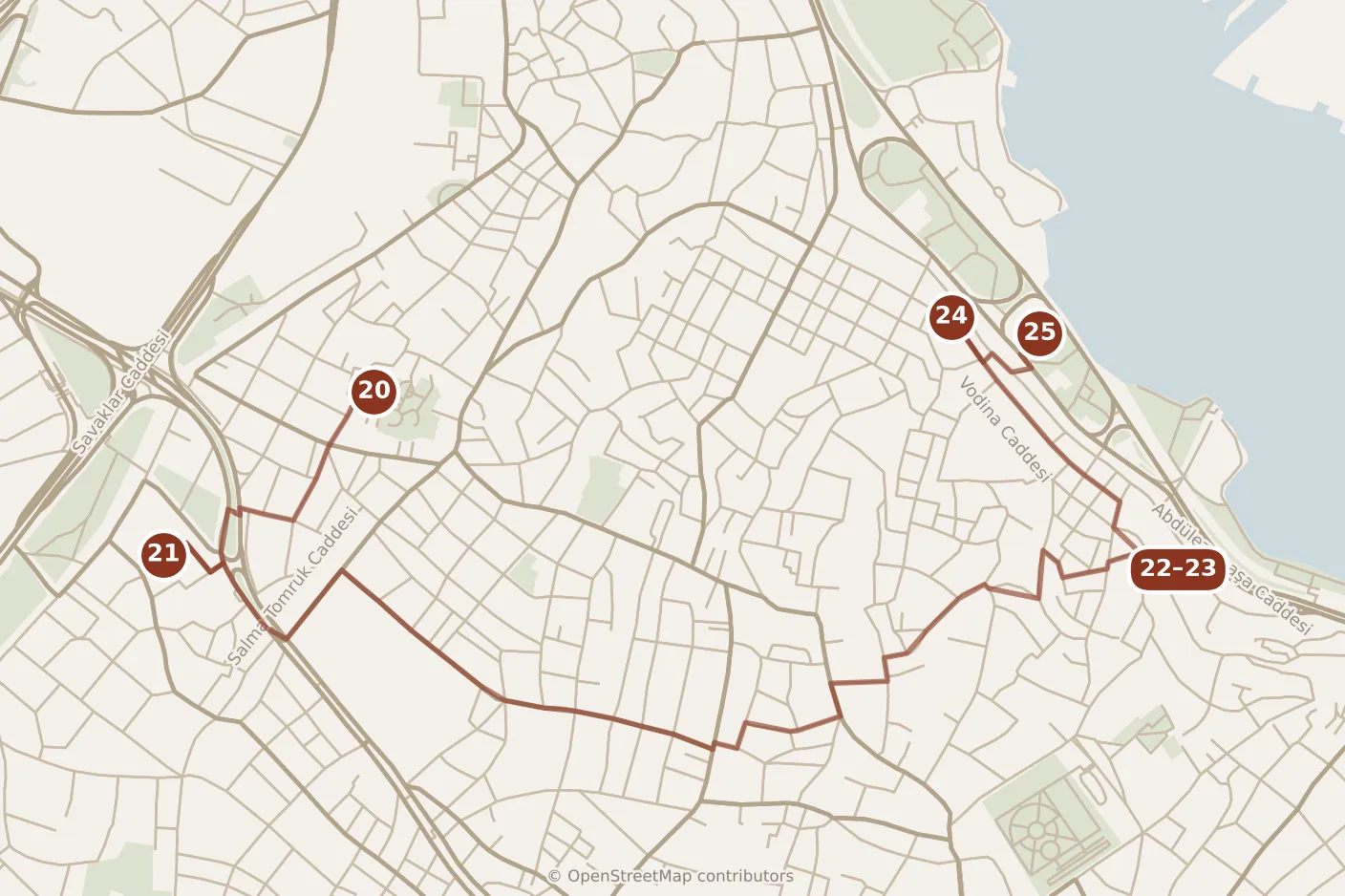
- Day five
- 20Chora
- 21Mihrimah Sultan Mosque
- Theodosian walls — in the prose, not on the map
- 22Fener
- 23Church of St George
- 24Balat
- 25Bulgarian St Stephen Church
The Byzantine west, and this is the one day that needs a ride to begin: take a taxi or a bus up to Edirnekapı, on the ridge at the edge of the old city, and the rest of the day runs downhill on foot to the water.
Chora is why you came up here. Behind a plain exterior are the finest late Byzantine mosaics and frescoes anywhere: a mosaic cycle of the life of the Virgin across the entrance halls, done in the 1310s with a naturalism that has no business being six hundred years early, and in the side chapel a fresco of the Anastasis — the Resurrection — in which Christ hauls Adam and Eve bodily out of their tombs, which is the single most reproduced image in Byzantine art. It became a mosque again in 2020 and reopened for worship in 2024, so how much is uncovered on the day you come depends on the hour, and some of it hangs behind curtains in the prayer area. Go between prayers, take what you are shown as the point of the day rather than a checklist, and give it an hour.
Five minutes away is the Mihrimah Sultan Mosque, another Sinan, and worth the detour for one reason: it is the lightest interior he built. A single dome on four arches, and the walls between them filled almost entirely with windows, so that on a clear morning the room is white. Ten minutes.
The Theodosian walls run past the end of the street. They were built in the 410s, they held this city for a thousand years, and at this gate they still stand well above your head in banded courses of brick and limestone, with a dry moat and vegetable plots at their foot. This is traditionally the gate the conquering army came through in 1453. Walk a stretch of them by all means; do not try to walk their length, which runs for several miles across the whole peninsula and is largely unlit.
Then down the hill for twenty-five minutes into Fener, which with Balat beside it is the old Greek and Jewish quarter of the city — steep lanes of tall wooden and stuccoed houses running down to the Golden Horn. In Fener the Church of St George is the seat of the Ecumenical Patriarchate, still the senior see of the Orthodox church, and its ordinariness is the point: a modest building behind a wall, rebuilt more than once, with a gilded interior and no sign at all that some two hundred million people look to it. Twenty minutes and a donation.
Balat is the next few streets and is the one part of today that has been thoroughly discovered — the painted house fronts and the steep stepped lanes are photographed constantly and there are cafés on every corner now. It is still worth an hour of wandering, and the antique shops and the surviving synagogue frontages are more interesting than the famous staircase. Finish on the shore at the Bulgarian St Stephen Church, which is cast iron: prefabricated in Vienna in the 1890s, shipped down the Danube and across the Black Sea in pieces and bolted together here. It was restored and reopened in 2018 and it is painted to look like stone, which stops fooling you the moment you touch it.
Local tip. Do this day downhill and only downhill. Every stop above sits higher than the one after it, and taking the ridge downward is the difference between a long pleasant walk and a day of climbing between churches in the sun.
Day six

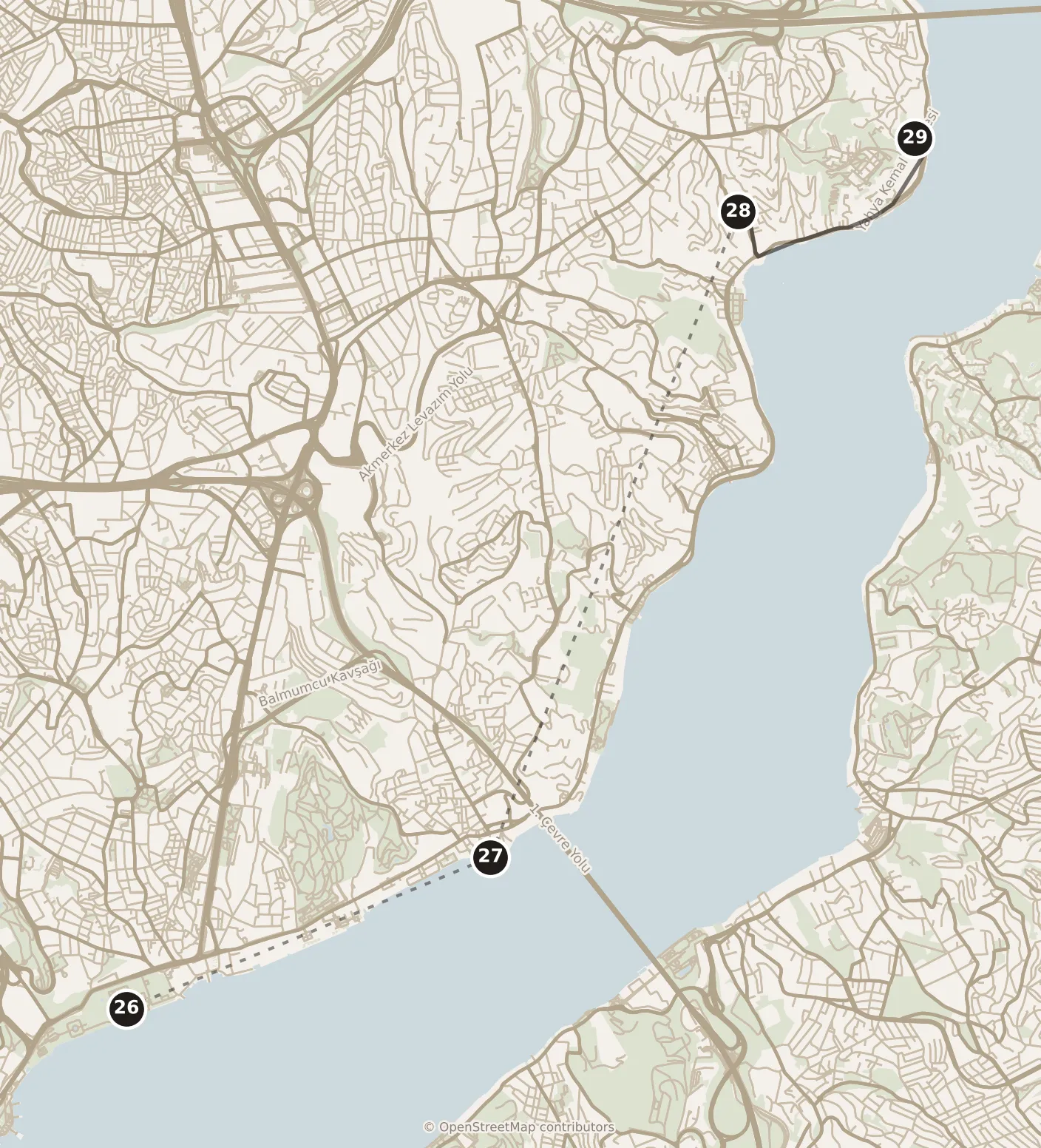
- Day six
- 26Dolmabahçe Palace
- 27Ortaköy Mosque
- 28Bebek
- 29Rumeli Hisarı
The Bosphorus shore, going north, and today the city gradually stops being a city.
Start at Dolmabahçe Palace on the water. It was finished in 1856, and the sultans left Topkapı for it, which tells you everything about what the empire wanted to look like by then: not courtyards and pavilions but a single European facade six hundred meters long, and inside a ceremonial hall under a dome hung with a chandelier of some four and a half tonnes. Among the rooms is the one where Atatürk died in 1938; every clock in the palace stands at five past nine, stopped at the hour of it. The interior is seen on a fixed route rather than wandered. It closes weekly, and that is the one date in this week worth checking before you fix anything: put this day where the palace allows, and nothing else in the week will argue.
Then go north up the shore. Ortaköy is a short bus ride, and the little mosque there is the most photographed juxtaposition in the city for a reason — an 1850s baroque mosque standing at the water’s edge directly beneath the first of the strait’s great suspension bridges, three hundred years and a full change of scale in a single frame. The square behind it is a food square and a good place to eat outdoors. Half an hour.
Carry on to Bebek, another twenty minutes up the shore. There is nothing to see here, which is why it is in the itinerary: it is a bay of moored boats with a promenade round it and a park at one end, and it is where the city comes to sit on a Sunday. Walk the shore road from here rather than riding it.
Twenty minutes on foot brings you to Rumeli Hisarı, and it is worth the walk. Mehmed threw this fortress up in 1452, in a matter of months, at the narrowest point of the strait, with an older fortress facing it from the Asian bank — the two of them together could close the Bosphorus, which is precisely what they did the year before the siege. It has been a museum since 1960; you climb the walls and the towers, and the strait below is barely seven hundred meters across. An hour, then a bus or a ferry back down the shore.
Local tip. There is a second, entirely different version of this day: the long public ferry that runs from Eminönü to the top of the strait and back, which takes most of a day and turns the whole thing into one continuous view from a deck. It is a genuinely good day out. Choose one or the other — the palace and the fortress cannot be added to it, and trying is how people end up seeing the Bosphorus through a bus window.
Day seven

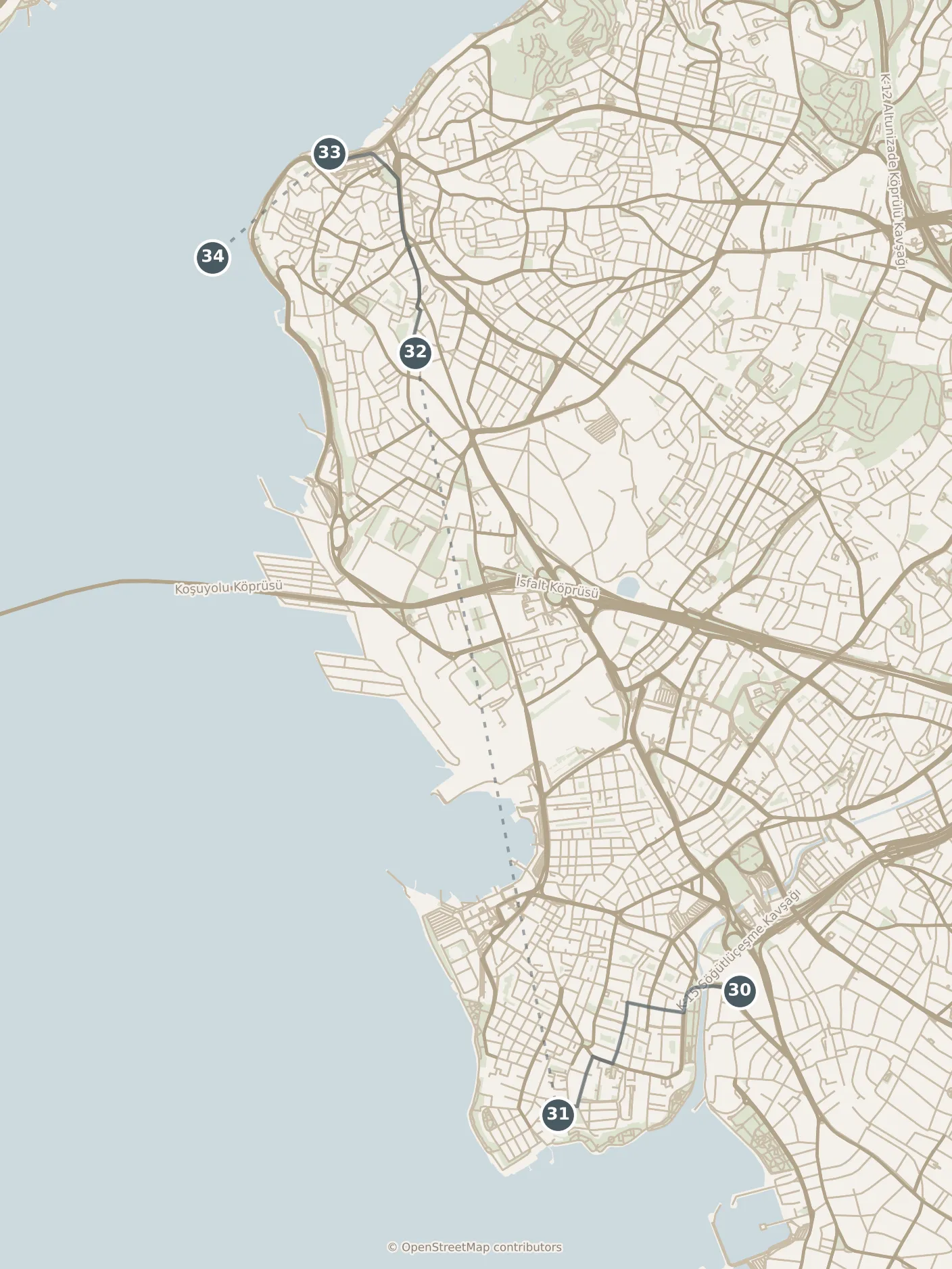
- Day seven
- 30Kadıköy
- 31Moda
- 32Üsküdar
- 33Şemsi Pasha Mosque
- 34Maiden's Tower
The Asian side, and the crossing is the first pleasure of the day rather than the price of it.
Take a ferry from Eminönü or Karaköy to Kadıköy: about twenty minutes, and the right place to be is outside at the back, where the old city and then Galata and then the mouth of the strait open out one after another. It is an ordinary commuter crossing at an ordinary commuter fare, and it is the best value in the city.
Kadıköy on the far side is where several hundred thousand people live and shop and eat, and almost nothing in it exists for visitors. The market streets behind the pier are the whole morning: fish on ice, barrels of pickles, cheese counters, coffee roasted in the doorway, and small places where you stand up to eat. A late breakfast here, or lahmacun, is better than anything you will be sold in Sultanahmet, and half of the pleasure is that nobody is selling you anything at all.
Walk out to Moda, twenty-five minutes along the shore or through the back streets. It is a low, leafy residential quarter on a headland with a long grass promenade round its edge, the Sea of Marmara in front, the islands on the horizon and an ancient tram making a slow loop through it. There is nothing to do, and doing nothing here for an hour on a bench with the water in front of you is the correct use of the last afternoon of a week.
Come back to the pier and take the ferry up to Üsküdar, twenty minutes along the Asian bank. Üsküdar is older, plainer and more religious than Kadıköy, and it is a good corrective: mosques rather than bars, and a waterfront that is a working one. Walk along it to the Şemsi Pasha Mosque, which is Sinan again and almost the smallest thing he built — a tiny mosque, tomb and school around a courtyard that opens directly onto the water, with the whole of the old city across the strait behind it. Ten minutes, and it is one of the loveliest ten minutes of the week.
Maiden’s Tower stands on its own rock just off the Üsküdar shore, ten minutes further along the promenade. It was closed for restoration and reopened in 2023, and a small boat runs out to it; inside there is a café and a view. If you have to choose — and at the end of a week you probably do — stay on the promenade instead and watch the light go behind the peninsula from the shore. The tower is better as the thing in the picture than as the place you are standing. Then take a ferry back across in the dark, which is the correct way to end a week in this city.
Local tip. Do not plan the evening. A week is long enough that by now there is somewhere you already want to go a second time, and the last night is better spent on that than on a new quarter at the far end of a bus route — it is also the one plan that survives arriving back tired.
Practicalities
Get the single rechargeable card the city guide names before day one. It is not an optional convenience here: it works the trams, the funiculars, the metro and — the reason it matters for this week — the ferries, which day seven crosses on and which several other days use as the pleasant way round. One card, every mode. The city guide says which and where to buy it.
Three dates decide this week. Topkapı closes on Tuesdays, so day two cannot fall on one. The Grand Bazaar closes on Sundays and on public holidays, which rules out day three. And Dolmabahçe on day six closes weekly, so check which day before you settle the other six. Fix those three and the rest can be shuffled freely.
Nothing here has to be booked before you travel. The lines that cost real time are Hagia Sophia’s and Topkapı’s, both worst in the middle of the morning, which is why both of those days start early; buying those two tickets online the night before saves the ticket line but not the security one.
If a Friday falls inside your week, put day two or day four on it. Those are the two days with no mosque in them at all, and the midday prayer on Friday is the one that closes mosque doors to visitors for longest. During Ramadan the evenings around the mosques of days one and three become the best hours of the day rather than the quietest — worth knowing either way.
Days one, two and three are joined end to end by the tram along the peninsula, so you can break any of them and pick them up later. On the last two days the connective tissue is the ferry, and it is worth remembering that ferries stop earlier than the rail tunnel under the strait does — so an evening that runs long on day seven comes back by Marmaray rather than by boat. The one leg in the week with no convenient public link is the start of day five, up to Edirnekapı: take a taxi, or a bus from Eminönü, and treat the fare as the price of a day that otherwise involves no transport at all.
Two stretches catch people out on foot. Day three climbs the third hill and comes down the other side of it, and day five comes down the whole height of the ridge from Edirnekapı to the Golden Horn; both are longer than the map suggests because the lanes zigzag. Neither is hard in April or October and both are punishing in August, when the old city has almost no shade.


.jpeg)


.jpg)