Istanbul in one day: the old city on foot, ending across the Golden Horn

Last updated 3 August 2026
Overview
Istanbul does not have one day in it, and the way to waste the one you have is to pretend otherwise. This is a city cut into three by water — the Bosphorus separating Europe from Asia, the Golden Horn then splitting the European side again — and a day spent crossing that water twice is a day spent mostly on boats and in traffic. So this route crosses once, on foot, at dusk, and the crossing is what the day is built towards rather than a transfer in the middle.
Everything before it happens inside about a kilometer and a half of the old peninsula, which is the piece of luck that makes a single day here work at all. The headline monuments stand within sight of each other; the bazaar quarter is twenty minutes west of them; the water is downhill from the bazaars. You walk out of Sultanahmet, through the markets, down to the Golden Horn, and over it into the other city — one line, no doubling back, about an hour and a half on foot in total.
What one day costs you is Topkapı Palace, and it is worth naming the loss rather than letting you find it. Topkapı is not a stop, it is four walled courtyards and an afternoon, and putting it in would take the bazaars, Süleymaniye and the crossing out. It also costs you the water as a thing in itself: the long Bosphorus ferry, the Asian side, the islands. Those are what a second and third day in this city are for, and a day that tries to sample them ends up having done neither the monuments nor the strait.
The day is built around the walk across the Galata Bridge in the last of the light, with the domes of everything you have just seen behind you and the fishermen’s lines along the whole upper deck. That is the hinge, so work backwards from it. The sun goes down here as early as about twenty to six in the first days of December and as late as about twenty to nine at the end of June, so take your month’s hour and count back. Everything above the bridge — Hagia Sophia and the Hippodrome, the Blue Mosque, both bazaars, Süleymaniye and Rüstem Pasha, an hour for lunch and the walking between them — comes to roughly seven hours. In December that means starting when Hagia Sophia opens and not lingering. In June it means you can start at noon and still have slack.
Those seven hours are the time you spend inside the places and walking between them, and they are not the whole picture: they do not include the line at Hagia Sophia, which is the one line on this route that can take an hour by itself. That is why the day begins there, and why its ticket is the single thing worth buying before you travel.
You are carrying a bag, and the shape that matters is that this day does not come back. It begins at Sultanahmet on the T1 tram and finishes at Taksim Square on the M2, three and a half kilometers and a water crossing apart, so anything left at the near end has to be fetched back across the Golden Horn. Leave it wherever you can reach at the end of the evening rather than at the beginning — if you are flying in and out on the same day, that means the airport, which both ends of this route reach on rails. Do not carry it up out of Karaköy in the evening: that hill is steep enough that they dug a funicular under it in 1875.
The day

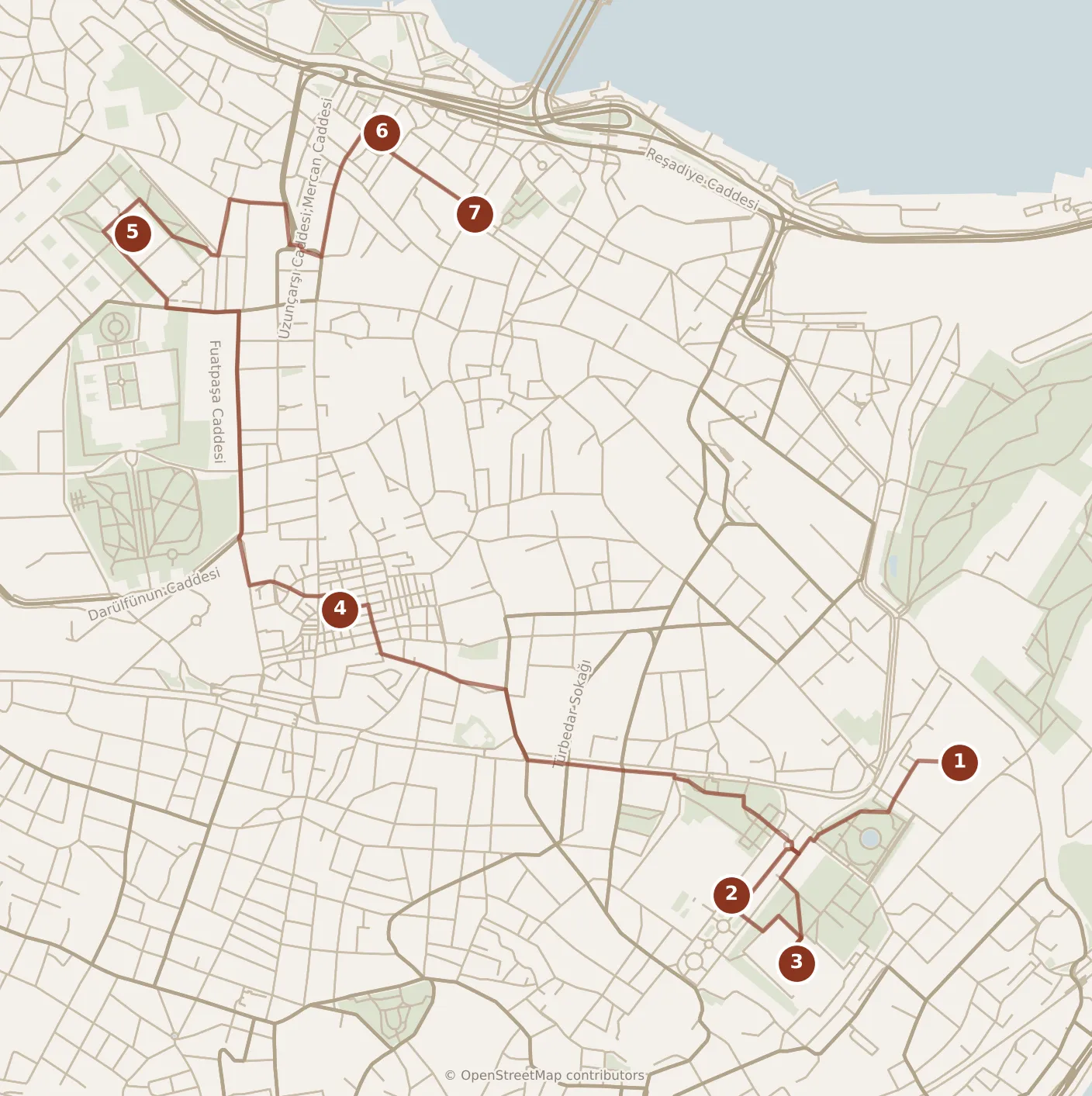
- Morning and afternoon
- 1Hagia Sophia
- 2Hippodrome
- 3Blue Mosque
- 4Grand Bazaar
- 5Süleymaniye Mosque
- 6Rüstem Pasha Mosque
- 7Spice Bazaar
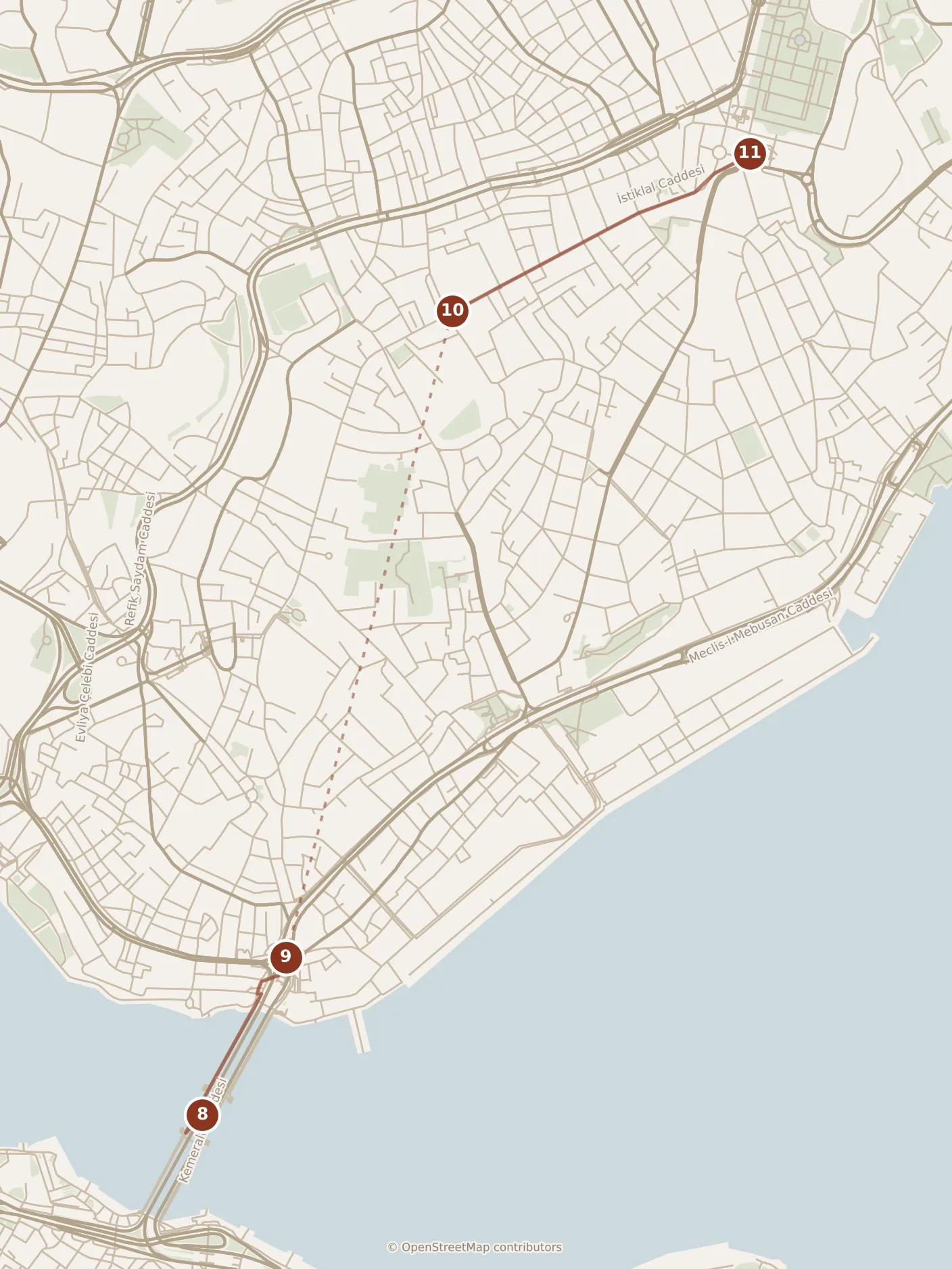
- Evening
- 8Galata Bridge
- 9Karaköy
- 10İstiklal Avenue
- 11Taksim Square
Morning
Be at Hagia Sophia when it opens, and understand the arrangement before you arrive, because it confuses people at the door. It was built for Justinian in the 530s in under six years, and for a thousand years afterwards there was no interior anywhere of its size. It has been a working mosque again since 2020: the ground floor is for worshippers, and everyone else goes up to the gallery, which became a ticketed visit in 2024. That is a piece of luck rather than a consolation, because the gallery is where the surviving Byzantine mosaics are and it is also the right height from which to feel the span of the dome. The dome itself has been under restoration since 2024, with scaffolding inside and out; find out what has come down before you go, and read this morning as one that works either way, since the building is not principally a ceiling. Give the gallery an hour.
Under ten minutes west, across the gardens, is the Hippodrome — now a long public garden, once a Roman chariot track, and the pleasure of standing in it is that the garden still keeps the track’s shape. Three things survive on the central line: an Egyptian obelisk cut for Thutmose and re-erected here by Theodosius, still crisp, on a base carved with the emperor watching the races; the Serpent Column, a bronze trophy brought from Delphi, now headless and sunk below ground level; and the Walled Obelisk, stripped of its bronze plates by crusaders. Fifteen minutes, and it is free.
Three minutes on stands the Blue Mosque, which reopened in 2023 after a restoration that had run five years, so what you see is newly cleaned. Six minarets outside; inside, a cascade of domes over some twenty thousand tiles whose blue gives the building its English name. Visitors have their own entrance, separate from the worshippers’. Twenty minutes inside is enough and the courtyard is worth as long again.
The Basilica Cistern is three minutes from where you started this morning, and this day deliberately does not go into it. It is ticketed, it has a line, and three quarters of an hour underground is most of the hour that buys you Süleymaniye this afternoon. It is the first thing to add if the one day turns into two.
Afternoon
Leave Sultanahmet westwards along Divanyolu, the old Roman road out of the city, twenty minutes gently uphill to the Grand Bazaar — or two stops on the T1 tram, Sultanahmet to Beyazıt-Kapalıçarşı, if the morning has already cost you the legs.
Start inside the bazaar with the right expectation: it is a fifteenth-century covered town of some sixty streets, a building to be walked through rather than a shop to be visited. The streets are still named for the trades that held them, the two oldest halls at the center are stone and domed and were built as strong rooms, and the light comes down from windows under the vaults in a way no photograph manages. Give it an hour of getting lost on purpose. Buying is optional; being approached is not.
Eat before you leave the quarter, and eat sitting down. The lanes on the downhill side, between the bazaar and the mosque above it, are where the district’s own traders and porters have lunch, and a tray lunch at a table there costs a fraction of anything on the main drags of Sultanahmet and is better. Give it an hour: with one day the temptation is to buy something to carry and keep walking, and in this city that is the wrong economy.
A quarter of an hour north-west, on the crown of the hill, is the Süleymaniye Mosque, and this is the one to see if you see one. Mimar Sinan built it in the 1550s for Suleiman, and its greatness is spatial rather than decorative: a single vast room under a dome carried on four piers, almost no tilework, and an extraordinary evenness of light. Sit down for part of the hour, because the reason is acoustic as much as visual — it was built to carry one voice to the back wall and it still does. The garden behind holds the tombs of Suleiman and his wife, and the architect’s own small tomb sits just outside the precinct wall, which is the sort of thing you walk past twice before noticing. The terrace at the edge of the precinct looks straight down over the Golden Horn, and the city you have spent the day inside becomes a shape rather than a set of streets. That view is free and it matters again this evening.
Under ten minutes downhill, through the hardware and lighting streets — an ordinary working quarter, and one of the few places on this route where you see the old city at work — is the Rüstem Pasha Mosque. It is small, it is hidden above a row of shops, and you reach it by a staircase that is easy to miss twice. Inside is the best İznik tilework in the city, floor to gallery, at a scale you can stand close to. Twenty minutes, and it is free.
Two hundred meters on is the Spice Bazaar: seventeenth-century, bent at a right angle, and much shorter than the Grand Bazaar. Where to spend the time is the streets outside it rather than the aisles within, because that is where the city buys its cheese, its coffee and its pickles. Half an hour, and then you are at the water.
Evening
You come out at Eminönü, where the boats moored at the quay sell balık ekmek and where the Galata Bridge starts. Cross it on foot. It takes ten minutes, there are fishermen’s lines along the whole upper deck, the lower deck is a row of restaurants with the worst value and the best position in the city, and the old city recedes behind you the entire way. This is the stretch the day was built around and the one to give the last of the light to.
On the far side is Karaköy, a warehouse quarter that turned into coffee, design and small galleries about fifteen years ago and has kept enough of its ships’ chandlers and hardware shops to still read as a port. Above it stands the Galata Tower, a Genoese watchtower of 1348 from the years when this side of the water was a separate colonial town; it has been run as a museum since 2020, with entry capped by the hour.
Local tip. Do not go up the tower. What you would be buying is the peninsula seen in profile — the same city you walked out of this afternoon, and you have already looked down on it for nothing from the terrace at Süleymaniye. With capped entry the line is most of what the last hour of your day would cost.
Take the F2 funicular instead: one stop, Karaköy to Beyoğlu, ninety seconds under the hill, and it has run since 1875. If it is not running, walk up past the tower — fifteen minutes and the steepest climb of the day, which is the reason the funicular is there.
You surface at the bottom of İstiklal Avenue, which runs a little under a mile to Taksim Square: about twenty minutes if you do not stop, and you should stop. An old red tram rattles down the middle of it, and the thing to do is look above the shopfronts, because the street level has been rebuilt into chain frontages and the nineteenth-century city is on the two floors above it. The glass-roofed arcades of the 1870s off both sides are the point rather than the avenue itself — some restored into food halls, some left as staircases to dentists and tailors, and you can only tell which by going in. The side streets below the avenue are where the meze-and-rakı taverns are, and that is where dinner goes.
Taksim Square at the top is a transport interchange with a monument in it, and five minutes there is generous. It is also the M2 station, which is why the day ends here rather than somewhere prettier: three stops to Gayrettepe, then the M11 straight out to İstanbul Airport.
Practicalities
One thing on this route is worth booking before you travel, and it is the Hagia Sophia gallery ticket. Since 2024 foreign visitors have paid for it, and it is priced in euros rather than in lira: reckon on the twenty-to-thirty-euro range in 2026. Booking a slot online before you travel saves the ticket line, which is the one that can eat the hour; there is still a security check at the door. Nothing else here has to be bought in advance — the mosques, the Hippodrome and both bazaars are walked into.
The one practical thing this route needs from the city guide is the single rechargeable travel card it names. This day rides three times — in from wherever you land, up the funicular from Karaköy, and out again from Taksim Square — and the card covers all three, so buy it at the first station you pass through rather than at a barrier with a line behind you.
The Grand Bazaar is shut on Sundays, and shut again for several days around each of the two big religious holidays, and it does not shut alone: much of the hardware and lighting quarter below Süleymaniye closes with it, so a Sunday takes that stretch of the afternoon too. The Spice Bazaar stays open. If your day falls on a Sunday, give the bazaar’s hour to Süleymaniye and walk on down to the streets outside the Spice Bazaar, which are the better half of it and are streets; the tray-lunch lanes below the bazaar shut with the quarter, so a Sunday lunch is Sultanahmet’s main drags at their prices, and nothing on this route replaces them. Around the religious holidays check both bazaars before you count on them. The mosques on this route are working mosques rather than monuments with a mosque past, and they close to visitors around each of the five daily prayers — longest around the midday prayer on Friday. The times move through the year with the sun, so there is nothing to memorize; the rule that helps is never to build an hour around a mosque door, and every stop above has something beside it. In Ramadan the evenings around these mosques become the best hours of the day rather than the quietest, which is worth knowing either way.
Getting to the start: from İstanbul Airport it is the M11 to Gayrettepe, the M2 across to Yenikapı and the Marmaray one stop to Sirkeci, which leaves you a quarter of an hour uphill from Hagia Sophia or two stops on the T1, Sirkeci to Sultanahmet. Allow well over an hour, and allow extra at Gayrettepe, where the change between the two metro lines is a long walk underground. The shuttle buses the city guide names run to Sultanahmet directly and are the simpler option with a bag. From Sabiha Gökçen it is the M4 to Ayrılık Çeşmesi and the Marmaray under the strait to Sirkeci. Leaving at the end, reverse the first of those from Taksim Square, or take the M2 to Yenikapı, the Marmaray to Ayrılık Çeşmesi and the M4 back out to Sabiha Gökçen.
Two stretches on foot catch people out. The twenty minutes west out of Sultanahmet to the Grand Bazaar is uphill, and so is the quarter of an hour on up to Süleymaniye; everything from Süleymaniye down to the water is the other way. And the peninsula has almost no shade, which is what makes this day hard in August and pleasant in April or October.


