Istanbul in two or three days: the palace, the bazaar hill and the water

Last updated 8 August 2026
Overview
Two days is the length at which this city stops making you choose between the palace and everything else. Topkapı is not a building you look at; it is four walled courtyards and the better part of a morning, and one day that contains it contains almost nothing else on the peninsula. Two days will hold the palace, the great church that became a mosque, both bazaars, the finest interior in the old city, and the walk over the Golden Horn into the other one. A third day buys the thing the first two only look at, which is the water.
The arrangement is one quarter a day, and the reason is that the geography here punishes doubling back harder than almost anywhere does. The Bosphorus puts Europe on one bank and Asia on the other; the Golden Horn then splits the European bank a second time, so a crossing you make twice is an hour simply gone. Day one keeps to one square kilometer of the peninsula, which you could cross on foot in a quarter of an hour, is almost entirely indoors, and only walks out of that square at the end to reach the water. Day two runs uphill from the water through the bazaar quarter to the mosque on the crown of the hill, then comes back down and crosses the Horn on foot into Beyoğlu. Between them there is exactly one water crossing, and it comes at the end of the second day rather than in the middle of either.
Two days of the week fix the order before you read a word of what is in them. Topkapı is shut on Tuesdays, so day one cannot be one. The Grand Bazaar is shut on Sundays, so day two cannot be one. The two days are independent of each other — both begin on the peninsula, and neither teaches you anything the other needs — so if the dates fall badly, take them in the other order. With two consecutive days that always works, because the two prohibitions cannot both bite at once: Tuesday and Sunday are never neighbors.
The sums, so you can decide when to start — with one number missing, which is the gate’s own opening hour. I could not confirm it well enough to print it, so check it the week before you travel and count everything below forward from it. Day one comes to about eight hours from the palace gate to the door of the Blue Mosque: three hours at the palace, one at the museums beside it, an hour for lunch and half an hour of walking to reach it and get back, and two and a half for the four things around the square below. The evening at the water is another hour on top of that. What the eight hours do not contain is the two ticket lines, which are the real variable of the day — the line at Hagia Sophia can take an hour by itself, and Topkapı’s courtyards take nearly as long to cross as its rooms take to see. Day two comes to a little under seven hours from the quay to the top of İstiklal, dinner not included, and has no line worth the name.
Two things on day one both want to be first and cannot both have it: the palace shuts in the afternoon, and Hagia Sophia’s line is at its worst in the middle of the morning. This route gives the morning to the palace, because a line costs you an hour while a closed gate costs you the palace outright — and the way to buy back most of that hour is the one thing here worth arranging from home.
That thing is the Hagia Sophia gallery ticket. Foreign nationals have had to buy one since 2024, and it is charged in euros and not in lira — the ticket’s own currency, not a conversion I have done for you. In 2026 the figure sat somewhere between twenty and thirty of them. A slot held from home removes the ticket line, which is most of the hour named above; the bag and body check at the door stays, exactly as it does at the palace. Nothing else on these three days has to be arranged before you leave, and the third day adds no booking of any kind.
Neither of the first two days is built around the light; each is built around a closing hour, and each says which. The third day is built around the light, so you need the shape of the year: the earliest sunset here falls a shade before twenty to six, in the opening week of December, and the latest a shade after twenty to nine, in the closing week of June. Find where your month sits between those two; the five and a half hours that day sets out below are counted back from it, and what they give you is a latest departure rather than a departure time.
Once you are at the gate, day one contains no ride whatsoever, and day two contains one — the funicular up the hill out of Karaköy. The third day contains four: two ferries, one metro stop and one Marmaray stop, and the ferries are half the reason for the day. You have a room on this trip, so a bag is a question only on the first morning and the last afternoon, and on both the answer is the room you booked. Do not plan on a locker: the stations this route uses are tram, metro and Marmaray stops rather than the sort of terminus that keeps a left-luggage hall, and Sirkeci, which looks like one, has had no mainline trains for years. What the bag argues for is a base on the T1 tram line rather than one chosen for a view. Day one starts at the Imperial Gate of Topkapı, seven minutes uphill from the Gülhane stop on the T1.
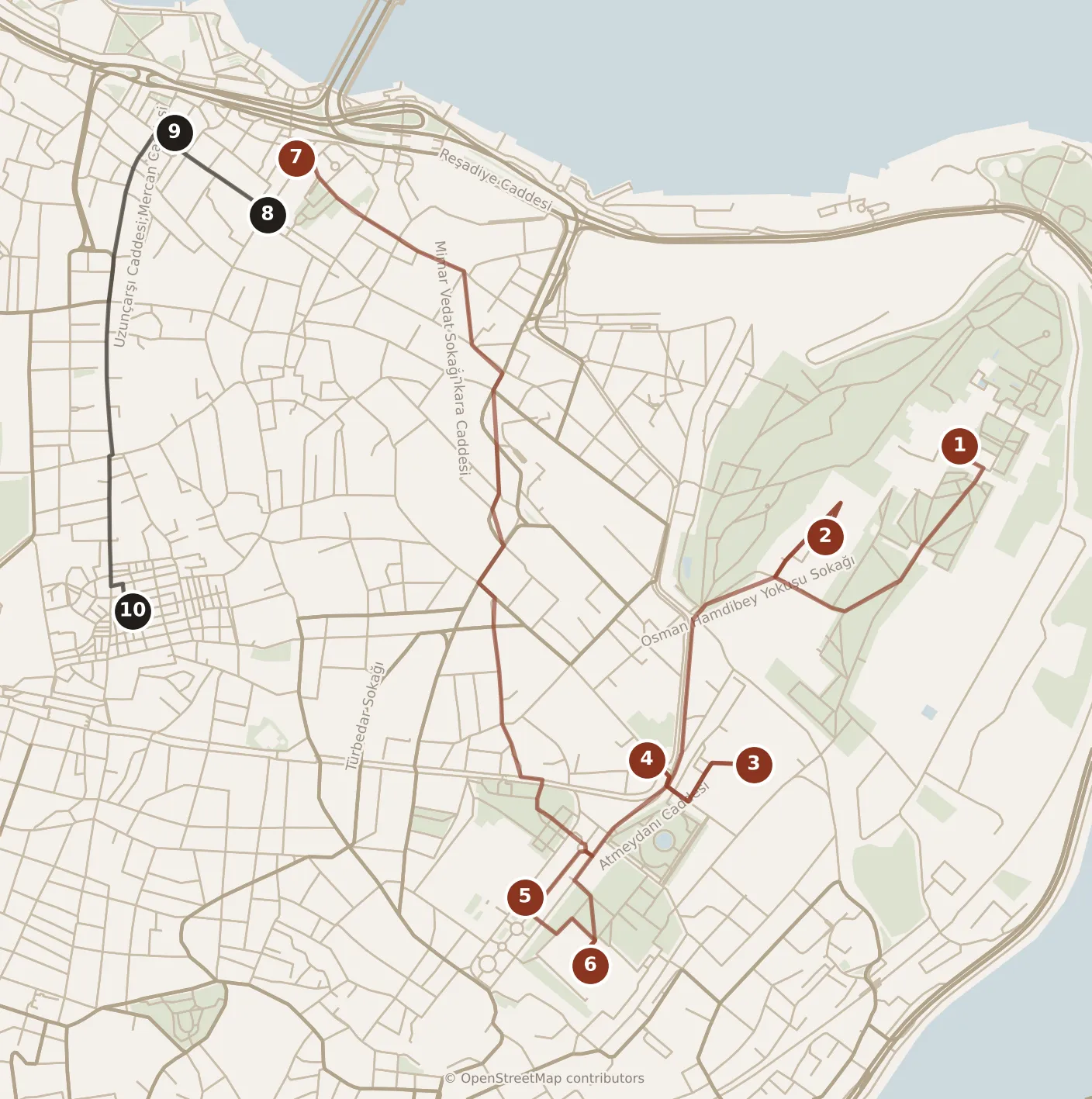
- Day one
- 1Topkapı Palace
- 2Istanbul Archaeology Museums
- 3Hagia Sophia
- 4Basilica Cistern
- 5Hippodrome
- 6Blue Mosque
- 7Eminönü
- Day two
- 8Spice Bazaar
- 9Rüstem Pasha Mosque
- 10Grand Bazaar
Day one

The imperial quarter, almost entirely indoors, and its order is not a preference. Topkapı shuts in the late afternoon — five o’clock when this was written, in 2026 — and it wants three hours, so a palace and a museum cannot both be squeezed between lunch and closing. That is why the largest thing on these two days goes first, at an hour when being wrong about the clock costs nothing. If you find a different closing time, the method survives it: subtract four hours, and if the answer falls after lunch, the palace still goes first.
Morning
Be at the Imperial Gate when it opens, and decide what you are doing before you go through it. Topkapı disorients people for a reason that is fixable in advance: it was never a palace in the sense of a single grand building, so there is no facade to read and no route laid out for you. What there is instead is a walled compound of low pavilions, kitchens, barracks, treasuries and gardens, arranged as an office of government that happened to house a household, spread along the headland where the Golden Horn meets the strait.
So choose two things and let the rest go. The Imperial Treasury is objects in cases: astonishing for twenty minutes and punishing for an hour, and it collects the longest internal line. The palace kitchens run down one whole flank of the second courtyard beneath a row of domes, and what fills them is Chinese porcelain — thousands of pieces of it, bought as crockery and not as art, which is precisely what makes the collection both odd and complete. The Harem is a separate ticket and a lattice of tiled rooms around small courtyards; it is the one quarter of the compound that still reads as lodging rather than as storage. And the fourth courtyard is not rooms at all but terraces at the end of the headland, with the strait below and ships coming down it. Three hours, and go in expecting to leave things unseen rather than hoping not to.
Local tip. Take the combined ticket — palace, Harem, and Hagia Irene in the first courtyard — in one transaction rather than deciding at the inner gate, because a second line in the middle of a visit is what turns three good hours here into four tired ones. And if only one of them is going to happen beyond the courtyards, make it the Harem and not the Imperial Treasury: one is the wait, the other is the architecture.
The Istanbul Archaeology Museums stand inside the palace’s own outer courtyard, five minutes down a ramp on its western side, so you never go back out through the gate. One hour earns itself on a single object. The Alexander Sarcophagus was cut for a king of Sidon, and the Alexander of the name is a figure fighting along its flank rather than the man who was buried inside it. What lifts it past merely fine is the paint: enough survives in the carving that the battle reads as a colored object and not as white marble, which is not how anybody pictures classical sculpture. Across the garden stands the Tiled Kiosk, a pavilion of the 1470s built in an architecture with nothing in common with the hill above it — ten minutes if it is open, although it and the oriental-art annexe were both closed to visitors from October 2025, so let the main building be your reason for coming.
This hour is also the one to surrender if the morning has overrun. It is the only cut on this day that costs nothing structural, and what it returns is an afternoon that reaches the Blue Mosque without hurrying and the water while there is still light on it.
Afternoon
Lunch first, and not on the square. The eating lanes behind Sirkeci are nine minutes downhill from the palace gate and a quarter of an hour back up, and those twenty-five minutes buy you a tray of hot food at a table for a fraction of what the tourist frontages of Sultanahmet charge. Give it an hour and sit down for all of it; this is the meal of the day, for reasons that become clear this evening.
Justinian had Hagia Sophia finished, in the 530s, inside six years, and understanding how it is arranged today will spare you an argument at the door. The building returned to use as a mosque in 2020. Its floor belongs to worshippers, and everyone else is sent up to the gallery, which has carried a ticket since 2024. That split is a piece of luck and not a consolation prize: the surviving Byzantine mosaics are in the gallery, and the gallery is also the height at which the span of the dome stops being a number and becomes a sensation. The dome has meanwhile stood scaffolded for restoration since 2024, inside and out. Ask what has been uncovered before you travel, and treat the afternoon as one that survives either answer, because the interest of this building was never only overhead. An hour. As you go in, note that every mosque on these three days is in use: shoulders and knees covered, shoes left at the door, and a visitor route held clear of the prayer floor. Hair covered for women is asked at the working prayer halls you enter, the Blue Mosque this afternoon included; here you are on a ticketed gallery route rather than on the floor, and I cannot tell you which rule that door applies. Carry a scarf and you never have to find out at the threshold.
Three minutes away, the Basilica Cistern is the right thing to do second, because after a room full of people you want somewhere cold, dark and quiet. It is a sixth-century reservoir underneath the street: three hundred and thirty-six columns in ranks, most of them salvaged second-hand, standing ankle deep in water beneath brick vaulting, two of them propped on carved heads that nobody has satisfactorily accounted for. Three quarters of an hour. It also carries a caveat no other stop here does. Through 2026 its own operator was displaying a notice that it was temporarily closed to visitors, undated, on a page whose other half still advertised daily hours. Check that notice the week before you come. If it is shut, take the substitute the operator itself names: the Theodosius Cistern, five minutes west of the Hippodrome, smaller and better lit, half an hour rather than three quarters. It sits directly on the line this afternoon already walks, so the swap moves nothing else and hands fifteen minutes back to the walk down to the water.
Six minutes on is the Hippodrome, a long public garden that has kept the outline of the Roman chariot track beneath it, and that outline is the reason to stand in it at all — what you are looking at is a shape, not a ruin. Three things are left on the central spine. The obelisk is Egyptian, cut for Thutmose, shipped here and re-erected by Theodosius, and it is sharp enough after three and a half thousand years to embarrass everything around it; its Roman base is the softer stone and the more interesting carving, with the emperor in his box watching the racing. The Serpent Column beside it is a bronze victory trophy from Delphi, headless in a pit because the ground has risen around it; the Walled Obelisk is the plain one, stripped of its bronze sheathing by crusaders. A quarter of an hour, and free.
Three minutes further, the Blue Mosque came out of five years of restoration in 2023, so what you are looking at is freshly cleaned rather than dimmed — six minarets from outside, and inside a descending cascade of domes above tens of thousands of blue-painted tiles, which are what got the building its English name. Visitors and worshippers use different entrances. Twenty minutes inside, and leave through the courtyard rather than back the way you came.
Evening
Walk down to the water: twenty-five minutes from the Blue Mosque to Eminönü, downhill throughout, past the corner you started at this morning. That repeat is unavoidable — the Golden Horn is north and everything else today is south of it — and if eight hours have emptied your legs the T1 does the same ground in three stops, Sultanahmet to Eminönü.
Eminönü is a quay, a bus and tram interchange and the foot of the Galata Bridge, and it is the best free half-hour on the peninsula. When the fish boats are running they are moored hard against the front frying fish for balık ekmek; the fishermen’s rods are already out along the bridge deck above; ferries leave in three directions at once; and the whole domed skyline you have spent the day inside stands over the top of it. Half an hour here is the right end to a day spent under vaults.
It is not, though, a place to have dinner, and neither is Sultanahmet. That is the one honest weakness of a first day in this city, and the answer is not a better restaurant inside the weakness. You ate properly at midday for this reason; take supper standing at the quay — the boats have been moved and suspended more than once, so treat them as the good version of this evening rather than the plan, and the stalls behind them sell the same sandwich when the boats are not there — and keep the tables for the night day two ends on, up in Beyoğlu, where the eating is.
Day two

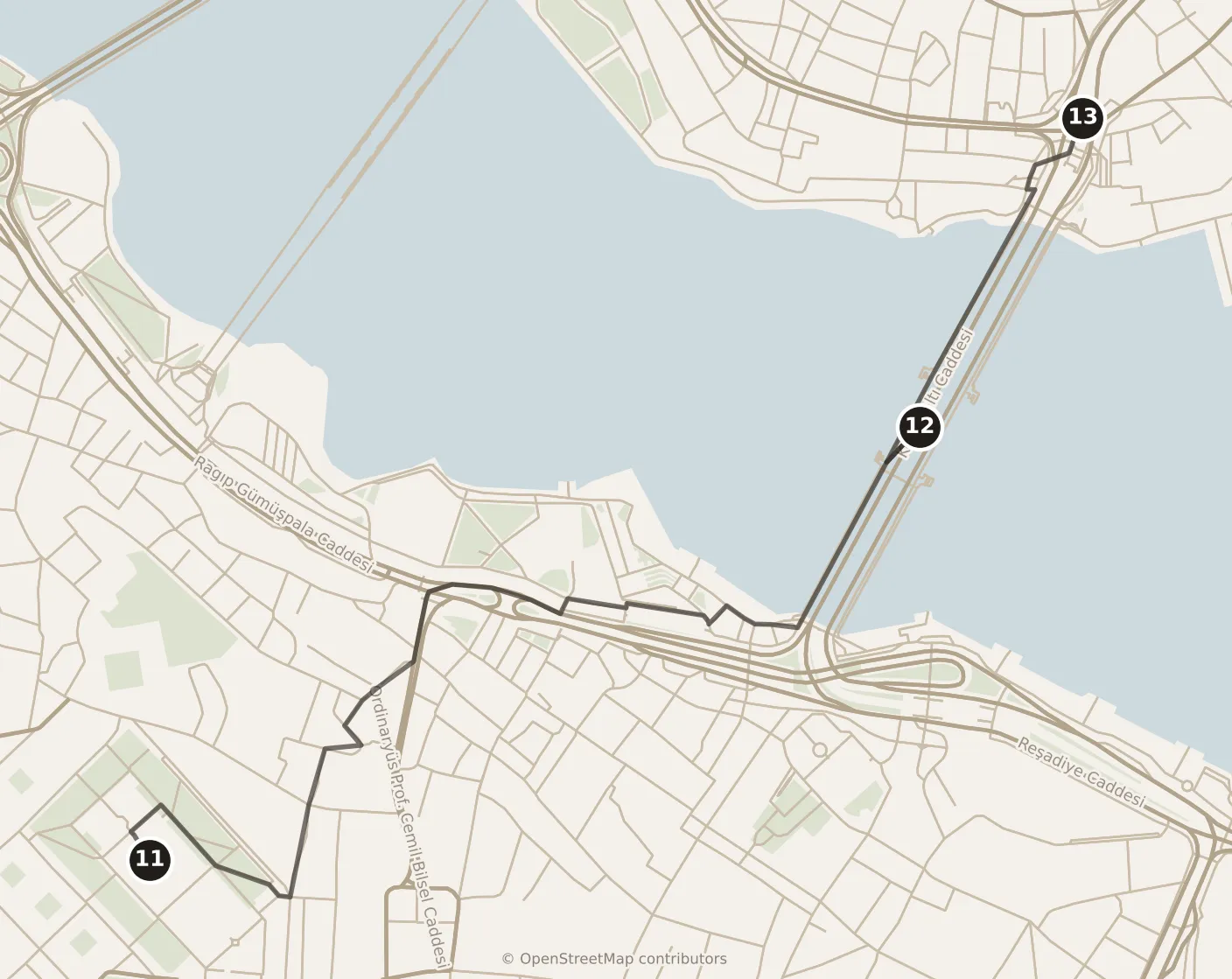
- Afternoon
- 11Süleymaniye Mosque
- 12Galata Bridge
- 13Karaköy
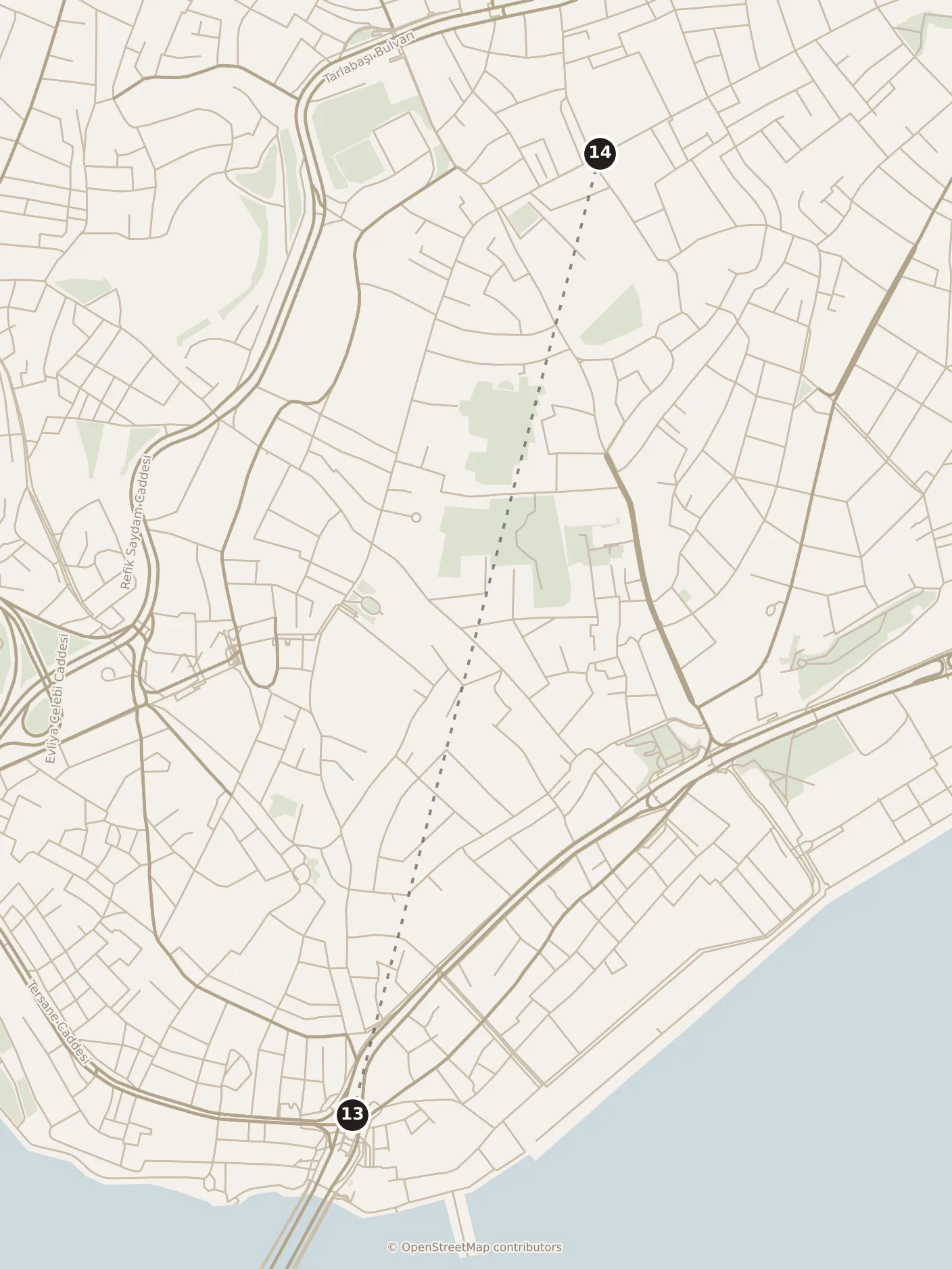
The leg out of the center: from stop 13 by metro, not on foot.
- Evening
- 14İstiklal Avenue
The bazaar quarter, taken uphill, which is deliberate and is the whole argument of the day. Everything hangs on one hour: Süleymaniye stopped admitting visitors at five when this was written, in 2026, and at half past one on a Friday. Everything above it in the day comes to about three and three-quarter hours, and you want a clear hour inside, so aim to be at its door an hour before whatever closing time you find. From an ordinary morning start that happens with hours in hand — the hour matters as a deadline you should know exists, not as something to build the morning around.
Morning
Begin at the water, where yesterday ended. The Spice Bazaar dates from the 1660s, turns a right angle halfway along and is a fraction of the length of its famous neighbor, and the part worth your time is not the vaulted aisle but the grid of streets pressing in on it from the west, where the city does its actual food shopping: sacks rather than gift tins, cheese counters, sheep’s-milk butter, coffee ground while you wait, whole streets of nothing but nuts. Three quarters of an hour, most of it outdoors.
Four minutes away is the Rüstem Pasha Mosque, and you will walk past its door: the prayer hall sits above a row of shops, and the way up is a narrow stair let into the shopfronts. Ask in the shop below rather than circling the block, which is what everyone else is doing. The room upstairs is small and sheathed in İznik tile from the floor to the gallery rail, and because it is small you stand close enough to read one panel at a time — the thing the great mosques, for all their size, cannot give you. Twenty minutes, and free.
Then fifteen minutes uphill to the Grand Bazaar, through the hardware, tool and lighting streets, which are one of very few stretches on these days where the old city is visibly working rather than selling. Arrive at the bazaar with the wrong expectation and it is an ordeal; arrive with the right one and it is the best hour of the morning. It is closer to a small walled town than to a market: sixty-odd lanes under one continuous roof, put up in the fifteenth century as a fortified trading quarter, with two domed stone halls at the center that were strongrooms before they were shops. Walk it without a shopping list for an hour and let yourself get turned around; the pleasure is architectural. You will be approached, and prices inside run above what the streets you climbed up through ask — how far above is not a number anybody can give you honestly, because the two mostly sell different categories of thing.
Afternoon
Eat in the lanes between the bazaar and the mosque above it — uphill from the bazaar’s gates, not back down the way you came. This is where the quarter’s own porters and traders take their lunch, it costs a fraction of anything in Sultanahmet, and it is the reason this day climbs rather than descends. An hour, sitting.
Eight minutes on, at the top of the hill, stands the Süleymaniye Mosque, and if you go inside one building in this city it should be this one. Sinan built it for Suleiman in the 1550s, and what makes it great is not decoration — there is hardly any tile — but volume and light: one enormous room under a dome on four piers, with the windows arranged so that the light arrives evenly instead of in shafts, and nothing anywhere to catch the eye and stop it. Give it an hour and spend part of that hour sitting down, because the room was designed for a voice as much as for an eye, and standing in the doorway tells you nothing about that. In the garden behind are the tombs of Suleiman and of Hurrem; Sinan’s own is a small one outside the precinct wall, easy to walk past twice.
Then the terrace at the precinct’s edge, which is outside the mosque, keeps no ticket and asks nothing of you. The Golden Horn lies directly below it, Beyoğlu is opposite, and the two days you have spent down in those streets resolve into a shape you can take in at once. Twenty minutes.
Local tip. If this day is running late, drop the Grand Bazaar and keep the mosque. The bazaar is an hour that will still be there on five other days of the week; Süleymaniye stops admitting visitors in the late afternoon, and at lunchtime on a Friday, and the hour inside it is the only thing today you cannot buy back later.
From the terrace it is a little under twenty minutes down to the Galata Bridge. The bridge is 490 meters, a seven-minute walk that takes ten because you will stop: rods and lines the whole length of the upper deck, the lower deck a row of restaurants priced for the position and not for the food, and the old city sliding away behind you the entire crossing. On the far bank is Karaköy, coffee places, galleries and design shops laid over an old port district. Its waterfront has been redeveloped and the lanes a street or two back from it have not, so give the twenty minutes to those rather than to the front. The Galata Tower stands above you on the hill and this route does not go up it: entry is capped by the hour, the line would eat most of what is left of the day, and you were looking down on the same peninsula for nothing two hours ago from Süleymaniye.
Evening
Take the F2 funicular — the Tünel — from Karaköy up to Beyoğlu: one stop, about ninety seconds, running since 1875, and if it is out of service the walk up past the tower is fifteen minutes and the steepest climb of these three days — which is precisely the problem the funicular was dug to solve.
You come out at the lower end of İstiklal Avenue, 1.4 kilometers of it running north to Taksim, with a single red tram grinding up the middle. Twenty minutes if you walk it, an hour if you use it properly, and using it properly means keeping your eyes above the shopfronts, because the ground floor has been remodelled into the same frontages you would find anywhere and the nineteenth-century street survives intact on the two stories over them. Better still are the covered passages off both sides, glass-roofed arcades of the 1870s — some converted into food halls, others still nothing but staircases up to tailors and dental offices, and the only way to know which is to walk in. Dinner is in the side streets dropping away below the avenue, which is where the meze-and-rakı taverns keep going late, and this is the meal day one told you to hold back. One thing about these streets after dark, and it is the only sentence of its kind on these three days: official travel advice for Turkey is to be wary of a stranger who approaches you and offers to take you to a restaurant or a nightclub. Nothing else on this route earns a line like that, which is why this one has it.
With a third day

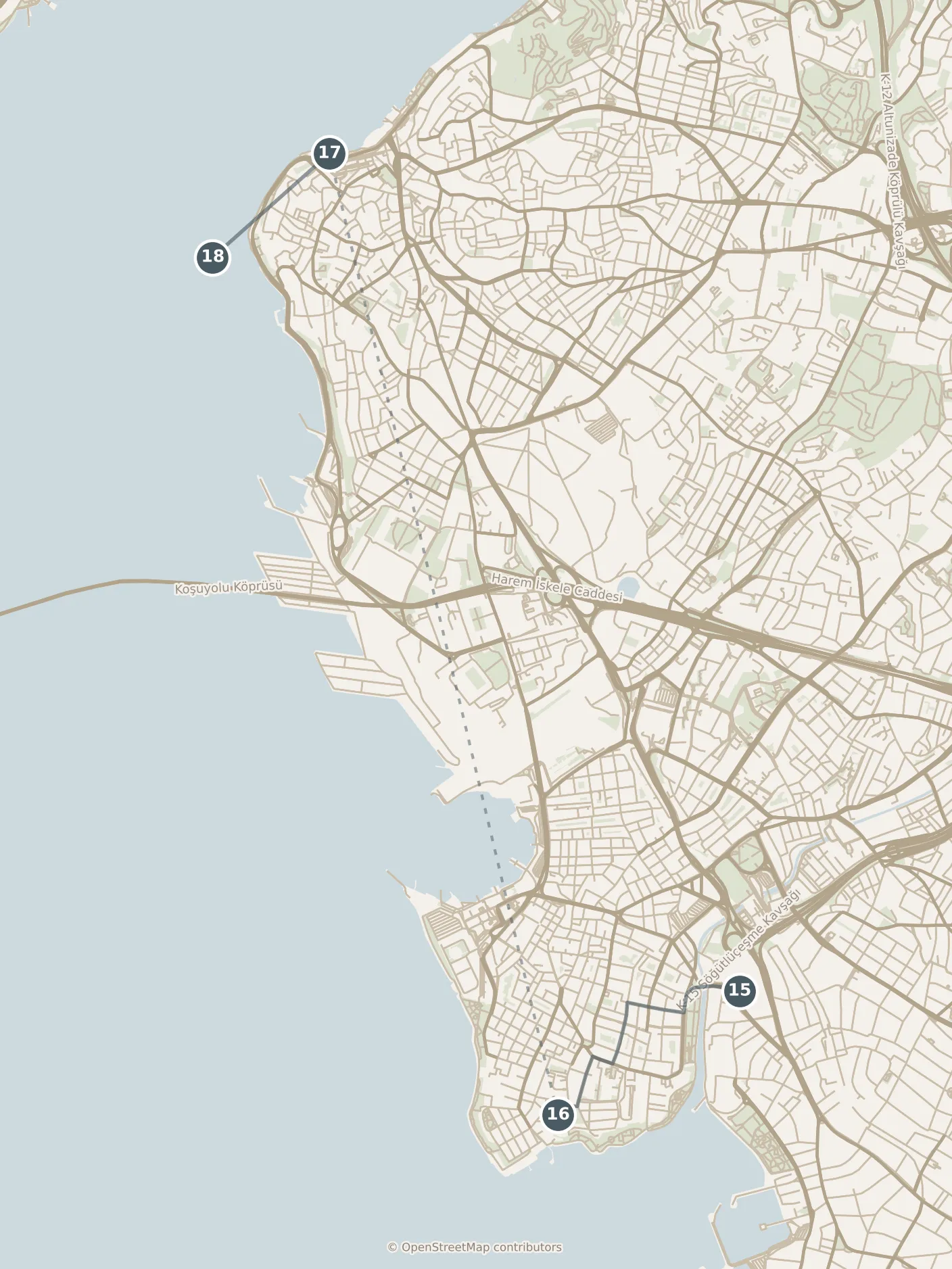
- With a third day
- 15Kadıköy
- 16Moda
- Üsküdar — in the prose, not on the map
- 17Şemsi Pasha Mosque
- 18Maiden's Tower
A third day goes on the water. It is the only one of the three that is not a walk between buildings: two ferries at a commuter fare, and a city on the Asian bank with almost nothing in it built for visitors.
It goes last if nothing forces it, because it is the day for legs that have done two days of hills, and because sitting on a bench with the strait in front of you is a poor first impression of Istanbul and an excellent last one. But it has no closures at all, which is what makes it the day to move: it is what you put on the Tuesday Topkapı will not take, or on the Sunday the Grand Bazaar will not. Inserted, it simply pushes the other two down a day and changes nothing inside them — the ferry back lands at Eminönü, which is where day two begins, so even the seam holds. The trap is arriving for a Sunday, a Monday and a Tuesday, where both prohibitions bite inside the same three days: the palace day then has to be the Sunday or the Monday, the bazaar day the Monday or the Tuesday, and the water day takes whichever is left. Three of the six possible orders survive that; the other three put the palace on a closed Tuesday or the bazaar on a closed Sunday.
Take a boat from Eminönü to Kadıköy — about half an hour, or twenty minutes if you board at Karaköy on the other side of the bridge instead. Eminönü is not one boat door: it is a row of separate piers along the quay, each signed for the bank it serves, so read the destination board before you join a line. This article names the tram stop for day one to the minute, and the wrong pier here is the one easy way to lose the start of this one. Stand outside at the stern, where the old city, then Galata, then the mouth of the strait open up one behind the other. Kadıköy is a district of several hundred thousand people going about an ordinary week, and the market grid behind the pier is the whole morning: crushed ice and fish, pickle jars by the barrel, cheesemongers, roasters working in the doorway, and narrow places where lunch is eaten standing at a shelf. A long breakfast here, or lahmacun, is the meal of this day, and the grid is doing the neighborhood’s shopping as much as anybody’s. Two hours.
Twenty-five minutes on foot brings you out to Moda, a low, green residential headland with a grass promenade round its rim and the Sea of Marmara in front of it. There is nothing to see and that is the point: an hour on a bench there is the correct use of a third day, and it is the only hour of these three days with no building in it.
Then cross to Üsküdar: twenty-five minutes back to the pier, one stop on the M4 from Kadıköy to Ayrılık Çeşmesi, one stop on the Marmaray to Üsküdar, about a quarter of an hour with the changes. Üsküdar is older, plainer and quieter than Kadıköy, a shore people live on rather than go out on, and the contrast is the reason to come. Five minutes along the waterfront is the Şemsi Pasha Mosque, Sinan again and close to the smallest thing he ever built: a mosque, a tomb and a school around a courtyard opening straight onto the water, and the whole of the old city ranged along the far bank behind it. Ten minutes, and the smallness is the point, exactly as it is at Rüstem Pasha.
Ten minutes south along the promenade brings you level with Maiden’s Tower, which stands on its own rock offshore. This day looks at it rather than visiting it: the shore is free, you want the tower in front of you rather than underneath you, and the boat out and back would cost you the light. Which is the point of the day — everything above this promenade comes to about five hours, and the promenade below them wants a last half-hour of daylight, so five and a half hours before your month’s sunset is the latest the first boat can go, using the December-to-June band given further up. In the long half of the year that is the middle of the afternoon and you would not use it: go in the morning, as the market paragraph assumes, and take the longer bench at the end. In December it is the real constraint, and the long breakfast is the thing that has to shorten. Give the promenade the last half-hour of daylight, then take a ferry back over in the dark, twenty minutes, which is the right way to finish three days here.
Practicalities
The one thing to arrange before you travel is the Hagia Sophia gallery slot; its price band and the reason for it are set out above. I have not named the site to buy it on, because I could not confirm which channel is the operator’s own — and a wrong name here is precisely how a first-timer pays a reseller triple. What you can check without one: the ticket is charged in euros, so a page quoting it in your home currency, or bundling a guide with it, or selling you a skip-the-line that is the line everybody else is standing in, is not the operator. Topkapı’s combined ticket is worth buying online the evening before rather than from home — it removes the ticket line and leaves the security one, and unlike a timed slot it does not sell out. The other tickets on these three days — the cistern, the archaeology museums — are bought at the door on the day, and everything else is free. Nothing else on this page carries a figure, and that is deliberate rather than an oversight: the euro band above survives being written down because the ticket is priced in euros, and a lira price written a year before you read it would only mislead you.
Three days of the week matter and the other four do not. Tuesday: Topkapı is shut, so day one cannot be a Tuesday. Sunday: the Grand Bazaar is shut, and so is most of the hardware and lighting quarter below it, which takes the lunch lanes with it; the Spice Bazaar and its streets stay open, so a Sunday costs day two its middle rather than the whole of it, and the honest advice is to move the day rather than to patch it. Friday: Süleymaniye’s visiting hours end at lunchtime, so on a Friday day two is walked in reverse — the mosque at opening, then lunch in the lanes just below it, then the Grand Bazaar, then Rüstem Pasha, the Spice Bazaar and the bridge at the end as written. The lunch comes early in that order, and that is the price of the reversal: the lanes sit above the bazaar’s gates, so eating after the bazaar would mean climbing back up the hill this order exists to come down. Rüstem Pasha is a working mosque too, and in that order you reach it near the Friday midday prayer — and the way up is the narrow stair the quarter’s own traders will be filling, so a four-minute swap may not be the size of the problem. Take the Spice Bazaar first and walk back to it, and if the stair is still busy, let Rüstem Pasha go: it is twenty minutes, and it is the least structural stop on the day. Monday, Wednesday, Thursday and Saturday will take any of the three days in any order.
Beyond that one Friday, mosque doors are a question of order rather than of planning. Each of them shuts its visitor route around the five prayers, the times drift through the year with the sun, and the only rule worth carrying is never to let a half-hour of your day depend on a mosque door. Every mosque above has something free standing beside it. In Ramadan the hours after dark around them are the fullest of the whole day rather than the emptiest, which cuts both ways depending on what you came for.
The one thing this route borrows from the city guide is the Istanbulkart, the rechargeable card described there, and the third day is why it matters: the same card pays for the ferries as well as for the tram and the funicular. Ask for it by that name — this is the sentence that sends you to a machine with a line behind you, so the argument for the card can live in the city guide but the word cannot. Get it the moment you first reach a station rather than at a gate.
Getting to the start, and away from the end. From İstanbul Airport it is three trains: M11 as far as Gayrettepe, M2 from there to Yenikapı, then a single Marmaray stop to Sirkeci, which puts you seven minutes uphill from the Gülhane tram stop with the Imperial Gate above it. Budget an hour and a quarter at the very least, and add slack at Gayrettepe, where changing from one metro line to the other means several minutes of tunnel; with a bag the airport shuttle buses described in the city guide are the simpler option. Sabiha Gökçen is shorter: M4 as far as Ayrılık Çeşmesi, then Marmaray beneath the strait, again to Sirkeci. Leaving is where the third day earns its place at the end: it finishes at Üsküdar, one Marmaray stop from Ayrılık Çeşmesi and the M4 out to Sabiha Gökçen. For İstanbul Airport you are on the wrong bank, so take the ferry back to Eminönü as written and reverse the arrival. If you arrive by train rather than by air, do not aim at Sirkeci — as above, it has had no mainline trains for years — and I cannot tell you which station outside the old city your service terminates at, so ask when you book and plan the last leg as a Marmaray or metro ride rather than as a walk.
Two stretches catch people out on foot. The fifteen minutes up to the Grand Bazaar is the longest continuous climb on the peninsula, and if the climb has already gone out of your legs the T1 runs from Eminönü up to Beyazıt-Kapalıçarşı, which is at the bazaar’s own gate — walk back down to the tram after Rüstem Pasha, and the price of the ride is the hardware streets. And the old city has almost no shade anywhere, which is what makes these two days punishing in August and easy in April or October.


.jpg)
.jpg)
.jpg)