Bruges in two or three days: the Dijver collections, the eastern ramparts, and a third day out to Damme

Last updated 15 August 2026
Overview
The whole historic center of Bruges fits inside a ring of water about two kilometers from end to end, and no leg between two stops in the two days below is longer than ten minutes. So the second day here is not bought with distance. It buys two things instead.
The first is the collections. This city’s art is not gathered in one building: it is spread across four addresses within three hundred meters of each other on and around the Dijver, and a single day takes one or two of them and leaves the rest. The second is the other half of the ring. Almost everyone who comes here walks the same few hundred meters between the Markt, the Burg and the Rozenhoedkaai, and the north-east quarter — merchant streets, a Genoese family’s private chapel, a working windmill on a grass embankment — has front doors on it and a fraction of the traffic. Day one below is the indoor day and stays in the south-west. Day two is the outdoor day and goes north and east. Neither crosses the other’s ground.
One structural fact shapes both evenings: almost nothing on these two days is open after five. The museums shut at five, and the Groeningemuseum at six in the summer half. The belfry is the exception, and a larger one than it looks: open to eight every day from the first of April to early November, and to eight on Saturdays through the winter as well, while on other winter days it shuts at six — with the last climb sold an hour before closing in every case. That is why day one ends on it and why it is the one thing on either day worth booking an hour for. Apart from that climb the last hours of both days are water and streets, which is what people come here for anyway; the one lit door either day walks past is the concert hall on ‘t Zand, which programs at eight.
Do not simply do day one first. Two rules decide the order and they are the whole of it. Day one cannot be a Monday or a Wednesday: it carries the two great museums, and since a change in 2026 the Groeningemuseum closes on Mondays and the Gruuthusemuseum on Wednesdays, all year rather than seasonally. Day two cannot be a Sunday: it carries a private estate and a lace museum that shut that day. There is always an arrangement that works, and for five of the seven possible arrival days there is only one — the pair-by-pair working is in Practicalities, and you need it only if your own two dates do not settle it at a glance. The days swap cleanly, nothing in day one depends on having done day two or the reverse, so this costs you nothing but a decision, and the decision has to be made before you set out rather than at a locked door.
Light matters for the end of day two and for nothing else. The sun goes down in Bruges anywhere between about twenty to five in the middle of December and a few minutes past ten around midsummer, and day two finishes outdoors on the eastern ramparts. Take your month’s hour, subtract an hour and a half — the mills and the rampart walk, with the walk out to them — and that is when to leave the lace museum. Day two as written leaves it at a quarter past three, which clears that bar in every month except roughly mid-November to mid-January, when the sun is down before a quarter to five; through those weeks the last of the rampart walk is done in the last of the light — and the mill at the end of it is shut in any case, which is half an hour you were not going to spend. In June it lands at half past eight, which no sequence of museums reaches, and here two rules in this article genuinely cannot both hold: the day is built round doors that shut at five, and the light does not go for another five hours. The trade is to stop treating the ramparts as a sunset stop in the long half of the year — walk them in the late afternoon as written, eat at seven, and give the last of the light to the canals in the center instead, which is thirty minutes’ walk back and needs no ticket. Both counts are set out in their own days below.
Two things are worth settling before you travel, and only two. Every ticket on these two days except three belongs to a single operator, Musea Brugge, and it sells a Musea Brugge Card valid for seventy-two hours from your first scan — which is the exact shape of this trip. It was in the forty-five-to-fifty-euro range in 2026, against about eighty euros of separate tickets for the doors below, and it is sold online on Musea Brugge’s own site and at every one of its box offices. Buy it there rather than at the first door, and while you are on that page reserve a time slot for the belfry, which is the one climb in this city with a line at its foot. The belfry is on the card, so that reservation is a free slot against something you already hold and not a second purchase — which is worth being sure of before you are at the door with the card in your hand. Everything else on these days is bought where you stand. If you are visiting other Belgian museums on the same trip, the national Museum Pass costs rather more and lasts a year, and the arithmetic changes; for Bruges alone it does not.
And the bag. This is a two-night trip, so the bag is an arrival-and-departure problem rather than a carrying one, and it has a shape worth knowing: Station Brugge is twenty-five minutes’ walk south of the Markt, and day one’s first hour is the worst stretch in the city to wheel a case through. The beguinage is a courtyard people live in and the request for quiet inside its gate is a real request; the lanes around it are laid in setts, which a wheeled case announces for a hundred meters in each direction. There are left-luggage lockers in the station on the Stationsplein side. Use them, or ride a De Lijn bus in from the forecourt and check in first — but do not begin day one holding anything. On the last morning the geometry reverses: day two ends out in the north-east, forty to fifty minutes from the platform on foot, and the third day spends its whole morning up the canal at Damme and is not back inside the ring until half past one. If your train is an early one, neither of those belongs on it — give that morning to the Dijver instead, ten minutes from the Markt and twenty-five from the platform.
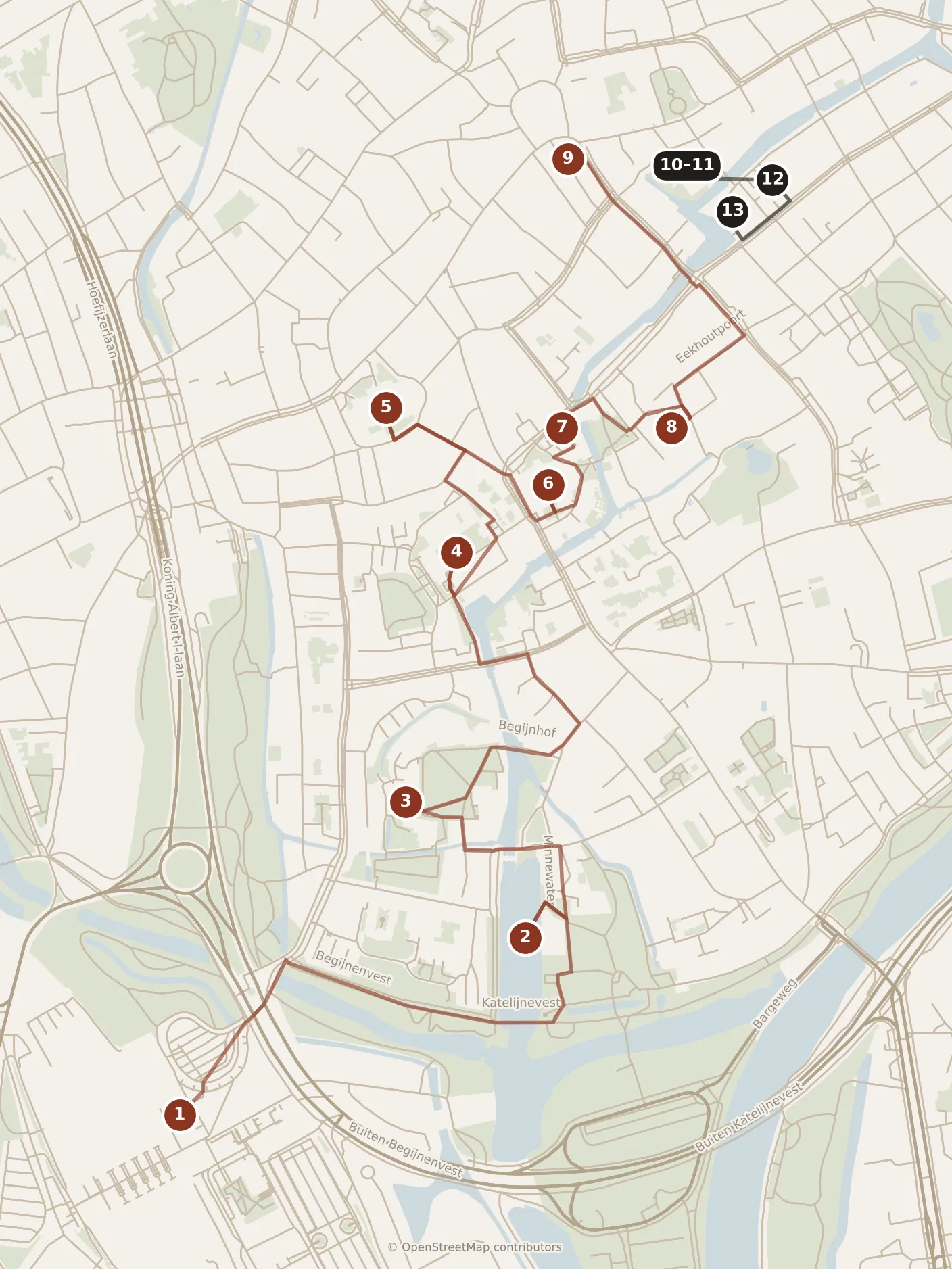
- Day one
- 1Station Brugge
- 2Minnewater
- 3Begijnhof
- 4Sint-Janshospitaal
- 5Sint-Salvatorskathedraal
- 6Onze-Lieve-Vrouwekerk
- 7Gruuthusemuseum
- 8Groeningemuseum
- 9Belfort
- Day two
- 10Heilig-Bloedbasiliek
- 11Stadhuis
- 12Vismarkt
- 13Huidenvettersplein
Day one

Almost everything today is a door, and the last of them stops admitting well before dark, so this day has no hinge in the light and one hard wall at the far end. Add up the recommendations below and the run from the station barrier to the top of the belfry comes to about eight and a quarter hours with the walking and the hour at the table included, which puts the start at nine. That figure models the time inside the places and the walking between them and nothing else: not the ticket desks, not the ten minutes finding a table, not the wait at the foot of the tower. In 2026 the hospital museum admitted nobody before half past nine and the belfry sold its last climb an hour before it closed — so the half hour before the museums open is the water and the beguinage, which is where it belongs, and if either of those hours has moved, rebuild the day from the new one rather than from these.
How late you can start, which is the question an arriving train actually asks. From April to early November the tower runs to eight, so this day can begin as late as about half past ten and still end on it — at the cost of exactly one door, and it is the same one the evening’s dropping order names second. Run the hours below forward from half past ten and the cathedral lands at about a quarter to one, inside the lunch closure that makes it a morning stop or nothing. It is free and it is twenty-five minutes, so it is the cheapest thing here to lose; everything else clears with room, the Groeningemuseum going in at about twenty past four and out before the summer six. From November to March it cannot: the last climb is five on every winter day but Saturday, the run from the station barrier to the tower’s foot is about seven and a half hours, and no door in this city opens before half past nine — a window of minutes rather than of hours. An arrival later than that should not attempt day one on the arrival day at all. If you are in by mid-morning, run day two first and day one the next morning; the weekday rules allow that swap on a Monday, Wednesday, Thursday, Friday or Saturday arrival anyway. If you are in later still, give the afternoon to the things the third day below lists as leftovers — none of them is load-bearing and all of them are within ten minutes of the Markt.
Morning
From Station Brugge it is ten minutes on foot to the Minnewater, the long still basin at the bottom of the ring, and this is the leg to get right because it is the one you make carrying things. One name is worth knowing, and only one arrival can trip on it: there is a small halt called Brugge-Sint-Pieters three kilometers north of the city, and the only trains calling there are the stopping service from Zeebrugge and the coast plus a couple of weekday peak trains. Coming in from the sea, stay on past it. Everything from Brussels, the airport, Ghent and Antwerp runs to Station Brugge and nowhere else, so from those directions there is nothing here to get wrong. Ten minutes at the water, walking one bank, is enough — it is a decompression rather than a sight.
Four minutes further, through the gate and over the bridge, the Begijnhof: a ring of whitewashed houses round a court of grass and trees, walled since the thirteenth century and inhabited ever since, today by a community of sisters. It is free and it is not a monument. Keep your voice down inside the gate: the notice at the entrance asks for silence, and it asks because people are at home behind those doors and not because it is a nice idea. Twenty-five minutes, going round the court rather than across it.
Two minutes off the far side of it, on Walplein, stands the one working brewery left in the historic center: five hundred years of brewing on the same ground, five generations of the same family, and a beer pipeline running three kilometers under these streets to the bottling plant outside the ring, because the setts could not take the lorries. The tour, which ends on the roof, takes about three quarters of an hour — three quarters of an hour this day does not have. Put it in the third day’s free afternoon instead; it is the one thing in this city that is neither a museum nor a church, and a Bruges itinerary with no beer in it has been drawn from a map of museums.
Six minutes north up Mariastraat is the Sint-Janshospitaal, and this is the hour the morning exists for. A twelfth-century hospital that still reads as one — long wards under a timber roof, a hospital church at the end, a seventeenth-century pharmacy with its jars and its herb garden — hung with the second-largest collection of Hans Memling anywhere, four of whose masterpieces were painted for this building and have never left it. Give it an hour and a quarter. If the day is running behind, the piece to drop is the audiovisual installation in the attic, which is pitched at least as much at children.
Four minutes north-west, on Steenstraat, the Sint-Salvatorskathedraal is the one door on this day that costs nothing and is easiest to skip. Do not: it explains the rest. This was an ordinary parish church until 1834, when the diocese was re-established and it was promoted, because the cathedral that had stood on the Burg — Sint-Donaas — had been sold off and pulled down at the end of the eighteenth century. Much of what hangs here was carried out of that vanished building, which is why a modest church holds a choir dressed in eighteenth-century tapestries. Twenty-five minutes. It shuts for lunch every day and does not open at all on a Sunday morning, so it is a morning stop or it is nothing.
Afternoon
Four minutes back east, the Onze-Lieve-Vrouwekerk has a free half and a ticketed half, and the ticket is what you came for: Michelangelo’s marble Madonna and child, among the first works by the artist to leave Italy in his lifetime, and the gilded bronze effigies of Charles the Bold and his daughter Mary of Burgundy lying on black stone. Thirty minutes, and stand with the Madonna for five of them; it is small, set high, and photographed in eight seconds by almost everybody. Remember the duke’s face: the third day below goes to the town where he married.
Lunch is the hour after that, in the lanes off Mariastraat and Katelijnestraat rather than on the quays themselves — this is a country that takes the middle of the day seriously and the alternative is eating standing up on the most crowded ground in the city. What to look for at the door is a dagschotel: the day’s single plate, written up by hand and changed daily, which is the opposite end of the trade from a laminated card in six languages. A plate of stoofvlees is the honest order, beef gone to pieces in dark beer, with fries beside it rather than under it.
The Gruuthusemuseum is a minute from the church door and shares a discounted ticket with it. It is the palace of Louis of Gruuthuse, whose motto — there is more in you — is cut into the building, and it holds five hundred years of the city’s own objects: tapestries, glass, lace, manuscripts, wooden sculpture. The thing to walk through it for is the late fifteenth-century oratory, a private box hung off the palace and through the wall into the chancel of the church you have just left, so that the family could hear Mass without going outside. An hour and a quarter, and be warned that the route through it is stairs from end to end.
Two minutes east, take the fifteen minutes the Arentshof and the Bonifaciusbrug are worth. The bridge is the most photographed small corner in Bruges and one of its youngest structures, built in 1910; the bridge beside it carries a white house on its back, which no other bridge here does.
Then the Groeningemuseum, on the Dijver, built on the site of the medieval Eekhout abbey and holding six centuries of painting. Give it an hour and a half and spend it in the first rooms: Jan van Eyck’s Madonna with Canon van der Paele of 1436, Hugo van der Goes, Hieronymus Bosch’s Last Judgment, and above all Gerard David’s two panels of the judgment of Cambyses, in which the corrupt Persian judge Sisamnes is arrested and then flayed alive while his son takes the bench, the seat draped in his father’s skin. The city commissioned it in the late 1480s for a room in its own town hall, as a warning to the magistrates who sat there — and the town hall stands on the square day two begins in. The nineteenth- and twentieth-century half of the museum is good and is what to leave if you are short. Next door on the same address, BRUSK opened in May 2026 as the city’s gallery for temporary exhibitions. It is not part of this day, but it is on the Musea Brugge Card, as are the Brugse Vrije and the Volkskundemuseum further down — and the card’s seventy-two hours reach the third day, so the leftovers there cost nothing extra.
Evening
Eight minutes north-west and the Markt opens out, and by now it is a square rather than a funnel. The Belfort stands on its south side: eighty-three meters, thirteenth century, three hundred and sixty-six steps past the treasury where the city kept its charters and its money, to a carillon of forty-seven bells and the flat green country beyond the roofs. UNESCO listed it in 1999 with thirty-one other Belgian belfries; the property was extended in 2005 to take in the French ones, and now runs to fifty-six. Give the climb forty-five minutes including the wait, and stop at the landings rather than racing them: the stair narrows near the top and there is no passing. One warning here is not invented and comes from the people who run it — the tower gets very hot, and in real heat they may close the doors and will say so on the spot.
Local tip. Decide now, before you are tired, the order in which things get cut if the day slips — this is a dropping order, not a running order. Five ticketed doors stand on today, all five of them on the card: the hospital museum, the ticketed half of the church, the Gruuthusemuseum, the Groeningemuseum and the belfry, with the free cathedral beside them. The belfry is dropped first, because it keeps the longest hours of anything here and day two begins three minutes from its door — moving it there costs day two three quarters of an hour, which is exactly what dropping the boat on that day would give back. The cathedral goes second, and it is free, so it costs you nothing but the twenty-five minutes. The hospital museum and the Groeningemuseum do not go at all: they are the two reasons this is a two-day city.
Dinner is west, around ‘t Zand and the streets off it, ten minutes from the Markt and off the ground this day has spent itself walking, which is the right end to a day spent indoors. One date to check before you count on the square: for about a month each spring the Meifoor, the city’s fair, holds ‘t Zand end to end and spills into the park beside it. It opens on the third Friday after Easter and closes the weekend after Ascension Day, which in most years puts it across late April and the first half of May. The streets off the square still work; the square itself is a funfair.
Day two

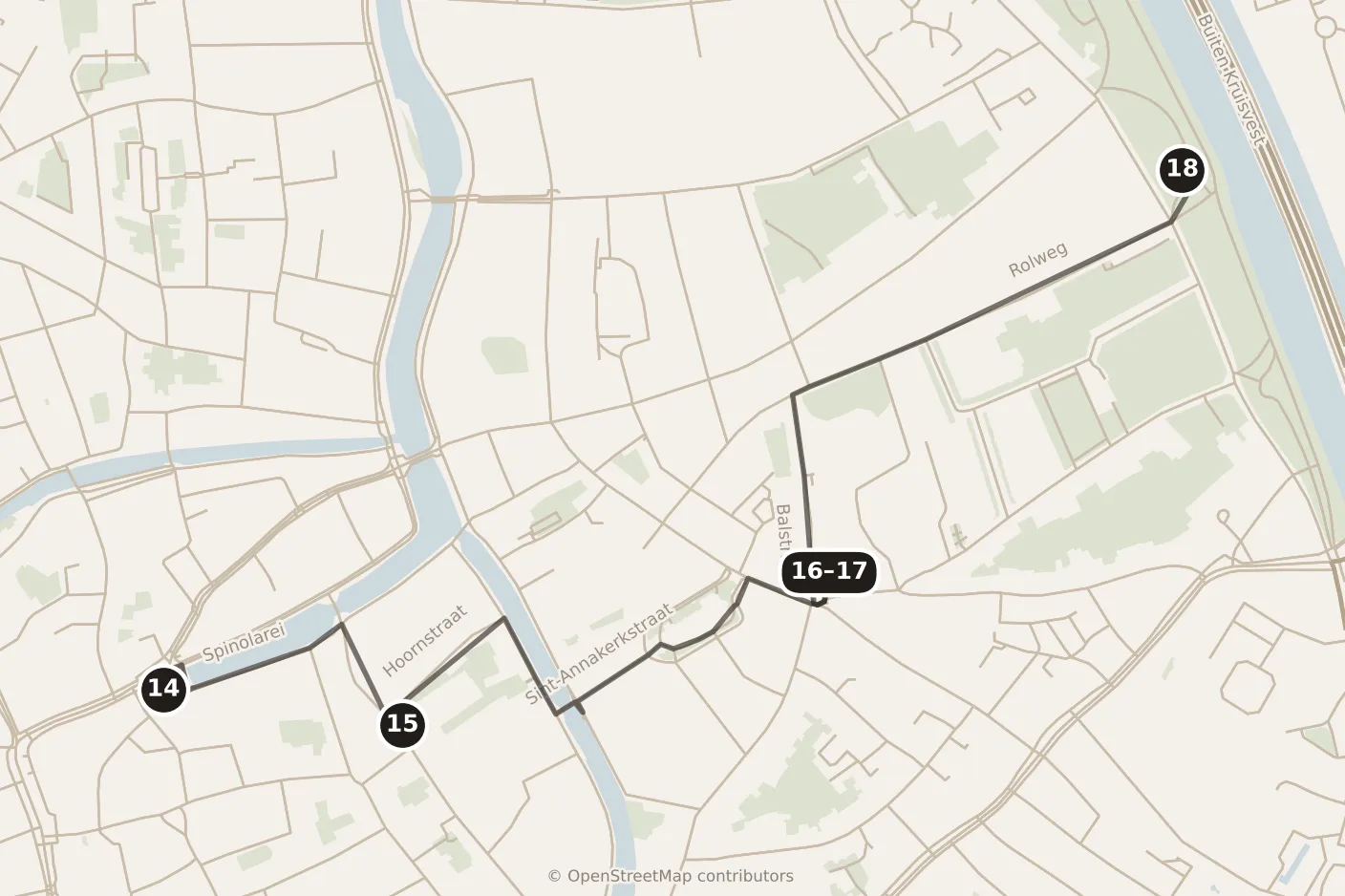
- Afternoon and evening
- 14Jan van Eyckplein
- 15Sint-Walburgakerk
- 16Adornesdomein
- 17Kantcentrum
- 18Sint-Janshuismolen
Today has two fixed hours and a horizon. The canal boats were guaranteed daily from March through October in 2026 and started at ten; you cannot reserve one as an individual, tickets are sold only at the jetty, and the line therefore only grows through the morning. So the day is built to reach a jetty inside the first hour of sailing — about a quarter to eleven, on the numbers below — which is why the Burg comes before the water rather than after it. At the other end the lace demonstrations ran from two in the afternoon, Monday to Saturday, in 2026 — before that hour the museum is cases and after it there are people working — so the eastern quarter is an afternoon and cannot be brought forward. If either hour has moved, keep the shape: something early that opens before the boats, the lace after the lace-makers arrive.
Everything below comes to about seven hours from the Burg to the last mill, with the walking, the line for the boat and the hour at the table counted in, and nothing else counted at all: not the five ticket desks, not the twenty minutes the Adornes rooms take to work through if there is a group ahead of you. Start at half past nine — which is when the earliest door in this city opens, and there is nothing to be bought by standing on the Burg before it — and you are on the embankment at a quarter past three and off it by a quarter to five. Those are the numbers to hold against the sunset band in the Overview.
Morning
Begin on the Burg, the small square behind the Markt where the demolished cathedral once stood. The Heilig-Bloedbasiliek is the low dark end of the row: two churches stacked, the lower one bare, heavy and Romanesque, the upper one painted and gilded and reached by a covered stair. Both are free. Twenty minutes is right unless you have come for the relic, which is brought out for veneration in a fixed afternoon window the basilica publishes itself — read it the week before if that is why you are here, and build the afternoon back from it rather than round the boat. During a service the chapel in use is for people attending it, and that is enforced rather than suggested.
Thirty seconds along the same side, the Stadhuis, built between 1376 and 1421 and copied afterwards by half of Flanders. The ticket buys the Gothic hall upstairs, whose early twentieth-century murals are less interesting than the fourteenth-century painted consoles holding up the timber vault above them. Forty minutes. And if today is a Saturday you gain a room rather than losing one: the same ticket admits you to the Brugse Vrije next door, the aldermen’s courtroom of the old rural jurisdiction, which opens only on weekends — and its 1528 chimneypiece in oak, marble and alabaster, made by Lanceloot Blondeel for Charles V, is the best single object on the Burg. It is also the room that makes day one’s flayed judge make sense.
Two minutes east, under a colonnade of 1820, the Vismarkt is the oldest surviving fish market in Belgium and still sells fish — Wednesday to Saturday mornings, and on the other three days it is a handsome empty arcade. Ten minutes either way.
One minute on, the Huidenvettersplein is one of five jetties for the canal boats; the others are on the Rozenhoedkaai, Wollestraat, Nieuwstraat and Katelijnestraat, they run the same route and charge the same, and you can neither depart from nor return to a different one. The trip is half an hour, from the head of the old harbor to the beguinage and back, and it shows you the one Bruges you cannot reach on foot: the water side of the houses, where the doors and the mooring rings are. Allow three quarters of an hour with the wait. This is the thing a one-day visit usually gives up, and it is the clearest argument for the second day.
Afternoon
Nine minutes north through the merchant streets brings you to Jan van Eyckplein, which was the head of the medieval harbor: ships came up to here, and the tall houses round the square are what a port looked like before the Zwin silted and the money stopped. Fifteen minutes standing in it. Lunch is the hour after, in these streets rather than back in the center — the tables here are away from the Markt’s crowd, which is the whole of the argument for them — and a bowl of waterzooi is the mild counterweight to everything else on a Flemish menu.
Four minutes east, the Sint-Walburgakerk is free and takes a quarter of an hour. It was built from 1619 and it is the one thoroughly Baroque interior in a Gothic city — a single white theatrical room, and a useful shock after two days of brick.
Eight minutes further east, on Peperstraat, is the Adornesdomein, and this is the reason to come out here. The Adornes family arrived from Genoa around 1300 and were running Bruges within a century. Their private chapel, begun in 1428 and consecrated the following year, was built as a copy of the church of the Holy Sepulchre in Jerusalem — the Jeruzalemkerk, still owned by their descendants, and topped by a tower in an eastern manner that belongs to no Flemish skyline. Anselm Adornes walked to Jerusalem in 1470 with his son, enlarged the chapel when he came back, was knighted by James III of Scotland, and was murdered near a Scottish monastery in January 1483. His body stayed there; his heart came home the same year and is under the tomb in the middle of the floor, beside his wife Margriet. An hour, and the ticket includes the almshouses and the family’s own rooms.
Half a minute away on Balstraat, the Kantcentrum occupies the almshouses the same family built. One half of it is a museum of the trade; the other, from two in the afternoon, is lace-makers working at the pillow with bobbins, and the point of coming is that you can watch hands do it and ask questions. Forty-five minutes, and there is no reason at all to arrive before two. Directly opposite, the Volkskundemuseum is a row of seventeenth-century workmen’s cottages fitted out as a classroom, a sweet shop and a grocer’s; it is not on this route and it is the best wet-weather substitute in the city, on a joint ticket with the lace museum, shut on Mondays and on Tuesdays as well in the winter half.
Local tip. If the day has slipped and something has to go, it is the boat and not the estate — the boat runs eight hours a day for eight months and you can take it on any other morning before you leave, whereas the chapel and the lace-makers are both finished by five and the lace-makers are not there at all on a Sunday. Losing the boat gives the afternoon three quarters of an hour back. That is the same three quarters of an hour the belfry costs if you moved it here off day one, so you may spend it once and not twice.
Evening
Nine minutes east and you are out of the streets and onto the Kruisvest, the raised green embankment where the city wall stood. Four medieval gates survive on the ring and the Kruispoort is the one you meet here: two heavy towers and a narrow passage, the third gate on this spot, put up in 1400. Sint-Janshuismolen stands seven minutes north of it on its mound. There were as many as thirty mills on these ramparts in the sixteenth century; four stand today and this is the only one that is genuinely a Bruges mill and still grinds grain, built in 1770 and in its original place. Half an hour, if it is open — it works from April to early November and shuts on Mondays, and through the winter it opens one Sunday a month from December and not at all before then. The mound and the view over the ramparts are free and always there.
Three more mills stand along this embankment — Koeleweimolen, Bonne Chiere and the Nieuwe Papegaai — all three brought here from other Flemish towns last century. The Koeleweimolen turns and grinds too; what is true of the Sint-Janshuismolen and of nothing else on this ring is that it is a Bruges mill standing on its own ground. Walk the top of the bank anyway, in whichever direction the light is better. This is the walk and not the mills: twenty-six hectares of grass and three thousand trees on the line of the wall, with the town’s towers on one side and flat polder on the other. Give it three quarters of an hour and turn back when you like; the Markt is under half an hour away on foot from anywhere along here.
The eastern quarter has very little open once the light goes, so eat back in the center either way. In the cooler half of the year a pot of mosselen-friet is the thing. In the warm half the walk ends with hours of light still to come — five of them at midsummer, when the sun does not go until after ten — so take the half hour back along the water rather than straight through the streets, eat at seven, and give what is left of the evening to the canals in the center.
With a third day

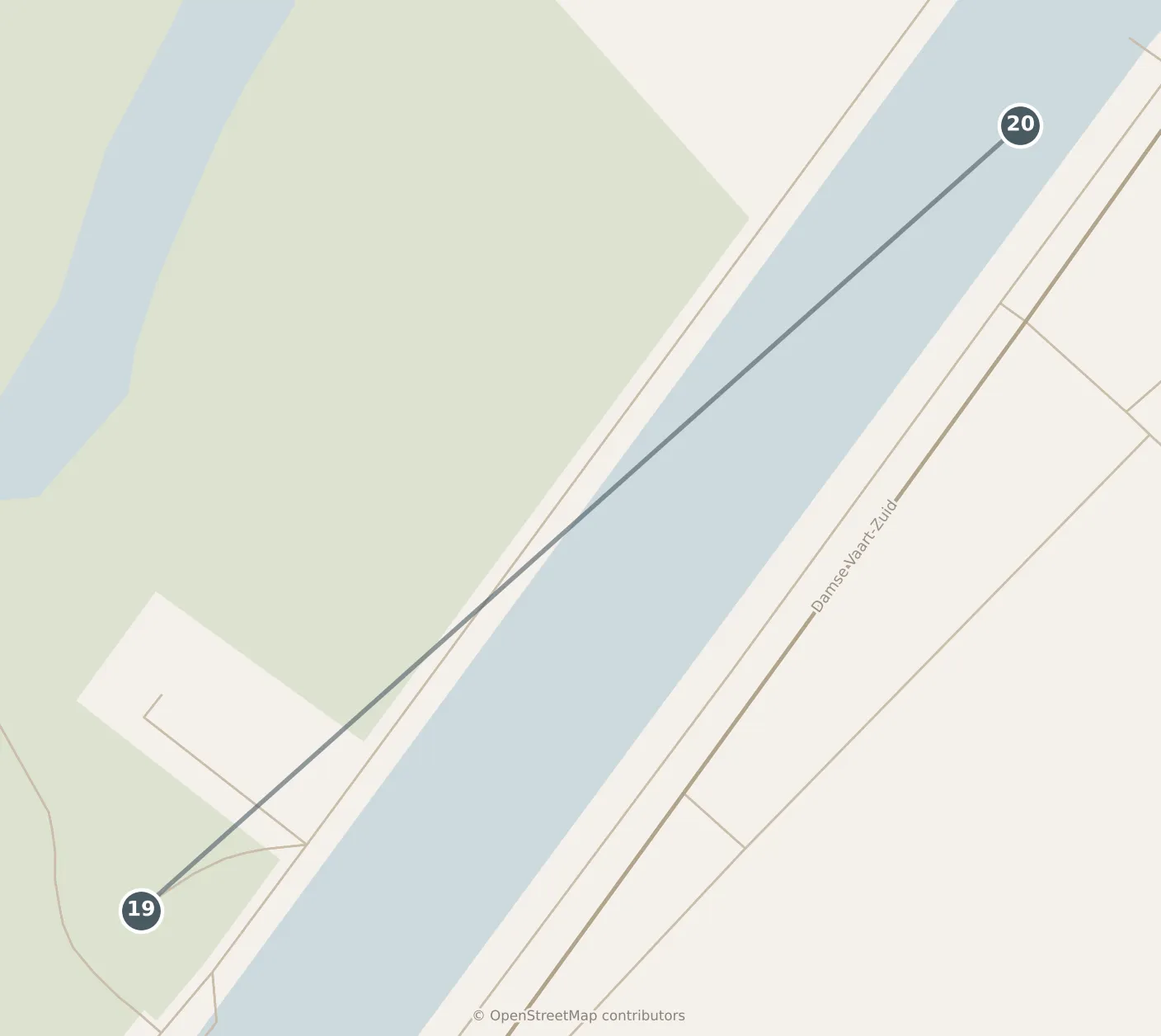
- With a third day
- 19Schellemolen
- 20Damme town hall
The third day goes on the end by default, and it is the only one of the three that could go anywhere, because it is the only one with no weekday of its own — days one and two have to be assigned around three closing days between them, and this one floats, so it absorbs whatever is left. If you would rather put it in the middle you can, and it costs nothing: separating days one and two loosens their rules instead of tightening them, because they stop being consecutive.
Give it to Damme, six kilometers north-east as the canal runs and about seven from the Markt once you have got out of the ring. This is not a detour from the subject, it is the subject: Damme was the outport of Bruges, the place where seagoing ships transferred cargo when the Zwin still reached inland, and Charles the Bold married Margaret of York here in 1468 — the same duke whose effigy you stood over on day one. When the water left, the town shrank from about eleven hundred people to eighty households, and in 1725 the parish church gave up and demolished its own nave and transept, keeping two walls to hold the tower upright. That stump is still what you walk towards.
Ride out. The Damse Vaart leaves the ring at the Dampoort in the north-east and runs dead straight to Damme and on to Sluis in the Netherlands, with a towpath on each bank and one of the great avenues of poplars in the country over it. It is entirely flat and about half an hour of unhurried pedalling. There is a path along each bank and they are not the same thing — one of them carries a quiet public road — so follow the signed Damme cycle route out of the gate rather than picking a side by eye. Rent from Blue-bike, the shared-bike scheme at Station Brugge, which unlocks from an app, wants an account made before you are standing at the rack rather than on the morning, and wants the machine back at the same rack; for two of you arriving without one, the rental shops around ‘t Zand and the Markt are the simpler answer. Almost every street in the center is inside a bicycle zone where nothing may pass a cyclist or exceed thirty, which sounds generous until you meet the crowd on Katelijnestraat — ride at walking pace through it and start properly at the gate.
Leave the center at ten and allow two and a half hours in Damme, and you will not be hurrying. The Schellemolen is the first thing you reach, a whitewashed tower mill of 1867 standing where a mill has stood since 1479, with an oil press in its cellar; the inside is open on weekends from April to late September and the outside always. Four minutes on, Damme town hall is the center of the place — Brabantine Gothic of 1464 to 1467, a double staircase with lions, four corner turrets, and a building visibly a third smaller than the one it replaced, because the town could no longer fill it. Read the canal here before you leave: it was dug on Napoleon’s order from 1810 to move troops behind the coast out of reach of the English navy, left unfinished at his fall, and completed after 1818 — and it was cut straight through the middle of Damme, so the market square and a row of merchants’ houses were demolished to make room. The thing you rode along is what finally took the town apart. Damme trades in second-hand books now, from dealers around that square — how many are open on an ordinary weekday varies, and the trade is smaller than its reputation, so treat it as something to wander into rather than an hour to plan.
Ride back the same way and you are in the center by half past one, with three hours before the last admissions — half an hour before the doors shut, as everywhere here. Spend them on what days one and two cut: the brewery on Walplein, which is the one of these that is neither a museum nor a church; the Volkskundemuseum and its lace neighbor on Balstraat if you skipped them; BRUSK on the Dijver if temporary exhibitions are your thing; or simply the canal boat if the line defeated you on day two. The Volkskundemuseum and BRUSK are on the card you bought for day one, whose seventy-two hours are still running; the lace center, the boat and the brewery are not. Then the last evening is the center, and it is the one to give to the canals at dusk: nothing is open by then in any case, and the water is what the town is for.
Local tip. If you would rather not cycle, the Lamme Goedzak sails the same canal four times a day from Noorweegse Kaai 31, out on the even hours from noon and back from Damme on the odd ones — daily from early April to early October in 2026 and weekends only for the month after that. Take the noon boat out and the three o’clock back and you get the same two and a half hours in Damme; what changes is that the morning is now the free part of the day rather than the afternoon, so move the leftovers above to the start. Two things to know before you plan around it: the jetty is on the Handelskom in the north-east, about forty minutes’ walk from the Markt or a De Lijn bus, and the boat does not carry bicycles. So it is bike both ways or boat both ways, never one of each — unless you use the one-way e-bikes from Hoppy, whose zones the city lists as reaching Damme, which is worth checking in their app before you set out rather than at the quayside.
If a whole day out of Bruges is not what you want, the honest alternative is a city rather than a village: Ghent is about half an hour from Station Brugge to Gent-Sint-Pieters, with between one and four direct trains an hour, and its cathedral holds the Jan van Eyck altarpiece that everything in the Groeningemuseum is measured against. That is a replacement for this whole day and not an addition to it — the two do not fit together — and it is ticketed at its own door rather than with anything you bought for Bruges.
Practicalities
Book two things before you travel and nothing else. The Musea Brugge Card, which covers all five of day one’s ticketed doors — the hospital museum, the ticketed half of the church, the Gruuthusemuseum, the Groeningemuseum and the belfry — plus the town hall, the Brugse Vrije, the mill and BRUSK on the days after, and not the canal boat, the Adornes estate or the lace center, which belong to other people; on day one’s five alone it has paid for itself. And a time slot for the belfry, on the same site — which is a free reservation against a card you already hold and not a second purchase — for the hour you actually mean to climb rather than the hour you hope to — the slot lapses if you are late, and on a heavy day they can close the line at the door before the tower closes. Everything else is sold where you stand: the canal boats only at their jetties, the Adornes estate and the lace center at their own doors, the Damme boat on the quay.
The weekday rules, and how to apply them rather than follow them. Day one must miss Monday, when both the Groeningemuseum and the Sint-Janshospitaal are shut, and Wednesday, when the Gruuthusemuseum is. Day two must miss Sunday, when the Adornes estate and the lace center are both closed. One smaller thing rides with that. The town hall opens every day, Mondays included — which is what makes the Monday and Wednesday arrivals work at all — but access to it is limited on the last Monday of the month outside July, when the council sits. If your day two lands there, expect to lose those forty minutes and give them to the boat, whose line only grows through the morning — not to the Vismarkt, which on a Monday is selling nothing and is ten minutes in any case. Those are the only two load-bearing rules, and they never collide — for any two consecutive dates at least one assignment satisfies both. Worked out over all seven pairs it comes to this: a Monday, a Wednesday or a Saturday arrival means running day two first, because in each of those pairs day one has nowhere else to go; a Tuesday or a Sunday arrival means running them in the order written, because there the swap is what breaks; and a Thursday or a Friday arrival takes either. The mill at the end of day two carries a season as well as a closing day: April to early November, shut on Mondays; then nothing at all until December, and from December to March one Sunday a month. So once the season closes in early November day two ends on the embankment rather than in the mill — the winter Sunday is no use to it, since day two cannot be a Sunday — and on a Monday in season the same, which costs half an hour and nothing else, since the mound and the rampart walk are free and always open.
Two published exceptions are worth knowing. On Easter Monday and Whit Monday the Monday closures are lifted for the day one museums, so those two dates behave like any other day. Ascension Day is the other one, and it is not an inconvenience — it is the largest thing that happens in this city all year. It is the Procession of the Holy Blood, on the UNESCO list of intangible heritage since 2009: some three thousand people through the center in the afternoon, after a pontifical Mass in the cathedral in the morning, watched by tens of thousands. That is why everything Musea Brugge runs shuts at half past twelve and the town hall and the church museum do not open at all. Neither day as written survives it, and the streets they walk are not walkable in the way they assume. Take the morning for whatever is open, give the afternoon to the procession — or move your dates, if what you came for is the paintings. All of this is published by Musea Brugge for its own sites in one place, which is one page to check rather than five, and it is the single thing most likely to cost you a morning.
A Sunday on day one reorders the morning. The ticketed half of the Onze-Lieve-Vrouwekerk does not open until after lunch on a Sunday, and the cathedral does not open at all until the afternoon. So on a Sunday run day one backwards: hospital museum first thing, then the Gruuthusemuseum, then the Groeningemuseum, eat late, and take the church and the cathedral in the last two hours. The belfry still fits after them.
Last entry is half an hour before closing at the museums and a full hour at the belfry, which is what makes the running order of day one matter more than its contents. The Groeningemuseum is the only one of the day’s four museums that stays open an hour later in the summer half, which is exactly why it goes last there. In the winter half all four shut together at five, so half an hour of slippage before lunch is enough to lose it, and the repair is to drop the cathedral rather than to hurry the hospital. Note that dropping the belfry does not help with this one: it comes after the museum you are trying to save, so its three quarters of an hour are behind the problem rather than in front of it.
Nothing on days one and two needs public transport inside the city. The half-hour canal boat is a sight rather than a way of getting anywhere and it puts you back on the quay you left from. Day one walks about three and a half kilometers and day two about four and a half, plus whatever you take of the rampart walk. No single leg between stops is longer than about ten minutes; the two long walks on this trip sit outside the route, and they are the twenty-five minutes between Station Brugge and the Markt at each end, and the half hour back into the center from the mills. Bruges is flat and that is not the problem: nearly every street here is laid in setts, and that is what tells on feet and on wheels. How the city’s buses and passes work, if you want to ride the first stretch in, belongs to the city guide rather than to this page.
The third day is the one with a season. The Damme boat runs from early April to the beginning of November and the Schellemolen opens its inside only on weekends between April and late September, so a February third day is a bicycle and a closed mill — which is still a good ride, and worth knowing before you build a day around a paddle boat. The canal boats in the city carry the same caveat in milder form: they are guaranteed March to October and run outside that at the companies’ discretion and the weather’s.
One season crowds the center, and it is also the season with the year’s fixed closed days inside it. Through December and into January the city runs its winter lights and sets a Christmas market on the Markt — two different things on two different calendars, both of which move year to year, so read the current dates rather than a range. While they are on, the last crossing to the belfry on day one takes longer than the eight minutes given for it and the walk west to dinner is a crowd; neither is a reason to reorder anything, both are a reason to leave five minutes earlier than the numbers above suggest. What is a reason to move a date is that the year’s fixed closing days fall inside this window — and they are published on the same Musea Brugge page as everything else above, which is the page to open before you book rather than after.


