Bruges in one day: south to north on foot, with the crowded hours spent indoors

Last updated 4 August 2026
Overview
One day in Bruges is not a compromise, and the reason is the size of the place. The historic center sits inside an egg of water about two kilometers long, the route below comes to four kilometers of walking spread across a whole day, and no stop on it is more than ten minutes from the one before it. Nothing here is far from anything.
What makes a single day hard is the hours rather than the map. Between about ten in the morning and five in the afternoon the lanes around the Markt fill with coach parties and cruise passengers, and that is precisely the window in which every ticketed door in the city stands open. Spend the middle of the day outdoors and you spend it in a crowd. Spend it indoors and you come out into the city people actually travel here for.
So this route runs the unobvious way round: south to north, quiet end first. It starts at the station, goes straight to the two enclosed, near-silent places at the bottom of the egg, takes its interiors through the crowded middle, and gives the squares and the canals to the last hours, after the coaches have gone. What that costs you is a museum. This city holds two great collections of the Flemish primitives — one is a picture gallery, the other is the hospital the pictures were painted for and never left — and one day takes one of them. This route takes the hospital, which means the Groeningemuseum is what the day gives up, along with the windmills on the eastern ramparts and the canal boats. The argument runs the other way if six centuries of painting under one roof is what you came for, and swapping them costs you four minutes of walking and nothing else.
Light matters here, and it moves more than most visitors expect. The canals at the end of the day are worth the last of it, and the sun sets in this city anywhere from about twenty to five in the middle of December to a few minutes past ten at midsummer. In winter that works in your favor, because the lit gables arrive while you are still out in them. In midsummer it does not, since your train will very likely leave before the sky does anything at all: what you wait for in June is the emptying rather than the dark, and the emptying happens by the clock.
The one moment on this day that will not wait sits in the middle of the afternoon rather than at either end of it. The relic that gives the Heilig-Bloedbasiliek its name is brought out for veneration for two hours from two o’clock in 2026, on every day the basilica is open but one: on Ascension Day it goes out to Saint Salvator’s Cathedral in the morning and spends the afternoon in the procession. Outside that window you get two handsome chapels and no relic. Everything above is built backwards from that hour, so if you find the hour has moved, move the afternoon to meet the new one. Add up the recommendations below and the run from the station to the door of the basilica comes to about four hours with the walking and the lunch hour included, which puts the start at half past nine — which is also, in 2026, the hour at which the morning’s two museum doors first admitted anybody, so the day is bracketed at both ends by something real. That four-hour figure models the stops, the walking between them and the hour at the table, and nothing else: not the ticket desk at the hospital museum, not the first coffee, not the ten minutes lost finding a table at lunch. The half hour of slack it leaves you is the whole reason to start where it says.
And the bag. This day begins and ends at the same station, which is the easy case — whatever you do with it you do once, and the route brings you back past it. You can almost certainly put it down: there are left-luggage lockers in the station itself, on the Stationsplein side directly opposite the tourist office, in several sizes, paid by card and bookable ahead; a second set sits in the inner courtyard of the Historium on the Markt, which this route walks past in the middle of the afternoon. Use the station set if you can, because two stops are genuinely bad with a bag in your hand: three hundred and sixty-six steps up a medieval staircase, and a monastic courtyard where people live and where wheeling a case over cobbles is the wrong kind of noise. The station is before both of them and the Historium is not, so the second set solves the tower and leaves the courtyard exactly as it was: if the case is still with you at the Begijnhof, take it from the gate and the near side of the court, ten minutes rather than twenty-five, as below.
If both sets are full, the day is still a real day — it is this one with the tower taken out of it. Minnewater, ten minutes. The Begijnhof from the gate and the near side of the court, ten minutes rather than twenty-five, because a case wheeled over those cobbles is exactly the noise the sisters ask you not to make. The hospital museum, an hour and a quarter, which is the stop the whole morning exists for. The Michelangelo across the street, half an hour. Lunch sitting down on Simon Stevinplein, an hour, which is also where the bag stops mattering for a while. The basilica at two, the Stadhuis after it, and then straight across the Markt without climbing anything — north to Jan van Eyckplein, back down the Groenerei, and an hour rather than twenty minutes at the water before the walk to the train. You lose the tower and the view from it; you gain the best part of this day twice over.
The day

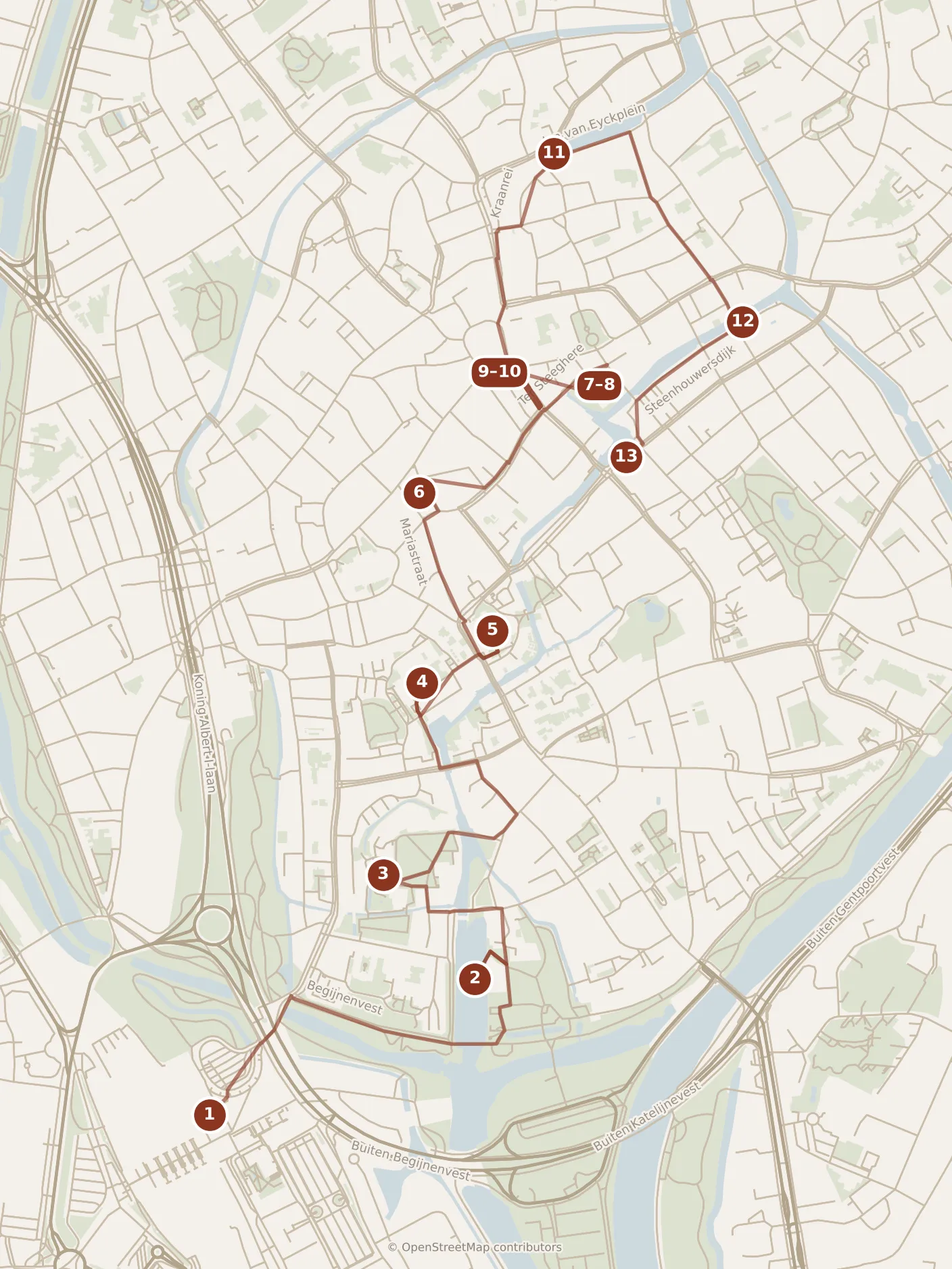
- The day
- 1Station Brugge
- 2Minnewater
- 3Begijnhof
- 4Sint-Janshospitaal
- 5Onze-Lieve-Vrouwekerk
- 6Simon Stevinplein
- 7Heilig-Bloedbasiliek
- 8Stadhuis
- 9Markt
- 10Belfort
- 11Jan van Eyckplein
- 12Groenerei
- 13Rozenhoedkaai
Morning
Ten minutes north of Station Brugge, at the bottom of the egg of water, the Minnewater is a long still rectangle with willows down the bank and swans on it. There is nothing to do here and that is its function: it is the decompression between a train and a medieval city, and it is the last water on this route you are likely to have largely to yourself. Ten minutes, walking one bank rather than circling the whole thing.
Five minutes further, through the gate and over the bridge, the Begijnhof — the Princely Beguinage Ten Wijngaerde. It is a ring of whitewashed houses round a courtyard of grass and trees, and it has been walled since the thirteenth century: first written mention in 1242, a hundred and fifty-two beguines living here in eleven convents at its fifteenth-century height, and in 1927 the last of them absorbed into the Benedictine community whose sisters have had the houses ever since. UNESCO listed it in 1998 together with twelve other Flemish beguinages. It is free to walk into, and it is not a monument — people live behind those doors, and the request for quiet inside the gate is a real request rather than decoration. Twenty-five minutes, slowly, going round the court rather than straight across it.
Six or seven minutes north up Mariastraat is the Sint-Janshospitaal, and this is the hour the morning is really for. It is a twelfth-century hospital, one of the oldest anywhere in Europe to survive with its buildings intact, and it still reads as one: long wards under a timber roof, a hospital church at the end of them, and a seventeenth-century pharmacy with its jars and its herb garden behind. What hangs in it is the second-largest collection of Hans Memling in the world, and four of the seven masterpieces here were painted for this building and have never been anywhere else — among them the Saint Ursula Shrine, a reliquary the size and shape of a small church with the saint’s whole story painted round its sides. Give it an hour and a quarter. If the day is running late, the piece to drop is the attic, where an audiovisual installation under the oak roof structure is pitched at children as much as adults and will take twenty minutes you would rather have later.
Two minutes across the street, the Onze-Lieve-Vrouwekerk, whose spire is 115.5 meters and the second-highest brick tower in the world — you have already been looking at it all morning without knowing which one it was. The church has a free half and a ticketed museum half, and the ticket is the one that matters: it holds Michelangelo’s marble Madonna and Child, thought to have been carved for the Piccolomini altar in Siena Cathedral and bought out from under it by a Bruges merchant family called Mouscron, who had it shipped north — the museum that owns it claims no more than that it was among the first works by the artist to leave Italy in his lifetime; and it holds the mausoleums of Charles the Bold and his daughter Mary of Burgundy, gilded bronze figures lying on black stone. Thirty-five minutes. Stand with the Madonna for five of them rather than one — it is small, it is set high, and everybody photographs it in eight seconds and leaves.
Afternoon
Five minutes north, Simon Stevinplein is a small square a street off the through-route between the station and the Markt, and this is where lunch goes. Not because it is any kind of secret, but because it is the last square before the Burg that is not on the funnel, and because a sit-down hour is worth spending in a country that takes lunch seriously. Order stoofvlees if you see it: beef stewed in dark beer until it falls apart, with fries alongside rather than underneath. In the cooler half of the year mosselen-friet is the other honest answer. An hour, and it is not a wasted hour — the alternative is eating out of paper on the most crowded ground in the city, which is where you are going next.
Seven minutes north-east through the lanes and the Burg opens up, a small square with several centuries of civic architecture standing shoulder to shoulder down one side. The Heilig-Bloedbasiliek is the low dark end of that row, and it is two churches stacked on top of each other. The lower one is bare, heavy and Romanesque and takes four minutes. The stair puts you in a completely different room, painted and gilded, and that is where the relic is: a phial said to hold cloth stained with the blood of Christ, brought here in the twelfth century and carried through the streets once a year on Ascension Day. Both chapels are free, and during a service the one in use is open only to people attending it. Nothing the basilica publishes says how the line for the veneration forms or whether you may photograph the relic; that you find out at the door. The small treasury beside them is not free, and it is a reliquary and some vestments that you can skip without regret. Twenty-five minutes if you are there for the veneration, ten if you are not.
Thirty seconds along the same side of the square, the Stadhuis. Built between 1376 and 1421, it is one of the oldest city halls in the Low Countries, and it was copied rather than merely admired — the city halls of Brussels, Ghent, Leuven and Oudenaarde all owe it something. What the ticket buys is the Gothic Hall upstairs: a mural cycle of the city’s history painted in the early twentieth century, under a timber vault whose fourteenth-century painted consoles are the older and much the better thing in the room. Half an hour. The room next door on Bruges and the sea deserves five minutes of that half hour and no more.
Four minutes west along Breidelstraat and you are on the Markt, which in the middle of the afternoon is ground to cross rather than stand on. The Belfort is on its south side: eighty-three meters, thirteenth century, three hundred and sixty-six steps, with the treasury room where the city kept its charters, its seals and its money on the way up, and a carillon of forty-seven bells above that. UNESCO listed it in 1999 along with fifty-five other belfries in this country and in France. Give the climb forty-five minutes including the wait at the bottom, and stop at the landings instead of racing them; the staircase narrows and there is no overtaking near the top. One warning here is not invented and comes from the people who run it: the tower gets very hot, and they say plainly that in real heat they may have to close the doors, and that they will announce it on the spot.
Local tip. This day holds four tickets comfortably and no more, so if one has to go, take them out in this order. The Gothic Hall goes first — half an hour of murals is the least surprising thing on the route. The climb goes second, and only because the wait at its door is the one thing here you cannot plan around. Neither the hospital museum nor the church’s ticketed half goes at all. And note that the basilica never competes with any of them, because it costs nothing.
Evening
Seven or eight minutes north of the Markt, up through the old merchant streets, Jan van Eyckplein was the head of the medieval harbor. The water came to here, and the tall merchant houses standing round it are what a port was built out of before the channel to the sea silted up and the city stopped being rich. The painter it is named for lived and worked in these streets. Ten minutes standing in it at the start of the evening, mostly because it is where the crowd is not.
From there, eight minutes back south-east along the water brings you onto the Groenerei, and this is the best walk of the day. It is a residential quay with low bridges, almshouses and front doors on it, and there is no attraction along it whatsoever, which is the entire point: this is the twenty minutes in which Bruges stops being a thing you are looking at and becomes a place people are having their evening in. Do not hurry it. If you have any of the day’s slack left, spend it here.
Six minutes west, where the Dijver meets the Groenerei, is the Rozenhoedkaai — the corner with the belfry rising behind the gables over the water, which is the most photographed view in the city and which earns it in the last hour of the day in a way it cannot in the middle of one. This is the stop the last part of the day exists for. Stay as long as the light lasts, which in December is not long — the sun will be going down as you arrive — and in June means you will not outlast it.
Then the train. From the Rozenhoedkaai it is about twenty-five minutes on foot back to Station Brugge, west across the shoulder of the Markt and out through ‘t Zand. That is the longest single stretch of the day by a wide margin — the next longest is the ten minutes you walked in the other direction this morning — so leave for it with light still in the sky if you do not know the lanes, because the pretty way out of the center and the direct one are not the same way.
Practicalities
One ticket here is worth settling before you travel, and one only: the climb up the Belfort. The people who run it recommend buying online in advance, because the tower is busy and because a staircase that narrow is not a line that gets shorter by your standing in it earlier. What they sell online is a timed slot and they say plainly that a ticket lapses if you are not there on time, so book the hour you actually mean to climb rather than the hour you hope to — and on a heavy day they can close the line at the door before the tower itself closes, which is the other half of the same argument. The standard ticket was in the fifteen-to-sixteen-euro range in 2026, which is the top of what any door on this route asks — one reason it is the one worth deciding about before you leave home. Everything else on this route is bought at the door or free, and the route itself needs no transport at all: it is walked from the station and back to it. How the city’s buses and passes work, if you want to ride the first stretch in, is the city guide’s business rather than this page’s.
Monday is the day that breaks this route, and it breaks it twice over. The Sint-Janshospitaal closes on Mondays and so does the Groeningemuseum — except Easter Monday and Whit Monday, when both open — which means that on any other Monday the collection this day gives up is also the one that would have replaced it. Everything else survives a Monday: the Begijnhof, the Onze-Lieve-Vrouwekerk, the Heilig-Bloedbasiliek, the Stadhuis, the Belfort, and every square and canal below them. So a Monday is not a lost day, it is a day with no Memling in it, and the honest repair is not a substitute museum but more of what this city is actually good at — take the morning at half the pace, add the free walk out along the eastern ramparts to the surviving windmills, and leave the rest of the order exactly as it stands. Check both museums before you fix your day rather than after: one operator, Musea Brugge, publishes the hours for those two and for the Stadhuis, the Belfort and the church museum as well, so it is one site rather than five, and it is the single thing most likely to cost you a morning.
Sunday reorders the morning instead of breaking it. The ticketed half of the Onze-Lieve-Vrouwekerk does not open on a Sunday morning at all — on that one day of the week it opens after lunch. So on a Sunday put the hospital museum first thing, eat early, take the church when it opens, and let the afternoon slide back behind it: the veneration runs on a Sunday like any other day, and the climb still fits after both. The rule survives whatever hour you find posted: the church is the piece that moves, and everything else keeps its order around it. It is not quite the only thing on this route that reads the day of the week — the Stadhuis shuts for weddings on some Tuesday and Saturday mornings and some Friday afternoons — but it is the only one that moves the order.
Two smaller things can shut a door in your face. The Heilig-Bloedbasiliek took a week off in the middle of January in 2026, which is worth a glance if your one day falls in deep winter; and the Stadhuis part-closes for a council meeting on the last Monday of most months, which is a Monday problem you have already been warned off for better reasons. One date closes more of this route than any Monday does, and it is the date the middle of this day is built backwards from.
On Ascension Day the Stadhuis and the ticketed half of the Onze-Lieve-Vrouwekerk do not open at all, the Belfort and the Sint-Janshospitaal admit in the morning only, and the relic is out in the streets rather than in the basilica, so the hinge everything above is timed to is not there. From the early afternoon the Markt, Simon Stevinplein, Mariastraat, the Dijver, ‘t Zand and most of the lanes between them are shut to traffic, pedestrians are held to marked crossing points, and the buses come off the route. Take this itinerary on another day. Do not take the city off the list for it, though: it is the one day of the year the relic is carried through those streets, and the honest plan is the two museums that open in the morning and the procession after them. Every museum on this route also shuts on 25 December and on 1 January, and closes early on the 24th and the 31st.
One season changes two stops without shutting anything. From late November to the middle of February the city runs its winter lights, and two Christmas markets stand inside them: one on the Markt, which makes the middle-of-the-day crossing slower rather than quicker, and one on Simon Stevinplein, which in those weeks is a destination in its own right rather than the square one street off the funnel that this route picks it for. Neither is a reason to reorder anything; both are a reason to know what you are walking into before you choose where to sit down.
The walking comes to about four kilometers from the station to the Rozenhoedkaai, and the longest leg inside the route is the ten minutes from the station to the Minnewater at the start. Bruges is flat, but almost every street on this route is laid in setts, and that is what will tell on your feet rather than any climb — it is also why a wheeled case is a worse idea here than the flatness makes it sound. The exception is the walk home: twenty-five minutes from the Rozenhoedkaai to Station Brugge, on top of everything above, and it is worth knowing that number before you decide how long to stand at the water.


