Berlin in a week: seven days, one district at a time, ending at the lakes

Last updated 27 July 2026
Overview
Berlin has no center, and a week is the length at which that stops being a problem and becomes the plan. A compact city rewards drifting; this one punishes it. The distances between its neighborhood cores are real — half an hour on the train between the west and the east — so a week spent sampling three of them a day is a week spent underground. The discipline here is the opposite of the one a small city teaches: one district a day, arrived at once in the morning, walked until the evening. Most days below are one walk with at most a single ride in the middle of it; only the last is a day of trains and buses, and its first line says so.
A single day in this city has to run one line and give up almost everything: the west, the lakes, the clubs, and four of the five houses on Museum Island. This week is where those come back, and its shape follows from that. The order opens with the avenue and the island, because they are what a first visit came for and getting them behind you frees the rest of the week. The west, which is a train ride away and a different city in temper, then gets a whole day rather than an afternoon. The last day leaves the built city altogether without leaving Berlin.
One thing is worth understanding before the first morning, because it governs how you look at almost every stop below. The subject of this city is largely not standing. What you have come to read is ground: a line of cobbles across a road, a field of concrete blocks, an excavated cellar wall, a strip of grass where a street used to be built up on both sides. The buildings that survive are often the ones that were ruined and then left ruined on purpose. A visitor who arrives expecting monuments finds the place thin; a visitor who arrives expecting to read the ground finds it inexhaustible, and that is the whole difference between a good week here and a disappointed one.
Two fixed points and no more. The dome of the parliament on day one is free and cannot be entered without registering in advance — it costs nothing, so nothing but time rations it, and the only usable instruction is to register the day you have your dates. And every house on Museum Island shuts on Mondays, which is the one closure that can wreck a day as written. Beyond those two, almost every stop in this article is free, outdoors and open every day of the week, which is unusual enough that the whole planning problem resolves into a single line in the last section.
Two real omissions, named because they are omissions rather than oversights: the Gemäldegalerie at the Kulturforum, one of the great old-master collections in Europe, and the Jewish museum in northern Kreuzberg. Both are half a day each and neither fits without breaking a district into two. They are the first things to add on an eighth day — along with Potsdam, which the last day of this week stops one station short of, deliberately, and which the last paragraph of day seven explains. Where to sleep is the city guide’s decision and this article does not repeat it.
Day one

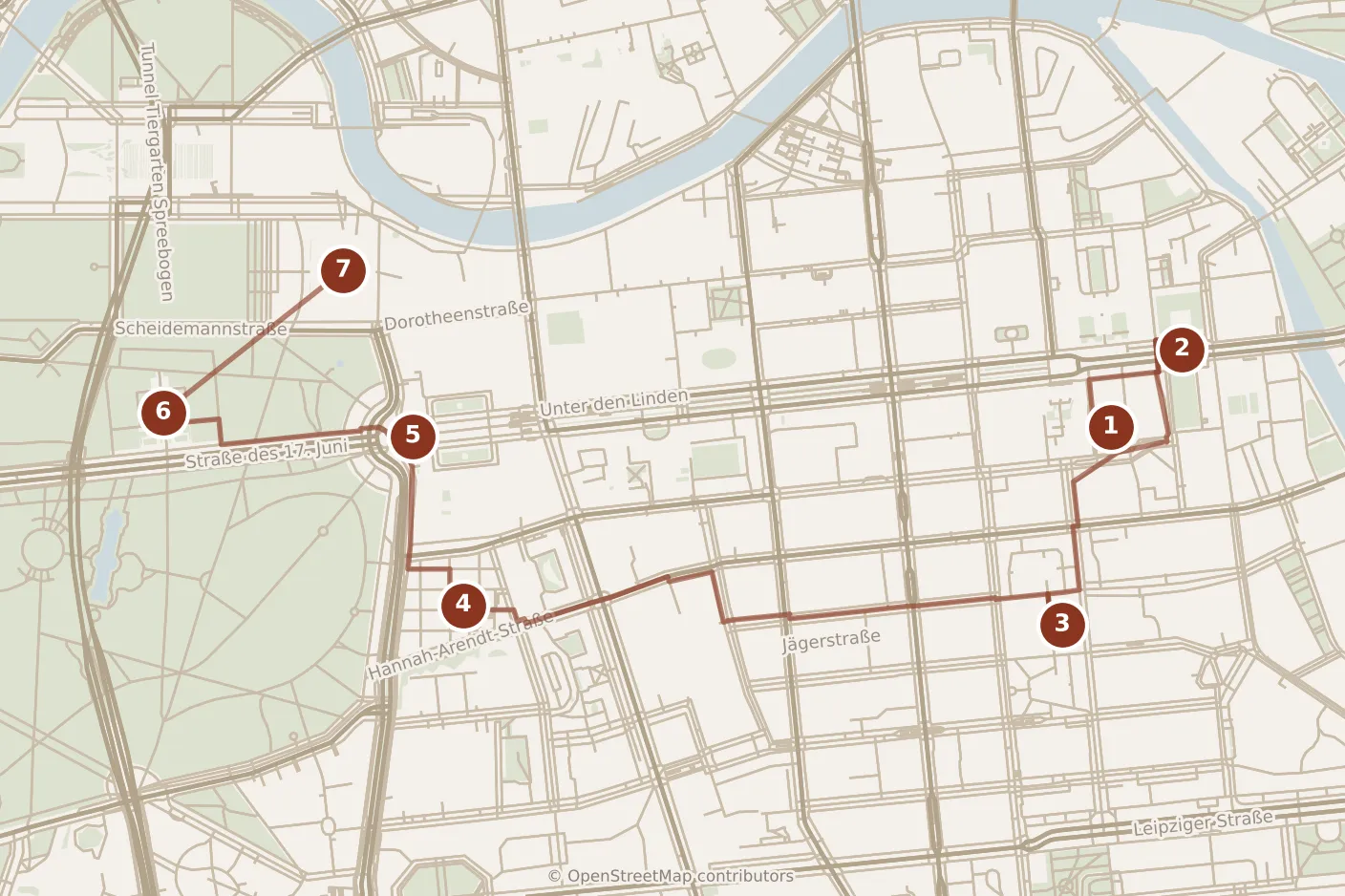
- Day one
- 1Bebelplatz
- 2Neue Wache
- 3Gendarmenmarkt
- 4Memorial to the Murdered Jews of Europe
- 5Brandenburg Gate
- 6Soviet War Memorial
- 7Reichstag
Mitte and the historic avenue, walked from east to west, finishing inside the glass dome above the parliament after dark. The direction is deliberate: the dome admits visitors later than anything else on this route, so it is the one stop that can hold the end of a day, and walking towards it means the postcard arrives last rather than first. If the slot you are given is a morning one, run the day backwards — the order below is a recommendation, and the booking is not.
Start at Bebelplatz, on the south side of the avenue. There is nothing to see here until you look down. Set flush into the paving near the middle of the square is a pane of glass over a small white room of empty shelves — room for the twenty thousand and more books burned on this spot in May 1933. It is Micha Ullman’s, unveiled in 1995, and people walk over it without noticing; the giveaway is the knot of visitors standing looking at their feet. The square around it is worth a slow circuit for the curved facade of the old royal library and the opera house opposite. Fifteen minutes.
Two minutes east on the avenue is the Neue Wache, a small columned guardhouse Karl Friedrich Schinkel built in 1816. Inside is one bare room and one object: an enlarged version of Käthe Kollwitz’s sculpture of a mother holding her dead son, alone on the floor under an open circle cut in the roof, so rain and snow fall on it. It is free, it takes five minutes, and it is the most affecting room in the district. Go in even if you are not going into anything else today.
Turn south for Gendarmenmarkt, five minutes away — two matching domed churches facing each other across a square with a concert hall between them, one church built for the city’s Huguenot refugees and one for its German congregation, the domes added later and purely for symmetry. The square itself was dug up and relaid over two years and reopened in March 2025, so it is now flat, clean and slightly bare. Twenty minutes, and it is the handsomest ensemble in Berlin.
From here walk west for about twenty minutes, which is the long leg of the day. Eat in the first few minutes of it, where the route crosses Friedrichstraße: everything after that is ministries and embassies and there is nothing on the sidewalk until the memorial. The Memorial to the Murdered Jews of Europe is where you come out: two thousand seven hundred and eleven concrete blocks on ground that rises and falls, by Peter Eisenman, opened in 2005. Do not photograph it from the edge and move on. Walk into the middle, where the paving drops away, the blocks go over your head and the traffic noise stops. Twenty minutes for the field. Underneath it and free is the information center, where the abstraction above becomes names, dates and postcards thrown from trains — give it an hour, and note that it is the one thing here that closes on Mondays.
Three hundred meters north is the Brandenburg Gate, on Pariser Platz. It is smaller than photographs suggest and it takes ten minutes. What is worth registering is not the arch but the ground under it: for twenty-eight years this gate stood inside the border strip, belonging to neither side, and nobody at all could walk through it.
Keep going west through the park for five minutes to the Soviet War Memorial — a curved colonnade with a bronze soldier on top and a real tank at each end, put up in 1945 within months of the surrender. The thing that makes it strange is that they knew: the sectors had been agreed the year before and the British had already moved into theirs, so the Soviets built this on ground they were handing over, and for the whole of the division a Soviet honor guard stood on duty inside West Berlin. Ten minutes.
Then double back to the Reichstag for your slot. An elevator takes you to the roof and the rest is on foot: two spiral ramps, one climbing and one descending, wound round a mirrored funnel that drops daylight into the debating chamber below. You look out over the government quarter going up and down through the middle at the parliament, which is the argument of the building — the electorate standing on top of the elected. The dome is Norman Foster’s, finished in 1999, on a building that burned in 1933 and then spent the years of the division empty with the Wall running past its back. Give it an hour, identity check included.
Local tip. Book the dome before you book anything else on this week, and then read this day outward from whatever hour you are given. An evening slot gives you the day exactly as written above. A morning one turns it round: the dome, the memorial, the square with the churches, the sunken library. Nothing is lost either way, and the one thing that cannot be rearranged is the slot.
Day two

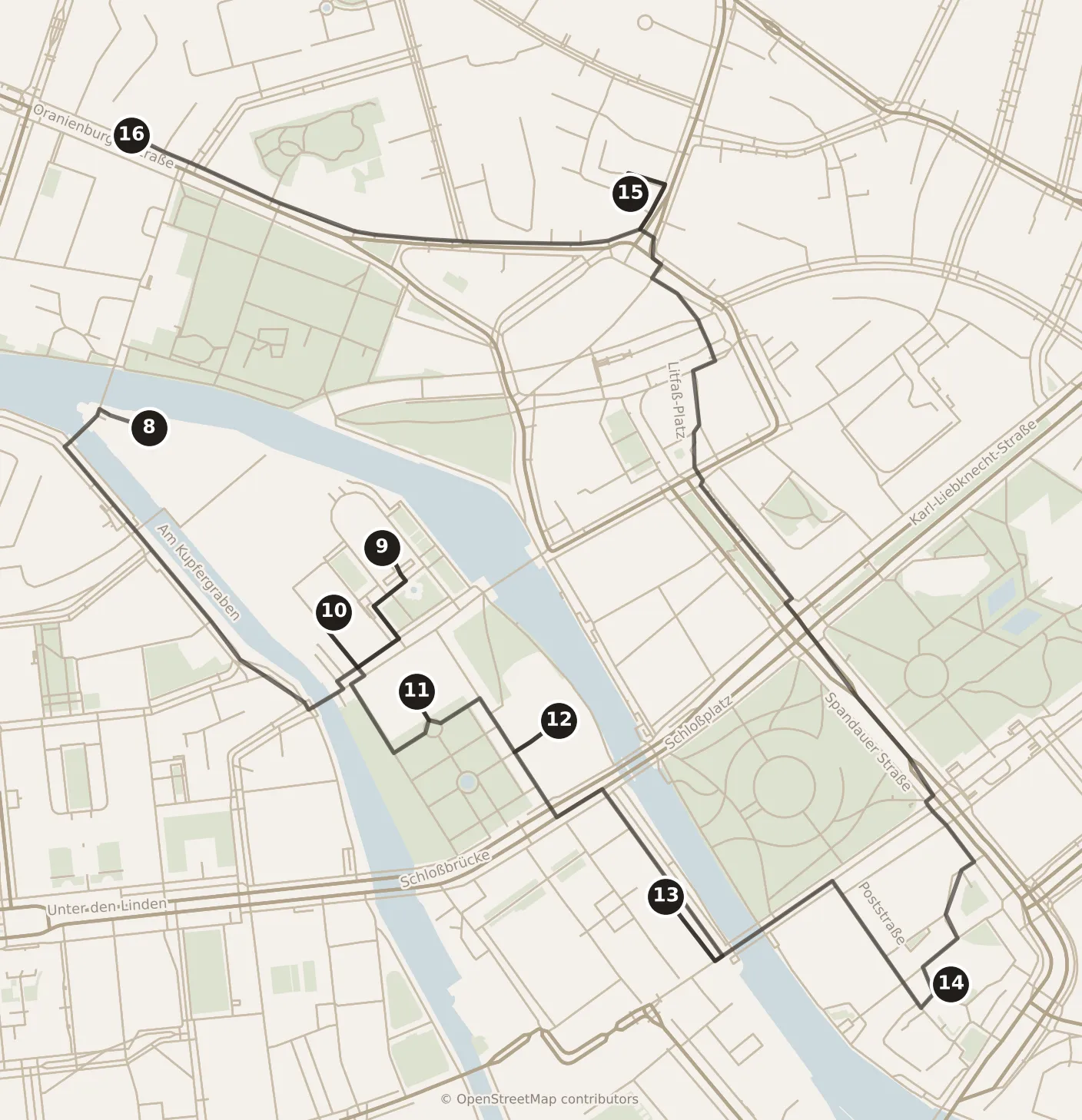
- Day two
- 8Bode Museum
- 9Alte Nationalgalerie
- 10Neues Museum
- 11Altes Museum
- 12Berlin Cathedral
- 13Humboldt Forum
- 14Nikolaiviertel
- 15Hackesche Höfe
- 16New Synagogue
Museum Island, and it begins five minutes from where yesterday began — the only two days of this week that touch. This one is indoors, and the whole service this article can do you here is to say plainly that four museums in a day is not a plan, it is a way of enjoying none of them. Take two. Below is what each of the four actually is, so you can choose rather than sweep.
The Neues Museum is the obvious one and it deserves to be. The painted limestone bust of Nefertiti is here, dug out of a sculptor’s workshop in Egypt in 1912 and startling chiefly for how unfinished it is — one eye has no inlay at all, and it is generally read as a master model rather than a portrait. But the building is half the visit: left a ruin by the war and rebuilt by David Chipperfield, reopening in 2009, with the damage deliberately unhidden — shrapnel-pocked columns, burnt brick, blank patches where the frescoes were. Ninety minutes. Give up the prehistory floors to do it; the Egyptian rooms and the staircase are what you came for. It sells an ordinary day ticket rather than a timed slot, so there is no arrival hour to hit.
The Alte Nationalgalerie next door is the one most visitors skip and the one this article would choose second. It is nineteenth-century painting arranged over three floors of a building shaped like a temple on a plinth: Caspar David Friedrich’s small, cold, enormous-feeling landscapes on the top floor, and Adolph Menzel’s iron rolling mill, which is the century’s industry painted by somebody who went and stood in one. Two hours if you take all three floors, an hour if you take the top.
The Bode Museum sits on the northern point of the island like the bow of a ship, and it holds sculpture and Byzantine art in a sequence of domed halls that are worth the ticket on their own. It is the quietest of the four by a distance. The Altes Museum is Schinkel’s, the oldest building on the island, and the reason to go in is the rotunda inside the portico — a domed circular hall ringed with statues, modeled on an ancient temple — with the classical antiquities around it.
One fact that will date, so it is written to date honestly. The Pergamon Museum, the house most people picture when they hear Museum Island, has been shut since October 2023 for a rebuilding done in halves: the north wing is announced for June 2027 and the south, which holds the Ishtar Gate, for around 2037. What survives of it meanwhile is a separate rotunda across the canal showing a painted panorama of the ancient city with some of the original sculpture around the walls. It keeps the island’s habits, including the Monday closure. Check what has reopened before you count on any of it, and plan this day so the answer does not matter.
Out of the museums and three minutes south-east, Berlin Cathedral is the enormous green-domed thing you have been seeing all day. Two reasons to pay: the crypt, holding the coffins of the Hohenzollern who ruled here until 1918, and the two hundred and seventy steps to the walkway around the outside of the dome. Forty-five minutes. Next to it the Humboldt Forum is a modern museum wearing three reconstructed baroque facades of the palace that stood here until the East demolished it in 1950. It is the one thing on this day that does not keep the island’s calendar: it opens on Mondays, when the island does not, and closes on Tuesdays, when the island is open. The roof terrace is free and is the best place to understand the island you have just walked. Inside are the ethnological collections, and the honest thing to say about them is that Germany transferred ownership of its Benin bronzes to Nigeria in 2022, so what is shown here now is shown by agreement rather than by right, and the building says so.
Two short things close the day. The Nikolaiviertel, five minutes east, looks like a medieval quarter and is a reconstruction built in the 1980s around one genuinely old church; it is pleasant and it is scenery, and if you are tired it is the thing to drop. Better is to walk fifteen minutes north into the Scheunenviertel, the old Jewish quarter, and through the Hackesche Höfe — eight interlocking courtyards of 1906 behind a tiled art nouveau front, restored and now full of shops, but the sequence of courtyards is the architecture and it is free to walk. The gilded dome of the New Synagogue is on the next street, five minutes away; the building behind the front was gutted in the war and only the front section is rebuilt, which is why the visit is short and the outside is the point. Dinner in the streets north of here, towards the old Jewish quarter and Rosenthaler Platz, which is where this district eats.
Day three

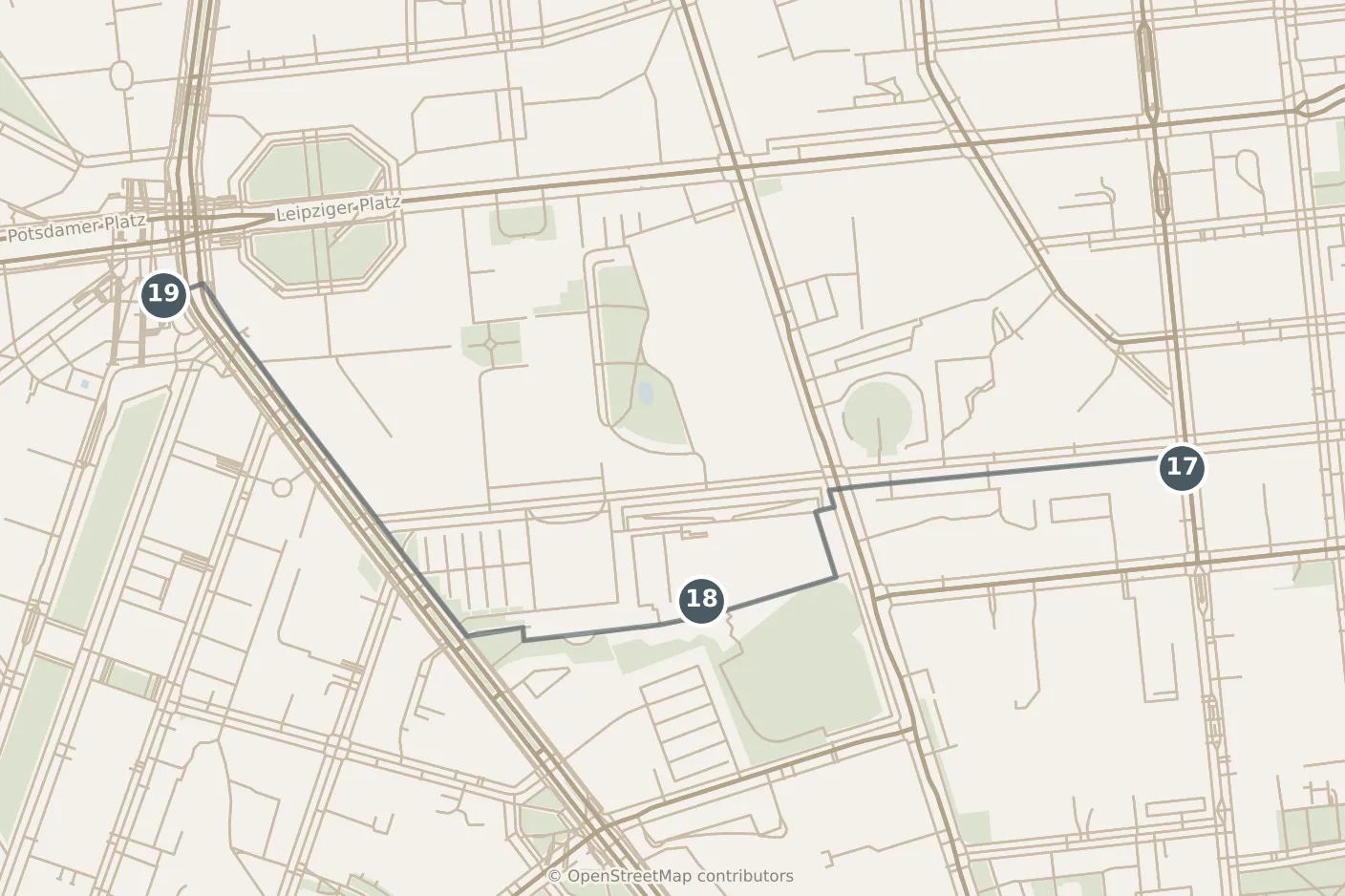
- Day three · stops 17–19
- 17Checkpoint Charlie
- 18Topography of Terror
- 19Potsdamer Platz
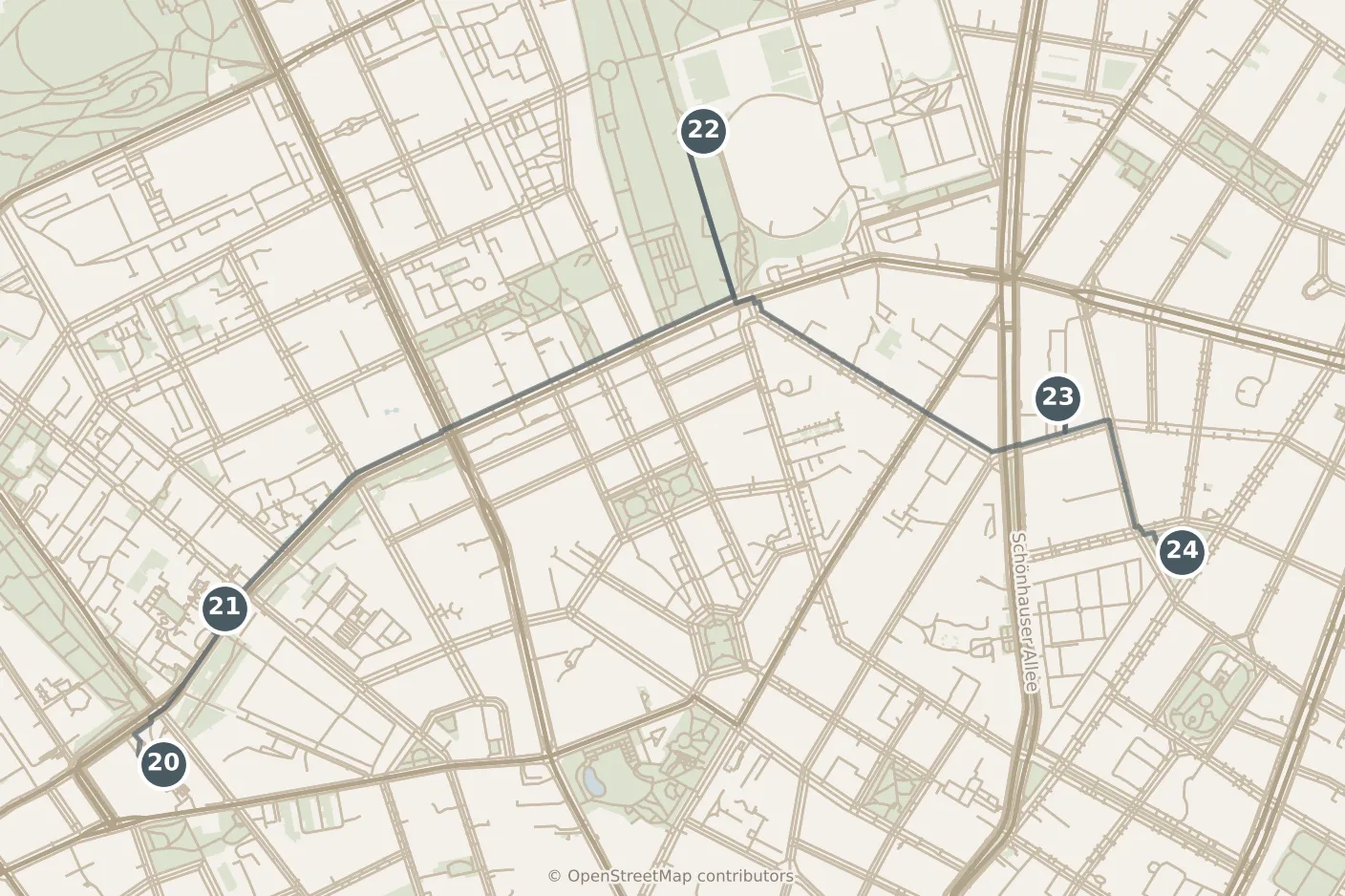
- Day three · stops 20–24
- 20Nordbahnhof
- 21Berlin Wall Memorial
- 22Mauerpark
- 23Kulturbrauerei
- 24Kollwitzplatz
The Wall, south to north, as a system rather than as a surface — and this is the day the week is built around. It begins with the version of it that has become a souvenir and spends the rest of the day undoing that impression. One train ride in the middle; everything else is on foot.
Start at Checkpoint Charlie and give it ten minutes, no more. A replica hut and a reproduction sign stand marooned in a road junction with nothing original left in the street, ringed by souvenir shops and men in costume. It is worth standing in for exactly as long as it takes to register what has happened here, because the rest of the day is the corrective.
Five minutes west is the Topography of Terror, free and open every day, and this is the hour that earns the morning. The Gestapo and the SS ran the machinery of the Nazi terror from buildings on this block; they were demolished after 1945 and the ground lay derelict for decades before it became a documentation center standing over the excavated cellar walls. There are two exhibitions and they are not equal. The indoor one is dense and almost entirely panels of text. The open-air trench along the cellars is the one to read if you read only one, and along the street outside runs the longest surviving stretch of the outer wall — the face that the West could see, a different structure from the one you will walk this evening. Give it ninety minutes.
Ten minutes further west is Potsdamer Platz, and it takes fifteen. This was one of the busiest traffic junctions in Europe between the wars; then it was flattened, then it was inside the death strip, and for twenty-eight years it was an empty field with a wall across it. What stands here now was built from nothing in the 1990s, which is why it feels like an airport. A double line of cobbles set into the road marks where the wall ran, and a handful of original segments stand outside the station. That double line runs across the whole city and once you have seen it here you will keep finding it.
From the station take the S1 north to Nordbahnhof. Before you come up, look at the free exhibition on the mezzanine: this was a ghost station, one of the stops on western lines that ran under East Berlin without stopping, its entrances bricked up and its platforms patrolled by guards for twenty-eight years. The marks of the sealing walls are still on the tiles.
You come out onto Bernauer Straße and the Berlin Wall Memorial, which needs two hours and is free. This is the last stretch of the border strip that survives at its full depth — one and a half kilometers of it, running along the street, with about seventy meters kept complete: outer wall, raked sand, signal fence, inner wall and a watchtower. Everything else is marked rather than rebuilt, and that is what makes it legible. Rows of steel rods stand where the wall ran. The foundations of the tenement houses whose front walls were the border until they were demolished are exposed in the grass. The Chapel of Reconciliation is an oval of rammed earth built on the footprint of the church that stood inside the strip and was blown up in 1985. There is an observation tower at the visitor center that lets you look down into the whole arrangement, which is the only way to see that it was a system with a width and not a line. And there is a wall of photographs of the people who died trying to cross.
Then the strip simply becomes a park. Mauerpark, twenty minutes north along the same line, is the death strip with grass on it; the raised bank on its eastern edge is where the inner wall stood, and a painted stretch of it is still up there. On Sundays the whole park fills with a flea market, on ground nobody was allowed to stand on within living memory. From late spring to autumn, and only if it is not raining, one man wheels a battery-powered sound system into the little amphitheatre and runs an open-air karaoke, which is the most cheerful thing in this city and is worth a Sunday if you get one.
Finish in Prenzlauer Berg, fifteen minutes east: the Kulturbrauerei, a brewery of the 1890s in yellow and red brick now full of cinemas and bars, with a small free museum of everyday life in the East inside it, and then Kollwitzplatz five minutes on for dinner. The district is restored nineteenth-century tenements that came through the war largely intact, which after a day of gaps and markers is a deliberate contrast.
Local tip. The strip on Bernauer Straße is a public street: no ticket, no hour, and you can walk it at any time. The documentation center and the tower are not, so take those first and the strip afterwards. Doing it the other way round is how people end up looking at the best half through a locked door.
Day four

- Day four
- 25Charlottenburg Palace
- 26Kurfürstendamm
- 27Kaiser Wilhelm Memorial Church
- 28Berlin Zoological Garden
- 29Victory Column
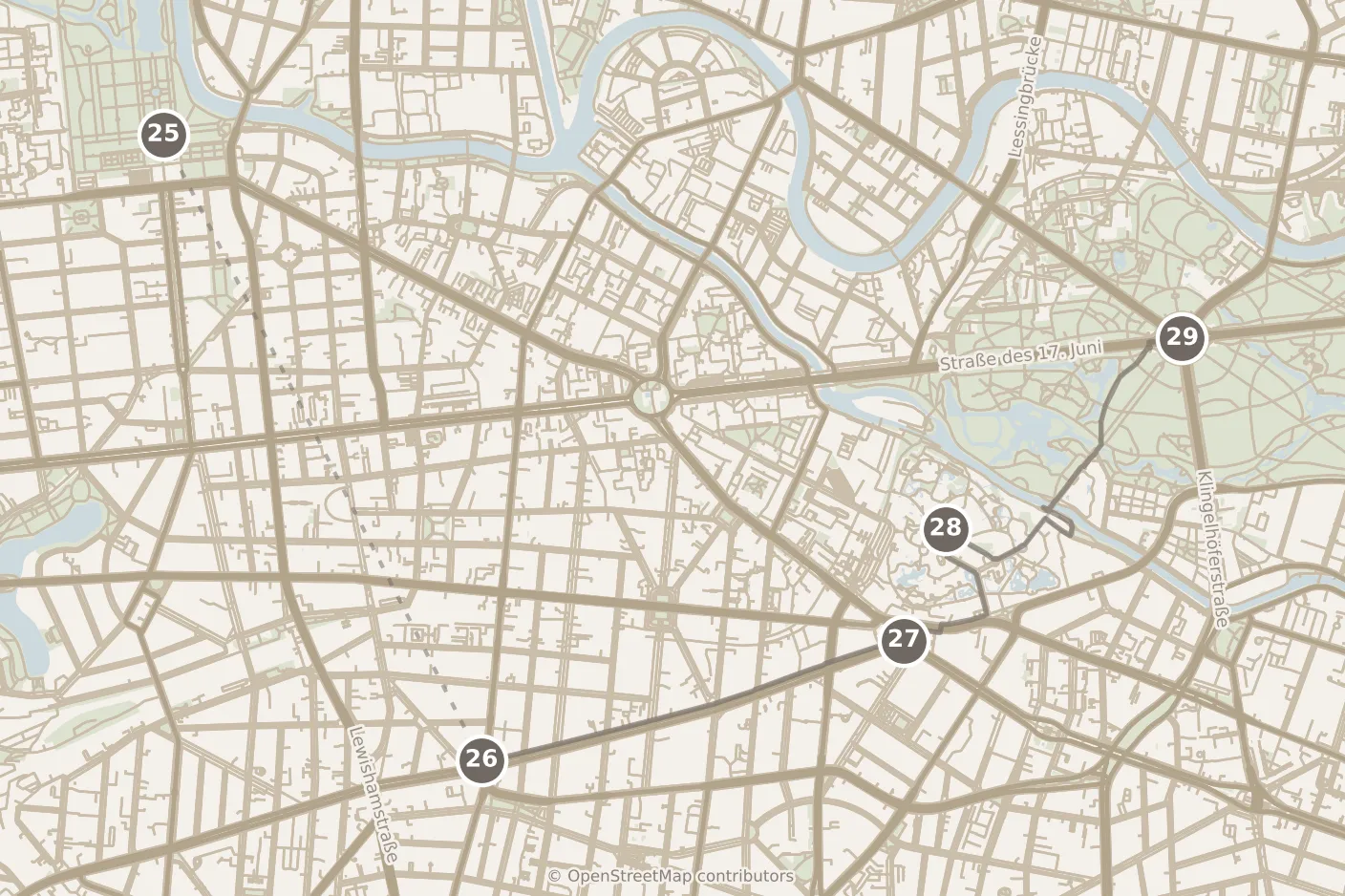
Charlottenburg and the west, which is a separate city in temper and needs a day rather than an afternoon. This was the center of West Berlin during the division — not the whole of it, since three other days of this week are also in the former West, but the half of the city that had the shops, the money and the shop windows — and it is calmer, older, richer and more conventionally handsome than anywhere else here. It is also the one day that starts with a real journey out — about half an hour on the U-Bahn from the middle of the city, and then ten minutes on foot from the station, or a bus that stops at the palace gates — so treat the morning as part of it.
Charlottenburg Palace takes the morning. It is a baroque summer palace begun in 1695 and extended for a century afterwards, and it comes in two halves with separate tickets: the old palace, with a domed center and a porcelain cabinet lined floor to ceiling with several thousand pieces of blue and white china, and the new wing, which is the eighteenth-century state rooms and the better half if you are only taking one. Ninety minutes inside. The garden behind it is free and open every day, and is worth half an hour on its own: a formal parterre nearest the house, then an informal landscape park running down to the Spree with a mausoleum and a tea pavilion in it. The palace is shut on Mondays; the garden never is.
A bus east takes about a quarter of an hour and puts you on the Kurfürstendamm, the west’s high street — three and a half kilometers of shopping and cafés laid out in the 1880s as a boulevard and rebuilt plainly after the war. Walk the eastern end of it rather than all of it, and read the side streets, which is where the surviving nineteenth-century apartment blocks are.
It delivers you to the Kaiser Wilhelm Memorial Church, which is the west in one object. The church was gutted by bombing in 1943 and the broken tower was left standing on purpose, with the top of it torn off and open to the weather. Beside it Egon Eiermann built a new church between 1959 and 1963, an octagon and a separate bell tower with walls made entirely of small blue glass blocks. Go into the new one. The light inside is deep blue and almost solid, and it is a completely different thing from the photograph of it. Twenty minutes for the ruin, twenty for the blue room.
The Berlin Zoological Garden is directly behind it, opened in 1844 as the first zoo in the country and holding one of the broadest collections of species anywhere. It takes two to three hours done properly and it is entirely reasonable to skip it: if you do, you get the afternoon back for the park, which is the better half of this day anyway.
Because the Tiergarten is the point. It is a royal hunting ground that became a public park, and it is not a formal one — paths through woodland, a rowing lake, statues appearing between the trees. In the winters after the war it was cut down almost entirely for firewood and planted with potatoes, and everything you walk under was put back afterwards. Give it an hour crossing east.
You come out at the Victory Column in the middle of a large roundabout, reached by pedestrian tunnels under the traffic. It went up in 1873 to mark three Prussian wars and stood in front of the parliament until 1939, when it was taken down and re-erected here, taller, on the axis the Nazi plan for the city was to be built along. There are two hundred and eighty-five steps up a narrowing spiral to a platform fifty-one meters up, directly under the gilded figure, and the view is the whole park with the gate and the parliament at the end of the avenue. Finish at the beer garden on the rowing lake, ten minutes back into the park to the south-west, which is where the west spends a summer evening — so come down off the column and walk back the way you came in.
Day five

- Day five
- 30Viktoriapark
- Bergmannstraße — in the prose, not on the map
- 31Tempelhofer Feld
- 32Maybachufer
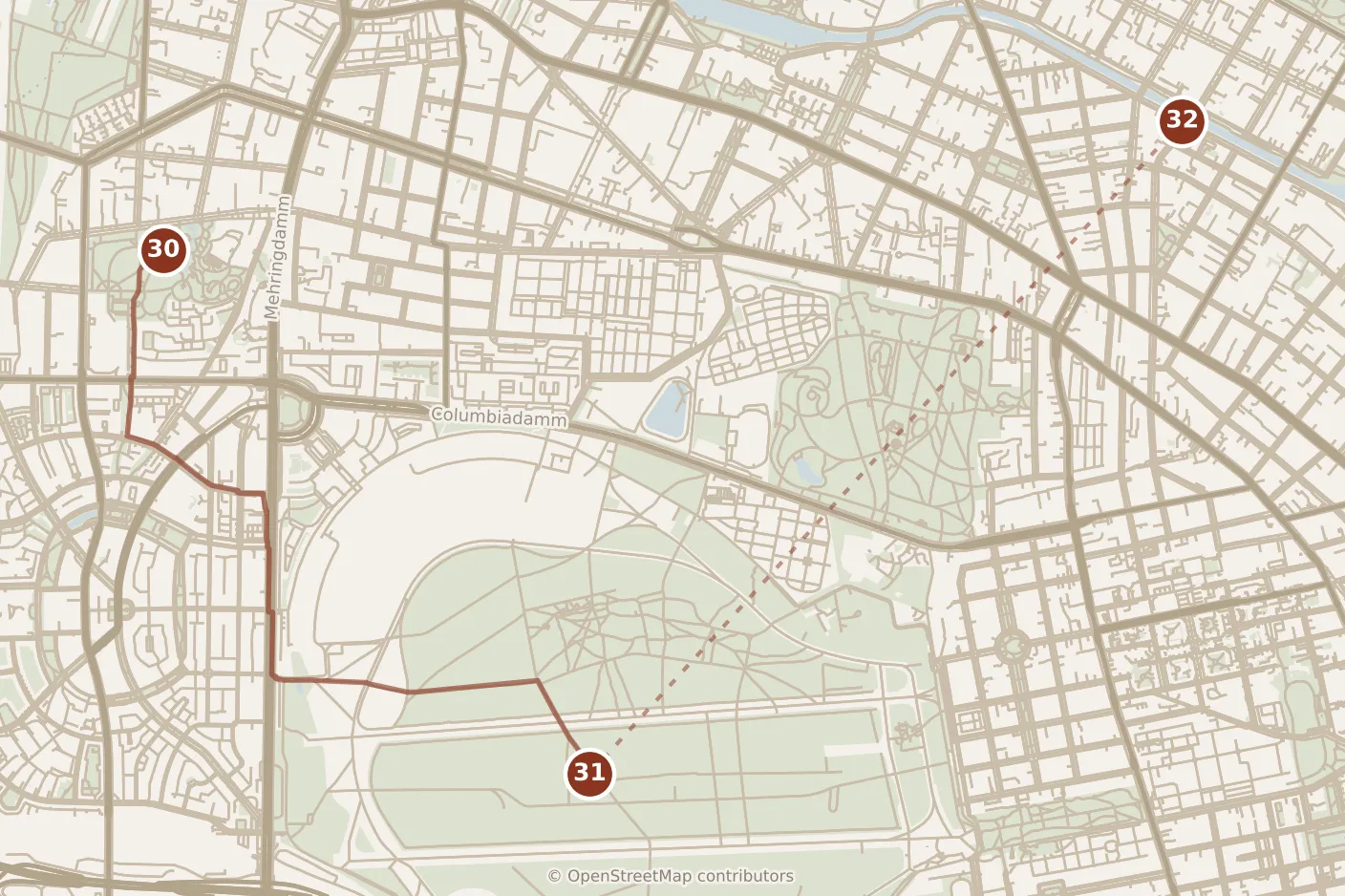
Kreuzberg, an airfield and Neukölln — and after two heavy days this is deliberately the loose one, with a hill, a park the size of a small town and no ticket anywhere in it. It is also the longest walk of the week, and flat everywhere except the first half hour.
Begin at Viktoriapark, on the hill the district is named after. It is sixty-six meters high, which is nothing anywhere else and is a genuine viewpoint here, and on top of it stands a cast-iron spire Schinkel designed in 1821 to mark the wars against the French. Down the northern face runs an artificial waterfall built in the 1890s, fed by a pump and switched on for the warmer half of the year, with a path beside it. Half an hour up and down, and it is the only place all week you look at the flatness from ground you climbed rather than from the top of a building.
Ten minutes east is Bergmannstraße, the gentle half of Kreuzberg — a long street of nineteenth-century blocks, second-hand shops and sidewalk tables, with a covered market hall on the south side that has been a working neighborhood market since the 1890s and has lunch counters in among the butchers and the greengrocers. This is lunch, and it is the right lunch, because there is nothing to buy for the next two hours.
Ten minutes south the ground opens. Tempelhofer Feld is an airfield inside the city that stopped being one in 2008 and was opened as a park in 2010: three hundred and eighty-six hectares of flat grass with two runways down the middle, no trees to speak of, and the terminal along one edge — a single curved building more than a kilometer long, built in the 1930s. People cycle and skate on the runways, fly kites, barbecue, and grow vegetables in allotments at the edges. In 2014 the city held a referendum on building housing on part of it and sixty-four per cent voted to leave it empty, which is the fact that explains the place: this is not a park that was designed, it is one that was defended. Enter at the terminal end and walk out diagonally to the far south-eastern corner, at the Oderstraße gates, which is about forty minutes and gives you the runway down its length. Do not try to see all of it. Two things about the field itself: there is no shade and nothing to buy once you are past the entrances, so carry water and eat before you go in; and the gates follow the daylight, opening near sunrise and closing near sunset, so on a short winter afternoon this walk has to start early. (You can always leave — the four main entrances have turnstiles that work at any hour — but you cannot always get in.)
From the Oderstraße gates the U8 is a few minutes away at Leinestraße; take it north to Hermannplatz rather than walking the streets, and come up in the middle of Neukölln. Walk down to the Maybachufer, the canal bank, where a Turkish market trades on Tuesdays and Fridays — fabric by the meter, mountains of herbs, bread, and a crowd from the whole southern half of the city. On the other five days it is simply the best towpath in Berlin, and the Landwehrkanal here is a green corridor with the district on one side and Kreuzberg on the other.
The evening stays where you are. Neukölln is where the city’s cheap eating is now and its bar streets are two blocks south of the canal, behind the market, and this is the night for a Döner — a wedge of flatbread split into a pocket and loaded, not the rolled kind. It is also, if you are going, the night for the clubs. The serious ones sit on the river between here and the east, they open around the time everything else closes, and the entrance is a selection rather than a line; phone cameras get taped over at the door and stay taped. Nobody is owed entry and plenty of people do not get in. There is no list of names in this article because the ones worth the wait do not advertise, and asking where you are staying will get you a better answer than any page will.
Local tip. Decide about the clubs before dinner rather than after it. A night out here does not start until the small hours and does not end in the morning, so it costs you the following day as well as this one — which is why it sits on this day and not on the last one. The day after it is the one day of the week that can start late: nothing on it opens early, and its only fixed point is at the far end, where the wall wants the last of the light.
Day six

- Day six · stops 33–35
- 33Strausberger Platz
- 34Karl-Marx-Allee
- 35Frankfurter Tor
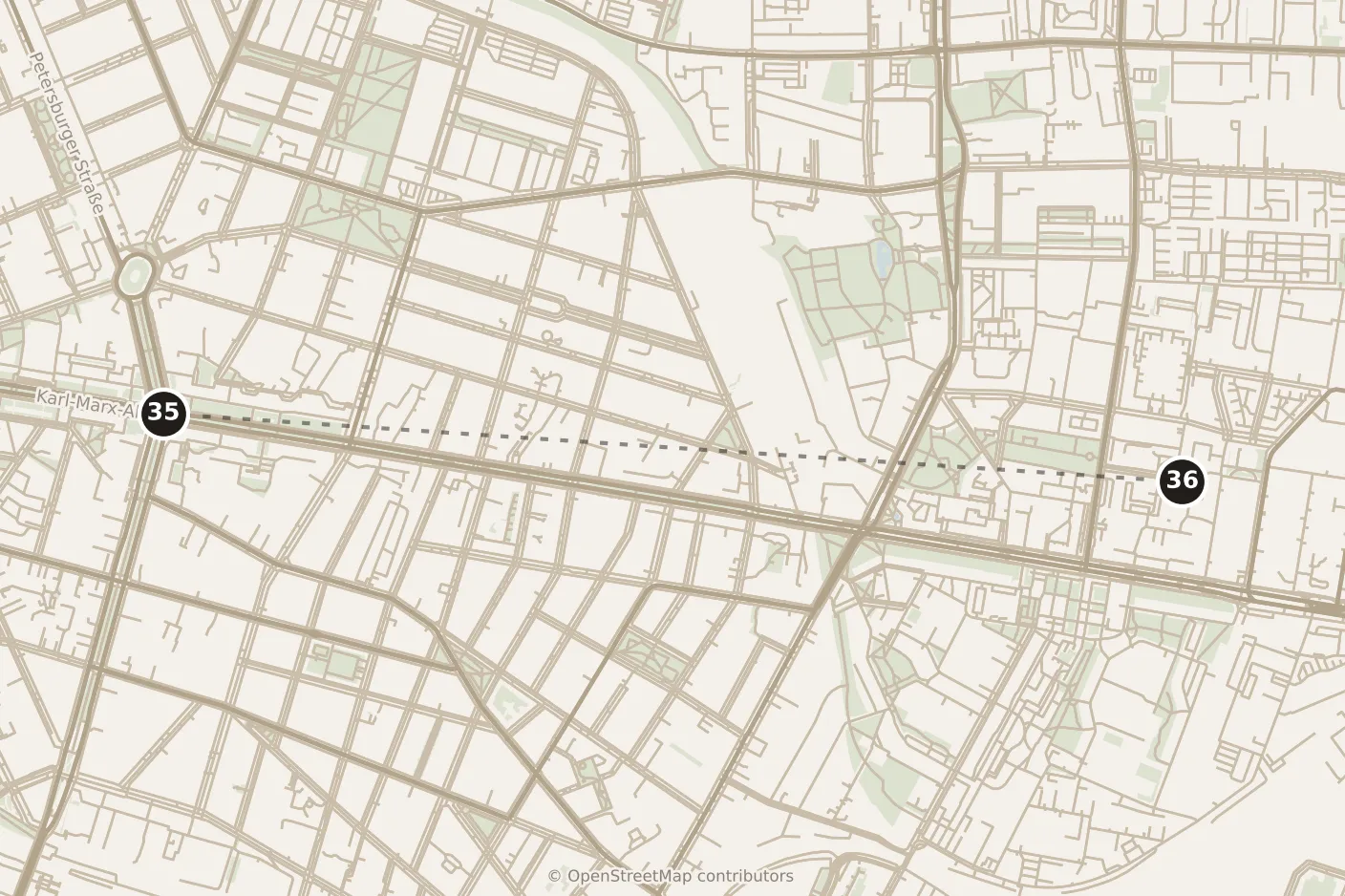
The leg out of the center: from stop 35 by metro, not on foot.
- Day six · stop 36
- 36Stasi Museum
- Day six · stops 37–41
- 37Boxhagener Platz
- 38Simon-Dach-Straße
- 39Oberbaumbrücke
- 40East Side Gallery
- 41Ostbahnhof
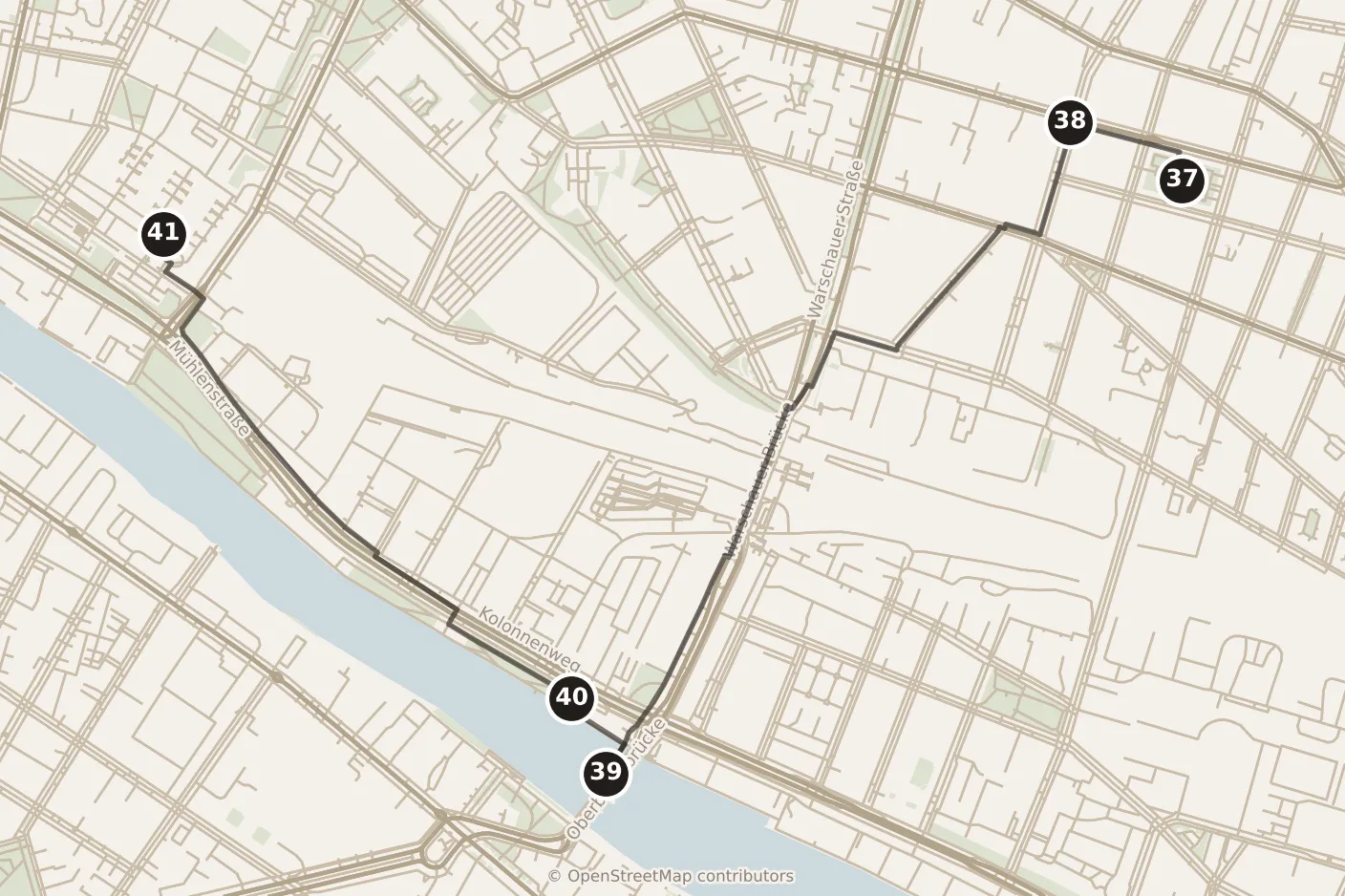
Friedrichshain and the east: the boulevard the East built to be photographed, the ministry that watched everybody, and then the longest surviving stretch of the Wall — the inner one this time — walked at dusk. Two short rides on one metro line; the rest is on foot, and the day runs in one direction.
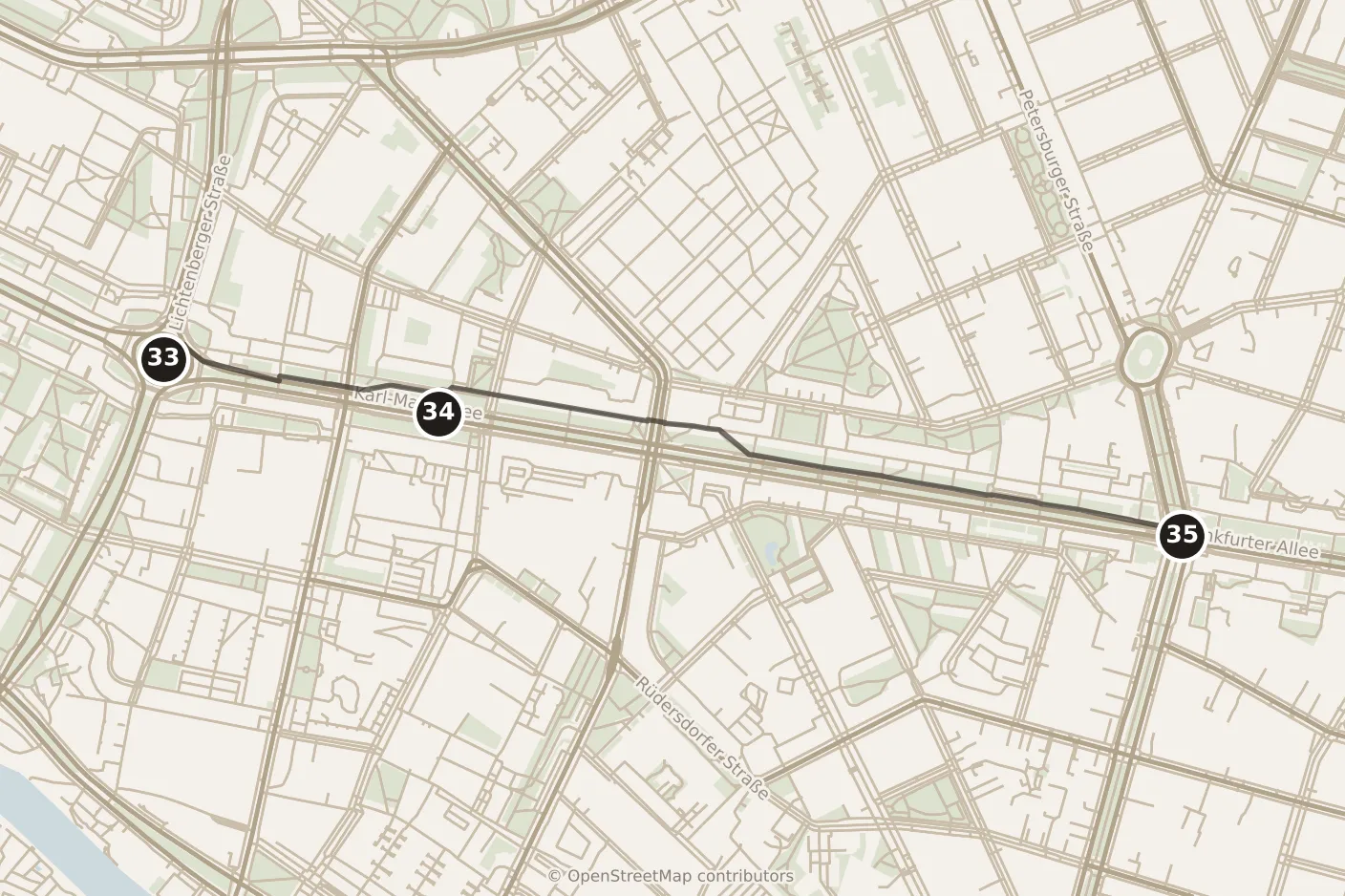
Start at Strausberger Platz, a circular junction with fountains and two curved towers, and walk east along Karl-Marx-Allee. This is two kilometers of boulevard built between 1952 and 1960 as the showpiece of the new state — ninety meters wide, lined with apartment blocks faced in cream ceramic tiles, with colonnades, cornices and shop fronts, in a style that took its proportions from Prussian classicism and its politics from Moscow. They were called workers’ palaces and they were built for workers, with elevators and central heating. The street is also where the state’s first crisis began: in June 1953 the construction workers on this site walked off over their work quotas and the protest spread across the country within a day, ending under Soviet tanks. Walk it slowly and look at the detail on the ground floors. Forty-five minutes, and it is the only place in the week where the East built something that meant to be admired.
It ends at Frankfurter Tor, where two domed towers face each other across the junction, quoting the churches on the square you saw on day one. From the station beneath it take the U5 three stops east to Magdalenenstraße and the Stasi Museum, which is not a museum about the ministry so much as the ministry itself — the headquarters of the state security service, in a courtyard of gray office blocks, with the minister’s own suite of rooms on the first floor left exactly as it was. Erich Mielke’s desk, his telephones, his safe, his conference table, his private bathroom. Around it are the listening devices, the cameras in watering cans and briefcases, the jars of scent samples taken from interrogation chairs and kept in case a dog was ever needed. It is open every day. Ninety minutes, and it is the coldest hour and a half in this week.
Take the U5 back west and come up at Frankfurter Tor again, then walk ten minutes south to Boxhagener Platz. This is Friedrichshain as people live in it: a square with a playground in the middle, a farmers’ market some days and a flea market on Sunday mornings, and bars and kitchens on all four sides of it. Simon-Dach-Straße runs off it and is the concentrated version — one street of bars, loud and young, and the one the rest of the district sends visitors to. Walk it and then come back: the eating is on the streets around the square, which is where the people who live here are. Understand that the district is scruffy on purpose and has been arguing about how long it can stay that way for twenty years.
Walk fifteen minutes south-west down Warschauer Straße, past a former railway repair yard now full of bars and painted from end to end, and cross the Oberbaumbrücke. It is brick, twin-decked and built in 1896 in a north German gothic that makes it look like a fortified gate it never was, with the U-Bahn running over the top. From 1963 it was a border crossing that only West Berliners could use, on foot — for the first two years after the border closed, nobody crossed here at all. Its middle span was destroyed in the war and the plain steel one that replaced it opened on the ninth of November 1994, five years to the day after the border did.
Then walk back along the north bank for the East Side Gallery, and time the day so this happens in the last hour of light. It is one thousand three hundred and sixteen meters of wall standing where it stood, painted in 1990 by more than a hundred artists in the months after the border opened. The thing to understand is which wall this is: the inner one, facing East Berlin, the side nobody was permitted to approach — the opposite case from the stretch you stood at on day three, which faced west and was painted for forty years by anyone who felt like it. Most of what you see is not the 1990 paint. The originals weathered and were repainted by their own artists in 2009, and the few who refused have left their sections bare ever since, which are the most interesting stretches on it. Forty-five minutes at a walking pace, ending at Ostbahnhof.
Day seven

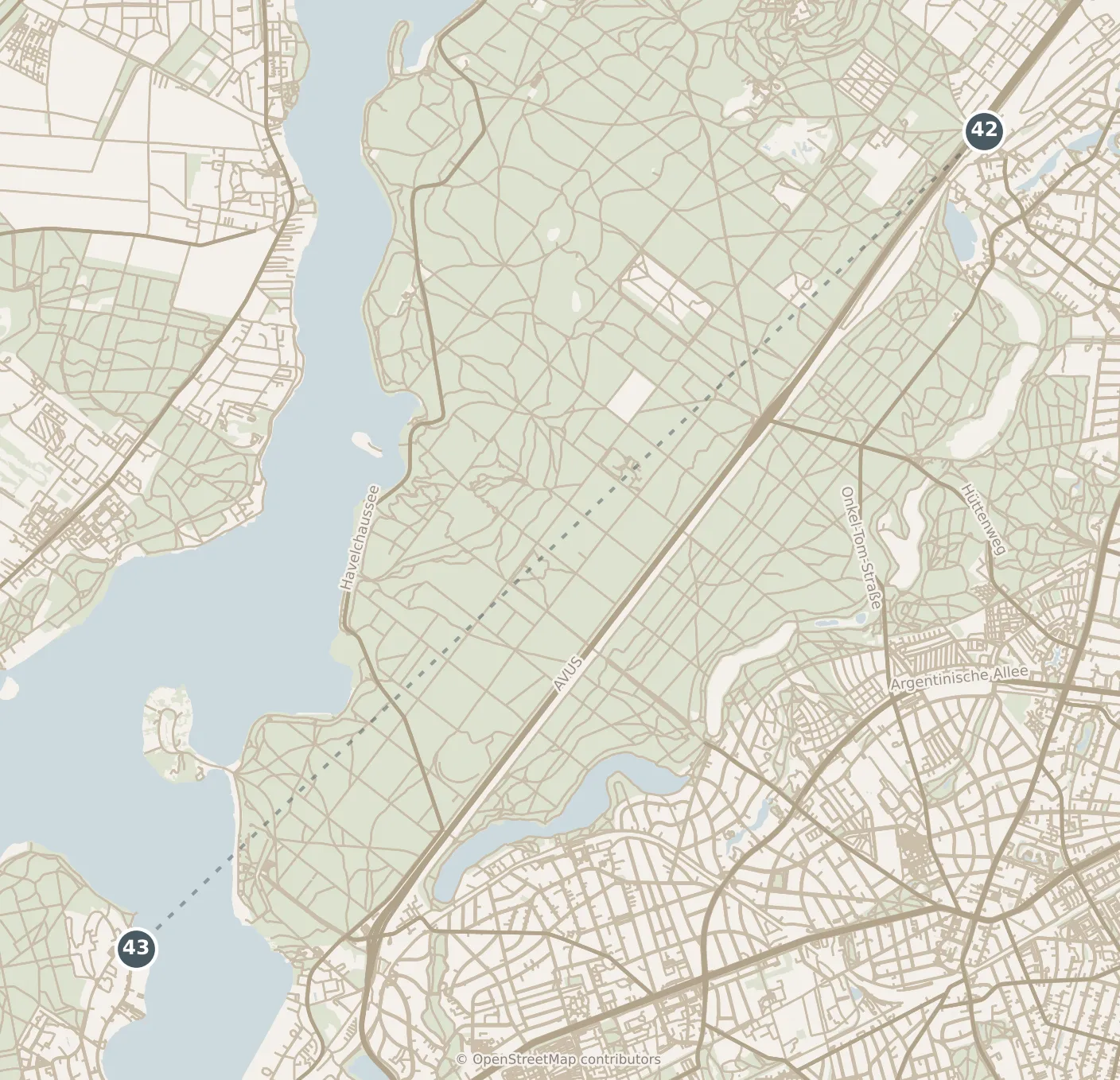
The ride on to stop 43, by train, not on foot.
- Day seven · stop 42
- 42Grunewald station
- Day seven · stops 43–46
- 43House of the Wannsee Conference
- 44Strandbad Wannsee
- 45Glienicke Bridge
- 46Glienicke Palace
The lakes, and the edge of the city. This is the one day that is not a walk: it is a suburban train and three short bus rides, and everything on it is free and outdoors except the lido, which is a ticketed bathing station and only exists in the warm half of the year. It is also the day this week stops being about the twentieth century, though it does not manage that until the afternoon.
Take the S7 out of the center, about forty minutes, and get off first at Grunewald station, where the platforms are already in pine forest. Walk round to platform seventeen. Along both edges of it run one hundred and eighty-six cast steel plates, one for each transport, each stamped with a date, the number of people and the destination: to the ghettos first and then to the camps. The rails behind them have been left to the birches growing between the sleepers, and the platform will never be used again. It is free, it is always open, there is no building and no ticket desk, and it takes twenty minutes. Nothing in this week is quieter.
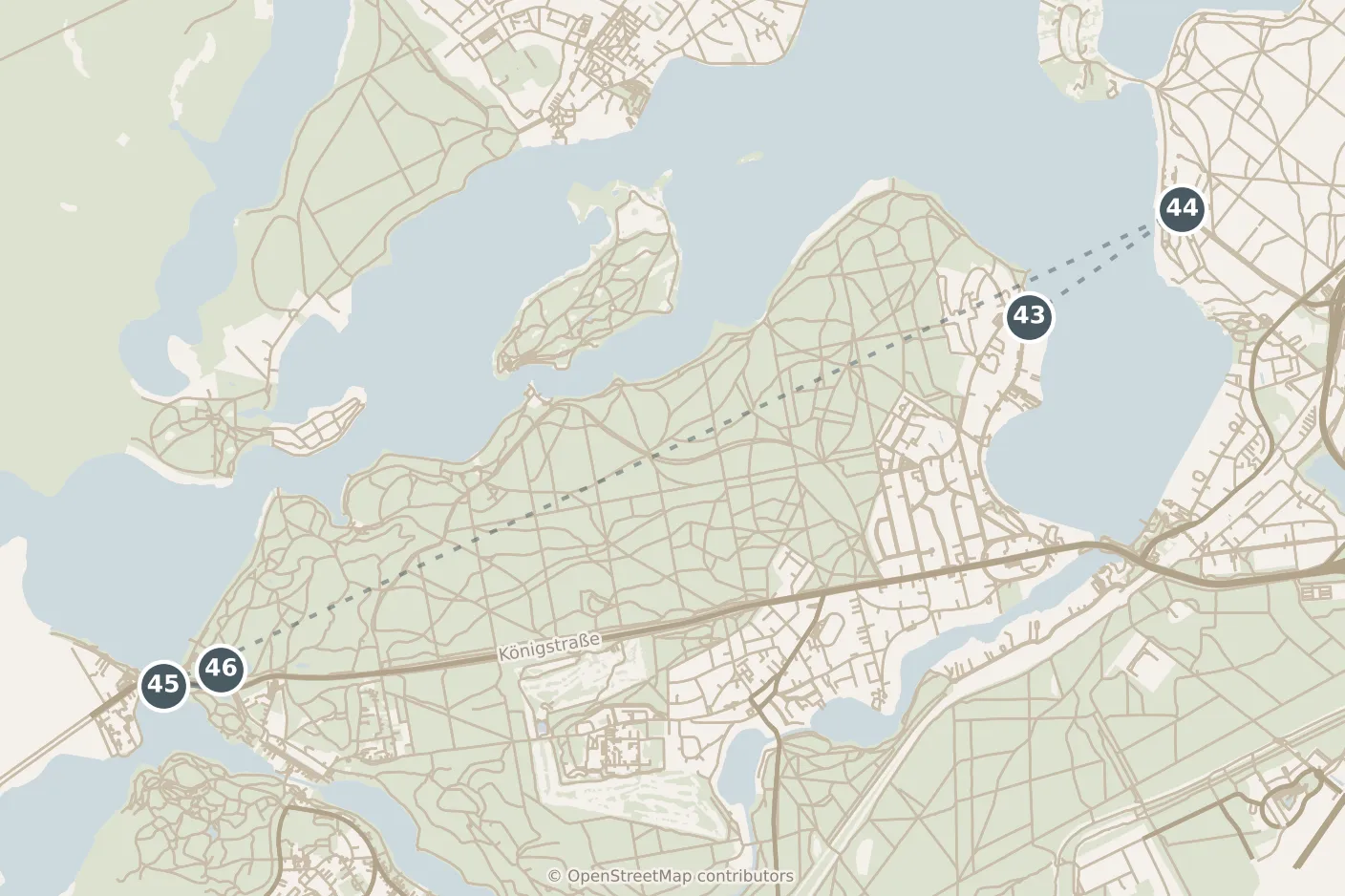
Two stops further and you are at Wannsee, on the water. A bus from the station goes to the House of the Wannsee Conference, a lakeside villa of 1915 where on the twentieth of January 1942 fifteen senior officials sat for about ninety minutes from midday and coordinated the murder of the Jews of Europe across the ministries that would have to carry it out. The invitation had promised them a meal afterwards. One copy of the minutes survived the war and it is here, in a permanent exhibition through the ground-floor rooms. Give it an hour and a half; the garden running down to the lake behind it is part of the difficulty of the place rather than a relief from it. Entry is free and it opens every day.
Back towards the center, one station up the line you came out on, is the Strandbad Wannsee, which is where the city swims. It is a bathing station rather than a shore: a fence, a gate, an admission and a season that runs from about Easter to the end of the summer. Inside it is a kilometer and a quarter of imported sand, eighty meters deep, backed by a terrace of long flat-roofed buildings put up in 1929 and 1930 that were meant to be the largest inland bathing station in Europe and still look like an argument for the future. In warm weather this is where the day should end and you should plan for it: bring what you need for a swim, do the villa first and take the beach on the way back, and come out of the water at dusk. Out of season the gate is shut and the day ends at the bridge instead.
Otherwise finish at the Glienicke Bridge, twenty minutes by bus. It crosses the Havel, and for the whole of the division it was the border: Berlin on this bank, another country on the other, one bridge maintained in halves by two states that did not speak. Prisoners and agents were exchanged across the middle of it three times during the Cold War, which is why it is in every film about the period. Now it is an ordinary road bridge, and the strangeness is exactly that. Beside it, Glienicke Palace and its park are a small Prussian summer villa laid out by Schinkel and his gardener with views arranged across the water; the park is free and open, the house keeps palace hours and shuts on Mondays, and the park is the part worth having.
Stand on the bridge and look at the far bank, because that is where this week ends and what an eighth day would be. Potsdam is three stops further down the line you came out on: a former royal residence town with Sanssouci and its terraced vineyard above it, and it is a full day rather than an afternoon. This week deliberately stops here. Seven days is exactly what Berlin fills on its own, and adding a day outside it would have cost a day inside it — which is a trade worth making on the eighth day and not on the seventh.
Practicalities
Start the week on a Tuesday. That is the whole planning problem solved in one line, and if you cannot, two rules put it back together in any order. Day two is the fussy one: every house on Museum Island shuts on Mondays and the Humboldt Forum shuts on Tuesdays, so day two wants a Wednesday, Thursday, Friday or Saturday — a Sunday works too, but the cathedral at the end of it opens to visitors only from midday, the morning being for services. Day four wants anything but a Monday, when Charlottenburg Palace is shut. Nothing else in the week has a door that closes on a weekday. Starting on a Tuesday satisfies both without thinking about it: day two lands on a Wednesday and day four on a Friday. Day five lands on a Saturday, which is the night the clubs matter and the day the covered market hall on Bergmannstraße is trading. Day six lands on a Sunday, when there is a flea market on Boxhagener Platz and the district is at its best doing nothing — and when, as everywhere in Germany, the shops are shut, so the boulevard that morning is architecture with its shutters down rather than a street of windows. And day seven lands on a Monday, which costs almost nothing: the memorial house at Wannsee opens every day, the platform in the forest and the parks have no doors at all, and the only thing shut is the interior of the small palace at the end, which is the least of that day. The lido at Wannsee is the one stop of the seven days that is neither free nor always there — it is a fenced bathing station with an admission and a season, so it belongs to a warm-weather visit and to no other.
Two things are lost by starting on a Tuesday and both are markets. The Turkish market on the Maybachufer trades on Tuesdays and Fridays, and day five is a Saturday — the canal bank is worth the walk regardless. And the Sunday flea market and karaoke at Mauerpark fall outside the week, since day three is a Thursday. If either matters more to you than the two palace closures, move day three or day five onto the Sunday and let the rest rotate, but check the two Monday closures before you do.
One booking, and it is not optional. The dome above the parliament on day one is free but cannot be entered without registering in advance, with the full name and date of birth of everyone coming, and you are identity-checked at the entrance, so bring the document you registered with. Registration is on the parliament’s own site and opens about three months ahead; in high summer the good hours are gone weeks before you would think to look, so register the day your dates are fixed. If you arrive with nothing booked, there is a visitors’ service point a short walk from the building that hands out unclaimed places on the day, a couple of hours ahead — that is the fallback, not the plan. Its slots run later into the evening than anything else in this week, which is why day one is built to end there. Nothing else in this article needs a reservation. The museums on days two and four sell tickets online, which saves a desk line and buys you nothing else; on Museum Island a single day ticket covers all of the houses, so the advice to take two is about what a day can hold and not about what it costs.
Getting between the stops is mostly walking, and the exceptions are worth naming because they are the only ones. Day three uses one short train, from Potsdamer Platz north to Nordbahnhof. Day four uses a bus from the palace to the shopping street, a quarter of an hour. Day five uses a few stops on the U8 from the corner of the airfield into Neukölln, which you can walk in twenty-five minutes instead. Day six uses the U5 three stops out to the ministry, at Magdalenenstraße, and three back. Day seven is entirely trains and buses, and although it runs to the far edge of the map it never leaves the city, so the ordinary city ticket the parent guide describes covers all of it. The first thing that would not be covered is Potsdam, one station further on, which is the eighth day.
One stretch catches people out, and it is on day three: Bernauer Straße is one and a half kilometers of open ground with a documentation center at one end and a park at the other; there is very little to sit on, and two hours there is longer than it sounds. (Tempelhofer Feld on day five catches people out too, and that warning now sits on the day itself, where you are deciding.)
Local tip. Almost everything in this week is free — both memorials on day one, the whole of day three, the parks, the field, the wall, the platform in the forest and the villa on the lake. The tickets are concentrated on two days, the second and the fourth. If money or energy is short, those are the two days that bend, and the week loses less than you would expect.


