Berlin in two or three days: two museums, the border strip end to end, and the west

Last updated 4 August 2026
Overview
Berlin is not a city you look at. It is one you have explained to you, and two days is roughly the length at which the explaining starts to take.
A single day here can only be a line, and a line walks past every door. The second day buys the other half of the sentence in the two subjects this city goes deepest on. One is indoors: a day allows one museum, and one museum tells you nothing about why there are five on a single island. The other is the border. On a first pass the Wall is a surface with paint on it. It was never a wall — it was a strip of ground with an outer wall, a raked sand bed, a patrol road, a lit fence and a second wall behind it, and one place is left where you can stand and see that whole width at once. Reaching it and reading it costs most of an afternoon, which is exactly why one day cannot have it.
So the days below each run in one direction and never double back. Day one is three and a half kilometers of the old middle, east to west, ending inside the glass dome over the parliament. Day two is the border in the order that makes it legible: the block the terror was run from, north to the strip at full depth, east to the painted stretch by the river, dinner over the bridge. Day one is where the tickets are; day two is free from the first stop to the last.
One thing about the light, because it governs both days and swings further here than visitors expect. The sun sets in Berlin anywhere between just before four in December and half past nine at the end of June — five and a half hours of difference across the year. Look the sunset up for your own dates before you register for the dome: it does not move evenly between those two ends, so the range will not give you your hour. Each day says what to count back from it.
Two days still gives up most of the city: the whole west, the lakes on the S-Bahn, the airfield, the clubs and Potsdam. The west is what the third day below is for; the rest need a week.
One thing to arrange before you travel and one to buy when you land. The dome over the parliament is free, cannot be entered without registering in advance, and is the only booking these days contain. Everything else runs on the ordinary inner-zone transport ticket, which the city guide explains — this route asks nothing more of it than six short rides.
Day one

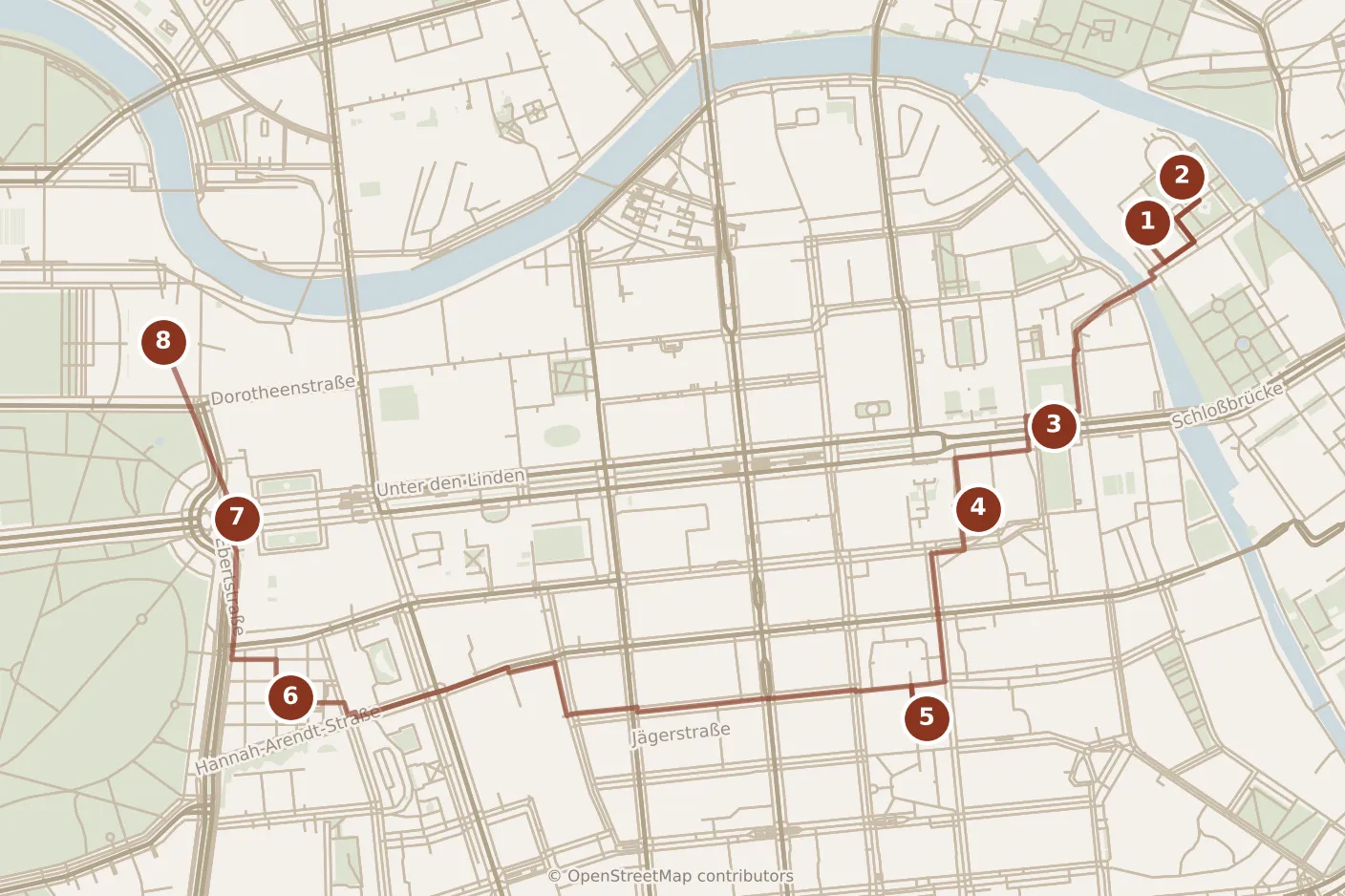
- Day one
- 1Neues Museum
- 2Alte Nationalgalerie
- 3Neue Wache
- 4Bebelplatz
- 5Gendarmenmarkt
- 6Memorial to the Murdered Jews of Europe
- 7Brandenburg Gate
- 8Reichstag
Mitte, east to west: two museums, the old avenue after lunch, the dome at the end. Nothing today is more than twenty minutes from the thing before it.
Morning
The first leg is the one nobody describes. From the airport the FEX regional train reaches Hauptbahnhof in a little over twenty minutes; the S9 is not the same journey shortened but a stopping suburban line the long way round, seventeen stations and nearer fifty minutes, so take the FEX if the morning is built on it. A long-distance train arrives in the same building. From there the U5 runs east under the avenue — Bundestag, Brandenburger Tor, Unter den Linden, Museumsinsel — four stops and under ten minutes, surfacing at the south end of the island ten minutes’ walk from the museum doors. Hauptbahnhof is a long way from everything on this day, and the U5 is what fixes it.
The houses on Museum Island did not open before ten in 2026, and they shut on Mondays. The morning is built back from that door; if the hour has moved, build it back from the new one.
Take two museums, and only two — that is the whole difference between this morning and a single day here. The Neues Museum first, ninety minutes. The painted limestone bust of Nefertiti is here, dug out of a sculptor’s workshop in Egypt in 1912 and startling chiefly for how unfinished it is: one eye carries no inlay at all, and it is generally read as a master model rather than a portrait. Give the building as much attention as the objects: left a ruin by the war and rebuilt by David Chipperfield, reopening in 2009, with the damage kept visible on purpose — shrapnel-pitted columns, burnt brick, blank plaster where frescoes were. Give up the prehistory floors to make the time; the Egyptian rooms and the staircase are what this house is.
Next door, an hour in the Alte Nationalgalerie, the one most visitors skip. German nineteenth-century painting in a building shaped like a temple on a plinth: Caspar David Friedrich’s small, cold landscapes that feel enormous, and Adolph Menzel’s iron rolling mill, which is industry painted by a man who went and stood in one. An hour is enough if you take one floor properly instead of all of them badly.
The island sells a day ticket for every house on it, in the twenty to twenty-five-euro range in 2026 against roughly half that for one museum, so the second museum is barely a second decision. Buy it online to skip the desk; there is no timed slot to hit. One house is missing and will be for years: the Pergamon Museum closed in October 2023 for a rebuilding done in halves, the first announced for 2027. Check what has reopened, and plan the morning so the answer does not matter.
Local tip. The second museum is the thing this day has that a single day does not, and it is also the first thing to give back. If you arrive late, or the morning overruns, take the Neues Museum alone and walk out at noon — everything after it fits into an afternoon. Nothing further down this day can be shortened without losing the reason the stop is there.
Afternoon
Eight minutes west, on the avenue, the Neue Wache is a columned guardhouse Karl Friedrich Schinkel built in 1816. One bare room, one object: an enlarged version of Käthe Kollwitz’s sculpture of a mother holding her dead son, alone on the floor under a circle cut open in the roof, so rain and snow fall on it. Free, five minutes, and not the settled thing it looks: since 1993 it has been the country’s central memorial to the victims of war and tyranny, and the dedication has been argued over ever since — one formula for the murdered and for those who murdered them, under a sculpture critics said left out the largest groups of the dead.
Three minutes on is Bebelplatz, where there is nothing to see until you look down. A pane of glass set flush in the paving covers a small white room of empty shelves — room for the twenty thousand and more books burned on this square in May 1933, by Micha Ullman, unveiled in 1995. Five minutes; the giveaway is the knot of people looking at their feet.
Five minutes south, Gendarmenmarkt: two matching domed churches facing each other across one square with a concert hall between them, one built for the city’s Huguenot refugees and one for its German congregation, the domes added afterwards purely so the pair would match. The square was dug up, relaid and reopened in March 2025, and a third of it was left out of the works on cost grounds, so it is flat and slightly bare. Twenty minutes.
Then west, a little under twenty minutes, the long leg of the day. Eat in its first few minutes, where the route crosses Friedrichstraße; after that it is ministries and embassies and there is nothing on the sidewalk.
You come out at the Memorial to the Murdered Jews of Europe: two thousand seven hundred and eleven concrete blocks on ground that rises and falls, by Peter Eisenman, opened in 2005. Do not photograph the edge and move on — walk into the middle, where the paving drops away underfoot, the blocks go over your head and the traffic noise stops. Twenty minutes. One thing a visitor cannot guess before standing on it: the outer blocks are low and look like benches, and climbing them or jumping between them is against the site’s own rules, and staff patrol the field and will stop you. Underneath, and free, is the information center, where the abstraction above becomes names, dates and postcards thrown from moving trains. An hour. It closes on Mondays; the field above it never does.
Evening
Five minutes north is the Brandenburg Gate, smaller than photographs suggest and worth ten minutes. What matters is not the arch but the ground under it: for twenty-eight years this gate stood inside the border strip, belonging to neither side, and nobody at all could walk through it. That will make more sense tomorrow afternoon than it does now.
Six minutes more and the day ends at the Reichstag. An elevator takes you to the roof terrace and the rest is on foot: two spiral ramps, one climbing and one descending, wound round a mirrored funnel that drops daylight into the debating chamber below. Going up you look over the government quarter; going down you look through the middle at the parliament, which is the argument of the building — the electorate standing on top of the elected. The dome is Norman Foster’s, finished in 1999, on a building that burned in 1933 and then stood empty through the division with the Wall running past its back. An hour inside, and the identity check at the door is on top of it.
It is last because its door is the last open: admission ran until quarter to ten at night in 2026, hours after anything else here. Everything above it comes to five and a half hours of standing still and the better part of an hour of walking between — call it six and a half — so a late-afternoon slot wants you at the museum doors as they open, and an early-evening one leaves an hour and a half of slack, which is lunch and not much else. That total counts time inside the places and nothing else: not lunch, not the two cloakroom-and-ticket lines on the island, and not the security checks at the parliament and at the information center under the stelae, the two points today where a line forms you cannot walk past.
Choose the slot for the light if you are offered a choice: take the sunset hour for your own dates and aim for the hour before it, so the government quarter is legible going up and the city lit coming down. If what you are given is the middle of the day, run the whole day backwards — Reichstag first, the avenue eastward, the island in the afternoon, still well inside museum hours. Nothing is lost but the view after dark.
Then eat: the government quarter empties after office hours and has nothing on the sidewalk, so walk five minutes to the Brandenburger Tor S-Bahn platforms and take the S1, S2 or S25 two stops north to Oranienburger Straße. That is the Spandauer Vorstadt, the old Jewish quarter — often called the Scheunenviertel, which was in fact the smaller district beside it — and the nearest place to this route where dinner is a matter of choosing rather than finding.
Day two

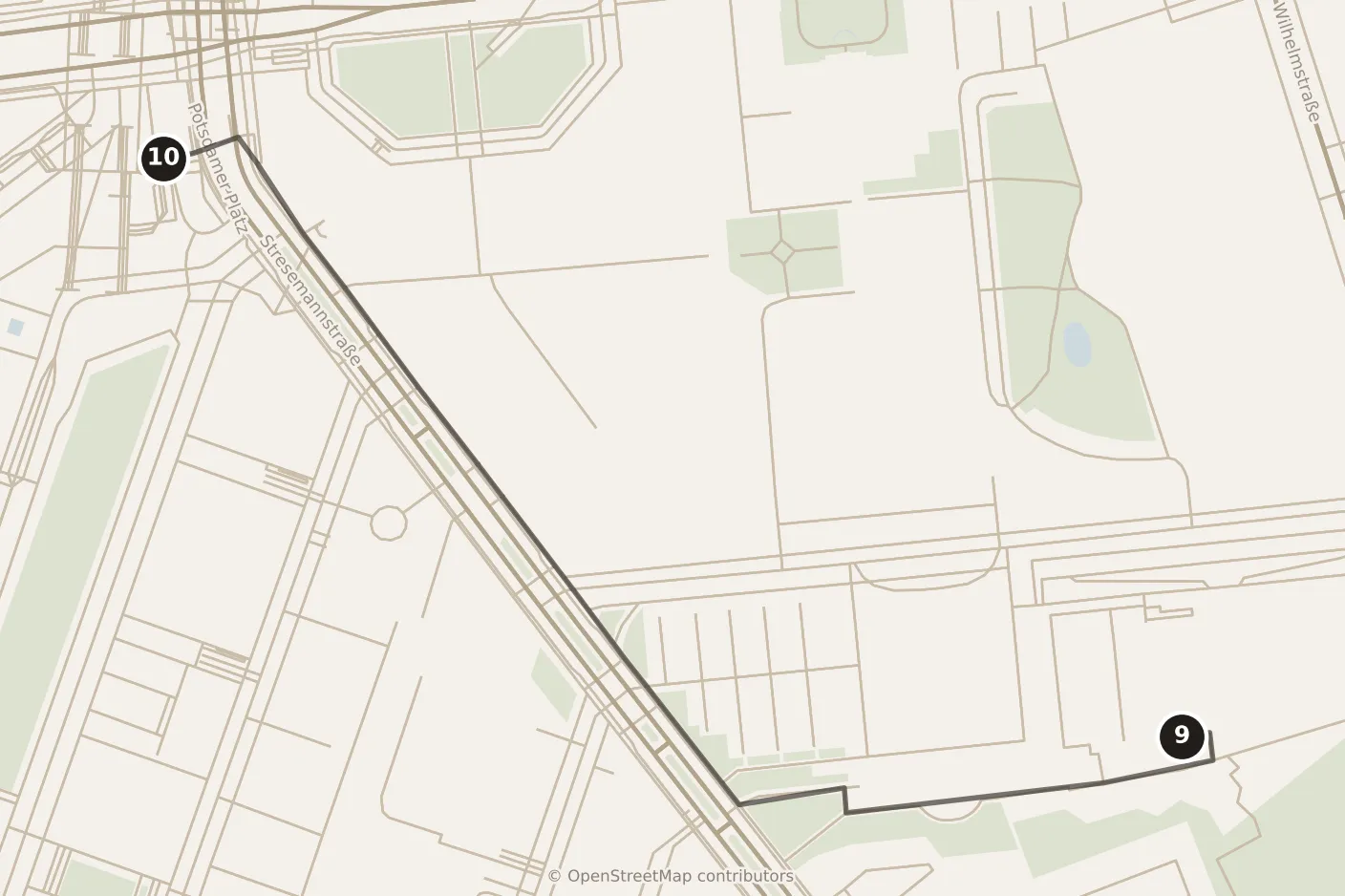
- Morning
- 9Topography of Terror
- 10Potsdamer Platz
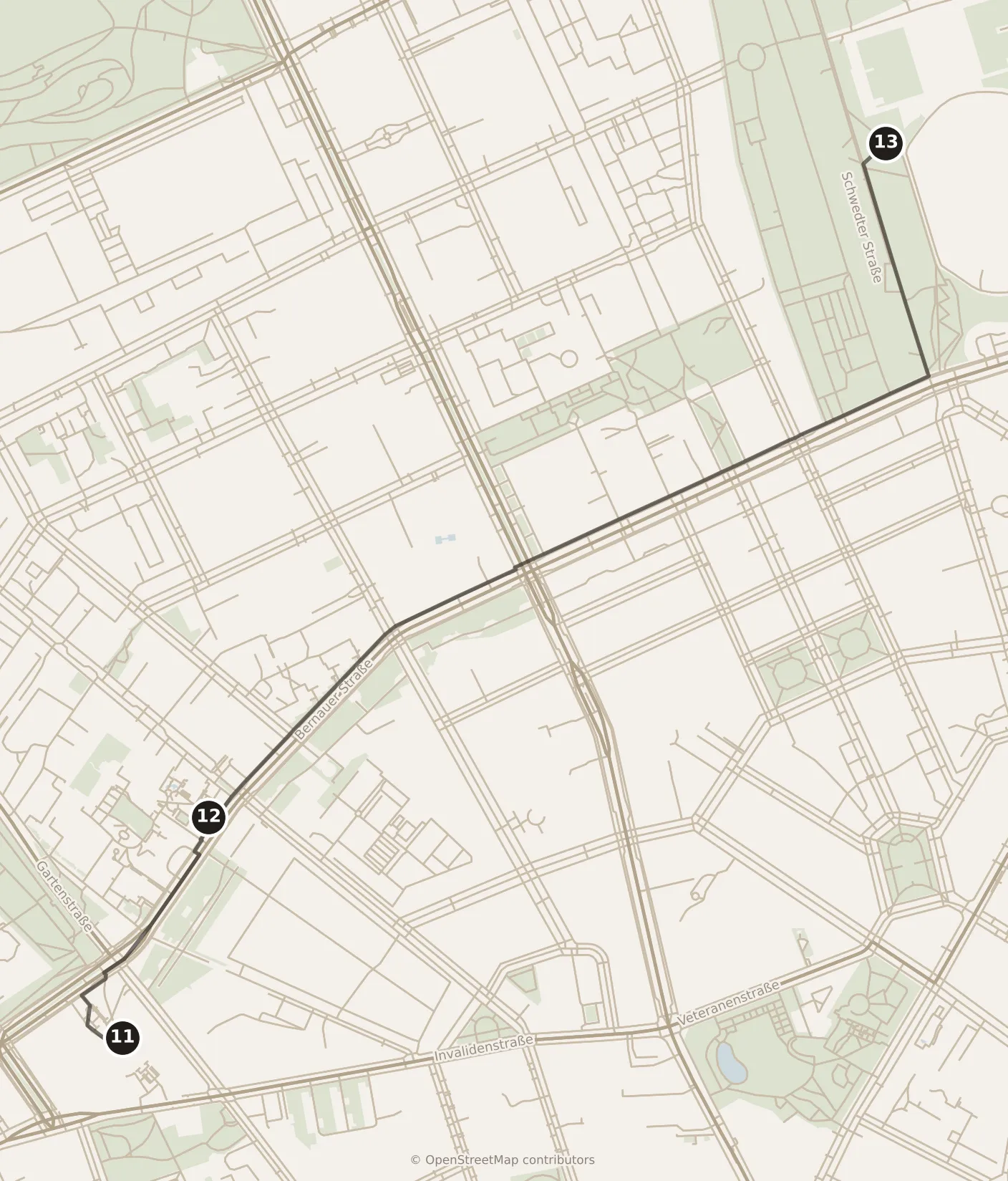
- Afternoon
- 11Berlin Nordbahnhof
- 12Berlin Wall Memorial
- 13Mauerpark
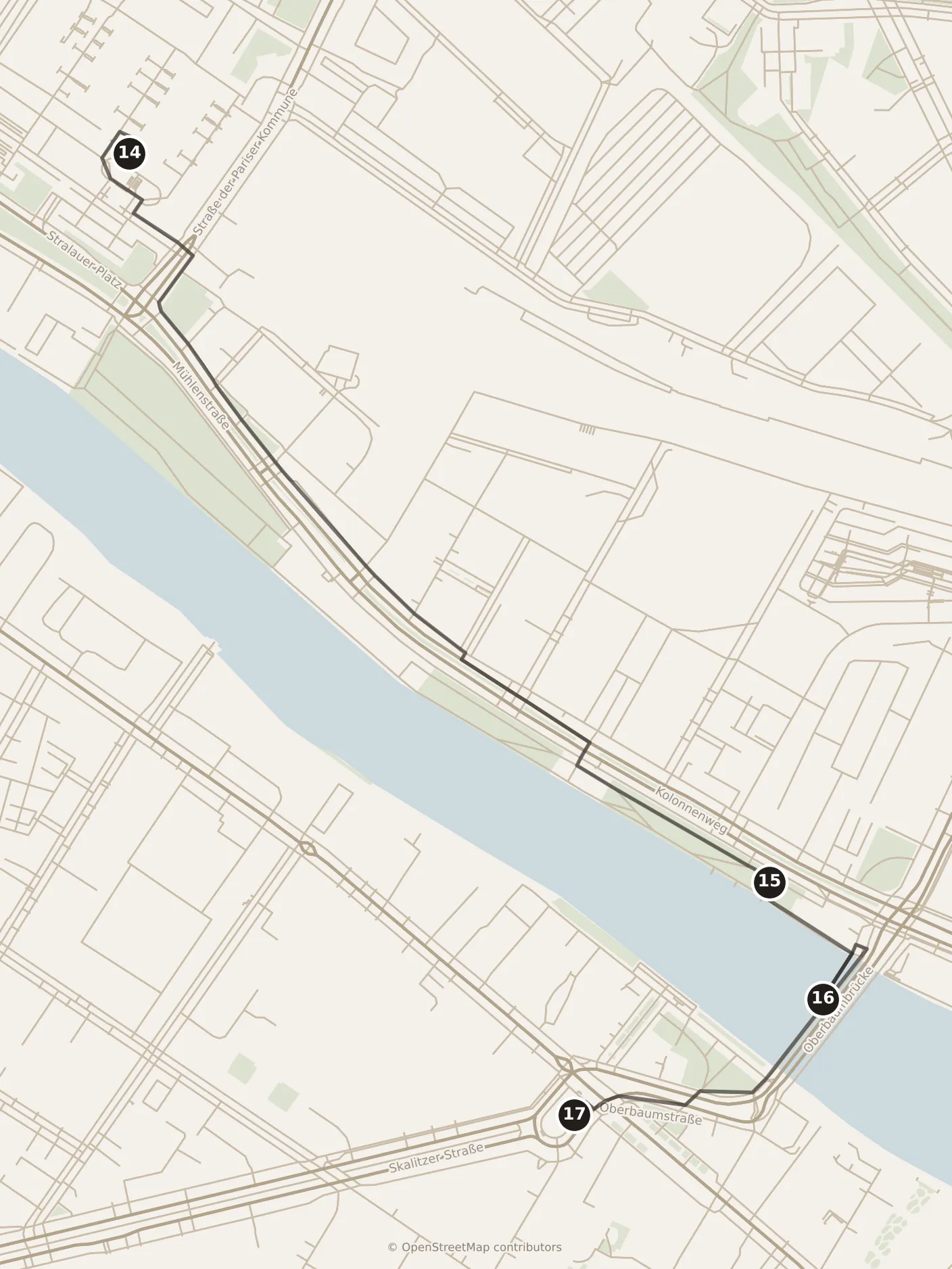
- Evening
- 14Berlin Ostbahnhof
- 15East Side Gallery
- 16Oberbaum Bridge
- 17Schlesisches Tor
The border, in the order that makes it readable, and this is the day the second day exists for. Four short rides — the one in, a train north, a metro and a hop east — and nothing to pay at any door. The fare is the exception: buy the ticket before you step onto the platform, because there are no barriers to remind you and a paper ticket has to be stamped at the machine there.
Morning
Start at the Topography of Terror, which opened at ten and closed at eight, every day of the week, in 2026 — the rare Berlin institution with no closing day, which is why it anchors a day built to survive a Monday. It is free. Two stations serve it: Kochstraße on the U6, about ten minutes east, and Potsdamer Platz, where this morning ends. Come in by the first and leave by the second, and the morning runs one way. The Gestapo and the SS ran the machinery of the Nazi terror from buildings on this block; they were demolished after 1945 and the ground lay derelict for decades before it became a documentation center standing over the excavated cellar walls.
Ninety minutes, and the two exhibitions are not equal. The indoor one is dense and almost entirely panels of text and photographs; the open-air trench along the cellars is the one to read if you read only one, and it is the half that decides whether this stop works in winter, because the outdoor part closes when the light goes. Along the street outside, on Niederkirchnerstraße, stands the longest surviving stretch of the outer wall, the face West Berlin could see. Look at it properly: this evening you will stand at the other face of the same structure, and the difference between them is the point of the day.
Eleven minutes west is Potsdamer Platz, and a quarter of an hour is enough. Between the wars this was one of the busiest junctions in Europe; then it was flattened, then it was inside the death strip, and for twenty-eight years it was an empty field with a wall across it. What stands here now went up from nothing in the 1990s, which is why it feels like an airport. Two things earn the fifteen minutes: a double line of cobbles set into the road where the wall ran, which you will start seeing all over the city once you have seen it once, and a few original segments outside the station.
Eat here — it is a shopping center and not the meal of the trip, but the two hours after it are a memorial you will not want to interrupt and there is nothing in between. Then take the S-Bahn north, the S1, S2 and S25 all run it, four stops and about seven minutes to Nordbahnhof.
Afternoon
Do not come straight up. On the platform level at Nordbahnhof is a free exhibition about what this station was for twenty-eight years: a ghost station, one of the stops on western lines that ran under East Berlin without stopping, its street entrances bricked up and its platforms patrolled by guards. The marks of the sealing walls are still on the tiles. Fifteen minutes, and it sets up everything above ground.
Six minutes away is the Berlin Wall Memorial, and it needs two hours. This is a kilometer and a half of border strip along Bernauer Straße, the only place where the thing was kept rather than cleared. One short section stands complete — outer wall, raked sand, patrol road, signal fence, inner wall, watchtower behind — and everything else is marked instead of rebuilt, which is what makes it legible. Steel rods stand in the line the wall took, and the cellar foundations of the tenement houses whose own front walls were the border, until they were pulled down, are exposed in the grass. The Chapel of Reconciliation is an oval of rammed earth on the footprint of the church that stood inside the strip and was blown up in 1985; it is a working chapel and services are held in it. The Window of Remembrance is a wall of photographs of the people who died crossing. And in the documentation center a tower lets you look down into the whole arrangement, which is the only way to see that this was a system with a width rather than a line — after this morning’s flat slab, it is the correction the day is built to deliver.
Two of those are behind doors and the rest is not: the documentation center and its tower keep museum hours and shut on Mondays, while the open ground is walkable from early morning until late at night, every day of the year. Take the indoor half and the tower first and the strip afterwards, which is the order that survives arriving late.
Then follow the line of the strip north-east for about twenty-five minutes on foot. That walk is part of the visit and not a transfer — the ground under you is the ground you have spent two hours learning to read — and it ends where the strip simply becomes a park. Mauerpark is the death strip with grass on it: the raised bank along its eastern edge is where the inner wall stood, and a painted stretch of it is still up there. Twenty minutes, except on a Sunday, when the park fills with a flea market on ground nobody was permitted to stand on within living memory and twenty minutes becomes an hour.
Evening
Eberswalder Straße station is at the top of Mauerpark. Take the U2 three stops south to Alexanderplatz, go up to the elevated S-Bahn platforms and take any eastbound train two stops to Ostbahnhof — twenty-five minutes, and the only change of the day. Come out on the river side.
The East Side Gallery begins a few minutes’ walk from the station and runs one thousand three hundred and sixteen meters south-east along Mühlenstraße to the Oberbaum Bridge, painted in the spring of 1990 by a hundred and eighteen artists from twenty-one countries in the months after the border opened. Forty-five minutes at a looking pace.
What today has bought you is the ability to place this slab in the drawing. This is the inner wall, the one that faced East Berlin — the side nobody was permitted to approach, let alone paint, which is the opposite case from the stretch you stood at this morning, painted on for years by anyone in the West who felt like it. And the slab stands between you and the water: the frontier here was not the bank you are on but the far one, because the Spree itself belonged to the East all the way across to the Kreuzberg side. That is why West Berlin police and firemen were not allowed into it — five children drowned within a few meters of their own bank, and the crosses on the far side by the bridge are for them. Most of what you see is not the 1990 paint either — the originals weathered and were repainted by their own artists in 2009, and the handful who refused have left their sections bare ever since, which are the most interesting meters on it. One thing a visitor cannot guess: the whole run is a protected monument, and the felt-tip names over the paintwork are damage rather than a custom to join in with.
Between November and February this day cannot hold both its outdoor halves in daylight, and it is better to choose than to find out at half past three. Taken as written you read the wall by street light, which keeps the paint legible and loses the color. The other way round is a plan rather than a consolation: start at Ostbahnhof at first light and walk the gallery, take the S-Bahn and the U2 north for Bernauer Straße in the middle of the day, and finish at the Topography of Terror, whose indoor half stays open into the evening every day of the year — the half this article otherwise tells you to skip, and on a December afternoon the right one. What it costs is the open-air trench, which will have shut with the light — and the order the day is built on, since you now meet the painted inner wall first and the flat outer slab last, so the two sentences that point across the day at each other are read the other way round.
The gallery ends at the Oberbaum Bridge and you cross it: brick, twin-decked, built in 1896 in a north German gothic that makes it look like a fortified gate it never was, with the U1 running over the top. From 1972 it was a crossing point only West Berliners could use, and only on foot. Ten minutes, and it is the seam where the day changes temper.
Six minutes on is Schlesisches Tor, where the U1 runs above the street on an iron viaduct, and this is where the evening is. The streets behind the station are Kreuzberg at its most ordinary, and they are well fed: after a day of raked sand and steel rods a Döner — the Berlin kind, a slab of flatbread cut open and packed rather than rolled — is the correct end to it.
Local tip. Three doors shut on a Monday on day one and one on day two, so if either of your days falls on a Monday, make it this one. The loss is real: the documentation center and its tower go, and the tower is the stop that explains the subject. What you keep is everything else, because everything else today is open ground with no door — and the strip stays walkable long after any museum has closed, which in winter is the difference between seeing it and not.
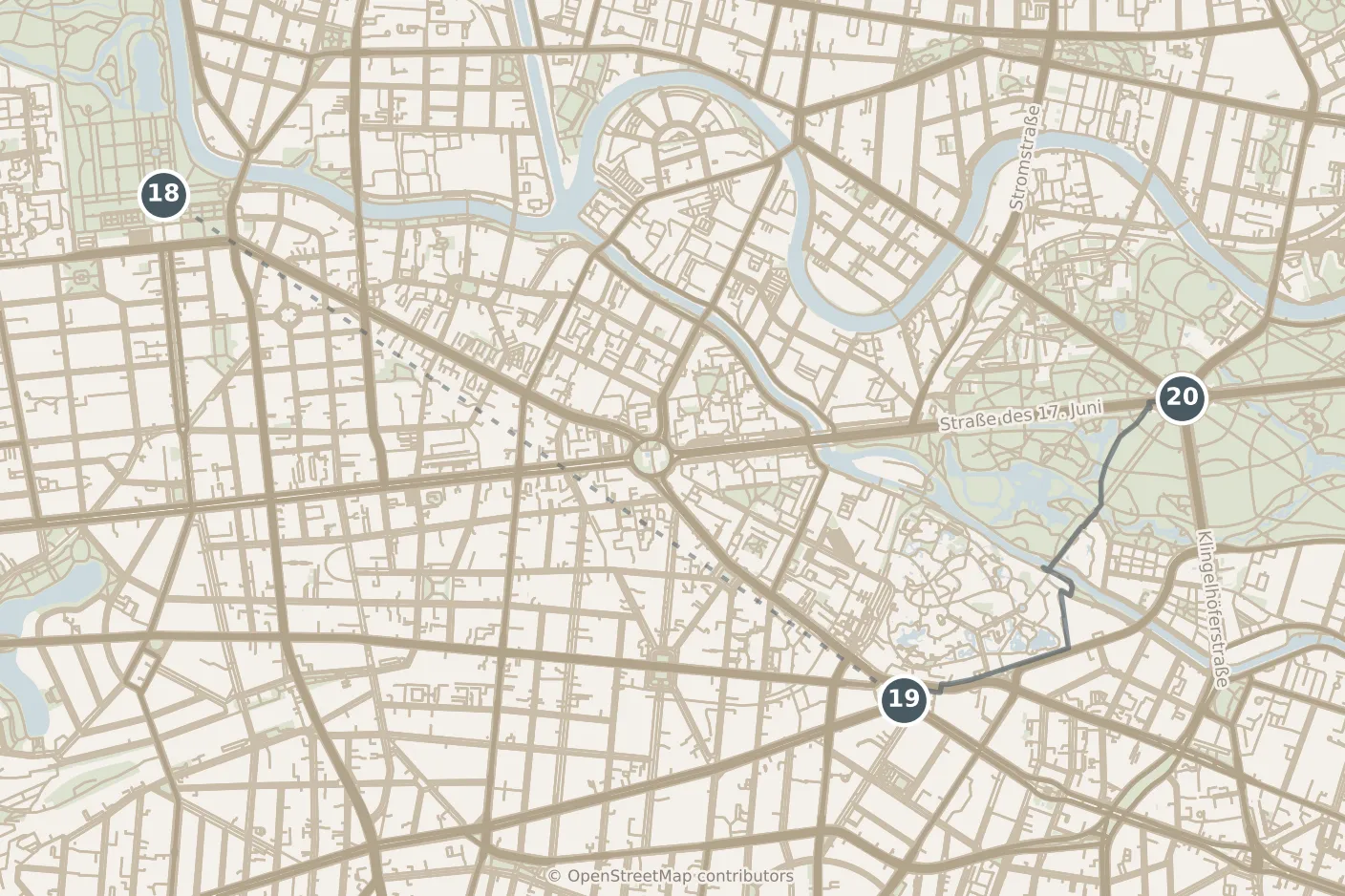
With a third day

- With a third day
- 18Charlottenburg Palace
- 19Kaiser Wilhelm Memorial Church
- 20Victory Column
The third day is appended, not inserted, and it is the west.
It goes after rather than between because days one and two are a pair with an order inside them — the objects, then the depth that makes the objects mean something — and a baroque palace dropped into the middle breaks the only sequence here that has to hold. It is the west because two days have read the border from the eastern side, and the question left over is what the apparatus was for. Half an hour out to the west is a part of Berlin that reads as an ordinary prosperous German city — nineteenth-century apartment streets that survived the bombing, and, spliced into them, the confident modern buildings the west put up to be looked at while the other half was being watched.
One thing moves when you add it, and it is not small: the dome moves off day one and onto the evening of day three. Day three ends there, thirty-five minutes’ walk east along the avenue from the Victory Column, so take the slot for the third evening. Day one then ends at the Brandenburg Gate, and the hour it recovers goes on Berlin Cathedral before the walk west begins, three minutes from the island’s southern end, where a ticket buys the crypt of Hohenzollern coffins and the climb to the walkway round the outside of its dome.
Charlottenburg Palace takes the morning: a baroque summer palace begun in 1695 and added to for a century, sold in two halves with separate tickets. The old palace holds a porcelain cabinet lined floor to ceiling with several thousand pieces of blue and white china; the new wing holds the eighteenth-century state rooms and is the better half if you take only one. Ninety minutes inside; it shuts on Mondays, which is the second reason a Monday in three days has to be day two. The garden behind is free, open every day and worth half an hour. There is no station at the gates: the stop outside them is called Schloss Charlottenburg, and the interchange at the far end is Zoologischer Garten. The nearest U-Bahn stations are a walk away rather than at the door, so put the palace into a journey planner before you set out instead of assuming one line does it.
At Breitscheidplatz stands the Kaiser Wilhelm Memorial Church, the west in one object. It was gutted by bombing in 1943 and the broken tower deliberately left standing, open to the weather at the top. Beside it Egon Eiermann built a new church between 1959 and 1963: an octagon and a separate bell tower, walls made entirely of small blue glass blocks. Go inside the new one — the light in there is deep blue and nearly solid, and completely unlike any photograph of it. It is a working church holding services through the day, so the room may be in use when you arrive, which is worth twenty minutes of waiting rather than twenty of walking away. Twenty minutes for the ruin, twenty for the blue room. Look down on the way up: a gold seam runs seventeen meters through the steps to the church plateau, filling a crack cut into the paving, and the names in the risers are of the people killed when a lorry was driven into the Christmas market on this square in December 2016. The eastern end of the Kurfürstendamm runs west from here and is worth twenty minutes and no more: read the side streets, where the surviving nineteenth-century apartment blocks are, rather than the shopfronts. Eat before you leave it — the park crossing and the roundabout at the far end have nothing on them.
Then east into the Tiergarten, half an hour through woodland — a royal hunting ground turned public park, felled almost entirely for firewood in the winters after the war and replanted, so everything overhead was put back afterwards. You come out at the Victory Column, in the middle of a roundabout reached by pedestrian tunnels under the traffic: raised in 1873 for three Prussian wars, then moved here from in front of the parliament in 1939 and made taller on the way, onto the axis a Nazi rebuilding of the city was to have been laid along. The ticketed climb to the platform under the gilded figure keeps its own hours, but the column is worth reaching whether or not you go up, because from its base the avenue runs dead straight east to the gate and the parliament — and that is the walk to the dome.
Practicalities
One booking, and it is not optional. The dome over the parliament is free, but nobody enters without registering in advance, giving the full name and date of birth of everyone in the party, and you are identity-checked at the door, so everyone named must carry photo identification. Registration is on the parliament’s own site and costs nothing, but it opens late: requests are taken only for the current month and the one after, so put a reminder in the diary for the first of the month before you travel and register that morning. On a three-day trip the slot you want is the evening of day three, not day one. If you arrive with nothing, the visitors’ service center is about a hundred and fifty meters from the building, on the north side of Scheidemannstraße on Platz der Republik, and issues unclaimed places on the day, a couple of hours ahead — the fallback, not the plan. The dome also shuts for a few days at a time, several times a year, for cleaning, and the parliament publishes those dates itself: check them against yours before registering, because the roof terrace stays open when the dome does not and a terrace is not what you came for. Nothing else here needs a reservation.
The weekday. These two days assume day one is not a Monday. On a Monday day one loses both museums and the information center under the field of stelae — three of the five doors it goes through — and it cannot be salvaged. Day two loses one door, the documentation center and tower on Bernauer Straße, and keeps everything else. So: if a Monday falls inside your stay it is day two, and nothing else in the order changes. A third day makes that stricter rather than looser, since Charlottenburg Palace shuts on Mondays too. Sundays need two: Mauerpark doubles, because the flea market is on it, and Berlin Cathedral — if a third day has put it on day one — opens to visitors only at midday and shuts an hour earlier, which the ten o’clock museum start already absorbs. The shops close too, which is the city guide’s business.
Which stop goes first when you are short. On day one, the Alte Nationalgalerie, for the reason given there. On day two, Potsdamer Platz — fifteen minutes and the least of the day — and after that Mauerpark, which is the strip once it has stopped being a memorial. Nothing else on either day survives being cut; if you are shorter still, give up the whole of day one’s morning rather than shaving every stop, and take day two intact.
The bag. Two nights means this is not the running problem it is on a single day, but the first morning and the last evening both catch people out. Left luggage in Berlin is at the stations, and the two that matter here are Hauptbahnhof, which day one rides the U5 away from, and Ostbahnhof, which day two’s evening starts at. If you leave on the evening of the second day, put the bag at Ostbahnhof and not Hauptbahnhof: the wall walk starts a few minutes from its door and finishes a little over two kilometers away past the bridge, so you can turn round at Schlesisches Tor and be back on the platform inside half an hour, where the reverse costs you a crossing of the city. And if you land early on day one with nowhere yet to put it, do not take it into the museums — two houses in a row with a rucksack is two cloakroom lines and a spoilt morning, and Hauptbahnhof is twenty minutes back down the U5 once you have started.
The walking, and the six rides. Day one is about three and a half kilometers, all flat, the longest stretch the twenty minutes from Gendarmenmarkt west to the field of stelae, which is why lunch sits at the start of it. Day two is nearer five, and its longest stretch — twenty-five minutes from the documentation center to Mauerpark — is not a transfer but the memorial continuing. The third day is the longest at about five and a half, most of it in a park, and the only one with an alternative for someone who would rather not walk it: take the S-Bahn from Zoologischer Garten straight to Brandenburger Tor for the dome, which skips the Tiergarten crossing and the Victory Column with it. The rides are six in two days, all named above and all inside the inner fare zones, so a day ticket covers a day. The airport is the exception, being outside them, and the city guide covers that.


.jpg)

.jpg)