Berlin in one day: the government quarter, Museum Island, and the Wall at both ends

Last updated 27 July 2026
Overview
Berlin has no center, and that single fact decides what one day here can be. This is a city assembled out of separate towns and then walled in half for twenty-eight years, and what it has instead of a middle is a dozen neighborhood cores half an hour apart from one another. Try to sample three of them and the day goes on trains.
So the honest shape for one day is a line rather than a tour. This one runs west to east, and it works because the two things people come to Berlin for happen to lie along the same axis: the government quarter and the museums at one end, the Wall and the districts that grew up hard against it at the other. It is about seven kilometers of flat sidewalk, two stops of S-Bahn in the middle and two stops of U-Bahn at the end, and it finishes with dinner in Kreuzberg.
What it costs you is most of the city, and the honest thing is to name which parts. Charlottenburg and the whole western half go. So do Prenzlauer Berg, the lakes out on the S-Bahn, the clubs, and four of the five museums on Museum Island. One museum is the right number for a single day here. Two would swallow the afternoon that carries the rest of the route, and the pleasure of this city is not indoors: what you have come to look at is mostly streets, ground and a wall.
Two things fix the shape before you plan anything else, and only one of them is negotiable. The Reichstag dome is free and cannot be entered without registering in advance, which makes it the single booking on this itinerary and a thing to do before you leave home. And the Neues Museum, like every museum on Museum Island, shuts on Mondays. Everything else below is open every day of the week, which makes this a better Monday in Berlin than most itineraries can offer.
One thing about the light, because the day is built to end on it. The stops below add up to about eight hours, and the wall at the far end is worth a good deal more at dusk than at midday — so count back from the hour the sky goes out and start early enough to get there. Between November and February that is not possible however early you start, and the honest choice is to walk the gallery by street light or run the line in reverse and take the wall first.
The day

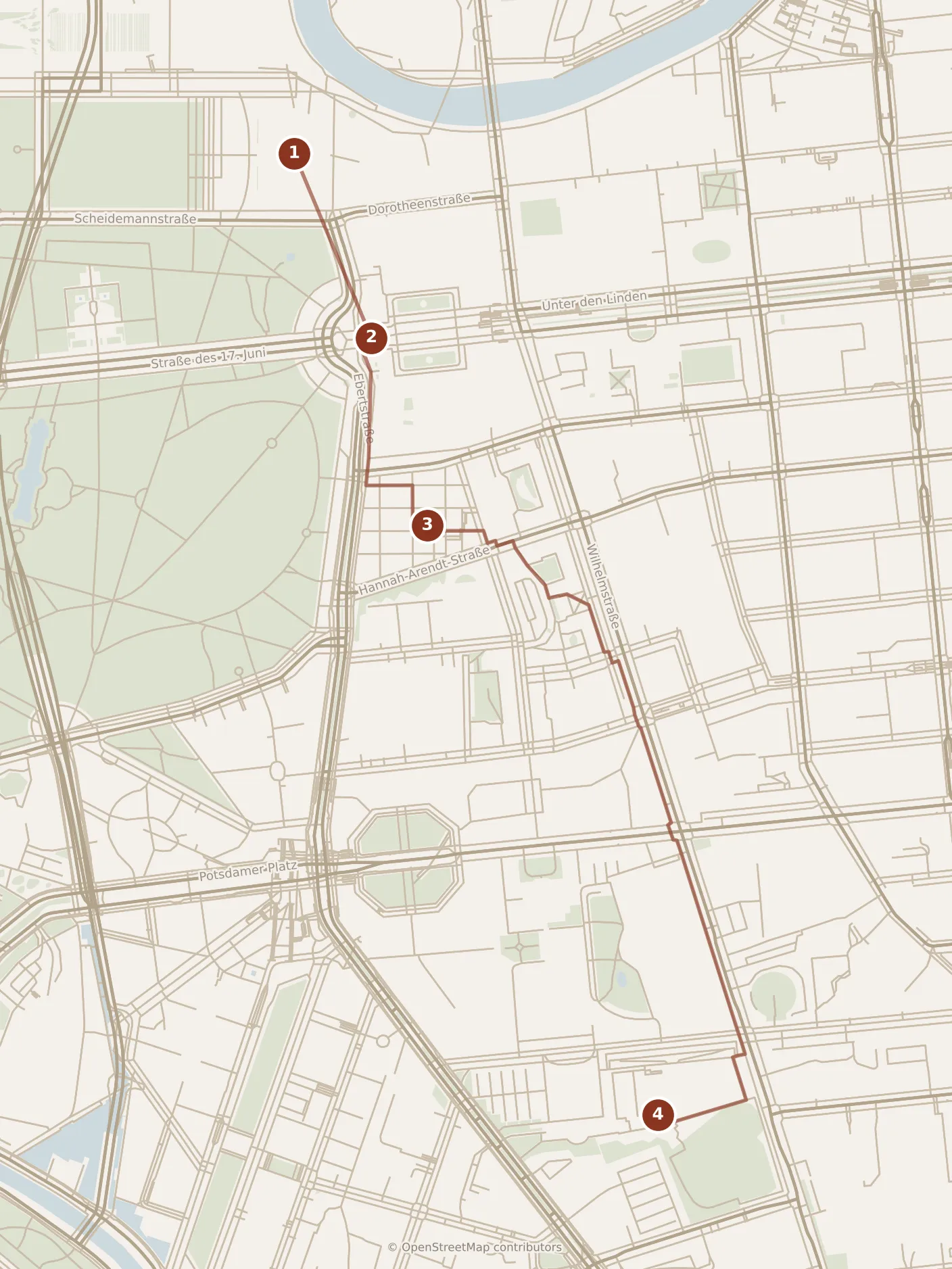
- Morning
- 1Reichstag
- 2Brandenburg Gate
- 3Memorial to the Murdered Jews of Europe
- 4Topography of Terror
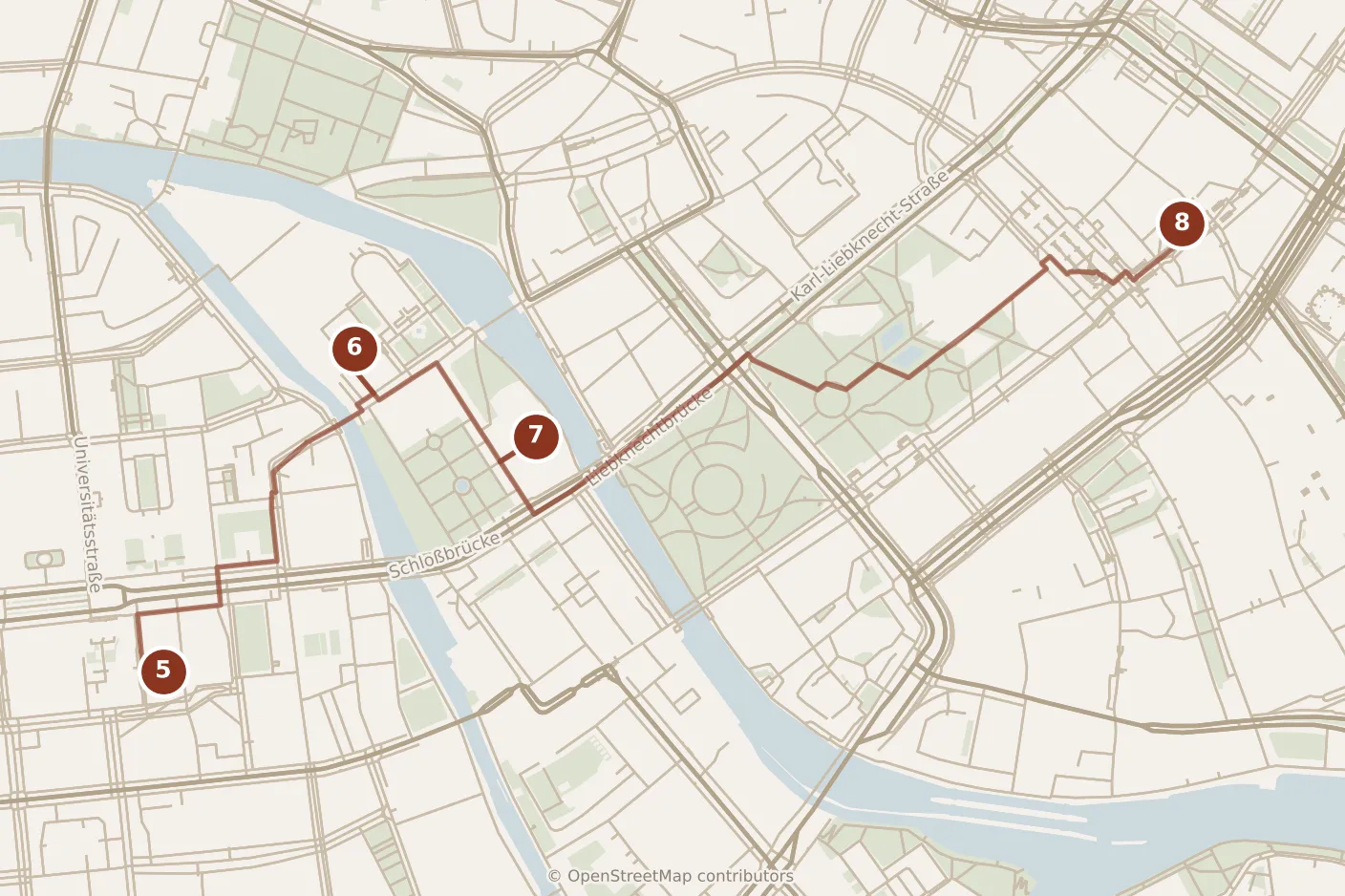
- Afternoon
- 5Bebelplatz
- 6Neues Museum
- 7Berlin Cathedral
- 8Alexanderplatz
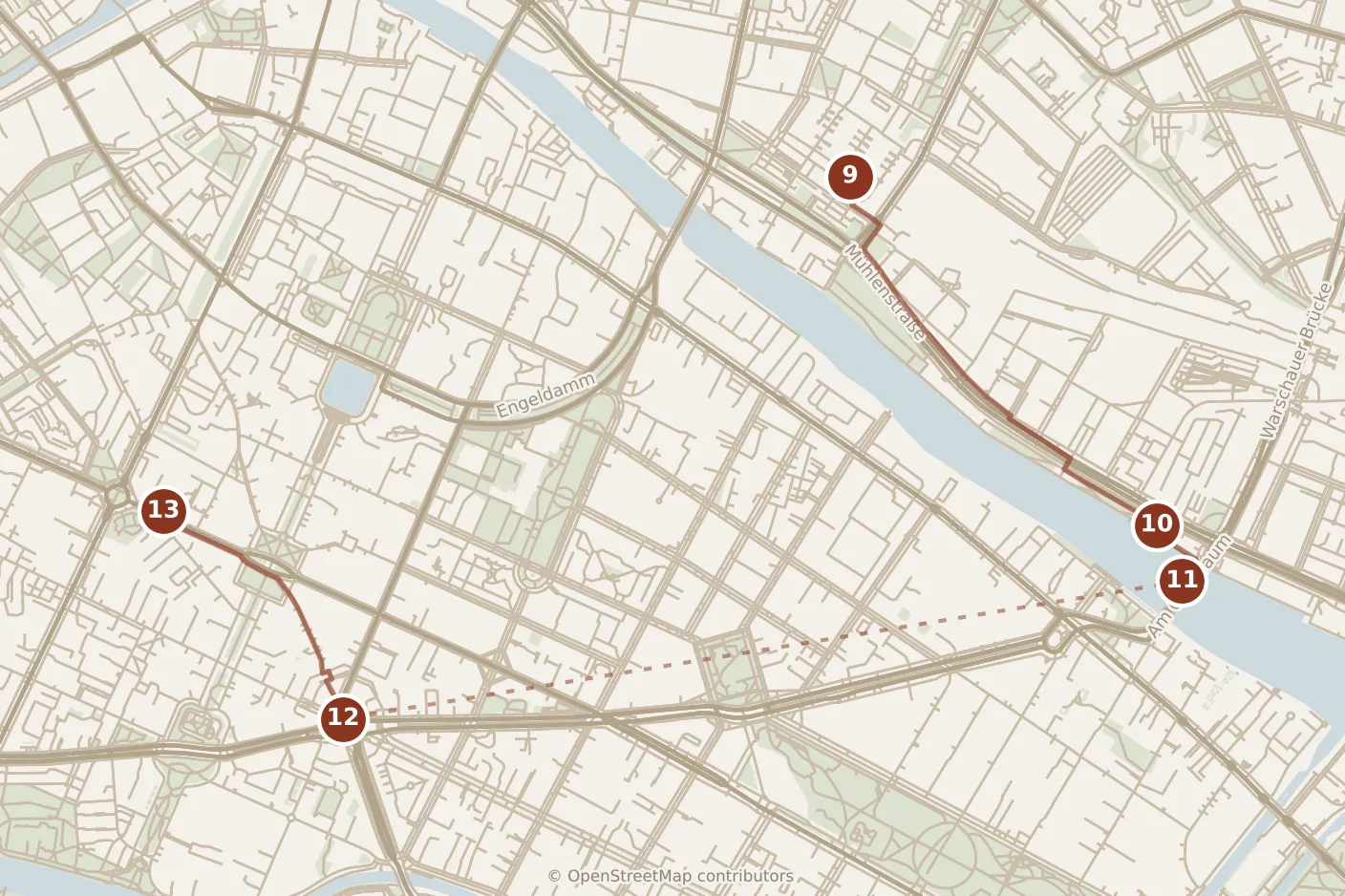
- Evening
- 9Ostbahnhof
- 10East Side Gallery
- 11Oberbaumbrücke
- 12Kottbusser Tor
- 13Oranienstraße
Morning
Start at the Reichstag, because it is the only stop on this route with a door you cannot simply walk through. An elevator takes you to the roof terrace and the rest is on foot: two spiral ramps, one climbing and one descending, wound around a mirrored funnel that drops daylight into the debating chamber underneath. You look out over the government quarter on the way up and down through the middle at the parliament, which is the whole argument of the building — the electorate stands on top of the elected. The dome is Norman Foster’s, finished in 1999, and it went on a building that had burned in 1933 and then spent the years of the division standing empty with the Wall running right past it. Give it an hour, including the identity check at the entrance. Its slots run late into the evening, far later than anything else on this route stays open.
Five minutes south is the Brandenburg Gate, which is smaller than photographs suggest and takes ten minutes rather than thirty. The thing worth registering is not the arch or the chariot group on top of it but the ground: for twenty-eight years this gate stood inside the border strip, on no side at all, and nobody could walk under it.
Three hundred meters further south, the Memorial to the Murdered Jews of Europe is two thousand seven hundred and eleven concrete blocks on ground that undulates, by Peter Eisenman, opened in 2005. Do not photograph it from the edge and leave; walk into the middle of it, where the paving drops away underfoot, the blocks rise well over your head and the traffic noise cuts out. Twenty minutes for the field. Underneath it, and free, is the information center, which is where the abstraction above becomes names, dates and letters thrown from trains — an hour if you take it, and it is closed on Mondays when the field above is not.
Ten minutes south brings you to the Topography of Terror, and this is the hour that earns the morning. The Gestapo and the SS ran the Nazi terror from buildings on this block; they were demolished after 1945 and the ground lay derelict for decades before it became a documentation center standing over the excavated cellar walls. It is free and open every day. There are two exhibitions and they are not equal: the indoor one is dense, unrelieved and mostly panels of text and photographs, while the open-air trench along the excavated cellars is the one to read if you only read one. And along the street outside runs about two hundred meters of the Wall — the longest surviving stretch of the outer wall, the face that West Berlin could see, which is a different structure from the longer, more famous one you will walk beside this evening.
Local tip. If you could not get a morning slot for the dome, take a late one rather than dropping it — it is the one stop here still admitting at that hour. That means running the line the other way: the wall and the open-air trench while it is light, dinner in Kreuzberg, and then about half an hour back across the city to the dome. What you cannot do is turn up without having registered.
Afternoon
The blocks around the Topography of Terror are ministries and offices and thin on lunch, so eat on the walk north. This is the meal for a Currywurst standing at a stall — sliced sausage under curry ketchup, ten minutes, no ceremony — and it is the right economy on a day with seven kilometers in it.
Walk east to Friedrichstraße and then north up it. Checkpoint Charlie sits where you meet it: a replica hut and a reproduction sign marooned in the middle of a road junction, with nothing original left in the street. It is the one thing on this axis you can walk straight past, and after the morning you have just had it will read as a souvenir shop, which is roughly what it is.
Turn east along Unter den Linden and, five minutes on, into Bebelplatz. There is nothing to see here until you look down. Set flush in the paving, near the middle of the square, is a pane of glass over a small white room of empty shelves — enough shelving for the twenty thousand and more books burned on this square in May 1933. It is Micha Ullman’s, unveiled in 1995, and it is easy to walk over without noticing; the giveaway is the knot of people standing looking at their feet. Five minutes, and it is the best five minutes in the afternoon.
Five minutes more and you are on Museum Island. Take the Neues Museum and only that. The bust of Nefertiti is here, painted limestone and stucco, dug out of a sculptor’s workshop in Egypt in 1912 and startling chiefly for how finished it is not: one eye has no inlay at all, and the thing is generally read as a sculptor’s master model rather than a finished portrait. But the building is half the visit: it was left a ruin by the war and rebuilt by David Chipperfield, reopening in 2009, with the damage deliberately unhidden — shrapnel-pocked columns, burnt brick, blank patches where frescoes were, and every new surface plainly and unapologetically new. Give it ninety minutes, and give up the prehistory floors to do it; they are thorough and they are not what you came for. The Egyptian rooms and the staircase are.
A note that will date, so it is written to date honestly: the Pergamon Museum, the one most people picture when they hear Museum Island, has been shut since October 2023 for a rebuilding done in halves, with the first half announced for June 2027 and the second a decade behind it. Check what has reopened before you count on it, and plan this day so that the answer does not matter.
Three minutes south-east, Berlin Cathedral is the enormous domed thing you have been seeing all afternoon. Inside there are two reasons to pay: the crypt, which holds the coffins of the Hohenzollern, the dynasty that ruled here until 1918, and the two hundred and seventy steps up to the walkway that runs around the outside of the dome. In a city with no hills that walkway looks the other way from the morning’s dome — east over Mitte, the river and the Nikolaiviertel. Forty-five minutes for both. On a Sunday it opens to visitors only at midday, the morning being for services.
Twelve minutes east and the afternoon ends at Alexanderplatz, which is not a sight and should not be treated as one — a wide, windy, hard-surfaced square that the guidebooks are kinder to than it deserves. Ten minutes buys the two things on it that are worth having. The world clock is a rotating drum listing the hours in all twenty-four zones, put up in 1969 and still the place Berliners say they will meet. Above it stands the television tower, 368 meters, from the same year, and on a sunny day the steel panels of its sphere throw a cross of reflected light that the atheist state which built it could never engineer away; the nickname that stuck to it has outlived the state. Do not go up. The elevator is ticketed and timed, the line is a line, and the view is of a flat city you have just looked at from a dome.
Evening
From the S-Bahn platforms on the square, two stops east to Ostbahnhof. Come out on the river side and walk five minutes to where the Wall starts again.
The East Side Gallery is one thousand three hundred and sixteen meters of it, standing where it stood apart from two stretches moved or cut through for the buildings behind it, painted in 1990 by more than a hundred artists from twenty-one countries in the months after the border opened. The thing to understand as you walk it is which wall this was. This is the inner one, the side facing East Berlin, which in the years it mattered no one was permitted to approach, let alone paint — the opposite case from the outer stretch you stood at this morning. Most of what you see is not the 1990 paint either: the originals weathered and were repainted by their own artists in 2009 — and the few who refused have left their segments bare ever since, which are the most interesting stretches on it. Forty-five minutes at a walking pace, and it is a better forty-five minutes at dusk than at noon.
The gallery ends at the Oberbaumbrücke. Cross it. It is brick, twin-decked and built in 1896 in a north German brick gothic that makes it look like a fortified city gate it never was; the upper deck carries the U-Bahn over the water. From 1963 it was a border crossing that only West Berliners were allowed to use, on foot. Its middle span went in the war, and the plain steel one that replaced it is Santiago Calatrava’s; the rebuilt bridge opened on the ninth of November 1994, five years to the day after the border did.
At the Kreuzberg end of the bridge the U1 runs on an iron viaduct above the street, as it has since 1902. Schlesisches Tor is the station; take it two stops west to Kottbusser Tor. You can walk it in twenty minutes instead, but the ride is at rooftop height through the backs of tenements and costs you nothing you have not already paid.
Kottbusser Tor is one of the rougher corners of central Berlin and it does not pretend otherwise: dealing happens in the open on the square, and it is a place to keep a phone in a pocket. What goes on here is petty theft rather than anything worse, and at dinner time the square is busy and ordinary. It is also where the eating is, and the two facts are not in tension — this is the Turkish and Middle Eastern heart of Kreuzberg, and it is where the eating is best. Oranienstraße runs north-west off the square and is the street to walk: grills, kebab counters and a solid strip of drinking. A Döner kebab here is the correct end to this particular day — a wedge of flatbread split into a pocket and loaded, not the rolled kind.
Then home on the U-Bahn from Kottbusser Tor, which on a Friday or Saturday runs all night. On the other five nights it stops around half past midnight, and the night bus takes over along the same line.
Practicalities
One booking, and it is not optional. The Reichstag dome is free but you cannot enter without registering in advance, giving the full name and date of birth of everyone coming, and you are identity-checked at the entrance, so bring the document you registered with. Do it well before you travel: it costs nothing, so nothing but time rations it. There is a visitors’ service point a short walk from the building where you can register in person for a later slot, but there is no walking up to the entrance and going in.
Nothing else here requires booking. The Neues Museum sells its ticket online, which is worth taking to skip the desk; there is no slot to book and no arrival time to hit.
Mondays cost this route exactly one stop and one basement. The Neues Museum closes, as every museum on Museum Island does as a rule, and so does the information center under the field of stelae. The field itself, the Reichstag, the Brandenburg Gate, the Topography of Terror, Berlin Cathedral, both stretches of the Wall and the whole of the evening are open. If your day falls on a Monday, spend the museum’s ninety minutes at the Wall memorial on Bernauer Straße instead — free, outdoors, open every day, and the one place that shows the Wall as a system rather than as a surface, which is what the rest of this day is about. That is a real day, not a salvage operation — which is unusual, and is a reason to take the single day as written rather than reshuffling it.
Sundays need one adjustment only: Berlin Cathedral opens to visitors at midday rather than in the morning. Since this route reaches it in mid-afternoon, a Sunday changes nothing about the order above.
Transport is barely a factor. The route uses it twice — two S-Bahn stops from Alexanderplatz to Ostbahnhof, two U1 stops across Kreuzberg — and both legs sit well inside the inner fare zones, so the city ticket covers the whole line. Buy it before you step onto the platform: there are no barriers to remind you, and a paper ticket has to be stamped at the machine there. Nothing on it needs a taxi, and the two rides exist only to spare you the two stretches that are genuinely too long to walk at the end of a day.
The walking is the thing to plan for: about seven kilometers, all of it flat, most of it on hard sidewalk and much of it outdoors with no shade — the field of stelae, the trench, the wall, the square. The longest single stretch is the twenty-five minutes from the Topography of Terror north to Bebelplatz, and it is placed over lunch on purpose. Everything after Museum Island is under fifteen minutes from the last thing.


_16.jpg)
