Beijing in a week: the imperial axis, the hutongs, the Summer Palace and a day at the Great Wall

Last updated 3 August 2026
Overview
Beijing is not a city you drift around. It is laid out on a grid of enormous blocks inside concentric ring roads, and two things that look adjacent on a map are routinely twenty minutes apart along a road with nowhere to cross. The consequence for a week is simple, and it governs everything below: each day is one district, entered once and then walked, with the subway joining the days rather than interrupting them. A week planned any other way is a week spent underground. Two of the seven bend the rule — day six adds the art district out past the fourth ring, and day seven moves three times across the east — and both say so where they begin.
So this one goes outward from the middle. The imperial axis first, because it is what you came for and getting it done on the first day turns it from an obligation into the thing everything else is measured against; then the south; then the alley city north-west of the palace; then a day at the wall, placed mid-week while your legs are still good; then the Summer Palace out beyond the north-west suburbs; then the temples of the north-east and the art district past them; and the last day in the modern east, which is a genuinely different city and earns a day precisely because of it. Six of the seven days are inside Beijing. The seventh is not, and that is deliberate rather than an omission from a longer list.
One structural thing decides the shape of all of it. Nearly every major site here works on advance, real-name booking: you reserve under the name in your passport, and you carry the passport itself to get through the gate. Not occasionally — routinely, and for a foreign visitor it is the commonest reason to arrive somewhere and be turned around. Book the ticketed sites before you leave home, and take your passport out with you every day of the week, not only on the days you expect to need it. The same applies to the square itself: it is fenced, entered at set points through an airport-style check, and admission has for several years been controlled by advance reservation. Establish what the current requirement is before day one, because it is the one thing that can end a morning at a barrier.
The other fixed point is the palace’s weekly closing day, which is a Monday as a rule, with exceptions in the summer peak and around the national holidays. It is the only date in this week that cannot move. Settle day one against it and let the other six arrange themselves. Everything else here bends: the wall day can slide, the market day wants a weekend, and nothing else in the seven depends on which day of the week it lands on.
Mutianyu — not on the walking map; you get there by bus.
Day one

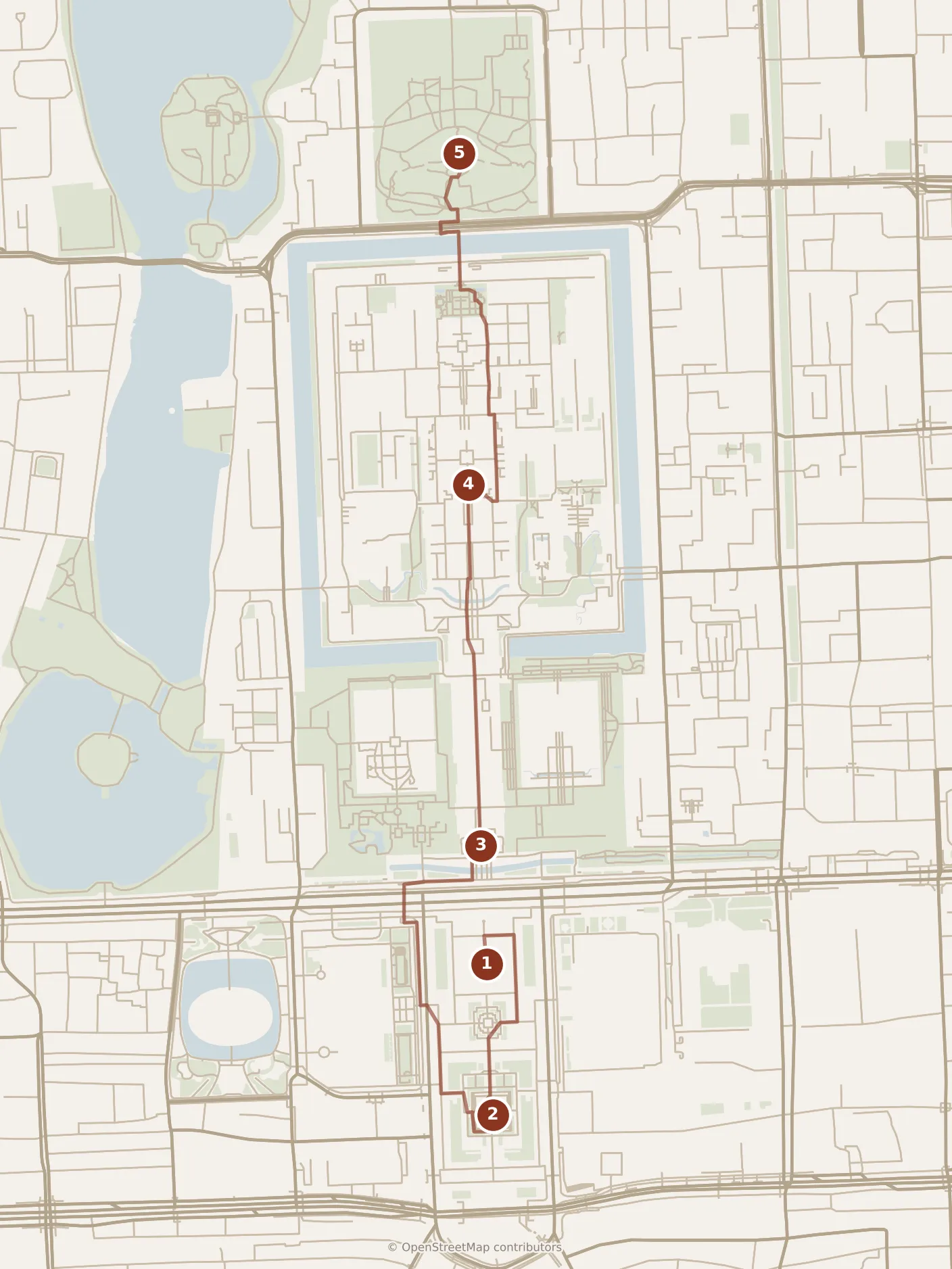
- Day one
- 1Tiananmen Square
- 2Mausoleum of Mao Zedong
- 3Tiananmen
- 4Forbidden City
- 5Jingshan Park
The central axis, walked from the south end to the north, which is how the city was built to be entered and the only way it still makes sense.
The hill at the end wants afternoon light and the palace below it is one-way, so this day is timed from the front rather than the back: the square, the palace and the climb come to about six hours without hurrying, which means a morning entry to the palace and nothing later. That is the whole reason the tip below tells you to book the morning slot — an afternoon one puts the climb after the light has gone, and there is no way to reorder your way out of it.
Start on Tiananmen Square, which is not a square in any European sense: it is a paved plain roughly eight hundred meters from end to end, wide enough that the buildings around it read as distant scenery rather than as walls. Cross it slowly and on foot. The scale is the exhibit, and it does not photograph — you have to walk it to understand that this is a space designed for several hundred thousand people and that you are three of them.
The Mausoleum of Mao Zedong sits in the middle of it, free to enter, and it is worth the line if you can spare the first hour of the morning. Bags are not allowed inside and must be left at a deposit outside the perimeter, the line is silent and moves fast, and you file past the body without stopping. It opens for a limited window and not on every day of the week, so check before you build a morning around it; if the answer is no, you have lost nothing and gained an hour.
Then north, under the Tiananmen gate with the portrait on it, and into the palace. The rostrum on top of the gate is a separate ticket and a separate line for a view of the square you have just crossed: skip it. The Forbidden City proper begins at the Meridian Gate, and the single most important thing to know about it is that it is one-way. You enter at the south, you walk north, and you leave by the Gate of Divine Prowess at the far end; there is no coming back for the bit you missed. Give it three hours. The spine is the three great halls on their marble terrace, of which the Hall of Supreme Harmony is the largest surviving wooden building in China and rises some thirty meters above the courtyard — but the spine is also where every visitor is, in one slow river. The palace is nine hundred-odd buildings, and the pleasure of it is stepping off the axis into the side courtyards of the inner court, where the crowd thins to nothing within a hundred meters. The Treasure Gallery and the Clock Gallery are separate tickets inside the walls; if you take one, take the clocks, which are an eighteenth-century emperor’s collection of European automata and quite unlike anything else in the building. The Imperial Garden, just before the north gate, is small, gnarled and crowded, and is a poor last impression of a great building — walk through it rather than sitting in it.
Cross the road at the north gate to Jingshan Park, which is the day’s ending and its argument. The hill is artificial: forty-five meters of spoil dug out to make the palace moat, piled up behind the palace it protects. Climb it — twenty minutes, steep steps, no elevator — to the Wanchun Pavilion on the central peak, and turn round. You get the Forbidden City whole, the sea of yellow roofs you have just spent three hours inside, laid out in one frame with the axis running away north and south beyond it. There is nowhere else in Beijing this view exists. The afternoon is when to do it. On the way down, the marked spot where the last Ming emperor hanged himself in 1644 as the rebels entered the city is a small, oddly plain thing at the foot of the hill, and it is the whole dynasty’s ending in one signpost.
Local tip. Book the palace for a morning slot rather than an afternoon one. Because it is one-way and ends at the north gate, an afternoon entry leaves you coming out with the light going and Jingshan — which is the view of everything you have just walked — closed or dark. The order only works forwards.
That leaves the evening, and Peking duck belongs to it more than to any other night of the week. It is the one dish the whole city agrees about, it wants a proper sat-down meal rather than a snack at the end of a long day, and the places that carve it at the table are thickest in the streets east of the axis you have just walked.
Day two

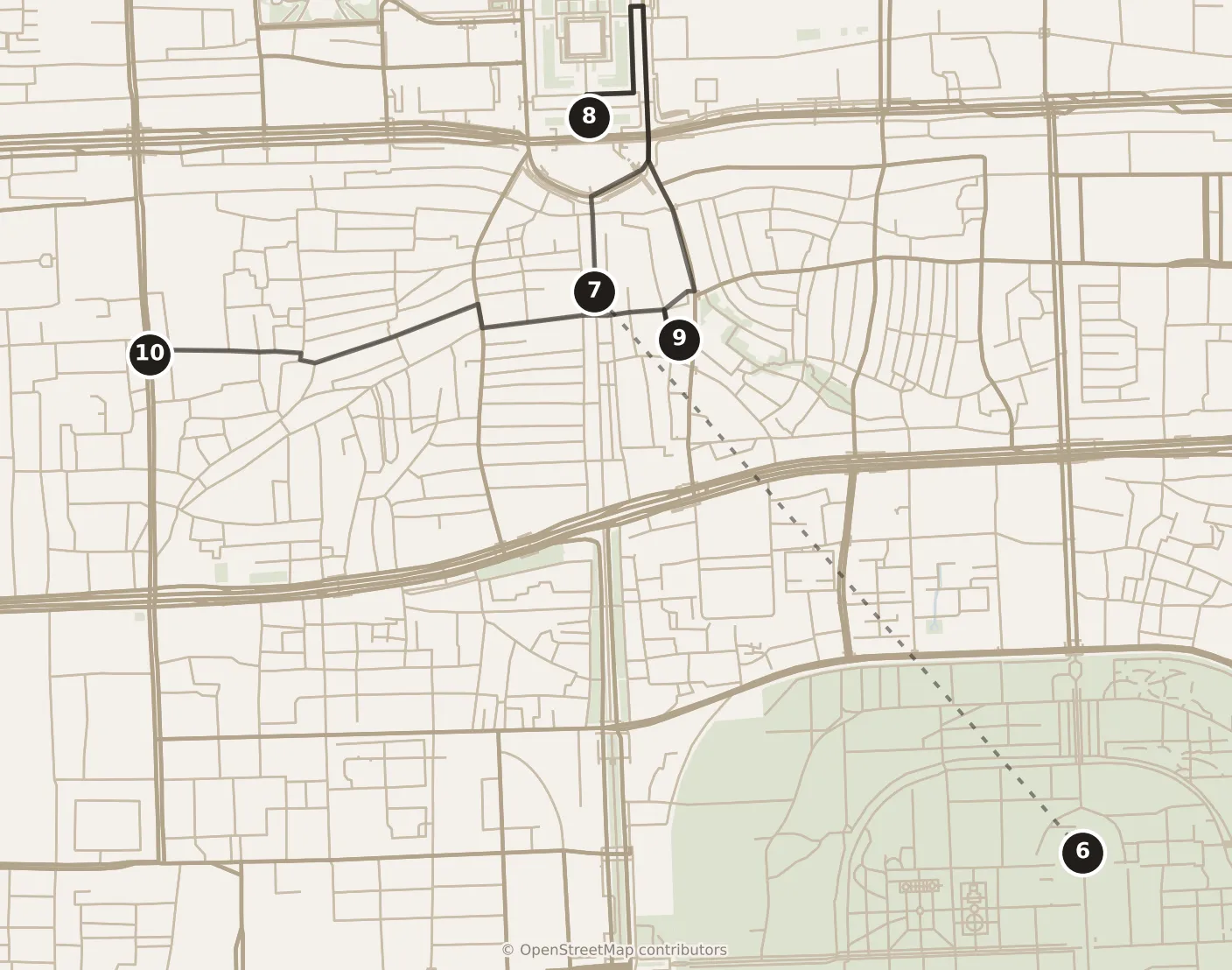
- Day two
- 6Temple of Heaven
- 7Qianmen Street
- 8Zhengyangmen
- 9Dashilan
- 10Liulichang
The south, and an early start, which is the one morning of the week where getting up matters. Eat on the way rather than at the hotel: jianbing, the folded savory crêpe griddled to order from a cart, is a breakfast you carry, and today is the day to have it in your hand.
The Temple of Heaven is not a temple in the sense of a building you go into; it is a walled park of two hundred and sixty-odd hectares with three ritual structures strung along a raised north-south causeway inside it. Enter from the south gate so that you walk it in the order it was designed to be walked. First the Circular Mound Altar, an open three-tiered marble platform with nothing on it at all — the point is the emptiness and the arithmetic, the stones laid in rings of nine, eighteen, twenty-seven and so on outward. Then the Imperial Vault of Heaven, ringed by the Echo Wall, a smooth circular wall that carries a voice around its curve. Then the long raised walk north to the Hall of Prayer for Good Harvests, the triple-roofed blue drum that is the building on every postcard: thirty-six meters across, thirty-eight high, built entirely of wood, with four inner pillars for the seasons and two rings of twelve for the months and the old Chinese hours.
The reason to come at opening is the park rather than the buildings. The tree-covered ground between the gates is where a large part of the surrounding neighborhood spends its early morning: choirs, ballroom dancing on the paving, card schools, ribbon and sword forms, people playing instruments alone under the cypresses. It is not staged for anybody and it thins out as the morning goes on. Give the whole thing two and a half hours and spend at least a third of that not looking at monuments.
Local tip. The park and the monuments are two different tickets, and a park ticket gets you into none of the three buildings — they sit in their own walled enclosures inside it. Buy the through-ticket. It is the only way the walk described above joins up.
Then north-west to Qianmen Street: one subway stop, or a flat twenty-five minutes on foot if the weather is good. This is old commercial Beijing, rebuilt — a broad pedestrian avenue of restored shopfronts with a tram running down it, handsome and entirely without surprise. Walk up it rather than lingering, and use it as the approach to Zhengyangmen at the top, the great double-structure gate that was the front door of the inner city. Its two parts, the gate tower and the archery tower, face each other across the road where the wall used to run, and standing between them is the clearest sense you will get anywhere in Beijing of a city that used to have walls.
Turn west into Dashilan, and the register changes within a hundred meters. These are the lanes of the old merchant quarter — narrower, older, patchier, with century-old pharmacies and silk and hat shops still trading under their original signs alongside a good deal of tourist tat. Wander rather than route yourself; the good blocks and the rough ones sit side by side and that is the character of the place. Give it an hour and a half.
Keep going west and slightly south, about a mile in total, to Liulichang: two short streets of gray-brick shopfronts selling ink, brushes, seals, rubbings, paper and old books. Most of what is on sale is reproduction, which does not matter, because this is a browsing street rather than a buying one and the shops let you look. It is much quieter than everything else today, and it is the right last hour of an afternoon.
Day three

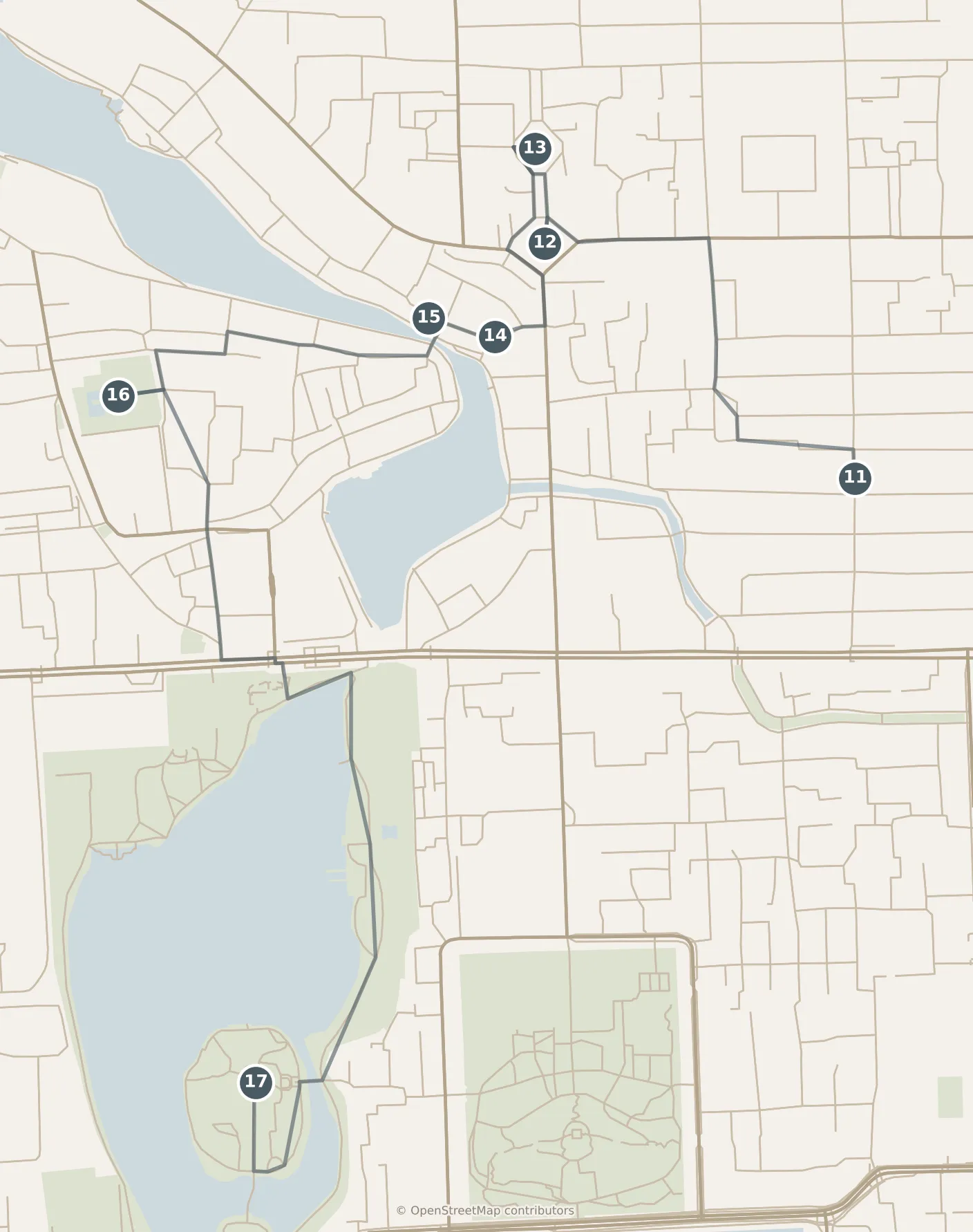
- Day three
- 11Nanluoguxiang
- 12Beijing Drum Tower
- 13Beijing Bell Tower
- 14Yandai Xiejie
- 15Shichahai
- 16Prince Gong's Mansion
- 17Beihai Park
The old alley city, north-west of the palace, and the only day of the week that is entirely on foot from start to finish. This is the day people remember.
Begin at Nanluoguxiang, which is a lane about eight hundred meters long running north-south, and be honest with yourself about it: the lane itself is a shopping street, crowded from mid-morning, selling snacks and souvenirs. It is worth ten minutes, and it is worth them mainly because sixteen alleys run off it either side, and those are the actual thing. Turn into any of them. Within thirty seconds you are among gray brick walls, courtyard gates with worn stone drums beside them, bicycles, cabbages drying, and people going about a Tuesday. Spend an hour losing yourself in that grid rather than walking the lane.
Come out at the west end and walk to the Beijing Drum Tower and, a hundred and fifty meters beyond it, the Beijing Bell Tower — two heavy brick towers closing the north end of the same imperial axis you walked on day one. Between them they were the official clock of the city, for the Yuan, Ming and Qing and on until 1924: the drum struck the watches of the night and the bell carried the hours across the roofs. You can climb the Drum Tower, and it is a proper climb up a very steep single flight, but the reward is the best view in Beijing of what is left of the low city — an unbroken gray sea of tiled courtyard roofs, which is the thing everyone assumes has gone and which from up here plainly has not. Half an hour for both towers and the climb.
Yandai Xiejie runs south-west off the square between the towers, a short crooked lane at an angle to everything around it, and it delivers you to the water. Shichahai is a chain of three connected lakes, of which Houhai is the largest and the one people mean; the banks are willows, old men fishing, and — in winter — a proper skating and ice-chair rink on the frozen surface. The lakeside strip immediately by the bridge is bars and pedicab touts and can be ignored; walk on, anticlockwise, and within five minutes it becomes a residential waterfront. Allow an hour, more if the weather rewards it. Lunch is a ten-minute business somewhere in the alleys behind the bank, and zhajiangmian is what to look for — thick wheat noodles under a dark, salty fermented-bean sauce, mixed at the table with whatever raw vegetable comes with it.
On the west bank stands Prince Gong’s Mansion, the best-preserved great courtyard house in the city. It was built by Heshen, an official whose corruption is proverbial in China, confiscated when he fell, and later given to the Qing prince whose name it now carries. Six hectares of halls and, behind them, nearly three of garden in the southern manner — rockeries, ponds, covered walks, an opera house in the grounds and a much-visited stele carved with the character for good fortune in the Kangxi emperor’s own hand. An hour and a half, and go in the afternoon when the tour groups have thinned.
Finish at Beihai Park, twenty minutes’ walk south, and time it for the late afternoon. It is an imperial garden first laid out in the twelfth century, opened to the public in 1925, and more than half of its seventy-odd hectares is lake. Jade Flower Island rises out of the middle of it under the White Dagoba, a forty-meter white stone stupa put up in 1651 for a visit by the fifth Dalai Lama and rebuilt after two earthquakes since. Row a boat if there are boats, or simply walk the shore. On the north side of the water is one of only three nine-dragon walls in China, a glazed screen from 1402 with nine dragons on each face, and near the south gate the Round City holds a white jade Buddha whose arm was damaged in the fighting of 1900. Two hours, and it is a better ending than anything indoors.
Local tip. Everything today is within about four kilometers end to end, which is the whole case for the day, but almost none of it is signposted for a visitor once you leave the lanes that are. Take the alleys as they come rather than trying to hold a route in your head — you cannot get badly lost between the towers and the lakes, and the wandering is the point.
Day four

Out of the city, and the only day of the seven that is. The wall is roughly seventy kilometers away and the day belongs entirely to it, so do not try to attach anything else to it.
Go to Mutianyu. There are five or six restored sections open from Beijing and the choice between them is real. Badaling is the most restored, the closest to a direct rail connection from the city, and by a long way the most crowded — the ease and the crowds are the same fact. Jinshanling is the walkers’ section, partly unrestored, magnificent and more than twice as far, which makes it a long day of driving for a long day of walking. Mutianyu sits between them: extensively rebuilt in the 1980s, twenty-two watchtowers along a bit over two kilometers of wall, wooded hills on both sides, and enough space that ten minutes’ walking gets you clear of most people. For a first visit it is the right answer.
Getting there needs arranging in advance, and it is the one piece of transport in the week that does. There is no single train; the practical options are a car rented for the day, a seat on a shared shuttle, or a public bus north to Huairou and a local shuttle onward. Whichever you take, leave early. The wall is at its best in the first two hours it is open and the coaches arrive later.
At the site itself you have three ways up: a two-person chairlift, a larger gondola, or four thousand-odd steps on foot. The steps are a serious climb of about forty minutes and there is no prize for them; take a lift up and keep your legs for the wall, which is what you came for. Once you are on it, the wall runs along a ridge in both directions and the towers are numbered. Walk for at least an hour and a half — this is not a viewpoint you photograph and leave. The restoration thins out as you go, the paving turns to rubble, the gradients get absurd, and the sections where the wall climbs a slope at what feels like forty-five degrees are the ones worth having come for. Coming down, the toboggan is a single-rider cart on a metal track, and it is exactly as silly and as enjoyable as it sounds; the lifts also run downwards if you would rather not.
Take water and take more than you think, because there is none on the wall itself, and take a hat: the ridge is exposed for its whole length and there is no shade in either direction.
Resist the packaged day that pairs the wall with the Ming Tombs. Both are worth unhurried time and they are an hour apart in opposite directions from anywhere useful; a day that does both gives neither its hours, and the wall is the one that repays them.
Local tip. At the top of the lift, look at which way the crowd is turning and go the other way. Both directions are wall and both are worth walking; only one of them has everybody else on it, and which one that is changes with the hour and the coach park.
Day five

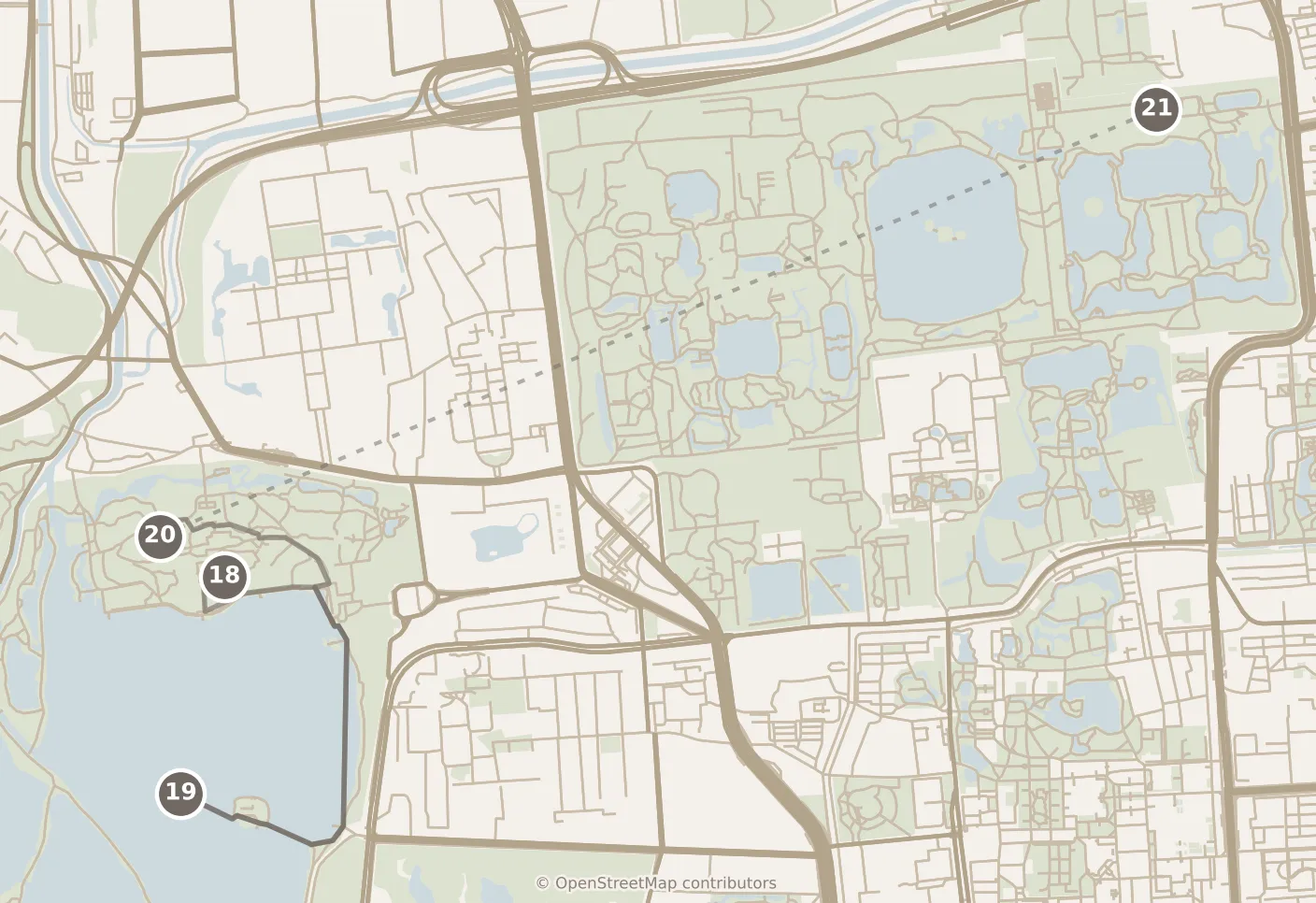
- Day five
- 18Summer Palace
- 19Kunming Lake
- 20Longevity Hill
- 21Old Summer Palace
The north-west, and the two summer palaces — the one that survived and the one that did not. This is a subway day rather than a walking one to begin with, and it is a long ride out; treat it as such and go early.
The Summer Palace is three square kilometers and three-quarters of that is water. Kunming Lake was dug by hand and Longevity Hill was built out of what came out of it, which is the same trick as Jingshan on a scale forty times larger. Enter from the east and take the front of the hill first, along the water. The Long Corridor runs seven hundred and twenty-eight meters along the lakeshore, a covered walk roofed and beamed the whole way and painted along its length with thousands of small scenes from Chinese landscape and literature — walk it slowly, because the paintings are the reason it exists and nobody looks up at them. At its western end is the Marble Boat, a stone pavilion in the shape of a paddle steamer, which replaced a wooden one burnt by British and French troops in 1860 and is the most eloquent thing in the park about what late imperial money was spent on.
Turn uphill. The Tower of Buddhist Incense stands three stories and forty-one meters up the face of Longevity Hill and is the vertical anchor of the whole composition; the climb to it is steep-ish and short, and the view down over the lake with the Seventeen-Arch Bridge crossing to its island is the picture the place was designed to produce. Give the palace three hours in all. If time is short, skip the island and the bridge — they are half an hour’s walk out and back around the lake for a view you have already had from above — and spend it instead on Suzhou Street on the far side of the hill, a canal lined with mock shopfronts built in 1762 as a plaything for the court, burnt in 1860 and rebuilt in 1988, which is a strange and rather touching thing to walk down.
Then one stop on the subway to the Old Summer Palace, and the reason for going in this order becomes obvious as soon as you arrive. This was the far larger and, by contemporary accounts, far finer of the two, and in 1860 it was systematically looted and burned. What is left is a park of lakes and low mounds, and at one end the Western Mansions: the marble skeletons of a set of European-style baroque palaces built for the Qianlong emperor by Jesuit missionaries, now carved fragments lying in a field. It takes an hour and a half. It is a national wound rather than a sight, it is presented as one, and going there straight from the restored palace is the only way to understand what the restoration is a restoration of.
Day six

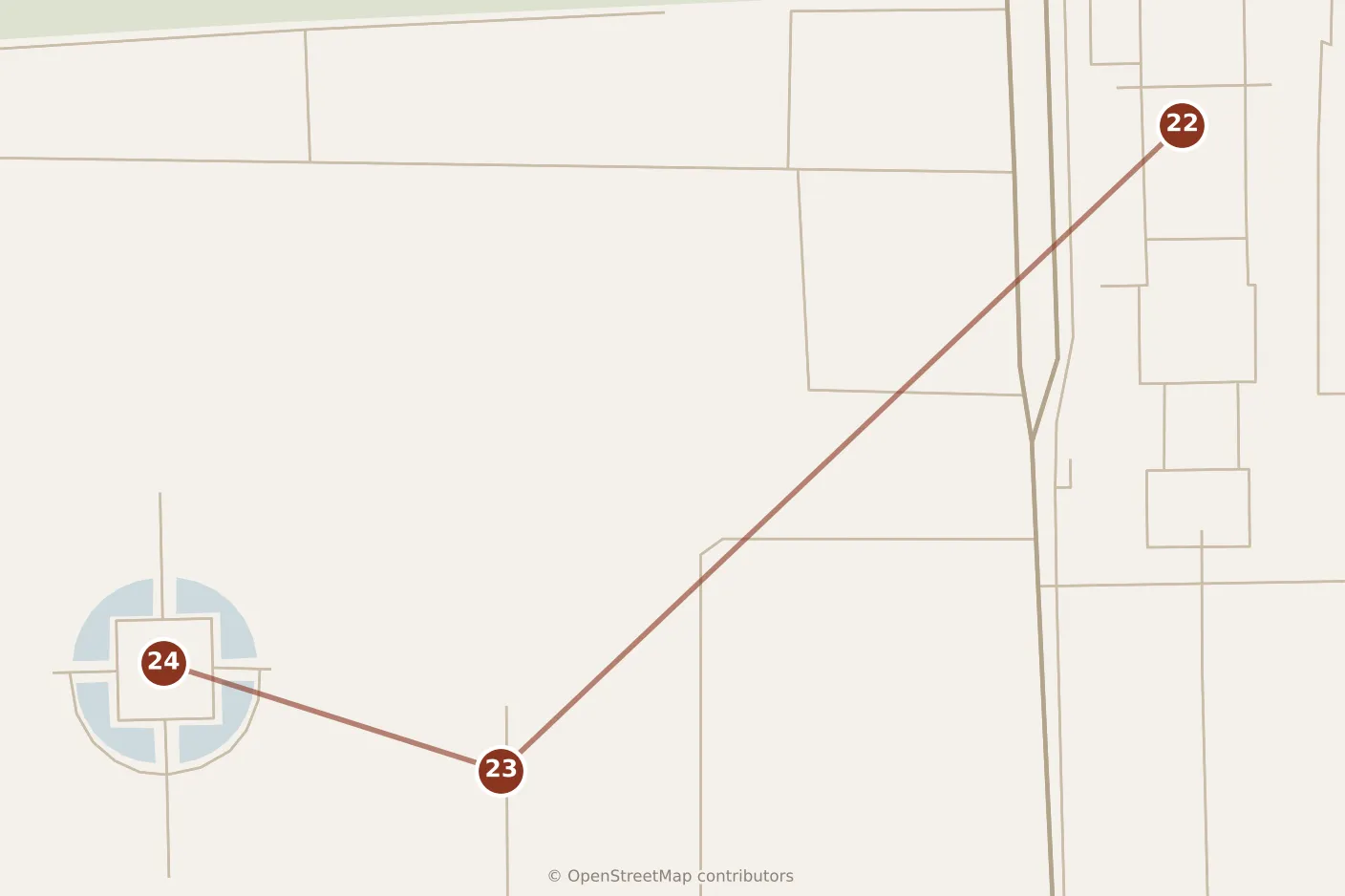
- Day six · stops 22–24
- 22Yonghe Temple
- 23Beijing Temple of Confucius
- 24Guozijian
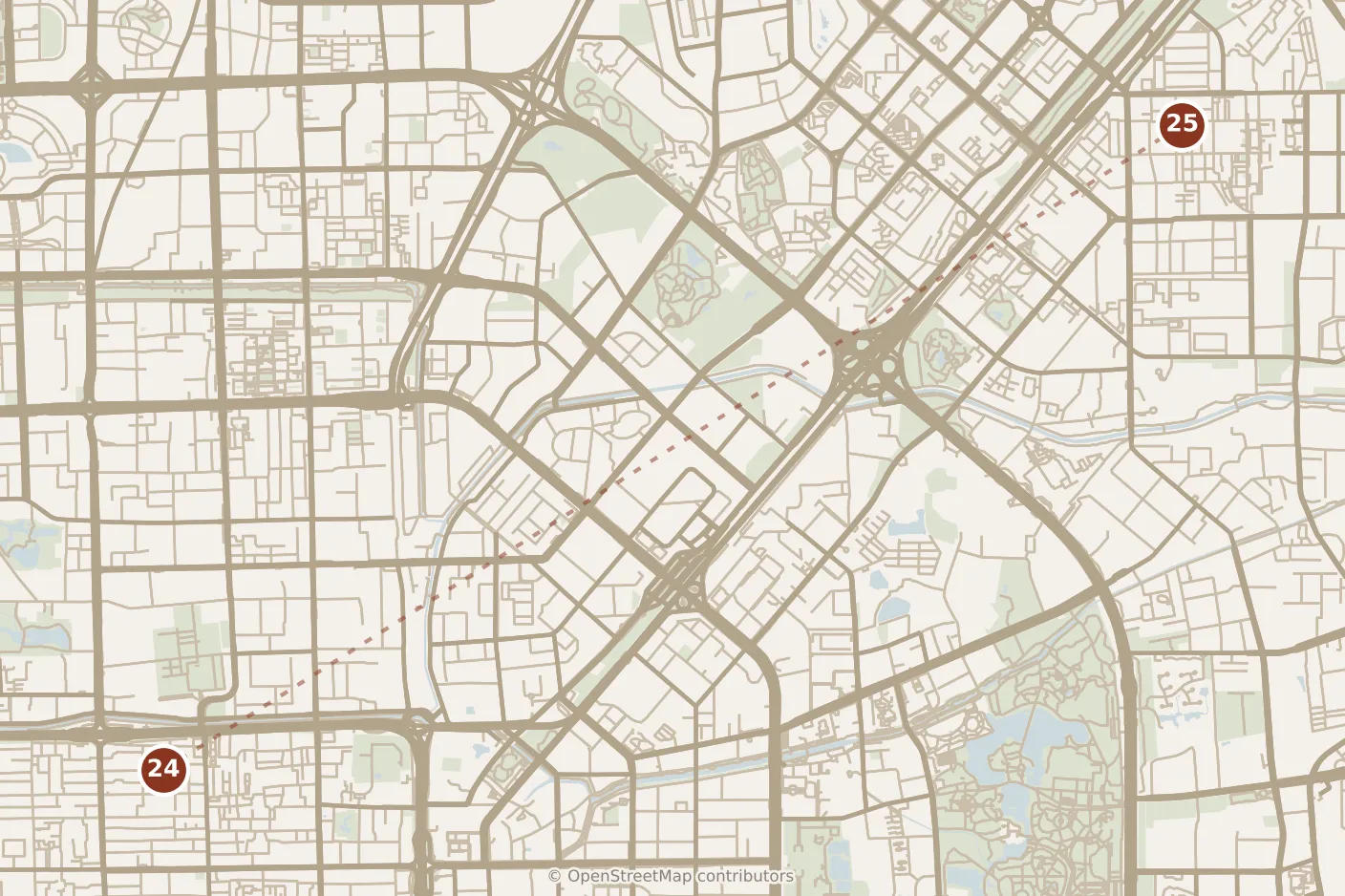
The leg out of the center: from stop 24 by taxi, not on foot.
- Day six · stop 25
- 25798 Art Zone
The north-east: two temples and an academy in one compact quarter, then the art district out past the fourth ring. One real transit leg in the middle, and no walking between districts.
Yonghe Temple opens the day. It began as the residence of a prince who became emperor, which is why it has imperial yellow tiles on a monastery, and in 1744 his son turned it into a Tibetan Buddhist lamasery of the Gelug school. It is still a working temple, and that is what makes it worth the first hour of the morning: the courtyards are thick with incense smoke and with people actually praying, which is not true of anywhere else on this week’s list. Five halls in a row, rising as you go north, and the last of them contains the thing to come for — a standing Maitreya eighteen meters high above the floor and another eight below it, carved from a single white sandalwood trunk that took three years to bring from Tibet. It is too tall for the hall it is in, which is the point: you cannot step back far enough to see it whole. An hour, and take the incense as offered rather than buying armfuls.
Cross the main road west and go a few hundred meters along Guozijian Street, one of the few streets in the city that still has its old ceremonial arches standing over it. Two neighbors share the quarter: the Beijing Temple of Confucius, the second largest in China, and the Guozijian, the imperial academy that trained the empire’s officials for six centuries. They are now entered together. The temple’s courtyards hold nearly two hundred stone tablets carved with the names of every man who passed the highest civil examination over several dynasties — a stone-cut list of everyone who ever won, standing under cypresses in a silent yard — and the academy behind it has the hall where the emperor came in person to lecture. An hour and a half between them, and it is the quietest place in this article.
Wudaoying, running parallel a short way north, is where to eat: a hutong that turned into small cafés and shops without turning into a shopping street, and the low-key version of what Nanluoguxiang became.
The afternoon is the 798 Art Zone, and getting there is the one long hop of the day — take a taxi, which does it in about half the time the subway manages with a change. It is a 1950s electronics factory complex in Dashanzi, designed by East Germans under a Soviet industrial program in a stripped Bauhaus manner, with sawtooth north-facing roof glazing that is the reason artists wanted it: abandoned as industry moved out, colonized from the mid-1990s, and now a district of galleries, bookshops, studios and cafés. Be clear-eyed about what it has become — it is heavily commercial now, and a good deal of it is boutiques in a factory shell. It is still worth three hours, because the buildings are extraordinary in themselves, because the big exhibition spaces are genuinely large-scale, and because the contemporary art is the one thing in this week that is not about the past. Wander; there is no route, and half the pleasure is walking into the ones that look shut.
Local tip. 798 is a district, not an institution: the streets are always open, but every gallery keeps its own days and some proportion will be closed whenever you go. That is not a reason to move the day — it is a reason not to arrive with one particular show in mind.
Day seven

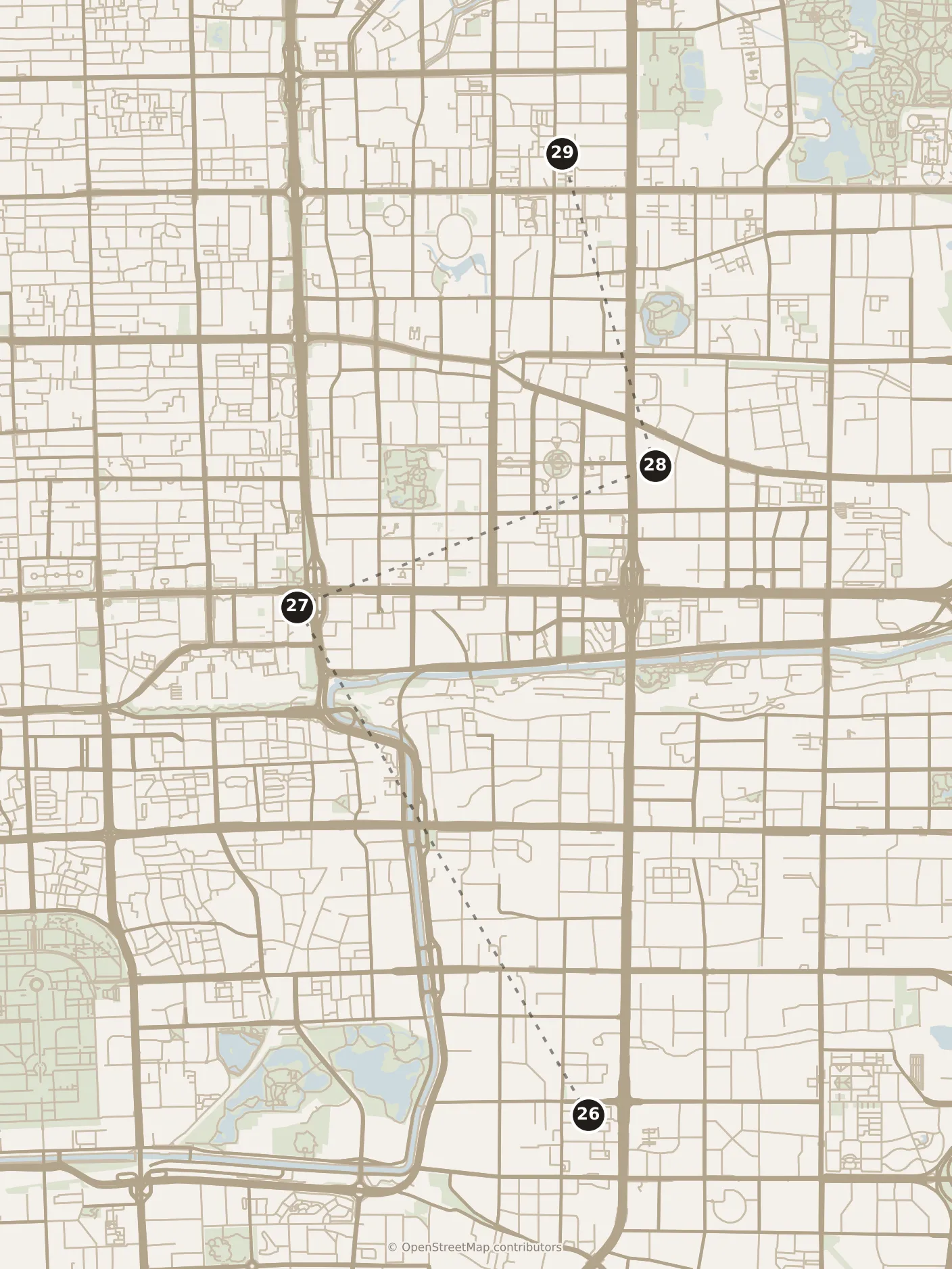
- Day seven
- 26Panjiayuan Antique Market
- 27Beijing Ancient Observatory
- 28CCTV Headquarters
- 29Sanlitun
The modern east, taken lightly, and the day deliberately left with an empty evening at the end of it.
Begin at the Panjiayuan Antique Market, and begin early — this is a morning market and the sellers pack up through the afternoon. It is a large covered and open-air ground of several thousand stalls: porcelain, jade, Cultural Revolution ephemera, furniture, calligraphy, beads, carved stone, old spectacles, birdcages. Almost none of it is antique and everybody involved knows this, which takes the anxiety out of it; treat it as an enormous and very good junk market and it is one of the most enjoyable two hours in Beijing. Haggling is expected and unhurried. The market is at its fullest on the weekend, when the temporary sellers spread their goods on the ground outside the permanent stalls; on a weekday you get the halls and not the sprawl, so put this day on a Saturday or a Sunday if the week allows.
Then the subway north-west to the Beijing Ancient Observatory, which is small, strange and almost always empty. It is a squat brick platform — a surviving stub of the old city wall — standing at a road junction with eight huge bronze astronomical instruments on its roof: armillary spheres, a quadrant, a celestial globe, sextants, all of them cast in the seventeenth and eighteenth centuries to designs by the Jesuit astronomers who ran the imperial observatory for the Qing court. They are beautiful objects, held up by cast bronze dragons, and the fact of them — European instrument-making commissioned by a Chinese emperor and still standing on a Ming wall — is the most compressed piece of history in the city. Forty-five minutes, and the courtyard below has more instruments and almost nobody in it.
One stop east and you are in Guomao, the business district, which is where to spend an hour on the twenty-first-century city. The CCTV Headquarters is the reason to come: a continuous loop of building, two leaning towers joined by an overhanging bridge, structurally alarming to look at from any angle and utterly unlike a skyscraper. You do not go in; you walk round it, and it changes shape completely as you do, which is the whole design. The tallest tower in the city stands a few hundred meters away, and the point of the hour is the contrast with six days of courtyards and gray brick.
Finish in Sanlitun, twenty minutes north, which is the city’s most concentrated eating and drinking quarter — a low-rise grid of glass-walled shops, bars, terraces and international restaurants that could be almost anywhere and is where a great many Beijingers actually spend their Saturday night. Have an early drink and then leave the rest of the evening unplanned. A week is long enough to have found something you want to do a second time, and the last night is better spent on that than on a new district at the far end of a line.
Practicalities
Before the bookings below, the small thing that makes the days work: the transport card or phone payment the city guide explains. Almost every day here is one district entered once and walked, with the subway joining them, so you will pass a gate morning and evening for seven days — and every station also has an airport-style bag scan, which is the line you actually wait in. The city guide covers how to pay; this week assumes it is sorted.
Book before you leave home, and book under your passport name. The palace, the Summer Palace, the Temple of Heaven and the square itself all work on advance, real-name reservation, released a fixed number of days ahead and gone quickly in the summer and around the national holidays. Find out what that window is for each and set a reminder — this is the one piece of admin that can dismantle the week, and it cannot be fixed on the day. Then carry the passport itself every single day: it is checked against the booking at the gate, and a photograph of it is not accepted.
Three closures shape the seven days. The palace on day one closes one day a week, normally a Monday, with exceptions in the summer peak and at the holidays; nothing else in the week is constrained like that, so place day one first. First onto the calendar, that is, not first in the week: a Monday landing puts day one straight onto the palace’s closing day, and the fix is a swap rather than a rewrite — trade it with day two, whose park asks for its booking but not for a particular day. It is not quite free — the axis is first because having it behind you is what the rest of the week is measured against, and a Monday landing buys that a day late — but it is the cheapest fix available. The other days can change places just as freely, so long as day seven keeps a weekend if it can and day four stays loose for the weather — settle the order before the real-name reservations pin each day to a date. The Mausoleum of Mao Zedong opens for a limited window and not on every day — if it is shut, day one simply starts an hour later. And the galleries in 798 on day six each keep their own days, so some will always be closed; the district itself never is.
Two days want a particular slot rather than a particular date. Day seven is better at the weekend, when the antique market is at full size. Day four wants clear weather more than any other day, since the wall is a ridge walk and fog removes the entire point of it — keep it movable within the week and watch the forecast rather than fixing it in advance.
Day four is also the only day that needs transport arranged before the morning. Everything else here is subway and feet: days one, two and three are walkable end to end once you arrive, day five is a long ride out and then walking, day six has one hop across the city built into it, and day seven has three of them, strung across the east. On day six that hop is worth a taxi rather than the subway, which is the only place in this week where that is true.
Two stretches are longer than they look. The palace on day one is about two kilometers of stone underfoot before you start climbing Jingshan, with almost nowhere to sit; and Mutianyu on day four is a full day of steps and gradients with no shade and no water on the wall. Both are worth an easy day beside them, which is why day two is a park and day five is a lake. Day four gets its easy day on one side only: day three, the week’s longest walk, sits immediately before the wall. If that matters to your legs, run day two and day three the other way round; nothing else in the week depends on their order.


.jpg)

.jpg)