Beijing in one day: the imperial axis walked south to north, then the lakes

Last updated 3 August 2026
Overview
Beijing does not reward improvisation. The blocks are enormous, two things that look adjacent on a map are routinely twenty minutes apart along a road with nowhere to cross, and the default answer to any mistake is another twenty minutes on the subway. One day here has one good answer and it is geographic rather than editorial: the city was laid out along a single north–south axis, that axis is still there, and nearly everything a first visit wants stands on it. So this day is a straight line walked from the south end to the north — about eight kilometers in all, with no subway between the first stop and the last, and no point at which you turn around.
What a single day costs you is everything outside the middle. The Great Wall is a full day and cannot be compressed into half of one; the Summer Palace is an hour out and an hour back before you have looked at anything; the temples of the north-east, the antique market and the art district in the old factories all belong to a longer stay. Give them up cleanly rather than bolting one on and wrecking the axis. Give up the indoor collections too — the national museum down the east side of the square is a serious building and it would eat the palace, and the palace is what you came for.
The day has one hinge and it is the hill. Jingshan is a mound of spoil piled directly behind the Forbidden City, and the only reason to climb it is that it is the one place the palace can be seen whole — so it wants light, and it falls at the end of the morning’s work rather than at the start of it. Count backwards. The square, the walk in through the gates, three hours in the palace and the climb come to about five hours; the lakes are three beyond that if you take Beihai on the way, which makes the whole thing eight hours of walking and standing. The sun sets here from about ten to five in the first week of December to a little before eight at the end of June. Take your own month’s hour and subtract five to find the latest you can begin and still have the hill in daylight, or the full eight if you want the water in it as well — and half an hour more again if the view of the roofs from the Drum Tower is to be in light rather than in the dark. In December the eight-hour sum puts the start of the day just before nine in the morning. At midsummer it lands around midday, and nothing about the day is tight.
That count is time spent inside the places and walking between them, and it is not how long the day takes. It leaves out the security check at the entrance to the square, which is airport-style and is the one line on this route that can genuinely run; it leaves out the check at the palace gate, where the booking is matched against the passport it was made in; and it leaves out lunch.
You are also, on a one-day visit, carrying a bag, and this is a day to do without one. Left luggage is at the main railway stations, and the palace runs a free deposit of its own — you leave the bag on the west side of Duanmen Square before the Meridian Gate and collect it outside the Gate of Divine Prowess, where this route comes out — but that one is same-day only and shuts in the afternoon, so it covers the palace and not the day. The route does not come back for a bag left at a station: it starts at Qianmen and ends five kilometers north at Gulou. That matters less than it sounds, because both ends sit on the same two lines — Line 2 and Line 8 each serve Qianmen station and Gulou Dajie station — so the bag is collected on the way out of the city rather than doubled back for. Walking the day with it would be genuinely miserable: the square is fenced and entered through a check, the palace is two kilometers of stone in one direction only, and outside the palace’s own deposit there is nowhere on the axis to set anything down.
The day

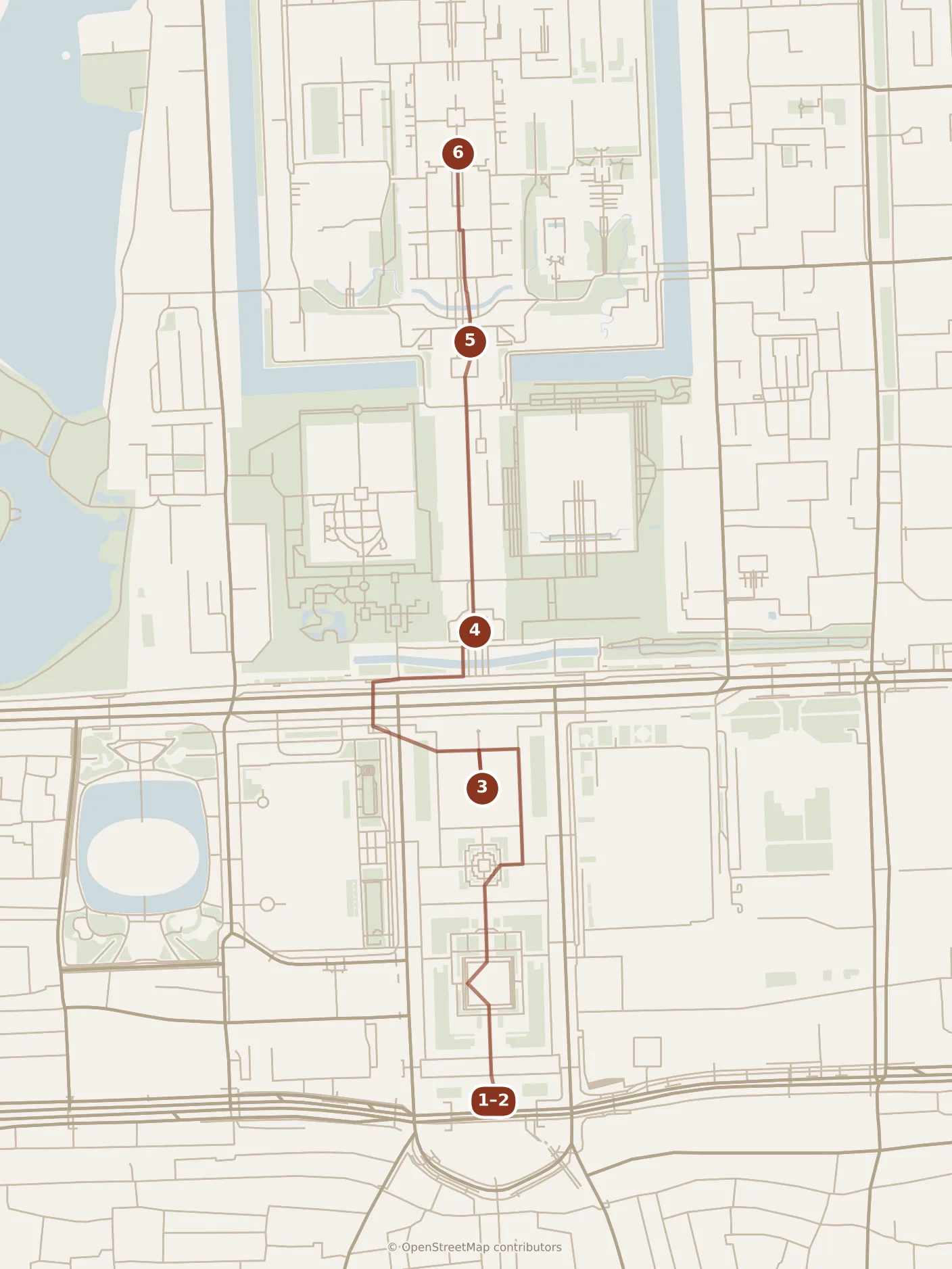
- Morning
- 1Qianmen station
- 2Zhengyangmen
- 3Tiananmen Square
- 4Tiananmen
- 5Meridian Gate
- 6Forbidden City
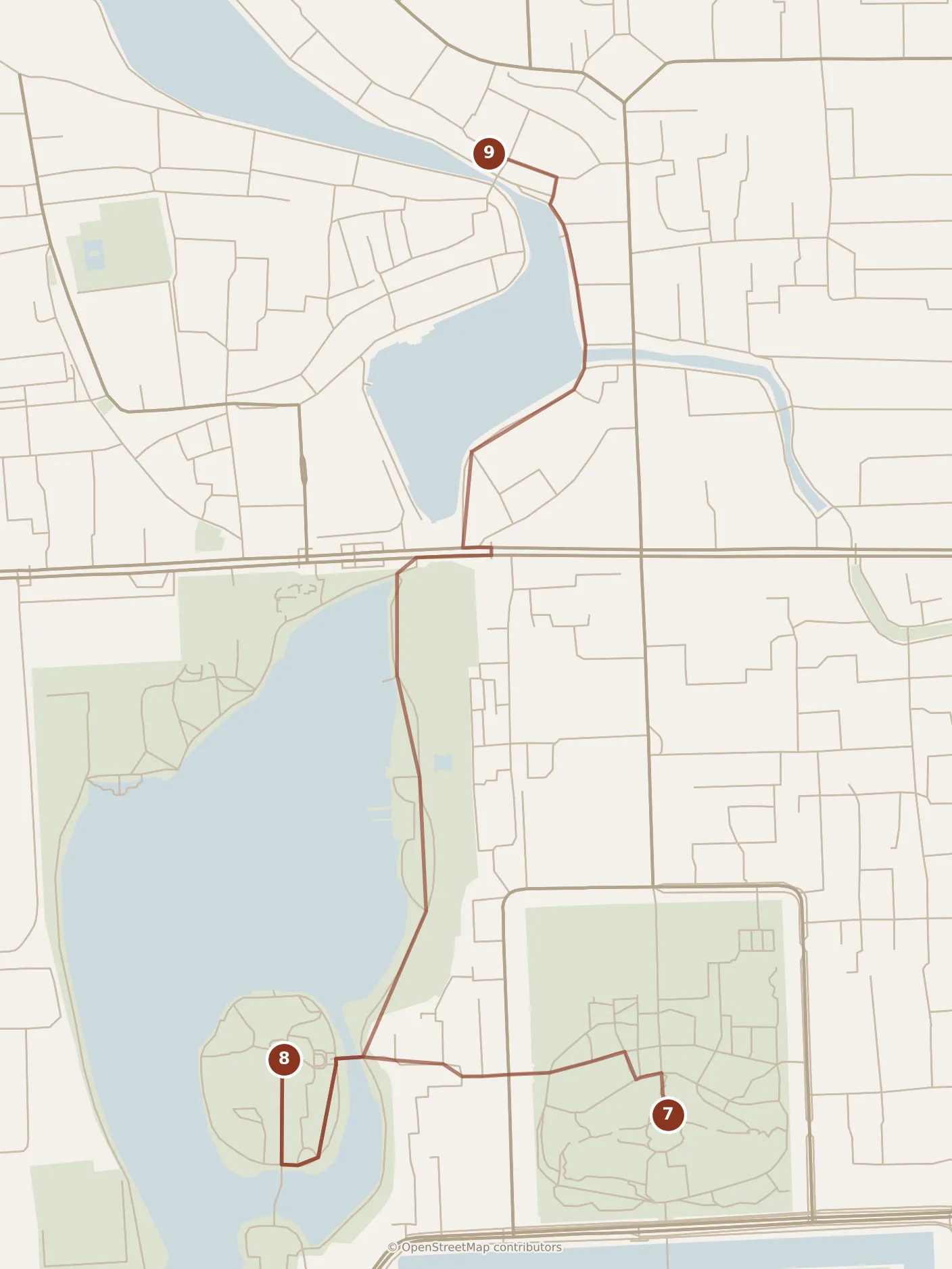
- Afternoon
- 7Jingshan Park
- 8Beihai Park
- 9Shichahai
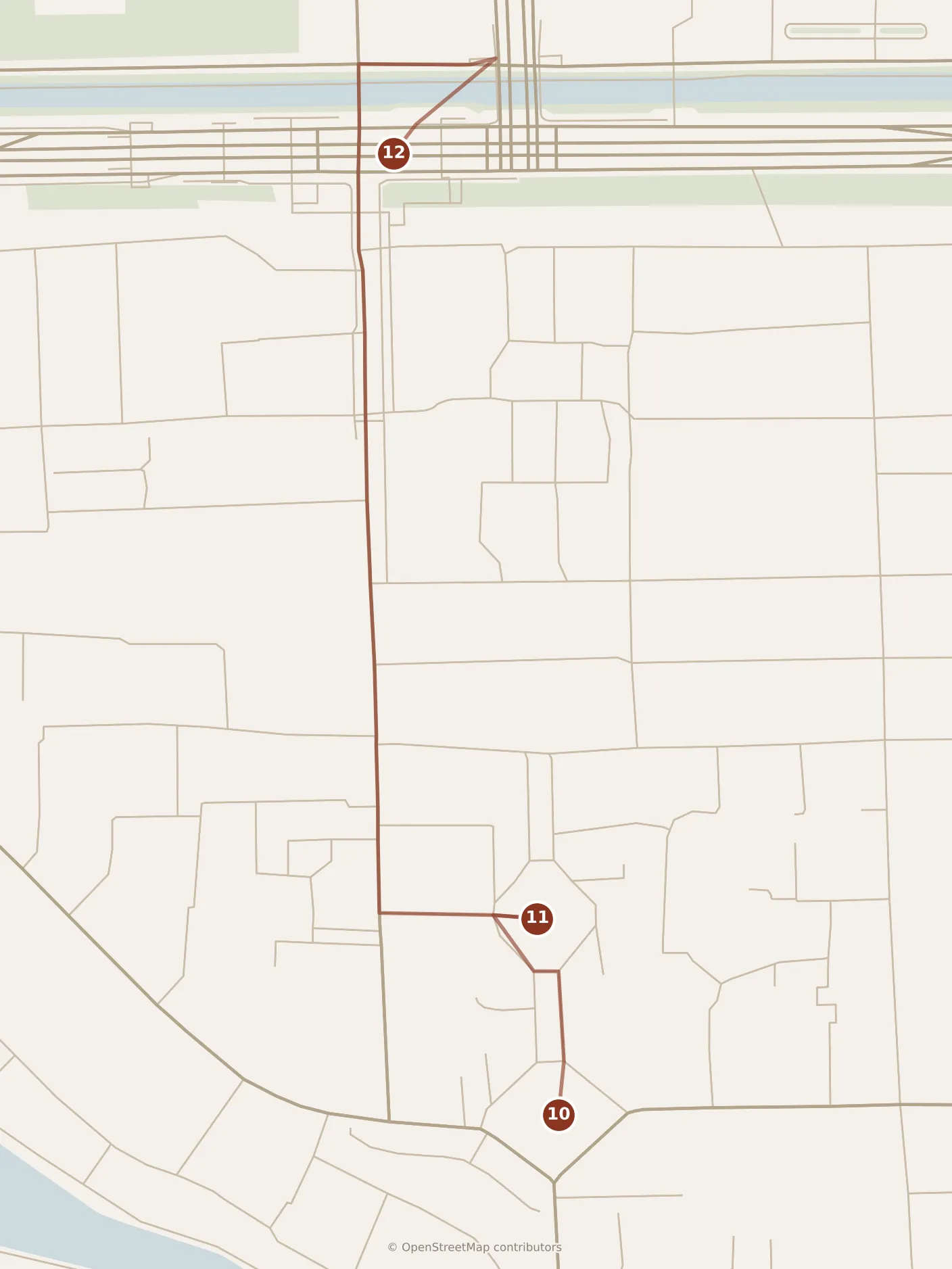
- Evening
- 10Beijing Drum Tower
- 11Beijing Bell Tower
- 12Gulou Dajie station
Morning
Come in at Qianmen station, which is on Line 2 and Line 8 and surfaces at the foot of Zhengyangmen. This is the double gate that was the front door of the inner city: a gate tower and, standing separately in front of it, an archery tower, the two of them facing each other across the road where the wall used to run. Give it five minutes from between the two, because it is the clearest sense you will get anywhere in Beijing that this was a walled city — almost nothing else of the wall survives. If you want breakfast, a jianbing griddled to order from a cart is the thing to eat with one hand on the way in.
Then north into Tiananmen Square, which is not a square in any European sense but a paved plain eight hundred-odd meters from end to end, fenced, and entered at set points through a bag and body check. The scale is the exhibit and it does not photograph; you have to walk it, and that is the better part of twenty minutes at a strolling pace. The Monument to the People’s Heroes stands in the middle, the Great Hall of the People runs down the west side and the National Museum of China down the east, and the Mausoleum of Mao Zedong sits between the monument and the gate you came in by. The mausoleum is free and the line moves fast, but bags have to be left at a deposit outside the perimeter and it opens only on a limited window — with one day that is an hour and a piece of admin spent on a body, and the trade is bad. Give the square forty-five minutes and keep walking north.
At the top of it is Tiananmen, the gate with the portrait of Mao on it, and the thing worth knowing is that this gate is not the palace. From under it you cross a further walled forecourt and pass a second gate before you reach the ticket check at the Meridian Gate, and that is a good ten minutes more than anyone expects. The rostrum on top of the gate is a separate ticket, a separate line and a view of the square you have just spent three quarters of an hour crossing. Skip it.
Give the Forbidden City three hours. The most useful thing to know before you go in is that it is one-way: you enter by the Meridian Gate in the south, you walk north, and you leave by the Gate of Divine Prowess at the far end, with no coming back for the thing you missed. The spine is the three great halls on their marble terrace, of which the Hall of Supreme Harmony is the largest in the complex and rises some thirty meters above the courtyard — and the spine is also where every visitor is, moving north in one slow river. The palace is nine hundred-odd buildings, and the pleasure of it is stepping off the axis into the side courtyards of the inner court, where the crowd thins to nothing within a hundred meters. Do that twice, deliberately, rather than once by accident. The Treasure Gallery and the Clock Gallery are separate tickets inside the walls and both are the wrong trade on a single day: they are an hour taken out of the empty courtyards, which are the thing a second visit would not give you back.
Afternoon
The palace’s north gate opens onto Jingshan Front Street and the park entrance is directly opposite, two minutes and the easiest transition of the day. Jingshan is artificial — forty-five meters of earth dug out to make the palace moat and piled up behind the palace it shelters. Climb it, steep steps and no elevator, about twenty minutes at an unhurried pace, to the Wanchun Pavilion on the central peak, and turn around. The Forbidden City lies below you whole: three hours of yellow roofs in a single frame, with the axis running away north and south beyond it. There is nowhere else in the city this view exists. Forty-five minutes for the park including the climb, and this is the stop the whole morning was arranged around.
Eat between the hill and the water rather than before the climb. This is alley ground and the thing to look for is zhajiangmian — thick wheat noodles under a dark, salty fermented-bean sauce, mixed at the table with whatever raw vegetable comes with it. Half an hour, sitting down.
Beihai Park is thirteen minutes west of the foot of Jingshan and more than half of its seventy-odd hectares is water. Jade Flower Island rises out of the middle of the lake under the White Dagoba, a thirty-six-meter white stone stupa put up in 1651 and rebuilt after two earthquakes since. Walk the shore, cross to the island, climb to the dagoba if the legs are still willing. An hour and a half. Then leave by the north gate; the water is about twenty minutes further, and taking the park this way adds barely three minutes of walking over going straight there.
Local tip. Beihai is barely a detour — three minutes of extra walking on a walk you were making anyway — but it is an hour and a half of standing still, and that is the hour this day is most likely to run out of. If the palace has taken more out of you than you expected, keep straight north from Jingshan instead, through the Di’anmen crossing to the water, about half an hour on foot. You lose an imperial garden and you keep the alleys, and the alleys are the half of Beijing the palace does not show you.
Shichahai is a chain of three connected lakes. Qianhai is the one you meet first and Houhai the larger one behind it, and the strip immediately around the bridge between them is bars and pedicab touts that can be walked past without regret. Within five minutes the bank turns residential — willows, old men fishing, and from January to late February a ticketed rink on the frozen surface, with skates and ice chairs for rent. Give it an hour along the water.
Evening
The Drum Tower is five minutes from the top of the lake and the Bell Tower four minutes north of that: two heavy brick towers closing the far end of the same axis you started on at Qianmen this morning. Between them they were the city’s official clock, for the Yuan, Ming and Qing and on until 1924 — the drum struck the watches of the night and the bell carried the hours out across the roofs. You can climb the Drum Tower, up one very steep flight, and what waits at the top is the best view in Beijing of the low city: an unbroken gray sea of tiled courtyard roofs, which is the thing everyone assumes has been demolished and which from up here plainly has not. Half an hour for both towers and the climb. It is the right last thing because it answers the morning — you have now seen the palace from above and the city from above, and they are two halves of one plan.
Dinner belongs in the lanes around the towers, and with one day the meal to give the evening to is Peking duck: lacquered, carved at the table, rolled into thin pancakes with scallion and sweet bean sauce. Be honest about the arithmetic, though. It wants a table and something like two hours, so it is the duck or another hour of walking and not both. Skip Nanluoguxiang, fifteen minutes east of the Drum Tower, which by evening is a souvenir street; the alleys running off the tower square are the quieter version of the same thing and cost you no walking at all.
Then close the day, because this is the paragraph with a deadline in it. Gulou Dajie station is fourteen minutes north on foot from the Bell Tower and carries both Line 2 and Line 8; Shichahai station, eleven minutes back the way you came, is Line 8 only. From Gulou Dajie, Line 2 runs round the ring of the old city to Beijing Railway Station. For Beijing West, take Line 8 south to Zhushikou and change to Line 7. For Beijing South, Line 2 to Xuanwumen and change to Line 4. If you are flying out of the Capital airport, Line 2 to Dongzhimen puts you on the Airport Express.
Practicalities
Two things on this route need arranging before you travel; the palace is the harder. Admission to the Palace Museum works on advance, real-name reservation: you book under the name in your passport, and you carry the passport itself to the gate, where it is checked against the booking — a photograph of it is not accepted. Standard admission was in the forty-to-sixty-yuan range in 2026, the low end in winter and the high end from spring to autumn. The release window is short, about a week ahead in recent years, and the day’s allocation goes; this is not something you can settle when you book the flight, so find out what the current window is and set a reminder for it. The square has for several years been controlled by its own advance reservation as well. Establish what is required there before you travel, because it is the very first thing you do and a barrier at the start ends the day before it begins.
The palace closes one day a week and it is normally a Monday, with the national holidays excepted. That is the one date that matters here, because on a single day there is no substitute — nothing else in Beijing is the Forbidden City. The Drum Tower is the other ticketed indoor stop on this route and it may keep its own closing day; check that one thing before setting out, and if it is shut, the square between the two towers and the lanes off it are most of what the evening was for anyway.
Local tip. If your one day falls on a Monday and cannot be moved, do not rebuild the route around the closure. Walk the same line — Zhengyangmen, the square, the gate, Jingshan, Beihai, the lakes, the towers — with the one detour the closure forces: the passage from Tiananmen through Duanmen to the Meridian Gate is shut all day when the museum is, so you go round the palace on one side or the other to reach Jingshan. Accept that you have seen the shape of imperial Beijing from outside it. Reshuffling buys you a distant museum and two subway rides, which is a worse day than the one you already had.
The route needs two rides and no more, one in at Qianmen and one out at Gulou. The city guide covers how a fare is paid here; sort that out the night before rather than at the gate, because everything after the palace booking depends on being at Zhengyangmen early rather than at a ticket machine. Beyond the palace and the square, nothing on the day needs booking: Jingshan, Beihai and the towers are small walk-up tickets, and the streets and the lakes are free.
This is about eight kilometers on foot, of which two are inside the palace, on stone, in one direction, with almost nowhere to sit down. The square and the palace courtyards have no shade at all — in July and August that is the real constraint on the day, and the answer is to start early rather than to shorten the route. In winter the wind across the open square is the constraint instead, and the answer is the same. In December the light itself is the closing time for everything outdoors, which is why the day is counted back from sunset rather than forward from the first stop.


