Beijing in two days: the palace given a whole day, the Temple of Heaven at dawn, and the Great Wall on a third

Last updated 8 August 2026
Overview
Two days in Beijing is not one day twice, and the second day does not buy more sights. A single day here has one honest answer — the old central axis taken in a straight line, from the square at its southern end to the hill at its northern one — and the price of that answer is that the Forbidden City gets three hours and everything else is fitted around it. A second day buys two things instead. It lets the first day stop at the hill rather than pushing on, and spend the hours it saves inside the palace. And it lets the second day be about something entirely different: the Temple of Heaven at opening, which is the other half of imperial Beijing. The palace is where the emperor lived. The temple is what he was for. One day cannot hold both, and choosing the palace is the right choice, which is exactly why the second day matters.
The street grid does most of the planning if you let it. What looks like a block here is often half a kilometer; crossings are rare and far apart; and a route that doubles back is not a small mistake but twenty minutes underground. So each of these days is a single line traveled in one direction. The first uses no subway at all between its opening stop and its closing one. The second uses it exactly once, and the line and both ends are named where it happens.
Three things are settled before you arrive rather than at a door. The palace’s timed, real-name reservation, which is the fixed point everything else has to be arranged around; whatever the square currently demands in order to be walked into, which is not nothing; and — only if you want it — the mausoleum, whose booking runs through a Chinese app with no English route through it. A third day adds a fourth, and it is the largest: the transport out to the wall. Nothing else on these days is booked. Admission to the palace itself was somewhere between forty and sixty yuan in 2026, and everything else you pay for here is a small ticket bought at a gate.
Each day turns on its deadlines, and the tightest of them sit at opposite ends of themselves. On day one it is the climb up Jingshan, which exists for a single reason — from the top the palace can be seen entire — and which therefore has to happen while there is something to look at. Everything above it, and the climb itself, adds up to about seven and a half hours, so take your own month’s sunset and count back seven and a half to find the latest you can start — the figure is for standing at the top of the hill, not for arriving at its gate, and it does not include the check at the edge of the square, which is the one line here that can genuinely stretch: whatever you allow for that comes off the start as well. That is only one of the two constraints on the start, and for most of the year it is the looser one. The mausoleum shuts at noon and this day puts an hour on the square in front of it, so from early February to early November it is the mausoleum rather than the sunset that fixes the latest hour you can begin. In Beijing the sun goes down as early as ten minutes to five in the first days of December, and as late as a few minutes short of ten to eight at midsummer. Day one runs to a shade under ten hours in all, or just under nine if you leave the mausoleum out, and it reaches the gate of its last stop, Beihai, about eight and a half hours in. Beihai shuts at five from November to March and at six from April to October, so what removes that stop is the gate rather than the dark: through the winter half this day cannot have the hour and a quarter at all, and through the summer half it has it only if the day began at the mausoleum’s opening. That is the real shape of it, and it is better known now than at a gate. Day two’s deadline sits at its far end instead, and it is a closing hour rather than a sunset: the Drum Tower is open from nine in the morning to five in the afternoon, and this route reaches it roughly nine hours into a day of about eleven. Starting at first light that puts you there in the middle of the afternoon in every month of the year, which is comfortable — but the comfort is measured against five o’clock and not against the sky, and in June the sky stays bright for three hours after the doors have shut.
Those totals cover the time spent inside places and walking between them, and they are not how long the days take. Day one leaves out the airport-style check at the edge of the square, the one line across both days that can genuinely stretch — and which the first morning crosses twice if you are carrying anything at all; it excludes the passport check at the palace gate; and it excludes dinner. Day two counts its lunch but not the wait for it.
The bag question here is not the one a single day poses, because you have a room for two nights and the room takes the case at both ends of the stay. What this route asks is narrower, and it matters on the first morning. The mausoleum admits no bag of any size, and yours has to go to a deposit outside the square’s perimeter, which charges a small fee although the visit itself does not — locate it before you join the line, not after, and reckon on clearing the entry check a second time, since the deposit sits outside the line you have already been let through. The palace does not admit large bags either, and what it currently does with the ones it will take is worth reading alongside its booking rules the week before rather than discovering at a gate. The short version for the first morning is to carry as little as you can. And if you have checked out and the third day is your last, do not take luggage to the wall — four thousand steps, a ridge, nowhere to set anything down, and every luggage storage office is back in the city at the main railway stations.
Mutianyu — not on the walking map; you get there by bus.
Day one

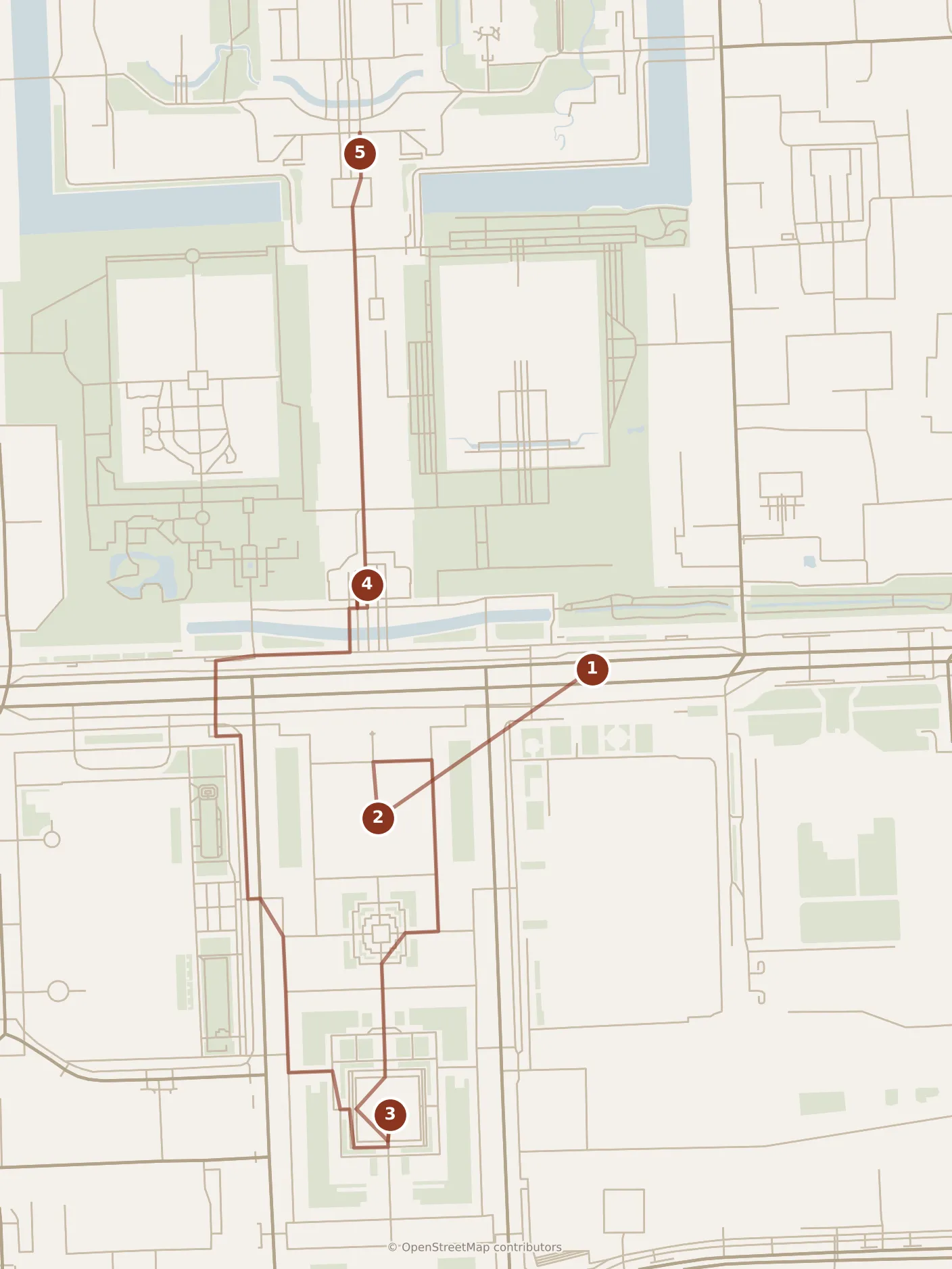
- Morning
- 1Tiananmen East station
- 2Tiananmen Square
- 3Mausoleum of Mao Zedong
- 4Tiananmen
- 5Meridian Gate
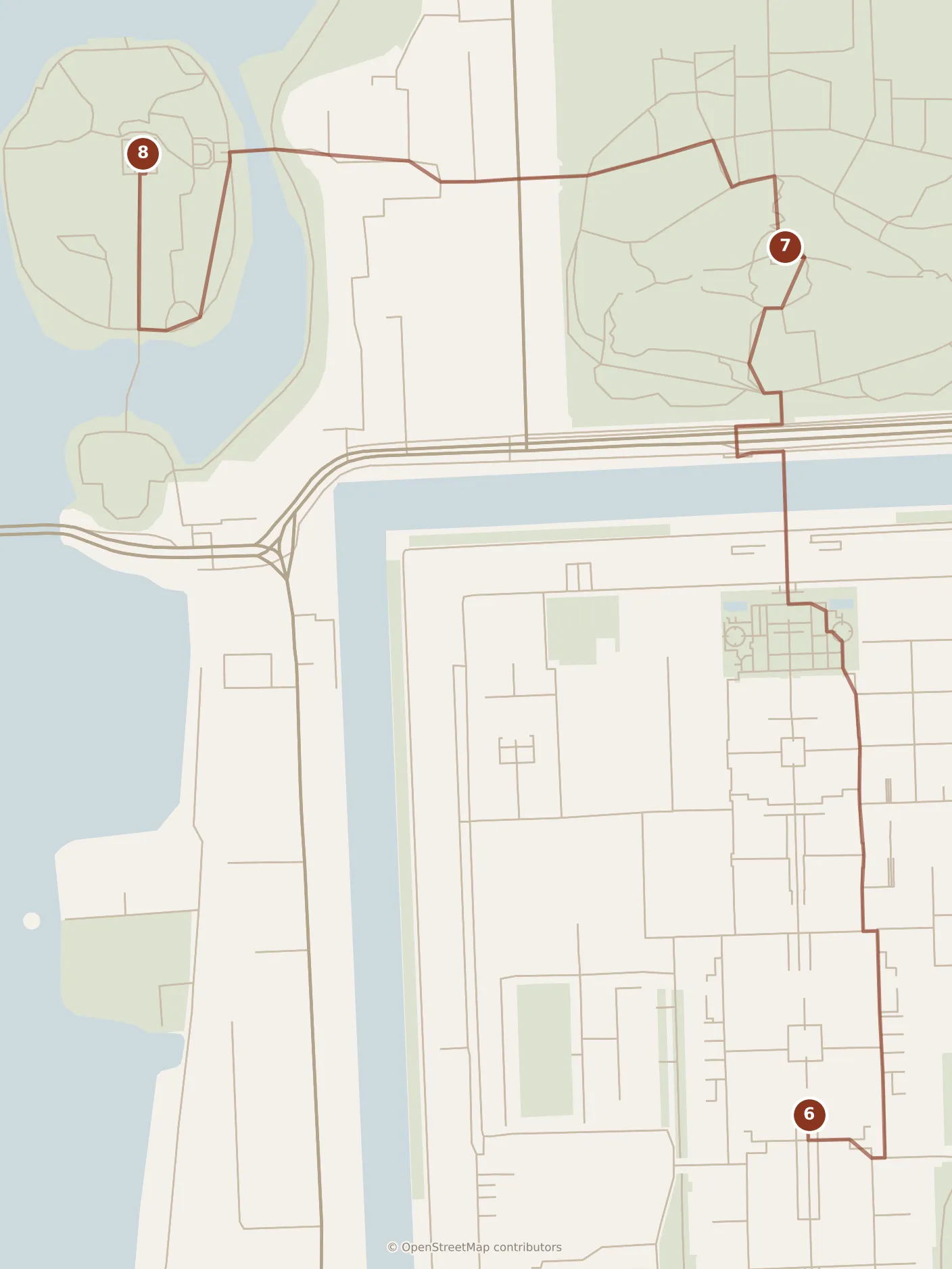
- Afternoon
- 6Forbidden City
- 7Jingshan Park
- 8Beihai Park
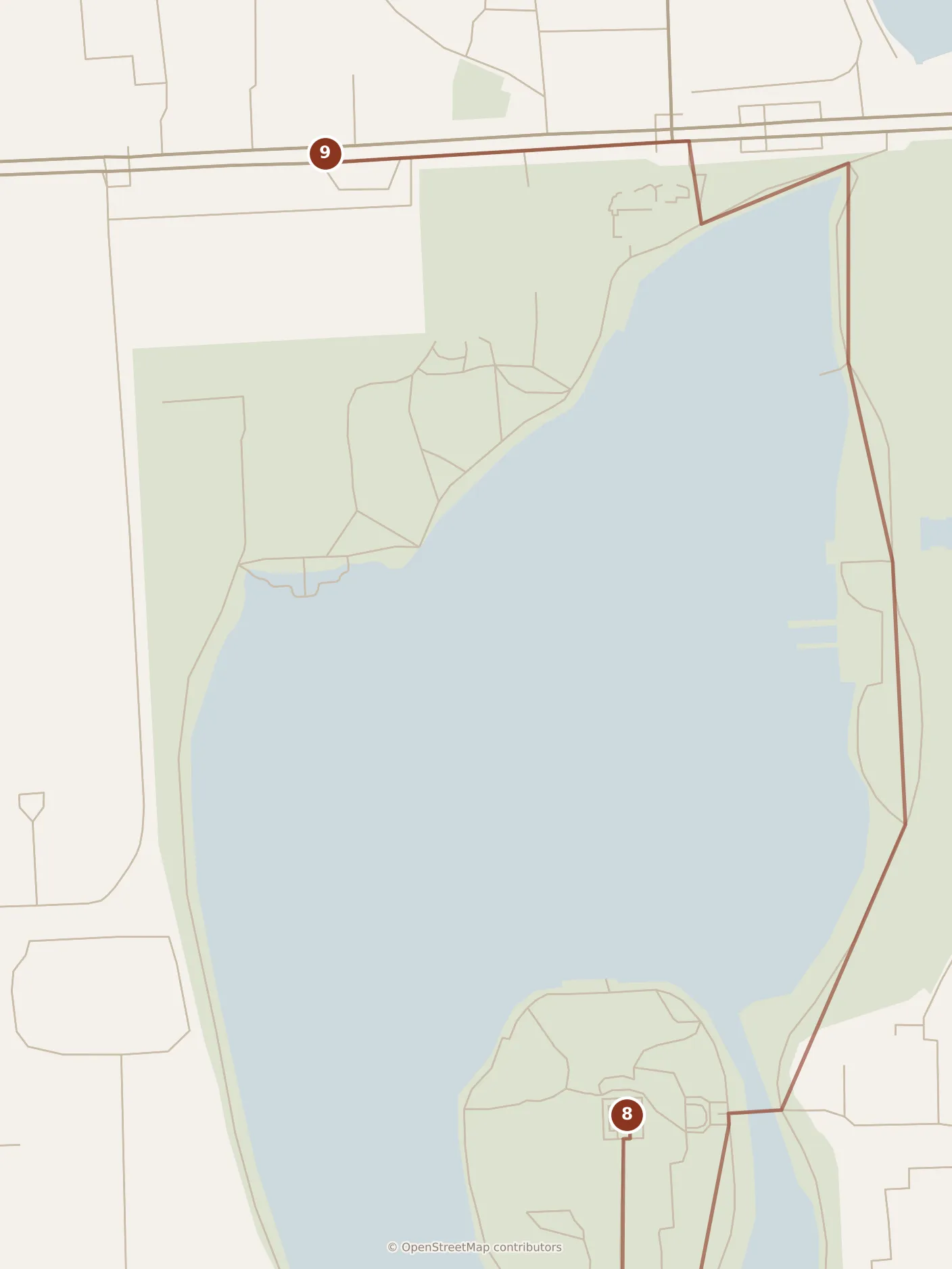
- Evening
- 9Beihai North station
The imperial center, walked from south to north and then stopped short on purpose. A one-day Beijing keeps going north past the hill and reaches the Drum Tower by nightfall. This one does not, and the hours saved by stopping go into the palace, which is the only building in the city that repays a fourth hour.
Morning
Come in at Tiananmen East station, on Line 1, which surfaces at the north-eastern corner of the square. Clear the check, and then walk in the wrong direction: south, the better part of a kilometer, down the eastern flank of the paving with the National Museum of China beside you and the Great Hall of the People far off across the emptiness. Halfway down stands the Monument to the People’s Heroes. Size is what is on show here and a photograph destroys it; the only way to register the place is to spend twenty minutes crossing it with almost nothing to look at. You will cover it twice, down and back, which is around half an hour of pure walking. Give the square an hour, that included. One thing does happen on this paving and this route leaves it out on purpose: at sunrise the flag goes up at the northern end, and at sunset it comes down again. It is over well before the mausoleum opens, so taking it costs a much earlier start and a wait rather than a rearrangement of the day.
At the southern end is the Mausoleum of Mao Zedong, and it is here because you have a second day. On one day the trade is bad: an hour and a piece of administration, taken straight out of the palace. On two days it is not, and this is the only thing on the square that is not simply a view. It opens Tuesday to Sunday, from eight in the morning until noon, and that noon is the real governor of this day’s start: with an hour on the square in front of it you have to be on the paving by about half past nine. Entry costs nothing and a passport is required at the door; the bag deposit is the part that charges. Know what is enforced inside before you commit to it, because the enforcement is the visit and none of it is discretionary — no bags at all, no photography anywhere, heads uncovered, no talking, and no stopping: the line moves and you move with it. An hour, deposit and line included. If the booking defeats you — it goes through a Chinese app and there is no English way through it — that hour comes off the day, which is nine hours rather than ten.
Then back north up the square, under Tiananmen with the portrait on it, and keep walking. The thing to understand about that gate is that it is not the palace. Past it lies another walled forecourt, then Duanmen, then tickets checked at the Meridian Gate, which is where the Forbidden City actually starts. The walking is under ten minutes; with two gates and a check between them, allow twenty. The viewing platform on top of Tiananmen has its own ticket and its own line, and what it shows you is the square you have now crossed twice over. Leave it.
Afternoon
Give the Forbidden City four hours. That single number is this itinerary’s whole argument: one day can afford three, and the fourth is what turns the palace from a corridor into a place.
Understand first that the route runs one way. You go in at the Meridian Gate in the south, north through seventy-two hectares and some nine hundred and eighty surviving buildings, and out at the Gate of Divine Prowess, and nothing you have passed can be returned to. Decide before you go in. Down the middle stand the three ceremonial halls on their tiered marble platform; the biggest of them is the Hall of Supreme Harmony, about thirty meters above its own courtyard. The middle is also where the entire day’s visitors are, drifting north together. Get off it. Two hundred paces into the inner court’s side courtyards there is almost nobody, and doing that twice on purpose is worth more than any hall you could add.
The fourth hour goes on the Treasure Gallery, in the north-eastern corner inside the walls. It has its own ticket, bought once you are in; it is the one part of the complex that is a museum rather than a building; and it is precisely what one day cannot buy — jade, gold, ceremonial armor, and the private garden an emperor laid out for his own retirement. The Clock Gallery, the other paid room within the walls, holds a collection of European automata and is the better call if machinery appeals to you more than treasure. Take one of the two. Taking both is paid for out of the quiet courtyards, and those are what a second visit would not hand back.
You come out at the north gate deep into the afternoon, later than most people expect to be eating, and that is the day’s one genuine friction. Have a real breakfast, and take the meal afterwards on Jingshan Front Street or in the lanes off it: zhajiangmian, wheat noodles under a dark, heavily fermented bean-and-pork sauce, with shredded raw vegetables you stir through yourself. Three quarters of an hour.
The south gate of Jingshan Park faces the palace exit directly across the road — two minutes, the easiest move of the trip. The hill is spoil. When they dug the palace moat the earth had to go somewhere, and it went here: forty-five meters of it, stacked immediately behind the buildings it now looks down on. Go up it — steep steps, nothing mechanical — as far as the Wanchun Pavilion at the top of the central peak, and then look back the way you came. The whole Forbidden City is laid out underneath — four hours of yellow roofing in one frame, with the axis continuing away north and south past it. Nothing else in the city offers that, and the entire morning is arranged to deliver you here. An hour for the park and the climb together. And one rule the third day gets and this one has needed all along: look at the air before you climb. If the haze is thick enough that the roofs will not read from the top, the hour is better given to Beihai while it is still open.
Local tip. The mausoleum and the Treasure Gallery cost about an hour apiece, and they are the two hours this day loses most easily. If you start late, drop them in that order, mausoleum first. Its value does not depend on the four hours around it and it can be given a whole morning on some future trip; the gallery only makes sense inside a palace visit that already has room in it.
Beihai Park lies a quarter of an hour to the west, on the flat below the hill, and water covers more than half of its seventy-one hectares. Jade Flower Island stands in the middle of the lake beneath the White Dagoba, a white stone stupa forty meters high, raised in 1651 for the fifth Dalai Lama’s visit, brought down by an earthquake in 1679 and repaired again after the shock of 1976. Walk the shore and cross to the island; the climb up to the dagoba itself is optional and, this far into the day, usually declined. An hour and a quarter, and check when it shuts before you count on it: five o’clock from November to March, six from April to October. This day reaches its gate about eight and a half hours in, so through the winter half it cannot have the hour and a quarter at all, and through the summer half it needs a start at the mausoleum’s opening to have it. Where the sums do not work, go from Jingshan straight to dinner and take Beihai off the day rather than arriving at a locked gate.
Evening
Leave Beihai by the north gate, about twenty minutes from the middle of the park, and you are on Di’anmen West Street with Beihai North station on Line 6 a few hundred meters to the west. Day one ends here. The lakes ten minutes further north, Qianhai and Houhai, are the omission this route passes closest to — two days leave out a great deal else, the Summer Palace and the wall among it — and the reason for this one is honest rather than clever: tomorrow evening comes down to the top of the axis from the eastern side and never reaches the water, and a lakeside walk in the dark at the end of a ten-hour day is a walk rather than a sight. If you want them, take them now, before dinner, and add forty minutes to a day that is already ten hours long.
Dinner is Peking duck, and this is the night for it: skin lacquered and crisp, sliced in front of you, eaten folded into thin pancakes with spring onion and a sweet dark sauce. It wants a table and the better part of two hours, and it belongs to this day for a plain reason: day one ends among the streets that serve it and day two ends across the city. There is a real cost in that and it is not an oversight — unless the closing day has put day two first, this is the night before its first-light start, so two hours at a table come out of the shortest sleep of the trip. Take it knowingly. The streets running off Di’anmen West Street have it, and so does most of this city.
Day two

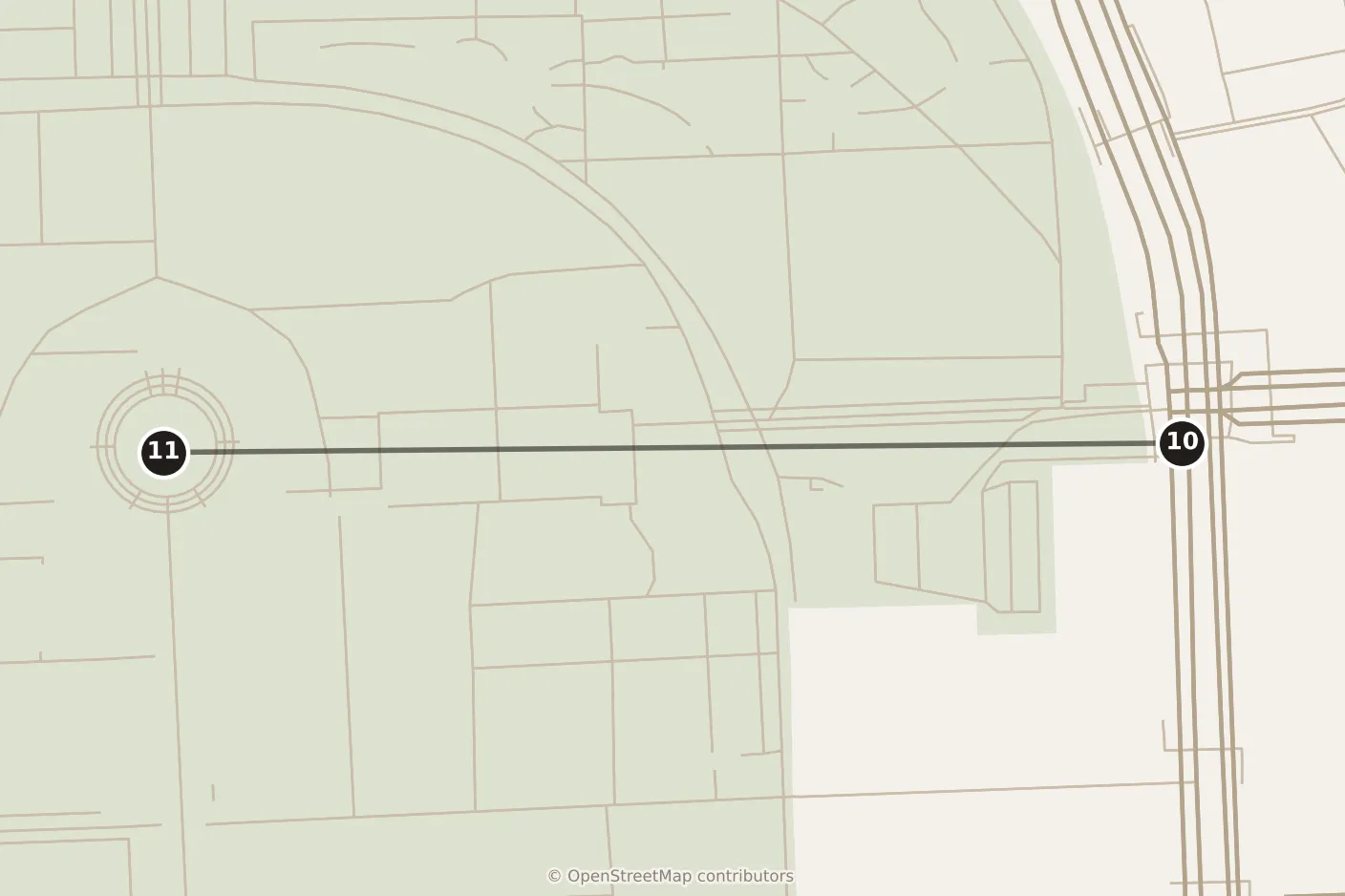
- Morning
- 10Temple of Heaven East Gate station
- 11Temple of Heaven
- Afternoon
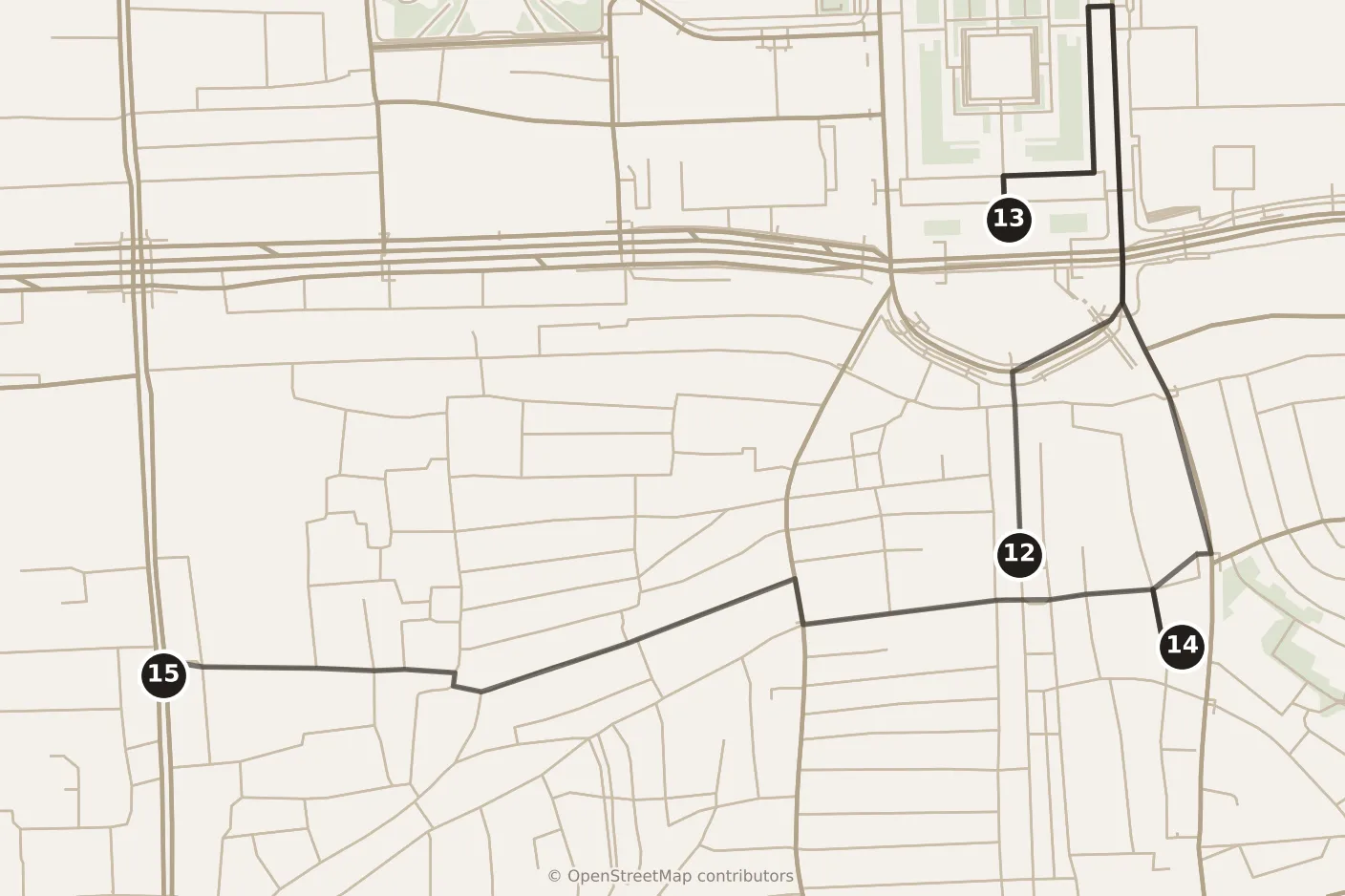
- 12Qianmen Street
- 13Zhengyangmen
- 14Dashilan
- 15Liulichang
- Evening
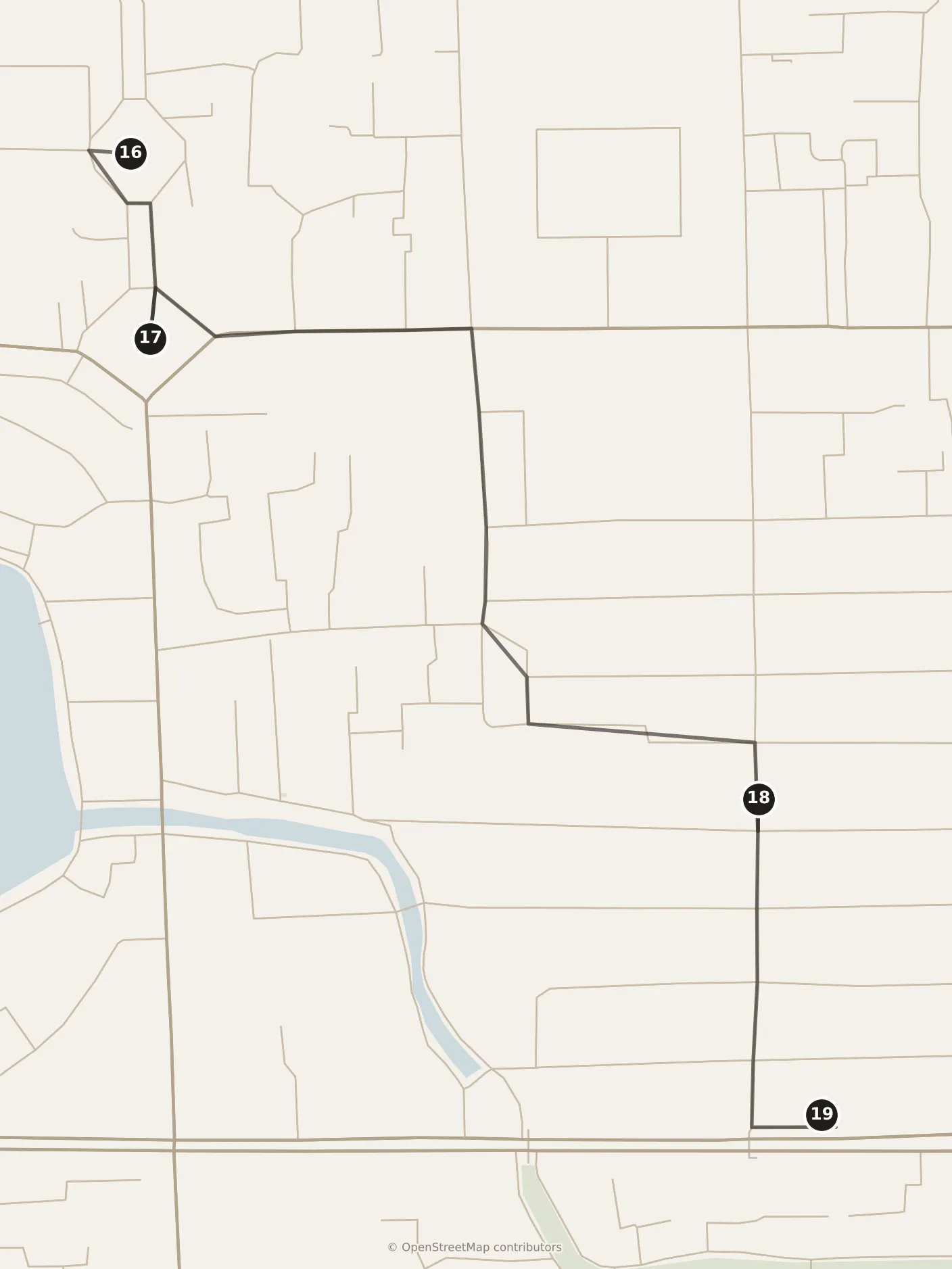
- 16Beijing Bell Tower
- 17Beijing Drum Tower
- 18Nanluoguxiang
- 19Nanluoguxiang station
The south at first light, then the merchant lanes under the old wall, then one ride north to the alley city and the top of the axis. It is a bigger day than yesterday, about eleven hours, and it only works because it starts early. Eat as you go: jianbing, a thin batter crêpe spread on a hot plate, folded round egg, sauce and a shard of something crisp, is a breakfast that comes wrapped in paper and needs one hand.
Morning
Come in at Temple of Heaven East Gate station, on Line 5, which is named for the gate it stands at.
The temple is not a building you go inside. It runs to two hundred and sixty-odd hectares behind a wall, and three ritual structures stand along a raised causeway inside it. The grounds are at least half of what you came for, and they are ticketed separately from the three monuments, with a combined ticket covering both. Its opening hours are what the day is counted back from: the outer gates open at six in the morning from April to October and at half past six from November to March, and the three monuments inside them not until eight in any month. That gap — two hours in the summer half, ninety minutes in the winter — is the itinerary. If the hours shift, the method does not: find the two openings and use the space between them.
That gap is not the same thing in every month, and the honesty has to come in here. At midsummer six o’clock is broad daylight and the ground is already busy. In December it is dark until about ten to seven and the sun is not up until half past, so treat first light rather than the gate as your useful hour and accept a shorter park — first light comes earlier than it feels, and that half hour is the difference between a park and a walk to a building. What the shorter park does not do is move the day forward: the monuments open at eight whatever the season, so a December day two begins later, holds less, and still arrives at its evening at about the hour a June one does.
Walk in and bear south-west, about a quarter of an hour inside the wall, straight through the ground you came early for: people singing in organized groups, couples waltzing on the paving, card schools, fan and sword forms, someone practicing a wind instrument alone under a cypress. Nobody is performing for you and most of it has gone home by mid-morning. Then take the three structures from the south, which is the order they were meant to be met in. First the Circular Mound Altar: three concentric marble terraces, open to the sky, holding nothing whatever. What it holds is a counting system — every ring of paving is a multiple of nine, outward. Next the Imperial Vault of Heaven, standing inside the Echo Wall, a circular enclosure so smoothly built that a word spoken at it travels round to the far side. Last, up the raised walk of some three hundred and sixty meters, the Hall of Prayer for Good Harvests — a blue triple-roofed drum, the one on the postcards, thirty-six meters across and thirty-eight high, built of timber, four inner columns standing for the seasons and then two rings of twelve, one for the months and one for the twelve hours the old Chinese day was cut into. Three hours from the gate for all of it, and spend at least the first of them somewhere other than in front of a building.
Local tip. Buy the combined ticket rather than the grounds-only one, and buy it at the gate you come in by. Then spend the hours before the monuments open on the ground rather than at a window. That order is the whole trick of this morning: the buildings will still be there at nine, and the thing happening on the paving will not.
Afternoon
Leave by the north gate — about fifteen minutes up from the Hall of Prayer — and walk twenty minutes more to the bottom of Qianmen Street. Old commercial Beijing, put back up again: a wide restored shopping avenue with a tramline down the middle of it. It is well done and it holds no surprises at all. Do not linger over it, use it as an approach. Eight hundred meters, about twenty minutes if you look at it properly, and what it delivers you to is the point.
Zhengyangmen closes the top of the street. It is two structures rather than one: the gatehouse proper, and planted on its own base out in front of it the archery tower, the pair of them facing each other across a road that used to be the wall. Twenty minutes standing between the two. Almost nothing else of that wall is left, and coming up at it from the merchants’ side is how it was built to be met — day one went past its back without stopping.
Dashilan opens off the western side of Qianmen Street a few hundred meters back down from the gate, and within a hundred paces the register has changed. This is the old trading quarter: narrower, older, scruffier, century-old pharmacies and hat and silk shops still working under their own signs, beside a considerable amount of souvenir trash. Do not plan a route through it — the good blocks and the poor ones alternate, and that alternation is the character of the place. An hour and a half, then lunch here, three quarters of an hour, somewhere off the main lane rather than on it.
Keep going west, about half an hour on foot, to Liulichang, where two short streets of gray brickwork sell brushes, ink stones, carved seals, rubbings, paper and secondhand books. Very little of it is old, and that hardly matters, since you are left to pick things up and put them down. It is far quieter than anything else today — except across the Spring Festival, when these two streets hold a two-week-long fair and are the busiest thing on the whole route — and it is the right way to spend the last hour before the ride.
Evening
Hepingmen station sits ten minutes north of Liulichang, on Line 2. Ride it eight stops round the western half of the loop to Gulou Dajie, about twenty minutes, then walk a quarter of an hour south.
Coming from that direction the Beijing Bell Tower arrives first, with the Beijing Drum Tower under two hundred meters beyond it. The two of them kept official time for the Yuan, the Ming and the Qing, and went on doing it until 1924: after dark the drum sounded the watches, and the bell threw the hours out across the rooftops. They shut the northern end of the same axis whose southern end you were standing on this morning, which is the shape of these two days in one sentence. Climb the Drum Tower — a single very steep flight — for what waits at the top: a low gray tide of courtyard roofing running away in every direction, the Beijing that everybody is told has been knocked down, plainly still standing. The two towers are open from nine in the morning to five in the afternoon, and five is the deadline that matters here rather than the sunset — this route arrives in the middle of the afternoon in every month, but in June the light says nothing whatever about the doors, which shut three hours before it goes. Three quarters of an hour covers the pair of them and the stairs.
Then a quarter of an hour south-east to Nanluoguxiang, about which you should be honest: the lane itself is eight hundred meters of snack stalls and souvenirs and deserves ten minutes. Sixteen alleys run off it to either side and they are the actual thing. Turn into one. Half a minute in there are gray walls, courtyard gates with their stone drums worn round at the base, bicycles, cabbages drying against a step. Give the grid an hour and the lane its ten minutes.
Dinner is on the lane rather than in the alleys behind it: the alleys are where people live, and the lane, for all that it deserves ten minutes and not an hour of your attention, is where the food is. From November onward the thing to look for is the sesame-paste lamb hotpot the city eats all winter. Nanluoguxiang station, at the southern end of the lane, carries Line 6 and Line 8 and is six minutes from where you will be standing.
With a third day

Give the third day to the Great Wall, and append it rather than inserting it. One restored section is the right answer for a first visit and it is Mutianyu, about seventy kilometers to the north- east: twenty-two towers along a shade over two kilometers of it, rebuilt in the 1980s, forest falling away on both flanks, and room enough that ten minutes of walking puts most of the crowd behind you. Badaling has a suburban train running to it and the crowds that follow a train — the convenience and the line are the same fact. Jinshanling is for people who want unrestored wall and will drive more than twice as far to walk it, which is a second visit’s day and not a first’s.
The day belongs entirely to the wall. Attach nothing else to it, and turn down the packaged trip that bolts on the imperial tombs: they lie an hour off in another direction, and a day attempting both short-changes each of them.
Getting there is the fourth booking and the only one on this trip that is not a ticket. There is no through train to Mutianyu — that is the flat negative, and it is why this cannot be improvised on the morning. Three forms exist: rent a car for the day, buy a seat on somebody else’s shuttle, or take the public bus north out of Dongzhimen to Huairou, with a local shuttle covering the last stretch. Arrange whichever before the night before. At the site you can get up three ways: a chairlift taking two, a bigger gondola, or the four thousand steps. The steps take about forty minutes and earn you nothing but tired legs before the part that matters; ride up, and save your legs for the wall itself. Then walk it for an hour and a half at the very least. The further out you go the rougher the paving becomes and the steeper the pitches, and the stretches that climb a hillside like a staircase are the ones you will actually remember. Coming down, the toboggan is a one-person sled on a steel channel, as undignified and as good as that sounds; the lifts also run the other way.
Nothing is sold on the wall itself. Carry more water than seems sensible and something for your head: the ridge has no shade at any point along it, in either direction.
Local tip. Once there are two of you the choice between a rented car and a shared seat stops being about money and becomes about who decides when you leave. A shuttle goes when it goes, which is fine if you are walking the standard hour and a half and awkward if the light is doing something and you want another forty minutes on the ridge. Book the car if the day is the point; book the seat if the wall is a box to tick.
Where it goes, and what moves. Appended, as day three, for two reasons that are both about the palace. The palace booking is the fixed point of the trip and it has a weekly closing day, so it wants settling first and taking early, while a spare day still exists to move it onto if the reservation you are offered lands wrong. And the wall is the one day of the three whose worth depends on the weather, so it should be the day that is still free to move.
If you must insert it — because the only clear sky in your three days is the middle one, which is a real and sufficient reason — put it between day one and day two rather than ahead of day one, and know what it costs. Day two is built on a dawn start, and a dawn start on the morning after a full day on a ridge is a plan that survives on paper and not in a room at six. Inserting the wall does not break day two’s route; it breaks the one thing day two’s route is arranged around. If you take that trade, take the Temple of Heaven at eight with the monuments rather than at six with the park. That is an hour off it in December, where the dark has already shortened the park anyway, and two off its three in June — so after the cut the two seasons run the same day from eight, about nine hours of it, and the cut falls on the park rather than on the buildings.
If the third morning arrives with the hills closed in, do not go and photograph fog. The substitution that costs the day nothing is the Summer Palace, which is also a full day out and back and holds up better in poor weather: Line 4 north to Beigongmen, in at the north gate, three hours round the lake and the hill, back the same way. It replaces the wall day whole instead of being squeezed in beside it, so nothing else is cut.
Practicalities
The one thing to carry. Your passport, the document itself and not a photograph of it, on both days. It is checked against your reservation at the palace gate and it is required at the mausoleum door, and the way you discover this is by being turned round at a barrier. Everything else about how this city is paid for and traveled on belongs to the city guide, and it is worth ten minutes the night before you begin: both days below assume the fare is already sorted out.
What is booked, and when. Four things across three days, and they release at different times. The palace’s timed, real-name reservation goes first, and the channel matters more than the alarm. It runs through the museum’s mini-program on a Chinese platform, which wants a mainland payment account; a visitor who has not set one up cannot reach the booking screen at all, and the way round it is the museum’s own alternative — write to it with each traveler’s full name and passport number and the date you want, at least a day ahead. If you can use the app, then the alarm is worth setting: the release opens only a short time before the visit and each day’s quota disappears. The Palace Museum publishes its own hours, closing days and booking rules, and that is where to read both routes the week before. For several years now the square has had an advance reservation of its own; establish what it currently requires before day one, since it is the first obstacle of the trip, and one that stops you at a perimeter costs you everything behind it. The mausoleum is optional and books through a Chinese app with no English interface, which for most visitors means either finding somebody to do it or letting it go. And the third day’s transport, which is the only one arranged with a person rather than a website. The Temple of Heaven’s combined ticket is bought at the gate and needs nothing in advance.
Which days close what. Only one closure can actually break a day here, and it is the palace: it shuts one day a week, normally a Monday, with two exceptions — national holidays that fall on a Monday, and the summer school holiday from the middle of July to late August, through which it opens every day. In those weeks nothing below applies. Otherwise check the closing day against your own dates rather than trusting the rule, and then arrange as follows. Day one must miss it; that is the only hard constraint in the whole itinerary, and it carries the mausoleum with it, which keeps the same day of the week and in any case runs only from eight to noon. Day two carries no weekly closure at all — the Temple of Heaven, the streets, the lanes, both towers and the square between them are open every day of the week. Beihai, Jingshan and the wall are open daily too; Beihai is the one whose hours rather than whose days decide anything here.
The rules that follow are short. Two days: if one of them is the palace’s closing day, put day two on it and day one on the other. The swap always works, because two consecutive days contain at most one such day, and day two loses nothing whatever to a Monday. Three days: if the closing day is the last of the three, put the wall on it and nothing moves at all; and if it falls on the middle day, day two is already sitting on it and nothing moves either. Those are the two clean cases. Only a closure on the first of the three is a problem, and the wall cannot simply take it: ahead of day one is the placement this article has already ruled out. What works there is the two-day swap — put day two on the closure and let day one and the wall fall around it, since day two is the one day of the three that a Monday costs nothing. The trap is a three- day trip whose car is already booked for a fixed date that is not the closing day: the closure then lands on a city day after all, and the fix is the two-day rule above, with day two taking it.
Local tip. Take a morning slot for the palace, but not the earliest one offered: with an hour on the square and an hour in the mausoleum in front of it, this route needs two hours and twenty minutes in front of the Meridian Gate, which off an ordinary start puts it there about half past ten. If only an afternoon is left and you are traveling in the short half of the year, you have a genuine collision rather than an inconvenience: Jingshan needs the light, and because the palace runs one way it cannot come first. There is no free way out of that one, and the honest answer is that the hill goes. Moving it to the head of day two would mean going north, then the length of the city south, then north again — it ends the single-direction day the whole plan rests on, and it costs the temple’s first hour, which the paragraph below rightly says cannot be bought back. So take the loss knowingly: the palace keeps its four hours, day two’s evening still puts you above the courtyard grid, and what this itinerary can no longer promise you is the palace seen entire from above.
If the day is short. Both days have a stated order for what goes, and both drop the same kind of thing first: the stop whose value does not depend on the stops around it. Day one, in order — the mausoleum, then the Treasure Gallery, then Beihai, which from November to March any start but the earliest has already put past its closing hour. Lose all three and you still have the square, three hours inside the palace, and the hill — six hours, and a day that works. Be clear about what it is no longer, though: three hours in the palace is the one-day compromise, and the fourth hour is the thing the second day was bought for. Day two, in order — Liulichang, then half an hour off Dashilan, then the Drum Tower climb, which is the only ticketed interior in that evening and the only part of it you have to pay for. Do not buy time by cutting the Temple of Heaven’s first hour. It is the one hour across both days that cannot be had at any other time — with the single exception named where it arises: inserting the wall between day one and day two takes exactly this hour, because a day two that follows a ridge cannot start at first light. That is the price of the insertion, and it is why the wall is appended rather than inserted.
Getting to the start, and away from the end. From Capital, the Airport Express runs to Dongzhimen; from there take Line 2 to Jianguomen and three stops west on Line 1 to Tiananmen East, where day one opens. Allow an hour from the terminal to the square. From Daxing it is longer: the airport’s own express ends at Caoqiao, where Line 10 takes over, and Line 10 to Jiaomenxi puts you on Line 4 into the center — allow half as long again, on the arriving day and on the leaving one.
Day two ends at Nanluoguxiang station, on Line 6 and Line 8, and it is worth knowing what that means if you have a train the next morning. For Beijing Railway Station, Line 6 east to Chaoyangmen and then two stops south on Line 2. For Beijing South, Line 6 west two stops to Ping’anli and Line 4 south. For Beijing West, the same Line 4 as far as Caishikou, then Line 7. For the Capital airport, Line 8 north to Gulou Dajie and Line 2 round the loop to Dongzhimen for the Airport Express. Daxing is the one that punishes a late start, because its express leaves from Caoqiao, which is south-west of everything on these two days.
On foot. Day one is about seven kilometers. Two of those are within the palace: stone underfoot, a single permitted direction, and hardly a bench in the whole enclosure. Day two is nearer eleven kilometers, but flat, broken into pieces, and with one ride in the middle of it. Neither the square nor the palace courtyards carry any shade at all. Through July and August it is the heat rather than the distance that limits day one, and the remedy is an earlier start, not a shorter route; through the winter the same is true of the wind that comes down the open square, and the remedy does not change.


.jpg)

