Zagreb in two or three days: the old town from the inside, Mirogoj, and the mountain behind it

Last updated 14 August 2026
Overview
A single day in Zagreb is a day spent outdoors, and it is a good one: the old town is two hills with a filled-in stream bed between them and a flat nineteenth-century grid below, and one day is exactly enough to walk that shape. What it cannot do is open anything. This city keeps an unreasonable number of small museums for its size, and a day gets you one of them, chosen in a hurry on a ridge.
Two days buy the doors. They also buy the two places the ring of parks does not reach: Mirogoj, the cemetery on the slope north of the cathedral, which is the best thing here after the Upper Town itself; and, with a third day, the wooded ridge of Medvednica that stands behind every view in the city and that almost nobody who comes for a weekend ever sets foot on.
One thing has to be said before the days, because it decides half of what is in them. Zagreb has rebuilt itself twice. The cathedral’s twin spires — the ones on every postcard of the place — are not medieval at all: Hermann Bollé raised them between 1889 and 1899 as part of a reconstruction that followed the earthquake of 9 November 1880, and the same architect designed the arcades at Mirogoj and the Museum of Arts and Crafts. Then, at twenty-four minutes past six on the morning of 22 March 2020, it happened again. The tip of the southern spire broke off onto the palace roof beside it, the northern spire was taken down deliberately the following April, and several of the largest collections in the city shut and have not reopened. The Museum of Arts and Crafts — Bollé’s own building — has been closed to the public since 1 January 2022 for reconstruction. The Strossmayer Gallery of Old Masters on Zrinjevac has been closed since the earthquake itself. The Mimara on the western arm of the parks closed that same March morning. None of this is written on anything you walk past, and all of it decides which two days are possible. What follows is built out of what is open, and what is shut is part of what you are looking at.
So: day one is the two hills, with time to go inside them — the market, the cathedral hill, the gate that is a chapel, the city museum, a sculptor’s house, the tiled roof, the noon gun, and then two small collections on the ridge and a tunnel under it. Day two is the cemetery first thing and the Lower Town’s two open collections after it, finishing at the railway station, which is where a bag and a departure both live. A third day leaves the center and goes up the mountain.
Day one has two fixed points and only one of them is a door. A cannon has been fired from Lotrščak Tower at noon every day since 1 January 1877, when it was put there to tell the city’s bell-ringers when midday was, and it is still the loudest civic event in Zagreb. Everything above it — half an hour at the market, twenty minutes on the cathedral hill, ten at the gate, an hour in the city museum, forty minutes in the sculptor’s house, ten in the square with the roof, and about half an hour of walking to join them — comes to three hours and twenty minutes.
The second fixed point is that museum, which in 2026 opened at ten, and it is the one that sets the pace: everything above its door takes two hours with no slack in it. So leave Trg bana Jelačića at half past eight. If the hour has moved since, the method has not: take the published opening, add two hours, and if that lands after noon then something above the door has to go — and the tip on day one says which.
That count models the time you spend standing in the places and walking between them, and nothing else. It does not model a ticket desk or a cloakroom, and the city museum has both. The number in it least worth trusting is the hour it gives that museum, which is a decision rather than a measurement: it is three joined historic buildings holding some seventy-five thousand objects, and a person who likes that sort of thing can lose two hours inside without noticing. If you do, the gun goes without you. It goes again tomorrow.
The other thing that governs a day here is how much daylight there is, and Zagreb sits far enough north for the difference to be startling. The sun goes down at about a quarter past four in the second week of December and not until ten minutes to nine in the last week of June — four and a half hours of swing. Both days below run to about four in the afternoon before the evening starts. In December that is the whole of the light, and the walk out of day two finishes exactly as it goes; in June it leaves four and a half hours still to spend, and the right place to spend them is the ridge above the Lower Town, which is free and has chairs. One caveat on every December figure below, and it is a real collision rather than an oversight: for about a month before Christmas the Advent market stands on the ground these days walk across — the linked squares, the main square and the approaches to the Upper Town — so the crossings are slower than the counts say and the squares are not the squares described here. The day the light genuinely governs is the third one, and it is dealt with there.
Two days here need no ticket of any kind until the second morning, when a bus takes you up to the cemetery. That bus is the first moment you must have paid for something: ZET sells one-way tickets in thirty-, sixty- and ninety-minute lengths, and they are single journeys as well as timed — one direction each, so the ride up to the cemetery and the ride back down are two tickets and not one. Thirty minutes covers either leg with room in hand. Buy in the MojZET app or at a kiosk rather than from the driver, who charges about half as much again, and how the validating works is the parent city guide’s business rather than this page’s. The only ride on these three days whose price decides anything is the cable car on day three, and an adult round-trip ticket was in the ten-euro range in 2026, on a price list ZET has had in force since May 2024. Children pay a fraction of it and people registered as living in Zagreb ride free, which is why the cabins are full of locals with dogs on a Sunday. The entries are the other half of the money and come to rather more than that; Practicalities counts them.
You have probably arrived at Glavni kolodvor with a bag, and the first leg is the walk out of its front doors and north through the linked park squares to Trg bana Jelačića: about twenty minutes, flat, and the one stretch of these days where you cannot get lost. If you came by coach or off the airport shuttle instead, both end at Autobusni kolodvor in the southern Lower Town, and tram 6 finishes the job — it runs the bus station, the railway station and the main square in that order. What the bag changes is the order, not the content. Day one goes up stairs and over cobbles from the Stone Gate onwards and never returns to the station; day two is flat from end to end and finishes at the platforms. So a reader who arrives in the morning and cannot put a case down should take day two first and day one on the second morning — and should know that Mirogoj is the one stop in this article where a wheeled case is not merely awkward but wrong, because it is a working cemetery with people at graves in it and gravel underfoot. You do not have to plan around a bag at all if you would rather not: the station has self-service left-luggage lockers in three sizes, charged by the twenty-four hours started and a couple of euro a block in 2026, which is less than one museum entry and removes the question.
Day one

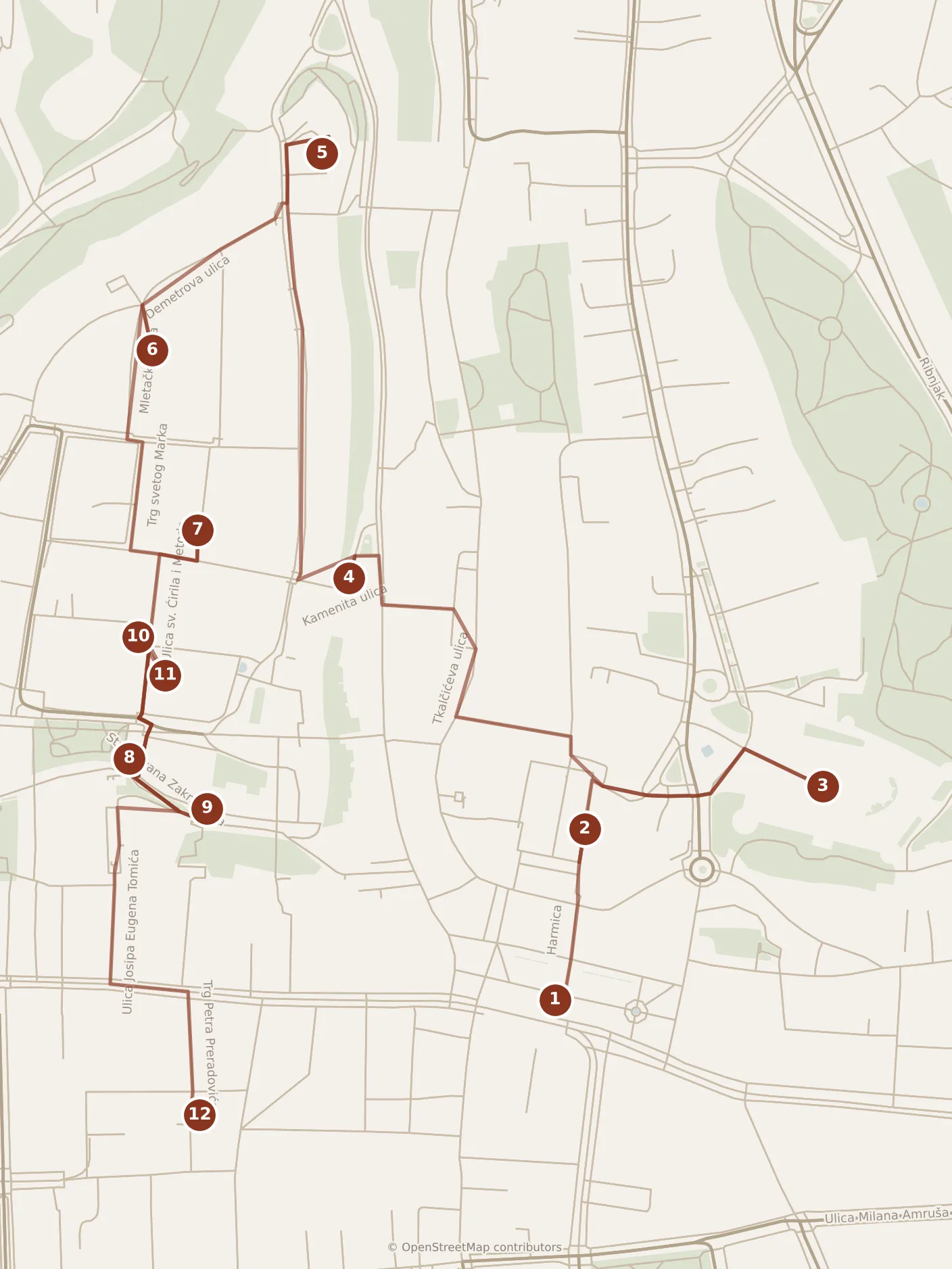
- Day one
- 1Trg bana Jelačića
- 2Dolac
- 3Zagreb Cathedral
- 4Stone Gate
- 5Zagreb City Museum
- 6Meštrović Atelier
- 7St Mark's Church
- 8Lotrščak Tower
- 9Strossmayer Promenade
- 10Croatian Museum of Naïve Art
- 11Museum of Broken Relationships
- Grič Tunnel — in the prose, not on the map
- 12Trg Petra Preradovića
Everything today happens on the two hills, and the route runs up the eastern one, across the seam between them, and then down the western one from its northern end to its southern tip. You never retrace a street.
Morning
Start on Trg bana Jelačića at half past eight. Three minutes north, up the steps on the square’s far side, is Dolac, and the reason it goes first is not that it is a sight. Having two days here means you can treat it as a shop rather than a photograph: this is where you buy the fruit and the bread you eat on the ridge after the gun. That is elevenses and not lunch — lunch is still the sitting-down hour on Radićeva this afternoon — and it is what stops the morning costing anything. Buy it early whichever day you are on: this is a morning market that thins through the afternoon, and Sunday is the shortest day of its week. The upper level under the red umbrellas is the growers’ market; the whole of it stands on the roof of a covered hall of butchers, bakers and dairy stalls that most visitors walk across without ever going down into, and the way in to that is on the Splavnica side. Half an hour buys both levels and a paper bag.
Three minutes east and you are on Kaptol, the church hill, in front of the cathedral. Give it twenty minutes and spend them on the two things the postcard leaves out. The first is the wall: Cardinal Toma Bakač, who died in 1521, ringed the cathedral with ramparts, six round towers and one square one against the Ottoman advance, and those fortifications are four centuries older than the spires and are still standing round the square. The second is the state of the building. The 2020 earthquake took the tip off one spire and the other came down on 17 April that year, so what you are looking at is a cathedral being taken apart and put back stone by stone, with numbered blocks stacked on pallets and cranes standing where the towers were. Access to the inside has come and gone with the works, so treat the interior as a bonus rather than a plan; the rebuilding itself is the rarer thing to be shown, and Bollé’s generation stood in front of exactly the same scene.
From Kaptol cross west and climb Radićeva, then take the steps up Kamenita to the Stone Gate — ten minutes, and the last of it is stairs. The gate is the surviving one of Gradec’s four medieval entrances, and you do not walk past it, you walk through it: after the fire of 1731 a painting of the Virgin was found unburnt in the ashes and the passage has been a shrine ever since, with a baroque altar screen set across the arch, iron benches, banks of candles and a wall of small stone plaques. Ten minutes. It is a working chapel with people praying in it at any hour of any day, so go through quietly and photograph nothing that has a person in it.
Six minutes north along Opatička, at the top end of the Upper Town, is the Zagreb City Museum, which in 2026 opened its doors at ten; leaving the square at half past eight puts you outside it at about eight minutes to. Give it an hour. It occupies three buildings knocked into one — a twelfth-century tower called Popov toranj, an eighteenth-century observatory and a seventeenth-century granary — and the fabric is half the visit. Inside, walk it as a chronology and do not try to see it whole. The two things to find are the model of Gradec as a walled town on its hill, which explains everything you walked through this morning in about ninety seconds, and, near the modern end, the actual Oscar that Dušan Vukotić won in 1962 for the animated short Surogat, sitting in a case in a municipal museum, which is a very Zagreb place for it to be.
Four minutes down and west, on Mletačka, is the Meštrović Atelier: the house and working studio that Ivan Meštrović lived in between the wars, kept as he left it, with his own furniture, his painted ceilings, and sculpture in plaster, wood, marble and bronze through the rooms and the courtyard. Forty minutes is right, and it is the most concentrated interior of the day — one artist in one house, which is a different experience from a collection and a better one after an hour of a city museum.
Three minutes south the lane opens onto the square that runs the country, with St Mark’s Church in the middle of it and its glazed-tile roof laid as two coats of arms. You look at this one from the edge: the square has been fenced and closed to the public since October 2020, when a man shot a police officer outside the government building on it, so the medieval portal of small figures in shallow niches under the porch — the thing actually worth reading, and much older than the roof — is out of reach, and the roof is what is left. Know what kind of fence it is before you arrive at it: this is a guarded closure in front of the government and the parliament, not a building site, so look, photograph the roof and move on rather than settling in. Ten minutes.
Three minutes further and the Upper Town ends at the parapet, at Lotrščak Tower, with the whole grid of the Lower Town laid out below it. You should be standing here by noon.
Local tip. If the morning runs over — and it runs over in the city museum, never anywhere else — drop the Meštrović Atelier whole rather than taking ten minutes off each of the others. It stays open until six, it is six minutes from where you will be standing at a quarter past twelve, and going back up for it after the gun costs you the naïve art museum’s three quarters of an hour this afternoon, plus the few minutes of climbing back up and down again. Shaving the morning evenly costs you the gun, which does not wait and cannot be rescheduled.
Afternoon
Stay at the parapet for the cannon, which is over in about a second, and then give the ridge a quarter of an hour. Strossmayer Promenade runs east from the tower along the top of the old wall under a line of trees, with the roofs below on one side and the wooded mass of Medvednica behind you on the other. Sit facing out. This is also the moment to look properly at that mountain, because on a third day you will be standing on top of it.
Two minutes north, on Ćirilometodska, two small museums stand almost next door to each other, and a two-day trip can have both where a one-day trip has to choose. The Croatian Museum of Naïve Art holds the Hlebine school: self-taught painters from a village near the Hungarian border, gathered from 1930 by Krsto Hegedušić, of whom Ivan Generalić became the one everybody knows. Much of it is painted in oils on the back of a sheet of glass, so the picture is built in reverse — highlights first, background last — and once you know that you cannot stop seeing it. Three quarters of an hour. Next door, the Museum of Broken Relationships is objects donated by strangers after a relationship ended, each with a card written by the donor saying what the thing is and what happened. An hour, and it is either entirely your sort of thing or not at all; there is no middle result and no point hurrying it. If you want one of the two rather than both — and a second day is as good an argument for sitting down somewhere as for a fourth interior — keep the naïve art, which is shorter and is the one that could not be anywhere else, and give the freed hour back to the promenade with something to drink.
Lunch after that, four minutes down Radićeva, where the hill starts to feel like a street people live on rather than a monument. Sitting down for an hour is normal here and nobody will hurry you.
Then the strangest twenty minutes on the itinerary. The eastern mouth of the Grič Tunnel is in a yard at Radićeva 19, and the tunnel runs three hundred and fifty meters straight through the hill you have spent all day on, coming out on Mesnička. It was dug in 1943 as a public air-raid shelter on the orders of Nikola Mandić, prime minister of the wartime puppet state, and it spent most of the decades after that sealed. It is now a lit pedestrian passage kept open long hours every day rather than museum ones, which means that it is there in the rain and on a Monday, when two of the four collections above it are shut. Come out on Mesnička and Ilica is in front of you; Trg bana Jelačića is nine minutes east along it.
As written, this afternoon ends at about four o’clock, which in the second week of December is some ten minutes before the light goes; the tunnel is the only stop above that would not have minded either way. In June you have four and a half hours in hand, and the honest advice is not to add a fifth museum: go back up to the promenade with something to drink, or walk west along Ilica, which stops being a shopping street and becomes an ordinary one about ten minutes out.
Evening
Come down into the grid for the evening rather than staying on the hill, and specifically to Trg Petra Preradovića and the pedestrian streets running east of it, which is where the Lower Town eats and drinks at tables set in the middle of the road. This is where zagrebački odrezak belongs — a veal escalope stuffed with ham and cheese, then breaded and fried, and a plate you do not want before a day of stairs. The other evening in this article goes up the valley between the two hills to a street that is nothing like this one, and having both is most of what a second day is for.
Day two

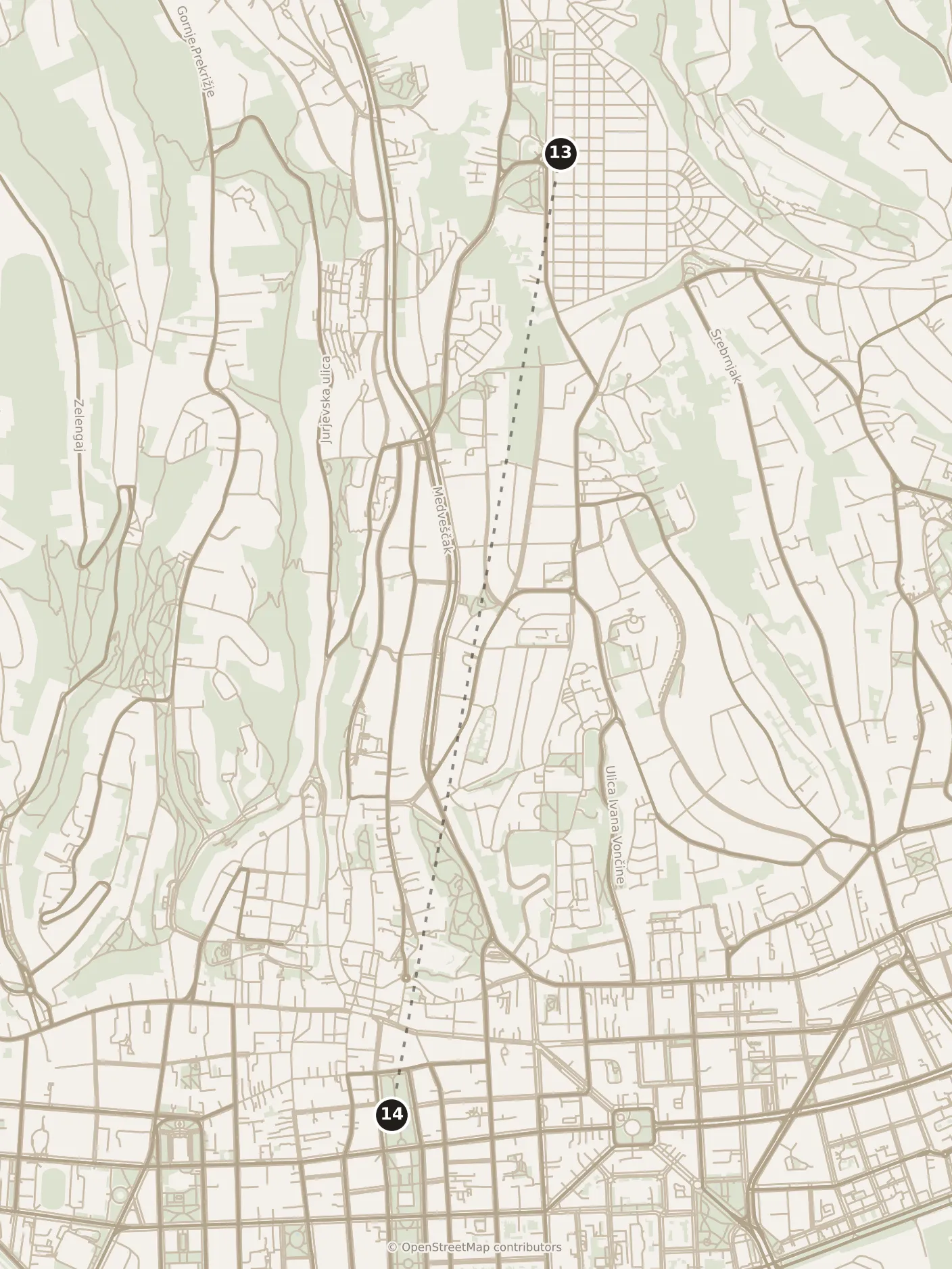
The ride on to stop 14, by bus, not on foot.
- Morning
- Kaptol — in the prose, not on the map
- 13Mirogoj
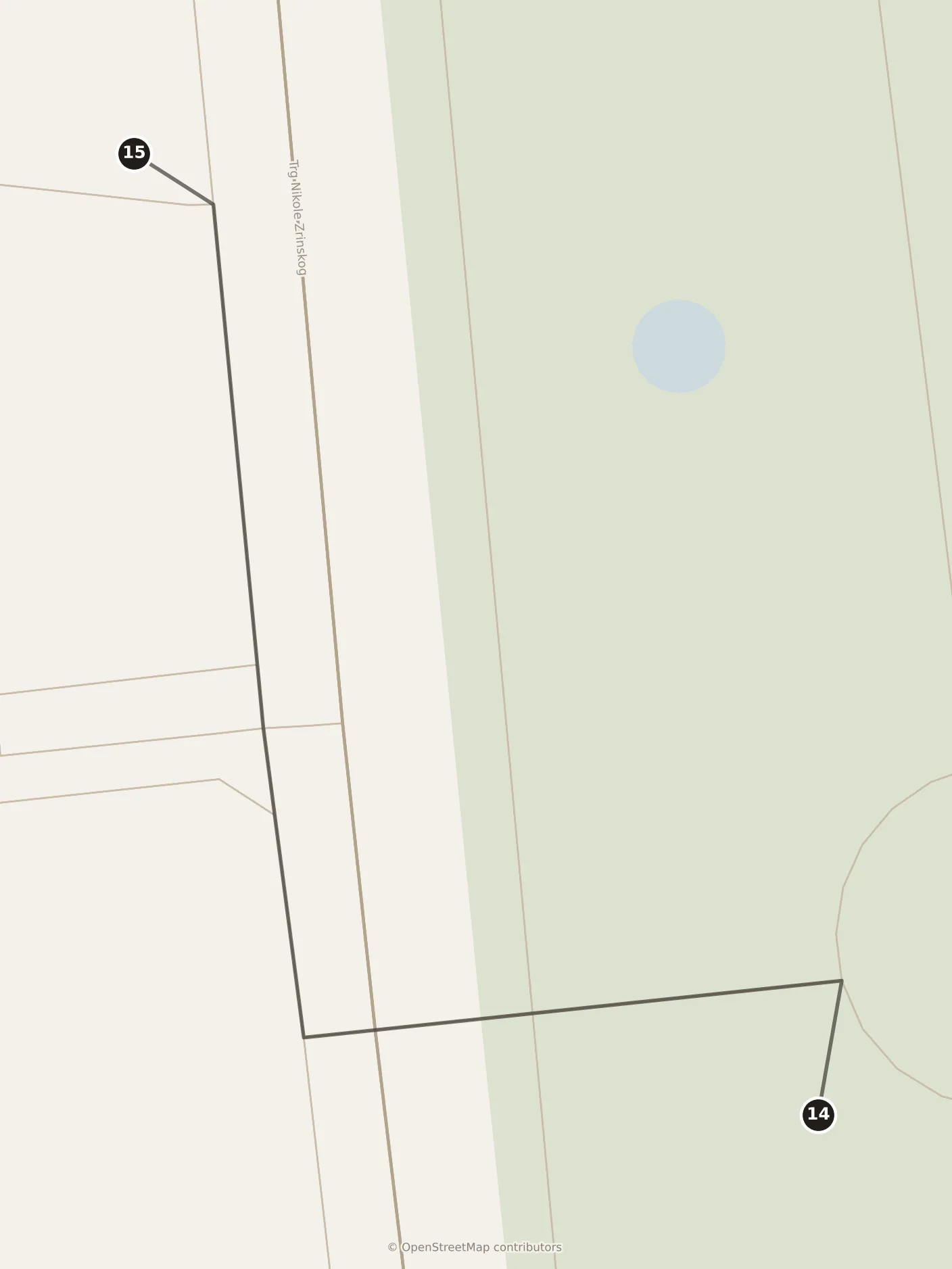
- Morning
- 14Zrinjevac
- 15Archaeological Museum
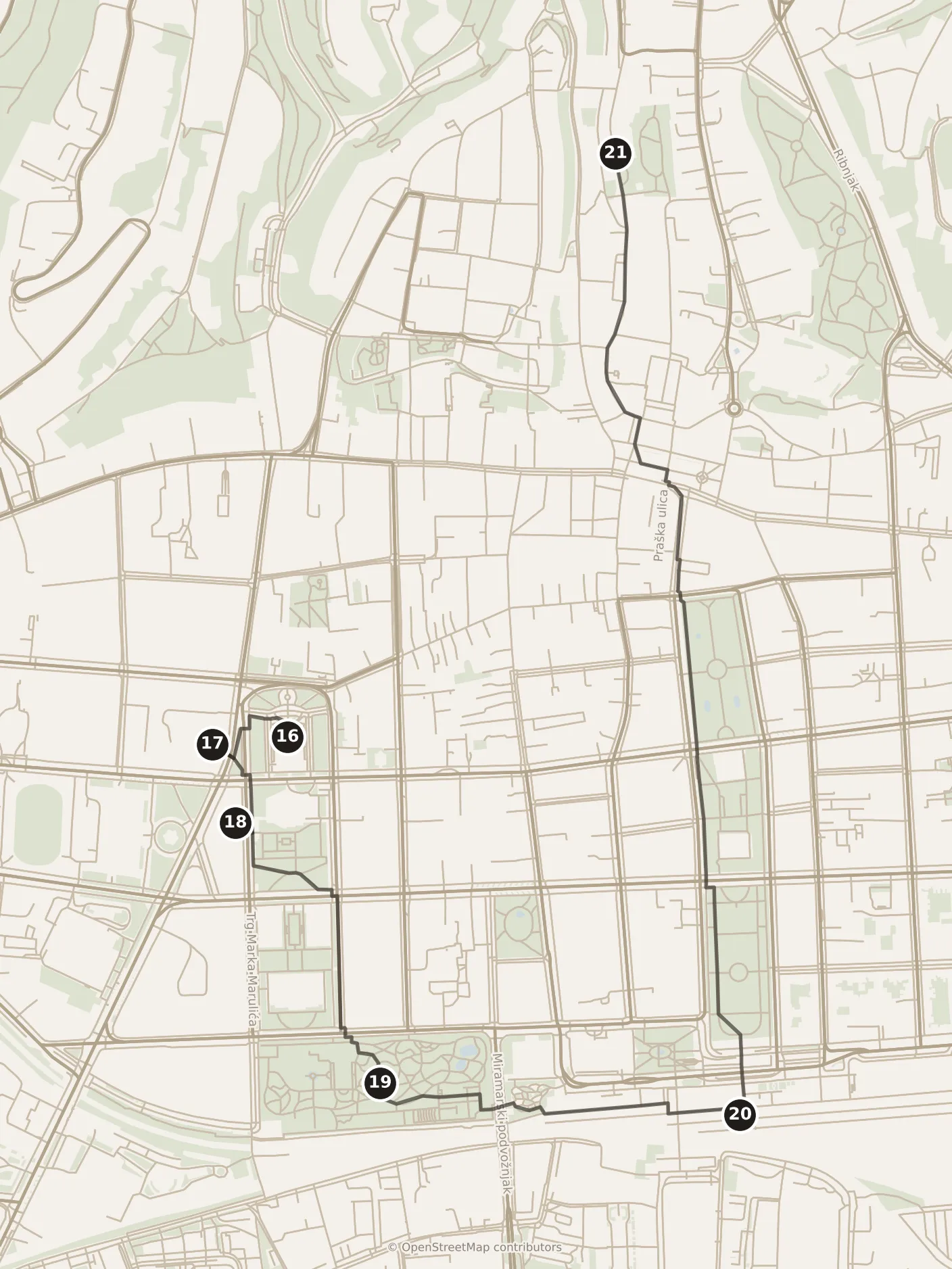
- Afternoon and evening
- 16Croatian National Theatre
- 17Museum of Arts and Crafts
- 18Ethnographic Museum
- 19Zagreb Botanical Garden
- 20Glavni kolodvor
- 21Tkalčićeva
Today is the reverse shape of yesterday: it starts furthest out and works back in, and it finishes at the railway station, which is where you want to be if this is your last day.
Morning
Begin at Kaptol at about nine, at the bus terminus beside the cathedral you looked at yesterday. Bus 106 runs from here to Mirogoj every twenty minutes, on a Sunday as on a Tuesday, though the last one back leaves well before the cemetery shuts on a summer evening. The ride is a little over ten minutes uphill through the villas north of the center.
Give Mirogoj an hour and a half; it is the reason day two exists. The cemetery opened in 1876 and Bollé’s arcades were begun three years after that and took decades to finish: a green-domed wall of brick and stone running the length of the cemetery, with a colonnade behind it and family tombs set into the arches, so that the burials are architecture rather than furniture on a lawn. The chapel of Christ the King stands inside the grounds. What makes it unusual, and what is worth understanding while you walk it, is that Mirogoj was laid out from its own statutes as one cemetery for four confessions — Catholic, Orthodox, Protestant and Jewish sections together from the start, in a century that mostly did the opposite — so you read the whole city’s history off the stones instead of one community’s. Composers, writers, chemists and presidents are here, and the grave people still leave flowers on is Dražen Petrović’s, the basketball player killed in a car crash in 1993 at twenty-eight; it is in the Catholic ground a few hundred meters north of the main entrance, outside the arcades, and it is the one grave here that people come specifically to find. Walk the arcades on both sides, then go out into the open sections behind them, which is where the twentieth century is.
It is a working cemetery and there are funerals most days. That is not a reason to stay away — it is entirely normal to visit and the city does it constantly — but keep out of an arcade while a service is going on in it, and know that around All Saints at the start of November the entire city comes up here at once and the place is candlelit and impassable, which is extraordinary to see and hopeless as a sightseeing morning.
Bus 106 back, then a little over ten minutes on foot down through Kaptol and across to Zrinjevac, the handsomest of the linked park squares, with its plane trees, its bandstand and its little meteorological column. You want the eastern side of it: at number 19 stands the Archaeological Museum, which is where the last of the morning and the start of the afternoon go. An hour and a half.
Two things justify it and the rest is optional. The first is upstairs among the Egyptian holdings: a mummy bought in Alexandria in the 1840s and brought back to Croatia, whose linen wrappings turned out to be a cut-up book written in Etruscan — the Liber Linteus, still by a distance the longest surviving text in that language, and one nobody can fully read. The second is the Vučedol dove, a prehistoric vessel shaped like a bird that has become one of the country’s emblems. The Lumbarda inscription, recording a Greek colony on Korčula in the fourth century before Christ, is worth five minutes on the way past. What to skip is the coin cabinet: it is one of the largest in Europe and it is not what you came for.
Afternoon
Lunch for an hour in the streets between Zrinjevac and the main square, which is the right place to have štrukli if you have not yet — sheets of thin dough with fresh cheese, either boiled and served in their own liquid or baked until the top blisters. Then walk twelve minutes west across the bottom of the horseshoe to Trg Republike Hrvatske — the longest stretch either day asks you to walk in one go before the evening.
Give the square a quarter of an hour, on foot and outside. The Croatian National Theatre in the middle of it is a yellow neo-baroque opera house of 1895; set into the paving in front of it is the Well of Life, a ring of bronze figures leaning in over water, cast in 1905 by the sculptor whose house you stood in yesterday morning, and it is better than the building behind it. Then turn and look at the long building on the western side: that is the Museum of Arts and Crafts, Bollé’s, holding the country’s applied art, and it has been closed to the public for reconstruction since the first day of 2022. Standing in front of a shut museum is not a stop most itineraries would give you, but it is unavoidable on the way through and it is the clearest single statement of what the earthquake did.
Five minutes south, on the next square down, the Ethnographic Museum is open, and it is the one that quietly repays the hour. It is the national collection of what people here wore, made and used: textiles and lace from the coast and from the northern hills, whole festival costumes, tools, and the domestic objects that a country of small farms produced for itself — which after a morning of Egypt and prehistory is the first thing all day that is about the people who live outside the door. An hour. Note before you build anything on it that its weekend hours are far shorter than its weekday ones, which is dealt with below.
Nine minutes further south is the botanical garden, the last corner of the horseshoe: a small, deliberately overgrown teaching garden of the 1890s with an arboretum, a pond and glasshouses. Twenty minutes if it is open. It is the one stop in this article that may simply be locked when you arrive — it shuts for the winter, and it keeps shorter hours at the start of the week — so read what the garden publishes for your own date, and if it is closed the path along its railings is on your way regardless and you lose nothing but a bench.
Eleven minutes east along the front of the parks and you are at Glavni kolodvor, with the platforms behind the booking hall. As written you reach it shortly after four.
Local tip. If the afternoon is running short, give up the Ethnographic Museum’s hour whole rather than taking a quarter of an hour off each of the four stops around it. It is the only interior left in the day, which makes it the only stop where the time is genuinely yours to take back: the theater square, the garden and the two walks are already the least they can be, and shaving them makes the afternoon less pleasant without making it shorter.
Evening
Go back up to Tkalčićeva, which is the one street this article has kept in reserve: the best part of half an hour on foot from the station, or tram 6 or 13 up to Trg bana Jelačića and ten minutes north from there. It runs in the bed of the stream that once divided the bishops’ town from the free town, put underground at the end of the nineteenth century; what is left is a long curving street with no crossroads, no traffic and an unbroken line of terraces running its whole length. Last night was a grid — squares, corners, tables set out across a junction; this is one line you walk from one end to the other, and having both is the point of two evenings. Which of the two is the livelier on a given night, and which the city currently counts as its own rather than the visitors’, is not something a page can tell you a week in advance. If you are here in December the Lower Town is under Advent lights by then and the squares you crossed this afternoon are full of stalls selling fritule by the paper cone.
With a third day

- With a third day
- Mihaljevac — in the prose, not on the map
- 22Zagreb cable car
- Sljeme — in the prose, not on the map
- 23Maksimir
- 24Zagreb Zoo
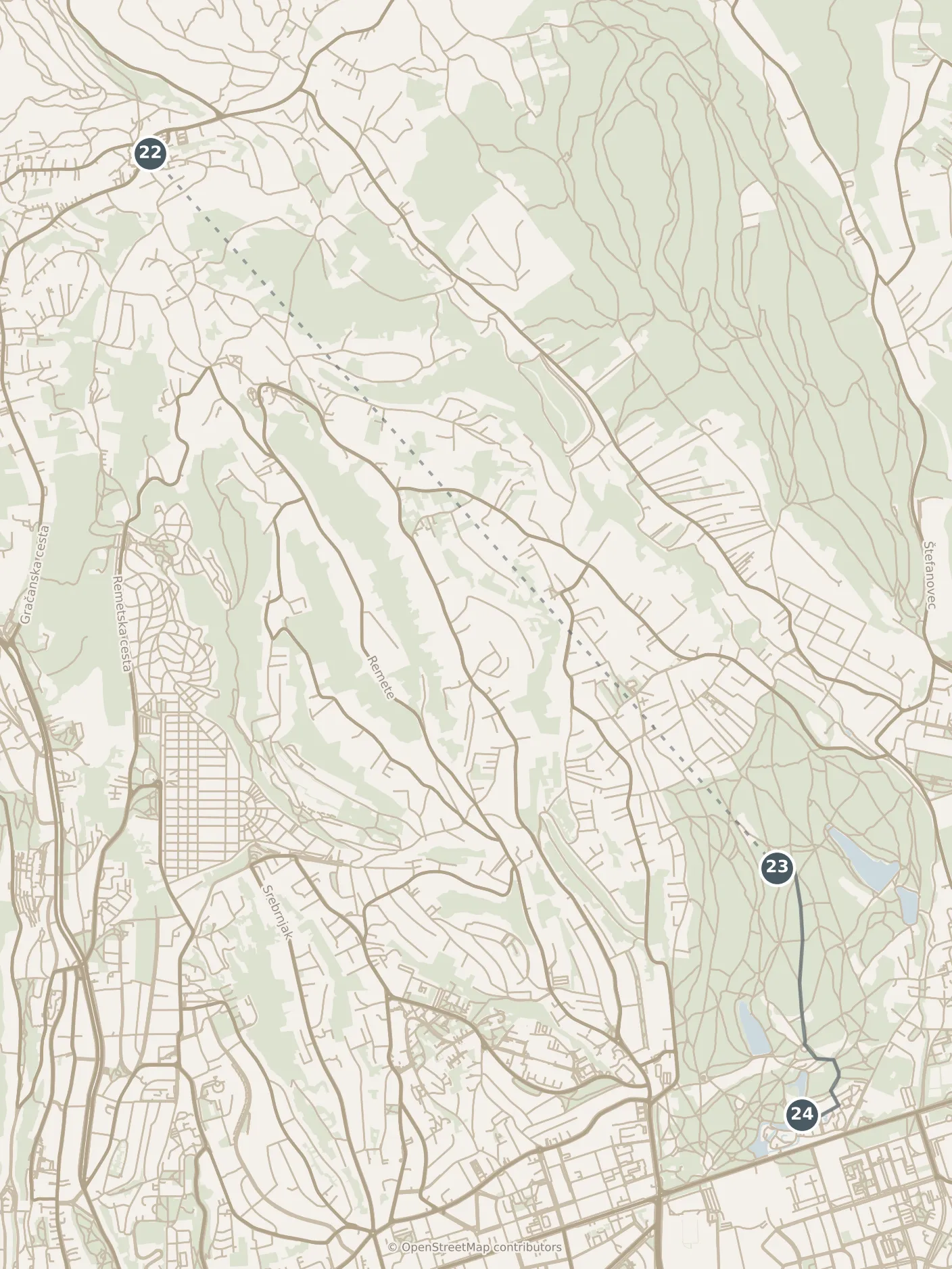
The third day sits at the end by default, and it goes up. Medvednica is the ridge behind every view you have had for two days; Sljeme, its highest point at 1,035 meters, is the top of it, and since 23 February 2022 there has been a cable car to it.
There are two reasons to move it and they point the same way, so settle this before you fix your dates. This is the only one of the three days that survives a Monday intact — the cable car runs, the park is a park, the zoo opens every day — while day one loses two of its four interiors to a Monday and day two loses both of its museums. So if any of your days is a Monday, that is the day the mountain takes, and the day it changes places with is day two, which moves whole and unaltered: Mirogoj keeps the same hours on every day of the week and bus 106 keeps the same twenty-minute headway. It is also the only day the weather can cancel outright, which pulls the same way — if exactly one of your days is clear, take the mountain on that one, and again it is day two that moves. Do not swap it with day one, whose morning is counted from a museum door and a cannon and does not survive being rearranged.
Getting there is two trams and one change. Tram 14 runs from Trg bana Jelačića to its northern terminus at Mihaljevac; there you change to tram 15, the shortest line in the network at about three kilometers of its own segregated track, and it ends at Gračansko Dolje beside the cable car’s lower station. Reckon on the best part of an hour from the square to the cabin, change and waiting included.
In 2026 the first cabin left the bottom at ten on a weekday and at nine on weekends and public holidays, and the last one came down from the top at seven in the evening. If those hours have moved, the method has not: take the published first departure and subtract the hour from the square — which on a weekday means leaving Trg bana Jelačića at about ten past nine, and on a weekend an hour earlier for an hour more on top. The ride itself is five kilometers, sixteen to twenty-two minutes depending on the speed it is run at, in ten-seat cabins, climbing seven hundred and sixty meters. And the operator says plainly, on the same notice as the hours, that the cabins stop when the wind is too strong to run them safely and again in a thunderstorm, so this is a day for a dull forecast rather than a dramatic one. If it is shut when you get there you have two choices, and neither of them is improvised on the platform. There is a road up the mountain and a bus on it — ZET’s line 140, which starts from Mihaljevac, the interchange you changed at on the way up — so ask at the lower station whether it is running that day before you give up. If it is not, ride the two trams back and give the whole day to the park below, which is described in a moment and is enough on its own.
The top is a broad wooded ridge rather than a peak, with a television mast on it, ski huts, and paths running off along the crest in both directions. What you came for is the two views: north over the green hill country of Zagorje, and south across the whole city and the plain beyond it until the haze takes over. Give it two hours if you are walking a little and three if you mean it. In the cold months take the first cabin without argument, because this is the one stop in the article whose entire value is the view: in the second week of December the view has gone by a quarter past four, while in the last week of June the last cabin down is still nearly two hours ahead of the sunset and the top can have the afternoon. On a fine weekend take the first cabin for a second reason: the lower station is the one place on these three days where a line can build, and a clear Saturday morning is when it would.
Nothing in this day as written is a meal, and the arithmetic is worse than it looks: a ten o’clock cabin and two hours on top puts you back at Trg bana Jelačića at about half past one with nothing eaten since breakfast and a park still to come. There are huts on the ridge, but do not build the day on them — buy something before you get on the first tram and eat it looking north over Zagorje, which is the best table on this itinerary and the only one that costs nothing. That still puts you back at the square at about half past one, and the rest of the day belongs to the other green thing the two days below leave out. From the square, trams 11 and 12 both run east to Maksimir, about a quarter of an hour: a park begun in 1787 by Bishop Maksimilijan Vrhovac and opened to the public in 1794, which makes it one of the oldest public parks anywhere and the first large one in this part of Europe. It is three hundred and sixteen hectares of woodland with five artificial lakes strung through it, and the one surviving pavilion, the Echo of 1840, stands in the middle of it. Zagreb Zoo is inside the park and open every day of the year. Two and a half hours covers the walk down to the lakes and back with the zoo in it, or half that without — and from half past one that is a finish at about four, which is the same hour the other two days end.
That is a full third day, and it is also the one to cut if you turn out to have two and a half rather than three. Cut it whole rather than in pieces: half a mountain is a tram ride.
Practicalities
Nothing on these three days is booked in advance, and that is worth saying plainly to somebody holding nothing. Every interior here sells at its own door on the day, and in 2026 none of the six cost more than about eight euro — so the whole museum half of these three days is something like forty euro a head, which is the number this page owes you before you decide how many of them you want. The cemetery, the tunnel, the promenade, the market and the parks cost nothing at all. There is no line on days one and two worth a strategy; the exception is the cable car’s lower station on a fine weekend, dealt with on day three. What this page cannot tell you is whether a particular terrace takes bookings on a Saturday night — nothing in these three days depends on getting a specific table. The one thing you must have bought before you can use it is a transport ticket, and the first moment you need one is bus 106 on the second morning. A one-way ticket is thirty, sixty or ninety minutes and one direction with it, so the ride out to the cemetery and the ride back are two of them; the shortest was under a euro at a kiosk in 2026 and about half as much again from the driver. Buy in the MojZET app or at a kiosk, and the parent city guide covers the validating. There is a Zagreb Card, and the arithmetic on this particular route is worth doing before you buy one: it carries you on ZET’s trams and buses inside the city zone and covers three of the paid entries on these three days — the city museum, the Museum of Broken Relationships and the zoo — and none of the other four museums. What it does not carry you on is the cable car: that ride on day three is sold at the lower station and is a fare of its own, and neither the tram ticket that got you there nor the card takes you up.
Which days close what, and how the days trade places. Read this as rules rather than as an answer, because a reader with two days starts on the day their train arrives.
- Day one must miss a Monday. The Zagreb City Museum and the Meštrović Atelier both close on Mondays, and they are the morning’s two interiors. What survives a Monday is everything outdoors — the market, the cathedral hill, the gate, the roof, the gun, the promenade — plus the tunnel, and the naïve art museum on Ćirilometodska, which keeps weekday hours and is open when its neighbors on the hill are not. Its neighbor on the same street keeps days of its own, so read both. That naïve art museum is also the day’s one weekend question: its Saturday is short and it does not advertise a Sunday, so if your day one is a Sunday, read its hours before you count on the three quarters of an hour above.
- Day two must also miss a Monday, and it is cut on the weekend. The Archaeological Museum and the Ethnographic Museum both close on Mondays, and against that there is no rearrangement — on a Monday day two moves to another date. On the weekend there is one, because both museums shut early: on a Sunday both of them stop in the early afternoon, which breaks the day as written outright, and on a Saturday the Ethnographic Museum alone does. The fix in each case is an order rather than a cut. Put the museums first thing and Mirogoj after them: the cemetery opens every day of the year and does not care which day you come — six in the morning to eight at night from April to the end of October, half past seven to six in the months either side — and the bus runs to the same headway all day. On a Sunday that means being at the archaeological rooms when they open and giving them an hour and a quarter instead of an hour and a half — which is the coin cabinet you were going to skip anyway — and the second museum from about half past eleven, which clears both before they shut.
- Day three takes any date at all.
- The trap is a weekend arrival, because a Saturday–Sunday or a Sunday–Monday pair lands day two on a day it does not fit. With three days this solves itself: give the Sunday or the Monday to the mountain and let day two find a weekday. With only two, give the awkward day to day one, which survives a Monday in its outdoor half and a Sunday but for one small museum, and put day two on the other one.
- The one-line version, if you would rather not think about any of it: start on a Tuesday and everything above is already true.
Getting between the stops this article names. Days one and two are walked end to end and the distances are small. The longest single stretch inside day one is the ten minutes up Radićeva and the Kamenita steps to the Stone Gate; inside day two, before the evening, it is the twelve minutes west from Zrinjevac to the theater square. The only ride the route itself requires in two days is bus 106 out to Mirogoj and back, from the terminus beside the cathedral — the tram up to Tkalčićeva on the second evening is a convenience, not a requirement, and the walk is the best part of half an hour. Day three is the opposite: tram 14 from Trg bana Jelačića to Mihaljevac, tram 15 from there to Gračansko Dolje, the cable car, and then trams 11 or 12 east to Maksimir in the afternoon.
Two things this route deliberately leaves out. The funicular between Tomićeva and the promenade, which is charming, a minute long and on neither of these days’ lines — take it on a spare evening if you want to have done it. And the Lower Town’s three largest collections, which are not a choice at all: the Museum of Arts and Crafts, the Strossmayer Gallery of Old Masters and the Mimara are all closed for post-earthquake reconstruction, and the last of those has had a reopening spoken of for some time. If you are reading this after they come back, day two changes shape completely and gains an afternoon’s worth of options it does not have here. Check before you assume that paragraph is still current: it is the one part of this article designed to expire.


.jpg)
.jpg)

