Zagreb in one day: up one arm of the parks, across the two hills, down the other

Last updated 4 August 2026
Overview
Zagreb’s old town is two hills with a filled-in stream bed between them, and the modern city is a flat grid below, laid out at the end of the nineteenth century around a horseshoe of linked parks. Glavni kolodvor, the main railway station, sits at the bottom of that horseshoe. The Upper Town sits at the top of it, a kilometer north. That geography writes the one-day plan by itself: up one arm of the parks in the morning, across the two hills at midday, down the other arm in the afternoon. It comes to a little over five kilometers, it never doubles back, and nothing on it needs a tram.
What one day costs you here is the museums, and Zagreb has more good small ones than a city this size has any business having. The loop below takes exactly one of them and leaves the rest, which will feel wrong when you are standing outside the second. Take the trade anyway: an hour indoors is the hour that would have bought you the market, the gate and the ridge, and those are what this city is actually made of.
The day has one fixed point, and it is the loudest thing in it. A gun has been fired from Lotrščak Tower on Grič to mark midday every day since 1877, when it was installed to tell the city’s bell-ringers when noon was. It is still a signal for the whole center rather than a show put on for visitors — no ticket, no door, nowhere you have to be standing — and it makes a natural end to the morning half of this loop. Everything above it comes to about two and a quarter hours of walking and standing: the walk in through the parks, half an hour at the market, a quarter of an hour on the cathedral hill, the climb, the gate, the roof. So leave the station at about half past nine. If you arrive and find the gun silenced for works, nothing else in the day moves; the ridge is still where the morning ends, and you build the morning back from whatever the new hour turns out to be.
That count models the walking and the time you spend standing in the places. It leaves out the one thing Zagreb will genuinely take from you, which is coffee. Sitting an hour over a single cup is the local unit of morning here, and there is a terrace at every stage of this walk. Build one in deliberately, or the sum will quietly absorb it and you will hear the gun from the wrong hill.
The other thing that decides the day is how much of it there is. The sun sets in Zagreb from just after four in the middle of December to a little before nine at the end of June — four and a half hours of difference, which is more than most people allow for. The morning half is pinned by the gun and does not move, so it is the afternoon that gives way. In June you walk the last arm of the parks in full light and still have hours in hand. In December the light goes somewhere on that last arm, and the walk out finishes under the Advent lamps, which is a fair exchange rather than a loss.
The loop returns to where it started, which is what makes it a day you can do between trains — provided the bag can be put down. Nothing on this route will take one from you, and the day ends a ten-minute walk from the platform you will leave from. But the railway’s own station pages give the address and the ticket-office hours and say nothing whatever about luggage storage, so treat the left-luggage office as something to establish at the ticket windows on arrival rather than something to plan the day around.
If there is nowhere to put it down, do not walk the loop below with the bag: the Upper Town half is cobbles, and the climb from Tkalčićeva to the Stone Gate is stairs. The day that works with a case in hand is the same day with the hill taken by machine. Out of the station and up through the parks to Trg bana Jelačića, twenty minutes. Dolac and the cathedral hill, three quarters of an hour between them. Then back down to the square and six or seven minutes west along Ilica to Tomićeva, and up on the funicular instead of the steps: that lands you on Strossmayer Promenade with the ridge already won, Lotrščak and the gun a few minutes west along it, and the museum two minutes north of the top station. The funicular carries you back down to the same lunch, and the theater square, the botanical garden and the station are the same flat walk as below. What it costs you is Tkalčićeva and the Stone Gate chapel, which are two of the best things in the morning; what it does not cost is time, and you still reach the tower before the gun.
The day

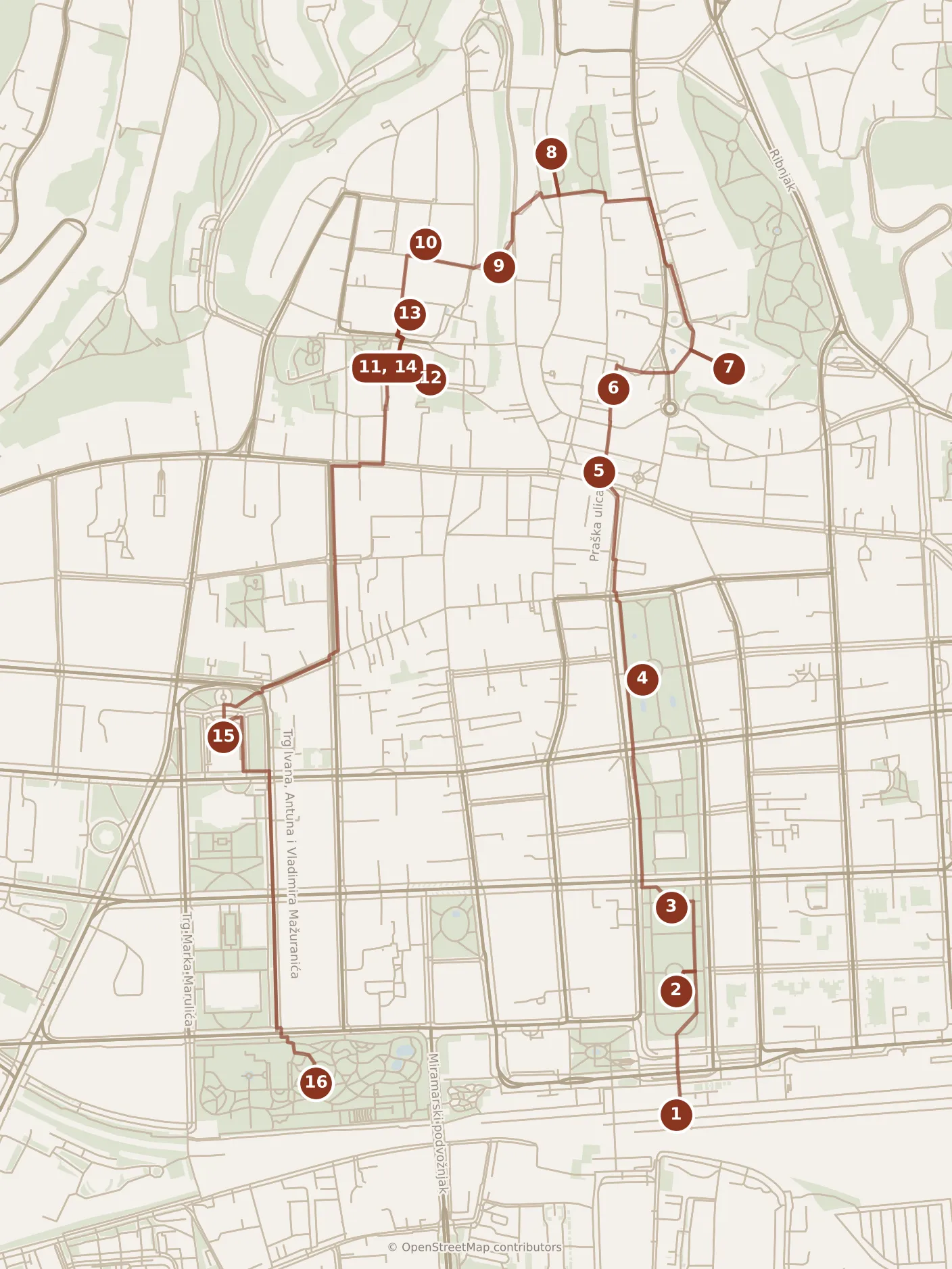
- The day
- 1Glavni kolodvor
- 2Trg kralja Tomislava
- 3Art Pavilion
- 4Zrinjevac
- 5Trg bana Jelačića
- 6Dolac
- 7Zagreb Cathedral
- 8Tkalčićeva
- 9Stone Gate
- 10St Mark's Church
- 11Lotrščak Tower
- 12Strossmayer Promenade
- 13Museum of Broken Relationships
- 14Zagreb Funicular
- 15Croatian National Theatre
- 16Zagreb Botanical Garden
Morning
Come out of the station’s front doors and the first stretch is entirely park. Trg kralja Tomislava opens straight ahead with its equestrian statue in it, and beyond that stands the Art Pavilion, a yellow hall whose iron skeleton was prefabricated for an exhibition in Budapest in 1896, shipped here when that closed, and dressed in stucco on this spot by 1898. It is a building that arrived by train, which is a satisfying thing to know while standing next to a railway station.
Keep going north and the horseshoe runs into Zrinjevac, the one park on this route worth stopping in rather than walking through. It was laid out in 1892 around a bandstand of the year before and a meteorological column of Istrian marble whose instruments were ordered from Göttingen: a public thermometer, barometer and clock, from the decade when knowing the weather was treated as a civic amenity like a drinking fountain. Give it ten minutes and a bench. From the station to Trg bana Jelačića, following this line of parks the whole way, is about twenty minutes on foot.
Trg bana Jelačića is where the tram lines meet and where the city measures its distances from. Cross it and climb the steps on its northern side to Dolac, which is why the morning starts early. The upper level is open air under rows of red umbrellas — growers with vegetables, fruit, and fresh cheese and cream sold by the ladleful. The lower level, directly under your feet, is a covered hall of butchers and dairy stalls, and it is easy to walk over without noticing. Beside it is the fish market. Half an hour does both levels honestly. A market is a market in the morning and a clearing-up operation afterwards, which is why this is the second stop of the day rather than the sixth.
Three minutes east is Kaptol, the church hill, and the cathedral on it. Look at it and know what you are looking at: the tip of the southern spire came off in the earthquake of 22 March 2020 and the northern spire was taken down deliberately in the April that followed, so the building is many meters shorter than the skyline it is famous for and has been a stone-by-stone rebuilding site ever since. Access to the inside has come and gone with the works. Give it a quarter of an hour as a cathedral being rebuilt — the scaffolding, the cranes, the numbered blocks waiting on pallets — which is a rarer thing to be shown than a finished one, and then it does not matter to your day whether the door happens to be open.
From Kaptol, cross west to the foot of Tkalčićeva and walk up it — with the length of the street itself that is about eight minutes, the longest continuous stretch of the morning — and it is worth understanding before you start. It runs in the bed of a stream that once separated the bishops’ town on Kaptol from the free town of Gradec on the hill opposite; the two fought over that water and the mills on it for centuries, the stream was put underground at the end of the nineteenth century, and what is left is a long curving street with no crossroads and no traffic. Today it is an unbroken line of bars and terraces, a different street in the middle of the morning from the one it becomes after dark. Walk it anyway, for the shape.
Part of the way up, steps on your left take you off the street and up to the Stone Gate — Kamenita vrata — the last of Gradec’s four medieval gates and still the way into the old town. Walking through it, you walk through a chapel. After the fire of 1731 a painting of the Virgin was found in the ashes unburnt, and the passage has been a shrine to it ever since: an eighteenth-century baroque altar screen set across the arch, iron benches, banks of candles, and the wall opposite covered in small stone plaques that mostly just say thank you. It is free, it is a working chapel with people praying in it, and the ten minutes you spend there are not a tourist stop.
Two minutes further and the lane reaches the edge of the square that runs the country, the Sabor on one side and Banski dvori on the other, with St Mark’s Church in the middle of it. You see this one from outside: the square was fenced off after the shooting at Banski dvori in October 2020, designated a guarded area a few weeks later, and has stayed closed to the public ever since. The roof is what everybody comes for: glazed tiles laid as two coats of arms side by side, the medieval arms of Croatia, Slavonia and Dalmatia, and the white castle on red that is Zagreb’s own. It is nineteenth-century work on a much older church, and the older church is the better half — under the roof there is a portal of fifteen small figures standing in shallow niches, attributed to the Parler workshop of Prague at the end of the fourteenth century. Reading them means standing at the door, and standing at the door is what the fencing has taken away.
Three minutes south-west along the lane the Upper Town runs out at the edge of the ridge, at Lotrščak Tower, with the Lower Town laid out below the parapet. This is where the morning ends, and at midday the gun goes off.
Local tip. The gun is a signal for the whole city, not a ticketed event — it is heard along the ridge and down in the grid below, so there is nothing to buy and nowhere you have to be standing. Which means the only choice at midday is whether to be inside the tower or on the free terrace beside it, and with a single day the terrace is the one that costs you nothing, seats you down, and leaves the view in front of you for as long as you want it.
Afternoon
That terrace is Strossmayer Promenade, running east from the tower along the top of the old town wall under a line of trees, the roofs of the Lower Town below it and the wooded ridge of Medvednica behind you. It is one of the best free things in Zagreb and it wants twenty minutes rather than five. Sit facing out and let the morning settle.
Two minutes back north is the Museum of Broken Relationships, the one museum this day keeps. It is objects donated by strangers after a relationship ended, each with a card written by the donor saying what the thing is and what happened: an axe, a wedding dress, a toaster, a prosthetic leg. It is funnier and considerably sadder than it sounds, it is small enough to see whole rather than sample, and an hour is the right amount to give it. If you would rather have that hour outdoors, skip it and say so to yourself plainly instead of going in and hurrying — this is the one stop on the day that a person either wants or does not, and rushing it is worse than missing it.
Then take the funicular down. Sixty-six meters of track, working since 1890, sixty-four seconds end to end, and one of the shortest public funiculars anywhere: it runs from Strossmayer Promenade to Tomićeva, a lane off Ilica, and the steps alongside it get you down in barely longer. The parent guide calls it fun once and skippable otherwise, and that is fair. The reason to take it here is simply that it puts you exactly where the afternoon needs to go. It has its own fare — a separate line on ZET’s price list, sixty-six euro cents one way in 2026 — and it is bought at the funicular itself; a tram ticket is not valid on it.
Lunch happens at the bottom, which is late by northern standards and unremarkable here. Ilica is the long shopping street the funicular delivers you onto, and the blocks south of it are full of places to sit down properly. This is where štrukli belongs if you have not had it yet — sheets of thin dough with fresh cheese, either baked until the top blisters or boiled and served in the liquid, savory or sweet — because it is a heavy plate and everything after this is flat.
Evening
From Ilica the western arm of the horseshoe begins, and the walk from the bottom of the funicular to the theater square is a little over ten minutes, which makes it the longest single stretch on the whole itinerary. The Croatian National Theatre stands in the middle of that square, a yellow neo-baroque opera house of 1895, and set into the paving in front of it is Ivan Meštrović’s Well of Life: a low ring of bronze figures leaning in over water, cast in 1905, easy to walk straight past and better than the building behind it.
Ten minutes further south is the botanical garden, the last corner of the horseshoe before the station. It is a small, deliberately overgrown teaching garden of the 1890s, with an arboretum, a pond and glasshouses, and it is the one stop on this route that can be locked when you arrive. It shuts for the winter — the season runs roughly March to December — and on Mondays and Tuesdays it closes hours earlier than on the other five days: at half past two in 2026, which is before this day can get there. The garden publishes those hours itself, and Monday and Tuesday are what you read them for. If it is shut, the path along its railings is on your way regardless and the loss costs you nothing but the sitting down.
From the garden it is ten minutes east and you are back at Glavni kolodvor with the loop closed and the platforms behind the booking hall. If you would rather not walk this last arm — rain, a train to make, a day that has already been long enough — trams 6 and 13 both run from Trg bana Jelačića to Glavni kolodvor, and Trg bana Jelačića is six or seven minutes east along Ilica from where the funicular leaves you.
And if your train is late enough to leave you an evening, there is one thing worth going back up for: Tkalčićeva after dark, which is the street you walked this morning and one of the places the city drinks. It is half an hour north of the station on foot, or trams 6 or 13 to Trg bana Jelačića and ten minutes up from there. That is the only doubling-back this day permits, and it is worth it.
Practicalities
Nothing on this day has to be booked, and nothing has to be bought before you travel. That is worth stating plainly, because a reader arriving on this page holding nothing has no way of knowing it: the parks, the squares of the Lower Town, the market, the cathedral hill, the Stone Gate chapel, the ridge and the promenade are all free and walk-up. St Mark’s is the exception, and not for a ticket: its square is fenced and closed to the public, so the church is something you look at from the edge. The only two things you pay for are a museum ticket bought at its own door and, if you use them, the fares — and the fares are two different things. A tram ticket is bought and validated the way the parent city guide explains, which is the one thing on that page worth reading before you come. The funicular is its own tariff line, bought at the funicular rather than from a kiosk, and no tram ticket carries you up it.
The morning rests on no opening hour, and that is a property of the day rather than an omission. It is a market, a street, a gate, a roof and a terrace; every one of them is outdoors or free-standing, so nothing in the order above is set by a door. The one clock time it has is midday, and that is a gun rather than an opening — which is also why it is safe to build a morning backwards from it. Only the last stop of the day has a door that can decide anything, and that is the botanical garden.
One thing on this route is worth checking rather than assuming, and it is the botanical garden. It is closed over winter, and on Mondays and Tuesdays it shuts in the early afternoon — hours before it does on the other five days, and before this day can arrive at it. The garden publishes those hours itself, and Monday and Tuesday are what you read them for; on those two days, and from late autumn to early spring, treat it as scenery on the walk out rather than as a stop. The Museum of Broken Relationships, by contrast, is the one thing here you do not have to check: it is the route’s only ticketed interior, but it opens every day of the year bar a handful of named holidays and stays open long after this day has finished with it, so the afternoon can be built around it without a second thought.
Dolac needs no checking either, and Sunday least of all: the market’s operator publishes the hours of each level, Sunday closes earliest of the seven days, and a half past nine start still puts you there hours before it. What no schedule gives is the peak. Dolac is the one stop here whose value collapses if you arrive at the end of it rather than the middle, and it is the stop everything else in the morning is sequenced around; if it is winding down when you get there, move the cathedral hill in front of it and lose nothing but the umbrellas.
This route survives a Monday, which is worth knowing if your one day falls on one. It is parks, a market, a street, a chapel gate, a roof and a ridge, and the categories of place that close on Mondays are the ones this day has already given up. The museum is not one of them — it opens on a Monday like any other day. The single casualty is the botanical garden, which on Mondays and Tuesdays is locked by the time this route reaches it, so on those two days the last corner of the horseshoe is a walk past the railings and nothing else in the order moves.
The whole loop is a little over five kilometers and something like an hour and twenty minutes of actual walking, spread across a day, which is why it works for people who would not describe themselves as walkers. The longest single stretch is the ten-odd minutes from the bottom of the funicular to the theater square; the longest in the morning is the eight minutes from the cathedral hill along the length of Tkalčićeva. The morning carries most of the walking — a little over forty minutes of it, against a quarter of an hour in the afternoon — because the kilometer in from the station is unavoidable and is best done on foot through the parks. The only genuinely uphill part is the climb from Tkalčićeva to the Stone Gate, and it is stairs rather than a slope — which is the part of the day a wheeled case makes miserable, and the reason the loop above assumes you are not carrying one.


.jpg)
