Yokohama in two or three days: the port in stone, the bluff, and a third day in the garden

Last updated 14 August 2026
Overview
Yokohama can be done in a day and almost everybody does it in a day: a single line along the water, beginning on the hill the treaty settlement was confined to and ending at the berths its shipping used. Two days is not that line walked more slowly. It is the city conceding that it has two halves and that only one of them faces the sea.
So day one goes inland and then north, into the parts a single day has to cut. Its morning is four blocks of stone put up between 1904 and 1934, when Yokohama was rebuilding itself out of an earthquake; its afternoon crosses the water into Minato Mirai, the district raised on the shipyard the port outgrew. Day two is the treaty port itself — the ridge of Western houses above the harbor, Chinatown at the foot of it, and the water at the end, which is where this city has always been at its best in the last hour of light. Both days are walked end to end: from the first stop of either one to its last there is no ride at all, and the only rail on either is whatever brings you to the start and takes you home from the end. About five and a half kilometers on each of them, plus the better part of a kilometer on day two for the pier, which is a walk out and a walk back.
What decides which day is which is a weekday. The rooftop of the prefectural building on day one opens on working days only. The foreigners’ cemetery on day two opens on weekends and public holidays only, and in January and August it does not open at all. They sit on different days deliberately, and that is the whole trick: put day one on a Tuesday, Wednesday or Friday and day two on the Saturday or Sunday, and outside those two months you get both. In them the gate is shut whatever you do, and day two is freed to be any day that is not the dead one. Two weekend days and you lose the roof; two weekdays and you lose the cemetery. Nothing rescues an ordinary Monday, when the ship, the port museum and the archives all shut together — which is what the third day is for, and why it is not always third. A public-holiday Monday is the exception and is worth checking your dates for: a museum that closes on Mondays here opens on the holiday and takes the Tuesday off instead, and the cemetery gate counts a public holiday as a weekend. That makes a holiday Monday an excellent day two and the Tuesday behind it the dead day. It does not make it a day one, because the prefectural roof opens on working days and a public holiday is not one.
The light is what the end of each day is for, and here it moves less than you expect. The sun goes down behind the city here and not over the water — the bay is east, so the light at the end of both days comes off the land and you stand looking into it. It sets between about half past four and one minute past seven, and never outside those two bounds: the earliest is in the first days of December, the latest in the last week of June, and Japan keeps no summer time, so the hour on your phone is the hour in the sky. Two anchors between those poles, since the arithmetic is the whole point of the paragraph: the sun goes down at about half past five in late September and at about six in late March. Take your month’s figure and count back. Day one comes to about six and a half hours from the first door to the Ferris wheel it ends on; day two to a little under seven, from the steps at the station to the pier. In December that means starting at ten and at half past nine respectively. In June both days have close to three hours of slack in them, which is what dinner is for.
What those counts measure is the time you spend inside places and the walking between them, and nothing else. They allow an hour for lunch, and that hour is the eating — not the standing about in an office district at noon on day one, or the line at the ship’s gangway on a fine weekend on day two. And day two’s largest omission is the bluff itself: there are seven of these houses along the ridge, they are all free, and the count allows for going into four — the two in the Italian garden and the pair at the far end of the ridge. You will go into more than four. Build it in, or accept reaching the pier later than the sum says.
Two things a visitor plans around are shut, and it is better to know now than to walk to them. The Landmark Tower’s viewing floor, the obvious way to get high above this harbor, took its last visitors at the end of December 2025 and shut for large-scale repair work on the tower itself; the operator expects it back when that work finishes, in 2028. The Kanagawa Prefectural Museum of Cultural History has been closed for works since December 2024, with a reopening announced for October 2026. Day one is arranged around both: it takes the museum’s building from the sidewalk, which is the better half of it anyway, and it puts the height at the end of the day on a Ferris wheel instead. That is a fairground ride in a fairground, and it is also, until the tower comes back, the only way to be a hundred meters above this port. The ride is a thousand yen a head in 2026.
Nothing on days one and two has to be booked before you travel and nothing on them sells out. What you do need in your hand from the first minute is a way through two different companies’ ticket barriers, because this route uses both the private Minatomirai line and JR. The card is called Suica; Pasmo is the same thing sold by the other operators and works identically, and either can live in a phone rather than a pocket. How it is bought and topped up is the city guide’s subject, and worth two minutes before you arrive. There is no app this route asks you to install: the card is the only thing you need to arrive holding, and the two hours that decide the days are published on the operators’ own sites, named at the end.
The bag is a smaller problem here than on a single day, because you have a room, but it has a shape. Both days begin on the sightseeing side of the city and neither begins at Yokohama Station, where most trains arrive and where the largest bank of coin lockers is. If you land in the morning before a room is ready, the case goes into a locker at Yokohama Station, or at Sakuragichō or Motomachi-Chūkagai, which are nearer to where you are going; whether one is free at nine on a Saturday is not published anywhere, so allow time to walk to a second bank. And if you must carry a bag through a whole day, carry it on day one: it is flat, it is shorter, and it finishes ten minutes from a station. Day two starts with a flight of steps off the platform, spends its morning on a two-kilometer ridge with a long descent at the end of it, and finishes on an open pier deck with nowhere to sit. That is the day to be empty-handed on.
Sankei-en — not on the walking map; you get there by train.
- With a third day
- 20Sankei-en
Day one

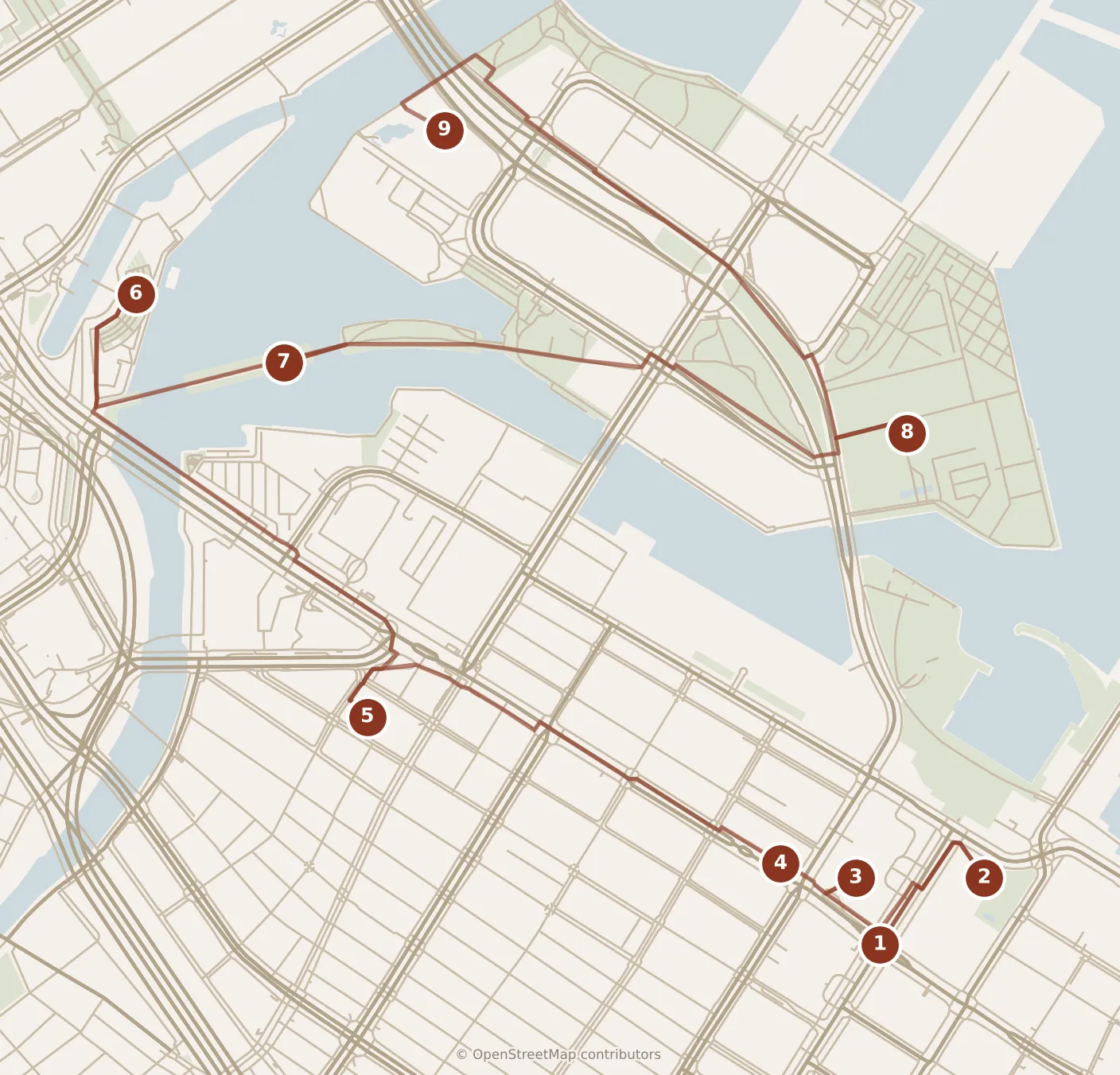
- Day one
- 1Nihon-ōdōri Station
- 2Yokohama Archives of History
- 3Kanagawa Prefectural Government Building
- 4Yokohama Port Opening Memorial Hall
- 5Kanagawa Prefectural Museum of Cultural History
- 6Nippon Maru Memorial Park
- 7Kishamichi Promenade
- 8Yokohama Red Brick Warehouse
- 9Cosmo Clock 21
Today is Yokohama explaining itself. Everything before lunch is inside four blocks; everything after it is one movement north-west, across the water and onto made ground, and you never come back over your own track.
Morning
Come in on the Minatomirai line to Nihon-ōdōri, four stops and about seven minutes from Yokohama Station. Coming from Haneda, the Keikyu line reaches Yokohama Station without a change in roughly thirty minutes, and the Minatomirai line begins under the same building; from Shin-Yokohama, where the bullet trains stop, take the Blue Line subway to Kannai and walk eight minutes east. The exit puts you on a boulevard laid out after the fire of 1866 as a firebreak between the foreign settlement and the Japanese town, which is why it is absurdly wide for the traffic on it.
Three minutes along it is the Yokohama Archives of History, in the former British consulate of 1931 — the replacement for the one the 1923 earthquake took. Give it three quarters of an hour. It holds the photographs, prints and newspapers of the first fifty years of the open port, and it is the one room on these two days that makes the rest of them legible: you come out knowing who was here, what they sold and how fast it all burned down. What to look at before you go in is in the courtyard — a camphor tree that was already old when the port opened, that survived the fire of 1866, the earthquake of 1923 and the air raids, and that stands on the ground where the treaty with Perry’s mission was signed in 1854. It appears in the woodblock prints of the landing. It is still there.
Two minutes west is the Kanagawa Prefectural Government Building, the 1928 tower that sailors in the 1930s nicknamed the King. It is a working county hall and it lets anyone in, free, on weekdays: the sixth floor has a room on the building’s own history, and above that the roof is open. Twenty minutes. From up there you have the port, the whole of Minato Mirai laid out for the afternoon ahead, and on a clear day the Skytree across the bay in Tokyo. It costs nothing, which is worth more now that the tower’s own floor is shut, and it is the reason day one wants a working day. Set into the boulevard opposite is a small metal plate, and it is worth finding: it marks one of the three spots in the city from which all three of the old harbor towers can be seen at once.
Local tip. The three towers are called the King, the Queen and the Jack, and only one of them needs your morning. The King is the one you go up — free, weekdays, twenty minutes. The Jack is the one you go into. The Queen you look at from the street and keep walking. Doing all three properly is an hour you will want back in Chinatown tomorrow.
Two minutes on is the Yokohama Port Opening Memorial Hall, the Jack: red brick banded in white stone, a clock tower on one corner and a domed one on the other, opened on 1 July 1917 for the port’s fiftieth year. In 1923 the fire took the roof and the whole interior and left the walls standing; the drawings for the dome had been lost, so it was rebuilt flat in 1927 and stayed flat for sixty years, until the drawings turned up in a house belonging to one of the men who had done the repairs, and the dome went back on in 1989. Inside, up the stair, is the stained glass, which is the reason to come in rather than photograph the tower from the sidewalk. In 2026 the hall admits general visitors between ten in the morning and four in the afternoon — the tightest window on the day, which is why the morning runs in this order and not the reverse. Its own closing day is the fourth Monday of the month, which day one is already missing; the exception is a fourth Monday that falls on a public holiday, when the closure moves to the Tuesday, and day one must miss that instead. If you find a different hour, build the morning forward from the new one: nothing else before lunch has a door that matters.
Then west. You pass the green dome of Yokohama Customs, the Queen, which is an office rather than a museum, and ten minutes further you are on Bashamichi, the street cut for carriages after that same 1866 fire. Japan’s first gaslights were lit along it on 31 October 1872, the first roadside trees in the country were planted on it, and ice cream was first sold here in May 1869; the replica lamps are the town’s own joke about itself. At the far end stands the Kanagawa Prefectural Museum of Cultural History, the 1904 head office of a bank founded to finance the silk trade, with a green dome of its own that is the best thing in Kannai. It has been shut for works since December 2024, with October 2026 announced for its return, so treat it today as a facade and check before you plan an hour indoors. Twenty minutes for the street and the building. The count above lands you here at about ten to twelve, which in an office district is the worst ten minutes of the day to go looking for a table: eat first, and walk the street afterwards. What an office quarter in this country feeds itself in is the kissaten, the old coffee house, and what a kissaten puts on a plate at noon is Napolitan — the ketchup spaghetti this city invented, and the one of its three dishes these days would otherwise never set in front of you. It comes as a set with a drink, it is served straight through the day, and the older rooms that make it best would rather have cash. The eating you actually came for is tomorrow.
Afternoon
Eleven minutes north-west, under the railway, is Nippon Maru Memorial Park, where the ship is sitting in a hole. Dock No. 1 was cut in 1898; the four-masted barque now standing in it was launched at Kobe in January 1930 alongside her sister, and trained eleven and a half thousand cadets over fifty-four years before she was retired in 1984 and handed to the city. Thirty-two sails, and they are bent on for only a handful of announced days a year — the operator publishes the dates, and if seeing her under canvas is why you came, that is the thing to check first. Below the quay is the Yokohama Port Museum, rebuilt in 2022, which is the port’s own account of itself from 1859 to the container terminals. An hour and a half for the pair, and the way to spend it is ship first, museum second, because the museum answers the questions the ship raises. Both close on Mondays.
Four minutes on, at the foot of the Landmark Tower, is the Dockyard Garden: Dock No. 2, cut in stone in 1896, worked until 1973, and now a sunken plaza a hundred and seven meters long and ten deep that you walk down into on its own steps. It is free, it is outdoors, it takes a quarter of an hour, and it is the single clearest thing on these two days about what this ground used to be. Everything made of glass around you is standing on a shipyard.
From there it is seven minutes to the mouth of the Kishamichi Promenade and twenty more to walk it. This is the old harbor freight formation, carried out over the water on riveted truss bridges, its rails still set in the boards underfoot, and it is the best twenty minutes of walking on day one — an industrial line turned into a footpath, the towers behind you and the basin on either side. If your legs have gone, the Air Cabin gondola crosses the same gap in five minutes from beside Sakuragichō; it is a paid ride and a view rather than a shortcut, since the walk is level and the line is not.
The promenade sets you down at the Yokohama Red Brick Warehouse, two customs sheds finished in 1911 and 1913 and reopened as halls and shops in 2002. Three quarters of an hour. Give it to the fabric and not to the retail: the iron, the brick, the fire doors, and the fact that one of the pair is noticeably stubbier than the other, a third of it having come down in 1923 and never been rebuilt. The open ground between the two carries the second of those three metal plates — the first being the one you walked over this morning, and the third the one you will stand on tomorrow evening — though that ground is under a ticketed event for a good part of the year, and the plate goes behind the fencing with it.
Evening
Thirteen minutes north-west across the Shinko basin is Cosmo Clock 21, and this is what the day was built to reach. It is a hundred and twelve and a half meters to the top, the wheel is a hundred meters across, one revolution takes about a quarter of an hour, and the whole thing is a clock, which is where the name comes from. Ride it in the half hour either side of sunset, when the towers have lit and the sky has not finished. Unlike a terrace or a lawn, this stop does not stop working when the light goes, so it is the one deadline on these two days you can miss and lose nothing by: the wheel turns long into the evening. In December that half hour is the reason to be moving by ten in the morning. In June it falls after seven, and the honest advice is not to stretch the day to reach it — eat first and come back, which you can, because everything here is walkable and the district does not close.
The park around it charges nothing to walk into and each ride separately, so you can go up without going near the rest of it. From the exit it is ten minutes to Minatomirai station and two stops back to Yokohama Station. Minato Mirai after dark eats indoors, in the chain restaurants of its shopping centers, so there are two ways out with a dinner in them. Yokohama Station is the one that costs no detour: iekei ramen was invented in this city in the 1970s at a shop near that station, and the counters are still there. Or walk eight minutes back south to the Air Cabin’s Unga Park end and ride five minutes over the water to Sakuragichō, where under the railway is Noge, a grid of narrow lanes and very small bars grown out of the post-war market, and the place this city actually drinks in.
Day two

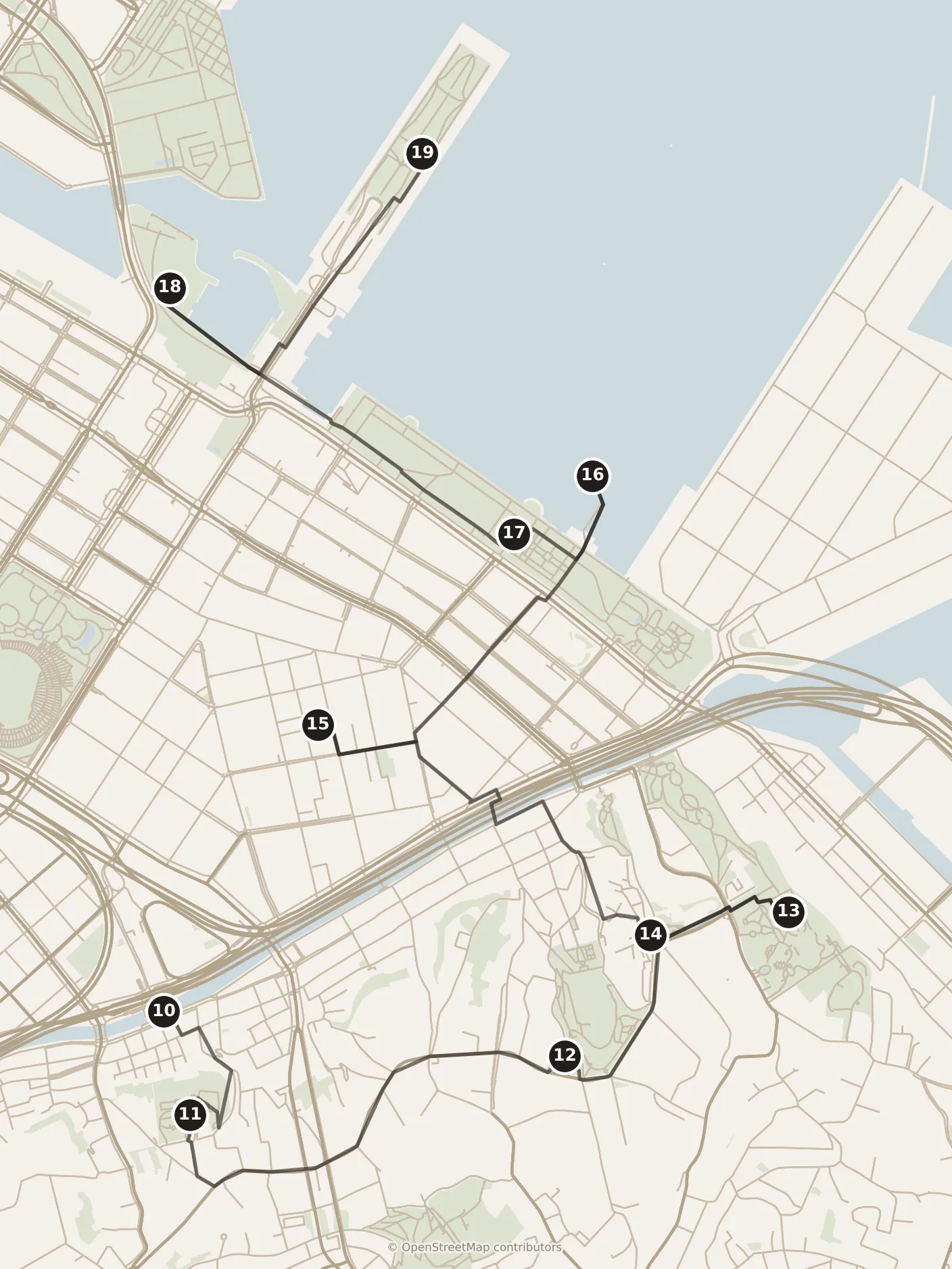
- Day two
- 10Ishikawachō Station
- 11Yamate Italian Garden
- 12Berrick Hall
- 13Harbour View Park
- 14Yokohama Foreign General Cemetery
- 15Yokohama Chinatown
- 16Hikawa Maru
- 17Yamashita Park
- 18Zō-no-hana Park
- 19Ōsanbashi Pier
Today is the foreign quarter: a ridge, the district at the foot of it, and the water it all looked out at. It runs downhill and then along, and it ends where the port physically began.
Morning
Start at Ishikawachō: on the JR Negishi line, three stops out of Yokohama Station, seven minutes. Leave by the south side and climb — a flight of steps, about five minutes — onto the Yamate Italian Garden, thirteen thousand square meters of terraced lawn on the site of the Italian consulate, which is where the name comes from and the only Italian thing about it. Two of the seven surviving Western houses stand here, both free to walk into. The Diplomat’s House of 1910 was built in Tokyo for a Japanese ambassador by an American architect, moved here whole in 1997 and made a national important cultural property in the same year; Bluff No. 18 beside it was a foreign resident’s house put up after the 1923 earthquake and brought into the garden in 1991. Forty minutes for the garden and both houses. The terrace on the north edge is your first sight of the harbor today and is worth two minutes of standing still.
Now walk the ridge east, thirteen minutes along the top, to Berrick Hall and the Ehrismann Residence, which stand fifty meters apart in the park at the far end. Take Ehrismann first: it was built in 1926 for a Swiss businessman by a Czech architect who had come to Japan to work on Frank Lloyd Wright’s Tokyo hotel and stayed, and it is the plainest house on the hill and the most modern — flat surfaces, long horizontals, almost no ornament. Berrick Hall next door is the largest still standing on this bluff, a 1930 house for a British trader done in an emphatically Spanish manner by an American. Forty-five minutes for the pair. The argument for doing both is that they went up four years apart for two foreign traders on the same street and agree about nothing, which is the most interesting fact on this hill and one a single house cannot give you. Bluff No. 234, an apartment block put up in 1927 for foreign tenants, is the third of the seven standing in that same park, and the one to leave out if anything is left out.
Nine minutes on, along the cliff edge, is Harbour View Park, and the last two of the seven stand in it: Bluff No. 111, and the British House, built in 1937 as the British consul-general’s residence. Be clear about what the terrace gives you: cranes, container ships and the Bay Bridge going out across the water — the port at work, and not the towers, which the shoulder of the hill puts out of sight from the terrace itself. Half an hour, or longer in either of the two rose seasons — mid-May into early June, and mid-October into early November — when the garden by the British House is the reason the park is full. Every house on this ridge shuts for one Wednesday in the month and they have not all chosen the same one: most take the second, at least one takes the fourth. A shut door here costs a house, never the morning.
Five minutes back west along the road is the Yokohama Foreign General Cemetery, and this is the hour the morning is pinned to. Burials began here in 1854 and the ground became official in 1861; the terraces cut into the slope hold well over four thousand people, from more than forty countries. The gate opens to visitors on Saturdays, Sundays and public holidays and on no other day, from midday until four, not in January or August at all, and not in bad weather — which is the clause that matters, because it is the one that can shut the gate on the very Saturday this morning was built around. A donation of two hundred yen is asked at the gate and a marked route round takes about ten minutes; this is a working cemetery, families come to tend graves, and the route exists so that visitors keep to it. The engineer who built Japan’s first railway is buried here, and so is the Englishman who drew this country for the illustrated London papers and founded its first satirical magazine. Twenty minutes, with the small photographic display by the gate, which is open every day of the year and is the consolation on a weekday, along with the terraces seen through the railings from the road.
Local tip. The gate at noon is what sets this morning’s direction. Walk the ridge west to east as above, and a half past nine start puts you at the cemetery at three minutes to twelve, which is arithmetic rather than luck. On a weekday, when it does not open at all, walk the ridge in whichever direction suits you and put those twenty minutes into Chinatown instead — that is where they will be wanted.
Afternoon
From the cemetery it is thirteen minutes down: through the shopping street of Motomachi, six hundred meters of awnings and tailoring that grew up to serve the households on the hill and has traded on it ever since, and then over into Yokohama Chinatown. This is the largest in Japan, a few hundred Chinese businesses in a grid of a few blocks under painted gates set at the compass points.
An hour and a half here, and it is a meal and a wander rather than a sight. There are two temples and the pairing is the point. Kanteibyō, on the main street, is the old one: a Chinese settler raised a wayside shrine to Guan Yu here in 1862, the community rebuilt it properly in 1871, and earthquake, air raid and lightning have taken it down three times since. Masobyō, a few streets away, is a Taoist temple to Mazu, the sea goddess sailors prayed to for a calm crossing — gold and vermilion and heavy with incense, and opened in 2006, which is the interesting part: a port community built a new temple to the sea in this century. Ten minutes each, and the second reads as an answer to the first. Buy your incense where you burn it, since bringing your own flame is not done. The other piece of conduct is about food and it is the district’s own request rather than a rule: buy your steamed buns and dumplings and eat them standing where you bought them, not walking. A small park sits inside the grid for anyone who would rather be sitting, and if you want a bowl rather than a handful, sanmamen — the thickened vegetable noodle soup the cooks here invented — is the one to order.
Thirteen minutes east brings you out at the far end of the seafront and the black hull of the Hikawa Maru, and this is the second hour the day rests on. In 2026 the gangway stops taking anyone at half past four, the ship empties at five, and Monday is her day off as a rule — moving to the Tuesday when that Monday is a public holiday. That is what makes the count matter: in the first week of December her last admission and the sunset fall in the same minute, so a day that starts late here loses either the ship or the pier, and there is no arrangement that saves both. Give her an hour. She was built for the run to Vancouver and Seattle and made her first crossing in 1930, and what survives inside is a whole liner rather than a display: the first class fitted out in the French art deco of that exact moment, and — this is the part to spend the hour on — the third class and the crew’s quarters below, which are on the same ship and might as well be on a different one. The ticket is bought at the gangway.
Evening
Walk west along Yamashita Park, which takes about twenty-five minutes end to end at the right pace and is the transition rather than an interruption in it. Two statues are worth stopping at. One is a small girl in bronze, put up in 1979 for a children’s poem of 1922 about a child taken abroad and never seen again, which in a port that sent people away is not sentimental. The other is a stone fountain figure given by San Diego in 1960 as a sister-city gift, a copy of one that still stands outside a county building in California.
At the far end the path lifts onto the old harbor viaduct and runs you along it into Zō-no-hana Park, twenty minutes’ worth of ground and the exact place the port opened in 1859. A pair of wooden jetties went out into the water here, and the eastern of the two was later rebuilt with a bend in it, which is how the spit got the name it still answers to. Set into the paving are the rails and turntable of the cargo tramway, and a length of breakwater that sank in the 1923 earthquake has been left lying where it fell. There is a low white exhibition building at the water’s edge, free to walk into, which is a good place to be if the weather has turned.
Ten minutes more and you are on Ōsanbashi, the pier, and this is where the light goes. The building is not a terminal in any recognisable sense: it was won in an open competition in the 1990s by a London practice and finished in 2002, and the upper level has no columns at all — the deck folds and pleats to hold itself up, which was done because of earthquakes and is why walking on it feels like walking on ground rather than on a floor. The roof is timber and grass, public at every hour, no gate and no ticket. Walk out to the tip. Ships lie berthed under your feet, Minato Mirai stands in a curve on the far side of the basin, and in clear winter air the cone of Mount Fuji comes up behind it. This is the last of the three plates, so before the light goes, turn round and pick out the King, the Queen and the Jack in the low city behind you — the three buildings you started yesterday in. Three quarters of an hour with the walk out and back, and longer if the sky is doing anything.
From the root of the pier it is ten minutes on foot to Nihon-ōdōri station and about fifteen to Motomachi-Chūkagai, whichever line you are on. Dinner is Chinatown, fifteen minutes back the way you came, and after dark it is a different place from the one you had lunch in: the counters give way to rooms with tablecloths. Walking back into a district you left at two o’clock sounds like a mistake and is not — the station you go home from stands inside it, so those fifteen minutes buy the meal and cost nothing.
With a third day

A third day goes to Sankei-en, and it goes there in the morning.
It is a garden of seventeen and a half hectares in the south of the city, some four kilometers beyond anything above, and it is not an ornamental park with a few pavilions in it. A silk merchant named Hara Tomitarō, who signed himself Sankei, spent decades buying historic buildings that were about to be demolished elsewhere in Japan and moving them here whole — seventeen of them, ten of which are nationally important cultural properties. A three-story pagoda of the mid-fifteenth century, taken from a defunct temple near Kyoto and re-erected on the hill here in 1914, stands over the whole garden and is the oldest wooden building of its kind in this part of the country. Rinshunkaku, a villa built in 1649 beside a river in Wakayama for a branch of the ruling family, sits by the water at the bottom. Hara opened the outer garden to the public in 1906, free, while he was still living in it.
Give it two hours, and about forty minutes each way. From Ishikawachō take the JR Negishi line two stops to Negishi, then the bus from outside that station towards Honmoku — the 58, the 99 and the 101 all serve it, about ten minutes — and walk the last five to ten. That makes the third day the only one of the three with a ride inside it: a train and a bus, each way. In 2026 the garden opens at nine and stops admitting at half past four, and it is open every day of the year bar the last three of December. Eat at one end of the ride or the other and not in the middle: take the meal before you set out, or once the train has brought you back.
Where the day goes depends on one thing. Normally it is appended and it is genuinely third, because days one and two are a sequence and reversing them puts the explanation after the thing it explains. But if any of your three days is a dead one, this day goes first and takes it. The dead day is the ordinary Monday, or the Tuesday behind a public-holiday Monday; either way it closes the archives, the port museum and the ship, and closes nothing here — Sankei-en does not care what day it is. Inserting it costs nothing internally: days one and two keep their own contents and their own order, they simply happen a day later each. The one thing it can break is the weekend rule above. If shifting day two off your Saturday or Sunday is what the insertion does, you have traded the cemetery for the archives and the ship, which is the right trade — but make it knowingly rather than by accident.
That leaves an afternoon, and the useful thing to do with it is to go back for whatever your weekdays shut. There are three candidates and they are in three different places. If day one fell on a Thursday the wheel may not have run, and the Yokohama Museum of Art — five minutes north of the Landmark Tower, and closed on Thursdays itself — is the substitute worth an afternoon: it reopened in 2024 after three years of rebuilding, and its photographic holdings are the point, this being where photography entered the country. If day two fell on a weekday the cemetery is what you missed, and it is a twenty-minute return to the bluff for a noon gate, plus as many of the three houses you skipped as you want — but only if this third day is itself a Saturday, a Sunday or a public holiday, and only outside January and August. Inserted as the dead day it is none of those, and the cemetery stays missed: that is the trade the insertion asks you to make knowingly. And if you are traveling with children, the Cup Noodles Museum in Shinko, ten minutes from the Red Brick Warehouse, is the one attraction in this city built for them — on a Monday. Its own closing day is the Tuesday, so where the holiday shift hands you a Tuesday as the dead day it is shut with everything else, and the afternoon goes to the art museum or back up the bluff instead. One of its workshops, the Chicken Ramen Factory, is the only thing on these three days that cannot be walked up to: it is booked separately, on the museum’s own site or by telephone, from ten in the morning three months ahead, and it will not take a booking for one person alone. The others are taken as you find them.
Practicalities
The weekday rules, and the trap. The Overview gives the arrangement; here it is as a checklist, with the two smaller closures that paragraph leaves out and the trap under all of it. Day one must miss the dead day — the ordinary Monday, when the Yokohama Archives of History, the Nippon Maru and the Yokohama Port Museum all close together, or the Tuesday behind a public-holiday Monday, when they close then instead. It wants a working weekday of any sort, because the prefectural roof opens Monday to Friday and counts a public holiday as neither. And it is thinner on a Thursday, when Cosmo World takes its regular closing day — not every Thursday, so read the park’s own calendar for your date rather than assuming either way. Day two must miss that same dead day, for the ship, and wants a Saturday, a Sunday or a public holiday, for the cemetery gate — except in January and August, when the gate is closed all month and that want simply disappears. Day two also loses a little on the second Wednesday of the month, when most of the Yamate houses close, and one of them takes the fourth Wednesday instead. In an ordinary week Tuesday and Friday close nothing on either day, though neither is a weekend and so neither opens the cemetery. The arrangement that satisfies all of it is day one on a Tuesday, Wednesday or Friday and day two on the Saturday or Sunday, in the ten months the gate opens at all — but the rules are the point, because the trap is arriving on a Sunday night for a Monday and a Tuesday, which puts a dead day first with no third day to absorb it. If that is your pair, run day two on the Monday without the ship and without the cemetery, which leaves the bluff, Chinatown and the pier and is still a good day; keep day one for the Tuesday; and put the ship in first thing on the Tuesday morning, before day one starts. That costs day one its first hour, and in December it pushes the wheel past sunset — which is the one stop on these days that does not mind. If that Monday is a public holiday the whole thing inverts and gets easier: run day two on the Monday, gate and ship and all, and day one on the Tuesday, which keeps the roof and the wheel and gives up the archives and the pair at Nippon Maru. Look first at which Monday of the month it is, because a fourth one takes the hall as well: the hall’s own closing day shifts onto that Tuesday with everything else’s, and it is the door this route is least willing to lose. On a fourth holiday Monday run it the other way instead — day one on the Monday, which keeps the hall, the archives and the pair and gives up only the roof, and day two on the Tuesday without the ship and without the cemetery, which is the stripped day two already described here. In 2026 that pair falls twice, on 23 February and on 23 November.
Booking. Nothing on the two main days needs booking and nothing sells out. The archives, the ship, the pair at Nippon Maru, the Ferris wheel and Sankei-en are all sold at the door on the day. The single exception sits on the third day and is optional: the Chicken Ramen Factory at the Cup Noodles Museum, booked ahead on the museum’s own site or by telephone, and not with the entry ticket. Everything else on these routes is free to walk into — the prefectural roof, the memorial hall, Bashamichi, the dockyard, the promenade, the warehouse yard, all seven houses on the bluff, the parks, the pier and its roof.
What it costs. Little enough that it is worth saying plainly, because so much of these three days is free. In 2026 day one’s paying stops are the archives at two hundred yen, the Nippon Maru and the port museum at eight hundred for the pair, and the Ferris wheel at a thousand: about two thousand yen a head for the day. Day two is the two hundred at the cemetery gate and three hundred for the Hikawa Maru, and nothing else at all. The third day is Sankei-en at nine hundred, plus five hundred at the door of the Cup Noodles Museum if you go, with each workshop charged on top. The Air Cabin, whichever end you take it from, is a thousand yen one way. The rest is the list above.
Checking the two hours. Both are published by the bodies that keep them: the memorial hall’s own site for its visiting window and its fourth Monday, and the shipping museum’s calendar for the ship’s last admission and its Monday. Read them the week before. If either has moved, nothing about the shape of these days changes — day one’s morning still runs forward from the hall’s opening, and day two still runs backward from the gangway.
If you are short. Cut in this order on day one: the port museum’s galleries, keeping the ship, which gives back three quarters of an hour; then the Red Brick interiors, walking the yard and going on, another half hour; then the Dockyard Garden’s quarter of an hour. Never cut the Ferris wheel, which is the whole shape of the day, and never cut the memorial hall, which has the narrowest door. On day two, drop Bluff No. 18 in the Italian garden and keep the Diplomat’s House, which is a quarter of an hour; then Zō-no-hana, twenty minutes and painful; then hold Harbour View Park to ten minutes on the terrace, which is twenty more. Motomachi is not on this list because it is not a stop — you walk through it either way and there is nothing in it to hand back. The ship and the pier are the two that stay: the first has a gangway that shuts, and the second is what the whole afternoon is aimed at.
If it rains. Day one barely notices: the archives, the memorial hall, the port museum and the warehouses are all indoors, and only Bashamichi, the dockyard, the promenade and the wheel are not. On a wet evening take the Air Cabin over the same water in place of the promenade, and accept that you have traded a twenty-minute walk for a covered five. Day two is the problem, because the bluff and the pier are the day. In steady rain take the morning as written minus the cemetery, which shuts in bad weather — the houses are interiors, the ridge between them is short, and the display by the gate stays open whatever the sky is doing — then give the afternoon to Chinatown and the ship, and end at the Yokohama Museum of Art instead of the pier. From the ship that is ten minutes on foot to Motomachi-Chūkagai, three stops on the Minatomirai line to Minatomirai and five minutes’ walk at the other end; it keeps its doors open until six in 2026, which is what makes it a replacement for a sunset rather than merely for an afternoon; and it is shut on Thursdays, which is the one day this swap does not exist. A wet Thursday is the one combination with no clean answer, because day one’s own ending may be shut on a Thursday as well: take day one’s morning that day — four interiors inside four blocks, and rain barely reaches it — and put the pier and the wheel on the next dry day, in whichever order the light allows.
Between the stops. Every leg on both days is walked and the distances above are real. The longest single stretch on day one is the twenty minutes over the water on the Kishamichi Promenade; on day two it is the twenty-five minutes along Yamashita Park from the ship to the elephant’s trunk, which is a park rather than a slog. Take shoes you would walk six or seven kilometers in on two consecutive days — day two is the longer of them once the pier and the walk to the station are counted. The only slope worth planning for is day two’s, and after the first five minutes it is all downhill.


