Yokohama in one day: the Yamate bluff, Chinatown, and the harbor as the light goes

Last updated 4 August 2026
Overview
Yokohama is a very large city with a small sight, and that is the reason one day works here. The port was forced open to foreign trade in 1859, and nearly everything a visitor comes for grew up in the three kilometers between the bluff where the foreigners were made to live and the piers their ships tied up at. That strip is the day. The rest is a suburb of several million people, and no itinerary of any length is going to send you into it.
The route below runs the strip once — down off the hill, then along the water — and never turns back on itself: the Western houses first, Chinatown for lunch, the ships and the old harbor front through the afternoon, and a disused freight railway across the water at the end. Seven kilometers of walking between the stops, in a dozen short pieces, and a kilometer more out to the end of the pier and back. The longest single stretch between two stops is a quarter of an hour, and the walk that ends the day, out over the water on the old freight line, is twenty minutes and is the longest of the lot. Nothing in the middle of this day needs a train: the only two trains are the one in and the one out.
The one door with a deadline is the ship. The Hikawa Maru, the 1930 liner tied up at Yamashita Park, is the single stop on this route with a gangway and a ticket, and in 2026 she stopped letting anyone aboard at half past four and shut half an hour after that. The morning has two more doors, a Western house and a cemetery gate, but both are free and neither is the reason you came; everything after the ship is a park, a pier, a warehouse yard and a footpath, and none of those shuts at all. That one hour is what fixes the order of the day, and it fixes it against your instinct: a reader who counts backwards from sunset and puts the ship at the end of the afternoon arrives at a locked gangway for most of the year. So the ship goes in the middle, before the light, always. If the hour has moved since, build the day back from the new one — the shape will not change, because nothing after the ship has a door at all.
The light is what the last hour is for, and the place to spend it is the roof of Ōsanbashi, the pier that runs out into the harbor opposite the towers. The sun goes down here between about half past four in the first week of December and just after seven at the end of June, so take your month’s hour and count back a shade under six: the bluff is an hour and a half with its walking, Motomachi and the descent half an hour, Chinatown and lunch an hour and three quarters, the ship and the park an hour and a half more, and the old jetty before the pier another half hour. What those six hours count is the time you spend inside the places and walking between them. What they do not count is the line at the gangway on a fine weekend, and — the larger omission by far — Chinatown, which is less a stop than a place where an hour and a half turns into two without anybody deciding that it should.
In the first week of December that puts the start of the day at about eleven, which is a civil hour to arrive from Tokyo and a real argument for taking this route in winter. At midsummer the same sum says start after one, which throws the morning away, so do not: begin as early as you would in any city and reach the pier with two or three hours of daylight still in hand. Nothing is spoiled by that, except in high summer, when an early start puts you on open seafront through the hottest part of a Yokohama August — the normal daily maximum is thirty-one degrees, and after lunch this route has no roof at all. In July and August take the wooded ridge of the morning and a sit-down lunch in Chinatown as the middle of the day, and let the deck wait for the cooler end of it. The deck is worth standing on in daylight as well — this is a working port and you can watch it work — and the towers light before the sky goes, so the walk out over the water at the end will hand you a lit skyline in any month. What midsummer will not give you is that skyline against a dark sky until long after the route has run out, and waiting for it is a decision about your evening rather than about this route.
What one day costs you is everything with a roof. Sankeien, the classical garden in the south of the city, is half a day once you have traveled to it and back. The observation floor near the top of the Landmark Tower is the easiest cut of all: it shows you this harbor from two hundred and seventy meters up, and the pier at the end of the day shows you the same harbor from the waterline for nothing. The museums of the reclaimed district go the same way. An hour indoors here is an hour not spent on the seafront, and the seafront is the exhibit.
One thing this route needs that you may not be holding: a way through a ticket barrier twice, on two different companies’ lines. How fares are paid in this country is the city guide’s subject and it is worth two minutes before you arrive. And settle the bag before you start. This day is a line between two stations and neither of them is the one your onward train leaves from — it begins at Motomachi-Chūkagai, the far end of the Minatomirai line, and ends at Sakuragichō, three kilometers up the coast on the JR Negishi line. Yokohama Station is five stops behind the first and one stop behind the last, so the bag goes there, before you set out, and you collect it on the way through at the end. That costs you a few minutes at each end, because nothing on the route itself is somewhere you would want to walk back to. Budget more than a few: whether a locker is free on a given morning is not a thing anyone publishes, so this is an arrangement that can fail, and the walk to a second bank of them is time you want to have allowed for rather than time taken off the bluff.
If it fails, or if you would rather carry the bag, the two stops that make you regret it are the two that make the day: the pier is the better part of a kilometer out and back over open water with nowhere to sit, and Chinatown at lunchtime is a crowd. Carry it anyway and the day still runs, in the same order and off the same six hours, with two changes. Eat at the front of the lunch hour rather than in the middle of it, and sit down to one bowl instead of standing at four counters — what a bag cannot do in Chinatown is the crush, not the district. And at the pier, stop where the deck lifts off the land instead of walking out to the tip: the whole arc of the towers is across the water from every part of that roof, and what the last stretch buys you is the ships berthed underneath, which is worth the walk with your hands free and worth nothing without. Same stops, same order, one view lighter.
The day

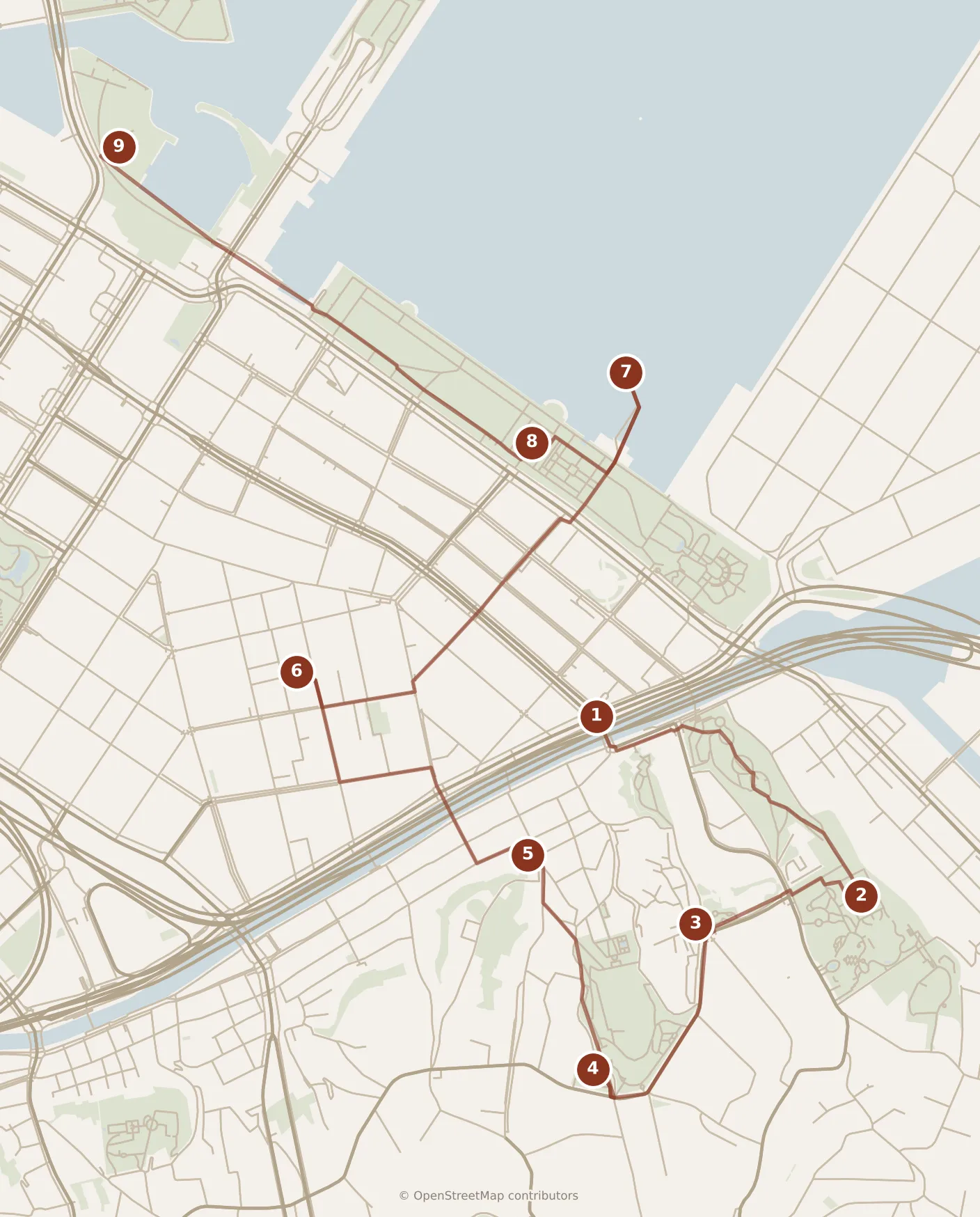
- Morning and afternoon
- 1Motomachi-Chūkagai Station
- 2Harbour View Park
- 3Yokohama Foreign General Cemetery
- 4Berrick Hall
- 5Motomachi
- 6Yokohama Chinatown
- 7Hikawa Maru
- 8Yamashita Park
- 9Zō-no-hana Park
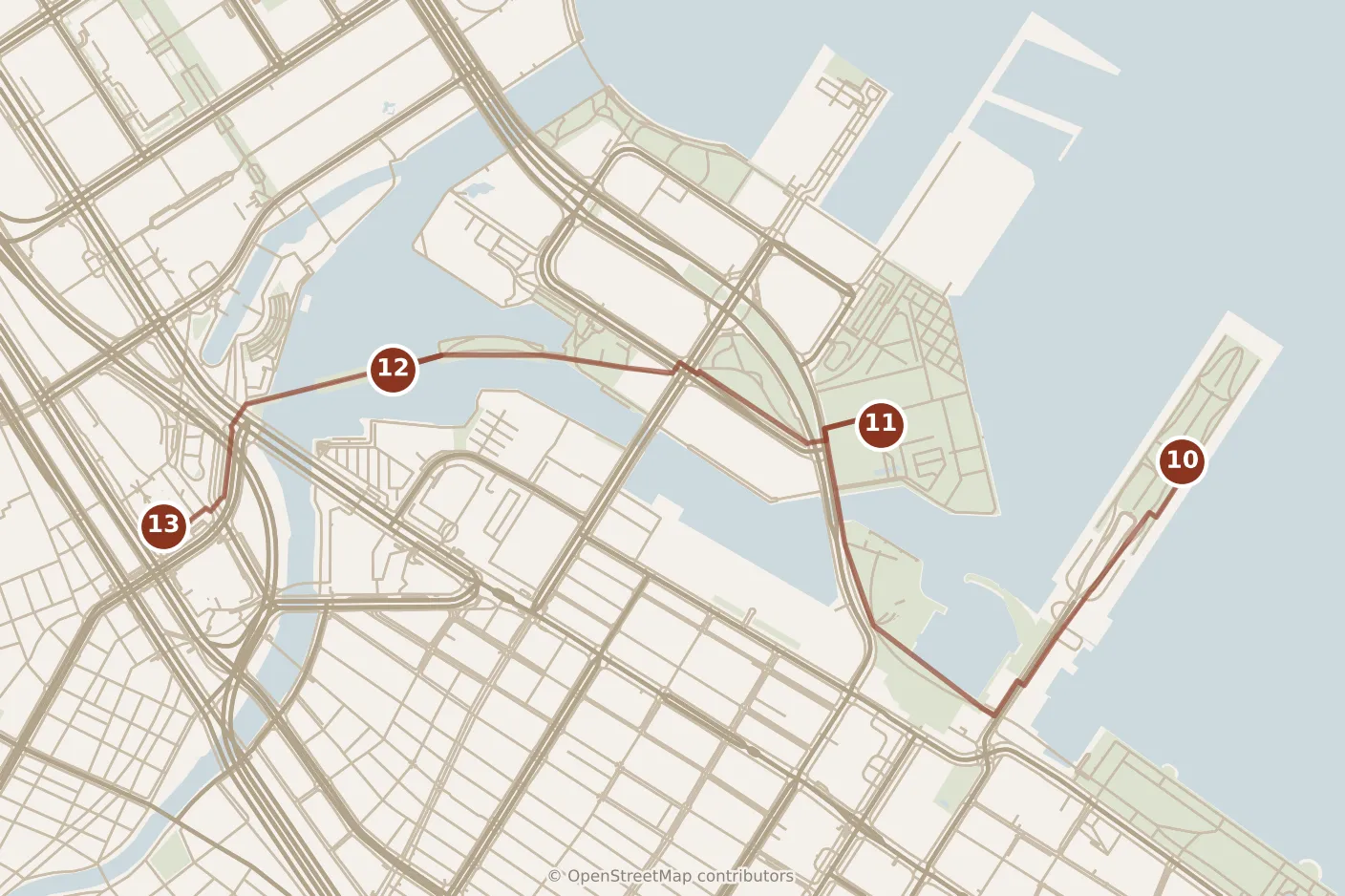
- Evening
- 10Ōsanbashi Pier
- 11Yokohama Red Brick Warehouse
- 12Kishamichi Promenade
- 13Sakuragichō Station
Morning
Start at Motomachi-Chūkagai, the last station on the Minatomirai line, five stops and under ten minutes from Yokohama Station. If you are coming on JR instead, the equivalent is Ishikawachō on the Negishi line, three stops from Yokohama and about ten minutes’ walk from the same hill.
Begin at the top because the bluff is the only climb in the day and the station does it for you: an elevator and escalators run from the ticket gate straight up through Amerikayama Park onto the top of the cliff, which is the whole of the hill taken care of. From there it is ten minutes along the road on the ridge to Harbour View Park.
The park is 5.7 hectares of lawn and terrace strung out along the edge of the bluff, and it opened in 1962, on ground that had been military for a century: British and then French troops were quartered here after the port opened, and the American occupation held it until the city was able to buy it. The name comes from a popular song of the late 1940s about a hill from which you can see the harbor, and the song is the right expectation to arrive with, because what you see is the working port and the long span of the Bay Bridge — not the skyline. Minato Mirai and Kannai sit behind the shoulder of the hill and cannot be seen from here at all, and an elevated expressway now crosses the bottom of the view. Come for the lawns, the roses in front of the British house — about eight hundred plants, at their best from the beginning of May for a month — and the container ships. The towers come later, from the water. Half an hour.
Five minutes west along the ridge is the Yokohama Foreign General Cemetery, which began in 1854 with an American sailor and became official in 1861. Rather more than four thousand four hundred people from over forty countries are buried on terraces cut into the slope, which is the whole history of the treaty port in one field. Access is the catch and it is worth knowing before you set out: the grounds are opened to visitors on weekends and on public holidays between the spring and the end of the year, and not otherwise. If your one day is a Saturday or a Sunday, go in, and there is a small display by the gate about the people below. If it is a Tuesday, you get the terraces through the railings from the road in ten minutes, which is less than it should be but is not nothing.
Five minutes further and you are at Berrick Hall, the largest house left standing on this hill from before the war. It was built in 1930 for a trader from London who had come out at twenty-five to take over the family firm — stationery, machinery, handmade paper, lacquer — and who later ran Finland’s consulate from inside it; the architect, Morgan, was American, and the result is emphatically Spanish: cream walls, orange pantiles, an arched porch, windows cut in quatrefoils. Going in is free. What is worth the time indoors is the palm room, built to look at the harbor and fitted with a lion’s-head fountain in the wall, and the child’s bedroom, done in turquoise fresco — the only room designed for a child in any of the houses up here, and the one thing on this hill you will not have seen a version of somewhere else. The family left for Vancouver as the war came on, the house spent half a century as a school dormitory, and it has been open to anyone who walks in since 2002. Half an hour. It closes one Wednesday a month, and there are six more Western houses spread along this same hill, all free, so a shut door here costs you a house rather than the morning.
Local tip. There are seven of these houses on the bluff and they are all free, which makes it tempting to do the lot. Do one properly instead. They are variations on a single idea, the second and the third add very little the first has not already said, and the hour they cost is the hour Chinatown is going to want.
Then down off the hill: six or seven minutes of slope and steps brings you onto Motomachi, six hundred meters of straight shopping street that grew to serve the foreigners living above it and has traded on that ever since — awnings, glass, tailoring, no hurry and no bargains. It is a walk-through rather than a stop. A quarter of an hour, and eight minutes more takes you into Chinatown.
This is the largest Chinatown in Japan and it is genuinely dense: something like two hundred and fifty Chinese shops and restaurants inside a few blocks, under a set of painted gates, of which one, over the middle of the main street, went up in 1955 and is what gave the district its name. In the middle of the grid there is a working temple to a general of the third century — people come here to pray, and the temple asks visitors to bring no incense and no flame of their own — gold and vermilion and thick with the smoke of the burner outside; five minutes and a look up at the roof is enough. Lunch is here, and it should be an hour and a half rather than forty minutes, because this is the middle of the day and everything after it is outdoors. Eat in small pieces at several counters — steamed buns, dumplings — standing where you bought them rather than eating as you walk, which is what the district’s own shop association asks of visitors, and there is a small park inside the grid if you would rather sit. Or sit down to a bowl of sanmamen, the stir-fried-vegetable noodle soup the cooks of this district invented and the prefecture around it then adopted.
Afternoon
Leave Chinatown on its eastern side and walk down to the water: a quarter of an hour brings you to the far end of Yamashita Park and the black-and-gray hull of the Hikawa Maru.
She was launched across this same harbor in September 1929 and made her first crossing in May 1930, on the run between here, Vancouver and Seattle. Chaplin sailed in her in 1932. The founder of judo died on board in 1938. In 1940 and 1941 she carried several hundred Jewish refugees away from Europe, and in December 1941 she was taken over as a hospital ship, struck three mines during the war and survived all three. She has been moored at this spot since 1961 and was listed as an important cultural property in 2016. What survives inside is the first-class end of a pre-war liner: the art deco dining saloon, the stair, the suites, the wheelhouse and the engine room. Give her three quarters of an hour and spend it on the cabins and the engine room, which are the two halves of the same argument; the open decks are pleasant and add nothing. This is the stop the order of the day is built around, so do not leave her until the afternoon has gone.
Then walk the park westward. Yamashita Park is made of the earthquake: the city was flattened on 1 September 1923, the rubble was tipped into the harbor, and what it made opened as a park in March 1930 — two months before the ship now moored at the end of it made her first crossing. That is the thing to carry along the whole seafront, because it is true of nearly all of it. Among the lawns there is a drinking fountain given by the local Indian community in thanks for the help their survivors were given after the Kantō earthquake, and it is a better monument than its size suggests. Give the park twenty minutes end to end, and at the far end it lifts you onto the viaduct of the old harbor railway and carries you along it.
It sets you down at Zō-no-hana Park, which is where the port began. Two timber jetties were driven out here in 1859 when Yokohama opened; the eastern one was rebuilt as a curve in 1867 and the shape earned it the name it still has, the elephant’s trunk. The earthquake broke it and it was patched back nearly straight, and then in 2009, for the port’s hundred and fiftieth year, the curve was put back as it had looked in the 1890s. What is on the ground is worth twenty minutes: a length of the breakwater that sank in 1923, left where it fell and preserved as it is, lamps in the shape of the gas lights that stood here, and the rails and turntable of the old cargo tramway set into the paving.
Evening
Ten minutes on is Ōsanbashi, and this is the stop the light is for. There has been a pier at the tip of the elephant’s trunk since the 1890s, when a British engineer built the first one; the building you walk on now was won in an open competition that drew more than six hundred and sixty entries and finished in 2002, and it does not look like a terminal: the roof of it is a rolling field of timber decking and lawn, open to anyone, and the city calls it the whale’s back. Walk to the end of it. Ships berth underneath you, the whole arc of the towers is across the water, and on a clear winter afternoon the cone of Mount Fuji stands on the horizon beyond them. The roof is a public space at every hour of the day and night, which is exactly why the light can be spent here and nowhere else on this route: there is no door to be shut out of. Three quarters of an hour, including the walk out and back, and more if the sky is doing anything.
Then off the pier and round the basin to the Yokohama Red Brick Warehouse — a quarter of an hour, of which the walk back down the deck is a good part. These are two customs warehouses, the second finished in 1911 and the first in 1913, put up by the finance ministry’s own building office at the height of the port’s trade. The shorter of the pair is number one, and it is shorter because about a third of its middle came down in the 1923 earthquake and was never rebuilt: once you know that, the two buildings stop being a matched pair and start being a record. They reopened as halls and shops in April 2002, the same year as the pier. Three quarters of an hour, and skip the shopping — what is worth looking at is the brickwork, the iron, and — when the open ground between the two is not fenced off for one of the ticketed events that occupy it much of the year — the yard with the harbor behind it. The Ferris wheel turning across the basin is not on this route and does not need to be; it is ten minutes away if the day has run short.
The last twenty minutes or so of the day are the best walking on it. From the far end of the warehouses the Kishamichi Promenade runs back across the water to Sakuragichō along the formation of the old harbor freight line, which opened in 1911 to work cargo between the original Yokohama station and these piers. From 1920 it also carried a boat train on the days a liner sailed for Seattle, and the last of those ran with the Hikawa Maru’s final sailing in August 1960 — so the walk you finish on and the ship you spent the afternoon in are two ends of the same line. Freight stopped in 1986; in 1997 five hundred meters of it became a footpath with the rails left in the deck, crossing the water on three riveted truss bridges. Two of them were made in America in 1907 and erected here in 1909; the third is British, moved here second-hand from another crossing in the city. The towers are in front of you for the whole of it, and by the end of the walk they will be lit.
Sakuragichō is at the end of the bridges. It is one stop and about three minutes from Yokohama Station on the JR Negishi line — where the bag is, and where the trains out of the city are.
Practicalities
Nothing on this route is booked in advance and nothing on it sells out. The one ticket in the day is bought at the gangway of the ship. Everything else is free to walk into: the bluff, the cemetery gate, the Western houses, the streets, the parks, the pier roof, the warehouses and the promenade.
There is one weekly closure that changes the day and it is the ship’s. She shuts one day a week — as a rule the Monday, moving to the next working day when that Monday is a public holiday — and that arrangement is published on the operator’s own calendar, so check it before you set out rather than after. If it falls on your day, the route still works: everything else here is outdoors and open, and what you lose is the one interior worth an hour. The honest substitution is not to find another museum but to give the hour back to the hill — a second and third Western house — and to reach the pier earlier, which on this particular route is not a punishment. Two smaller closures are worth knowing in the same breath. The cemetery’s grounds open only on weekends and on public holidays, and only between the spring and the end of the year; Berrick Hall closes one Wednesday a month. Neither of those breaks the day, because neither of them is the day.
Movement between the stops needs nothing at all. Every leg above is walked, the route is seven kilometers between the stops and about eight with the pier, and nothing between two stops is longer than a quarter of an hour, the twenty-minute promenade at the end aside. Take shoes you would walk eight kilometers in, and leave the case at Yokohama Station if the lockers allow it; if they do not, the two changes above are what keep the day walkable with it, because the pier and Chinatown are the two places that punish a case, for opposite reasons.
The weather decides more here than in most cities, because after lunch this day is a seafront and nothing else. In steady rain the strip stops working — the pier is exposed, the promenade is exposed, and the pier and the promenade that carry the end of the day are both outdoors — and the honest answer is to spend the afternoon in the museums of Minato Mirai instead and accept that you have taken a different day. Wind matters more than temperature on the deck at the end, in any season.
If you are running late, cut in this order: Motomachi first, since it is a walk-through; Zō-no-hana second, painful but survivable; and the warehouses third. Never cut the ship, which cannot be moved later, and never cut the pier, which is what the whole shape of the day was built to reach.


