Xi’an in one day: the Terracotta Army and the walled city

Last updated 15 August 2026
Overview
One day in Xi’an is a trade against itself: the single most famous thing to see here, the Terracotta Army, sits forty kilometers east of the walled center in Lintong, and getting there and back is most of a morning on its own. The alternative — staying inside the walls all day — leaves the pits out entirely, and for most readers that is the wrong economy. This route does both, and the discipline is in what it drops: no Big Wild Goose Pagoda, no history museum, no second temple. What is left is the excavation itself and a compact loop of the old walled city, which at its widest is under four kilometers across.
As Chang’an, this city was the eastern end of the Silk Road and the capital of a string of dynasties; the two halves of the day are really its two lives side by side — the imperial tomb complex outside the walls, and the Ming-era wall, towers and market lanes inside them.
The day starts and ends at Xi’an Railway Station, which sits just outside the wall’s north side, so the bag question has one honest answer: leave it at the station before you start, and the evening brings you back to within a few minutes of where you left it. A hard case rolled across the excavation grounds at Lintong is a genuine nuisance — there is walking between three separate halls and a security check at the gate — so this really is a day best done empty-handed.
Xi’an Railway Station, Terracotta Army — not on the walking map.
- Morning
- 1Xi’an Railway Station
The day

- Afternoon
- 2Xi’an Railway Station
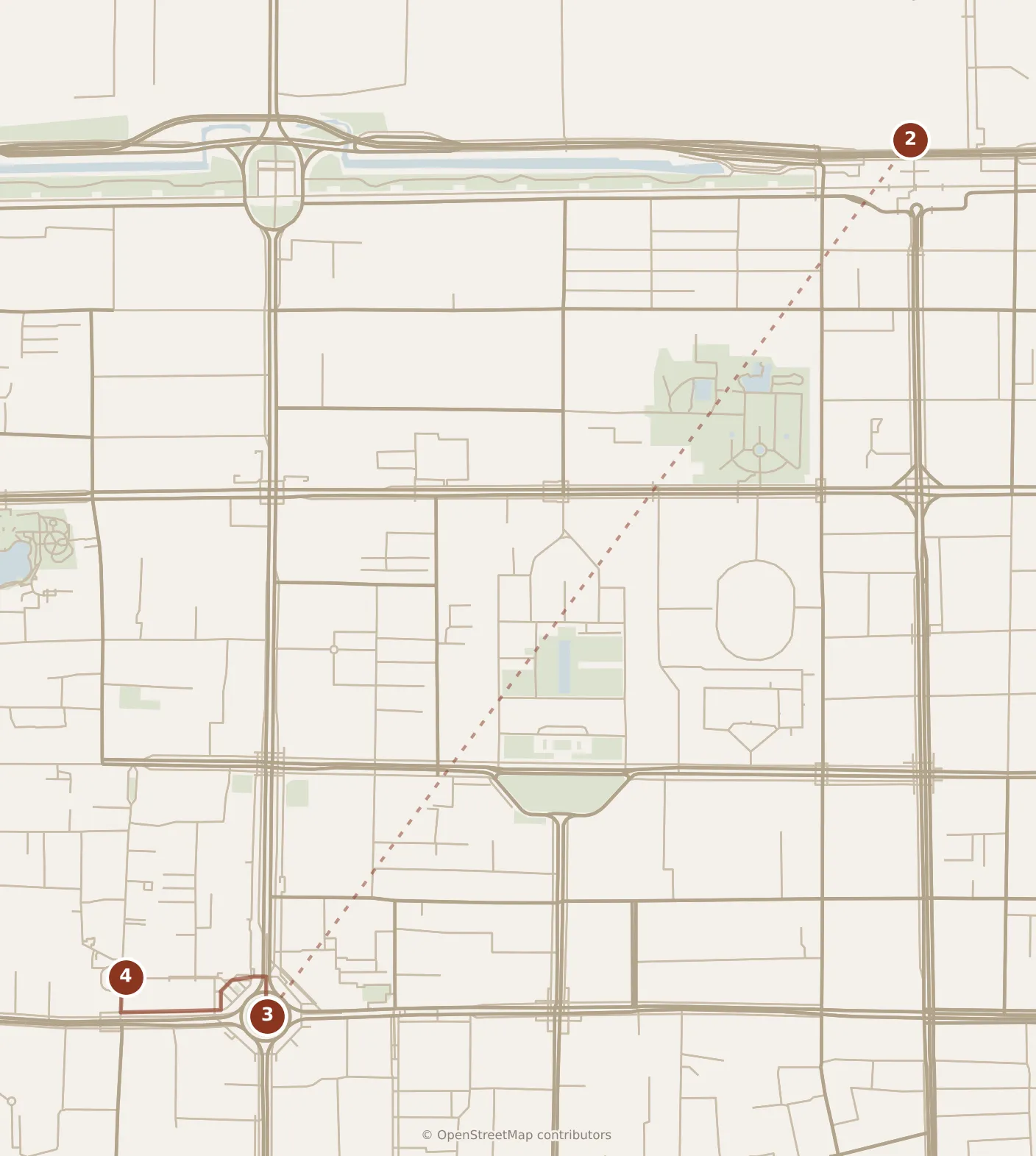
- 3Bell Tower
- 4Drum Tower
- Muslim Quarter — in the prose, not on the map
- Evening
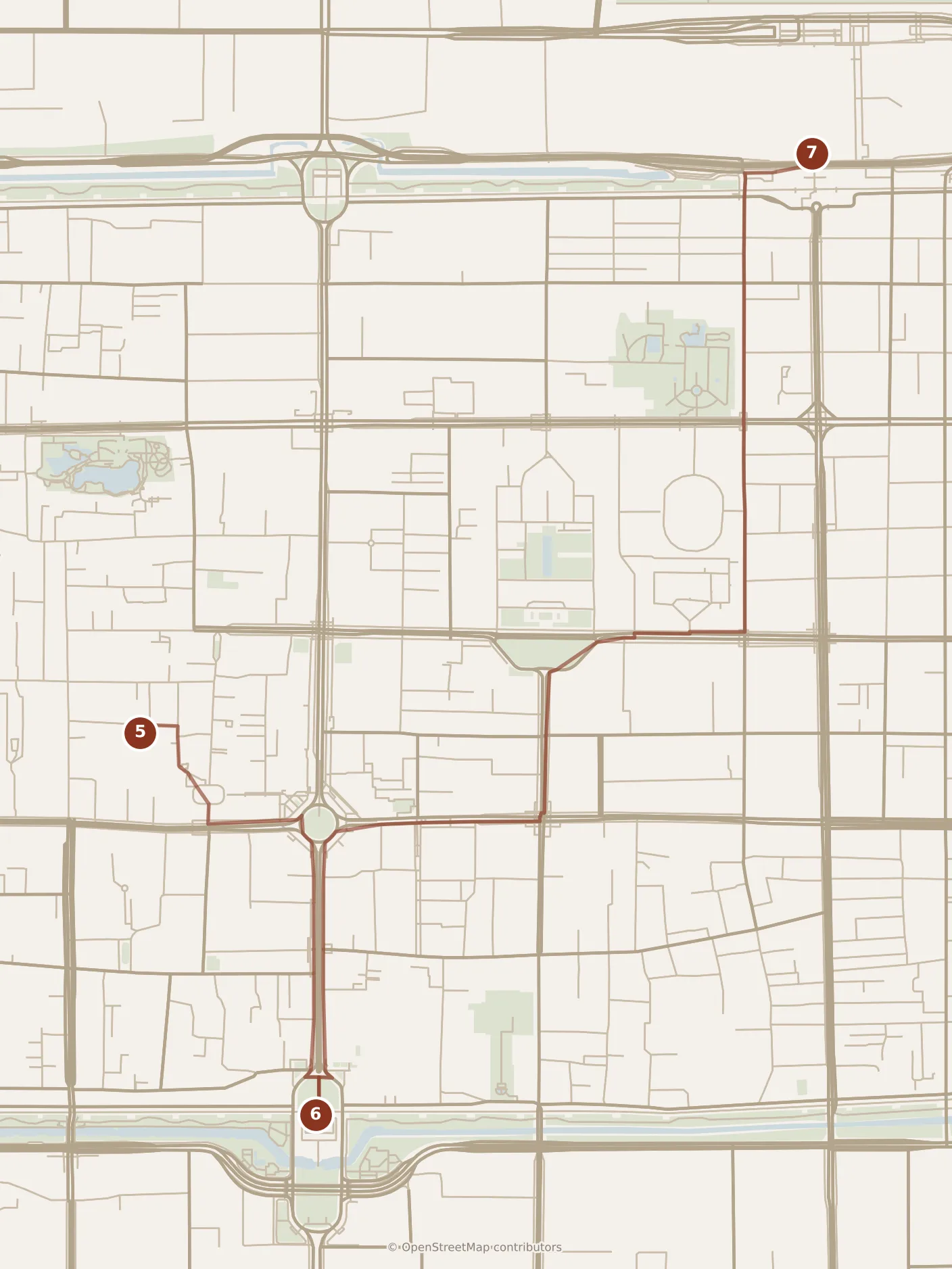
- 5Great Mosque of Xi’an
- 6Xi’an City Wall
- 7Xi’an Railway Station
Morning
From the station, the bus stop for route 306 has long been a few minutes’ walk from the main exit, on the square at the east side of the building — look for the line rather than a sign, it is usually the longest one there — but boarding points for this line have moved before, so have your hotel confirm it the night before. The ride out to Lintong takes an hour to an hour and a half depending on traffic, and buses leave often enough through the morning that there is no need to time one precisely; what is worth booking is the entry itself — admission runs on timed, real-name reservations against your passport, made online before you travel — and what is worth timing is your own start, because the excavation opens for the day at half past eight in 2026, and the difference between arriving then and arriving at ten is the difference between pit one empty enough to see and pit one three tour groups deep. There is no evening hinge to this day — the site has nothing that depends on the light — so the hinge is here, at the start: go early, and the rest of the day looks after itself.
The complex is three separate pits under their own roofs, plus a hall of bronze chariots found in a smaller pit nearby, and they are laid out for a walk of maybe twenty minutes between them. Pit one is the one you came for: rows of life-sized soldiers standing in battle formation, each face individually modeled, stretching back into a hall the size of an aircraft hangar — of an estimated eight thousand figures across the whole site, this is where most of the excavated ones stand. Pits two and three are smaller and only partly excavated, showing the work still in progress rather than a finished display; give them ten minutes each rather than the hour pit one deserves.
Local tip. Pit one is the one thing here not to rush; the bronze chariots hall and pits two and three are worth the walk over, but if the morning is tight, they are what to shorten first.
The whole complex was built for the man buried at its center, Qin Shi Huang, who unified China for the first time a little over two thousand years ago, and it was found by chance in 1974 by farmers digging a well — the well is still marked, close to pit one. Give the whole visit around two hours including the walk between halls; the bus back to the station leaves from the same stop and runs on the same rough frequency as the way out.
Afternoon
Back at Xi’an Railway Station, the fastest way into the old city is the metro: one stop on Line 2 to Bell Tower, about five minutes underground, coming up directly beneath it. The Bell Tower stands at the exact center of the walled city, a Ming-dynasty timber structure on a stone base, moved to this spot in the sixteenth century so that it would mark the crossing of the four main streets rather than sit off to one side. Climbing it is optional and quick — twenty minutes is enough to see the bronze bell replica and look down the four avenues the old city is built around.
A few minutes’ walk north-west, across the square and up the pedestrian street, is the Drum Tower, its twin from the same period: a drum was beaten from here each evening to signal the closing of the city gates, the way the bell was rung each morning to open them. The building itself is a shorter visit than the Bell Tower — the view from the top repeats it — so this is a stop to look up at rather than climb, unless the line at the Bell Tower was long enough that you skipped it there.
The Drum Tower backs directly onto Huajue Lane, the main street of the Muslim Quarter, and this is where the afternoon turns into food rather than sightseeing. It is a market street of stalls and small shop-fronts rather than a single site, and the two things worth eating standing up are roujiamo, a flatbread torn open and stuffed at the counter with slow-braised beef or mutton — the Quarter is halal, so the pork version the rest of the city defaults to is exactly what these stalls do not sell, and liangpi, a wide, cold noodle in a red chili dressing — neither needs a table, and neither is at its best carried away to eat later. If there is time for one seated meal in the day, this is the stretch to have it in: a bowl of yangrou paomo, mutton and bread soup where the bread is torn into small pieces by hand before the broth is ladled over it, a dish that takes a genuine twenty minutes just to prepare properly and is worth the wait.
Evening
A few minutes further into the lanes, down a quieter side turning off the main street, is the Great Mosque of Xi’an: a working mosque built in the local style rather than the domed one, its halls and courtyards laid out in the local temple manner, with minarets that read as pagodas from a distance. It has been a place of worship for the city’s Muslim community for centuries and is treated as one — dress modestly, and if you arrive around the Friday midday prayer, expect the prayer hall itself to be closed to visitors even where the courtyards stay open. The garden courtyards are the reason to come: quiet, planted, and about as far from the noise of the food street outside as it is possible to get in a hundred meters.
By the time you come back out, the Bell Tower and the Drum Tower are both worth a second look: they are lit after dark, and the walk back between them costs nothing extra since it is the way out anyway. From the Muslim Quarter, head back past the Drum Tower and the Bell Tower and continue north towards the wall — about fifteen minutes on foot, through streets that get quieter the closer you get to it.
At the wall’s north gate, close by the station, it is possible to climb up onto the ramparts for a short stretch without committing to the full loop — the wall here is broad enough to have carried traffic along its top for centuries, and at night, lit and mostly empty, it is worth the ten minutes it takes rather than being saved for a longer stay. Come back down, and the station is directly ahead: the same square you left from in the morning, and the same left-luggage counter if you stashed a bag there.
Practicalities
The only thing on this route that has to be arranged ahead is the Terracotta Army ticket itself: it is sold as a timed, real-name entry, booked online through the site’s own booking channel or its official WeChat account rather than through a general reseller, and the passport you book with is the one checked at the gate. The full ticket was in the region of one hundred and twenty to one hundred and fifty yuan in 2026. Book it a few days ahead in the warmer months; the site has no weekly closure and is open every day of the year, so there is no wrong day to choose, only a wrong week to leave it too late.
Everything else on this route is free or walk-up. The Great Mosque of Xi’an keeps its own hours as a working place of worship rather than a museum’s — check before you go, particularly around Friday prayer, when parts of it close to visitors for a time. Climbing the Bell Tower or the Drum Tower is a small ticket bought at the door of each; neither needs booking.
Public transport here runs on a QR code rather than a card: open the transport code in Alipay or WeChat and hold it to the reader at the metro gate or the bus farebox. It works the same way for both, so there is nothing separate to set up for the one metro ride this route uses.
If your onward train leaves from Xi’an North Railway Station rather than the old station in the center, allow extra time: it is well outside the walls, and Line 2 covers the distance in under half an hour, but it is a different building from the one this whole day is built around, so do not assume the two are close.


