Warsaw in two or three days: the rebuilt center, the ground beneath it, and a day of palaces

Last updated 8 August 2026
Overview
A single day in Warsaw is spent out of doors, walking past things. The second day is the one that takes you indoors, and what it buys is not more streets: it is the places in Muranów and Wola that one day here cannot hold without giving up the city itself.
The two days below share nothing. Day one is the Old Town and the New Town, north of the center, and it ends across the river. Day two is west, and it is a deportation point, a cemetery and two museums. Two of the four are about the same six years and two are not: the cemetery has been burying people since 1806 and still is, and POLIN gives the destruction one gallery out of eight. Nothing on either day is within a kilometer of anything on the other, which is why they are two districts rather than one long line, and it is also why they can be taken in either order.
Day two is the heavier one, and heavy in a particular way rather than a tiring one. Do not plan anything demanding for the evening after it.
The one sum worth doing before you set out belongs to day one. Its stops and the walking between them come to about six and a half hours including the hour sitting down at lunch, and then there is half an hour of riverside on top of that before you cross to the far bank. So if you want that half hour in daylight, start no later than seven hours before your month’s sunset. The sun goes down here just before half past three in the middle of December and just after nine at the end of June — a swing of five and a half hours, with barely seven hours of light between sunrise and sunset at midwinter. Which means that in the short months the sum does not close: the museum on the square does not open before ten, and there are not six and a half hours of daylight left after that. From about November to February, day one ends indoors and crosses the river underground, and that version is written out at the end of the day.
What that six and a half hours models is standing in the places and getting between them, and nothing else. It does not model a ticket desk, a bag check or a coat check line, and day one has two interiors you cannot simply walk into off the street: the Museum of Warsaw and the Royal Castle. The museum is where those could cost you twenty minutes, because it is a desk where you wait in line rather than a time you book; the castle sells a timed slot, which is exactly what buys you out of that line.
Three tickets are worth having before you arrive: the Royal Castle on day one, POLIN and the Warsaw Rising Museum on day two. A third day makes it four, adding the palace at Wilanów. The Rising Museum’s standard adult ticket was in the thirty-to-forty złoty range in 2026 and the other three run from about the same up to the ninety-to-a-hundred złoty the Royal Castle wanted that year for its full route — tens of złoty, not hundreds — so the price still decides nothing here, which is worth saying in a city where two headline museums falling on one day could easily have made it a question.
The only other thing these days need bought is an ordinary city fare, valid on all three modes the route uses; which kinds exist and when a pass repays itself are in the city guide, and nothing on this route asks for anything beyond them. Day one is on foot apart from two stops on the metro at the end. Day two is one tram ride and two metro journeys. A third day is a single bus line, end to end.
Day one

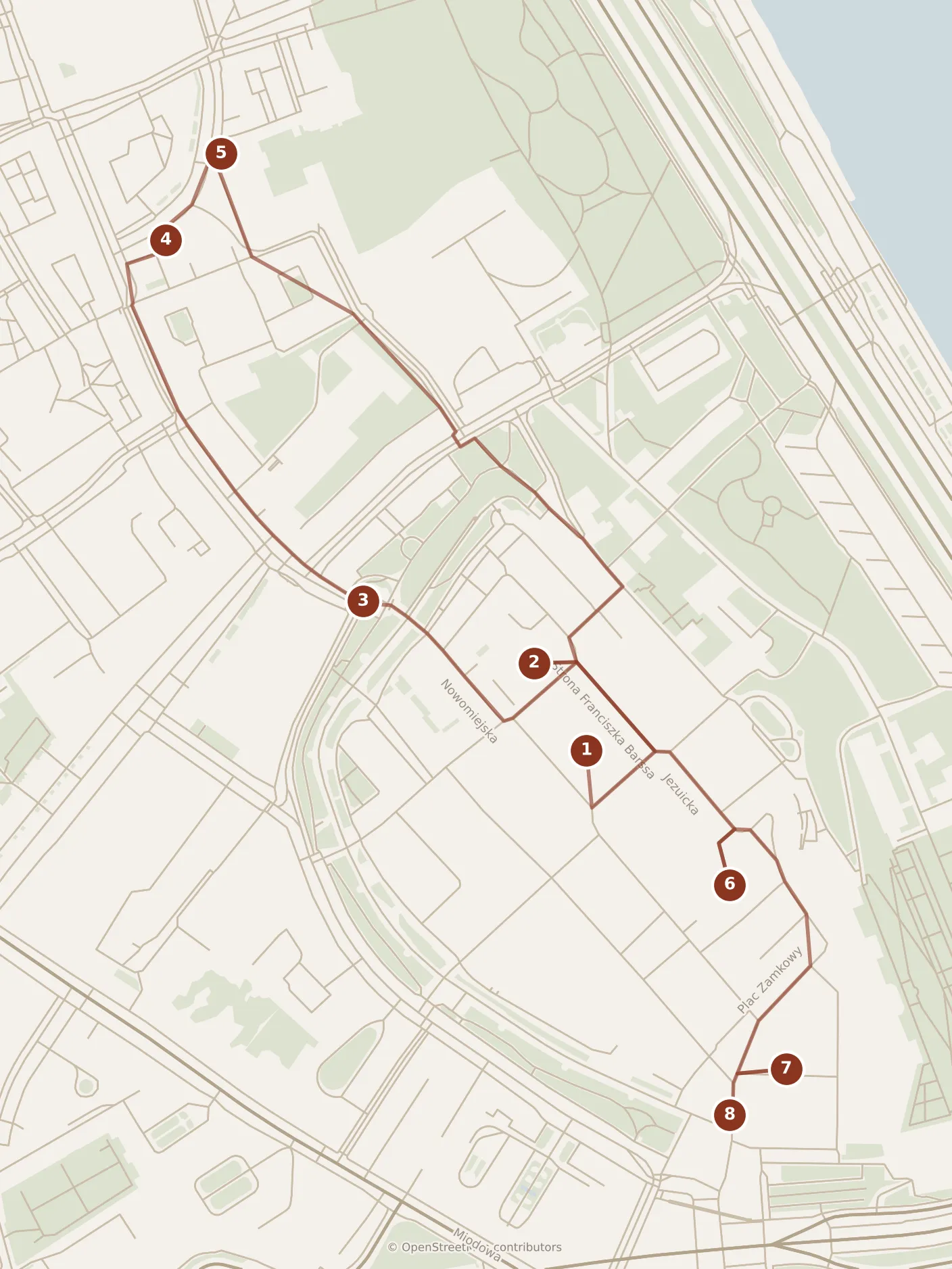
- Morning and afternoon
- 1Old Town Market Square
- 2Museum of Warsaw
- 3Warsaw Barbican
- 4New Town Market Place
- 5Church of St Kazimierz
- 6St John's Archcathedral
- 7Royal Castle
- 8Castle Square
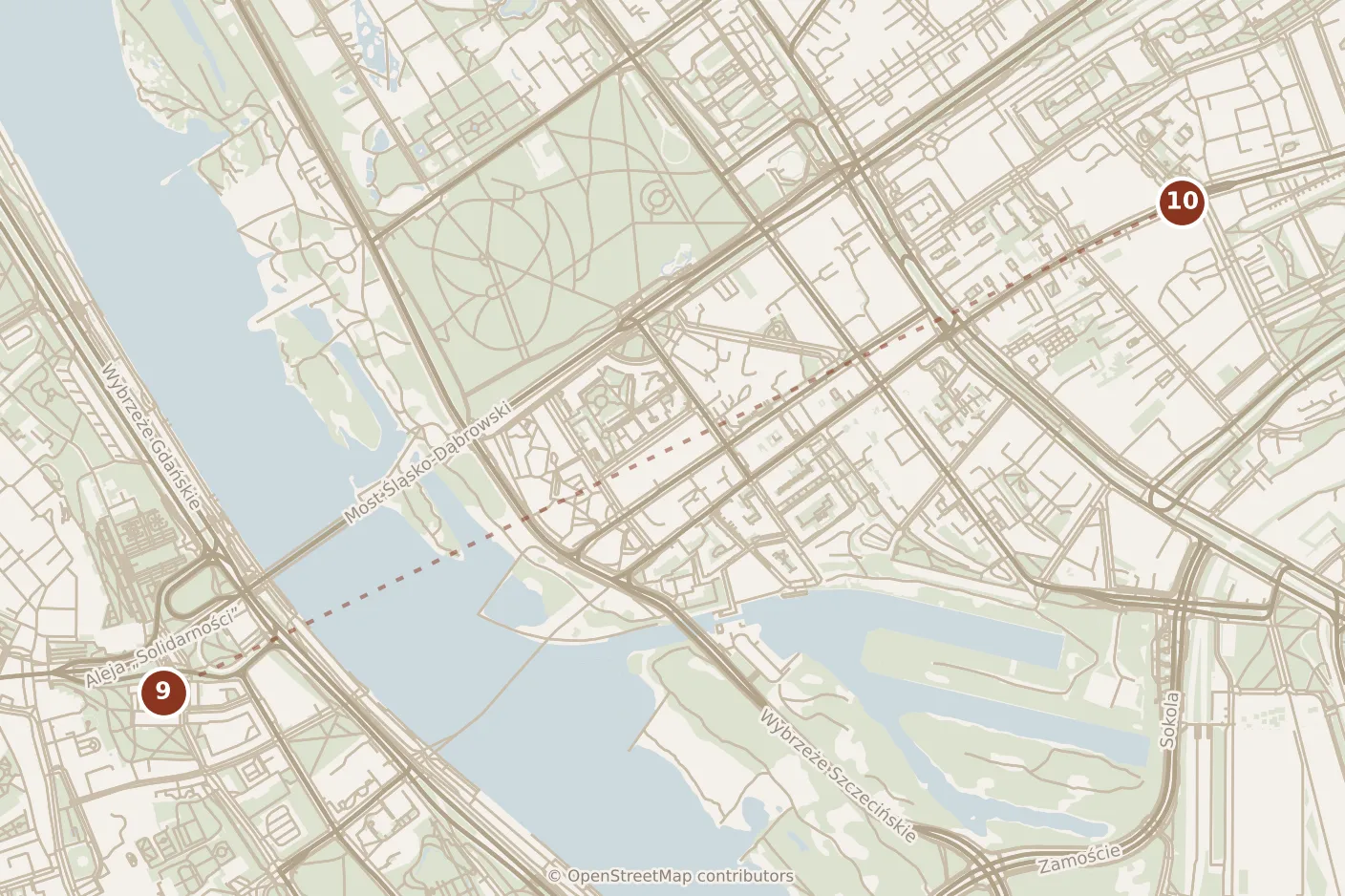
- Evening
- 9Mariensztat
- 10Ząbkowska Street
The Old Town has no metro station of its own, which surprises people who have looked at the map. There are two ways in and both are short. From Warszawa Centralna, take the M1 north from Centrum two stops to Ratusz Arsenał and walk about twenty minutes east along Długa; or, if you are staying anywhere on Krakowskie Przedmieście or Nowy Świat, take bus 116 or 180 north to the Plac Zamkowy stop and walk four minutes up through the lanes. The bus is the better of the two if you are anywhere near its line, because it sets you down at the foot of the climb up into the Old Town, which is also the top of the escarpment the evening walks down: the same place at both ends of the day, and two different slopes.
Morning
Start on the Old Town Market Square, and start before the museum on it opens: in 2026 that was ten o’clock, and the square in the hour before is a different place from the square after. If the opening has moved, move the start with it — the point is the hour before the door, not the clock. Give the square half an hour. The bronze mermaid in the middle is the thing to look at properly, because she is not the one you think: this is a cast made in 2008, after the original had been damaged and repaired once too often, and the original — Konstanty Hegel’s, of 1855 — is less than a hundred meters away, indoors, on the north side of the square. That is day one in one object.
Local tip. Do the square before the museum, not after. The square costs nothing and is at its emptiest early, and the museum does not open before ten. Reversed, you spend the best hour of the day waiting for a door, and the square you come out to is full.
The Museum of Warsaw is eleven merchant houses on one side of the square, rebuilt after the war and then knocked through into a single museum, so visiting it means climbing up and down through narrow houses rather than walking a floor. The permanent display is arranged as things rather than as a chronology — cabinets of silver, of clocks, of packaging, of portraits, of shop and house signs, of architectural fragments carried out of the rubble — and Hegel’s mermaid is in it. Ninety minutes. Do not attempt every cabinet; the fragments and the mermaid are the two that make the argument the rest of the day rests on, which is that this city keeps its originals indoors and puts copies outside.
Two minutes north the Warsaw Barbican closes the street: brick, semicircular, a sixteenth-century gun position bolted onto a medieval gate. Do not simply pass under it and press on. Follow the outside of the curtain wall for a few minutes instead: the double line of brick along Podwale is where the reconstruction is easiest to read, because here nobody pretended it was old. Set against the wall along this stretch is the Little Insurrectionist, a small bronze of a child in an adult’s helmet, put up in 1983 — and it is an object the city argues about, which is worth knowing before you meet it rather than after. Ten minutes for the gate and the wall together.
Five minutes further north the lanes open into the New Town Market Place, which is the same idea as the square you have just left and completely unlike it: wider, plainer, with no ring of tall houses, because the town hall that stood in the middle was pulled down in the nineteenth century and never replaced. At the head of it stands the Church of St Kazimierz, built between 1688 and 1692 to Tylman van Gameren’s design, founded by the queen, Maria Kazimiera, in thanks for the relief of Vienna. It was destroyed on 31 August 1944, and about a thousand people who had taken shelter under it died there; it was rebuilt between 1948 and 1952 and left almost bare inside, which is the point. It belongs to an enclosed Sacramentine community, so what you can walk into is the church and nothing beyond it, and if there is a service, look from the back. Half an hour for the square and the church.
Lunch goes on the way back south, on Freta or a few doors off it — the street is on the line between the New Town square and the cathedral, so it costs no walking of its own — and an hour is right. Żurek, the sour rye soup, is the thing to order if the day is cold, and it very often is.
Afternoon
Twelve minutes’ walking in all from the New Town square, back through the Barbican and down the main lane, brings you to St John’s Archcathedral. Most people give the outside ten minutes and leave; the reason to come here with two days is underneath, in the crypt. Poland’s last king is down there, put into it only in 1995 at the end of a two-century argument about where he belonged, and so is the republic’s first president, Gabriel Narutowicz, who was shot in a Warsaw art gallery five days after being sworn in, in December 1922, by a painter who objected to the parliamentary arithmetic that had elected him. Henryk Sienkiewicz is in the same vault. Twenty minutes, and take the stairs down rather than the nave.
Three minutes on is the Royal Castle, and two hours is what to give it — the hour a single day can afford gets you one room, and the second hour is most of what a second day is for. The room of eighteenth-century painted views of the city is what everyone comes for and it deserves twenty minutes of the two, but spend the rest on the two things an hour has to leave out. One is the chamber where the constitution of 3 May 1791 was voted, which is a plain room and reads as one until you know that the document argued about in it lasted rather under fifteen months. The other is the Lanckoroński Gallery, hung with what Karolina Lanckorońska gave back to Poland in the 1990s, the last of a collecting family handing over what had survived two wars in exile: two small Rembrandts of 1641 among them, a scholar at a desk and a girl leaning out of her own frame. Skip the porcelain and skip the Wettin Gallery without regret.
Come out onto Castle Square, ten minutes, and stand at the top of the slope rather than in the middle of it. This is where the Old Town stops and the ground drops away east towards the water, and it is the hinge of the day: everything so far has been uphill and enclosed, and everything after this is open and going down.
Evening
From Castle Square, walk down the escarpment into Mariensztat — five minutes, and it is a deliberate curiosity, a small square of low houses built from nothing in 1949 to look like a country town that had somehow got inside the capital. Then keep going east to the water and turn south along the Vistula boulevards. It is about twenty-five minutes of riverside to the metro station called Centrum Nauki Kopernik, and in warm weather this stretch is where the city actually is in the evening.
Take the M2 two stops east from there, Centrum Nauki Kopernik to Dworzec Wileński, and walk a few minutes to Ząbkowska Street. You are now in the part of Warsaw the war largely missed, and the difference is not subtle: the tenements are genuinely nineteenth-century, the render is off them in patches, and what is behind the street doors is courtyards. Some of those courtyards hold small Marian shrines, homemade, put up by residents during the occupation and still repainted and still given flowers. You may look in from the gateway, and people do; what you should not do is treat a courtyard as an exhibit — these are the yards of the apartments above them, so no going in for the photograph and no shooting into windows. Dinner goes on this street or immediately off it, and this is the good end of the day: after seven hours of buildings that were put back, an evening in a district that never came down.
From about November to February, replace the riverside half of that. The boulevards are dark and shut by mid-afternoon and there is no point walking them blind. Instead, from Castle Square walk seventeen minutes south down Krakowskie Przedmieście, which is lit and busy the whole way, to the Nowy Świat-Uniwersytet metro station and take the M2 three stops to Dworzec Wileński. Same street at the other end, same dinner, one street of the city traded for another. It costs you the water and Mariensztat with it, and nothing else.
Day two

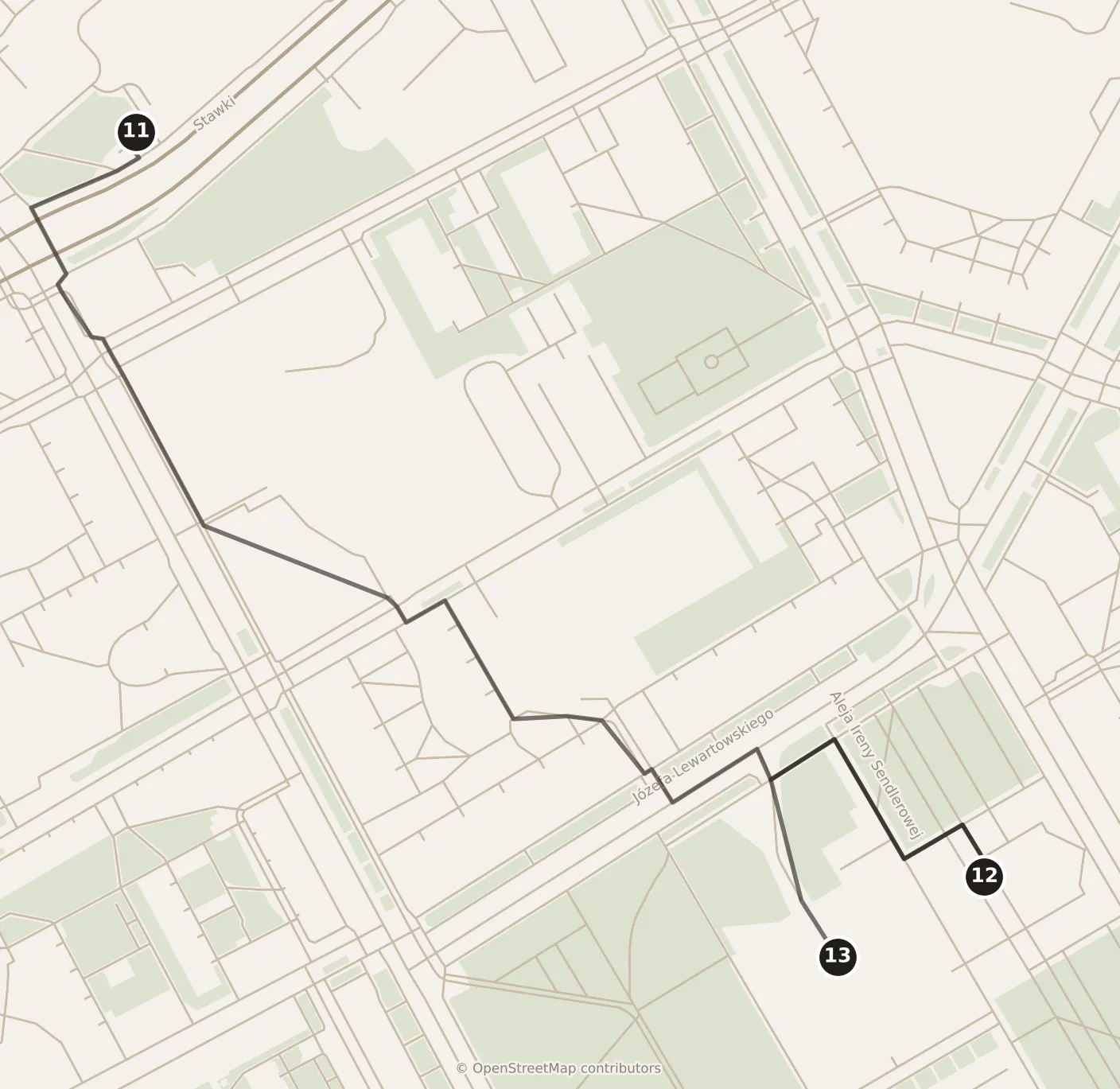
- Morning
- 11Umschlagplatz
- 12Monument to the Ghetto Heroes
- 13POLIN Museum of the History of Polish Jews
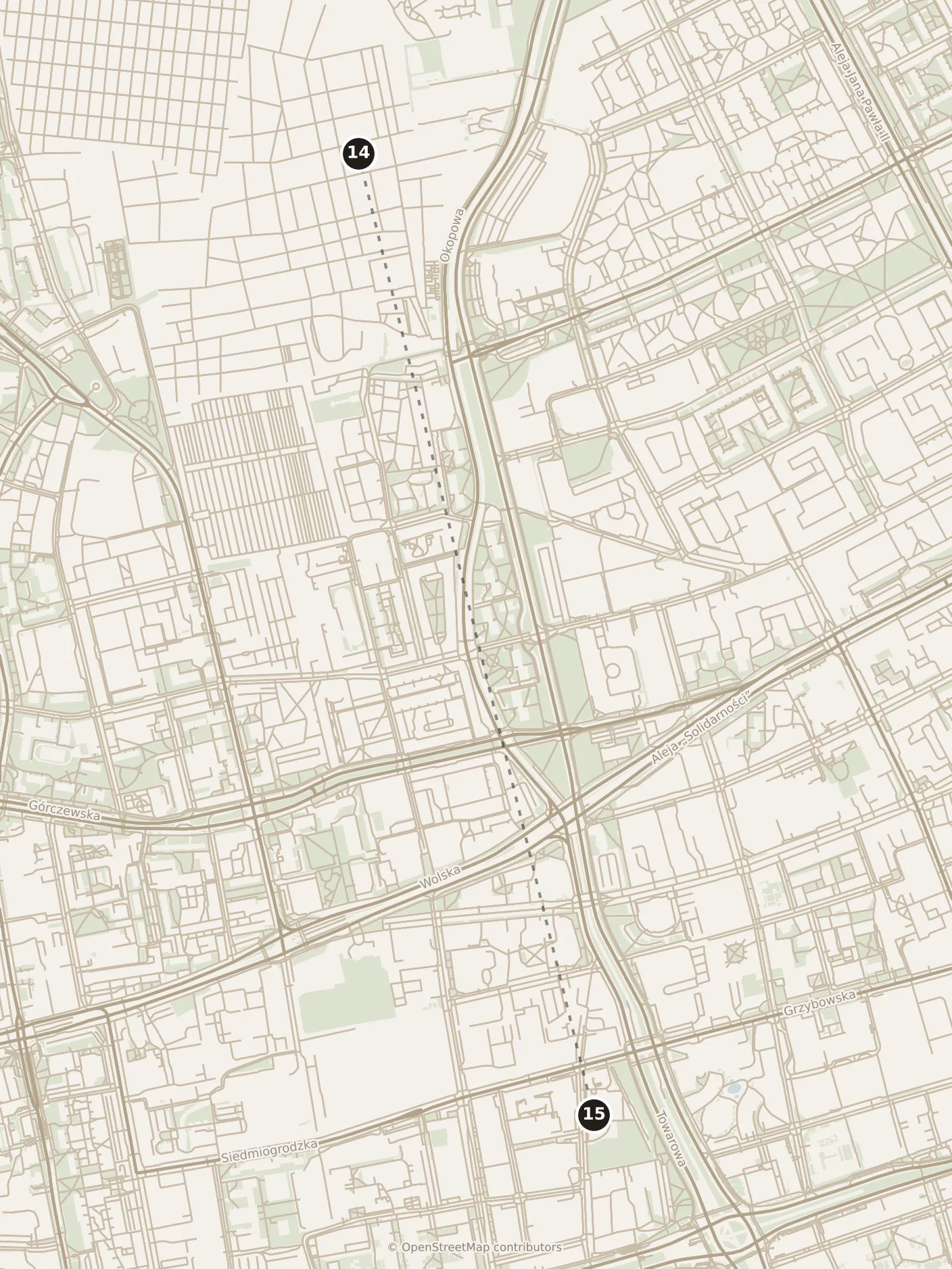
- Afternoon
- 14Okopowa Street Jewish Cemetery
- 15Warsaw Rising Museum
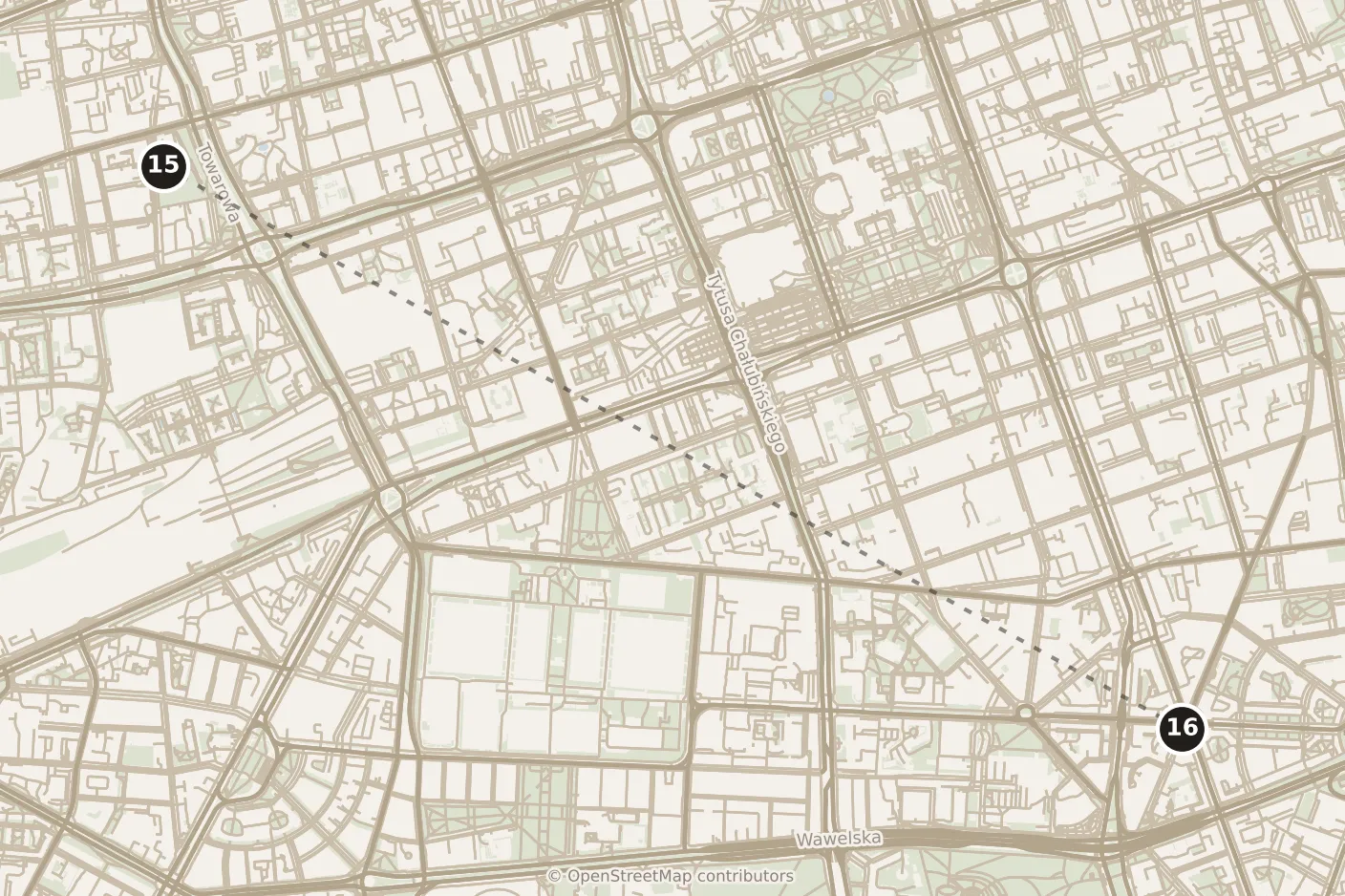
The leg out of the center: from stop 15 by metro, not on foot.
- Evening
- 16Saviour Square
Today has no stop whose worth depends on the light, so there is nothing to count backwards from — what it has instead is a hard edge at the far end, and the whole day is built forwards against it. The Warsaw Rising Museum shut at six in 2026 and wants two hours, so everything above it has to be done by mid-afternoon; if that closing hour has moved, move the whole afternoon with it rather than trimming the museum. From the middle of the city, take the M1 north from Centrum to Dworzec Gdański and walk about eleven minutes south-west. Start by half past nine. The two stops that open the day have no doors at all, which is exactly why they come before the museum opens. The whole of it adds up to a little over seven hours from the first stop, an hour of that sitting down at lunch — so a half-past-nine start leaves rather more than an hour in hand against that six o’clock. Cut the cemetery and it is six and a half.
Morning
Umschlagplatz is a small enclosure of white marble, open to the sky, set where a railway siding ran. Between July and September 1942 more than a quarter of a million people were taken from the ghetto through this point to Treblinka. The monument, put up in 1988, does not represent any of that: the inner wall is simply cut with hundreds of Jewish first names in alphabetical order, standing in for a list that does not exist. Twenty minutes, and it is not a place to be efficient in.
Walk nine minutes south along Zamenhofa, following the line of granite blocks set into the ground. This is the Path of Remembrance, also of 1988, each block naming a person or an event of the ghetto, and it deliberately connects the deportation point to the monument you are walking towards, which is the correct order to meet them in.
The Monument to the Ghetto Heroes went up in 1948, from Natan Rapaport’s design, on ground that was still rubble. The dark stone had been brought to Warsaw by the Germans for a victory monument of their own and was still lying about. Walk right round it before you decide what you think: one face is bronze, a group of fighters, and the other is carved stone, a column of people being driven along, and they are two different arguments about the same event standing back to back. The small square immediately beside the museum carries Willy Brandt’s name, because on 7 December 1970 the West German chancellor, at the monument and without warning anybody, knelt. Twenty minutes for the two together.
POLIN, the museum of the history of Polish Jews, is two minutes away and stands on the ghetto’s ground. The building opened in 2013 and the permanent exhibition in 2014, and its shape matters: eight galleries and a thousand years, of which the destruction is the seventh. This is a museum about Jewish life in Poland rather than only about its ending, which is a thing worth arriving knowing, because visitors routinely brace for the wrong museum. Its single most extraordinary object is the roof and painted ceiling of the wooden synagogue at Gwoździec, rebuilt full size by hand inside the hall. Two hours is what to give it. The way to spend two hours here rather than five is to take the first four galleries at reading-the-headings pace and slow down at the nineteenth century and the interwar decades, because that is the Warsaw everything else in these three days keeps pointing back at.
Afternoon
Eat before you leave — around the museum or in it, an hour — and then walk twenty-five minutes west across Muranów. The walk is a stop in itself. This district was built new in the 1950s on the leveled rubble of what had been here, and it was not cleared first: the ground you are crossing stands meters above the street plan it buried, and the blocks sit on their own ruins.
At the end of it is the Okopowa Street Jewish Cemetery, founded in 1806, thirty-three hectares, a couple of hundred thousand graves, and still in use. It has not been tidied into a monument; most of it is woodland with stones under the trees, and that is the reason to come. Ludwik Zamenhof, who invented Esperanto, is here, and Isaac Leib Peretz, who is to Yiddish literature roughly what a national poet is to any other language; so are the mass graves of people who died in the ghetto. Forty-five minutes.
Two things about this stop, and neither is a matter of taste. Men cover their heads inside a Jewish cemetery, and paper caps are kept at the gate for people who arrive without one. And the cemetery keeps Shabbat: it is closed on Saturdays and on Jewish holidays, which is not an opening hour that might quietly move but the calendar it runs on. Its ordinary hours are its own, shorter than the museums’ and shorter again in winter, and the Jewish Community of Warsaw publishes them — read them the week before, because this is the one stop on today that can be shut on a day when both museums are open.
Local tip. If this day has to lose something, lose the cemetery and not the walk to it. The walk is how you cross Muranów, and it is the only part of the day that puts you on the ground rather than in a museum about it — and the tram you need is at the cemetery gate whether you go in or not.
Tram 1 or 22 from the Cmentarz Żydowski stop outside the gate runs south to the stop named after the museum, Muzeum Powstania Warszawskiego: about five minutes, then three on foot. The Warsaw Rising Museum opened in 2004 in a disused tram power station on Grzybowska, and it is dark, loud and vertical — three levels wound round a central steel wall whose surface carries a recorded heartbeat you feel through the floor as much as hear. Two hours. Two things to make time for: the full-size replica sewer, which you walk through bent over and which is the single most useful thing in the building for understanding how anyone got out of the encircled Old Town in 1944, which was underground and in the dark; and the short film called City of Ruins, an aerial reconstruction of the flattened city assembled from photographs taken in 1945, which is five minutes and does more than the rest of the museum put together. What to skip if you are short: the hall with the Liberator bomber replica, and the rooms built for children.
Evening
Six minutes on foot to Rondo Daszyńskiego, the M2 east to Świętokrzyska, then the M1 south two stops to Politechnika and four minutes on foot. That puts you on Saviour Square, a round junction with a twin-towered church on one side of it and colonnaded blocks around the rest, ringed with small bars and places to eat. It is where the city eats on an ordinary evening, it is nowhere near anything you have seen today, and after this particular day that is the whole recommendation.
With a third day

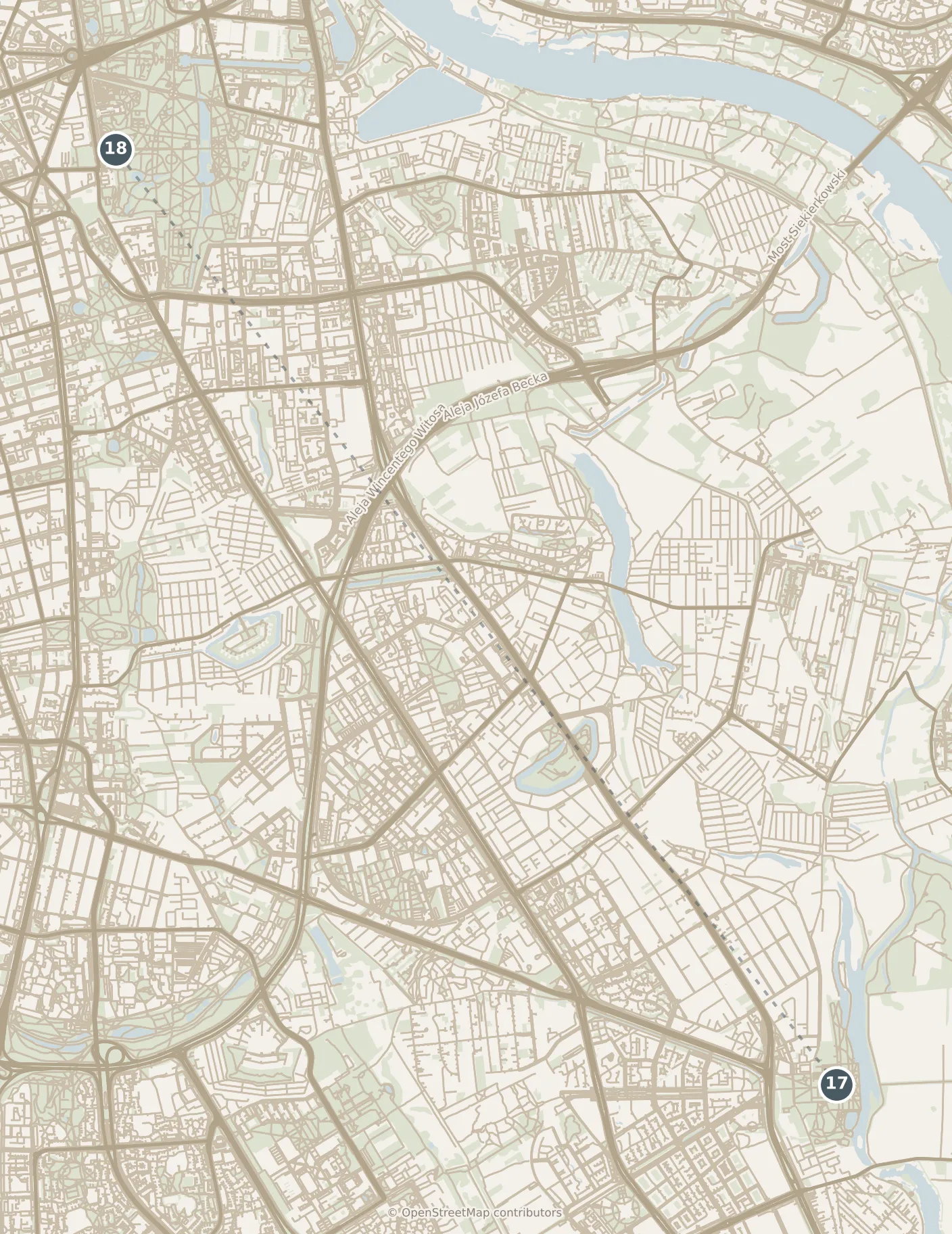
The ride on to stop 18, by bus, not on foot.
- With a third day · stop 17
- 17Wilanów Palace
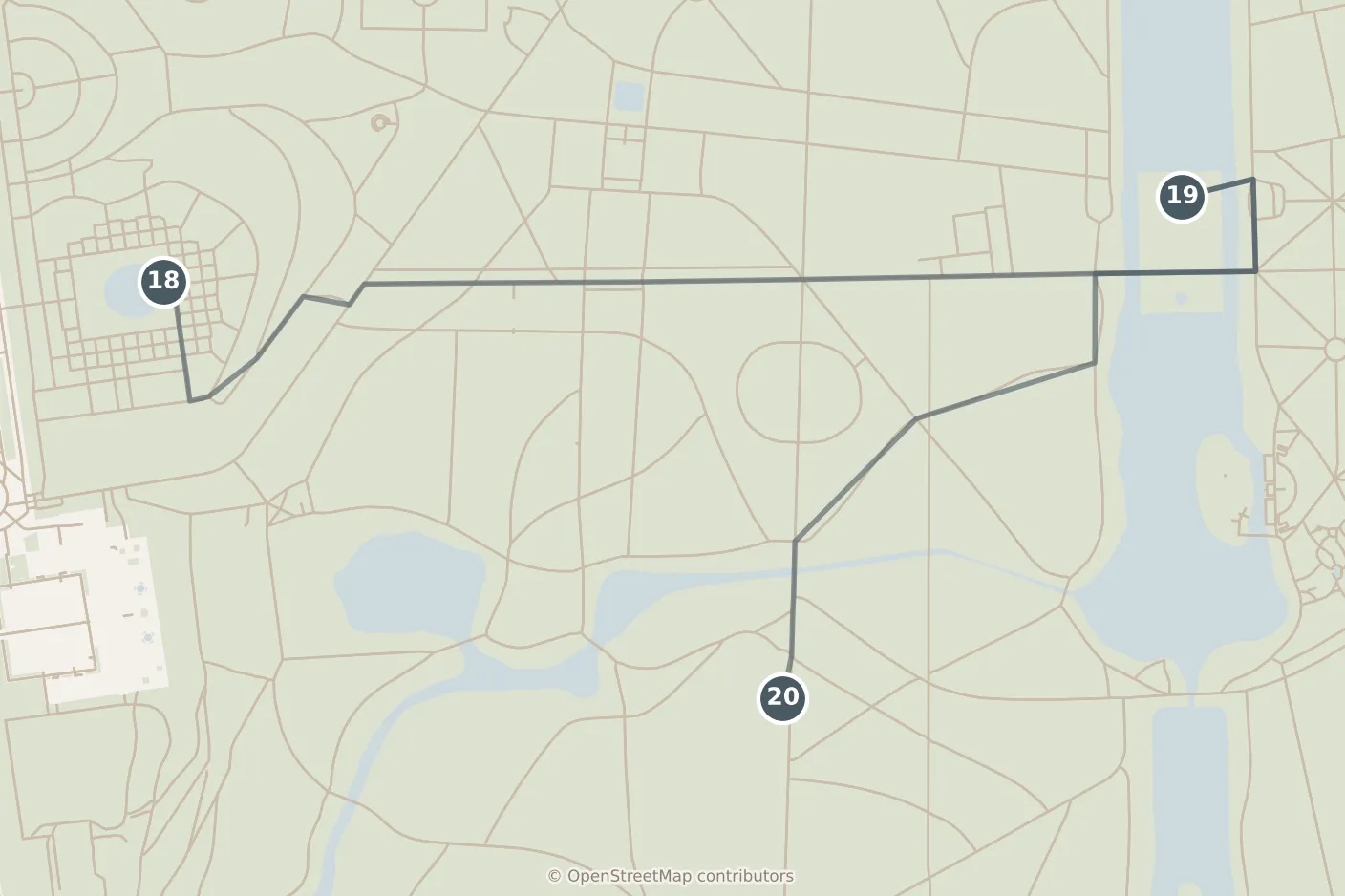
- With a third day · stops 18–20
- 18Chopin Monument
- 19Palace on the Isle
- 20Łazienki Park
The third day is the one that stops talking about the war. Give it to the two royal estates south of the city, and take it as day three — appended, not inserted. Nothing on days one and two moves to make room, because none of the three shares a stop with either of the others; what does change is which weekday each day falls on, and that is set out below in Practicalities. There is one case for inserting it by choice, and it is a summer Sunday falling in the middle of your three days: the recitals below are the only thing in this whole article that wants a particular weekday rather than merely avoiding one, so let the third day take the Sunday and let days one and two close up around it. A Tuesday in the middle is not that case — a Tuesday only has to miss day two, and day one will take it perfectly well. The other reasons to move the third day are not chosen but forced, by the weekday you arrive on, and they are worked out below.
One bus line does the whole day. Take 116 or 180 from the Nowy Świat stop, south past the parks to Wilanów at the end of the line, about forty minutes. Go to the far end first: the palace at Wilanów admitted nobody after three in the afternoon in 2026 and shut at four, which is the hard edge on this day, and building it the other way round leaves you racing it. If that hour has moved, keep the shape and read the new one.
Wilanów Palace was built for Jan III Sobieski from 1677 and is not a reconstruction: it was stripped rather than leveled, and its walls are its own, which is more than anything you walked into on day one can say. It has also been open to visitors since 1805, when Stanisław Kostka Potocki put part of his own house on show, which makes it about the oldest museum in the country. Ninety minutes inside. Then the garden below the terrace — half an hour if you want the second palace later in the day, an hour if you would rather not. Lunch at Wilanów rather than after it; there is nothing between here and the park.
Bus 116 or 180 back north, twenty-five minutes, to the Łazienki Królewskie stop on Belwederska. Two minutes inside the gate is the Chopin Monument, bronze, under a stylised willow bent over the figure; on Sundays through the summer there are free piano recitals at its foot, twice in the day, once around midday and once in the afternoon, and people bring folding chairs. Fifteen minutes if there is no music and considerably more if there is. Ten minutes east is the Palace on the Isle, the last king’s bathing pavilion rebuilt into a small classical villa standing on the water with a bridge at each end. Forty-five minutes, and take it before the park rather than after: it keeps much shorter hours than the grounds do and it closes on Mondays. Then give the last forty-five minutes to the park itself — seventy-six hectares, peacocks on the paths and red squirrels in the trees, and no closing time except the light.
That is about six hours all told, an hour of it lunch and just over an hour of it on a bus, so a ten o’clock start puts you in the park in the middle of the afternoon. Six hours is what this day contains rather than how long it lasts: the park closes with the light and everything on the day that does close is behind you by then, so around midsummer you can stay in it until nine — an hour or more less at either end of that — and the count stops mattering about halfway through the evening.
It is the short months where the arithmetic bites, and it bites hard: at midwinter that same ten o’clock start would put you at Łazienki with an hour and twenty minutes of light left and nearly two hours of stops still to run, and the park is the half of this day that needs it. Between November and February the honest version of a third day is Wilanów and back, in by two in the afternoon — and the hours that frees are the ones to spend putting back whatever day one had to cut, which if it was the northern morning is the Barbican and the New Town, seven minutes north of the Old Town Market Square on foot. What a winter day one loses is the riverside, and no spare afternoon here puts that back.
Local tip. The two recitals on a summer Sunday are what dissolves a collision that would otherwise cost you a stop. If you want the midday one you have to take Łazienki first, and then the day loses either the Palace on the Isle or the garden at Wilanów, because the palace’s last admission is at the other end of a bus ride. Take the afternoon recital and nothing has to give: Wilanów in the morning exactly as written, and you reach the monument in time.
Practicalities
What to book. Three timed tickets across the two days — the Royal Castle, POLIN and the Warsaw Rising Museum — and a fourth, the palace at Wilanów, if you take the third day. All four sell timed entry through their own websites and a week ahead is enough; the reason to do it online rather than at the door is that a timed slot decides when your day happens, and you would rather decide that at home than in a line. Nothing else across the three days needs arranging: the rest is streets, squares, a church, a monument, a park, a cemetery, the Museum of Warsaw and the Palace on the Isle, free or paid at the gate.
The days of the week, and the rules the answer comes from. Two closures decide everything, and they are conveniently on different days. Day one has two ticketed interiors, the Museum of Warsaw and the Royal Castle, and in 2026 both closed on Mondays: day one must miss Monday. Day two has two, POLIN and the Warsaw Rising Museum, and in 2026 both closed on Tuesdays: day two must miss Tuesday. Day two’s third interior, the cemetery, is shut on Saturdays and Jewish holidays, so a Saturday costs you that stop — which is also the one this article tells you to cut first, so it is the cheapest of the collisions. Day one has no second closed day, but it has two working churches, and a Sunday service in St John’s Archcathedral or the Church of St Kazimierz shuts the crypt or the nave you came for — minutes rather than a day, which is why it ranks below the closures rather than beside them. On the third day only the Palace on the Isle closes weekly, on Mondays; the parks and Wilanów close on no day of the week. And the third day is the only one with a weekday it actively wants rather than avoids: a Sunday between late spring and early autumn, for the recitals at the Chopin Monument.
Two of the ticketed interiors also have a free weekday, and it is not the same weekday. In 2026 the Royal Castle admitted free on Wednesdays, on a shortened route that keeps the Lanckoroński Gallery and drops the two this article tells you to skip anyway, and the Museum of Warsaw’s permanent exhibition was free on Thursdays. Both of those are day one, so you can have one of them free or the other and never both — and the free day is the crowded day, which on a day built around an empty square before ten in the morning is a trade rather than a gift.
Days one and two will trade places freely. Nothing in either depends on the other, and the printed order is a preference rather than a rule: it puts the copy first and the reason for it second, which is how it reads best, but taken the other way round day one becomes an answer instead of a question and that is a defensible trip too. The third day will go anywhere in the three.
The two arrival days that break it. With two days, the trap is arriving on a Monday: day one lands on the Monday and day two on the Tuesday, which is four closed doors in a row and both days’ entire ticketed content. The fix is the swap above — give the Monday to day two and the Tuesday to day one, and nothing is lost at all; with three days that same Monday arrival needs nothing more than the swap plus the third day on the Wednesday, and that holds even if you are leaving the Wednesday evening with a case, because the third day ends a quarter of an hour on foot and one metro stop from the left luggage. With three days the trap is different, and it catches precisely the reader who checked the two-day arithmetic and then added a day: a Saturday arrival is perfect for two days and puts the third day on a Monday, when the Palace on the Isle is shut. The fix is not to run the third day first but to put it in the middle: Saturday for day one, Sunday for the third day, Monday for day two. That clears every closure in the block above and picks up the one weekday this trip actively wants, since the recitals are on summer Sundays. Running the third day first — Saturday out to Wilanów and Łazienki, Sunday for day one, Monday for day two — is legal too, and it costs two things. It loses the recitals. And it puts day one on a Sunday, when services run in St John’s Archcathedral, which is a parish church before it is a monument, and a Sunday afternoon can find one in progress: the crypt is what day one is there for, and if it is shut with the nave in use, that is twenty minutes lost rather than a day. The Church of St Kazimierz, earlier the same morning, belongs to an enclosed community and behaves the same way — if there is a service, look from the back.
What to cut when short. On day one, the northern half of the morning goes: the Barbican, the New Town Market Place and the Church of St Kazimierz come to just under an hour together with the walking, and the day still works, because the museum and the castle are the pair the whole day was built to reach. On day two, the cemetery goes — three quarters of an hour — and note that you still walk the same twenty-five minutes west, because that is where the tram is. On the third day it is the Wilanów garden that shrinks and then goes: half an hour of it is most of what buys you the Palace on the Isle later — not all of it, so the version with the palace runs a little longer than the version without — and dropping the garden altogether buys an unhurried hour in the park at the end.
Moving between the stops these days name. Day one is entirely on foot from the Old Town Market Square to the metro station on the river, and no leg of it is longer than the riverside twenty-five minutes between Mariensztat and Centrum Nauki Kopernik. Day two’s longest walk is the twenty-five minutes across Muranów; its one tram ride is 1 or 22 from Cmentarz Żydowski to Muzeum Powstania Warszawskiego, and its two metro journeys are the M1 to Dworzec Gdański at the start and the M2 to Świętokrzyska with a change to the M1 at the end. The third day is buses 116 and 180 and nothing else. Those numbers are the ones that ran in 2026, and they are the least durable thing on this route: line numbers move, stop names do not, so board by the stop name on the sign and let the number confirm it rather than the other way round.
The bag, and it is the last morning that matters. A room comes with a trip of this length, so the bag is only a question twice: the morning you arrive before you can get into it, and the morning you leave. Warszawa Centralna keeps left luggage below the main hall, and the shape to know is which of these days ends near it. Day two does: from Politechnika it is one stop on the M1 to Centrum, which sits beside the station. The third day very nearly does too: it ends in a park about three kilometers out, but a quarter of an hour on foot brings you to Politechnika and the same single stop, so it costs eleven minutes more than day two and nothing else. Day one is the one that does not: it ends across the river. So if you are leaving in the evening of your last day, do not let that day be day one. If it is day two and the margin is thin, its evening on Saviour Square is what goes, straight from Rondo Daszyńskiego on the M2 to Świętokrzyska and changing to the M1 for Centrum. Arriving early with a case, the same office is the answer, and day one starts a metro ride and a walk north of it.


.jpg)

