Warsaw in one day: the sewers, the rebuilt Old Town, and the tower at the end

Last updated 3 August 2026
Overview
Warsaw is a hard European capital to read at first sight, because almost nothing you look at is as old as it appears. The Old Town was not repaired after the war; it was built again from nothing between 1948 and 1953, and UNESCO listed it in 1980 for that rather than for its age. So one day here is a day about the twentieth century whether you plan it that way or not, and the route below is arranged to make that legible instead of working around it.
It is a single line north to south and it never doubles back: four and a half kilometers of walking, a little over an hour of it, spread across a whole day. Once you have reached the start you need no transport at all until you go home.
What one day costs you is the two museums Warsaw is best known for, and they do not cost the same thing. The Warsaw Uprising Museum sits some three kilometers west of this line, so taking it means crossing the city twice and giving up most of what follows. POLIN is a ten-minute walk from the first stop, so what it costs is only the half day it wants. If the twentieth century is the only reason you came, spend the morning in one of them and read the rest of this as your afternoon. Otherwise leave them where they are: the day below tells much of the same story out of doors, and it is the version you can walk.
The day

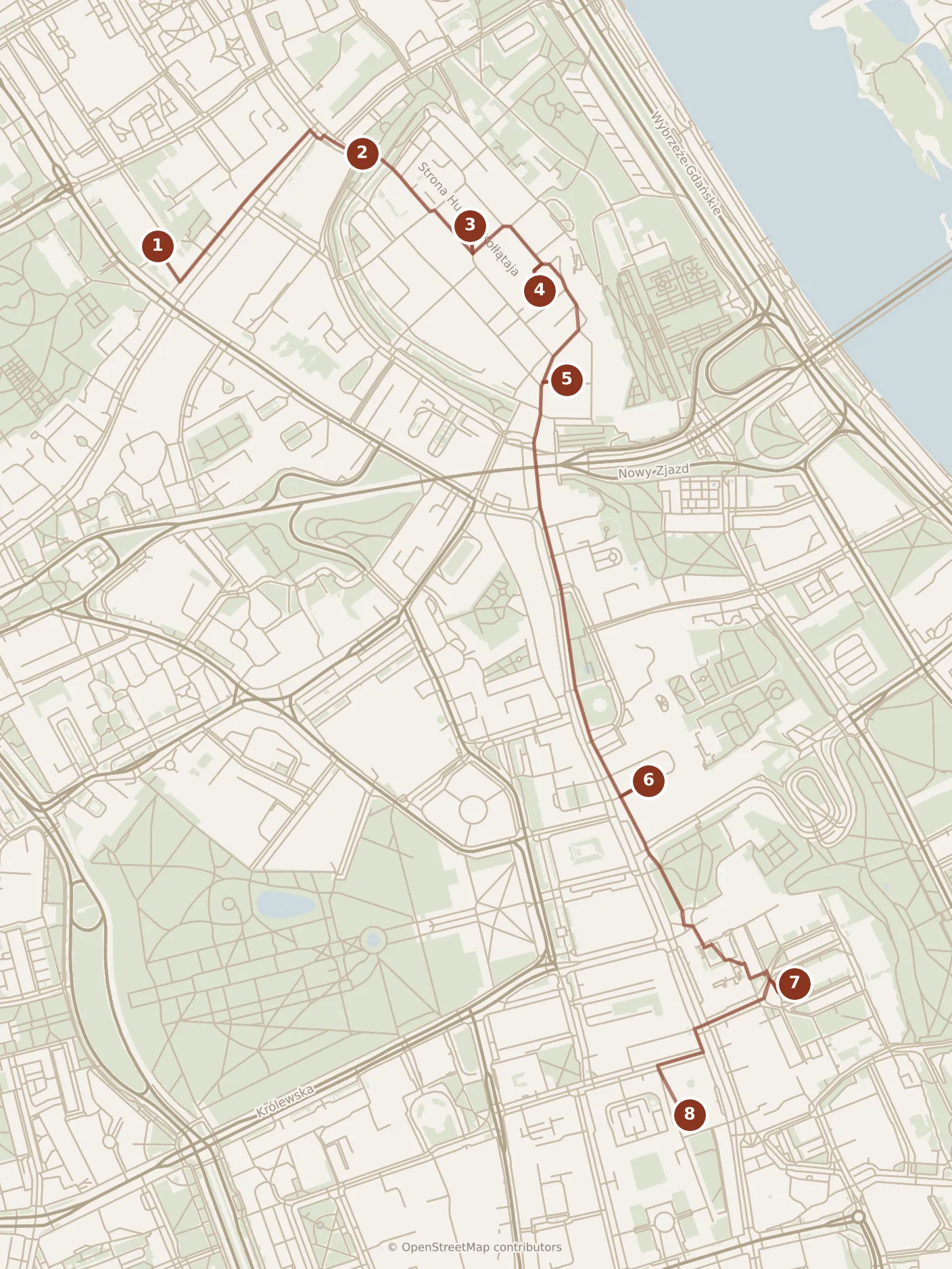
- Morning and afternoon
- 1Warsaw Uprising Monument
- 2Warsaw Barbican
- 3Old Town Market Square
- 4St John's Archcathedral
- 5Royal Castle
- 6Presidential Palace
- 7University of Warsaw
- 8Holy Cross Church
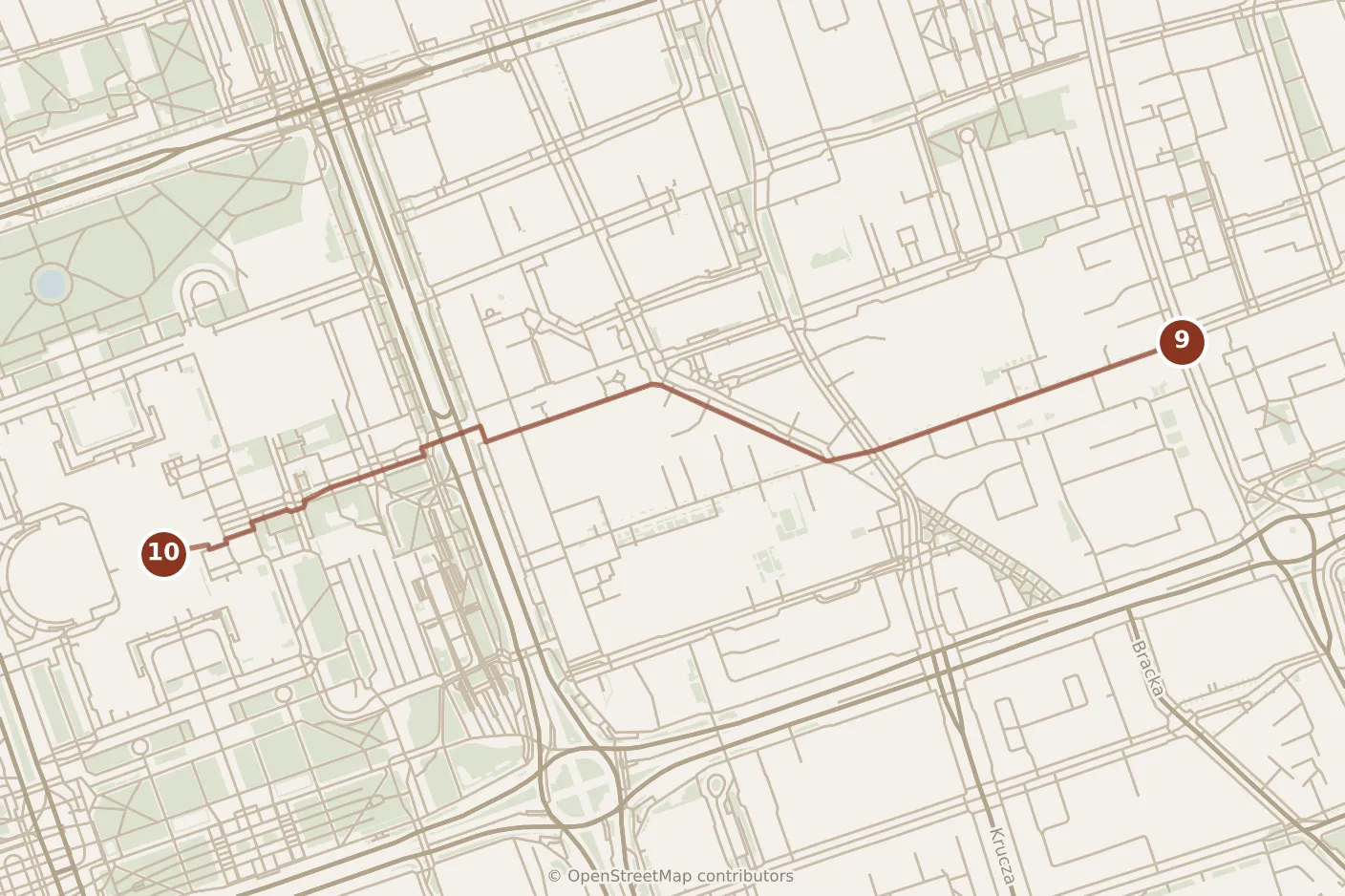
- Evening
- 9Nowy Świat
- 10Palace of Culture and Science
Morning
Start on Krasiński Square, in front of the Warsaw Uprising Monument — bronze, ten meters high, unveiled in 1989, which was the first year it could have been. The large group is fighters coming out from under a collapsing wall. The small group, set apart from it, is four figures climbing down into a manhole, and that is the one to walk over to. When the Old Town fell in September 1944, some five thousand fighters got out through the sewers under this square; the crawl took five or six hours in the dark, and they came out a kilometer and a half south, on a side street off Nowy Świat. Give the monument a quarter of an hour, and understand what the rest of this day is: their route, above ground, ending where they surfaced. The nearest metro station is Ratusz Arsenał, twelve minutes away on foot.
Six minutes north-east is the Warsaw Barbican, the round brick gun-gate in the town wall. It went up in 1540 and was obsolete almost at once, and by the eighteenth century it was being taken apart for being no use; the nineteenth century built houses into what was left. What you are looking at was put back between 1952 and 1954, from seventeenth-century etchings and out of bricks carted in from buildings demolished in Nysa and Wrocław. A city with nothing left rebuilt a gate that had already been gone for two hundred years, using other cities’ bricks. Ten minutes, and walk through the arch rather than round it.
Three or four minutes south through the gate is the Old Town Market Square. Half an hour is right here, and the first half hour of the day is the right one — it is a small square, and by the middle of the morning it belongs to the tour groups. The four sides carry four different names, one for each of four men who lived on them. The bronze mermaid in the middle, sword up and shield out, is the city’s coat of arms made solid. What repays looking at is the fronts of the houses: they were rebuilt to how they had looked in the seventeenth century rather than to how they looked in 1939, which is a decision and not a restoration, and much of the painted decoration on them was designed in the 1950s.
Three minutes down the lane is St John’s Archcathedral. Before going in, walk round the outside and find the length of tank track set into the brick under a plaque. The plaque calls it a Goliath, the small remote-controlled demolition machine the Germans used in the street fighting, and historians have argued for years that it came off a larger one called a Borgward; what neither side disputes is that a machine packed with explosive was got into this building in August 1944 and brought a great deal of it down, and that the Germans blew up the rest deliberately after the Uprising ended. The front you then walk through looks Gothic and is seventy years old: it was reconstructed to a guess at how the fourteenth-century church had looked, worked up from two old drawings, rather than to the front that actually stood here in 1939. Inside, the brick has been left raw because almost none of the fittings survived to put back. Fifteen minutes.
Two or three minutes on is Castle Square, where the Old Town ends and the Royal Route begins. The column in the middle carries Sigismund, the king who moved the court here from Kraków in 1596. The Royal Castle behind it was shelled in September 1939 and blown up after the Uprising; the decision to rebuild took until 1971 to turn into work, and the work took until 1984. Go in and give it an hour, which is less than the building wants and exactly what one day can afford. Walk the state rooms, but go for one room in particular: the one hung with the views of Warsaw that Bernardo Bellotto painted for this castle in the 1770s. He signed himself Canaletto after his uncle and the room still carries the name. Those pictures came back to Poland in 1921 and were used as reference when the city was rebuilt — which means the square outside, and the street you walk down after lunch, were partly copied from something hanging in here. Bellotto took liberties, and some of them were built. Let the furniture and the porcelain go.
Local tip. Two stops on this day take a ticket: this castle and the terrace at the top of the Palace of Culture at the end. If the day has room for only one, take the castle. The terrace sells you the view of a city that was rebuilt; the castle holds the pictures it was rebuilt from, and only one of those is a thing you cannot see anywhere else.
Afternoon
Lunch first, and eat it sitting down. The eleven minutes south from the castle gates run down Krakowskie Przedmieście, the first stretch of the Royal Route: churches, palaces and a university strung along one straight line, all of it rebuilt. Lunch goes on this street or a few streets off it, and what to look for is a milk bar — the sign says bar mleczny. They are the cheap cafeteria canteens that outlived the system that invented them and now feed students, pensioners and anyone else who walks in. Pierogi and żurek is the standard order and wuzetka, a chocolate cream cake, is what to do about dessert. Give it an hour.
Halfway down is the Presidential Palace, behind a fence and a forecourt. You do not go in — it is a working government building — and five minutes is what it is worth from the street. The equestrian bronze in the forecourt is Prince Józef Poniatowski by Thorvaldsen, and it is the second one: the Germans blew the original up in December 1944, and Denmark gave the city a nineteenth-century cast taken from the sculptor’s own model in Copenhagen.
Seven minutes further, an ornamented gate opens off the street into the University of Warsaw. Walk in — the campus is open, and the point of it is the contrast. It is a row of palaces round a long courtyard with students on the grass, and nothing about the scene in front of you says that the Germans closed this university for the whole occupation and that it went on teaching illegally in apartments. Fifteen minutes.
Four or five minutes on is Holy Cross Church. On the steps outside stands a stone Christ carrying his cross, one hand raised towards the words Sursum Corda cut above him; a photograph of that figure lying face down in the rubble, the hand still pointing at the inscription, is one of the images this country uses for the whole war. The church behind it is a baroque one of the 1690s, rebuilt plainer after 1945 because the Germans detonated two Goliaths inside it in September 1944 — the same weapon whose track is in the cathedral wall, and here nobody argues about the name. A pillar in the nave holds an urn with Chopin’s heart, walled in there in the 1880s: he died in Paris and had asked for the heart to come home, and this is where it came. It did not stay through the war — the Germans took it out of this pillar in 1944 and handed it to a bishop who kept it outside the city, and it went back in October 1945. An inscription on the pillar names it, and there is a second urn nearby holding the heart of a novelist, which reads as a habit once you have noticed it. Fifteen minutes.
Evening
Twelve minutes south and Krakowskie Przedmieście has become Nowy Świat. The street was put back after the war to one height and one early-nineteenth-century manner, which is why it reads as more consistent than a street that had grown by itself ever would, and it is now lined with places to eat and drink. Dinner goes here rather than back in the Old Town, which is behind you and uphill. If you started early you will have an hour spare by now, and the place to spend it is downhill: the riverside is ten minutes east of this street and is where the city goes in warm weather.
Then the last stretch and the longest single walk of the day, eighteen minutes west to the Palace of Culture and Science. Two hundred and thirty-seven meters, finished in 1955, designed by a Soviet architect and given to Poland by Stalin, and there is still no agreement about whether to love it. Go up anyway. The terrace is on the thirtieth floor at a hundred and fourteen meters and it is open to the air. It is no longer the highest terrace in the city — a deck at twice the height opened in Varso Tower, five minutes west, in 2025 — and the reason to come here instead is the standing joke in Warsaw, that this is the best view in the city because it is the only one without the Palace in it. From up here the place reads as what it is, a grid of post-war blocks, a knot of glass towers to the west, and the Old Town as a small brown patch two kilometers north. Three quarters of an hour.
This is the one stop whose worth moves with the hour, and Warsaw makes that harder than most cities do: the sun is down here before half past three in late December and still up at nine in June. So the terrace is the right last thing from spring to autumn and the wrong one in winter, when the light has gone before you have had dinner. In the short months, do the tower straight after the church and eat on Nowy Świat afterwards — it is the same walk in the other direction.
To know when to start, count the day rather than the clock. From the monument to Nowy Świat is about four and a half hours: the eight stops at the times recommended above, the fifty minutes of walking between them, and the hour sitting down at lunch. Start at nine and you reach Nowy Świat in the early afternoon with the whole evening still in front of you, which is the point — one day in Warsaw is not a day you have to run, and the reason to start early is the empty square rather than a shortage of hours. But that count is time spent inside the places and nothing else. It does not include the ticket desk and the cloakroom at the castle, the elevator at the Palace of Culture, or dinner; and the castle is the one where a wait would actually cost you, because it is the only one of the eight you cannot look at from the street.
Practicalities
This route asks one thing of the transport system and nothing else: a ride to the start and a ride back from wherever you finish. Everything in between is on foot — four and a half kilometers in total, a little over an hour of walking, and the longest single stretch is the last one, the eighteen minutes from Nowy Świat to the Palace of Culture. One ticket covers metro, tram and bus alike; the city guide explains how they are bought and when a time-based pass is worth it.
Nothing here has to be arranged before you arrive. Only two stops cost money, the castle and the terrace, and only two things are worth checking before you set out. The first is the castle, which is the one stop on this day that closes one day a week, and the one the whole morning is built on. Check which day it is before you fix the order. If it falls on yours the route still stands — everything else on it is a street, a square or a church — but you lose the paintings, and with them the thing that explains what the morning has been looking at all along. There is no substitute for them inside this day, which is an argument for checking rather than for improvising. While you are on the page, look for one more thing: Polish law obliges a museum to make its permanent exhibition free on one day of the week, and each museum chooses its own day and publishes it. The castle is the larger of this day’s two tickets, so it is worth knowing whether that day is yours.
The second is Sunday. The cathedral and the church on Krakowskie Przedmieście are working parishes and shut to visitors during services, which on a Sunday morning is most of the morning — and this route reaches the church after lunch, so there a Sunday costs you a different hour than it costs you at the cathedral. They sit in the middle of the route rather than at either end, so a Sunday does not remove them; it just means expecting to see both from the door rather than to walk round them. The cathedral’s tank track is on the outside wall in any case, and it is the part of that building this day is really for.


.jpg)
