Vienna in two or three days: under the old town, then the palaces past the Ring

Last updated 18 October 2026
Overview
Vienna is an easy city to walk and a hard one to choose in. Almost everything a visitor comes for belonged to one family that owned the whole place, and the buildings sit deliberately apart: the winter palace in the middle of the old town, the summer palace at the end of a subway line, and a third in its own gardens to the south-east that the family did not build at all but bought, sixteen years after the death of the general who did. A short trip that tries to reach all three becomes a trip spent at gates.
Two days solve that by cutting the city in half rather than by hurrying. A single day here has to take the old town from the surface and keep moving; the second day is what buys the first one the time to go underneath it. Day one stays inside the Ringstrasse and goes downwards — a crypt under the cathedral, a Roman camp under one square, a burnt medieval synagogue under another, and a library built to be a room rather than a store. Nothing on it is more than about ten minutes from the thing before it, and the whole day comes to under three kilometers on foot. Day two leaves the Ring altogether for two of the three palaces, on one subway line and one tram, and ends in a wine village that is still, technically, Vienna.
What this costs is one museum, and it is a large one. The picture gallery of the Kunsthistorisches Museum — the Bruegel room above all — does not fit two days that also contain Schönbrunn, and pretending it does produces an afternoon of waiting in line at the end of a day of traveling. If paintings matter to you more than palaces the swap is clean, and it is set out where it happens, at the end of day two’s morning; what does not survive is trying to have both. The other thing these days pass without entering is the Hofburg, twice on day one and deliberately: the state apartments and the treasury are the imperial city at its own ground level, and this day one is the same city from underneath it.
Two of these days have a fixed point in them and one does not. Day one turns on a clock that performs at noon and on the first guided descent into the catacombs; day three, if you take it, is built around the last of the light, so here is the range it needs — the sun goes down in Vienna from a minute before four in the second week of December to a few minutes before nine at midsummer. Take your month’s hour out of that band and count backwards where the day asks you to. Day two has no such hinge at all, which is unusual and worth saying: nothing on it shuts early, so the only thing that pins it is the entry slot you booked yourself.
That slot is the single reservation these days contain. Everything else is bought at a door. What a transport ticket costs and how it is validated is in the city guide, and the only thing worth adding here is that this route barely uses one on day one and leans on it hard on the other two, so a pass timed to start on your second morning is the version that is not wasted.
Day one

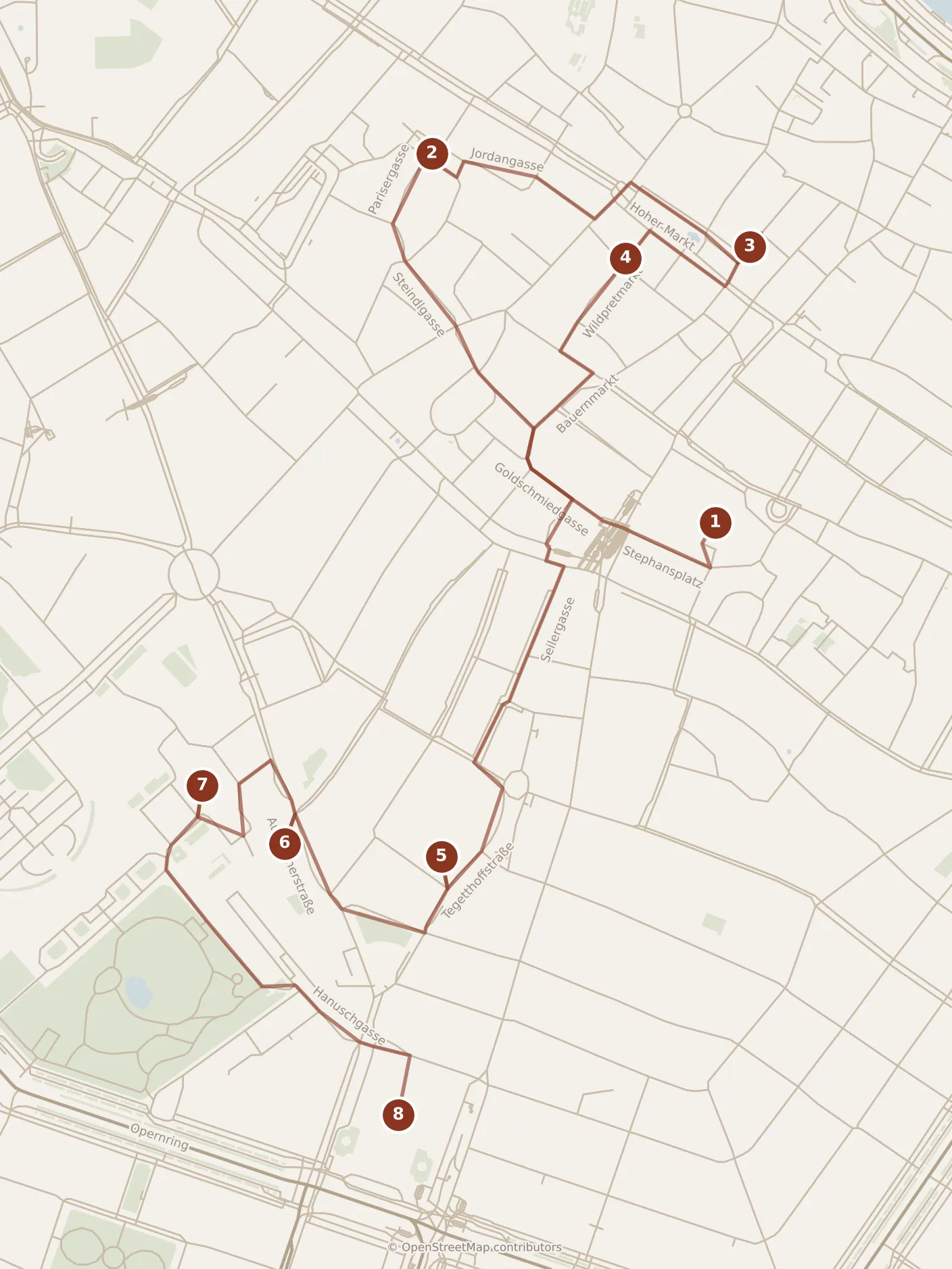
- Day one
- 1Stephansdom
- 2Judenplatz
- 3Ankeruhr
- 4Römermuseum
- 5Kapuzinergruft
- 6Augustinerkirche
- 7Prunksaal
- 8Wiener Staatsoper
Today is the old town read from the bottom up, and it is arranged that way on purpose: you meet the Romans, the medieval city and the Habsburgs’ own dead before you meet a single state room. Everything is within about seven hundred meters of the cathedral. You will cross the Graben and Kohlmarkt several times without planning to — they are simply the streets between the things below, and they are better crossed than scheduled.
Morning
First, the leg nobody describes. Until the end of October 2027 the airport trains do not reach Wien Mitte, because the central S-Bahn line is closed for works; the quickest way in is a railjet to the Hauptbahnhof, about fifteen minutes nonstop. From the Hauptbahnhof it is three stops on the U1 to Stephansplatz with no change; from Westbahnhof, five on the U3. All of them surface in the station under Stephansplatz, which puts you out on the square with the cathedral in front of you, which is where the day starts.
Go past the nave to the catacombs. The meeting point is signposted inside, down a stair off one of the side aisles, and a notice beside it posts the next departure — the first thing to look at when you walk in. In 2026 the first tour of the day left at ten from Monday to Saturday, and on a Sunday nothing went down before the early afternoon, because the cathedral gives its mornings to services. Build the morning back from whatever the first tour is when you go, and if the hour has moved, build it back from the new one. Below there are two crypts: a fourteenth-century one under the high altar, and a darker eighteenth-century warren of some thirty chambers holding around eleven thousand people, including a plague pit. In the older part are copper urns holding the internal organs of the Habsburgs, and that is the first third of an arrangement this afternoon completes. It is a working burial place, photography is not allowed, and there are a great many stairs. Give it the tour’s own length and no more.
Nine minutes north-west is Judenplatz, and its center is a windowless concrete box the size of a small room: Rachel Whiteread’s Nameless Library, unveiled in 2000, cast as library shelves turned inward so that no spine can be read, with double doors that have no handles. Beneath the square are the excavated foundations of the Or-Sarua synagogue, burnt in the persecution of 1420 and 1421, reached through the Misrachi-Haus on the same square, where the Museum Judenplatz also lists the names of roughly sixty-five thousand murdered Austrian Jews. The museum closes on Saturdays, for the Sabbath: the square and the memorial are outdoors and open whenever you arrive, the synagogue underneath is not. Give the two together three-quarters of an hour.
Six minutes east brings you to Hoher Markt and to the day’s other fixed point. The Ankeruhr, a copper-and-enamel bridge slung between two office buildings, designed by Franz Matsch and finished in 1915, slides a single historical figure across its face each hour. At noon it runs all twelve in procession, each to music of its own period, and the whole parade takes about ten minutes. Marcus Aurelius goes first and Joseph Haydn last. At any other hour you get one figure and a gong, so if you cannot be here at twelve, do not come back for it.
Then down the steps beside the same square into the Römermuseum, built on the excavated floors of two officers’ houses of Vindobona, the legionary camp that stood here — the camp where Marcus Aurelius is said to have died in 180, ten minutes after you watched him cross a clock face, which is roughly the order in which this city hands you its history. Underfloor heating channels, a length of drain, the domestic trash of a garrison. Three-quarters of an hour. Like the city’s other municipal museums it closes on Mondays, which is one of the reasons the last section keeps day one off a Monday.
Afternoon
Eat somewhere plain in the lanes around Hoher Markt, and the afternoon is a long one on the feet.
Twelve minutes south, on Neuer Markt, an unremarkable friary door leads down into the Kapuzinergruft, where the Habsburgs put their bodies. A hundred and forty-five of them, twelve emperors and eighteen empresses, in copper and tin coffins that grow steadily more theatrical through the eighteenth century and then stop: Maria Theresa and Francis Stephen share an enormous double sarcophagus with the pair of them modeled reclining and turned towards each other, while in the same vault her son Joseph II lies in a plain copper box, unembalmed, having legislated against exactly the kind of display his mother is lying in. Franz Joseph, Elisabeth and their son are together in a bay of their own, and it is the one people leave flowers at. The most recent burial here was in 2023. The Capuchins of the church above still keep it, and it behaves like a vault in use rather than a museum: quiet, and not a place to work through with a camera. Three-quarters of an hour.
Local tip. The organs, the hearts and the bodies were separated at death and sent to three different churches, and this day passes all three. If you have time for only one, take the Kapuzinergruft: it is the only one you can walk into without a tour or a request, and the only one that holds the people rather than a part of them.
Three minutes west, on the corner of the Hofburg, the Augustinerkirche is the church the Habsburgs married in — Maria Theresa, Franz Joseph and Elisabeth, and Marie Louise to Napoleon, who did not attend his own wedding and sent a proxy. Their hearts are in the Herzgruft behind a side chapel here, in silver urns, and it is not routinely open. Go in anyway, for Antonio Canova’s monument to Maria Christina: a white marble pyramid with a black doorway cut into it and a procession of mourners walking in and not coming out, which is one of the strangest and best things in the city and costs nothing. Twenty minutes.
Two minutes on is Josefsplatz and the Prunksaal, the state hall of the national library. Fischer von Erlach began it in 1721 and his son finished it after his death: nearly eighty meters of room, wall to wall in dark shelving under a frescoed dome, marble emperors down the middle, four enormous globes by Vincenzo Coronelli standing on the floor, and something like two hundred thousand baroque books shelved where they were put — including the fifteen thousand volumes Prince Eugene of Savoy left behind. Daniel Gran’s frescoes divide the room into war and peace and you can see the seam. It is a room rather than an exhibition, and forty-five minutes is enough to have been in it properly. In 2026 it shut on Mondays between October and May and stayed open through them in summer. The Globe Museum in the same building is a separate visit and not one this day has room for.
Evening
Seven minutes south, the Wiener Staatsoper sells five hundred and sixty-seven standing places for each performance, on the day, eighty minutes before the curtain, at a window of its own rather than at the main box office — it is signposted, and by the time it opens the line in front of it is what you are looking for. The house plays a repertory of fifty or sixty operas across more than three hundred and fifty performances a year, so there is something on most nights of the season, and the point is less which one than the room you are standing in: the auditorium burned in March 1945, and what reopened with Fidelio in November 1955 is a rebuild, so the house is a good deal older than the room inside it. The house publishes its season’s program, and the hour the curtain goes up is not the same every night, so look up both before you fix which weekday day one falls on — the eighty minutes count back from the curtain and not from an hour you can assume. This is why the afternoon above stops where it stops: be in line with time in hand rather than arriving as it starts moving.
Eat in the gap between the last room of the afternoon and the line, not after the curtain: the eighty minutes before it are spent standing in line. Go to one of the old dining rooms in the lanes between here and the cathedral, where Tafelspitz is the plate to order — boiled beef brought in its own broth, with a vocabulary of named cuts behind it.
Two things break this evening and both have a real replacement. If there is nothing on the night you are here, the Albertina is three minutes back the way you came and stays open until nine on two evenings a week — Wednesday and Friday in 2026, and it publishes those itself. Its Habsburg state rooms and the Batliner collection of Monet to Picasso are a full evening; do not go for the Dürers, which come out only occasionally, because they cannot take the light. And the house is dark through July and August, when the honest answer is not another ticket at all: walk twenty minutes north-east to the Danube Canal, or take the U1 two stops from Karlsplatz to Schwedenplatz, and eat outdoors on the water.
Day two

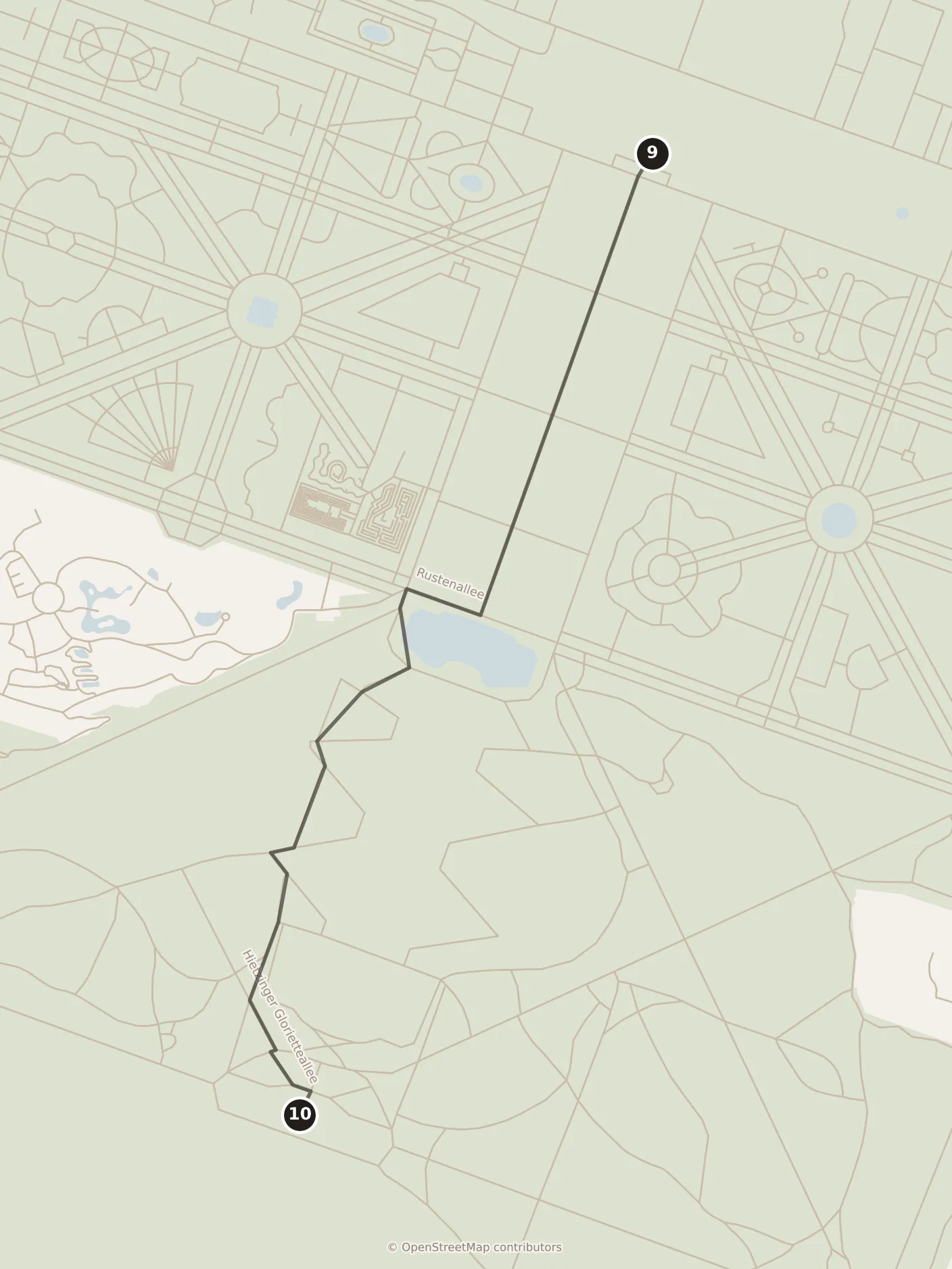
- Morning
- 9Schönbrunn
- 10Gloriette
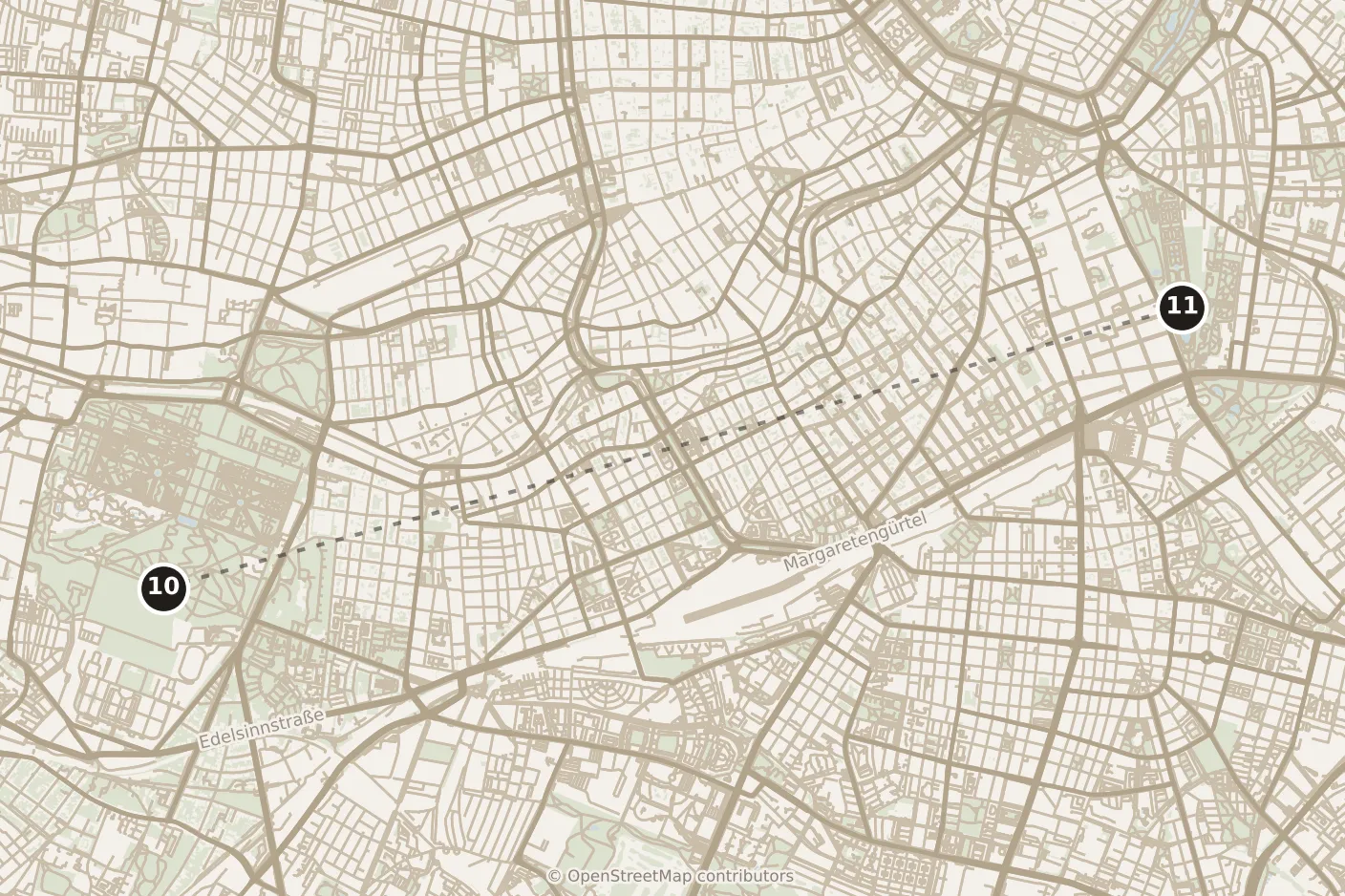
The leg out of the center: from stop 10 by metro, not on foot.
- Afternoon
- 11Upper Belvedere
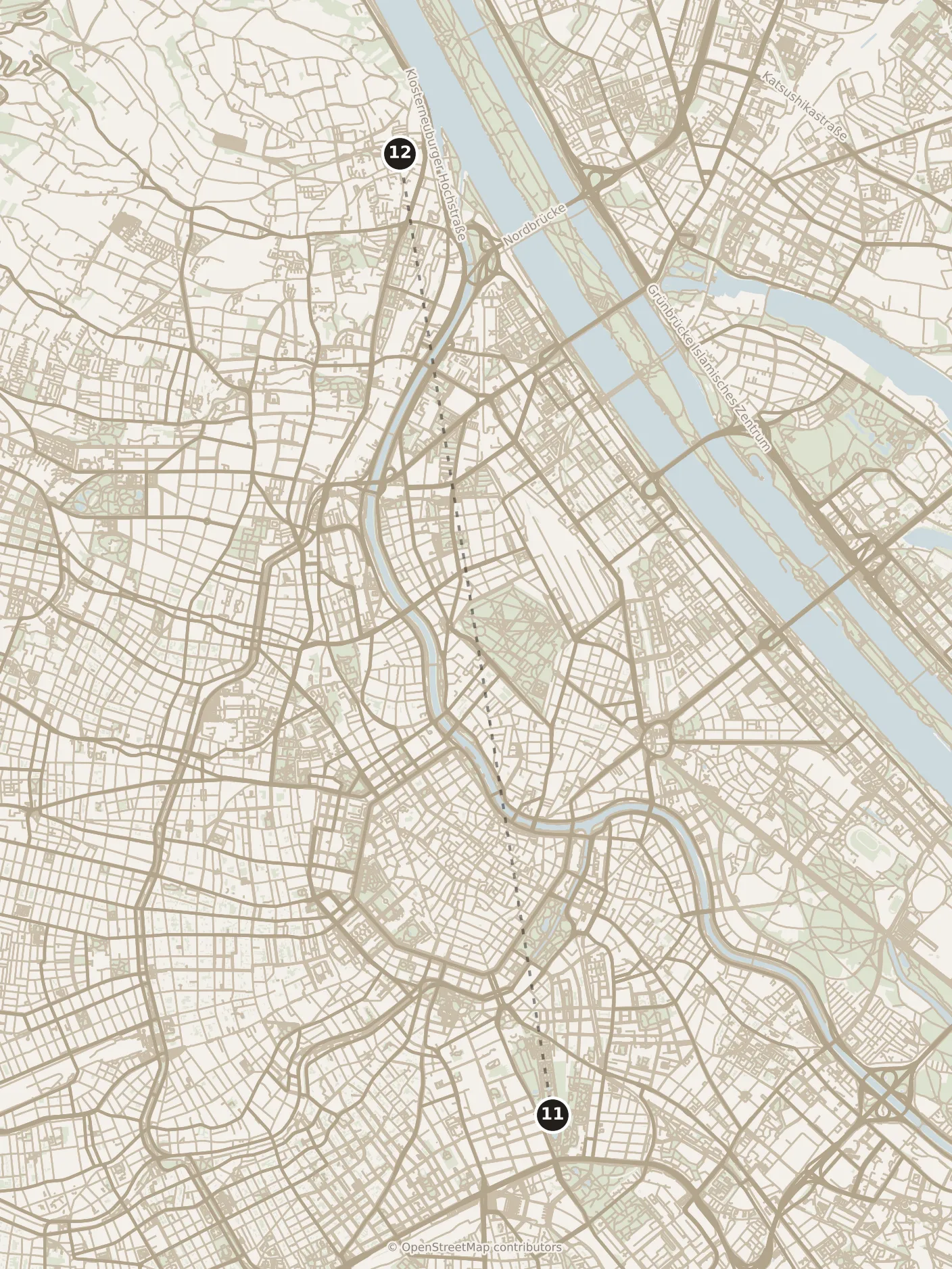
The leg out of the center: from stop 11 by tram, not on foot.
- Evening
- 12Nussdorf
Two palaces, both outside the Ring, in the order that makes the transport work: west first while you are fresh, then back across the center and out to the south-east, then a long tram ride north to sit down. The day has no hinge in it — neither palace takes a weekly closing day, which is unusual here — so it is anchored at the front instead. Take the earliest palace slot you can get, because everything after it is untimed and will expand to fill whatever is left.
Morning
The U4 runs west to Schönbrunn; the station is a few minutes from the main gate, and Hietzing, one stop further, puts you at the garden’s other side if that suits where you slept. The palace sells its interior as timed entry and you should have bought it before leaving home: in summer and on weekends the slots go weeks ahead, and the walk-up counter is a line with nothing at the end of it. It was in the twenty-to-forty-five-euro range in 2026, depending which of the two lengths of route you take, and the difference between them is the whole decision. The shorter one gives you the ceremonial rooms and stops. The longer one goes on into Maria Theresa’s own apartments — the Vieux-Laque Room panelled in black lacquer, and the Millions Room, rosewood walls inset with Indo-Persian miniatures cut up and reassembled into rococo cartouches — and those rooms are the reason to go inside a palace whose outside is free. On the way, the Great Gallery runs the length of the garden front, gilded and chandeliered, and the Hall of Mirrors, a smaller room on the same floor, is where a six-year-old Mozart played for Maria Theresa in 1762. The longer route is timed at about seventy-five minutes.
Then out of the back of the palace into the park, which costs nothing and is the better half of the morning. Ahead of you the ground rises about sixty meters to the Gloriette, a colonnade Maria Theresa put on the crest in 1775 and built of stone carted from a palace she had demolished for the purpose. It is roughly twenty minutes up a path that switches back, less coming down, and from the front of it the palace lies below with the whole city behind it. The terrace on its roof is separately ticketed, and so are the maze and the walled privy garden; the park itself, the Neptune fountain under the hill and the folly of a Roman ruin off to one side are free. Give the park an hour and a half including the climb.
Local tip. The Gloriette’s roof terrace has a ticket, and a café underneath it. The view everyone climbs for is from the gravel in front of the building, a few meters lower and free, and it is the same city.
The zoo takes up the park’s western corner and was founded in 1752, which is old enough that it is generally called the oldest surviving zoo in the world. It is a good one and it is a separate half-day: take it instead of the palace interior if you have children, not as well.
And this is the morning the Overview’s swap replaces, now that you know what it holds: if the paintings matter more than the palace, give these hours to the picture gallery on Maria-Theresien-Platz instead of riding west, and pick the afternoon up unchanged by boarding tram D at Burgring, three minutes from the museum steps, instead of at Karlsplatz. Day one and the rest of day two are untouched.
Afternoon
Back on the U4 to Karlsplatz, up at the opera, and tram D from there to Schloss Belvedere, which sets you down at the upper palace’s own gate. Reckon on the better part of an hour door to door with the change, and put the day’s one meal into it: the change is the last ordinary street this day passes through, and both palaces leave you with their own cafés or with nothing at all until the tavern tonight. Allow three-quarters of an hour for eating on top of the hour of traveling.
The Upper Belvedere was Prince Eugene’s summer showpiece — he entertained here and lived elsewhere — and is now a picture gallery that most people come to for Klimt. The Kiss is here, and Judith, and it is worth knowing before you go in that The Kiss hangs in a room usually three deep in people and that the paintings on either side of it are better than the crowd around them suggests. Schiele hangs in the same rooms, which is the pairing that actually explains the city. This is also the building where the Austrian State Treaty was signed on 15 May 1955, and where the foreign minister carried the document out onto the balcony afterwards to show it to the crowd below. Two hours does it.
Then leave through the garden rather than back to the tram. It steps down in terraces towards the Lower Belvedere, where the prince actually lived, and as you go the city opens in front of you — the parterres, the low palace, the old town’s spires beyond. That is the view Bellotto painted in about 1760 from close to where you are standing, and the painting itself hangs in the picture gallery this itinerary asked you to give up, unless you took the morning’s swap and spent those hours in front of it. Twenty minutes, and it is free.
Evening
Walk back up through the garden — ten minutes, and the terraces read differently going the other way — to the stop you arrived at, and take tram D the opposite way, to the end of the line at Nussdorf, Beethovengang. It is the better part of forty minutes — the western half of the Ringstrasse, and then a long climb out through the inner suburbs — which after a day of palaces is a fair way to spend the time sitting down.
Nussdorf and the villages beside it are inside the city and are still wine country, and the Heuriger is the tavern a grower opens to sell their own year’s wine. The traditional ones do not open continuously — they take turns, a few weeks at a time — and the sign that one is pouring is a bundle of fir twigs, a Buschen, hung above the door, so walk the Kahlenberger Strasse, which is the street the taverns are on, reading doorways rather than aiming at an address; several of the larger places nearby trade all year and will be obvious. Inside, the custom is not a restaurant’s, and nobody will explain it: you wait in line at a counter for the food, pay for it there, carry the plate to a table you may well be sharing, and order the wine from the table afterwards. Ask for a Brettljause — cold cuts, spreads and bread on a board — and some Liptauer to go with it.
If the day has run long, this is the piece to drop rather than compress: it is an evening in its own right, and tram D runs back the way it came, on past the Belvedere to the main station.
With a third day

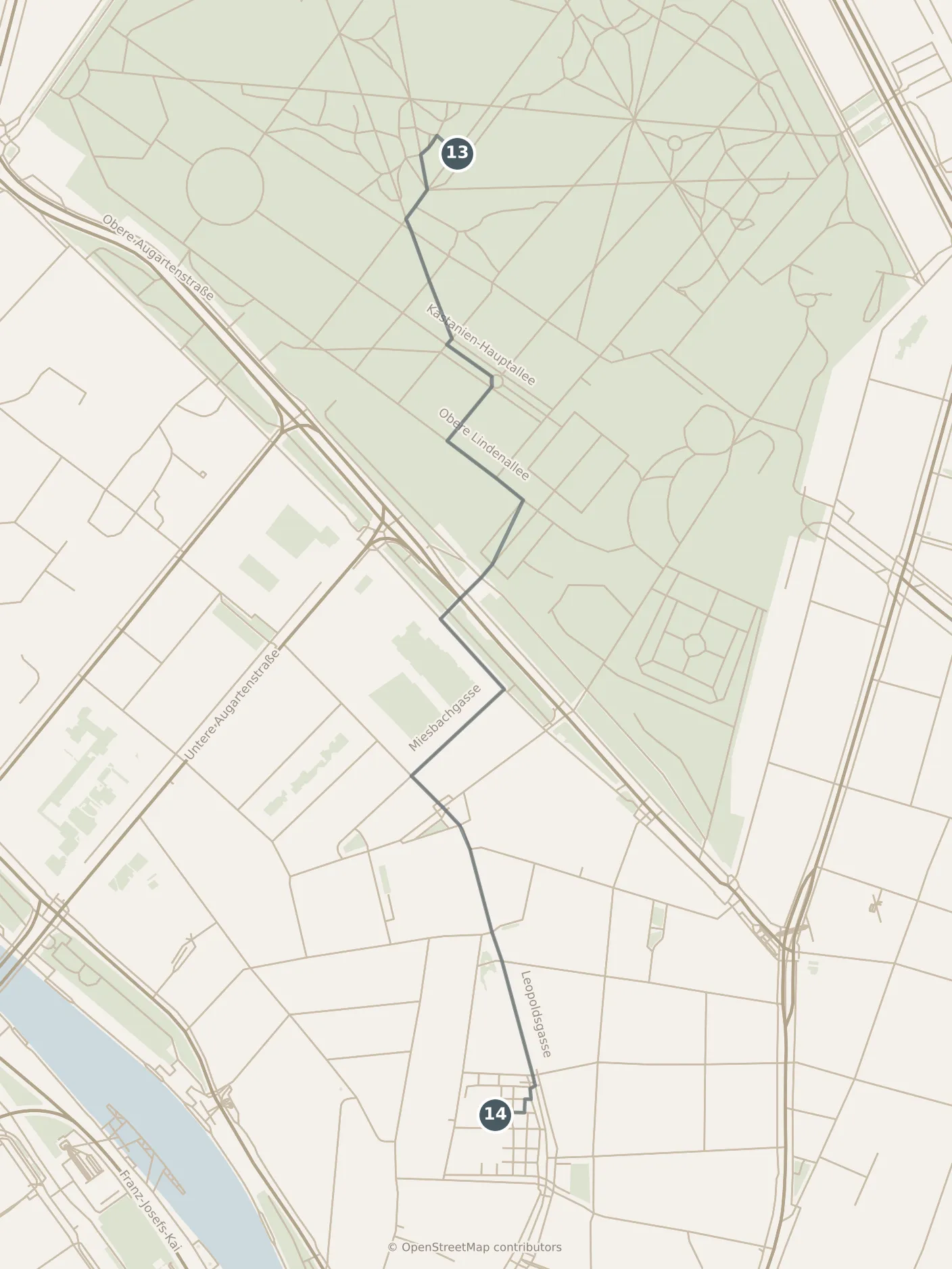
- With a third day · stops 13–14
- 13Augarten
- 14Karmelitermarkt
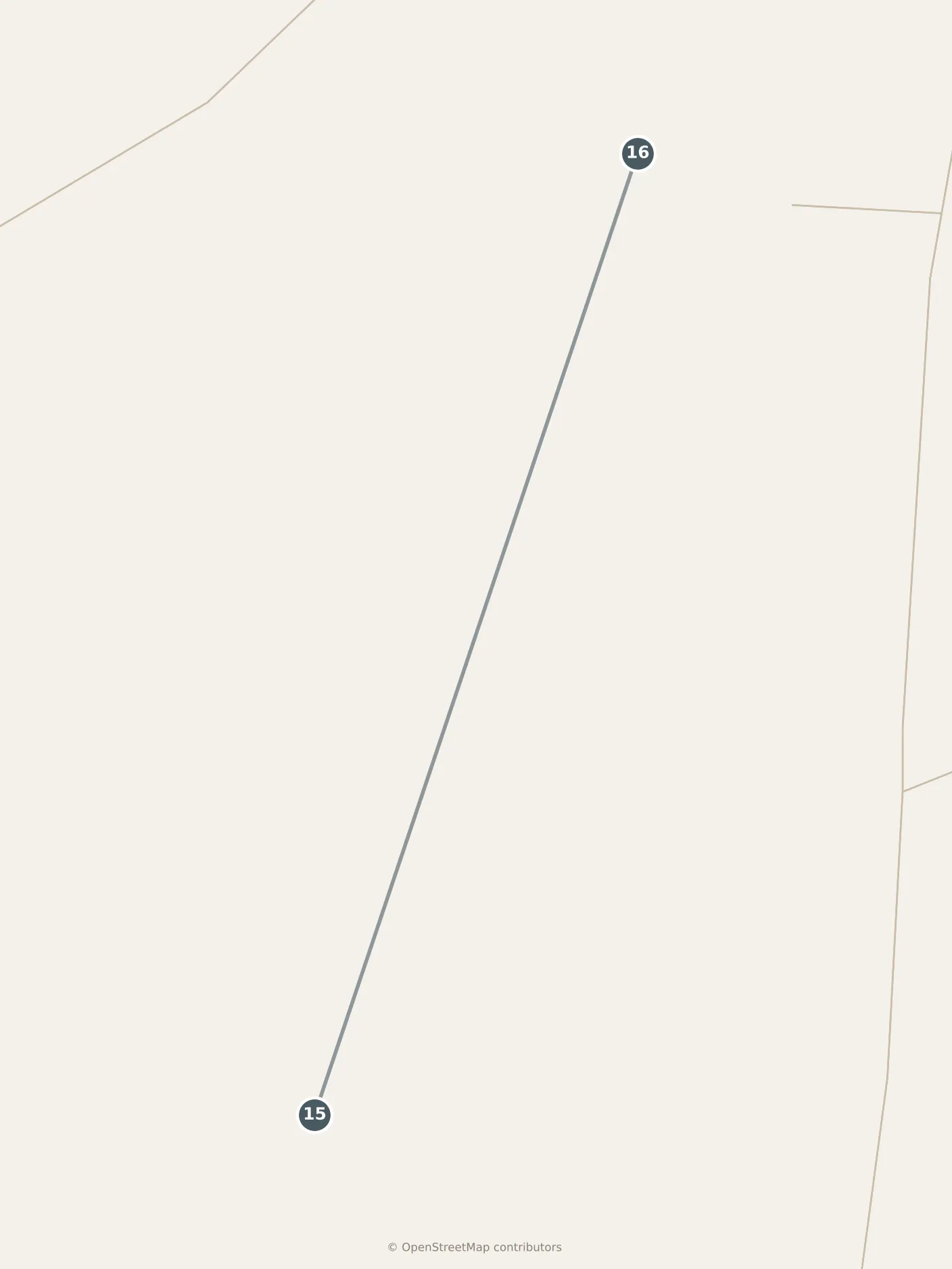
- With a third day · stops 15–16
- 15Prater
- 16Wiener Riesenrad
A third day is not more of the same, and it should not go at the end. It goes in the middle, and what it adds is the Vienna that is not the empire: the flat green half across the Danube Canal that the same Joseph II who lies in the plain copper coffin gave away to the public in the 1760s and 1770s, while his mother was still building Gloriettes. It is the day with nothing to book in it — the one ticket it holds is bought at the door — and it is the loosest of the three on dates: any day but a Sunday, when the market square that carries both its lunch and its dinner is shut. Day one wants a particular weekday for the reasons the last section sets out, and day two is pinned to whichever palace slot you could get, so in practice this one goes into the hole the other two leave. Nothing else moves when you insert it: the numbering shifts and the wine village stays attached to the palace day wherever that lands.
Start at the Augarten, which is the U2 to Taborstrasse — one stop past Schottenring — and then under ten minutes north on foot. It is the oldest baroque garden in the city, opened to everyone in 1775 with an inscription over the gate dedicating it to all people by their admirer, and it is fifty-two hectares of straight avenues that still meet where they were planted to meet. Standing in the middle of them are two concrete anti-aircraft towers, one fifty-five meters and one fifty-one, begun in the summer of 1944 and never finished, still there because nobody has worked out how to take them down without taking the district with them. That juxtaposition is the reason to come, and walking it takes about an hour. The porcelain works and the Vienna Boys’ Choir both occupy buildings in the park; neither has to be visited for the walk to work.
Twenty minutes south is the Karmelitermarkt, a square of stalls in the Karmeliterviertel that is a neighborhood market rather than a produce showcase — greengrocers, a fishmonger, half a dozen counters with tables outside them. Lunch goes here, at a counter rather than at a terrace. It shuts on Sundays entirely; on Saturday mornings a farmers’ market sets up alongside it and the square is at its best, which is convenient, because Saturday is precisely the day that day one cannot use.
Nestroyplatz, eight minutes east of the market, is one stop on the U1 from Praterstern; on foot the whole way is twenty-odd minutes, due east. Either way you arrive at the Prater. It is not a funfair with a park around it but a former imperial hunting ground of enormous size, thrown open in 1766, with the funfair — the Wurstelprater — occupying the one corner of it beside the station. The rest is the Hauptallee: about four and a half kilometers of chestnut avenue running dead straight from Praterstern to the Lusthaus, cut in 1538 so that the emperor could ride from the Augarten to his hunting. You do not walk all of it. Walk twenty minutes down it, far enough that the noise of the fair stops and the trees close over, and turn round. An hour and a half in the Prater, including that walk and a look at the fair, which was flattened in 1945 and rebuilt smaller — the old Vienna on this day is the avenue and the wheel, not the rides. The fair also has a season: it runs from the middle of March to the end of October, and outside that only whatever chooses to open on a mild day, so a winter version of this day is the garden, the market, the avenue and the wheel, and the hour and a half here becomes the walk alone.
Finish on the Wiener Riesenrad, back at the gate you came in by. It went up in 1897 for the emperor’s golden jubilee, engineered by a British team, sixty-five meters high; it carried thirty wooden cabins until the war and fifteen since, because only half were replaced when it was rebuilt. It is not a viewing platform and should not be treated as one — the city is flat and sixty-five meters does not conquer it. What you are buying is one slow revolution in a wooden room the size of a small tram, and the last of the daylight is when to buy it. Counting backwards: the garden, the market, lunch and the Prater come to about four hours with the walking between them, so take your month’s sunset hour out of the band in the Overview and subtract four — or three between November and the middle of March, when the fair is shut and the Prater is the walk alone. In December that means being at the Augarten gate by about one; in June it means the day is yours and you can walk the Hauptallee properly. That sum covers the stops and the walking between them and nothing else — it does not include the line at the wheel, which on a summer weekend is the one wait on this day worth planning around.
Dinner goes back in the Karmeliterviertel, twenty minutes west on foot or one stop back on the U1, where the square you had lunch on has a second life after dark.
If the day is wet, the honest replacement is not another park. From Praterstern the U1 runs to Karlsplatz, and the picture gallery on Maria-Theresien-Platz is a quarter of an hour north-west of there on foot — which is the museum the two-day version had to give up, so a rained-off third day quietly hands back the thing the Overview said you would lose. Take the Bruegel room first and the Egyptian wing not at all.
Practicalities
Day one is the pinned day, and these are the rules it was pinned by. It cannot be a Saturday, because the Museum Judenplatz closes for the Sabbath and the synagogue foundations are the morning’s point. It cannot be a Sunday, because the cathedral gives its mornings to services and the catacombs do not go down until the afternoon, which collapses the shape of the day. It cannot be a Monday, because the Römermuseum closes on Mondays all year, and between October and May the Prunksaal shut on Mondays too in 2026. That leaves Tuesday to Friday — and of those, Wednesday and Friday are the two on which the Albertina stays open late, which is the evening’s fallback if there is no performance. So: a Wednesday or a Friday, and if neither is available, any of Tuesday to Friday works with the pieces above. Day two will take any date at all; the third day will take any but a Sunday, when the market square that carries its lunch and its dinner is shut, and it is simply better on a Saturday.
The one thing to book before you travel is the Schönbrunn palace slot. Everything else on these days is free, bought at the door, or bought by standing in line: the crypts, the Roman museum, the state hall, the Belvedere and the wheel all sell at the door, and the opera’s standing places cannot be bought in advance at all. If you want a seat at the opera rather than a standing place, that is weeks ahead and a different kind of evening.
If you are short and something has to go, cut in this order. The Römermuseum goes first: it is the smallest of day one’s interiors, and the two things above it on the same square — the clock, and the square itself — cost nothing and lose nothing by being seen without it. Next is the Gloriette climb, which is about half an hour of the palace morning and gives you a view rather than a thing; the park below it is free and flat and most of the pleasure. What should not go is the Kapuzinergruft, forty-five minutes that make the cathedral catacombs and the Augustinerkirche mean something.
The bag. Unlike a day trip, this itinerary assumes you have a room, so the bag matters exactly twice. On the arrival morning, if you land before check-in, note that the first stop of day one is a stair down into a crypt in a guided group, which is the one thing on these three days you cannot do holding a case. The main station has left luggage; and because every airport train calls at a station within two subway stops of the center, going on to wherever you are sleeping and leaving the bag there costs about half an hour and beats looking for a locker. Make that detour before the cathedral rather than after, because the tour times, not you, decide when the morning starts. On the departure afternoon the geography is kind — tram D runs from the Belvedere gate on past Quartier Belvedere to the main station, so a day two that ends at the palace ends two stops from the trains.
Moving between the stops this article names. Day one is walked end to end and needs no transport once you are in the center. Day two is the U4 out to Schönbrunn and back to Karlsplatz, then tram D, which does the evening as well: one tram, no change, from the Belvedere gate to Nussdorf. The third day is the U2 to Taborstrasse at the start and one stop on the U1 in the middle, and the rest of it is on foot.


