Vienna in one day: the imperial core on foot, then out past the Ring

Last updated 3 August 2026
Overview
Vienna’s one-day problem is not distance. It is that the city’s famous buildings were put up by people who owned the whole of it, so they are scattered on purpose: the winter palace in the middle, the summer palace at the end of a subway line, a third in its own park to the south-east. Trying to see all three is how a single day here becomes a day of traveling between gates.
The way out is to take the winter palace and give up the other two. Everything below sits on a loop of about four and a half kilometers’ walking, from the cathedral at the dead center of the old town, out south-west across the Ringstrasse, and into the districts immediately beyond it. Nothing is more than a quarter of an hour’s walk from the thing before it, the route never turns back on itself, and it needs no transport at all between its stops.
What that costs, plainly. Schönbrunn is half a day before you have waited in line for anything, and the park is the better half of it, so it does not compress. The Belvedere is the harder loss, because it holds Klimt’s The Kiss — and if that painting is why you came, swap it in deliberately rather than hoping this route grazes it; there is a note on how in the last section. The Prater and its wheel, and the wine taverns out on the northern hills, are each an evening in their own right and neither is near anything else here.
It also costs you the second museum. There are a dozen good ones inside this loop and the whole discipline of one day is to enter exactly one of them, unhurried, rather than three at a trot. The one this day takes is the picture gallery in the Kunsthistorisches Museum, and it is also the day’s only fixed point: everything else on the route is a street, a square, a garden, a market or a church, and none of them minds what hour you turn up. The gallery does. It wants the last two unhurried hours before it shuts, and everything above it — the cathedral, the walk west along the shopping streets, the treasury, a coffee house, the opera and the domed church past it, and lunch at the market — comes to about six hours with the walking between. Eight hours before the gallery closes — six for everything above, plus the gallery’s own two — is therefore when to be standing at the cathedral door, which for most of the week means starting near opening time.
The day

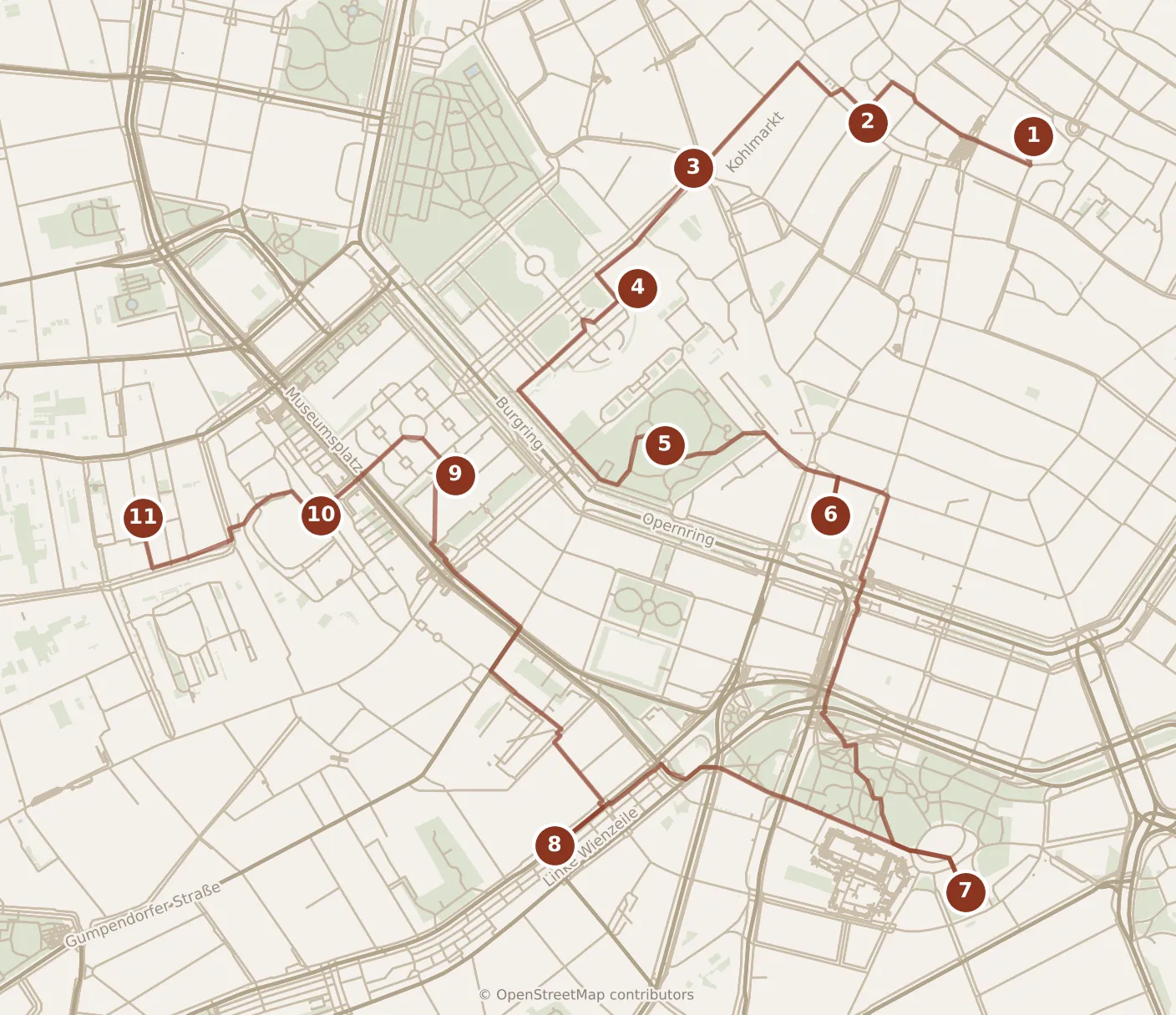
- The day
- 1Stephansdom
- 2Graben
- 3Michaelerplatz
- 4Hofburg
- 5Burggarten
- 6Wiener Staatsoper
- 7Karlskirche
- 8Naschmarkt
- 9Kunsthistorisches Museum
- 10MuseumsQuartier
- 11Spittelberg
Morning
Start at Stephansdom, in the middle of the old town, and look at the roof before you go in. It carries about a quarter of a million glazed tiles laid in zigzags, with the double-headed eagle of the empire picked out on one slope and the arms of Vienna and Austria on the other — and it is easy to leave the square without ever having walked round to see it whole. The nave is free as far as the barrier a little way in, which is enough to read the building: a Gothic hall the color of soot and honey, most of it fourteenth and fifteenth century, with a carved stone pulpit against one of the piers and a man’s figure leaning out of a window beneath its staircase, traditionally read as the sculptor watching his own work. Give the interior half an hour.
The two towers are separate decisions and only one is worth it with a single day. The south tower is a climb of three hundred and forty-three steps up a stone spiral with no elevator and no landing to rest on, and the reward is the tiled roof from directly above and the city flat all round it. The north tower was never finished, has an elevator, and delivers you to the Pummerin — a bell recast in 1951 from the fragments of the one that fell when the cathedral burned in 1945, the original having been cast from captured Ottoman cannon. If you want height, climb the south tower and give it half an hour; if you want the bell, the elevator takes ten minutes of your day. The catacombs beneath, seen only on a guided tour, hold the Habsburgs’ internal organs, which were separated at death from their hearts and their bodies and distributed across three churches in this city. It is a good hour and this day does not have it — but the fact reframes the palace you are about to walk to.
Four minutes west and you are on the Graben, which was the ditch of the Roman camp and is now the broad, grand shopping street at the center of the old town. In the middle of it stands the Pestsäule, a writhing gilt cloud of marble that Leopold I vowed during the plague of 1679 and finished in 1693 — a monument to an epidemic, built as thanks for its ending. A short way along, and much easier to miss, a stairway leads down to a public lavatory of 1905 fitted out by Adolf Loos in polished wood, brass and etched glass, and still in use as one. Walk the length of the street and turn left down Kohlmarkt.
That brings you out at Michaelerplatz, which is a five-minute stop and a lesson. On one side is the domed gate of the Hofburg, imperial architecture at its most emphatic; directly facing it is the Looshaus of 1911, the same Loos again, whose upper floors are flat plaster with no mouldings at all above the windows. It was a scandal — the story that Franz Joseph took to using a different gate is probably too good to be true, but the offense was real, and the two buildings arguing across a small square is the clearest thing in Vienna about what the twentieth century was going to do. In the middle of the square a sunken pit exposes Roman foundations and later cellars, left open under the paving.
Then into the Hofburg itself, which is not a building but eight centuries of them joined together, and is still the working seat of the country’s president. Three separate collections inside sell three separate tickets, and with one day you buy one. Buy the Schatzkammer. It holds the regalia of the Holy Roman Empire — a tenth-century crown of eight gold plates, the Holy Lance, and a coronation mantle embroidered in Palermo in the 1130s for Roger II with an Arabic inscription still running round its hem — alongside Rudolf II’s own imperial crown, an agate bowl once thought to be the Holy Grail, and a narwhal tusk kept for centuries as a unicorn’s horn. These are objects that exist nowhere else. The Kaiserappartements next door, with the Sisi rooms attached, are furnished nineteenth-century apartments of a kind a dozen European palaces can show you. Give the treasury ninety minutes.
Local tip. The three Hofburg tickets are not a set and nothing rewards buying two: the treasury, the imperial apartments and the riding school are separate visits in separate wings. If you have never seen the imperial regalia, take the treasury; if you would rather see rooms people actually lived in, take the apartments; and if the line at either would cost you this afternoon’s gallery, take neither and walk through the palace courtyards, which are free, open and on your way out regardless.
Before you leave the center, sit down in a coffee house. This is not a detour on this day, it is where the middle of it goes: order a Melange, take the paper off the rack, and give it half an hour, because the second half of this route has no comfortable pause in it until dinner.
Afternoon
Leave the palace by its south side into the Burggarten, the emperors’ private garden until 1918 and public since. There is a Mozart monument with a treble clef laid out in bedding plants in front of it, and along one flank a long iron-and-glass palm house of the early 1900s, part of which is a heated butterfly house with its own ticket. Ten minutes, unless the butterflies tempt you, in which case half an hour.
Cross the Ringstrasse to the Wiener Staatsoper. From outside it is a lesson in what 1945 did: the loggia and the front rooms are the original 1869 building, and everything behind them was rebuilt after the house was gutted by bombing, reopening in 1955. This is the one stop that can rearrange your evening. Guided tours of the house are the way in without a ticket for a performance, and on a performance night a standing place is sold on the day for a fraction of what a seat costs, with a line that forms before they go on sale. The season runs roughly autumn to midsummer and the house is dark through the hottest weeks, so if this matters to you, find out before you plan the rest of the day rather than after.
Twelve minutes south across Karlsplatz — pausing at the two green-and-gold iron pavilions Otto Wagner built for the Stadtbahn in the 1890s, one of which is now a small museum — brings you to the Karlskirche, at the far side of a shallow reflecting pool with a Henry Moore sculpture in it. Fischer von Erlach began it in 1716 on a vow Charles VI made during the plague of 1713, and it is the strangest important building in the city: a Greek temple portico, a dome that reads as eastern, and two enormous free-standing columns carved with a spiralling narrative in the manner of Trajan’s, showing the life of Charles Borromeo. The Habsburgs were claiming every empire at once and said so in stone. The pool, the columns and the front are free and are most of the point; the interior is ticketed and worth twenty minutes if you want the frescoed dome from below.
From there walk west to the top of the Naschmarkt and down it. The market runs about half a kilometer along the vaulted-over course of the river Wien, and it is two markets in a row. The end nearest the square is restaurant terraces and menus in five languages; keep walking and it turns into a working food market — Turkish and Balkan groceries, cheese counters, barrels of olives and pickles, spice stalls. Lunch goes here, at a counter in the second half rather than at a terrace in the first. This is not where a Wiener Schnitzel belongs: that is a sit-down dinner and it comes at the end of this day. Give the market and lunch an hour together. The market stalls close for Sunday entirely — the restaurant terraces at the city end trade on, but they are the half this lunch avoids — and on a Saturday its far end becomes one of the biggest flea markets in the city, which is a good reason to come and a bad day to be in a hurry.
Ten minutes north up Getreidemarkt is the Kunsthistorisches Museum, and this is why the morning had to keep moving. It opened in 1891 to hold what one family had accumulated over four centuries, and that provenance is the thing to understand about it: it is not an encyclopaedic museum assembled by purchase, so it is extraordinarily deep where the Habsburgs collected and thin where they did not. Go up the great staircase to the Picture Gallery on the second floor and go to the Bruegel room first, before anything else — around a dozen of his surviving panels are here, more than anywhere in the world, including Hunters in the Snow, The Tower of Babel and The Peasant Wedding, and it is the room the building exists for. Then Vermeer’s The Art of Painting, and the Velázquez portraits of Habsburg children, which were painted in Madrid and posted to Vienna as marriage-market likenesses. Downstairs in the Kunstkammer is Cellini’s gold salt cellar, stolen from this building in 2003 and recovered three years later from a wood. Skip the Egyptian and Greek wings unless you have an hour spare; they are good and they are not what makes this place. Two hours is the right amount to give it with one day.
Evening
Come out onto Maria-Theresien-Platz, where Maria Theresa sits in bronze between two identical palaces — the museum you have just left and the Naturhistorisches Museum facing it, built as a matched pair so that neither took precedence. Cross it westwards and you are at the MuseumsQuartier, the imperial court stables of the 1720s with modern galleries dropped into the yards behind the old frontage. The Leopold Museum in there holds the Schiele collection and mumok the modern one, and both will be closed by now, which is fine: the courtyards are the evening. They are full of moulded plastic loungers, repainted in a new color from time to time, and people sit on them with something from the kiosks until late. Half an hour of sitting down, which by this point in the day you have earned.
Five minutes north-west, across the road behind the quarter, is Spittelberg: a small grid of low Biedermeier houses on cobbled lanes that was a garrison suburb and then a brothel quarter, was scheduled for demolition, and was restored instead from the 1970s. It is the right end to the day because it is the first place on this route that was not built to impress anybody. Dinner goes here, in one of the old panelled dining rooms in the lanes, and this is where the Wiener Schnitzel comes in — veal, plain, the size of the plate — or Tafelspitz if you would rather eat what the emperor actually ate. In Advent these same lanes hold the best of the city’s small Christmas markets. When you are done, the subway at Volkstheater is five minutes back the way you came.
Practicalities
The one thing worth settling before you start is which of the Hofburg’s collections you are buying, because that choice is made at a counter with a line in front of it and it is the only ticket on this route that shapes the day. Everything else is free, or bought at the door on arrival: the cathedral nave, the Graben, both squares, the gardens, the outside of the opera and of the domed church, the market and the courtyards cost nothing at all. The gallery sells timed slots but rarely needs one. An opera seat is the exception in the other direction — that wants booking weeks ahead, and standing places are the only thing you can decide on the day. What a transport ticket costs and how it is paid for is in the city guide, and this day needs remarkably little of it: the route between the first stop and the last is entirely on foot, and the subway only carries you in at the start and out at the end.
Check the gallery’s closing day — and its closing hour, which is the number the whole count above hangs on — before you fix anything else. It is the one stop here with a weekly closure that would break the day as written, and the rule to know is that the great museums in this city commonly shut one day a week outside high summer while the streets, squares, churches and market do not. If your day falls on the closed one, do not go looking for a substitute museum on the other side of town — that is the swap that turns this walk into a commute. Give the hours back to the palace end of the morning instead, add the cathedral tower, and take a longer lunch.
Sunday changes two things and nothing else. The market does not open, which removes lunch from the plan, so eat in the lanes north of the Graben on the way through instead. And the cathedral holds services through the morning, during which the sightseeing part of it is restricted — arrive early, or start at the palace and pick up the cathedral afterwards, which the geography allows without any doubling back.
For The Kiss, the honest arrangement is a substitution rather than an addition. The palace that holds it stands in its own gardens about a quarter of an hour’s walk south-east of the domed church on this route — near enough to reach, far enough that it takes the afternoon. So take it instead of the picture gallery rather than as well: carry on south-east from the church rather than turning west to the market, eat near the palace afterwards, and ride back west for the evening, which is the one leg this day would otherwise not need. Trying to have both is how people end up seeing neither properly.
If you are between trains rather than staying, the main station has left luggage, and one subway line runs from it straight to Stephansplatz, three stops, no change. Start and finish at the cathedral instead of the seventh district and you have a compact loop with the station at both ends of it.


