Verona, 2-3 Days: the Arena, the Balcony and a Climb Above the Adige

Last updated 15 August 2026
Overview
Verona is a two-to-three-day city, built around a single bend of the Adige, and almost everything you came for sits inside that bend. Two days cover the old town properly: the Roman arena, the market square, the balcony everyone has heard of, and a climb across the river for the view that explains why the city sits where it does. A third day gives you what the first two deliberately leave out — the fortress the city’s medieval rulers built on the river, and the Romanesque church that outlasted them.
It suits arriving by train and staying on foot for the whole visit; nothing described below needs a car. Spring and early autumn are the easiest months to be here — comfortable walking weather and no particular crowd to plan around. Midsummer brings both the heat and an open-air opera season at the Arena that changes its daytime hours once the stage is up, which is worth knowing if seeing the interior is part of the plan.
One thing decides the shape of day three before you read it: Castelvecchio is a museum, and like several of the city’s paid sights it can close, or run shortened hours, one day a week. Check before a morning depends on it — San Zeno needs no ticket and can absorb the time instead if the fortress is shut when you arrive.
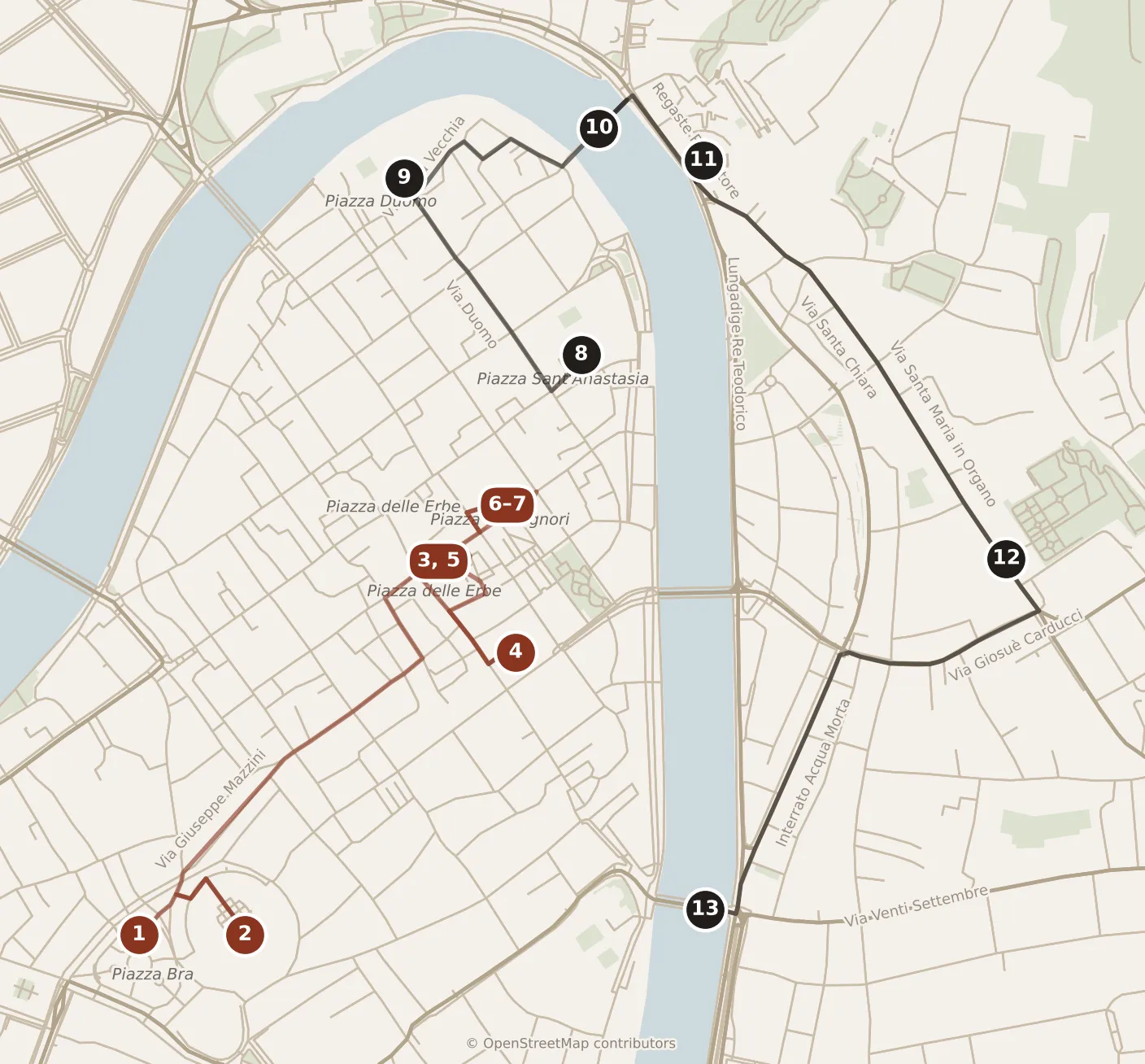
- Day one
- Porta Nuova — in the prose, not on the map
- 1Piazza Bra
- 2Arena
- Via Mazzini — in the prose, not on the map
- 3Piazza delle Erbe
- 4Casa di Giulietta
- 5Torre dei Lamberti
- 6Piazza dei Signori
- 7Arche Scaligere
- Day two
- 8Sant'Anastasia
- 9Duomo
- 10Ponte Pietra
- 11Teatro Romano
- Castel San Pietro — in the prose, not on the map
- 12Giardino Giusti
- 13Ponte Navi
Day one

Everything today is inside the old town’s central loop, on foot, and you never have to backtrack more than a street to reach the next thing.
Morning
Arrive into Porta Nuova and start walking: it is a straight run up Corso Porta Nuova into Piazza Bra, about twenty minutes on foot, or a short bus ride if the case is heavy. Piazza Bra is one of the largest squares in Italy and the Arena sits in the middle of it — start here rather than saving it for later, since the square is calmest before the day’s tour groups arrive.
The Arena is a Roman amphitheatre, and what you see from the square is only part of it: an earthquake brought down most of the outer ring in the twelfth century, leaving the surviving fragment locals still call the wing. Go inside. The stone tiers are intact enough to climb, and standing on them is what tells you this is a working building rather than a ruin — it has staged opera every summer since 1913, and once the festival season is under way the interior can close to sightseers well before evening to ready the stage, so check the hours on the day rather than assume the ones printed.
Leave the square up Via Mazzini, the pedestrian street that runs straight into the old center — ten minutes of shopfronts, no need to linger — and it opens directly onto Piazza delle Erbe. This was the city’s Roman forum and is now its market: stalls under umbrellas, frescoed façades on every side, a fountain built around a reused Roman statue, and a column topped by the winged lion of Venice, a reminder that Verona spent four centuries as a Venetian city rather than an independent one. Give it half an hour before lunch and treat it as the square you return to all day, since everything else this morning is a few minutes from it.
Afternoon
South down Via Cappello, three minutes from Piazza delle Erbe, Casa di Giulietta is the courtyard everyone recognizes: a bronze statue worn bright at one shoulder from being touched for luck, walls layered with graffitied notes, and a balcony above the doorway that made the address famous. It is worth saying plainly that the balcony itself was added in the twentieth century, assembled from an old stone sarcophagus lid to give the building’s Shakespeare connection something to look at — the association with Romeo and the story is what draws you here, not an artifact that predates the play. Ten minutes is enough unless the courtyard is busy, in which case it takes longer simply to reach the wall.
Back at Piazza delle Erbe, Torre dei Lamberti is the tower on the square’s north side, tall enough that its top clears every roofline in the old town; an elevator takes you most of the way up, stairs finish it. Give it twenty minutes and take it before the light gets flat — the view is the best orientation you get all trip: the river’s bend, the hill across it where tomorrow goes, and the old town laid out as the single loop it actually is.
Through the arched passage on the square’s far side — a whale rib hangs from the vault above it, unexplained and centuries old — Piazza dei Signori is quieter and more official than the market square: a statue of Dante stands at its center, ringed by the city’s medieval government buildings. Through the railings on its far side you can see Arche Scaligere without paying to enter: the funerary monuments of the della Scala family who ruled Verona through the 1300s, canopied tombs stacked with a Gothic excess that has no equivalent elsewhere in the city. A rider on horseback tops the tallest of them — a copy; the original has been moved indoors for its own protection, and day three goes to see it close up. Fifteen minutes at the railings is enough to take in what there is; the enclosure itself is not always open to walk into.
Evening
Stay in the center. The lanes east of Piazza delle Erbe are where the lunchtime crowd thins to locals once the day-trip groups leave — risotto made with Amarone, the region’s heavy red wine reduced into the rice, is worth ordering if you have not already, and it is very much a here dish rather than a Veronese cliché exported everywhere. There is no need to go looking further afield; today never left a five-minute radius of the market square, and there is no reason the evening should either.
Day two

Today crosses the river and comes back once, not twice: everything runs north from Piazza delle Erbe to the water, across it, up a hill, and down again on the same side before recrossing for the evening.
Morning
Corso Sant’Anastasia runs north out of the old center and ends at the church it is named for: Sant’Anastasia is the largest in Verona, Gothic, brick outside and cavernous within, and the detail worth finding just inside the door is a pair of hunchbacked stone figures crouched under the two front columns, each holding a holy-water basin on its back — a piece of medieval whimsy that has survived every restoration since. Give it twenty minutes.
A few minutes further is the Duomo, Verona’s cathedral, Romanesque below and Gothic above where later builders kept adding to it. Inside, on the first altar on the left, is Titian’s Assumption of the Virgin, painted for this specific space and still hanging in it — a reason to go in beyond the architecture. As with any working church, this and Sant’Anastasia both expect shoulders and knees covered; neither takes long to see properly, half an hour between them is generous.
From the Duomo it is a two-minute walk down to Ponte Pietra, the oldest bridge in the city and, in one sense, the newest: the retreating German army blew it in 1945, and what stands now was rebuilt using the original Roman and medieval stones, fished back out of the riverbed one by one. Cross it. On the far bank, built directly into the hillside, is Teatro Romano — a Roman theater still shallow-stepped and still used for performances in summer — with an archaeological museum stacked in the former convent above it.
Afternoon
Above the theater the hill keeps climbing to Castel San Pietro, and there are two ways up: a set of steps, or a funicular that saves the legs and takes only a couple of minutes. Either way, the building on top is nineteenth-century — put up as a barracks when the city was under Austrian rule, on the site of older fortifications — and it is not really the point; the terrace in front of it is. This is the view that explains the city: the whole Adige loop laid out below, the old town’s rooftops filling it edge to edge, and on a clear day the ground rising to the foothills of the Alps behind everything. Give it as long as the terrace stays comfortable and no more; there is nothing to see inside the building itself.
Down the way you came, or by the steps if you took the funicular up, and south along the same bank — not back over the bridge yet — to Giardino Giusti, a Renaissance garden climbing the same hillside in formal terraces: box hedges cut into patterns, an avenue of cypresses old enough to have been mentioned by visitors for four centuries, and, cut into the rock face at the top, a huge grotesque stone mask that has grinned down over the terraces for centuries. The top terrace has its own view back over the river, quieter than the one you just left, since almost nobody carries on this far. An hour is enough to see all of it without hurrying.
Evening
Cross back over the river at Ponte Navi, the bridge nearest the garden, and let the center pull you back toward Piazza delle Erbe for dinner. Today never asks you to retrace a step: everything from Sant’Anastasia to the garden ran in one direction along the same bank, and the only crossing either way is this one and this morning’s.
With a third day

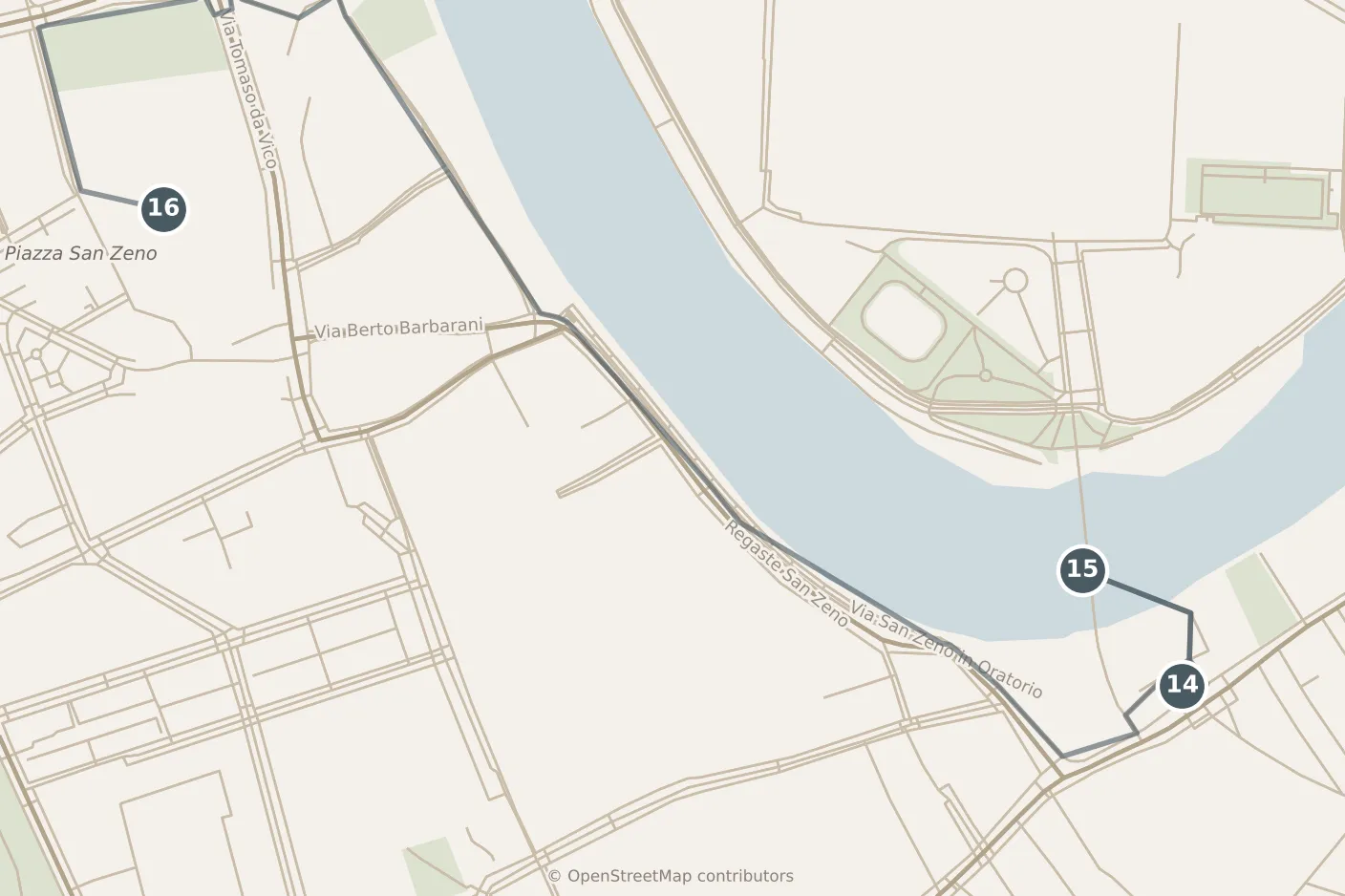
- With a third day
- 14Castelvecchio
- 15Ponte Scaligero
- 16San Zeno
Give the third day to the side of the river the first two deliberately skip: west from Piazza Bra, along the water, to the fortress and the church that outlasted the family who built it.
Castelvecchio is a fifteen-minute walk from Piazza Bra along the riverside, a red-brick castle the della Scala family built for themselves in the 1350s, moat and battlements intact. Inside, since the 1960s, it has been one of Italy’s most admired museum conversions: an architect named Carlo Scarpa rebuilt the interior around the collection rather than hiding it, so a courtyard, a bridge and a room built specifically to let one bronze equestrian statue be seen from below the way it was meant to be — this is the original rider from the tomb you saw through the railings in Piazza dei Signori, Cangrande, the family’s most famous ruler, the copy outside being the one that stayed in the weather. Painting galleries fill the rest of the museum, strongest in the city’s own medieval and Renaissance work. Two hours sees the collection properly; ninety minutes, taking only the Scarpa rooms and the Cangrande statue, is enough if the morning is running short.
Attached to the castle is Ponte Scaligero, a fortified bridge with the same crenellations as the walls it grows out of — also rebuilt after 1945, from the same recovered stones as yesterday’s other bridge, on the strength of photographs taken before the war. Cross it and back, five minutes each way, mostly for the view of the castle from the water it was built to defend.
From Castelvecchio it is a further twenty-five minutes west, away from the center, to San Zeno: a Romanesque basilica with its original twelfth-century bronze doors still hanging, forty-eight panels of Bible scenes and local legend cast by different hands over different decades, worn smooth in places by nine hundred years of hands doing exactly what yours will do. Inside, above the altar, is a triptych by Andrea Mantegna painted for this specific space — though not every panel that started here stayed here, so what you see is not quite what he finished. Above the entrance is a rose window known locally as the wheel of fortune, carved so its figures appear to rise and fall around the rim. This is the far edge of the walk: give the basilica forty minutes and then decide whether to bus or taxi back rather than retrace the whole route on tired legs.
That leaves an early afternoon free, and the honest advice is not to force a fourth sight into it. The riverside walk back from San Zeno, taken at whatever pace is left, covers ground the first two days never touched and asks nothing of you beyond walking it.
Practicalities
The Duomo, Sant’Anastasia and San Zeno are sold on one combined ticket, cheaper than paying at each door separately — buy it at whichever of the three you reach first, since day two visits two of them and day three the last.
Castelvecchio, like several of the city’s paid sights, can close or run shortened hours one day a week; check before a morning on day three depends on it, and if it is shut, San Zeno needs no ticket and can absorb the extra time instead.
The Arena keeps standard sightseeing hours outside the summer festival, and shorter, unpredictable ones once the opera season is under way and the stage is being built or struck inside it — worth checking on the day if the interior matters as much as the outside seen from Piazza Bra.
Nothing on these three days needs booking ahead beyond the interiors above; the balcony, the towers, the bridges and the gardens are all walk-up. The distances are real, and none of the three days leaves the Adige’s loop by more than the length of Corso Porta Nuova at the start.


