Verona in a day: piazzas, the arena and the view above the river

Last updated 15 August 2026
Overview
One day in Verona means giving up Castelvecchio and the fortified bridge beside it, the terraced garden at Giardino Giusti, and the Romanesque basilica of San Zeno out to the west — all of them real, none of them close enough to the loop below to fit without doubling back on ground you’ve already covered. What a single day buys instead is the old town itself, which is genuinely compact: the whole route below, arena to hilltop and back, sits inside a stretch of the city you could walk end to end in under half an hour if you weren’t stopping.
Verona sits on one of the country’s busier rail lines, between Milan and Venice with a branch north to the Brenner, so plenty of people arrive here with a few hours to spend rather than a room booked. This route is built for that reader as much as for anyone staying the night: it starts and ends within twenty minutes of Verona Porta Nuova, and it assumes your hands are empty. Leave the bag at the station’s left-luggage office before you set out — the climb near the end of the day is not one to do carrying a case.
The one thing this route asks you to buy before you go is nothing at all: everything on it is walked to, and every ticket on it — the small museum behind the balcony, the inside of the arena, the funicular up to the fort — is bought on the spot. If you do take a bus for the walk in rather than the twenty minutes on foot, the ticket is bought before you board, at a kiosk or a newsstand, not from the driver.
The day

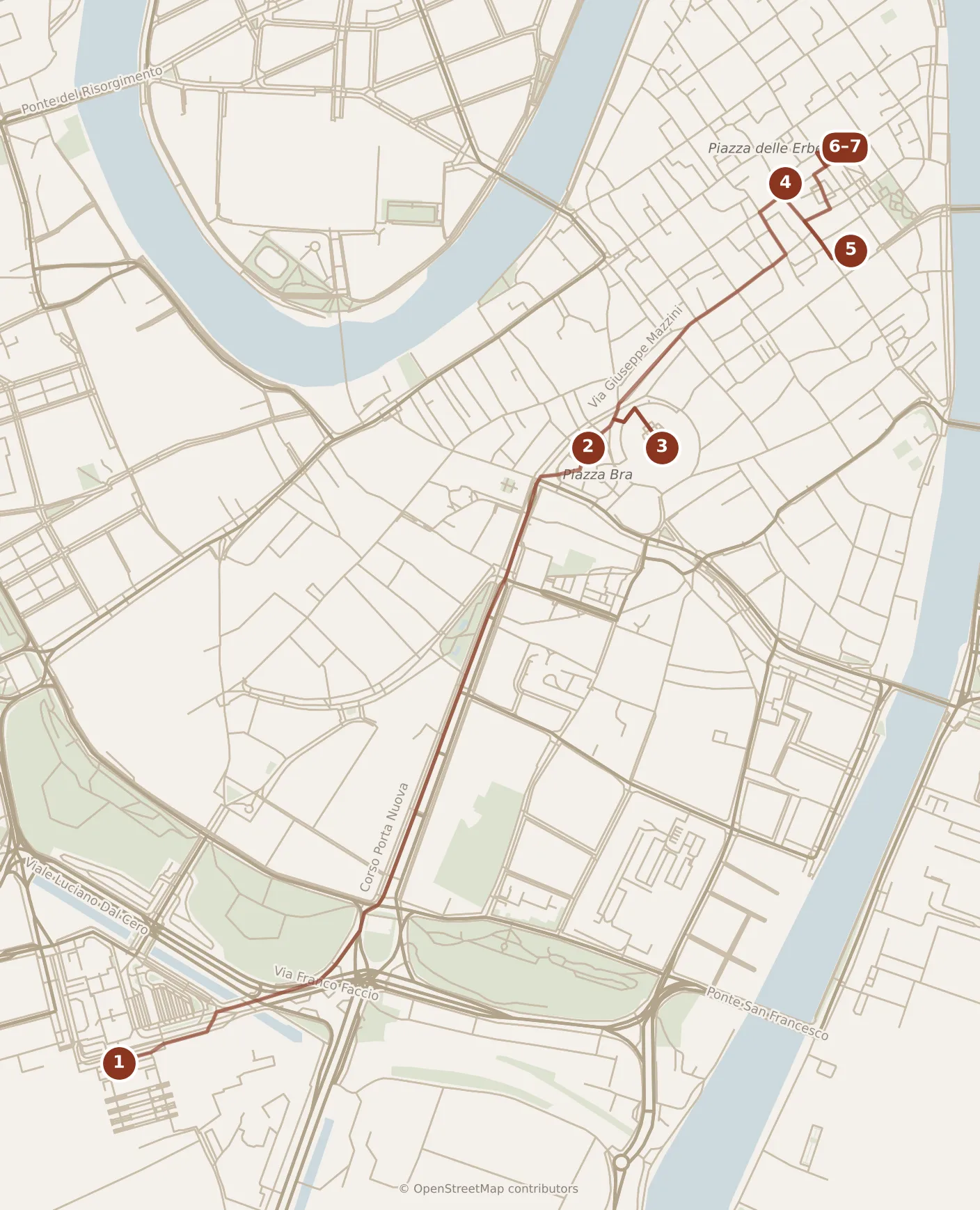
- Morning
- 1Verona Porta Nuova
- 2Piazza Bra
- 3Arena di Verona
- 4Piazza delle Erbe
- 5Casa di Giulietta
- 6Piazza dei Signori
- 7Arche Scaligere
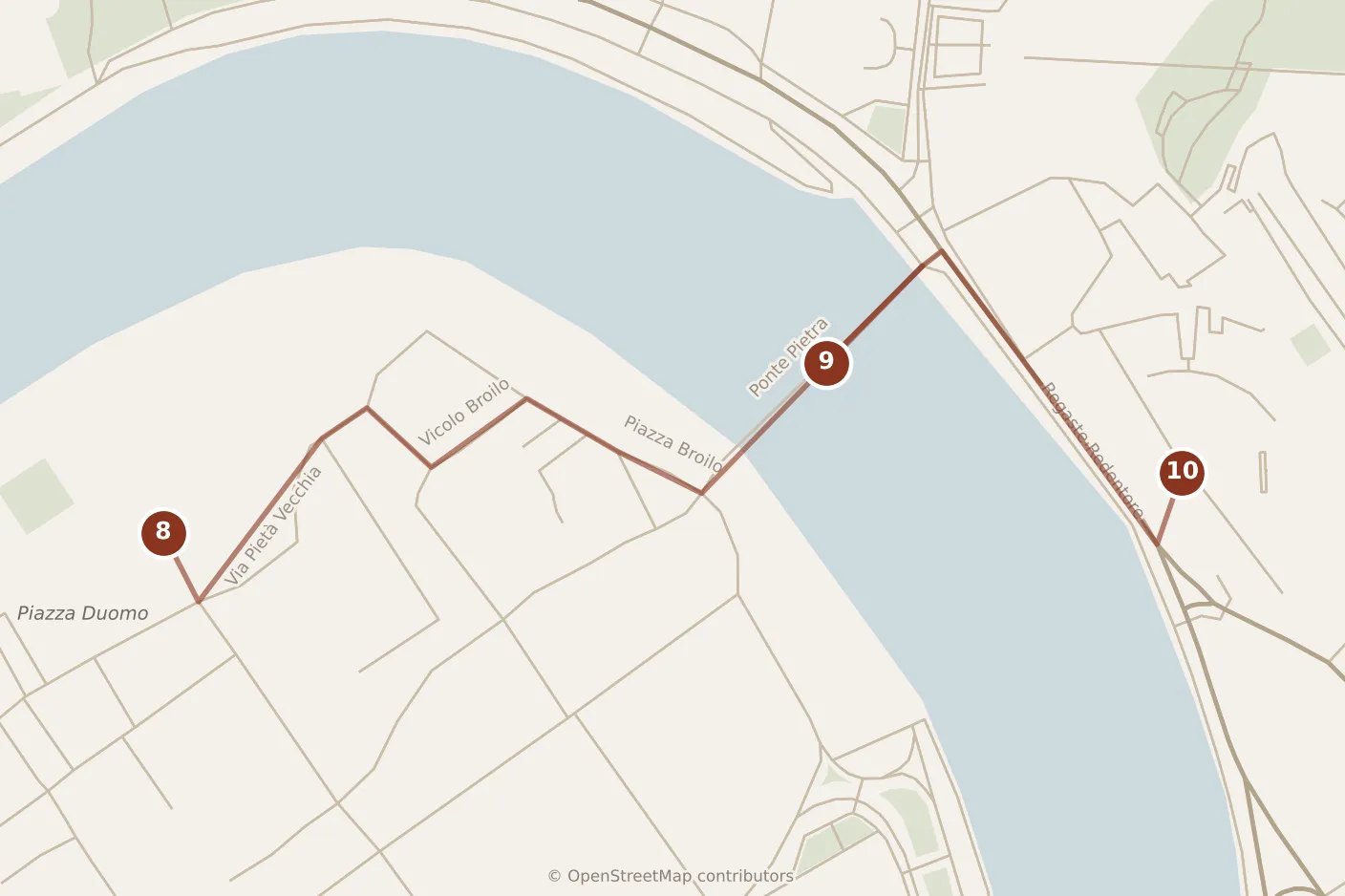
- Afternoon
- 8Duomo di Verona
- 9Ponte Pietra
- 10Teatro Romano
- Castel San Pietro — in the prose, not on the map
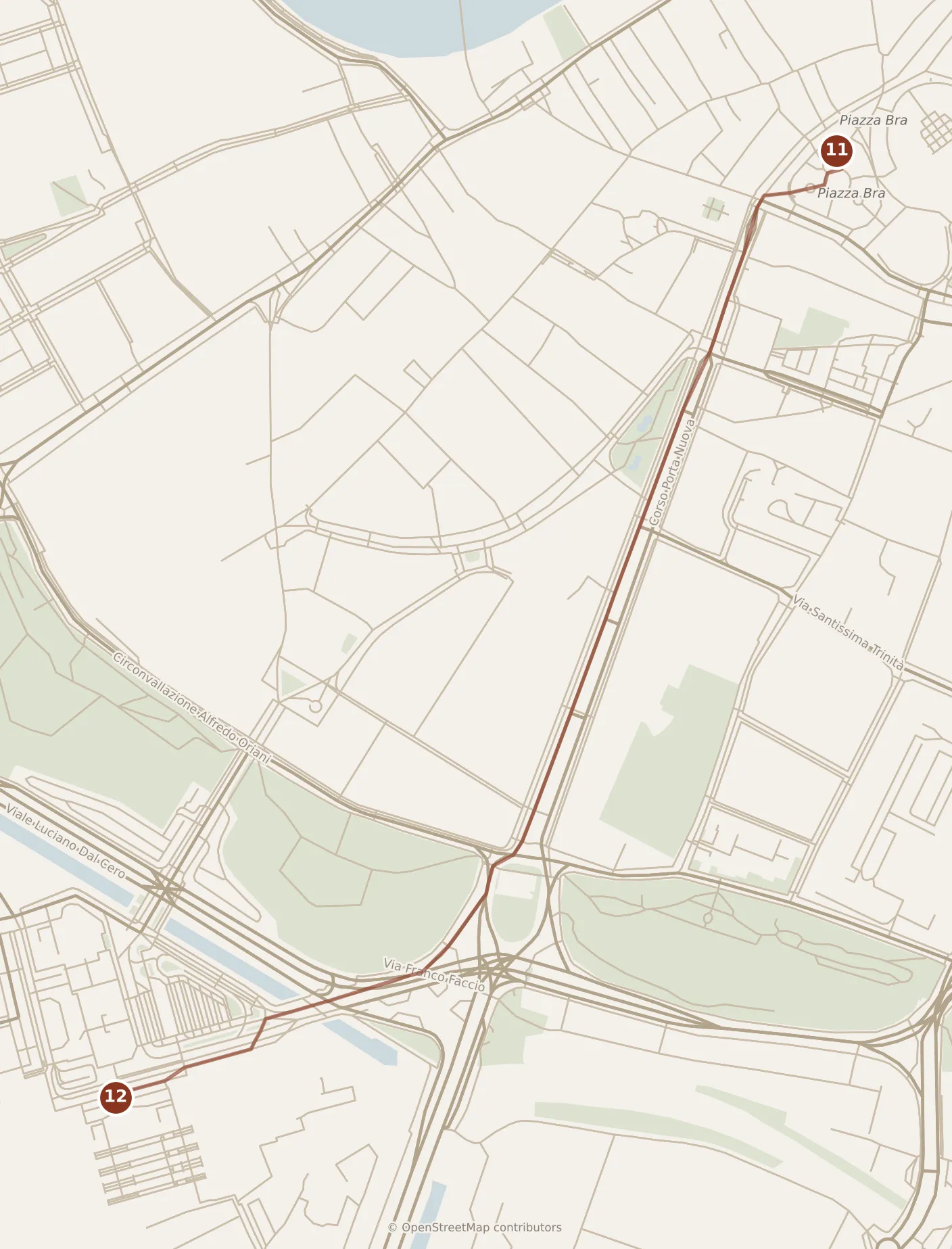
- Evening
- 11Piazza Bra
- 12Verona Porta Nuova
Morning
Come out of Verona Porta Nuova and walk straight up Corso Porta Nuova — it runs dead straight into the old town — for about twenty minutes, until the street opens into Piazza Bra with the Arena di Verona directly in front of you. It’s a Roman amphitheatre from the first century, one of the largest to survive anywhere, missing most of its outer ring but with the inner tiers intact enough that opera has been staged here in summer since 1913, when the first season opened with Verdi’s Aida to mark the centenary of his birth. Give it twenty minutes from the square; if you want to walk the tiers inside, closer to an hour, and check before you plan around a summer evening here — through the open-air opera season the daytime visiting hours are cut short to let the stage go up for that night’s performance.
Cross the square and go up Via Mazzini, the pedestrian street opposite the arena, for about ten minutes, into Piazza delle Erbe. This was the city’s Roman forum and is still a produce market most mornings: a fountain at the center reuses a Roman-era statue as its figure, the buildings around it carry faded frescoes on their façades, and a squat medieval clock tower stands over one corner. Give it twenty minutes to look properly, longer if you want to sit with a coffee among the stalls.
A narrow passage off the square’s south side, on Via Cappello, leads to Casa di Giulietta — the courtyard with the balcony that gave Shakespeare’s Romeo and Juliet its most photographed scene, though the building’s only real connection to the play is the name over the door and a balcony added in the twentieth century to match it. None of that makes the courtyard less worth the stop.
Local tip. The courtyard under the balcony costs nothing and stays open regardless of the line for a photo; the small museum behind it, ticketed and decorated as though someone still lived there, is worth the twenty minutes only if the courtyard hasn’t already told you everything you wanted from this stop.
Back at Piazza delle Erbe, an arch on its north side — a whale rib still hangs from the underside, nobody quite knows why — leads through to Piazza dei Signori, a plainer and quieter square with a statue of Dante at its center; he spent part of his exile here, under the patronage of the family whose tombs stand just behind the square. Those tombs, the Arche Scaligere, are Gothic funerary monuments raised over two centuries by the family that ruled the city before Venice did; the most elaborate belongs to the dynasty’s most powerful ruler, Cangrande, who died in 1329, and its original equestrian statue was moved indoors to a museum decades ago, leaving a copy in its place outside. Give the square and the tombs half an hour together.
This is also where lunch goes. You are a few minutes from the market lanes behind Piazza delle Erbe, and eating something sitting down there, rather than carrying it while you walk, is the better use of the hour — the city’s food is built around sitting still for it.
Afternoon
From Piazza dei Signori, walk north for about seven minutes to the Duomo di Verona, the city’s cathedral. The west doorway is Romanesque, carved by a sculptor named Nicholaus who worked on more than one cathedral in this part of the country, and it’s flanked by two stone knights identified by inscription as Roland and Oliver — legendary rather than historical, but carved in the twelfth century as though they weren’t. As with any working church here, shoulders and knees need to be covered to go inside. Give it fifteen minutes unless the portal holds you longer.
A few minutes further, the ground drops to the river and Ponte Pietra, the oldest bridge in the city: the arches nearest this bank are medieval, the ones on the far side are Roman, and the whole thing is a reconstruction — retreating forces blew it up in 1945, and it was rebuilt through the 1950s using the original Roman stones, fished back out of the riverbed where they had fallen. Walk it slowly; it’s two minutes across and worth every one of them.
On the far bank, immediately below the hillside, is the Teatro Romano — a Roman theater cut into the slope, still complete enough that it hosts an open-air season of theater and music most summers. A former convent above the seating now holds a small museum of what’s been dug up on this side of the river; climb through it for the view down over the tiers alone if nothing else catches you. Give the theater and the museum three-quarters of an hour.
From beside the theater, either a flight of open steps or a short funicular climbs to Castel San Pietro on the hilltop above. What’s up there today is a nineteenth-century barracks rather than anything medieval, despite a long history of forts on the same spot, and the reason to make the climb is not the building but what’s in front of it: a terrace looking straight down the bend of the Adige and across every roof you’ve walked past today. The steps take about fifteen minutes and cost nothing; the funicular is quicker and cheaper than it looks, in the one-to-two-euro range each way in 2026. Give the terrace itself twenty minutes just standing there — the view holds up in flat light as well as good, and there’s no clock this stop answers to.
What decides the order of the day is simpler than a clock: everything above this point, from the station in, comes to about six hours of stops and the walking between them, so if you’re off the train by mid-morning, you’re standing on this terrace with plenty of the afternoon still in hand. That figure is the time inside places and on the sidewalk between them; it doesn’t allow for a lingering lunch, and it doesn’t allow for the line that can build at the balcony in the middle of the day in high season — allow extra for both if either applies to you.
If you’re short on time, this hilltop is the first stop to cut: it’s the one part of the day that means crossing the river and climbing, rather than staying inside the loop everything else walks, and losing it costs you a view rather than a place. If it’s raining, the same logic runs the other way — skip the open terrace and give that half hour to the museum above the theater instead, which is under a roof.
Evening
Go back down to the theater and cross Ponte Pietra the way you came, then work back through the center — past the cathedral, back through Piazza delle Erbe without lingering this time — to Piazza Bra. In the evening the wide paved strip along one side of the square, known locally as the Liston, is where the city comes out to walk: cafés with tables facing the arena, and no particular reason to hurry. Give it as long as you have left.
If you’re catching a train, Verona Porta Nuova is back down Corso Porta Nuova, the same twenty minutes you walked in on, with the left-luggage office at the end of it.
Practicalities
The only figure worth carrying on this route is the funicular to Castel San Pietro, in the one-to-two-euro range each way in 2026 — everything else you might pay for on the way (the small museum behind Juliet’s balcony, the inside of the arena, the museum above the Roman theater) is a walk-up ticket bought at the door, and nothing on this route has to be booked before you arrive.
Several of the sights on this route are run by the city rather than by a church, and those keep shorter hours, or none at all, on a Monday — check the museum behind the balcony and the one above the theater before you build a Monday into this day. Nothing here is lost entirely if it lands on one: the squares, the two bridges, the cathedral’s doorway and the terrace at the top are all outdoors or free to enter, and they carry the day well on their own.
This route runs on foot from station to station, so there is nothing to arrange beyond a working pair of shoes. If you do use a bus for the walk in — lines 11, 12 or 13 run the length of Corso Porta Nuova — buy the ticket before boarding, at a kiosk or newsstand, not from the driver.
If you’re between trains, the left-luggage office at Porta Nuova means you do this whole day without the bag: the walk in is twenty minutes to Piazza Bra, and everything on the route beyond that stays within about a kilometer of it, out to the hilltop and back.


